2019 Paper 3 Q1
Year: 2019
Paper: 3
Question Number: 1
Course: UFM Pure
Section: Second order differential equations
Problem
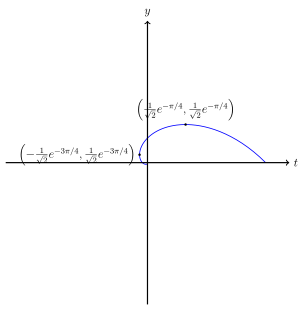
- Let \(k = 1\). Find \(x\) and \(y\) in terms of \(t\) and sketch \(y\) as a function of \(t\). Sketch the path of the particle in the \(x\)-\(y\) plane, giving the coordinates of the point at which \(y\) is greatest and the coordinates of the point at which \(x\) is least.
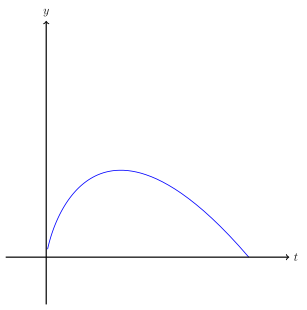
- Instead, let \(k = 0\). Find \(x\) and \(y\) in terms of \(t\) and sketch the path of the particle in the \(x\)-\(y\) plane.
Solution
- Let \(k = 1\), then
\begin{align*}
\dot{x} &= - x - y \\
\dot{y} &= x - y \\
\dot{x}-\dot{y} &= -2x \\
\ddot{x} &= -\dot{x}-\dot{y} \\
&= -\dot{x} - (\dot{x}+2x) \\
&= -2\dot{x}- 2x \\
\dot{x}+\dot{y} &= -2y \\
\ddot{y} &= \dot{x}-\dot{y} \\
&= -2y-2\dot{y}
\end{align*}
So we have an auxiliary equation for \(x\) and \(y\) which is \(\lambda^2 + 2 \lambda+2 = 0 \Rightarrow \lambda = -1 \pm i\).
Therefore \(x = Ae^{-t} \cos t + B e^{-t} \sin t, y = Ce^{-t}\cos t + De^{-t} \sin t\). We also must have that, \(A = 1, C = 0\), so \(x = e^{-t} \cos t + Be^{-t} \sin t\) and \(y = De^{-t} \sin x\).
\begin{align*}
\dot{y} &= -De^{-t} \sin t +De^{-t} \cos t \\
&= e^{-t} \cos x + Be^{-t} \sin t- De^{-t} \sin t \\
\end{align*}
therefore \(B = 0, D = 1\) and \(x = e^{-t} \cos t, y = e^{-t} \sin t\)
\begin{align*} y &= e^{-t} \sin t \\ \dot{y} &= -e^{-t} \sin t + e^{-t} \cos t \\ \dot{x} &= e^{-t} \cos t -e^{-t} \sin t \end{align*}

- \begin{align*}
\dot{x} = -x \\
\dot{y} = x-y
\end{align*}
So \(x = e^{-t}\). \(\dot{y} + y = e^{-t}\) so \(y = (t+B)e^{-t}\) and so \(y =te^{-t}\).
Examiner's report
— 2019 STEP 3, Question 1There was a significant rise in the total entry this year with an increase of nearly 8.5% on 2018. One question was attempted by over 90%, two others were very popular, and three further questions were attempted by 60% or more. No question was generally avoided and even the least popular attracted more than 10% of the candidates. 88% restricted themselves to attempting no more than 7 questions, and only a handful, but not the very best, scored strongly attempting more than 7 questions.
Rating Information
Difficulty Rating: 1500.0
Difficulty Comparisons: 0
Banger Rating: 1500.0
Banger Comparisons: 0
Show LaTeX source
Problem source
The coordinates of a particle at time $t$ are $x$ and $y$. For $t \geq 0$, they satisfy the pair of coupled differential equations
\[ \begin{cases} \dot{x} &= -x -ky \\
\dot{y} &= x - y \end{cases}\]
where $k$ is a constant. When $t = 0$, $x = 1$ and $y = 0$.
\begin{questionparts}
\item Let $k = 1$. Find $x$ and $y$ in terms of $t$ and sketch $y$ as a function of $t$.
Sketch the path of the particle in the $x$-$y$ plane, giving the coordinates of the point at which $y$ is greatest and the coordinates of the point at which $x$ is least.
\item Instead, let $k = 0$. Find $x$ and $y$ in terms of $t$ and sketch the path of the particle in the $x$-$y$ plane.
\end{questionparts}
Solution source
\begin{questionparts}
\item Let $k = 1$, then

\begin{align*}
\dot{x} &= - x - y \\
\dot{y} &= x - y \\
\dot{x}-\dot{y} &= -2x \\
\ddot{x} &= -\dot{x}-\dot{y} \\
&= -\dot{x} - (\dot{x}+2x) \\
&= -2\dot{x}- 2x \\
\dot{x}+\dot{y} &= -2y \\
\ddot{y} &= \dot{x}-\dot{y} \\
&= -2y-2\dot{y}
\end{align*}

So we have an auxiliary equation for $x$ and $y$ which is $\lambda^2 + 2 \lambda+2 = 0 \Rightarrow \lambda = -1 \pm i$.

Therefore $x = Ae^{-t} \cos t + B e^{-t} \sin t, y = Ce^{-t}\cos t + De^{-t} \sin t$. We also must have that, $A = 1, C = 0$, so $x = e^{-t} \cos t + Be^{-t} \sin t$ and $y = De^{-t} \sin x$.

\begin{align*}
\dot{y} &= -De^{-t} \sin t +De^{-t} \cos t \\
&= e^{-t} \cos x + Be^{-t} \sin t- De^{-t} \sin t \\
\end{align*}

therefore $B = 0, D = 1$ and $x = e^{-t} \cos t, y = e^{-t} \sin t$

\begin{center}
    \begin{tikzpicture}
    \def\functionf(#1){2*(#1)*((#1)^2 - 5)/((#1)^2-4)};
    \def\xl{-0.2};
    \def\xu{7};
    \def\yl{-1};
    \def\yu{1};

    % Calculate scaling factors to make the plot square
    \pgfmathsetmacro{\xrange}{\xu-\xl}
    \pgfmathsetmacro{\yrange}{\yu-\yl}
    \pgfmathsetmacro{\xscale}{10/\xrange}
    \pgfmathsetmacro{\yscale}{10/\yrange}

    % Define the styles for the axes and grid
    \tikzset{
        axis/.style={very thick, ->},
        grid/.style={thin, gray!30},
        x=\xscale cm,
        y=\yscale cm
    }

    % Define the bounding region with clip
    \begin{scope}
        % You can modify these values to change your plotting region
        \clip (\xl,\yl) rectangle (\xu,\yu);

        % Draw a grid (optional)
        % \draw[grid] (-5,-3) grid (5,3);

        \draw[thick, blue, smooth, domain=0:5, samples=100]
            plot (\x, {exp(-\x)*sin(5*deg(\x))});
        \draw[thick, red, dashed, smooth, domain=0:5, samples=100]
            plot (\x, {exp(-\x)});
        \draw[thick, red, dashed, smooth, domain=0:5, samples=100]
            plot (\x, {-exp(-\x)});

        \node[blue] at (1, {exp(-1)*sin(deg(1))}) {$y=e^{-t}\sin t$};
    \end{scope}


    % Set up axes
    \draw[axis] (\xl,0) -- (\xu,0) node[right] {$t$};
    \draw[axis] (0,\yl) -- (0,\yu) node[above] {$y$};

    \end{tikzpicture}
\end{center}

\begin{align*}
y &= e^{-t} \sin t \\
\dot{y} &= -e^{-t} \sin t + e^{-t} \cos t \\
\dot{x} &= e^{-t} \cos t -e^{-t} \sin t
\end{align*}


\begin{center}
    \begin{tikzpicture}
    \def\functionf(#1){2*(#1)*((#1)^2 - 5)/((#1)^2-4)};
    \def\xl{-1.2};
    \def\xu{1.2};
    \def\yl{-1.2};
    \def\yu{1.2};

    % Calculate scaling factors to make the plot square
    \pgfmathsetmacro{\xrange}{\xu-\xl}
    \pgfmathsetmacro{\yrange}{\yu-\yl}
    \pgfmathsetmacro{\xscale}{10/\xrange}
    \pgfmathsetmacro{\yscale}{10/\yrange}

    % Define the styles for the axes and grid
    \tikzset{
        axis/.style={very thick, ->},
        grid/.style={thin, gray!30},
        x=\xscale cm,
        y=\yscale cm
    }

    % Define the bounding region with clip
    \begin{scope}
        % You can modify these values to change your plotting region
        \clip (\xl,\yl) rectangle (\xu,\yu);

        % Draw a grid (optional)
        % \draw[grid] (-5,-3) grid (5,3);

        \draw[thick, blue, smooth, domain=0:5, samples=100]
            plot ({exp(-\x)*cos(deg(\x))}, {exp(-\x)*sin(deg(\x))});

        \filldraw ({exp(-pi/4)*cos(45)}, {exp(-pi/4)*sin(45)}) circle (1pt) node[above] {$\left (\frac1{\sqrt{2}} e^{-\pi/4},\frac1{\sqrt{2}} e^{-\pi/4}\right)$};
        \filldraw ({exp(-3*pi/4)*cos(135)}, {exp(-3*pi/4)*sin(135)}) circle (1pt) node[left] {$\left (-\frac1{\sqrt{2}} e^{-3\pi/4},\frac1{\sqrt{2}} e^{-3\pi/4}\right)$};

    \end{scope}


    % Set up axes
    \draw[axis] (\xl,0) -- (\xu,0) node[right] {$t$};
    \draw[axis] (0,\yl) -- (0,\yu) node[above] {$y$};

    \end{tikzpicture}
\end{center}

\item \begin{align*}
\dot{x} = -x \\
\dot{y} = x-y
\end{align*}

So $x = e^{-t}$. $\dot{y} + y = e^{-t}$ so $y = (t+B)e^{-t}$ and so $y  =te^{-t}$.


\begin{center}
    \begin{tikzpicture}
    \def\functionf(#1){2*(#1)*((#1)^2 - 5)/((#1)^2-4)};
    \def\xl{-.2};
    \def\xu{1.2};
    \def\yl{-.2};
    \def\yu{1};

    % Calculate scaling factors to make the plot square
    \pgfmathsetmacro{\xrange}{\xu-\xl}
    \pgfmathsetmacro{\yrange}{\yu-\yl}
    \pgfmathsetmacro{\xscale}{10/\xrange}
    \pgfmathsetmacro{\yscale}{10/\yrange}

    % Define the styles for the axes and grid
    \tikzset{
        axis/.style={very thick, ->},
        grid/.style={thin, gray!30},
        x=\xscale cm,
        y=\yscale cm
    }

    % Define the bounding region with clip
    \begin{scope}
        % You can modify these values to change your plotting region
        \clip (\xl,\yl) rectangle (\xu,\yu);

        % Draw a grid (optional)
        % \draw[grid] (-5,-3) grid (5,3);

        \draw[thick, blue, smooth, domain=0:5, samples=100]
            plot ({exp(-\x)}, {(\x)*exp(-\x)});

    \end{scope}


    % Set up axes
    \draw[axis] (\xl,0) -- (\xu,0) node[right] {$t$};
    \draw[axis] (0,\yl) -- (0,\yu) node[above] {$y$};

    \end{tikzpicture}
\end{center}

\end{questionparts}
This was the third most popular question attracting 83% of candidates, though it was only the 6th most successful with an average mark just under 8/20, and no candidate achieved full marks on it. Small mistakes when starting the question often resulted in very different differential equations and hence solutions which lost lots of marks. Some candidates simply did not know how to solve a differential equation and they appeared to waste a lot of time. Drawing the spiral in part (i), lots of candidates guessed that the extrema occurred on the axes losing substantial marks. Candidates should have spent a few minutes more sketching their graphs as these sketches were the main feature of the question and a lot of candidates forgot to mark salient points. Attempting the final sketch, only a handful considered the behaviour for large t.