Problems
Filters
29 problems found
2020 Paper 2 Q9
Point \(A\) is a distance \(h\) above ground level and point \(N\) is directly below \(A\) at ground level. Point \(B\) is also at ground level, a distance \(d\) horizontally from \(N\). The angle of elevation of \(A\) from \(B\) is \(\beta\). A particle is projected horizontally from \(A\), with initial speed \(V\). A second particle is projected from \(B\) with speed \(U\) at an acute angle \(\theta\) above the horizontal. The horizontal components of the velocities of the two particles are in opposite directions. The two particles are projected simultaneously, in the vertical plane through \(A\), \(N\) and \(B\). Given that the two particles collide, show that \[d\sin\theta - h\cos\theta = \frac{Vh}{U}\] and also that
- \(\theta > \beta\);
- \(U\sin\theta \geqslant \sqrt{\dfrac{gh}{2}}\);
- \(\dfrac{U}{V} > \sin\beta\).
2018 Paper 1 Q9
A straight road leading to my house consists of two sections. The first section is inclined downwards at a constant angle \(\alpha\) to the horizontal and ends in traffic lights; the second section is inclined upwards at an angle \(\beta\) to the horizontal and ends at my house. The distance between the traffic lights and my house is \(d\). I have a go-kart which I start from rest, pointing downhill, a distance \(x\) from the traffic lights on the downward-sloping section. The go-kart is not powered in any way, all resistance forces are negligible, and there is no sudden change of speed as I pass the traffic lights. Given that I reach my house, show that \(x \sin \alpha\ge d \sin\beta\,\). Let \(T\) be the total time taken to reach my house. Show that \[ \left(\frac{g\sin\alpha}2 \right)^{\!\frac12} T = (1+k) \sqrt{x} - \sqrt{k^2 x -kd\;} \,, \] where \(k = \dfrac{\sin\alpha}{\sin\beta}\,\). Hence determine, in terms of \(d\) and \(k\), the value of \(x\) which minimises \(T\). [You need not justify the fact that the stationary value is a minimum.]
Solution: Applying conservation of energy, since there are no external forces (other than gravity) the condition to reach the house (with any speed) is the initial GPE is larger than the final GPE, ie: \begin{align*} && m g x \sin \alpha &\geq m g d \sin \beta \\ \Rightarrow && x \sin \alpha &\geq d \sin \beta \end{align*} Let \(T_1\) be the time taken on the downward section, and \(T_2\) the time taken on the upward section, then: \begin{align*} && s &= ut + \frac12 a t^2 \\ \Rightarrow && x &= \frac12 g \sin \alpha T_1^2 \\ \Rightarrow && T_1^2 &= \frac{2x}{g \sin \alpha} \\ && v &= u + at \\ \Rightarrow && v &= T_1 g \sin \alpha \\ && mg x \sin \alpha &= mg d \sin \beta + \frac12 m w^2 \\ \Rightarrow && w &= \sqrt{2(x \sin \alpha - d \sin \beta)} \\ && w &= v - g \sin \beta T_2 \\ \Rightarrow && T_2 &= \frac{v - w}{g \sin \beta} \\ \Rightarrow && T &= T_1 + T_2 \\ &&&= \sqrt{\frac{2x}{g \sin \alpha}} + \frac{\sqrt{\frac{2x}{g \sin \alpha}} g \sin \alpha- \sqrt{2(x \sin \alpha - d \sin \beta)}}{g \sin \beta} \\ &&&= \left ( \frac{2}{g \sin \alpha} \right)^{\tfrac12} \left ( \sqrt{x} + \sqrt{x}k - \sqrt{k^2x-kd}\right) \end{align*} Differentiating wrt to \(x\), we obtain: \begin{align*} && \frac{\d T}{\d x} &= C(-(1+k)x^{-1/2}+k^2(k^2 x - kd)^{-1/2}) \\ \text{set to }0: && 0 &= k^2(k^2 x - kd)^{-1/2} - (1+k)x^{-1/2} \\ \Rightarrow && \sqrt{x} k^2 &= \sqrt{k^2x - kd} (1+k) \\ \Rightarrow && x k^4 &= (k^2x-kd)(1+k)^2 \\ \Rightarrow && x(k^4-k^2(1+k)^2) &= -kd(1+k)^2 \\ \Rightarrow && x(2k^2+k) &= d \\ \Rightarrow && x &= \frac{d}{(2k^2+k)} \end{align*}
2018 Paper 2 Q9
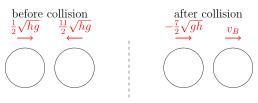
Two small beads, \(A\) and \(B\), of the same mass, are threaded onto a vertical wire on which they slide without friction, and which is fixed to the ground at \(P\). They are released simultaneously from rest, \(A\) from a height of \(8h\) above \(P\) and \(B\) from a height of \(17h\) above \(P\). When \(A\) reaches the ground for the first time, it is moving with speed \( V\). It then rebounds with coefficient of restitution \(\frac{1}{2}\) and subsequently collides with \(B\) at height \(H\) above \(P\). Show that \(H= \frac{15}8h\) and find, in terms of \(g\) and \(h\), the speeds \(u_A\) and \(u_B\) of the two beads just before the collision. When \(A\) reaches the ground for the second time, it is again moving with speed \( V\). Determine the coefficient of restitution between the two beads.
Solution: \begin{align*} && v^2 &= u^2 +2as \\ \Rightarrow && V^2 &= 2 g \cdot (8h)\\ \Rightarrow && V &=4\sqrt{hg}\\ \end{align*} When the first particle collides with the ground, the second particle is at \(9h\) traveling with speed \(V\), the first particle is at \(0\) traveling (upwards) with speed \(\tfrac12 V\). For a collision we need: \begin{align*} && \underbrace{\frac12 V t- \frac12 g t^2}_{\text{position of A}} &= \underbrace{9h - Vt - \frac12 gt^2}_{\text{position of B}} \\ \Rightarrow && \frac32Vt &= 9h \\ \Rightarrow && t &= \frac{6h}{V} \\ \\ && \underbrace{\frac12 V t- \frac12 g t^2}_{\text{position of A}} &= \frac12 V \frac{6h}{V} - \frac12 g t^2 \\ &&&= 3h - \frac12 g\frac{36h^2}{16hg} \\ &&&= 3h - \frac{9}{8}h \\ &&&= \frac{15}{8}h \end{align*} Just before the collision, \(A\) will be moving with velocity (taking upwards as positive) \begin{align*} && u_A &= \frac12 V-gt \\ &&&= 2\sqrt{hg}-g \frac{6h}{V} \\ &&&= 2\sqrt{hg} - g \frac{6h}{4\sqrt{hg}} \\ &&&= 2\sqrt{hg}-\frac32\sqrt{hg} \\ &&&= \frac12 \sqrt{hg} \end{align*} Similarly, for \(B\). \begin{align*} && u_B &= -V -gt \\ &&&= -4\sqrt{hg} - \frac32\sqrt{hg} \\ &&&= -\frac{11}{2}\sqrt{hg} \end{align*} Considering \(A\), to figure out \(v_A\). \begin{align*} && v^2 &= u^2 + 2as \\ && V^2 &= v_A^2 + 2g\frac{15}{8}h \\ && 16hg &= v_A^2 + \frac{15}{4}gh \\ \Rightarrow && v_A^2 &= \frac{49}{4}gh \\ \Rightarrow && v_A &= -\frac{7}{2}\sqrt{gh} \end{align*}
2017 Paper 2 Q11
Two thin vertical parallel walls, each of height \(2a\), stand a distance \(a\) apart on horizontal ground. The projectiles in this question move in a plane perpendicular to the walls.
- A particle is projected with speed \(\sqrt{5ag}\) towards the two walls from a point \( A\) at ground level. It just clears the first wall. By considering the energy of the particle, find its speed when it passes over the first wall. Given that it just clears the second wall, show that the angle its trajectory makes with the horizontal when it passes over the first wall is \(45^\circ\,\). Find the distance of \(A\) from the foot of the first wall.
- A second particle is projected with speed \(\sqrt{5ag}\) from a point \(B\) at ground level towards the two walls. It passes a distance \(h\) above the first wall, where \(h>0\). Show that it does not clear the second wall.
Solution:
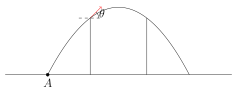
- \(\,\) \begin{align*} \bf{COE}: && \frac12 m \cdot 5ag &= mg\cdot 2a + \frac12 m v^2 \\ \Rightarrow && v^2 &= ag \\ && v &= \sqrt{ag} \end{align*} If it just clears the second wall, we must have: \begin{align*} && 0 &= \sqrt{ag} \sin \theta t - \frac12 gt^2 \\ \Rightarrow && t &= \frac{2\sqrt{ag}\sin \theta}{g} \\ && a &= \sqrt{ag} \cos \theta t \\ &&&=\sqrt{ag} \cos \theta \frac{2\sqrt{ag}\sin \theta}{g} \\ &&&= a \sin 2 \theta \\ \Rightarrow && \theta &= 45^{\circ} \end{align*} Imagine firing the particle backwards from the top of the wall at \(45^\circ\) then \begin{align*} && -2a &= \sqrt{ag}\cdot \left ( -\frac1{\sqrt{2}} \right) t - \frac12 g t^2 \\ \Rightarrow && 0 &= gt^2+\sqrt{2ag} t -4a \\ &&&= (\sqrt{g}t -\sqrt{2} \sqrt{a})(\sqrt{g}t +2\sqrt{2} \sqrt{a}) \\ \Rightarrow && t &= \sqrt{\frac{2a}{g}} \\ \Rightarrow && s &= \left ( -\frac1{\sqrt{2}} \right) \sqrt{ag} \sqrt{\frac{2a}{g}} \\ &&&= -a \end{align*} Therefore the \(A\) is \(a\) from the wall.
- When it passes over the first wall, \begin{align*} \bf{COE}: && \frac52amg &= (2a+h)mg + \frac12 m v^2 \\ \Rightarrow && v^2 &= (a-2h)g \end{align*} Now imagine firing a particle with this speed in any direction. The question is asking whether we can ever travel \(2a\) without descending more than \(h\). \begin{align*} && a &= \sqrt{(a-2h)g} \cos \beta t \\ \Rightarrow && t &= \frac{a}{\sqrt{(a-2h)g} \cos \beta}\\ && -h &= \sqrt{(a-2h)g} \sin \beta t - \frac12 g t^2 \\ &&&= a \tan \beta - \frac12 \frac{a^2}{(a-2h)} \sec^2 \beta \\ &&&= a \tan \beta - \frac{a^2}{2(a-2h)}(1+ \tan^2 \beta )\\ \Rightarrow && 0 &= \frac{a^2}{2(a-2h)} \tan^2 \beta-a \tan \beta + \frac{a^2-2ah+4h^2}{2(a-2h)} \\ && \Delta &= a^2 - \frac{a^2}{a-2h} \frac{a^2-2ah+4h^2}{a-2h} \\ &&&= \frac{a^2}{(a-2h)^2}\left ( a^2-4ah+4h^2-a^2+2ah-4h^2\right) \\ &&&= \frac{a^2}{(a-2h)^2}\left ( -2ah\right) < 0 \\ \end{align*} So there are no solutions if \(h > 0\)
2015 Paper 1 Q10
A bus has the shape of a cuboid of length \(a\) and height \(h\). It is travelling northwards on a journey of fixed distance at constant speed \(u\) (chosen by the driver). The maximum speed of the bus is \(w\). Rain is falling from the southerly direction at speed \(v\) in straight lines inclined to the horizontal at angle \(\theta\), where \(0<\theta<\frac12\pi\). By considering first the case \(u=0\), show that for \(u>0\) the total amount of rain that hits the roof and the back or front of the bus in unit time is proportional to \[ h\big \vert v\cos\theta - u \big\vert + av\sin\theta \,. \] Show that, in order to encounter as little rain as possible on the journey, the driver should choose \( u=w\) if either \(w< v\cos\theta\) or \( a\sin\theta > h\cos\theta\). How should the speed be chosen if \(w>v\cos\theta\) and \( a\sin\theta < h\cos\theta\)? Comment on the case \( a\sin\theta = h\cos\theta\). How should the driver choose \(u\) on the return journey?
2015 Paper 2 Q11
Three particles, \(A\), \(B\) and \(C\), each of mass \(m\), lie on a smooth horizontal table. Particles \(A\) and \(C\) are attached to the two ends of a light inextensible string of length \(2a\) and particle \(B\) is attached to the midpoint of the string. Initially, \(A\), \(B\) and \(C\) are at rest at points \((0,a)\), \((0,0)\) and \((0,-a)\), respectively. An impulse is delivered to \(B\), imparting to it a speed \(u\) in the positive \(x\) direction. The string remains taut throughout the subsequent motion.
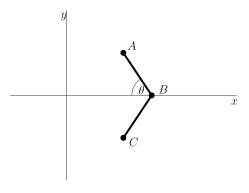
- At time \(t\), the angle between the \(x\)-axis and the string joining \(A\) and \(B\) is \(\theta\), as shown in the diagram, and \(B\) is at \((x,0)\). Write down the coordinates of \(A\) in terms of \(x,a\) and \(\theta\). Given that the velocity of \(B\) is \((v,0)\), show that the velocity of \(A\) is \((\dot x + a\sin\theta \,\dot \theta\,,\, a\cos\theta\, \dot\theta)\), where the dot denotes differentiation with respect to time.
- Show that, before particles \(A\) and \(C\) first collide, \[ 3\dot x + 2a \dot\theta \sin\theta =u \text{ and } \dot \theta^2 = \frac{u^2}{a^2(3-2\sin^2\theta)} \,. \]
- When \(A\) and \(C\) collide, the collision is elastic (no energy is lost). At what value of \(\theta\) does the second collision between particles \(A\) and \(C\) occur? (You should justify your answer.)
- When \(v=0\), what are the possible values of \(\theta\)? Is \(v =0\) whenever \(\theta\) takes these values?
Solution:
- \(A\) has coordinates \((x-a\cos \theta, a\sin \theta)\). Differentiating with respect to \(t\) the velocity of \(A\) is \((\dot{x}+a\sin \theta \cdot \dot{\theta}, a \cos \theta \cdot \dot{\theta})\)
- By considervation of momentum \(\rightarrow\) we must have \(mu = m(\dot{x}+a\dot{\theta}\sin \theta) + m\dot{x} + m(\dot{x}+a\dot{\theta}\sin \theta) = m(3\dot{x} + 2a \dot{\theta} \sin \theta)\) and the first equation follows. By conservation of energy, we must have \begin{align*} && \frac12 m u^2 &= \frac12 m \dot{x}^2 + \frac12m((\dot{x}+a\dot{\theta}\sin \theta)^2 + a^2 \dot{\theta}^2 \cos^2\theta ) + \frac12m((\dot{x}+a\dot{\theta}\sin \theta)^2 + a^2 \dot{\theta}^2 \cos^2\theta ) \\ &&&= \frac32m\dot{x}^2 + 2m a\dot{x}\dot{\theta}\sin \theta + ma^2\dot{\theta}^2(\sin^2\theta+\cos^2\theta) \\ \Rightarrow && u^2 &= \dot{x}(3\dot{x} + 4a \dot{\theta} \sin \theta) + 2a^2\dot{\theta}^2 \\ &&&= \left ( \frac{u-2a\dot{\theta}\sin \theta}{3}\right)\left ( 3\left ( \frac{u-2a\dot{\theta}\sin \theta}{3}\right)+ 4a \dot{x}\dot{\theta} \sin \theta \right) + 2a^2\dot{\theta}^2 \\ \Rightarrow && 3u^2 &= (u - 2a\dot{\theta} \sin \theta)^2 + 4a(u - 2 a \dot{\theta} \sin \theta) \dot{\theta}\sin \theta + 6a^2 \dot{\theta}^2 \\ &&&= u^2 + 4a^2\dot{\theta}^2 \sin^2 \theta - 8a^2\dot{\theta}^2\sin^2\theta + 6a^2 \dot{\theta}^2 \\ \Rightarrow && \dot{\theta}^2 &= \frac{u^2}{a^2(3-2\sin^2\theta)} \end{align*}
- Since \(\dot{\theta}^2 > 0\) \(\theta\) is strictly increasing or decreasing, therefore the first collision will be when \(\theta = 0\), the second when \(\theta = \pi\)
- If \(v = 0\), from our first equation we have \(2a \dot{\theta} \sin \theta = u \Rightarrow \dot{\theta}^2 = \frac{u^2}{4a^2 \sin^2 \theta} = \frac{u^2}{a^2(3-2\sin^2\theta)}\) so \(4\sin^2 \theta = 3 - 2\sin^2 \theta \Rightarrow \sin^2 \theta = \frac{1}{2}\) therefore the angles are all the multiples of \(\frac{\pi}{4}\).
2015 Paper 3 Q10
A light rod of length \(2a\) has a particle of mass \(m\) attached to each end and it moves in a vertical plane. The midpoint of the rod has coordinates \((x,y)\), where the \(x\)-axis is horizontal (within the plane of motion) and \(y\) is the height above a horizontal table. Initially, the rod is vertical, and at time \(t\) later it is inclined at an angle \(\theta\) to the vertical. Show that the velocity of one particle can be written in the form \[ \begin{pmatrix} \dot x + a \dot\theta \cos\theta \\ \dot y - a \dot\theta \sin\theta \end{pmatrix} \] and that \[ m\begin{pmatrix} \ddot x + a\ddot\theta \cos\theta - a \dot\theta^2 \sin\theta \\ \ddot y- a\ddot\theta \sin\theta - a \dot\theta^2 \cos\theta \end{pmatrix} =-T\begin{pmatrix} \sin\theta \\ \cos\theta \end{pmatrix} -mg \begin{pmatrix} 0 \\ 1 \end{pmatrix} \] where the dots denote differentiation with respect to time \(t\) and \(T\) is the tension in the rod. Obtain the corresponding equations for the other particle. Deduce that \(\ddot x =0\), \(\ddot y = -g\) and \(\ddot\theta =0\). Initially, the midpoint of the rod is a height \(h\) above the table, the velocity of the higher particle is \(\Big(\begin{matrix} \, u \, \\ v \end{matrix}\Big)\), and the velocity of the lower particle is \(\Big(\begin{matrix}\, 0 \, \\ v\end{matrix}\Big)\). Given that the two particles hit the table for the first time simultaneously, when the rod has rotated by \(\frac12\pi\), show that \[ 2hu^2 = \pi^2a^2 g - 2\pi uva \,. \]
2014 Paper 1 Q9
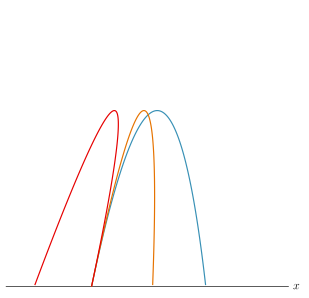
A particle of mass \(m\) is projected due east at speed \(U\) from a point on horizontal ground at an angle \(\theta\) above the horizontal, where \(0 < \theta < 90^\circ\). In addition to the gravitational force \(mg\), it experiences a horizontal force of magnitude \(mkg\), where \(k\) is a positive constant, acting due west in the plane of motion of the particle. Determine expressions in terms of \(U\), \(\theta\) and \(g\) for the time, \(T_H\), at which the particle reaches its greatest height and the time, \(T_L \), at which it lands. Let \(T = U\cos\theta /(kg)\). By considering the relative magnitudes of \(T_H\), \(T_L \) and \(T\), or otherwise, sketch the trajectory of the particle in the cases \(k\tan\theta<\frac12\), \(\frac12 < k\tan\theta<1\), and \(k\tan\theta>1\). What happens when \(k\tan\theta =1\)?
Solution: \begin{align*} && v_{\uparrow} &= U\sin \theta - g t \\ \Rightarrow && T_H &= \frac{U \sin \theta}{g} \\ \\ && s_{\uparrow} &= U \sin \theta t - \frac12 g t^2 \\ \Rightarrow && 0 &= U\sin \theta T_L - \frac12 g T_L^2 \\ && T_L &= \frac{2 U \sin \theta}{g} \end{align*} \(T = U\cos \theta / (kg)\) is the point when the particle's horizontal motion is reversed.
2012 Paper 1 Q10
I stand at the top of a vertical well. The depth of the well, from the top to the surface of the water, is \(D\). I drop a stone from the top of the well and measure the time that elapses between the release of the stone and the moment when I hear the splash of the stone entering the water. In order to gauge the depth of the well, I climb a distance \(\delta\) down into the well and drop a stone from my new position. The time until I hear the splash is \(t\) less than the previous time. Show that \[ t = \sqrt{\frac{2D}g} - \sqrt{\frac{2(D-\delta)}g} + \frac \delta u\,, \] where \(u\) is the (constant) speed of sound. Hence show that \[ D = \tfrac12 gT^2\,, \] where \(T= \dfrac12 \beta + \dfrac \delta{\beta g}\) and \(\beta = t - \dfrac \delta u\,\). Taking \(u=300\,\)m\,s\(^{-1}\) and \(g=10\,\)m\,s\(^{-2}\), show that if \(t= \frac 15\,\)s and \(\delta=10\,\)m, the well is approximately \(185\,\)m deep.
Solution: \begin{align*} && s &= ut + \frac12at^2 \\ && D &= \frac12gt_D^2 \\ \Rightarrow && t_D &= \sqrt{\frac{2D}{g}} \\ \Rightarrow && t_{D-\delta} &= \sqrt{\frac{2(D-\delta}{g}} \end{align*} Therefore the difference in times of what I hear will be: \begin{align*} t &= \underbrace{\sqrt{\frac{2D}{g}}}_{\text{time for first stone to hit water}} + \underbrace{\frac{D}{u}}_{\text{time to hear about it}} - \left (\underbrace{\sqrt{\frac{2(D-\delta)}{g}}}_{\text{time for second stone to hit water}} + \underbrace{\frac{D-\delta}{u}}_{\text{time to hear about it}} \right) \\ &= \sqrt{\frac{2D}g} - \sqrt{\frac{2(D-\delta)}g} + \frac \delta u \end{align*} \begin{align*} && t &= \sqrt{\frac{2D}g} - \sqrt{\frac{2(D-\delta)}g} + \frac \delta u \\ \Rightarrow && \beta &= \sqrt{\frac{2D}g} - \sqrt{\frac{2(D-\delta)}g} \\ && \beta^2 &= \frac{2D}{g} + \frac{2(D-\delta)}{g} - \frac{4}{g}\sqrt{D(D-g)} \\ &&&= \frac{4D}{g} - \frac{2\delta}{g} - \frac{4}{g} \sqrt{D(D-\delta)}\\ \Rightarrow && g\beta^2 &= 4D-2\delta -4\sqrt{D(D-\delta)}\\ \Rightarrow && (g \beta^2-4D+2\delta)^2 &= 16D(D-\delta) \\ \Rightarrow && g^2\beta^4 + 16D^2 + 4\delta^2 -8g\beta^2D+4g\beta^2 \delta -16D\delta &= 16D^2-16D\delta \\ \Rightarrow && 8g\beta^2D &= g\beta^4 +4\delta^2 +4g\beta^2 \delta \\ \Rightarrow && D &= \frac1{8g\beta^2} \left ( g^2\beta^4 +4\delta^2 +4g\beta^2 \delta\right) \\ &&&= \frac1{8g\beta^2} \left ( g\beta^2 +2\delta \right)^2 \\ &&&= \frac12g \left ( \frac{\beta}{2} + \frac{\delta}{g\beta} \right)^2 \end{align*} If \(u = 300, g = 10, t = \frac15, \delta = 10\), then \begin{align*} && \beta &= \frac15-\frac{10}{300}\\ &&&= \frac15 - \frac1{30} \\ &&&= \frac{1}{6}\\ && D &= \frac12 \cdot 10 \left ( \frac1{12} + 6 \right)^2 \\ &&&= 5\cdot (36 + 1 + \frac{1}{12^2}) \\ &&&\approx 37 \cdot 5 = 185 \end{align*}
2010 Paper 3 Q11
A bullet of mass \(m\) is fired horizontally with speed \(u\) into a wooden block of mass \(M\) at rest on a horizontal surface. The coefficient of friction between the block and the surface is \(\mu\). While the bullet is moving through the block, it experiences a constant force of resistance to its motion of magnitude \(R\), where \(R>(M+m)\mu g\). The bullet moves horizontally in the block and does not emerge from the other side of the block.
- Show that the magnitude, \(a\), of the deceleration of the bullet relative to the block while the bullet is moving through the block is given by \[ a= \frac R m + \frac {R-(M+m)\mu g}{M}\, . \]
- Show that the common speed, \(v\), of the block and bullet when the bullet stops moving through the block satisfies \[ av = \frac{Ru-(M+m)\mu gu}M\,. \]
- Obtain an expression, in terms of \(u\), \(v\) and \(a\), for the distance moved by the block while the bullet is moving through the block.
- Show that the total distance moved by the block is \[ \frac{muv}{2(M+m)\mu g}\,. \]
2009 Paper 1 Q9
Two particles \(P\) and \(Q\) are projected simultaneously from points \(O\) and \(D\), respectively, where~\(D\) is a distance \(d\) directly above \(O\). The initial speed of \(P\) is \(V\) and its angle of projection {\em above} the horizontal is \(\alpha\). The initial speed of \(Q\) is \(kV\), where \(k>1\), and its angle of projection {\em below} the horizontal is \(\beta\). The particles collide at time \(T\) after projection. Show that \(\cos\alpha = k\cos\beta\) and that \(T\) satisfies the equation \[ (k^2-1)V^2T^2 +2dVT\sin\alpha -d^2 =0\,. \] Given that the particles collide when \(P\) reaches its maximum height, find an expression for~\(\sin^2\alpha\) in terms of \(g\), \(d\), \(k\) and \(V\), and deduce that \[ gd\le (1+k)V^2\,. \]
2009 Paper 2 Q11
A train consists of an engine and \(n\) trucks. It is travelling along a straight horizontal section of track. The mass of the engine and of each truck is \(M\). The resistance to motion of the engine and of each truck is \(R\), which is constant. The maximum power at which the engine can work is \(P\). Obtain an expression for the acceleration of the train when its speed is \(v\) and the engine is working at maximum power. The train starts from rest with the engine working at maximum power. Obtain an expression for the time \(T\) taken to reach a given speed \(V\), and show that this speed is only achievable if \[ P>(n+1)RV\,. \]
- In the case when \((n+1) RV/P\) is small, use the approximation \(\ln (1-x) \approx -x -\frac12 x^2\) (valid for small \( x \)) to obtain the approximation \[ PT\approx \tfrac 12 (n+1) MV^2\, \] and interpret this result.
- In the general case, the distance moved from rest in time \(T\) is \(X\). {\em Write down}, with explanation, an equation relating \(P\), \(T\), \(X\), \(M\), \(V\), \(R\) and \(n\) and hence show that \[ X= \frac{2PT - (n+1)MV^2}{2(n+1)R} \,. \]
2008 Paper 1 Q10
On the (flat) planet Zog, the acceleration due to gravity is \(g\) up to height \(h\) above the surface and \(g'\) at greater heights. A particle is projected from the surface at speed \(V\) and at an angle \(\alpha\) to the surface, where \(V^2 \sin^2\alpha > 2 gh\,\). Sketch, on the same axes, the trajectories in the cases \(g'=g\) and \(g' < g\). Show that the particle lands a distance \(d\) from the point of projection given by \[ d = \left(\frac {V-V'} g + \frac {V'}{ g'} \right) V\sin2\alpha\,, \] where \(V' = \sqrt{V^2-2gh\,\rm{cosec}^2\alpha\,}\,\).
2007 Paper 1 Q10
The Norman army is advancing with constant speed \(u\) towards the Saxon army, which is at rest. When the armies are \(d\) apart, a Saxon horseman rides from the Saxon army directly towards the Norman army at constant speed \(x\). Simultaneously a Norman horseman rides from the Norman army directly towards the Saxon army at constant speed \(y\), where $y > u$. The horsemen ride their horses so that \(y - 2x < u < 2y - x\). When each horseman reaches the opposing army, he immediately rides straight back to his own army without changing his speed. Represent this information on a displacement-time graph, and show that the two horsemen pass each other at distances \[ \frac{xd }{ x + y} \;\; \mbox{and} \;\; \frac{xd(2y -x-u)} {(u+x ) ( x + y )} \] from the Saxon army. Explain briefly what will happen in the cases (i) \(u > 2y - x\) and (ii) \(u < y - 2x\).
2007 Paper 1 Q11
A smooth, straight, narrow tube of length \(L\) is fixed at an angle of \(30^\circ\) to the horizontal. A~particle is fired up the tube, from the lower end, with initial velocity \(u\). When the particle reaches the upper end of the tube, it continues its motion until it returns to the same level as the lower end of the tube, having travelled a horizontal distance \(D\) after leaving the tube. Show that \(D\) satisfies the equation \[ 4gD^2 - 2 \sqrt{3} \left( u^2 - Lg \right)D - 3L \left( u^2 - gL \right) = 0 \] and hence that \[ \frac{{\rm d}D}{ {\rm d}L} = - \frac{ 2\sqrt{3}gD - 3(u^2-2gL)} { 8gD - 2 \sqrt{3} \left(u^2 - gL \right)}. \] The final horizontal displacement of the particle from the lower end of the tube is \(R\). Show that \(\dfrac{\d R}{\d L} = 0\) when \(2D = L \sqrt 3\), and determine, in terms of \(u\) and \(g\), the corresponding value of \(R\).