2017 Paper 2 Q11
Year: 2017
Paper: 2
Question Number: 11
Course: LFM Pure and Mechanics
Section: Projectiles
Problem
- A particle is projected with speed \(\sqrt{5ag}\) towards the two walls from a point \( A\) at ground level. It just clears the first wall. By considering the energy of the particle, find its speed when it passes over the first wall. Given that it just clears the second wall, show that the angle its trajectory makes with the horizontal when it passes over the first wall is \(45^\circ\,\). Find the distance of \(A\) from the foot of the first wall.
- A second particle is projected with speed \(\sqrt{5ag}\) from a point \(B\) at ground level towards the two walls. It passes a distance \(h\) above the first wall, where \(h>0\). Show that it does not clear the second wall.
Solution
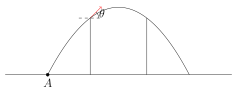
- \(\,\) \begin{align*} \bf{COE}: && \frac12 m \cdot 5ag &= mg\cdot 2a + \frac12 m v^2 \\ \Rightarrow && v^2 &= ag \\ && v &= \sqrt{ag} \end{align*} If it just clears the second wall, we must have: \begin{align*} && 0 &= \sqrt{ag} \sin \theta t - \frac12 gt^2 \\ \Rightarrow && t &= \frac{2\sqrt{ag}\sin \theta}{g} \\ && a &= \sqrt{ag} \cos \theta t \\ &&&=\sqrt{ag} \cos \theta \frac{2\sqrt{ag}\sin \theta}{g} \\ &&&= a \sin 2 \theta \\ \Rightarrow && \theta &= 45^{\circ} \end{align*} Imagine firing the particle backwards from the top of the wall at \(45^\circ\) then \begin{align*} && -2a &= \sqrt{ag}\cdot \left ( -\frac1{\sqrt{2}} \right) t - \frac12 g t^2 \\ \Rightarrow && 0 &= gt^2+\sqrt{2ag} t -4a \\ &&&= (\sqrt{g}t -\sqrt{2} \sqrt{a})(\sqrt{g}t +2\sqrt{2} \sqrt{a}) \\ \Rightarrow && t &= \sqrt{\frac{2a}{g}} \\ \Rightarrow && s &= \left ( -\frac1{\sqrt{2}} \right) \sqrt{ag} \sqrt{\frac{2a}{g}} \\ &&&= -a \end{align*} Therefore the \(A\) is \(a\) from the wall.
- When it passes over the first wall, \begin{align*} \bf{COE}: && \frac52amg &= (2a+h)mg + \frac12 m v^2 \\ \Rightarrow && v^2 &= (a-2h)g \end{align*} Now imagine firing a particle with this speed in any direction. The question is asking whether we can ever travel \(2a\) without descending more than \(h\). \begin{align*} && a &= \sqrt{(a-2h)g} \cos \beta t \\ \Rightarrow && t &= \frac{a}{\sqrt{(a-2h)g} \cos \beta}\\ && -h &= \sqrt{(a-2h)g} \sin \beta t - \frac12 g t^2 \\ &&&= a \tan \beta - \frac12 \frac{a^2}{(a-2h)} \sec^2 \beta \\ &&&= a \tan \beta - \frac{a^2}{2(a-2h)}(1+ \tan^2 \beta )\\ \Rightarrow && 0 &= \frac{a^2}{2(a-2h)} \tan^2 \beta-a \tan \beta + \frac{a^2-2ah+4h^2}{2(a-2h)} \\ && \Delta &= a^2 - \frac{a^2}{a-2h} \frac{a^2-2ah+4h^2}{a-2h} \\ &&&= \frac{a^2}{(a-2h)^2}\left ( a^2-4ah+4h^2-a^2+2ah-4h^2\right) \\ &&&= \frac{a^2}{(a-2h)^2}\left ( -2ah\right) < 0 \\ \end{align*} So there are no solutions if \(h > 0\)
Examiner's report
— 2017 STEP 2, Question 11This year's paper was, perhaps, slightly more straightforward than usual, with more helpful guidance offered in some of the questions. Thus the mark required for a "1", a Distinction, was 80 (out of 120), around ten marks higher than that which would customarily be required to be awarded this grade. Nonetheless, a three‐figure mark is still a considerable achievement and, of the 1330 candidates sitting the paper, there were 89 who achieved this. At the other end of the scale, there were over 350 who scored 40 or below, including almost 150 who failed to exceed a total score of 25. As a general strategy for success in a STEP examination, candidates should be looking to find four "good" questions to work at (which may be chosen freely by the candidates from a total of 13 questions overall). It is unfortunately the case that so many low‐scoring candidates flit from one question to another, barely starting each one before moving on. There needs to be a willingness to persevere with a question until a measure of understanding as to the nature of the question's purpose and direction begins to emerge. Many low‐scoring candidates fail to deal with those parts of questions which cover routine mathematical processes ‐ processes that should be standard for an A‐level candidate. The significance of the "rule of four" is that four high‐scoring questions (15‐20 marks apiece) obtains you up to around the total of 70 that is usually required for a "1"; and with a couple of supporting starts to questions, such a total should not be beyond a good candidate who has prepared adequately. This year, significantly more than 10% of candidates failed to score at least half marks on any one question; and, given that Q1 (and often Q2 also) is (are) specifically set to give all candidates the opportunity to secure some marks, this indicates that these candidates are giving up too easily. Mathematics is about more than just getting to correct answers. It is about communicating clearly and precisely. Particularly with "show that" questions, candidates need to distinguish themselves from those who are just tracking back from given results. They should also be aware that convincing themselves is not sufficient, and if they are using a result from 3 pages earlier, they should make this clear in their working. A few specifics: In answers to mechanics questions, clarity of diagrams would have helped many students. If new variables or functions are introduced, it is important that students clearly define them. One area which is very important in STEP but which was very poorly done is dealing with inequalities. Although a wide range of approaches such as perturbation theory were attempted, at STEP level having a good understanding of the basics – such as changing the inequality if multiplying by a negative number – is more than enough. In fact, candidates who used more advanced methods rarely succeeded.
Rating Information
Difficulty Rating: 1600.0
Difficulty Comparisons: 0
Banger Rating: 1516.0
Banger Comparisons: 1
Show LaTeX source
Problem source
Two thin vertical parallel walls, each of height $2a$, stand a distance $a$ apart on horizontal ground. The projectiles in this question move in a plane perpendicular to the walls.
\begin{questionparts}
\item A particle is projected with speed $\sqrt{5ag}$ towards the two walls from a point $ A$ at ground level. It just clears the first wall. By considering the energy of the particle, find its speed when it passes over the first wall.
Given that it just clears the second wall, show that the angle its trajectory makes with the horizontal when it passes over the first wall is $45^\circ\,$.
Find the distance of $A$ from the foot of the first wall.
\item  A second particle is projected with  speed $\sqrt{5ag}$ from a point $B$ at ground level towards the two walls. It passes a distance $h$ above the first wall, where $h>0$. Show that it does not clear the second wall.
\end{questionparts}
Solution source
\begin{center}
    \begin{tikzpicture}

        \def\a{2};
        \def\b{2.5};
        \draw (-4, 0) -- (4, 0);

        \draw ({-\a/2},0) -- ({-\a/2},\a);
        \draw ({\a/2},0) -- ({\a/2},\a);

        \draw[dashed] ({-\a/2-.4},\a)  -- ({-\a/2+.4},\a);

        \draw[red, ->] ({-\a/2},\a)  -- ({-\a/2+.4},{\a+.4});

        \coordinate (O) at ({-\a/2},\a);
        \coordinate (X) at ({-\a/2+.4},{\a+.4});
        \coordinate (Y) at ({-\a/2+.4},\a);

        \pic [draw, angle radius=.3cm, angle eccentricity=1.5, "$\theta$"] {angle = Y--O--X};

        \filldraw ({-\b}, 0) circle (1.5pt) node[below] {$A$};

        \draw[domain={-\b}:{\b}, samples=100, smooth] plot({\x}, {2*(\b-\x)*(\b+\x)/(\b-\a/2)/(\b+\a/2))});

    \end{tikzpicture}
\end{center}

\begin{questionparts}
\item $\,$
\begin{align*}
\bf{COE}: && \frac12 m \cdot 5ag &= mg\cdot 2a + \frac12 m v^2 \\
\Rightarrow && v^2 &= ag \\
&& v &= \sqrt{ag}
\end{align*}

If it just clears the second wall, we must have:

\begin{align*}
&& 0 &= \sqrt{ag} \sin \theta t - \frac12 gt^2 \\
\Rightarrow && t &= \frac{2\sqrt{ag}\sin \theta}{g} \\
&& a &= \sqrt{ag} \cos \theta t \\
&&&=\sqrt{ag} \cos \theta \frac{2\sqrt{ag}\sin \theta}{g} \\
&&&= a \sin 2 \theta \\
\Rightarrow && \theta &= 45^{\circ}
\end{align*}

Imagine firing the particle backwards from the top of the wall at $45^\circ$ then

\begin{align*}
&& -2a &= \sqrt{ag}\cdot \left ( -\frac1{\sqrt{2}} \right) t - \frac12 g t^2 \\
\Rightarrow && 0 &= gt^2+\sqrt{2ag} t -4a \\
&&&= (\sqrt{g}t -\sqrt{2} \sqrt{a})(\sqrt{g}t +2\sqrt{2} \sqrt{a}) \\
\Rightarrow && t &= \sqrt{\frac{2a}{g}} \\
\Rightarrow && s &= \left ( -\frac1{\sqrt{2}} \right) \sqrt{ag} \sqrt{\frac{2a}{g}}  \\
&&&= -a
\end{align*}

Therefore the $A$ is $a$ from the wall.

\item When it passes over the first wall, \begin{align*}
\bf{COE}: && \frac52amg &= (2a+h)mg + \frac12 m v^2 \\
\Rightarrow && v^2 &= (a-2h)g
\end{align*}
Now imagine firing a particle with this speed in any direction. The question is asking whether we can ever travel $2a$ without descending more than $h$.

\begin{align*}
&& a &= \sqrt{(a-2h)g} \cos \beta t \\
\Rightarrow && t &= \frac{a}{\sqrt{(a-2h)g} \cos \beta}\\
&& -h &= \sqrt{(a-2h)g} \sin \beta t - \frac12 g t^2 \\
&&&= a \tan \beta - \frac12 \frac{a^2}{(a-2h)} \sec^2 \beta \\
&&&= a \tan \beta -  \frac{a^2}{2(a-2h)}(1+ \tan^2 \beta )\\
\Rightarrow && 0 &= \frac{a^2}{2(a-2h)} \tan^2 \beta-a \tan \beta + \frac{a^2-2ah+4h^2}{2(a-2h)} \\
&& \Delta &= a^2 - \frac{a^2}{a-2h} \frac{a^2-2ah+4h^2}{a-2h} \\
&&&= \frac{a^2}{(a-2h)^2}\left ( a^2-4ah+4h^2-a^2+2ah-4h^2\right) \\
&&&= \frac{a^2}{(a-2h)^2}\left ( -2ah\right) < 0 \\
\end{align*}
So there are no solutions if $h > 0$
\end{questionparts}
This was by far the most popular and most successfully answered mechanics question. The general concepts of energy and kinematics certainly seem to be familiar to most candidates, although there was a certain amount of "throwing SUVAT equations around" without any particular strategy, hoping something would miraculously appear. The final part proved much more challenging. Several candidates attempted symmetry arguments, but these lacked the required rigour.