Problems
Filters
29 problems found
2025 Paper 3 Q7
Let \(f(x) = \sqrt{x^2 + 1} - x\).
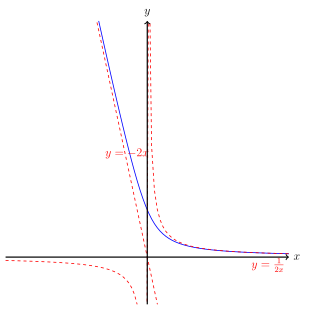
- Using a binomial series, or otherwise, show that, for large \(|x|\), \(\sqrt{x^2 + 1} \approx |x| + \frac{1}{2|x|}\). Sketch the graph \(y = f(x)\).
- Let \(g(x) = \tan^{-1} f(x)\) and, for \(x \neq 0\), let \(k(x) = \frac{1}{2}\tan^{-1}\frac{1}{x}\).
- Show that \(g(x) + g(-x) = \frac{1}{2}\pi\).
- Show that \(k(x) + k(-x) = 0\).
- Show that \(\tan k(x) = \tan g(x)\) for \(x > 0\).
- Sketch the graphs \(y = g(x)\) and \(y = k(x)\) on the same axes.
- Evaluate \(\int_0^1 k(x) \, dx\) and hence write down the value of \(\int_{-1}^0 g(x) \, dx\).
Solution:
- \begin{align*}
\sqrt{x^2+1} &= |x|\sqrt{1+\frac{1}{x^2}} \\
&=|x| \left (1 + \frac12 \frac{1}{x^2} + \cdots \right) & \text{if } \left (\frac{1}{x^2} < 1 \right) \\
&= |x| + \frac12 \frac{1}{|x|} + \cdots \\
&\approx |x| + \frac{1}{2|x|}
\end{align*}
- \begin{align*} && \tan( g(x) + g(-x)) &= \tan \left ( \tan^{-1}(\sqrt{x^2+1}-x) + \tan^{-1}(\sqrt{x^2+1}+x) \right) \\ &&&= \frac{\sqrt{x^2+1}-x+\sqrt{x^2+1}+x}{1-1} \\ \Rightarrow && g(x) + g(-x) &\in \left \{\cdots, -\frac{\pi}{2}, \frac{\pi}{2}, \cdots \right\} \end{align*} But \(g(x), g(-x) > 0\) and \(g(x), g(-x) \in (-\frac{\pi}{2}, \frac{\pi}{2})\), therefore it must be \(\frac{\pi}{2}\).
- \begin{align*} && \tan(2(k(x) + k(-x))) &= \tan(\tan^{-1}x + \tan^{-1}(-x)) \\ &&&= 0 \\ \Rightarrow && k(x)+k(-x) &\in \left \{\cdots, -\frac{\pi}{2}, 0, \frac{\pi}{2}, \cdots \right\} \\ \end{align*} But \(k(x) \in (-\frac{\pi}{4}, \frac{\pi}{4})\), therefore \(k(x) + k(-x) = 0\).
- Let \(t = \tan k(x)\). \begin{align*} && \tan \left ( \tan^{-1} \frac{1}{x} \right) &= \frac{2 \tan\left ( \frac12 \tan^{-1} \frac1x \right)}{ 1-\tan^2\left ( \frac12 \tan^{-1} \frac1x \right)} \\ \Rightarrow && \frac1x &= \frac{2t}{1-t^2} \\ \Rightarrow && 1-t^2 &= 2tx \\ \Rightarrow && 0 &= t^2+2tx - 1 \\ \Rightarrow && 0 &= (t+x)^2 - 1-x^2 \\ \Rightarrow && t &= -x \pm \sqrt{1+x^2} \end{align*} Since \(t > 0\), \(t = \sqrt{1+x^2}-x = f(x) = \tan g(x)\)
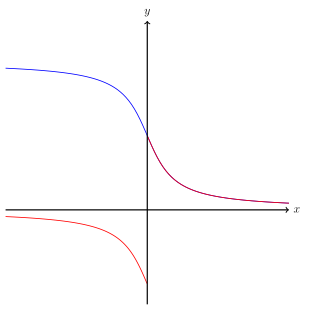
- \begin{align*} \int_0^1 k(x) \d x &= \int_0^1 \frac12 \tan^{-1} \left ( \frac1x \right) \d x \\ &= \left [ \frac{x}{2} \tan^{-1}\left ( \frac1x \right) \right]_0^1 - \int_0^1 \frac{x}{2} \frac{-1/x^2}{1+1/x^2} \d x \\ &= \left [ \frac{x}{2} \tan^{-1}\left ( \frac1x \right) \right]_0^1 + \frac14 \int_0^1 \frac{2x}{1+x^2} \d x \\ &= \frac12 \frac{\pi}{4} + \frac14 \ln(2) \\ &= \frac{\pi + \ln 4}{8}\end{align*} Therefore \(\displaystyle \int_{-1}^0 g(x) \d x = -\frac{\pi + \ln 4}{8}\)
2023 Paper 3 Q6
- By considering the Maclaurin series for \(\mathrm{e}^x\), show that for all real \(x\), \[\cosh^2 x \geqslant 1 + x^2.\] Hence show that the function \(\mathrm{f}\), defined for all real \(x\) by \(\mathrm{f}(x) = \tan^{-1} x - \tanh x\), is an increasing function. Sketch the graph \(y = \mathrm{f}(x)\).
- Function \(\mathrm{g}\) is defined for all real \(x\) by \(\mathrm{g}(x) = \tan^{-1} x - \frac{1}{2}\pi \tanh x\).
- Show that \(\mathrm{g}\) has at least two stationary points.
- Show, by considering its derivative, that \((1+x^2)\sinh x - x\cosh x\) is non-negative for \(x \geqslant 0\).
- Show that \(\dfrac{\cosh^2 x}{1+x^2}\) is an increasing function for \(x \geqslant 0\).
- Hence or otherwise show that \(\mathrm{g}\) has exactly two stationary points.
- Sketch the graph \(y = \mathrm{g}(x)\).
2021 Paper 3 Q6
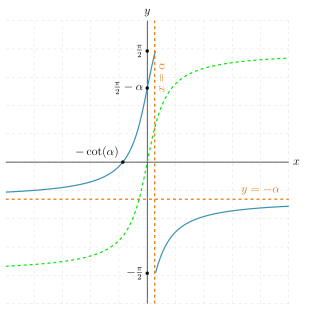
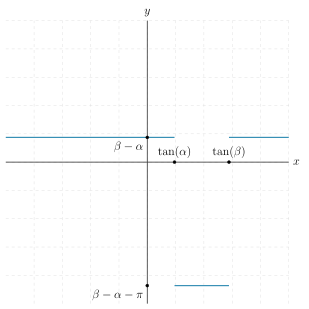
- For \(x \neq \tan\alpha\), the function \(f_\alpha\) is defined by \[ f_\alpha(x) = \tan^{-1}\!\left(\frac{x\tan\alpha + 1}{\tan\alpha - x}\right) \] where \(0 < \alpha < \tfrac{1}{2}\pi\). Show that \(f_\alpha'(x) = \dfrac{1}{1 + x^2}\). Hence sketch \(y = f_\alpha(x)\). On a separate diagram, sketch \(y = f_\alpha(x) - f_\beta(x)\) where \(0 < \alpha < \beta < \tfrac{1}{2}\pi\).
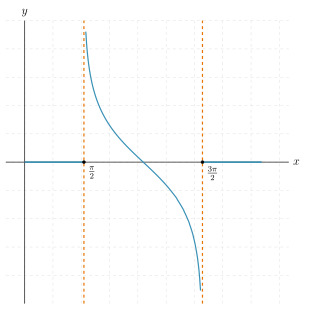
- For \(0 \leqslant x \leqslant 2\pi\) and \(x \neq \tfrac{1}{2}\pi,\, \tfrac{3}{2}\pi\), the function \(g(x)\) is defined by \[ g(x) = \tanh^{-1}(\sin x) - \sinh^{-1}(\tan x). \] For \(\tfrac{1}{2}\pi < x < \tfrac{3}{2}\pi\), show that \(g'(x) = 2\sec x\). Use this result to sketch \(y = g(x)\) for \(0 \leqslant x \leqslant 2\pi\).
Solution:
- \(\,\) \begin{align*}
&& f_\alpha(x) &= \tan^{-1}\!\left(\frac{x\tan\alpha + 1}{\tan\alpha - x}\right) \\
&& f'_\alpha(x) &= \frac{1}{1 + \left(\frac{x\tan\alpha + 1}{\tan\alpha - x}\right) ^2} \cdot \frac{\tan \alpha \cdot (\tan \alpha - x) - (x \tan \alpha + 1) \cdot (-1)}{(\tan \alpha - x)^2} \\
&&&= \frac{\tan^2 \alpha -1}{(\tan \alpha - x)^2 + (x \tan \alpha +1)^2} \\
&&&= \frac{\tan^2 \alpha +1}{\tan^2 \alpha - 2x \tan \alpha + x^2 + x^2 \tan^2 \alpha + 2 x \tan \alpha + 1} \\
&&&= \frac{1+\tan^2 \alpha}{(1+\tan^2 \alpha(x^2 + 1)} = \frac{1}{1+x^2}
\end{align*}
- Let \(g(x) = \tanh^{-1}(\sin x) - \sinh^{-1}(\tan x)\) then
\begin{align*}
&& g'(x) &= \frac{1}{1-\sin^2 x} \cdot \cos x - \frac{1}{\sqrt{\tan^2 +1}} \cdot \sec^2 x \\
&&&= \sec x - \frac{\sec^2 x}{|\sec x|} \\
&&& = \begin{cases} 0 &\text{if } \sec x \geq 0 \\
2 \sec x &\text{ otherwise}
\end{cases}
\end{align*}
Therefore \(g'(x) = 2\sec x\) if \(\tfrac12 \pi < x < \tfrac32\pi\)
Therefore $\displaystyle g(x) = \begin{cases} 0 & \text{if } x \in [0, \frac{\pi}{2}] \cup [\frac{3\pi}{2}, 2\pi] \\
\ln( (\tan x + \sec x)^2) + C &\text{otherwise} \end{cases}$
2019 Paper 3 Q5
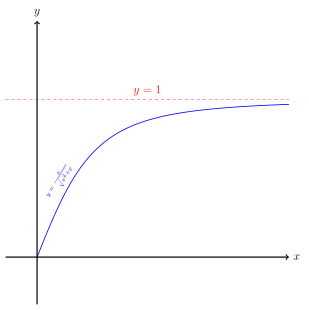
- Let $$f(x) = \frac{x}{\sqrt{x^2 + p}},$$ where \(p\) is a non-zero constant. Sketch the curve \(y = f(x)\) for \(x \geq 0\) in the case \(p > 0\).
- Let $$I = \int \frac{1}{(b^2 - y^2)\sqrt{c^2 - y^2}} \, dy,$$ where \(b\) and \(c\) are positive constants. Use the substitution \(y = \frac{cx}{\sqrt{x^2 + p}}\), where \(p\) is a suitably chosen constant, to show that $$I = \int \frac{1}{b^2 + (b^2 - c^2)x^2} \, dx.$$ Evaluate $$\int_1^{\sqrt{2}} \frac{1}{(3 - y^2)\sqrt{2 - y^2}} \, dy.$$ [ Note: \(\int \frac{1}{a^2 + x^2} \, dx = \frac{1}{a} \tan^{-1} \frac{x}{a} + \text{constant.}\) ] Hence evaluate $$\int_{\frac{1}{\sqrt{2}}}^1 \frac{y}{(3y^2 - 1)\sqrt{2y^2 - 1}} \, dy.$$
- By means of a suitable substitution, evaluate $$\int_{\frac{1}{\sqrt{2}}}^1 \frac{1}{(3y^2 - 1)\sqrt{2y^2 - 1}} \, dy.$$
Solution:
- \(\,\)
- \(\,\) \begin{align*} && y &= \frac{cx}{\sqrt{x^2+p}} \\ && \d y &= \frac{c(x^2+p)-cx^2}{(x^2+p)^{3/2}} \d x \\ &&&= \frac{cp^2}{(x^2+p)^{3/2}} \d x\\ && I &= \int \frac1{(b^2-y^2)\sqrt{c^2-y^2}} \d y \\ &&&= \int \frac{1}{\left ( b^2 - \frac{c^2x^2}{x^2+p} \right) \sqrt{c^2 - \frac{c^2x^2}{x^2+p} }} \d y \\ &&&= \int \frac{(x^2+p)^{3/2}}{((b^2-c^2)x^2+pb^2)\sqrt{c^2p}}\frac{cp}{(x^2+p)^{3/2}} \d x \\ &&&= \int \frac{\sqrt{p}}{((b^2-c^2)x^2+pb^2)} \d x \\ p=1: &&&= \int \frac{1}{(b^2-c^2)x^2+b^2} \d x \end{align*} When \(b = \sqrt{3}, c = \sqrt{2}\) \begin{align*} && I_1 &= \int_1^{\sqrt{2}} \frac{1}{(3 - y^2)\sqrt{2 - y^2}} \d y\\ &&&= \int_{x =1 }^{x=\infty} \frac{1}{3+x^2} \d x \\ &&&= \left [ \frac{1}{\sqrt{3}} \tan^{-1} \frac{x}{\sqrt{3}} \right]_1^\infty \\ &&&= \frac{\pi}{2\sqrt{3}} - \frac{1}{\sqrt{3}} \frac{\pi}{6} \\ &&&= \frac{\pi}{3\sqrt{3}} \end{align*} \begin{align*} && I_2 &= \int_{\frac{1}{\sqrt{2}}}^1 \frac{y}{(3y^2 - 1)\sqrt{2y^2 - 1}} \d y \\ x = \frac1y, \d x = -\frac1{y^2} \d y &&&= \int_{x=\sqrt{2}}^{x=1} \frac{x^2}{(3-x^2)\sqrt{2-x^2}}\cdot \left ( -\frac{1}{x^2} \right ) \d x \\ &&&= \int_1^{\sqrt{2}} \frac{1}{(3-x^2)\sqrt{2-x^2}} \d x \\ &&&= I_1 = \frac{\pi}{3\sqrt{3}} \end{align*}
- \(\,\) \begin{align*} && I_3 &= \int_{\frac{1}{\sqrt{2}}}^1 \frac{1}{(3y^2 - 1)\sqrt{2y^2 - 1}} \d y \\ x = 1/y, \d x = -1/y^2 \d y &&&= \int_{x=1}^{x=\sqrt{2}} \frac{x}{(3-x^2)\sqrt{2-x^2}} \d x \\ u = x^2, \d u = 2x \d x &&&= \int_{u=1}^{u=2} \frac{\frac12}{(3-u)\sqrt{2-u}} \d u \\ v=2-u, \d v = -\d u &&&= \frac12\int_{v=0}^{v=1} \frac{1}{(1+v)\sqrt{v}} \d v \\ &&&=\left [\tan^{-1}\sqrt{v}\right]_0^1 \\ &&&= \frac{\pi}{4} \end{align*}
2015 Paper 2 Q4
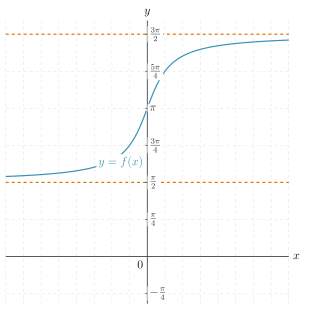
- The continuous function \(\f\) is defined by \[ \tan \f(x) = x \ \ \ \ \ (-\infty < x <\infty) \] and \(\f(0)=\pi\). Sketch the curve \(y=\f(x)\).
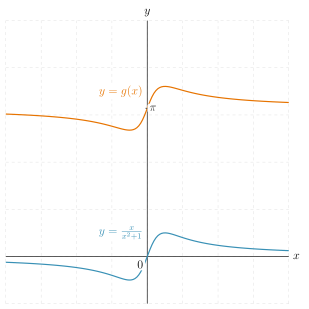
- The continuous function \(\g\) is defined by \[ \tan \g(x) = \frac x {1+x^2} \ \ \ \ \ \ (-\infty < x <\infty) \] and \(\g(0)=\pi\). Sketch the curves \(y= \dfrac x {1+x^2} \ \) and \(y=\g(x)\).
- The continuous function \(\h \) is defined by \(\h (0)=\pi\) and \[ \tan \h (x)= \frac x {1-x^2}\, \ \ \ \ \ (x \ne \pm 1) \,. \] (The values of \(\h (x)\) at \(x=\pm1\) are such that \(\h (x)\) is continuous at these points.) Sketch the curves \(y= \dfrac x {1-x^2} \ \) and \(y=\h (x)\).
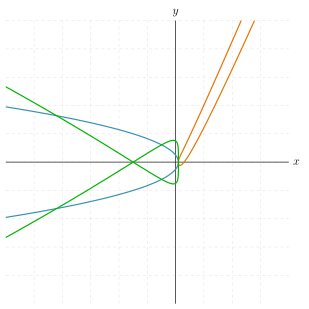
- [Not on original exam] The continuous functions \(\h_1\) and \(\h_2\) are defined by: \(\h_1(0)=\h_2(0)=\pi \), \[ \tan \h_1(x) = \frac {x+x^4} {1+x^2+x^4} \ \ \ \ \ \text{and} \ \ \ \ \ \ \tan \h_2(x) = \frac {4x-x^3} {1-x^4} \,. \] for values of \(x\) at which the right hand sides are defined. Find \(\lim\limits_{x\to\infty}\h_1(x)\) and \(\lim\limits_{x\to\infty}\h_2(x)\,\).
Solution:
- \(\,\)
- \(\,\)
- \(\,\)
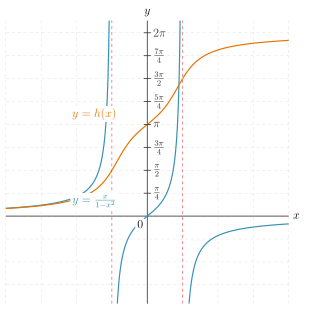
- Note that \(\frac{x+x^4}{1+x^2+x^4}\) is continuous, and nicely behaved on \((-\infty, \infty)\) so we can see that \(\lim_{x \to \infty} h_1(x) = \pi + \frac{\pi}{4} = \frac{5\pi}{4}\). \(\frac{4x-x^3}{1-x^4}\) on the other hand has asymptotes at \(\pm 1\). So as as \(x \to 1\), \(h_1(x) \to \pi + \frac{\pi}{2} = \frac{3\pi}{2}\). Then as \(x \to \infty\) we increase by another \(\frac{\pi}{2}\), so \(\lim_{x \to \infty} h_2(x) = 2\pi\)
2014 Paper 3 Q2
- Show, by means of the substitution \(u=\cosh x\,\), that \[ \int \frac{\sinh x}{\cosh 2x} \d x = \frac 1{2\sqrt2} \ln \left\vert \frac{\sqrt2 \cosh x - 1}{\sqrt2 \cosh x + 1 } \right\vert + C \,.\]
- Use a similar substitution to find an expression for \[ \int \frac{\cosh x}{\cosh 2x} \d x \,.\]
- Using parts (i) and (ii) above, show that \[ \int_0^1 \frac 1{1+u^4} \d u = \frac{\pi + 2\ln(\sqrt2 +1)}{4\sqrt2}\,. \]
Solution:
- \begin{align*} && \int \frac{\sinh x}{\cosh 2x} \d x &= \int \frac{\sinh x}{2\cosh^2 x -1} \d x \\ u = \cosh x, \d u = \sinh x \d x &&&= \int \frac{1}{2u^2 -1} \d u \\ &&&= \int\frac12 \left ( \frac{1}{\sqrt{2}u-1}-\frac{1}{\sqrt{2}u+1} \right) \d u \\ &&&= \frac1{2\sqrt{2}} \left (\ln (\sqrt{2}u-1) - \ln(\sqrt{2}u+1) \right) + C \\ &&&= \frac{1}{2\sqrt{2}} \ln \left ( \frac{\sqrt{2}\cosh x -1}{\sqrt{2}\cosh x +1} \right) + C \end{align*}
- \begin{align*} && \int \frac{\cosh x}{\cosh 2x} \d x &= \int \frac{\cosh x}{1+2\sinh^2 x} \d x \\ u = \sinh x && &= \int \frac{1}{1+2u^2} \d u \\ &&&=\frac{1}{\sqrt{2}} \tan^{-1} (\sqrt{2}u) + C \\ &&&= \frac{1}{\sqrt{2}} \tan^{-1}(\sqrt{2}\sinh x) + C \end{align*}
- \begin{align*} u = e^x : && \int_0^1 \frac{1}{1+u^4} \d u &= \int_{x=-\infty}^{x=0} \frac{1}{1+e^{4x}}e^{x} \d x \\ &&&= \int_{-\infty}^{0} \frac{e^{-x}}{e^{2x}+e^{-2x}} \d x \\ &&&= \int_{-\infty}^{0} \frac{\cosh x - \sinh x}{2\cosh 2x } \d x \\ &&&= \frac12 \int_{-\infty}^{0} \frac{\cosh x}{\cosh 2x} \d x - \frac12 \int_{-\infty}^{0} \frac{\sinh x}{\cosh 2x} \\ &&&= \frac12 \left [\frac{1}{\sqrt{2}} \tan^{-1}(\sqrt{2}\sinh x) \right]_{-\infty}^{0}-\frac12 \left [ \frac{1}{2\sqrt{2}}\ln \left ( \frac{\sqrt{2}\cosh x -1}{\sqrt{2}\cosh x +1} \right) \right]_{-\infty}^{0} \\ &&&= 0 - \frac1{2\sqrt{2}} \frac{-\pi}{2}-\left (\frac1{4\sqrt{2}} \ln \left (\frac{\sqrt{2}-1}{\sqrt{2}+1} \right) - 0 \right) \\ &&&= \frac{\pi - \ln((\sqrt{2}-1)^2)}{4\sqrt{2}} \\ &&&= \frac{\pi + 2 \ln(1+\sqrt{2})}{4\sqrt{2}} \end{align*}
2007 Paper 2 Q5
In this question, \(\f^2(x)\) denotes \(\f(\f(x))\), \(\f^3(x)\) denotes \(\f( \f (\f(x)))\,\), and so on.
- The function \(\f\) is defined, for \(x\ne \pm 1/ \sqrt3\,\), by $$ \f(x) = \ds \frac{x+\sqrt3} {1-\sqrt3\, x }\,. $$ Find by direct calculation \(\f^2(x) \) and \(\f^3(x)\), and determine \(\f^{2007}(x)\,\).
- Show that \(\f^n(x) = \tan(\theta + \frac 13 n\pi)\), where \(x=\tan\theta\) and \(n\) is any positive integer.
- The function \(\g(t)\) is defined, for \(\vert t\vert\le1\) by \(\g(t) = \frac {\sqrt3}2 t + \frac 12 \sqrt {1-t^2}\,\). Find an expression for \(\g^n(t)\) for any positive integer \(n\).
Solution:
- \(\,\) \begin{align*} && f(x) &= \frac{x+\sqrt3}{1-\sqrt3x} \\ \Rightarrow && f(f(x)) &= \frac{f(x)+\sqrt3}{1-\sqrt3f(x)} \\ &&&= \frac{\frac{x+\sqrt3}{1-\sqrt3x}+\sqrt3}{1-\sqrt3 \frac{x+\sqrt3}{1-\sqrt3x}} \\ &&&= \frac{x+\sqrt{3}+\sqrt3(1-\sqrt3x)}{1-\sqrt3x-\sqrt3(x+\sqrt3)} \\ &&&= \frac{-2x+2\sqrt3}{-2-2\sqrt3x} \\ &&&= \frac{x-\sqrt3}{1+\sqrt3 x} \\ \\ && f^3(x) &= f^2(f(x)) \\ &&&= \frac{f(x)-\sqrt3}{1+\sqrt3 f(x)} \\ &&&=\frac{\frac{x+\sqrt3}{1-\sqrt3x}-\sqrt3}{1+\sqrt3 \frac{x+\sqrt3}{1-\sqrt3x}} \\ &&&= \frac{(x+\sqrt3)-\sqrt3(1-\sqrt3 x)}{(1-\sqrt3x)+\sqrt3 (x+\sqrt3)} \\ &&&= \frac{-2x}{-2} = x \\ \\ && f^{2007}(x) &= x \end{align*}
- If \(x = \tan \theta\) then \(f(x) = \frac{\tan \theta + \tan \frac{\pi}{3}}{1 - \tan \frac{\pi}{3} \tan \theta} = \tan (\theta + \frac{\pi}{3})\) and hence \(f^n(x) = \tan (\theta + \frac{n \pi}{3})\)
- Note that if \(t = \sin \theta\) then \(g(t) = \cos \frac{\pi}{6} t\sin \theta + \frac12 \cos \theta = \sin(\theta + \frac{\pi}6)\) therefore \(g^n(t) = \sin(\sin^{-1}(t) + \frac{n\pi}{6})\)
2007 Paper 3 Q7
The functions \(\s(x)\) (\(0\le x<1\)) and \(t(x)\) (\(x\ge0\)), and the real number \(p\), are defined by \[ \s(x) = \int_0^x \frac 1 {\sqrt{1-u^2}}\, \d u\;, \ \ \ \ t(x) = \int_0^x \frac 1 {1+u^2}\, \d u\;, \ \ \ \ p= 2 \int_0^\infty \frac 1 {1+u^2}\, \d u \;. \] For this question, do not evaluate any of the above integrals explicitly in terms of inverse trigonometric functions or the number \(\pi\).
- Use the substitution \(u=v^{-1}\) to show that \(\displaystyle t(x) =\int_{1/x}^\infty\frac 1 {1+v^2}\, \d v \, \). Hence evaluate \(t(1/x) + t(x)\) in terms of \(p\) and deduce that \(2t(1)= \frac12 p\,\).
- Let \(y=\dfrac{u}{\sqrt{1+u^2}}\). Express \(u\) in terms of \(y\), and show that \(\displaystyle \frac{\d u}{\d y} = \frac 1 {\sqrt{(1-y^2)^3}}\). By making a substitution in the integral for \(t(x)\), show that \[ t(x) = \s\left(\frac{x}{\sqrt{1+x^2}}\right)\!. \] Deduce that \(\s\big(\frac1{\sqrt2}\big) =\frac1 4 p\,\).
- Let \(z= \dfrac{u+ \frac1{\sqrt3}}{1-\frac 1{\sqrt3}u}\,\). Show that \(\displaystyle t(\tfrac1{\sqrt3}) = \int_{\frac1{\sqrt3}}^{\sqrt3} \frac1 {1+z^2} \,\d z\;, \) and hence that \(3t(\frac1{\sqrt3}) = \frac12 p\,\).
Solution:
- \begin{align*} && t(x) &= \int_0^x \frac{1}{1+u^2} \d u \\ u = v^{-1}, \d u = -v^{-2} \d v&&&= \int_{v = \infty}^{v = 1/x} \frac{1}{1+v^{-2}} \frac{-1}{v^2} \d v \\ &&&= \int_{1/x}^\infty \frac{1}{1+v^2} \d v \\ \\ \Rightarrow && t(x) + t(1/x) &= \int_0^x \frac{1}{1+u^2} \d u + \int_0^{1/x} \frac{1}{1+u^2} \d u \\ &&&= \int_{1/x}^{\infty} \frac{1}{1+u^2} \d u + \int_0^{1/x} \frac{1}{1+u^2} \d u \\ &&&= \int_0^{\infty} \frac{1}{1+u^2} \d u \\ &&&= \frac12 p \\ \\ \Rightarrow && t(1) +t(1/1) = 2t(1) &= \frac12 p \end{align*}
- \(\,\) \begin{align*} && y &= \frac{u}{\sqrt{1+u^2}} \\ \Rightarrow && y^2 &= \frac{u^2}{1+u^2} \\ &&&= 1-\frac{1}{1+u^2} \\ \Rightarrow && 1+u^2 &= \frac{1}{1-y^2} \\ \Rightarrow && u &= \frac{y}{\sqrt{1-y^2}} \\ \\ && \frac{\d u}{\d y} &= \frac{\sqrt{1-y^2} + y^2(1-y^2)^{-1/2}}{1-y^2} \\ &&&= \frac{1}{(1-y^2)^{3/2}} \\ \\ && t(x) &= \int_0^x \frac{1}{1+u^2} \d u \\ &&&= \int_0^{y = x/\sqrt{1+x^2}} \frac{1}{1 + \frac{y^2}{1-y^2}} \frac{1}{(1-y^2)^{3/2}} \d y \\ &&&= \int_0^{x/\sqrt{1+x^2}} \frac{1-y^2}{(1-y^2)^{3/2}} \d y \\ &&&= \int_0^{x/\sqrt{1+x^2}} \frac{1}{(1-y^2)^{1/2}} \d y \\ &&&= s\left ( \frac{x}{\sqrt{1+x^2}} \right) \\ \\ \Rightarrow && s\left ( \frac{1}{\sqrt{2}} \right) &= t(1) = \frac14p \end{align*}
- \(\,\) \begin{align*} && z &= \frac{u + \frac1{\sqrt{3}}}{1- \frac{1}{\sqrt{3}} u}\\ \Rightarrow && z - \frac{z}{\sqrt{3}}u &= u + \frac{1}{\sqrt{3}} \\ \Rightarrow && u &= \frac{z-\frac{1}{\sqrt{3}}}{1 + \frac{z}{\sqrt{3}}} \\ \\ \Rightarrow && \frac{\d u}{\d z} &= \frac{\sqrt{3}(\sqrt{3}+z ) -(\sqrt{3}z-1)}{\left (\sqrt{3}+z \right)^2} \\ &&&= \frac{4}{(\sqrt{3}+z)^2} \\ \\ \Rightarrow && t \left ( \frac{1}{\sqrt{3}} \right) &= \int_0^{1/\sqrt{3}} \frac{1}{1+u^2} \d u \\ &&&= \int_{z=1/\sqrt{3}}^{z=\sqrt{3}} \frac{1}{1 + \left ( \frac{\sqrt{3}z-1}{\sqrt{3}+z}\right)^2} \frac{4}{(\sqrt{3}+z)^2} \d z\\ &&&= \int_{1/\sqrt{3}}^{\sqrt{3}} \frac{4}{(\sqrt{3}+z)^2+(\sqrt{3}z-1)^2} \d z \\ &&&= \int_{1/\sqrt{3}}^{\sqrt{3}} \frac{4}{4+4z^2} \d z \\ &&&= \int_{1/\sqrt{3}}^{\sqrt{3}} \frac{1}{1+z^2} \d z \end{align*} Notice that \(t(1/\sqrt{3})+t(\sqrt{3}) = \frac12p\) and also notice that \(t(1/\sqrt{3}) + t(1/\sqrt{3}) =t(\sqrt{3})\) so \(3t(1/\sqrt{3}) = \frac12p\)
2006 Paper 3 Q4
The function \(f\) satisfies the identity \begin{equation} f(x) +f(y) \equiv f(x+y) \tag{\(*\)} \end{equation} for all \(x\) and \(y\). Show that \(2\f(x)\equiv \f(2x)\) and deduce that \(f''(0)=0\). By considering the Maclaurin series for \(\f(x)\), find the most general function that satisfies \((*)\). [{\it Do not consider issues of existence or convergence of Maclaurin series in this question.}]
- By considering the function \(\G\), defined by \(\ln\big(\g(x)\big) =\G(x)\), find the most general function that, for all \(x\) and \(y\), satisfies the identity \[ \g(x) \g(y) \equiv \g(x+y)\,. \]
- By considering the function \(H\), defined by \(\h(\e^u) =H(u)\), find the most general function that satisfies, for all positive \(x\) and \(y\), the identity \[ \h(x) +\h(y) \equiv \h(xy) \,. \]
- Find the most general function \(t\) that, for all \(x\) and \(y\), satisfies the identity \begin{equation*} t(x) + t(y) \equiv t(z)\,, \end{equation*} where \(z= \dfrac{x+y}{1-xy}\,\).
Solution: \begin{align*} &&2f(x) &\equiv f(x) + f(x) \\ &&&\equiv f(x+x) \\ &&&\equiv f(2x) \\ \\ \Rightarrow && 2f(0) &= f(0) \\ \Rightarrow && f(0) &= 0 \\ && f''(0) &= \lim_{h \to 0} \frac{f(2h)-2f(0)+f(-2h)}{h^2} \\ &&&= \lim_{h \to 0} \frac{f(2h)+f(-2h)}{h^2} \\ &&&= \lim_{h \to 0} \frac{f(0)}{h^2} \\ &&&= 0 \\ \Rightarrow && f''(0) &= 0 \end{align*} If \(f(x)\) satisfies the equation, then \(f'(x)\) satisfies the equation. In particular this means that \(f^{(n)}(0) = 0\) for all \(n \geq 2\). Therefore the only non-zero term in the Maclaurin series is \(x^1\). Therefore \(f(x) = cx\)
- Suppose \(g(x)g(y) \equiv g(x+y)\), then if \(G(x) = \ln g(x)\) we must have \(G(x)+G(y) \equiv G(x+y)\), ie \(G(x) = cx \Rightarrow g(x) = e^{cx}\)
- Suppose \(h(x)+h(y) \equiv h(xy)\), then if \(h(e^u) = H(u)\) we must have that \(H(u)+H(v) \equiv h(e^u) + h(e^v) \equiv h(e^{u+v}) \equiv H(u+v)\).Therefore \(H(u) = cu\), ie \(h(e^u) = cu\) or \(h(x) = h(e^{\ln x}) = c \ln x\).
- Finally if \(t(x) + t(y) \equiv t(z)\), the considering \(T(w) = t(\tan w)\) then \(T(x) + T(y) \equiv t(\tan x) + t(\tan y) \equiv t( \frac{\tan x + \tan y}{1- \tan x \tan y}) \equiv t (\tan (x+y)) \equiv T(x+y)\). Therefore \(T(x) = cx\) Therefore \(t(\tan w) = c w \Rightarrow t(x) = c \tan^{-1} x\)
2005 Paper 2 Q4
The positive numbers \(a\), \(b\) and \(c\) satisfy \(bc=a^2+1\). Prove that $$ \arctan\left(\frac1 {a+b}\right)+ \arctan\left(\frac1 {a+c}\right)= \arctan\left(\frac1 a \right). $$ The positive numbers \(p\), \(q\), \(r\), \(s\), \(t\), \(u\) and \(v\) satisfy $$ st = (p+q)^2 + 1 \;, \ \ \ \ \ \ uv=(p+r)^2 + 1 \;, \ \ \ \ \ \ qr = p^2+1\;. $$ Prove that $$ \arctan \! \!\left(\!\frac1 {p+q+s}\!\right) + \arctan \! \!\left(\!\frac 1{p+q+t}\!\right) + \arctan \! \!\left(\!\frac 1 {p+r+u}\!\right) + \arctan \! \!\left(\!\frac1 {p+r+v}\!\right) =\arctan \! \!\left( \! \frac1 p \! \right) . $$ Hence show that $$ \arctan\left(\frac1 {13}\right) +\arctan\left(\frac1 {21}\right) +\arctan\left(\frac1 {82}\right) +\arctan\left(\frac1 {187}\right) =\arctan\left(\frac1 {7}\right). $$ [Note that \(\arctan x\) is another notation for \( \tan^{-1}x \,.\,\)]
Solution: \begin{align*} && \tan \left (\arctan\left(\frac1 {a+b}\right)+ \arctan\left(\frac1 {a+c}\right) \right) &= \frac{\frac1{a+b}+\frac1{a+c}}{1-\frac{1}{(a+b)(a+c)}} \\ &&&= \frac{a+c+a+b}{(a+b)(a+c)-1} \\ &&&= \frac{2a+b+c}{a^2+ab+ac+bc-1} \\ &&&= \frac{2a+b+c}{2a^2+ab+ac} \\ &&&= \frac{1}{a} \\ &&&= \tan \arctan \frac1a\\ \Rightarrow && \arctan\left(\frac1 {a+b}\right)+ \arctan\left(\frac1 {a+c}\right) &= \arctan \frac{1}{a} + n \pi \end{align*} Since \(\arctan x \in (-\frac{\pi}{2}, \frac{\pi}{2})\) the LHS \(\in (0, \pi)\) so \(n = 0\). \begin{align*} a=p+q, b = s, c = t:&& \arctan \! \!\left(\!\frac1 {p+q+s}\!\right) + \arctan \! \!\left(\!\frac 1{p+q+t}\!\right) &= \arctan \left ( \frac{1}{p+q} \right) \\ a=p+r, b= u, c = v && \arctan \! \!\left(\!\frac 1 {p+r+u}\!\right) + \arctan \! \!\left(\!\frac1 {p+r+v}\!\right) &= \arctan \! \!\left(\!\frac1 {p+r}\!\right) \\ a = p, b = q, c = r:&& \arctan \left ( \frac{1}{p+q} \right) +\arctan \! \!\left(\!\frac1 {p+r}\!\right) &= \arctan \left ( \frac1p \right) \end{align*} and the result follows. Taking \(p = 7\) we need to solve \[ \begin{cases} q+s &= 6 \\ q+t &= 14 \\ r+u &= 75 \\ r+v &= 180 \end{cases} \] also satisfying \(qr = 50\) etc, so say \(q = 1, r = 50, s = 5, v=25\)
2005 Paper 3 Q7
Show that if \(\displaystyle \int\frac1{u \, \f(u)}\; \d u = \F(u) + c\;\), then \(\displaystyle \int\frac{m}{x \, \f(x^m)} \;\d x = \F(x^m) + c\;\), where \(m\ne0\). Find:
- \(\displaystyle\int\frac1{x^n-x} \, \d x\,\);
- \(\displaystyle\int\frac1 {\sqrt{x^n+x^2}}\, \d x\,\).
Solution: \begin{align*} u = x^m, \d u = m x^{m-1} && \int \frac{m}{x f(x^m)} \d x &= \int \frac{m x^{m-1}}{uf(u)} \d x \\ &&&= \int \frac{1}{u f(u)} \d u \\ &&&= F(u) + c \\ &&&= F(x^m) + c \end{align*}
- \begin{align*} && \int \frac{1}{u(u-1)} \d u &= \int \left ( \frac{1}{u-1}-\frac{1}{u} \right ) \d u \\ &&&= \ln \left ( \frac{u-1}{u} \right) + c \\ &&&= \ln \left ( 1 - \frac{1}{u} \right) + c \\ && \int \frac{1}{x^n - x} \d x &= \int \frac{1}{x (x^{n-1}-1)} \d x \\ f(u) = u - 1: && &= \frac{1}{n-1} \ln \left ( 1 - \frac{1}{x^{n-1}} \right) + c \end{align*}
- \begin{align*} v = \sqrt{u+1}, \d v = \tfrac12 (u+1)^{-1/2} \d u && \int \frac{1}{u\sqrt{u+1}} \d u &= \int \frac{1}{(v^2-1)} (u+1)^{-1/2} \d u \\ &&&= \int \frac{2}{v^2-1} \d v \\ &&&=\ln \frac{1-v}{1+v} + c \\ &&&= \ln \left (\frac{1-\sqrt{u+1}}{1+\sqrt{u+1}} \right)+ c \\ f(u) = \sqrt{x+1}:&& \int \frac{1}{\sqrt{x^n + x^2}} \d x &= \int \frac{1}{x\sqrt{x^{n-2}+1}} \d x \\ &&&= \frac{1}{n-2} \ln \left ( \frac{1-\sqrt{x^{n-2}+1}}{1+\sqrt{x^{n-2}+1}} \right)+c \end{align*}
2004 Paper 3 Q1
Show that \[ \int_0^a \frac{\sinh x}{2\cosh^2 x -1} \, \mathrm{d} x = \frac{1}{2 \sqrt{2}} \ln \l \frac{\sqrt{2}\cosh a -1}{\sqrt{2}\cosh a +1}\r + \frac{1}{2 \sqrt{2}} \ln \l \frac{\sqrt{2}+1}{\sqrt{2}-1}\r \] and find \[ \int_0^a \frac{\cosh x}{1+2\sinh^2 x} \, \mathrm{d} x \, . \] Hence show that \[ \int_0^\infty \frac{\cosh x - \sinh x}{1+2\sinh^2 x} \, \mathrm{d} x = \frac{\pi}{2\sqrt{2}} - \frac{1}{2 \sqrt{2}} \ln \l \frac{\sqrt{2}+1}{\sqrt{2}-1}\r \, . \] By substituting \(u = \e^x\) in this result, or otherwise, find \[ \int_1^\infty \frac{1}{1+u^4} \, \mathrm{d} u \, . \]
2003 Paper 2 Q4
The line \(y=d\,\), where \(d>0\,\), intersects the circle \(x^2+y^2=R^2\) at \(G\) and \(H\). Show that the area of the minor segment \(GH\) is equal to \begin{equation} R^2\arccos \left({d \over R}\right) -d\sqrt{R^2 - d^2}\;. \tag {\(*\)} \end{equation} In the following cases, the given line intersects the given circle. Determine how, in each case, the expression \((*)\) should be modified to give the area of the minor segment.
- Line: \(y=c\,\); \ \ \ circle: \((x-a)^2+(y-b)^2=R^2\,\).
- Line: \(y=mx+c\, \); \ \ \ circle: \(x^2+y^2=R^2\,\).
- Line: \(y=mx+c\,\); \ \ \ circle: \((x-a)^2+(y-b)^2=R^2\,\).
2003 Paper 3 Q1
Given that \(x+a>0\) and \(x+b>0\,\), and that \(b>a\,\), show that \[ \frac{\mathrm{d} \ }{\mathrm{d} x} \arcsin \left ( \frac{x + a }{ \ x + b} \right) = \frac{ \sqrt{\;b - a\;}} {( x + b ) \sqrt{ a + b + 2x} \ \ } \] and find $\displaystyle \frac{\mathrm{d} \ }{ \mathrm{d} x} \; \mathrm{arcosh} \left ( \frac{x + b }{ \ x + a} \right)$. Hence, or otherwise, integrate, for \(x > -1\,\),
- \[ \int \frac{1}{ ( x + 1) \sqrt{x + 3} } \mathrm{d} x \]
- \[ \int \frac{1} {( x + 3 ) \sqrt{x + 1} } \mathrm{d} x \] .
Solution: \begin{align*} \frac{\mathrm{d} \ }{\mathrm{d} x} \arcsin \left ( \frac{x + a }{ \ x + b} \right ) &= \frac{1}{\sqrt{1-\left ( \frac{x + a }{ \ x + b} \right )^2}} \left ( \frac{b-a}{(x+b)^2} \right) \\ &= \frac{b-a}{(x+b)\sqrt{(x+b)^2-(x+a)^2}} \\ &= \frac{b-a}{(x+b)\sqrt{(b-a)(2x+b+a)}} \\ &= \frac{\sqrt{b-a}}{(x+b)\sqrt{a+b+2x}} \\ \\ \frac{\mathrm{d} \ }{ \mathrm{d} x} \; \mathrm{arcosh} \left ( \frac{x + b }{ \ x + a} \right) &= \frac{1}{\sqrt{\left ( \frac{x + b }{ \ x + a} \right)^2-1}} \left ( -\frac{b-a}{(x+a)^2} \right) \\ &= -\frac{b-a}{(x+a)\sqrt{(x+b)^2-(x+a)^2}} \\ &= -\frac{b-a}{(x+a)\sqrt{(b-a)(a+b+2x)}} \\ &= -\frac{\sqrt{b-a}}{(x+a)\sqrt{a+b+2x}} \end{align*}
- \begin{align*} \int \frac{1}{ ( x + 1) \sqrt{x + 3} } \mathrm{d} x &= \int \frac{1}{(x+1)\sqrt{\frac12 (2x+6)}} \d x\\ &= \int \frac{\sqrt{2}}{(x+1)\sqrt{2x+1+5}} \d x \\ &= \frac{\sqrt{2}}{2}\int \frac{\sqrt{5-1}}{(x+1)\sqrt{2x+1+5}} \d x \\ &= - \frac{\sqrt{2}}{2}\textrm{arcosh} \left ( \frac{x+5}{x+1} \right) + C \end{align*}
- \begin{align*} \int \frac{1}{(x+3)\sqrt{x+1}} \d x &= \int \frac{1}{(x+3)\sqrt{\tfrac12(2x+2)}} \d x + C \\ &= \int \frac{\sqrt{3-1}}{(x+3)\sqrt{2x+3-1}} \d x \\ &= \textrm{arcsin} \left ( \frac{x-1}{x+3} \right) \end{align*}
2002 Paper 3 Q2
Prove that \(\displaystyle \arctan a + \arctan b = \arctan \l {a + b \over 1-ab} \r\,\) when \(0 < a < 1\) and \(0 < b < 1\,\). Prove by induction that, for \(n \ge 1\,\), \[ \sum_{r = 1}^n \arctan \l {1 \over r^2 + r + 1} \r = \arctan \l {n \over n+2} \r \] and hence find \[ \sum_{r = 1}^\infty \arctan \l {1 \over r^2 + r + 1} \r\,. \] Hence prove that \[ \sum_{r = 1}^\infty \arctan \l {1 \over r^2 - r + 1} \r = {\pi \over 2}\,. \]
Solution: \begin{align*} && \arctan a &\in (0, \tfrac{\pi}{4}) \\ && \arctan b &\in (0, \tfrac{\pi}{4}) \\ \Rightarrow && \arctan a+\arctan b &\in (0, \tfrac{\pi}{2}) \\ && \tan \left ( \arctan a+\arctan b \right) &= \frac{\tan \arctan a + \tan \arctan b}{1 - \tan \arctan a \tan \arctan b} \\ &&&= \frac{a+b}{1-ab} \in (0, \infty) \\ \Rightarrow && \arctan \left ( \frac{a+b}{1-ab} \right) &\in (0, \tfrac{\pi}{2}) \\ \Rightarrow && \arctan a + \arctan b &= \arctan \left ( \frac{a+b}{1-ab} \right) \end{align*} Claim: \(\displaystyle \sum_{r = 1}^n \arctan \l {1 \over r^2 + r + 1} \r = \arctan \l {n \over n+2} \r\) Proof: (By Induction): Base case (\(n=1\)): \begin{align*} && LHS &= \sum_{r=1}^1 \arctan \left ( \frac{1}{r^2+r+1} \right) \\ &&&= \arctan \left ( \frac{1}{3} \right) \\ && RHS &= \arctan \left ( \frac{1}{1+2} \right)\\ &&&= \arctan \left ( \frac{1}{3} \right) = LHS \end{align*} Inductive step, suppose true for \(n = k\), ie \begin{align*} && \sum_{r = 1}^k \arctan \l {1 \over r^2 + r + 1} \r &= \arctan \l {k \over k+2} \r \\ \Rightarrow && \sum_{r = 1}^{k+1} \arctan \l {1 \over r^2 + r + 1} \r &= \sum_{r = 1}^k \arctan \l {1 \over r^2 + r + 1} \r+ \arctan \left ( \frac{1}{(k+1)^2+(k+1)+1} \right) \\ &&&= \arctan \l {k \over k+2} \r+\arctan \left ( \frac{1}{(k+1)^2+(k+1)+1} \right) \\ &&&= \arctan \left ( \frac{{k \over k+2}+\frac{1}{(k+1)^2+(k+1)+1} }{1-\frac{k}{k+2}\frac{1}{(k+1)^2+(k+1)+1} } \right) \\ &&&= \arctan \left ( \frac{k((k+1)^2+k+1+k)+(k+2) }{(k+2)((k+1)^2+(k+1)+1)-k} \right) \\ &&&= \arctan \left ( \frac{k^3+3k^2+4k+2 }{k^3+5k^2+8k+6} \right) \\ &&&= \arctan \left ( \frac{(k+1)(k^2+2k+2) }{(k+3)(k^2+2k+2)} \right) \\ &&&= \arctan \left ( \frac{k+1 }{(k+1)+2} \right) \\ \end{align*} Therefore it is true for \(n = k+1\), therefore it is true for all \(n \geq 1\) by the principle of mathematical induction. \begin{align*} && S &= \lim_{n \to \infty} \sum_{r = 1}^n \arctan \l {1 \over r^2 + r + 1} \r \\ &&&= \lim_{n \to \infty} \arctan \l \frac{n}{n+2} \r \\ &&&= \lim_{n \to \infty} \arctan \l \frac{1}{1+2/n} \r \\ &&&=\arctan\l \lim_{n \to \infty} \frac{1}{1+2/n} \r \\ &&&= \frac{\pi}{4} \end{align*} \begin{align*} && \sum_{r = 1}^\infty \arctan \l {1 \over r^2 - r + 1} \r &= \sum_{r = 0}^\infty \arctan \left( \frac{1}{ (r+1)^2 - (r+1) + 1} \right) \\ &&&= \sum_{r = 0}^\infty \arctan \left( \frac{1}{ r^2+r+1} \right) \\ &&&= \arctan \l \frac{1}{0^2+0+1} \r + \frac{\pi}{4} \\ &&&= \frac{\pi}{2} \end{align*}