2019 Paper 3 Q5
Year: 2019
Paper: 3
Question Number: 5
Course: LFM Pure
Section: Integration
Problem
- Let $$f(x) = \frac{x}{\sqrt{x^2 + p}},$$ where \(p\) is a non-zero constant. Sketch the curve \(y = f(x)\) for \(x \geq 0\) in the case \(p > 0\).
- Let $$I = \int \frac{1}{(b^2 - y^2)\sqrt{c^2 - y^2}} \, dy,$$ where \(b\) and \(c\) are positive constants. Use the substitution \(y = \frac{cx}{\sqrt{x^2 + p}}\), where \(p\) is a suitably chosen constant, to show that $$I = \int \frac{1}{b^2 + (b^2 - c^2)x^2} \, dx.$$ Evaluate $$\int_1^{\sqrt{2}} \frac{1}{(3 - y^2)\sqrt{2 - y^2}} \, dy.$$ [ Note: \(\int \frac{1}{a^2 + x^2} \, dx = \frac{1}{a} \tan^{-1} \frac{x}{a} + \text{constant.}\) ] Hence evaluate $$\int_{\frac{1}{\sqrt{2}}}^1 \frac{y}{(3y^2 - 1)\sqrt{2y^2 - 1}} \, dy.$$
- By means of a suitable substitution, evaluate $$\int_{\frac{1}{\sqrt{2}}}^1 \frac{1}{(3y^2 - 1)\sqrt{2y^2 - 1}} \, dy.$$
Solution
- \(\,\)
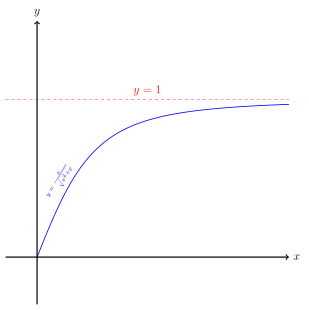
- \(\,\) \begin{align*} && y &= \frac{cx}{\sqrt{x^2+p}} \\ && \d y &= \frac{c(x^2+p)-cx^2}{(x^2+p)^{3/2}} \d x \\ &&&= \frac{cp^2}{(x^2+p)^{3/2}} \d x\\ && I &= \int \frac1{(b^2-y^2)\sqrt{c^2-y^2}} \d y \\ &&&= \int \frac{1}{\left ( b^2 - \frac{c^2x^2}{x^2+p} \right) \sqrt{c^2 - \frac{c^2x^2}{x^2+p} }} \d y \\ &&&= \int \frac{(x^2+p)^{3/2}}{((b^2-c^2)x^2+pb^2)\sqrt{c^2p}}\frac{cp}{(x^2+p)^{3/2}} \d x \\ &&&= \int \frac{\sqrt{p}}{((b^2-c^2)x^2+pb^2)} \d x \\ p=1: &&&= \int \frac{1}{(b^2-c^2)x^2+b^2} \d x \end{align*} When \(b = \sqrt{3}, c = \sqrt{2}\) \begin{align*} && I_1 &= \int_1^{\sqrt{2}} \frac{1}{(3 - y^2)\sqrt{2 - y^2}} \d y\\ &&&= \int_{x =1 }^{x=\infty} \frac{1}{3+x^2} \d x \\ &&&= \left [ \frac{1}{\sqrt{3}} \tan^{-1} \frac{x}{\sqrt{3}} \right]_1^\infty \\ &&&= \frac{\pi}{2\sqrt{3}} - \frac{1}{\sqrt{3}} \frac{\pi}{6} \\ &&&= \frac{\pi}{3\sqrt{3}} \end{align*} \begin{align*} && I_2 &= \int_{\frac{1}{\sqrt{2}}}^1 \frac{y}{(3y^2 - 1)\sqrt{2y^2 - 1}} \d y \\ x = \frac1y, \d x = -\frac1{y^2} \d y &&&= \int_{x=\sqrt{2}}^{x=1} \frac{x^2}{(3-x^2)\sqrt{2-x^2}}\cdot \left ( -\frac{1}{x^2} \right ) \d x \\ &&&= \int_1^{\sqrt{2}} \frac{1}{(3-x^2)\sqrt{2-x^2}} \d x \\ &&&= I_1 = \frac{\pi}{3\sqrt{3}} \end{align*}
- \(\,\) \begin{align*} && I_3 &= \int_{\frac{1}{\sqrt{2}}}^1 \frac{1}{(3y^2 - 1)\sqrt{2y^2 - 1}} \d y \\ x = 1/y, \d x = -1/y^2 \d y &&&= \int_{x=1}^{x=\sqrt{2}} \frac{x}{(3-x^2)\sqrt{2-x^2}} \d x \\ u = x^2, \d u = 2x \d x &&&= \int_{u=1}^{u=2} \frac{\frac12}{(3-u)\sqrt{2-u}} \d u \\ v=2-u, \d v = -\d u &&&= \frac12\int_{v=0}^{v=1} \frac{1}{(1+v)\sqrt{v}} \d v \\ &&&=\left [\tan^{-1}\sqrt{v}\right]_0^1 \\ &&&= \frac{\pi}{4} \end{align*}
Examiner's report
— 2019 STEP 3, Question 5There was a significant rise in the total entry this year with an increase of nearly 8.5% on 2018. One question was attempted by over 90%, two others were very popular, and three further questions were attempted by 60% or more. No question was generally avoided and even the least popular attracted more than 10% of the candidates. 88% restricted themselves to attempting no more than 7 questions, and only a handful, but not the very best, scored strongly attempting more than 7 questions.
Rating Information
Difficulty Rating: 1500.0
Difficulty Comparisons: 0
Banger Rating: 1500.0
Banger Comparisons: 0
Show LaTeX source
Problem source
\begin{questionparts}
\item Let
$$f(x) = \frac{x}{\sqrt{x^2 + p}},$$
where $p$ is a non-zero constant. Sketch the curve $y = f(x)$ for $x \geq 0$ in the case $p > 0$.
\item Let
$$I = \int \frac{1}{(b^2 - y^2)\sqrt{c^2 - y^2}} \, dy,$$
where $b$ and $c$ are positive constants. Use the substitution $y = \frac{cx}{\sqrt{x^2 + p}}$, where $p$ is a suitably chosen constant, to show that
$$I = \int \frac{1}{b^2 + (b^2 - c^2)x^2} \, dx.$$
Evaluate
$$\int_1^{\sqrt{2}} \frac{1}{(3 - y^2)\sqrt{2 - y^2}} \, dy.$$
[ Note: $\int \frac{1}{a^2 + x^2} \, dx = \frac{1}{a} \tan^{-1} \frac{x}{a} + \text{constant.}$ ]
Hence evaluate
$$\int_{\frac{1}{\sqrt{2}}}^1 \frac{y}{(3y^2 - 1)\sqrt{2y^2 - 1}} \, dy.$$
\item By means of a suitable substitution, evaluate
$$\int_{\frac{1}{\sqrt{2}}}^1 \frac{1}{(3y^2 - 1)\sqrt{2y^2 - 1}} \, dy.$$
\end{questionparts}
Solution source
\begin{questionparts}

\item $\,$
\begin{center}
    \begin{tikzpicture}
    \def\functionf(#1){(#1)/sqrt((#1)^2+4};
    \def\xl{-1};
    \def\xu{8};
    \def\yl{-.3};
    \def\yu{1.5};

    % Calculate scaling factors to make the plot square
    \pgfmathsetmacro{\xrange}{\xu-\xl}
    \pgfmathsetmacro{\yrange}{\yu-\yl}
    \pgfmathsetmacro{\xscale}{10/\xrange}
    \pgfmathsetmacro{\yscale}{10/\yrange}

    % Define the styles for the axes and grid
    \tikzset{
        axis/.style={very thick, ->},
        grid/.style={thin, gray!30},
        x=\xscale cm,
        y=\yscale cm
    }

    % Define the bounding region with clip
    \begin{scope}
        % You can modify these values to change your plotting region
        \clip (\xl,\yl) rectangle (\xu,\yu);

        % Draw a grid (optional)
        % \draw[grid] (-5,-3) grid (5,3);

        % \filldraw (-0.5, 0) circle (1.5pt) node[below]{$p$};
        % \filldraw (1, 0) circle (1.5pt) node[below]{$q$};
        % \filldraw (2.1, 0) circle (1.5pt) node[below]{$r$};

        \draw[thick, blue, smooth, domain=0:\xu, samples=100]
            plot (\x, {\functionf(\x)});

        \draw[dashed, red] (\xl, 1) -- (\xu, 1) node[pos=0.5, above] {$y = 1$};

        \node[blue, above, rotate=60] at (1, {\functionf(1)}) {\tiny $y = \frac{x}{\sqrt{x^2+p}}$};
    \end{scope}

    % Set up axes
    \draw[axis] (\xl,0) -- (\xu,0) node[right] {$x$};
    \draw[axis] (0,\yl) -- (0,\yu) node[above] {$y$};

    \end{tikzpicture}
\end{center}


\item $\,$ \begin{align*}
&& y &= \frac{cx}{\sqrt{x^2+p}} \\
&& \d y &= \frac{c(x^2+p)-cx^2}{(x^2+p)^{3/2}} \d x \\
&&&= \frac{cp^2}{(x^2+p)^{3/2}} \d x\\
&& I &= \int \frac1{(b^2-y^2)\sqrt{c^2-y^2}} \d y \\
&&&= \int \frac{1}{\left ( b^2 - \frac{c^2x^2}{x^2+p} \right) \sqrt{c^2 - \frac{c^2x^2}{x^2+p}  }} \d y \\
&&&= \int \frac{(x^2+p)^{3/2}}{((b^2-c^2)x^2+pb^2)\sqrt{c^2p}}\frac{cp}{(x^2+p)^{3/2}} \d x \\
&&&= \int \frac{\sqrt{p}}{((b^2-c^2)x^2+pb^2)} \d x \\
p=1: &&&= \int \frac{1}{(b^2-c^2)x^2+b^2} \d x
\end{align*}
When $b = \sqrt{3}, c = \sqrt{2}$
\begin{align*}
&& I_1 &= \int_1^{\sqrt{2}} \frac{1}{(3 - y^2)\sqrt{2 - y^2}} \d y\\
&&&= \int_{x =1 }^{x=\infty} \frac{1}{3+x^2} \d x \\
&&&= \left [ \frac{1}{\sqrt{3}} \tan^{-1} \frac{x}{\sqrt{3}} \right]_1^\infty \\
&&&= \frac{\pi}{2\sqrt{3}} - \frac{1}{\sqrt{3}} \frac{\pi}{6} \\
&&&= \frac{\pi}{3\sqrt{3}}
\end{align*}

\begin{align*}
&& I_2 &= \int_{\frac{1}{\sqrt{2}}}^1 \frac{y}{(3y^2 - 1)\sqrt{2y^2 - 1}} \d y \\
x = \frac1y, \d x = -\frac1{y^2} \d y &&&= \int_{x=\sqrt{2}}^{x=1} \frac{x^2}{(3-x^2)\sqrt{2-x^2}}\cdot \left ( -\frac{1}{x^2} \right ) \d x \\
&&&=  \int_1^{\sqrt{2}} \frac{1}{(3-x^2)\sqrt{2-x^2}} \d x \\
&&&= I_1 = \frac{\pi}{3\sqrt{3}}
\end{align*}

\item $\,$ \begin{align*}
&& I_3 &= \int_{\frac{1}{\sqrt{2}}}^1 \frac{1}{(3y^2 - 1)\sqrt{2y^2 - 1}} \d y \\
x = 1/y, \d x = -1/y^2 \d y &&&= \int_{x=1}^{x=\sqrt{2}} \frac{x}{(3-x^2)\sqrt{2-x^2}} \d x \\
u = x^2, \d u = 2x \d x &&&= \int_{u=1}^{u=2}  \frac{\frac12}{(3-u)\sqrt{2-u}} \d u \\
v=2-u, \d v = -\d u &&&= \frac12\int_{v=0}^{v=1} \frac{1}{(1+v)\sqrt{v}} \d v \\
&&&=\left [\tan^{-1}\sqrt{v}\right]_0^1 \\
&&&= \frac{\pi}{4}
\end{align*}

\end{questionparts}
A little more popular than question 1, attempts were only a little less successful than those for question 4. The effects and consequences of the typographical error in the substitution for part (ii) are dealt with in the protocol summary. The majority of candidates successfully drew the graph for (i), but common errors were failures to consider asymptotic behaviour and label appropriately. The vast majority used the incorrectly suggested substitution and proceeded as far as possible on the first result of (ii) using it; a few realised at this point that there was an error and then obtained the correct result. Candidates who moved on to the evaluation, scored strongly using the quoted result, even if they had not obtained it, and appreciated that the limits were needing to be changed. Most attempting the second evaluation of (ii) obtained full marks on that part as they successfully demonstrated that it was the same answer as the previous evaluation. Few attempted part (iii), and most that were successful made substitutions not involving using the previous part of the question.