Problems
Filters
72 problems found
2025 Paper 2 Q11
- By considering the sum of a geometric series, or otherwise, show that \[\sum_{r=1}^{\infty} rx^{r-1} = \frac{1}{(1-x)^2} \quad \text{for } |x| < 1.\]
- Ali plays a game with a fair \(2k\)-sided die. He rolls the die until the first \(2k\) appears. Ali wins if all the numbers he rolls are even.
- Find the probability that Ali wins the game. If Ali wins the game, he earns £1 for each roll, including the final one. If he loses, he earns nothing.
- Find Ali's expected earnings from playing the game.
- Find a simplified expression for \[1 + 2\binom{n}{1}x + 3\binom{n}{2}x^2 + \ldots + (n+1)x^n,\] where \(n\) is a positive integer.
- Zen plays a different game with a fair \(2k\)-sided die. She rolls the die until the first \(2k\) appears, and wins if the numbers rolled are strictly increasing in size. For example, if \(k = 3\), she wins if she rolls 2, 6 or 1, 4, 5, 6, but not if she rolls 1, 4, 2, 6 or 1, 3, 3, 6. If Zen wins the game, she earns £1 for each roll, including the final one. If she loses, she earns nothing. Find Zen's expected earnings from playing the game.
- Using the approximation \[\left(1 + \frac{1}{n}\right)^n \approx e \quad \text{for large } n,\] show that, when \(k\) is large, Zen's expected earnings are a little over 35\% more than Ali's expected earnings.
Solution:
- Note that, \begin{align*} && \sum_{r = 0}^\infty x^r &= \frac{1}{1-x} && |x| < 1\\ \underbrace{\Rightarrow}_{\frac{\d}{\d x}} && \sum_{r = 0}^\infty rx^{r-1} &= \frac{1}{(1-x)^2} && |x| < 1\\ && \sum_{r = 1}^\infty rx^{r-1} &= \frac{1}{(1-x)^2} && |x| < 1\\ \end{align*}
- \begin{align*} && \mathbb{P}(\text{Ali wins in }s\text{ rounds}) &= \left ( \frac{k-1}{2k} \right)^{s-1} \frac{1}{2k} \\ \Rightarrow && \mathbb{P}(\text{Ali wins}) &= \sum_{s=1}^\infty \mathbb{P}(\text{Ali wins in }s\text{ rounds}) \\ &&&=\sum_{s=1}^\infty \left ( \frac{k-1}{2k} \right)^{s-1} \frac{1}{2k} \\ &&&= \frac{1}{2k} \sum_{s=0}^\infty \left ( \frac{k-1}{2k} \right)^{s} \\ &&&= \frac{1}{2k} \frac{1}{1 - \frac{k-1}{2k}} \\ &&&= \frac{1}{2k - (k-1)} \\ &&&= \frac{1}{k+1} \end{align*}
- \begin{align*} \mathbb{E}(\text{Ali score}) &= \sum_{s=1}^{\infty} s \mathbb{P}(\text{Ali wins in }s\text{ rounds}) \\ &= \sum_{s=1}^{\infty} s \left ( \frac{k-1}{2k} \right)^{s-1} \frac{1}{2k} \\ &= \frac{1}{2k} \frac{1}{\left (1 - \frac{k-1}{2k} \right)^2} \\ &= \frac{2k}{(k+1)^2} \end{align*}
- \begin{align*} && (1+x)^{n} &= \sum_{k=0}^n \binom{n}{k} x^k \\ \Rightarrow && x(1+x)^n &= \sum_{k=0}^n \binom{n}{k} x^{k+1} \\ \Rightarrow && (1+x)^n + nx(1+x)^{n-1} &= \sum_{k=0}^n (k+1)\binom{n}{k} x^k \\ \Rightarrow && (1+x)^{n-1}(1+(n+1)x) &= 1 + 2\binom{n}{1}x + 3\binom{n}{2}x^2 + \ldots + (n+1)x^n \end{align*}
- \begin{align*} \mathbb{E}(\text{Zen score}) &= \sum_{s=1}^{2k} s \mathbb{P} \left ( \text{Zen gets }s\text{ numbers in increasing order ending with }2k \right) \\ &= \sum_{s=1}^{2k} s \binom{2k-1}{s-1} \frac{1}{(2k)^s} \\ &= \frac{1}{2k}\sum_{s=0}^{2k-1} (s+1) \binom{2k-1}{s} \frac{1}{(2k)^s} \\ &= \frac{1}{2k} \left ( 1 + \frac{1}{2k} \right)^{2k-2} \left ( 1 + (2k-1+1) \frac{1}{2k} \right) \\ &= \frac{1}{k}\left ( 1 + \frac{1}{2k} \right)^{2k-2} \end{align*}
- Therefore as \(k \to \infty\) \begin{align*} \frac{\mathbb{E}(\text{Zen score})}{\mathbb{E}(\text{Ali score}) } &= \frac{1}{k}\left ( 1 + \frac{1}{2k} \right)^{2k-2} \big / \frac{2k}{(k+1)^2} \\ &= \frac{(k+1)^2}{2k^2} \cdot \left ( 1 + \frac{1}{2k} \right)^{2k} \cdot \left ( 1 + \frac{1}{2k} \right)^{-2} \\ &\to \frac12 e \approx 2.7/2 = 1.35 \end{align*} ie Zen's expected earnings are \(\approx 35\%\) more.
2025 Paper 3 Q12
- Show that, for any functions \(f\) and \(g\), and for any \(m \geq 0\), $$\sum_{r=1}^{m+1} f(r)\sum_{s=r-1}^m g(s) = \sum_{s=0}^m g(s)\sum_{r=1}^{s+1} f(r)$$
- The random variables \(X_0, X_1, X_2, \ldots\) are defined as follows:
- \(X_0\) takes the value \(0\) with probability \(1\);
- \(X_{n+1}\) takes the values \(0, 1, \ldots, X_n + 1\) with equal probability, for \(n = 0, 1, \ldots\)
- Write down \(E(X_1)\). Find \(P(X_2 = 0)\) and \(P(X_2 = 1)\) and show that \(P(X_2 = 2) = \frac{1}{6}\). Hence calculate \(E(X_2)\).
- For \(n \geq 1\), show that $$P(X_n = 0) = \sum_{s=0}^{n-1} \frac{P(X_{n-1} = s)}{s+2}$$ and find a similar expression for \(P(X_n = r)\), for \(r = 1, 2, \ldots, n\).
- Hence show that \(E(X_n) = \frac{1}{2}(1 + E(X_{n-1}))\). Find an expression for \(E(X_n)\) in terms of \(n\), for \(n = 1, 2, \ldots\)
Solution:
- \begin{align*} \sum_{r=1}^{m+1} \left (f(r) \sum_{s=r-1}^m g(s) \right) &= \sum_{r=1}^{m+1} \sum_{s=r-1}^m f(r)g(s) \\ &= \sum_{(r,s) \in \{(r,s) : 1 \leq r \leq m+1, 0 \leq s \leq m, s \geq r-1\}} f(r)g(s) \\ &= \sum_{(r,s) \in \{(r,s) : 0 \leq s \leq m, 1 \leq r \leq m+1, r \leq s+1\}} f(r)g(s) \\ &= \sum_{s=0}^m \sum_{r=1}^{s+1} f(r)g(s) \\ &= \sum_{s=0}^m \left ( g(s) \sum_{r=1}^{s+1} f(r) \right) \end{align*}
- \(X_1\) takes the values \(0, 1\) with equal probabilities (since \(X_0 = 0\)). Therefore \(\mathbb{E}(X_1) = \frac12\).
- \begin{align*} \mathbb{P}(X_2 = 0) &= \mathbb{P}(X_2 = 0 | X_1 = 0) \mathbb{P}(X_1 = 0) + \mathbb{P}(X_2 = 0 | X_1 = 1) \mathbb{P}(X_1 = 1) \\ &= \frac12 \cdot \frac12 + \frac13 \cdot \frac12 \\ &= \frac5{12} \\ \\ \mathbb{P}(X_2 = 1) &= \mathbb{P}(X_2 = 1 | X_1 = 0) \mathbb{P}(X_1 = 0) + \mathbb{P}(X_2 = 1 | X_1 = 1) \mathbb{P}(X_1 = 1) \\ &= \frac12 \cdot \frac12 + \frac13 \cdot \frac12 \\ &= \frac5{12} \\ \\ \mathbb{P}(X_2 = 3) &= 1 - \mathbb{P}(X_2 = 0) - \mathbb{P}(X_2 = 1) \\ &= 1 - \frac{10}{12} = \frac16 \\ \\ \mathbb{E}(X_2) &= \frac{5}{12} + 2\cdot \frac{1}{6} \\ &= \frac34 \end{align*}
- \begin{align*} \mathbb{P}(X_n = 0) &= \sum_{s=0}^{n-1} \mathbb{P}(X_n = 0 | X_{n-1} = s)\mathbb{P}(X_{n-1} = s) \\ &= \sum_{s=0}^{n-1} \frac{1}{s+2}\mathbb{P}(X_{n-1} = s) \\ \end{align*} as required. (Where \(\mathbb{P}(X_n = 0 | X_{n-1} = s) = \frac{1}{s+2}\) since if \(X_{n-1} = s\) there are \(0, 1, \ldots, s + 1\) values \(X_n\) can take with equal chance (ie \(s+2\) different values). \begin{align*} \mathbb{P}(X_n = r) &= \sum_{s=0}^{n-1} \mathbb{P}(X_n = r | X_{n-1} = s)\mathbb{P}(X_{n-1} = s) \\ &= \sum_{s=r-1}^{n-1} \frac{\mathbb{P}(X_{n-1}=s)}{s+2} \end{align*}
- \begin{align*} \mathbb{E}(X_n) &= \sum_{r=1}^{n} r \cdot \mathbb{P}(X_n = r) \\ &= \sum_{r=1}^{n} r \cdot \sum_{s=r-1}^{n-1} \frac{\mathbb{P}(X_{n-1}=s)}{s+2} \\ &= \sum_{s=0}^{n-1} \frac{\mathbb{P}(X_{n-1}=s)}{s+2} \sum_{r=1}^{s+1} r \\ &= \sum_{s=0}^{n-1} \frac{\mathbb{P}(X_{n-1}=s)}{s+2} \frac{(s+1)(s+2)}{2} \\ &= \frac12 \sum_{s=0}^{n-1} (s+1)\mathbb{P}(X_{n-1}=s) \\ &= \frac12 \sum_{s=0}^{n-1} s\mathbb{P}(X_{n-1}=s) + \frac12 \sum_{s=0}^{n-1} \mathbb{P}(X_{n-1}=s) \\\\ &= \frac12 \left ( \mathbb{E}(X_{n-1}) + 1 \right) \end{align*} Suppose \(\mathbb{E}(X_n) = 1-2^{-n}\), then notice that this expression matches for \(n = 0, 1, 2\) and also: \(\frac12(1 - 2^{-n} + 1) = 1-2^{-n-1}\) satisfies the recusive formula. Therefore by induction (or similar) we can show that \(\mathbb{E}(X_n) = 1- 2^{-n}\).
2024 Paper 3 Q7
In this question, you need not consider issues of convergence. For positive integer \(n\) let \[\mathrm{f}(n) = \frac{1}{n+1} + \frac{1}{(n+1)(n+2)} + \frac{1}{(n+1)(n+2)(n+3)} + \ldots\] and \[\mathrm{g}(n) = \frac{1}{n+1} - \frac{1}{(n+1)(n+2)} + \frac{1}{(n+1)(n+2)(n+3)} - \ldots\,.\]
- Show, by considering a geometric series, that \(0 < \mathrm{f}(n) < \dfrac{1}{n}\).
- Show, by comparing consecutive terms, that \(0 < \mathrm{g}(n) < \dfrac{1}{n+1}\).
- Show, for positive integer \(n\), that \((2n)!\,\mathrm{e} - \mathrm{f}(2n)\) and \(\dfrac{(2n)!}{\mathrm{e}} + \mathrm{g}(2n)\) are both integers.
- Show that if \(q\,\mathrm{e} = \dfrac{p}{\mathrm{e}}\) for some positive integers \(p\) and \(q\), then \(q\,\mathrm{f}(2n) + p\,\mathrm{g}(2n)\) is an integer for all positive integers \(n\).
- Hence show that the number \(\mathrm{e}^2\) is irrational.
2021 Paper 2 Q12
- A game for two players, \(A\) and \(B\), can be won by player \(A\), with probability \(p_A\), won by player \(B\), with probability \(p_B\), where \(0 < p_A + p_B < 1\), or drawn. A match consists of a series of games and is won by the first player to win a game. Show that the probability that \(A\) wins the match is \[ \frac{p_A}{p_A + p_B}. \]
- A second game for two players, \(A\) and \(B\), can be won by player \(A\), with probability~\(p\), or won by player \(B\), with probability \(q = 1 - p\). A match consists of a series of games and is won by the first player to have won two more games than the other. Show that the match is won after an even number of games, and that the probability that \(A\) wins the match is \[ \frac{p^2}{p^2 + q^2}. \]
- A third game, for only one player, consists of a series of rounds. The player starts the game with one token, wins the game if they have four tokens at the end of a round and loses the game if they have no tokens at the end of a round. There are two versions of the game. In the cautious version, in each round where the player has any tokens, the player wins one token with probability \(p\) and loses one token with probability \(q = 1 - p\). In the bold version, in each round where the player has any tokens, the player's tokens are doubled in number with probability \(p\) and all lost with probability \(q = 1 - p\). In each of the two versions of the game, find the probability that the player wins. Hence show that the player is more likely to win in the cautious version if \(1 > p > \tfrac{1}{2}\) and more likely to win in the bold version if \(0 < p < \tfrac{1}{2}\).
2020 Paper 2 Q11
A coin is tossed repeatedly. The probability that a head appears is \(p\) and the probability that a tail appears is \(q = 1 - p\).
- A and B play a game. The game ends if two successive heads appear, in which case A wins, or if two successive tails appear, in which case B wins. Show that the probability that the game never ends is \(0\). Given that the first toss is a head, show that the probability that A wins is \(\dfrac{p}{1 - pq}\). Find and simplify an expression for the probability that A wins.
- A and B play another game. The game ends if three successive heads appear, in which case A wins, or if three successive tails appear, in which case B wins. Show that \[\mathrm{P}(\text{A wins} \mid \text{the first toss is a head}) = p^2 + (q + pq)\,\mathrm{P}(\text{A wins} \mid \text{the first toss is a tail})\] and give a similar result for \(\mathrm{P}(\text{A wins} \mid \text{the first toss is a tail})\). Show that \[\mathrm{P}(\text{A wins}) = \frac{p^2(1-q^3)}{1-(1-p^2)(1-q^2)}.\]
- A and B play a third game. The game ends if \(a\) successive heads appear, in which case A wins, or if \(b\) successive tails appear, in which case B wins, where \(a\) and \(b\) are integers greater than \(1\). Find the probability that A wins this game. Verify that your result agrees with part (i) when \(a = b = 2\).
2019 Paper 2 Q3
For any two real numbers \(x_1\) and \(x_2\), show that $$|x_1 + x_2| \leq |x_1| + |x_2|.$$ Show further that, for any real numbers \(x_1, x_2, \ldots, x_n\), $$|x_1 + x_2 + \cdots + x_n| \leq |x_1| + |x_2| + \cdots + |x_n|.$$
- The polynomial f is defined by
$$f(x) = 1 + a_1 x + a_2 x^2 + \cdots + a_{n-1} x^{n-1} + x^n$$
where the coefficients are real and satisfy \(|a_i| \leq A\) for \(i = 1, 2, \ldots, n-1\), where \(A \geq 1\).
- If \(|x| < 1\), show that $$|f(x) - 1| \leq \frac{A|x|}{1 - |x|}.$$
- Let \(\omega\) be a real root of f, so that \(f(\omega) = 0\). In the case \(|\omega| < 1\), show that $$\frac{1}{1 + A} \leq |\omega| \leq 1 + A. \quad (*)$$
- Show further that the inequalities \((*)\) also hold if \(|\omega| \geq 1\).
- Find the integer root or roots of the quintic equation $$135x^5 - 135x^4 - 100x^3 - 91x^2 - 126x + 135 = 0.$$
Solution: Claim: \(|x_1 + x_2| \leq |x_1| + |x_2|\) Proof: Case 1: \(x_1, x_2 \geq 0\). The inequality is equivalent to \(|x_1 + x_2| = x_1 + x_2 = |x_1|+|x_2|\) so it's an equality. Case 2: \(x_1, x_2 \leq 0\). The inequality is equivalent to \(|x_1+x_2| = -x_1-x_2 = |x_1|+|x_2\), so it's also an equality in this case. Case 3: (wlog) \(|x_1| \geq |x_2| > 0\) and \(x_1x_2 < 0\) then \(|x_1+x_2| = x_1-x_2 \leq x_1 \leq |x_1|+|x_2|\) We can prove this by induction, we've already proven the base case and: \(|x_1+x_2 + \cdots + x_n| \leq |x_1 + x_2 + \cdots x_{n-1}| + |x_n| \leq |x_1| + |x_2| + \cdots + |x_n|\)
- \(\,\) \begin{align*} && |f(x) - 1| &= |a_1 x + a_2x^2 + \cdots + a_{n-1}x^{n-1} + x^n| \\ &&&\leq |a_1x| + |a_2x^2| + \cdots + |a_{n-1}x^{n-1}| + |x^n| \\ &&&\leq |a_1||x| + |a_2||x|^2 + \cdots + |a_{n-1}||x|^{n-1} + |x|^n \\ &&&\leq A|x| + A|x|^2 + \cdots + A|x|^{n-1} + |x|^n \\ &&&=A|x| \frac{1-|x|^{n-1}}{1-|x|} + |x|^n \\ &&&= \frac{A|x|-A|x|^{n}+|x|^{n+1}-|x|^n}{1-|x|} \\ &&&= \frac{A|x|-|x|^n(\underbrace{A-|x|+1}_{\geq0})}{1-|x|} \\ &&&\leq \frac{A|x|}{1-|x|} \end{align*}
- If \(f(\omega) = 0\) then \begin{align*} && 1 & \leq \frac{A|\omega|}{1-|\omega|} \\ \Leftrightarrow && 1-|\omega| &\leq A |\omega| \\ \Leftrightarrow && 1 &\leq (1+A) |\omega| \\ \Leftrightarrow && \frac{1}{1+A} &\leq |\omega| \\ \end{align*} We also know \(\omega \leq 1 < 1 + A\)
- If \(\omega\) is a root of \(f(x)\) then \(1/\omega\) is a root of \(1 + a_{n-1}x + a_{n-2}x^2 + \cdots + a_1x^{n-1}+x^n\) and so \(1/\omega\) satisfies that inequality, ie \begin{align*} && \frac{1}{1+A} && \leq &&|1/\omega| && \leq &&1 + A \\ \Leftrightarrow &&1+A && \geq&& |\omega| && \geq&& \frac{1}{1 + A} \end{align*}
- First notice that it's equivalent to: \(0 = x^5 - 1x^4 - \frac{100}{135}x^3-\frac{91}{135}x^2-\frac{126}{135} + 1\) therefore all integer roots must be between \(-2,-1\) and \(1\) and \(2\). \(1\) doesn't work. \(-1\) works. Clearly \(2\) cannot work by parity argument, therefore the only integer root is \(-1\).
2019 Paper 3 Q11
The number of customers arriving at a builders' merchants each day follows a Poisson distribution with mean \(\lambda\). Each customer is offered some free sand. The probability of any given customer taking the free sand is \(p\).
- Show that the number of customers each day who take sand follows a Poisson distribution with mean \(p\lambda\).
- The merchant has a mass \(S\) of sand at the beginning of the day. Each customer who takes the free sand gets a proportion \(k\) of the remaining sand, where \(0 \leq k < 1\). Show that by the end of the day the expected mass of sand taken is $$\left(1 - e^{-kp\lambda}\right)S.$$
- At the beginning of the day, the merchant's bag of sand contains a large number of grains, exactly one of which is made from solid gold. At the end of the day, the merchant's assistant takes a proportion \(k\) of the remaining sand. Find the probability that the assistant takes the golden grain. Comment on the case \(k = 0\) and on the limit \(k \to 1\). In the case \(p\lambda > 1\) find the value of \(k\) which maximises the probability that the assistant takes the golden grain.
Solution:
- Let \(X\) be the number of people arriving on a given day, and \(Y\) be the number taking sand, then \begin{align*} && \mathbb{P}(Y = k) &= \sum_{x=k}^{\infty} \mathbb{P}(x \text{ arrive and }k\text{ of them take sand}) \\ &&&= \sum_{x=k}^{\infty} \mathbb{P}(X=x)\mathbb{P}(k \text{ out of }x\text{ of them take sand})\\ &&&= \sum_{x=k}^{\infty} e^{-\lambda} \frac{\lambda^x}{x!}\binom{x}{k}p^k(1-p)^{x-k}\\ &&&= e^{-\lambda} \left ( \frac{p}{1-p} \right)^k \sum_{x=k}^{\infty} \frac{((1-p)\lambda)^x}{k!(x-k)!} \\ &&&= e^{-\lambda} \left ( \frac{p}{1-p} \right)^k \frac{((1-p)\lambda)^k}{k!} \sum_{x=0}^{\infty} \frac{((1-p)\lambda)^x}{x!} \\ &&&= e^{-\lambda} \left ( \frac{p}{1-p} \right)^k \frac{((1-p)\lambda)^k}{k!}e^{(1-p)\lambda)} \\ &&&= e^{-p\lambda} \frac{(p\lambda)^k}{k!} \end{align*} which is precisely a Poisson with parameter \(p\lambda\). Alternatively, \(Y = B_1 + B_2 + \cdots + B_X\) where \(B_i \sim Bernoulli(p)\) so \(G_Y(t) = G_X(G_B(t)) = G_X(1-p+pt) = e^{-\lambda(1-(1-p+pt))} = e^{-p\lambda(1-t)}\) so \(Y \sim Po(\lambda)\) Alternatively, alternatively, let \(Z\) be the number of people not taking sand, so \begin{align*} && \mathbb{P}(Y = y, Z= z) &= \mathbb{P}(X=y+z) \cdot \binom{y+z}{y} p^y(1-p)^z \\ &&&= e^{-\lambda} \frac{\lambda^{y+z}}{(y+z)!} \frac{(y+z)!}{y!z!} p^y(1-p)^z \\ &&&=\left ( e^{-p\lambda} \frac{(p\lambda)^y}{y!} \right) \cdot \left ( e^{-(1-p)\lambda} \frac{((1-p)\lambda)^z}{z!}\right) \end{align*} So clearly \(Y\) and \(Z\) are both (independent!) Poisson with parameters \(p\lambda \) and \((1-p)\lambda\)
- The amount taken is \(Sk + S(1-k)k + \cdots +Sk(1-k)^{Y-1} = Sk\cdot \frac{1-(1-k)^Y}{k} = S(1-(1-k)^Y)\) so \begin{align*} \E[\text{taken sand}] &= \E \left [ S(1-(1-k)^Y)\right] \\ &= S-S\E\left [(1-k)^Y \right] \\ &= S - SG_Y(1-k)\\ &=S - Se^{-p\lambda(1-(1-k))} \tag{pgf for Poisson} \\ &= S\left (1-e^{-kp\lambda} \right) \end{align*}
- The fraction of grains the assistant takes home is: \((1-k)^Yk\), which has expected value \(ke^{-kp\lambda}\). This the the probability he takes home the golden grain. When \(k = 0\) the probability is \(0\) which makes sense (no-one takes home any sand, including the merchant's assistant). As \(k \to 1\) we get \(e^{-p\lambda}\) which is the probability that no-one gets any sand other than him. \begin{align*} && \frac{\d }{\d k} \left ( ke^{-kp\lambda} \right) &= e^{-kp\lambda} - (p\lambda)ke^{-kp\lambda} \\ &&&= e^{-kp\lambda}(1 - (p\lambda)k) \end{align*} Therefore maximised at \(k = \frac{1}{p\lambda}\). (Clearly this is a maximum just by sketching the function)
2017 Paper 1 Q4
- Let \(r\) be a real number with \(\vert r \vert<1\) and let \[ S = \sum_{n=0}^\infty r^n\,. \] You may assume without proof that \(S = \displaystyle \frac{1}{1-r}\, \). Let \(p= 1 + r +r^2\). Sketch the graph of the function \(1+r+r^2\) and deduce that \(\frac{3}{4} \le p < 3\,\). Show that, if \(1 < p < 3\), then the value of \( p\) determines \(r\), and hence \(S\), uniquely. Show also that, if \(\frac{3}{4} < p < 1\), then there are two possible values of \(S\) and these values satisfy the equation \((3-p)S^2-3S+1=0\).
- Let \(r\) be a real number with \(\vert r \vert<1\) and let \[ T =\sum_{n=1}^\infty nr^{n-1}\,. \] You may assume without proof that \(T = \displaystyle \dfrac{1}{(1-r)^2}\,.\) Let \( q= 1+2r+3r^2\). Find the set of values of \( q\) that determine \(T\) uniquely. Find the set of values of \(q\) for which \(T\) has two possible values. Find also a quadratic equation, with coefficients depending on \( q\), that is satisfied by these two values.
Solution:
- \(\,\)
Notice that \(1+r+r^2\) ranges from \(\frac34\) to \(3\) over \((-1,1)\) therefore \(\frac34 \leq p < 3\) attaining its minimum but not its maximum. If \(p > 1\) we know we must be on the right branch and hence we can determine \(r\) and \(S\) uniquely. If \(\frac34 < p < 1\) then we must have two possible values for \(r\), satisfying \(r_i^2 + r+1 = p\) and so our two possible values for \(S_i = \frac{1}{1-r_i}\) or \(r_i = 1-\frac{1}{S_i}\) and so \begin{align*} && p &= \left ( 1 - \frac{1}{S} \right)^2 + 1 - \frac1S + 1 \\ \Rightarrow && pS^2 &= (S-1)^2 + S^2-S + S^2 \\ \Rightarrow && 0 &= (3-p)S^2 -3S + 1 \end{align*}
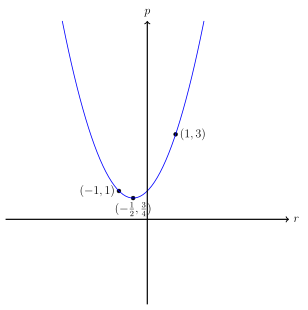
- \(\,\)
So \(\frac23 \leq q < 6\) and \(r\) and hence \(T\) is uniquely determined if \(2 \leq q < 6\). if \(\frac23
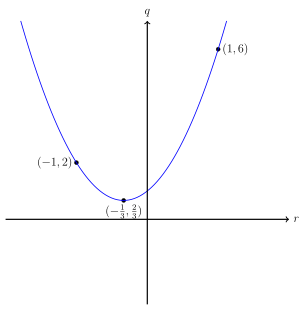
2017 Paper 1 Q10
Particles \(P_1\), \(P_2\), \(\ldots\) are at rest on the \(x\)-axis, and the \(x\)-coordinate of \(P_n\) is \(n\). The mass of \(P_n\) is \(\lambda^nm\). Particle \(P\), of mass \(m\), is projected from the origin at speed \(u\) towards \(P_1\). A series of collisions takes place, and the coefficient of restitution at each collision is \(e\), where \(0 < e <1\). The speed of \(P_n\) immediately after its first collision is \(u_n\) and the speed of \(P_n\) immediately after its second collision is \(v_n\). No external forces act on the particles.
- Show that \(u_1=\dfrac{1+e}{1+\lambda}\, u\) and find expressions for \(u_n\) and \(v_n\) in terms of \(e\), \(\lambda\), \(u\) and \(n\).
- Show that, if \(e > \lambda\), then each particle (except \(P\)) is involved in exactly two collisions.
- Describe what happens if \(e=\lambda\) and show that, in this case, the fraction of the initial kinetic energy lost approaches \(e\) as the number of collisions increases.
- Describe what happens if \(\lambda e=1\). What fraction of the initial kinetic energy is \mbox{eventually} lost in this case?
Solution:
- \begin{align*} \text{COM}: && mu &= mv + \lambda m u_1 \\ \Rightarrow && u &= v + \lambda u_1 \tag{1} \\ \text{NEL}: && e &= \frac{u_1-v}{u} \\ \Rightarrow && eu &= u_1 - v \tag{2} \\ (1)+(2) && (1+e)u &= (1+\lambda) u_1 \\ \Rightarrow && u_1 &= \frac{1+e}{1+\lambda}u \\ && v &= u_1 - eu \\ &&&= \frac{1+e - (1+\lambda)e}{1+\lambda} u \\ &&&= \frac{1-\lambda e}{1+\lambda}u \end{align*} Note that subsequent (first (and second)) are the same as these, therefore: \begin{align*} u_n &= \left ( \frac{1+e}{1+\lambda} \right)^n u \\ v_n &= \frac{1-\lambda e}{1+\lambda } u_n \\ &= \frac{1-\lambda e}{1+\lambda } \left ( \frac{1+e}{1+\lambda} \right)^n u \end{align*}

- If \(e > \lambda\) then \((1-\lambda e) > 1-e^2 > 0\) and \begin{align*} \frac{v_{n+1}}{v_n} &= \frac{1+e}{1+\lambda} > 1 \end{align*} So the particles are moving away from each other - hence no more collisions.
- If \(e = \lambda\) then \(u_n = u\) and \(v_n = (1-\lambda)u\) so all the particles end up moving at the same speed. \begin{align*} \text{initial k.e.} &= \frac12 m u^2 \\ \text{final k.e.} &= \frac12 m((1-e)u)^2 + \sum_{n = 1}^{\infty} \frac12 \lambda^n m ((1-e)u)^2 \\ &= \frac12mu^2(1-e)^2 \left ( \sum_{n=0}^{\infty} e^n \right) \tag{\(e = \lambda\)} \\ &= \frac12 mu^2(1-e)^2 \frac{1}{1-e} \\ &= \frac12m u^2 (1-e) \\ \text{change in k.e.} &= \frac12 m u^2 - \frac12m u^2 (1-e) \\ &= e\frac12m u^2 \end{align*} Ie the total energy lost approaches a fraction of \(e\).
- If \(\lambda e = 1\), after the second collision the particle will be stationary. ie \begin{align*} \text{initial k.e.} &= \frac12 m u^2 \\ \text{k.e. after }n\text{ collisions} &= \frac12 \lambda^n m \left (\left ( \frac{1+e}{1+\lambda} \right)^n u \right)^2\\ &= \frac12 \lambda^n m \left ( \frac{1+\frac1{\lambda}}{1+\lambda} \right)^{2n} u&2\\ &= \frac12 \lambda^n m \left ( \frac{1+\frac1{\lambda}}{1+\lambda} \right)^{2n} u\\ &= \frac12 \lambda^n m \left ( \frac{1}{\lambda} \right)^{2n} u\\ &= \frac12 m \lambda^{-n} u\\ &\to 0 \end{align*} Eventually we lose all the kinetic energy.
2017 Paper 1 Q13
I have a sliced loaf which initially contains \(n\) slices of bread. Each time I finish setting a STEP question, I make myself a snack: either toast, using one slice of bread; or a sandwich, using two slices of bread. I make toast with probability \(p\) and I make a sandwich with probability \(q\), where \(p+q=1\), unless there is only one slice left in which case I must, of course, make toast. Let \(s_r\) (\(1 \le r \le n\)) be the probability that the \(r\)th slice of bread is the second of two slices used to make a sandwich and let \(t_r\) (\(1 \le r \le n\)) be the probability that the \(r\)th slice of bread is used to make toast. What is the value of \(s_1\)? Explain why the following equations hold: \begin{align*} \phantom{\hspace{2cm} (2\le r \le n-1)} t_r &= (s_{r-1}+ t_{r-1})\,p \hspace{2cm} (2\le r \le n-1)\,; \\ \phantom{\hspace{1.53cm} (2\le r \le n) } s_r &= 1- (s_{r-1} + t_{r-1}) \hspace{1.53cm} ( 2\le r \le n )\,. \end{align*} Hence, or otherwise, show that \(s_{r} = q(1-s_{r-1})\) for \(2\le r\le n-1\). Show further that \[ \phantom{\hspace{2.7cm} (1\le r\le n)\,,} s_r = \frac{q+(-q)^r}{1+q} \hspace{2.7cm} (1\le r\le n-1)\,, \, \hspace{0.14cm} \] and find the corresponding expression for \(t_r\). Find also expressions for \(s_n\) and \(t_n\) in terms of \(q\).
Solution: The \(1\)st slice of bread can only be the first slice in a sandwich or a slice of toast. Therefore \(s_1 = 0\) \begin{align*} && t_r &= \underbrace{s_{r-1}}_{r-1\text{th is the end of a sandwich}} \cdot \underbrace{p}_{\text{and we make toast}} + \underbrace{t_{r-1}}_{r-1\text{th is toast}} \cdot \underbrace{p}_{\text{and we make toast}} \\ &&&= (s_{r-1}+t_{r-1})p \\ \\ && s_r &= 1-\mathbb{P}(\text{previous slice is not the first of a sandwich}) \\ &&&= 1-(s_{r-1} + t_{r-1}) \\ \\ \Rightarrow && s_r &= 1 - \frac{t_r}{p} \\ \Rightarrow && t_r &= p - ps_r \\ \Rightarrow && s_r &= 1 - s_{r-1} - (p-ps_{r-1}) \\ &&&= 1 -p -(1-p)s_{r-1} \\ &&&= q(1-s_{r-1}) \end{align*} Therefore since \(s_r + qs_{r-1} = q\) we should look for a solution of the form \(s_r = A(-q)^r + B\). The particular solution will have \((1+q)B = q \Rightarrow B = \frac{q}{1+q}\), the initial condition will have \(s_1 = \frac{q}{1+q} +A(-q) = 0 \Rightarrow q = \frac{1}{1+q}\), so we must have \begin{align*} && s_r &= \frac{q+(-q)^r}{1+q}\\ \Rightarrow && t_r &= p(1-s_r) \\ &&&= p \frac{1+q-q-(-q)^r}{1+q} \\ &&&= \frac{(1-q)(1-(-q)^r)}{1+q} \\ && s_n &= 1-\frac{q+(-q)^{n-1}}{1+q} - \frac{p(1-(-q)^{n-1})}{1+q} \\ &&&= 1-\frac{1+(1-p)(-q)^{n-1}}{1+q}\\ &&&= 1-\frac{1-(-q)^n}{1+q}\\ &&&= \frac{q+(-q)^n}{1+q}\\ && t_n &=1-s_n \\ &&&=\frac{1-(-q)^n}{1+q} \end{align*}
2016 Paper 1 Q1
- For \(n=1\), \(2\), \(3\) and \(4\), the functions \(\p_n\) and \(\q_n\) are defined by \[ \p_n(x) = (x+1)^{2n} - (2n+1)x (x^2+x+1)^{n-1} \] and \[ \q_n(x) = \frac{x^{2n+1}+1}{x+1} \ \ \ \ \ \ \ \ \ \ \ \ (x\ne -1) \,. \ \ \ \ \ \ \ \ \ \ \] Show that \(\p_n(x)\equiv \q_n(x)\) (for \(x\ne-1\)) in the cases \(n=1\), \(n=2\) and \(n=3\). Show also that this does not hold in the case \(n=4\).
- Using results from part (i):
- \(\bf (a)\) express \( \ \dfrac {300^3 +1}{301}\,\) as the product of two factors (neither of which is 1);
- \(\bf (b)\) express \( \ \dfrac {7^{49}+1}{7^7+1}\,\) as the product of two factors (neither of which is 1), each written in terms of various powers of 7 which you should not attempt to calculate explicitly.
Solution:
- \(n=1\): \begin{align*} && p_1(x) &= (x+1)^2 - 3x(x^2+x+1)^0 \\ &&&= x^2+2x+1-3x \\ &&&= x^2-x+1\\ && q_1(x) &= \frac{x^3+1}{x+1} \\ &&&= x^2-x+1 = p_1(x) \\ \\ && p_2(x) &= (x+1)^4-5x(x^2+x+1)^1 \\ &&&= x^4+4x^3+6x^2+4x+1 - 5x^3-5x^2-5x \\ &&&= x^4-x^3+x^2-x+1 \\ &&q_2(x) &= \frac{x^5+1}{x+1} \\ &&&= x^4-x^3+x^2-x+1 = p_2(x) \\ \\ && p_3(x) &= (x+1)^6-7x(x^2+x+1)^2 \\ &&&= x^6+6x^5+15x^4+20x^3+15x^2+6x+1 - 7x(x^4+2x^3+3x^2+2x+1) \\ &&&= x^6-x^5+x^4-x^3+x^2-x+1 \\ && q_3(x) &= \frac{x^7+1}{x+1} \\ &&&= x^6-x^5+x^4-x^3+x^2-x+1 = p_3(x) \\ \\ && p_4(1) &= 2^8 - 9 \cdot 1 \cdot 3^3 \\ &&&= 256 - 243 = 13 \\ && q_4(1) &= \frac{2}{2} = 1 \neq 13 \end{align*}
- \(\bf (a)\) \(\,\) \begin{align*} && \frac{300^3+1}{300+1} &= (300+1)^2 - 3 \cdot 300 \\ &&&= 301^2 - 30^2 \\ &&&= 271 \cdot 331 \end{align*}
- \(\bf (b)\) \(\,\) \begin{align*} && \dfrac {7^{49}+1}{7^7+1} &= (7^7+1)^6 - 7 \cdot 7^7 \cdot (7^2+7+1)^2 \\ &&&= (7^7+1)^6 - 7^8 \cdot (7^2+7+1)^2 \\ &&&= ((7^7+1)^3 - 7^4(7^2+7+1)) \cdot ((7^7+1)^3 + 7^4(7^2+7+1)) \end{align*}
2015 Paper 3 Q12
A 6-sided fair die has the numbers 1, 2, 3, 4, 5, 6 on its faces. The die is thrown \(n\) times, the outcome (the number on the top face) of each throw being independent of the outcome of any other throw. The random variable \(S_n\) is the sum of the outcomes.
- The random variable~\(R_n\) is the remainder when \(S_n\) is divided by 6. Write down the probability generating function, \(\G(x)\), of \(R_1\) and show that the probability generating function of \(R_2\) is also \(\G(x)\). Use a generating function to find the probability that \(S_n\) is divisible by 6.
- The random variable \(T_n\) is the remainder when \(S_n\) is divided by 5. Write down the probability generating function, \(\G_1(x)\), of \(T_1\) and show that \(\G_2(x)\), the probability generating function of \(T_2\), is given by \[ {\rm G}_2(x) = \tfrac 1 {36} (x^2 +7y) \] where \(y= 1+x+x^2+x^3+x^4\,\). Obtain the probability generating function of \(T_n\) and hence show that the probability that \(S_n\) is divisible by \(5\) is \[ \frac15\left(1- \frac1 {6^n}\right) \] if \(n\) is not divisible by 5. What is the corresponding probability if \(n\) is divisible by 5?
Solution:
- \(G(x) = \frac{1}{6} (1 + x + x^2 + x^3 + x^4 + x^5)\) The pgf for \(R_2\) is: \begin{align*} \frac1{36}x^2 + \frac{2}{36}x^3 + \frac{3}{36}x^4 + \frac{4}{36}x^5 + \frac{5}{36} +\\ \quad \quad + \frac{6}{36}x^1 + \frac{5}{36}x^2 + \frac4{36}x^3 + \frac3{36}x^4 + \frac{2}{36}x^5 + \frac{1}{36} \\ = \frac{1}{6}(1 + x + x^2 + x^3 + x^4 + x^5) = G(x) \end{align*} Since rolling the dice twice is the same as rolling the dice once, rolling the dice \(n\) times will be the same as rolling it once, ie the pgf for \(R_n\) will be \(G(x)\) and the probability \(S_n\) is divisible by \(6\) is \(\frac16\)
- \(G_1(x) = \frac{1}{6} + \frac{1}{3}x^1 + \frac{1}{6}x^2 + \frac16x^3+ \frac16x^4 = \frac16(1 + 2x+x^2+x^3+x^4)\). If \(G_n\) is the probability generating function for \(T_n\) then we can obtain \(G_n\) by multiplying \(G_{n-1}\) by \(G(x)\) and replacing any terms of order higher than \(5\) with their remainder on division by \(5\). (Or equivalently, working over \(\mathbb{R}[x]/(x^5-1)\). If \(y = 1 + x + x^2 + x^3 + x^4\) then: \begin{align*} xy &= x + x^2 + x^3 + x^4 +x^5 \\ &= x + x^2 + x^3 + x^4 + 1 \\ &= y \\ \\ y^2 &= (1 + x+x^2 + x^3+x^4)^2 \\ &= 1 + 2x + 3x^2 + 4x^3+5x^4+4x^5+3x^6 + 2x^7 + x^8 \\ &= (1+4) + (2+3)x+(3+2)x^2 + (4+1)x^3 + 5x^4 \\ &= 5y \end{align*} \begin{align*} \frac{1}{36}(y+x)(y+x) &= \frac1{36}(y^2 + 2xy + x^2) \\ &= \frac1{36}(5y + 2y + x^2 ) \\ &= \frac1{36}(7y + x^2) \end{align*} Similarly, \begin{align*} G_n(x) &= \l\frac{1}{6}(x+y) \r^n \\ &= \frac1{6^n} \l \sum_{i=0}^n \binom{n}{i} y^ix^{n-i} \r \\ &= \frac1{6^n} \l \sum_{i=1}^n \binom{n}{i} y^i + x^n \r \\ &= \frac1{6^n} \l \sum_{i=1}^n \binom{n}{i} 5^{i-1}y + x^n \r \\ &= \frac1{6^n} \l \frac{1}{5}y((5+1)^n-1) + x^n \r \\ &= \frac1{6^n} \l \frac{1}{5}y(6^n-1) + x^n \r \\ \end{align*} Therefore if \(n \not \equiv 0 \pmod{5}\), we can find the probability of \(T_n = 0\) by looking at the constant coefficient, ie plugging in \(x = 0\), which is: \[\frac1{6^n} \l \frac{1}{5}(6^n-1) \r = \frac{1}{5} \l 1- \frac{1}{6^n} \r \] When \(n \equiv 0 \pmod{5}\) we can also find the constant coefficient by plugging in \(x = 0\), which is: \[\frac1{6^n} \l \frac{1}{5}(6^n-1) + 1 \r = \frac{1}{5} \l 1+ \frac{4}{6^n} \r \]
2013 Paper 1 Q10
Two parallel vertical barriers are fixed a distance \(d\) apart on horizontal ice. A small ice hockey puck moves on the ice backwards and forwards between the barriers, in the direction perpendicular to the barriers, colliding with each in turn. The coefficient of friction between the puck and the ice is \(\mu\) and the coefficient of restitution between the puck and each of the barriers is \(r\). The puck starts at one of the barriers, moving with speed \(v\) towards the other barrier. Show that \[ v_{i+1}^2 - r^2 v_i^2 = - 2 r^2 \mu gd\, \] where \(v_i\) is the speed of the puck just after its \(i\)th collision. The puck comes to rest against one of the barriers after traversing the gap between them \(n\) times. In the case \(r\ne1\), express \(n\) in terms of \(r\) and \(k\), where \(k= \dfrac{v^2}{2\mu g d}\,\). If \(r=\e^{-1}\) (where \(\e\) is the base of natural logarithms) show that \[ n = \tfrac12 \ln\big(1+k(\e^2-1)\big)\,. \] Give an expression for \(n\) in the case \(r=1\).
Solution: \begin{align*} \text{W.E.P.}: && \text{change in energy} &= \text{work done on particle} \\ \Rightarrow && \underbrace{\frac12mv^2}_{\text{speed before hitting barrier}} - \underbrace{\frac12mu^2}_{\text{speed leaving first barrier}} &= \underbrace{\left( -\mu mg \right)}_{F} \cdot \underbrace{d}_{d} \\ \Rightarrow && v^2 &= v_i^2-2\mu gd \end{align*} Newton's experimental law tells us that the speed leaving the barrier will be \(r\) times the speed approaching, ie \begin{align*} && v_{i+1} &= rv \\ \Rightarrow && v_{i+1}^2 &= r^2 v^2 \\ &&&= r^2v_i^2 - 2r^2\mu gd \\ \Rightarrow && v_{i+1}^2 - r^2v_i^2 &= - 2r^2\mu gd \end{align*} It must be the case that after \(n+1\) collisions the speed is zero, ie \(v_{n+1}^2 = 0\). Not that we can consider \(w_i = \frac{v_i^2}{2\mu gd}\) and we have the recurrence: \begin{align*} && w_{i+1} &=r^2w_i -r^2 \\ \end{align*} Looking at this we have a linear recurrence with a constant term, so let's try \(w_i = C\), then \begin{align*} && C &= r^2 C - r^2 \\ \Rightarrow && C &= \frac{-r^2}{1-r^2} \\ \end{align*} So \(w_i = Ar^{2i} - \frac{r^2}{1-r^2}\). \(w_0 = k \Rightarrow A = k+\frac{r^2}{1-r^2}\) Therefore \(w_n = \left (k+\frac{r^2}{1-r^2} \right)r^{2n} - \frac{r^2}{1-r^2}\) Suppose \(w_n = 0\) then, \begin{align*} && 0 &= \left (k+\frac{r^2}{1-r^2} \right)r^{2n} - \frac{r^2}{1-r^2} \\ \Rightarrow && r^{2n} &= \frac{r^2}{1-r^2} \frac{1}{k+\frac{r^2}{1-r^2}} \\ &&&= \frac{r^2}{k(1-r^2)+r^2} \\ \Rightarrow && 2n \ln r &= 2\ln r - \ln[k(1-r^2)+r^2] \\ \Rightarrow && n &= 1 - \frac1{2\ln r} \ln[k(1-r^2)+r^2)] \end{align*} If \(r = e^{-1}\) then \(\ln r = -1\) \begin{align*} && n &= 1 + \frac12 \ln [k(1-e^{-2}) + e^{-2}] \\ &&&= 1 + \frac12 \ln [e^{-2}(k(e^2-1)+1)] \\ &&&= 1 + \frac12 \ln e^{-2} + \frac12 \ln [1+k(e^2-1)] \\ &&&= \frac12 \ln [1+k(e^2-1)] \end{align*} If \(r = 1\) the recurrence becomes: \(w_{i+1} = w_i - 1\), so \(w_i = k-n\), so we have \(k\) collisions.
2013 Paper 3 Q8
Evaluate \(\displaystyle \sum_{r=0}^{n-1} \e^{2i(\alpha + r\pi/n)}\) where \(\alpha\) is a fixed angle and \(n\ge2\). The fixed point \(O\) is a distance \(d\) from a fixed line \(D\). For any point \(P\), let \(s\) be the distance from \(P\) to \(D\) and let \(r\) be the distance from \(P\) to \(O\). Write down an expression for \(s\) in terms of \(d\), \(r\) and the angle \(\theta\), where \(\theta\) is as shown in the diagram below.

Solution: \begin{align*} \sum_{r=0}^{n-1} \e^{2i(\alpha + r\pi/n)} &= e^{2i\alpha} \sum_{r=0}^{n-1} \left (\e^{2i\pi/n} \right)^r \\ &= e^{2i\alpha} \frac{1-\left (\e^{2i\pi/n} \right)^n}{1-\e^{2i\pi/n} } \\ &= 0 \end{align*} \(d = s + r \cos \theta\) ie \(s = d - r \cos \theta\) Therefore \(d = \frac{r}{k} + r \cos \theta \Rightarrow r = \frac{kd}{1+k \cos \theta}\). The \(l_j\) will come from \(r(\alpha + \frac{j \pi}{n} )+r(\alpha + \pi + \frac{j \pi}{n} )\) \begin{align*} && l_j &= r(\alpha + \frac{(j-1) \pi}{n} )+r(\alpha + \pi + \frac{(j-1) \pi}{n} ) \\ &&&= \frac{kd}{1+k \cos \left ( \alpha + \frac{(j-1) \pi}{n}\right)}+\frac{kd}{1+k \cos \left ( \alpha+\pi+ \frac{(j-1) \pi}{n}\right)}\\ &&&= \frac{kd}{1+k \cos \left ( \alpha + \frac{(j-1) \pi}{n}\right)}+\frac{kd}{1-k \cos \left ( \alpha+ \frac{(j-1) \pi}{n}\right)}\\ &&&= \frac{2kd}{1-k^2 \cos^2 \left ( \alpha + \frac{(j-1) \pi}{n}\right)}\\ \Rightarrow && \sum_{j=1}^n \frac 1 {l_j} &= \sum_{j=0}^{n-1} \frac{1-k^2 \cos^2 \left ( \alpha + \frac{j \pi}{n}\right)}{2kd} \\ &&&= \frac{n}{2kd}-\frac{k^2}{2kd} \sum_{j=0}^{n-1} \cos^2 \left ( \alpha + \frac{j \pi}{n}\right) \\ &&&= \frac{n}{2kd}-\frac{k^2}{2kd} \sum_{j=0}^{n-1} \frac{1+ \cos \left ( 2\alpha + \frac{2j \pi}{n}\right)}{2} \\ &&&= \frac{n}{2kd}-\frac{nk^2}{2kd}-\frac{k^2}{4kd} \sum_{j=0}^{n-1}\cos \left ( 2\alpha + \frac{2j \pi}{n}\right) \\ &&&= \frac{n}{2kd}-\frac{nk^2}{2kd}-\frac{k^2}{4kd} \underbrace{\textrm{Re} \left ( \sum_{j=0}^{n-1}e^{ 2i(\alpha + \frac{j \pi}{n})} \right)}_{=0} \\ &&&= \frac{n}{2kd} - \frac{nk^2}{4kd} \\ &&&= \frac{n(2-k^2)}{4kd} \end{align*}
2012 Paper 2 Q1
Write down the general term in the expansion in powers of \(x\) of \((1-x^6)^{-2}\,\).
- Find the coefficient of \(x^{24}\) in the expansion in powers of \(x\) of \[ (1-x^6)^{-2} (1-x^3)^{-1}\,.\] Obtain also, and simplify, formulae for the coefficient of \(x^n\) in the different cases that arise.
- Show that the coefficient of \(x^{24}\) in the expansion in powers of \(x\) of \[ (1-x^6)^{-2} (1-x^3)^{-1} (1-x)^{-1}\,\] is \(55\), and find the coefficients of \(x^{25}\) and \(x^{66}\).
Solution: \(\displaystyle (1-x^6)^{-2} = \sum_{n=0}^{\infty} (n+1)x^{6n}\)
- \(\,\) \begin{align*} && f(x) &= (1-x^6)^{-2}(1-x^3)^{-1} \\ &&&= \left ( \sum_{n=0}^{\infty} (n+1)x^{6n} \right) \left ( \sum_{n=0}^{\infty} x^{3n} \right) \\ [x^{24}]: && c_{24} &= 1 + 2+ 3+4+5 = 15 \end{align*} Clearly \(n\) must be a multiple of \(3\). If \(n = 6k\) then we have \(1 + 2 + \cdots + (k+1) = \frac{(k+1)(k+2)}{2}\) If \(n = 6k+3\) then we have \(1 + 2 + \cdots + (k+1) = \frac{(k+1)(k+2)}{2}\) the same way, we just must always get one extra \(x^3\) term from the second expansion.
- We can obtain \(x^{24}\) from the product of \((1-x^6)^{-2}(1-x^3)^{-1}\) and \((1-x)^{-1}\) in the following ways: \begin{array}{c|c|c} (1-x^6)^{-2}(1-x^3)^{-1} & (1-x)^{-1} & \text{product} \\ \hline 15x^{24} & x^0 & 15x^{24} \\ 10x^{21} & x^3 & 10x^{24} \\ 10x^{18} & x^6 & 10x^{24} \\ 6x^{15} & x^9 & 6x^{24} \\ 6x^{12} & x^{12} & 6x^{24} \\ 3x^{9} & x^{15} & 3x^{24} \\ 3x^{6} & x^{18} & 3x^{24} \\ x^{3} & x^{21} & x^{24} \\ x^{0} & x^{24}& x^{24} \end{array} So the total is \(55\). Similarly for \(25\) we can only obtain this in the same ways but also taking an extra power of \(x\) from the geometric series, ie \(55\) For \(66\) we obtain by similar reasoning that it is: \(\frac{13\cdot12}{2} + 2 \left (1 + 3 + \cdots + \frac{13 \cdot 12}{2} \right) = \frac{13\cdot12}{2} + 2 \binom{14}{3} = \frac{13 \cdot 12}2 ( 1 + \frac{30}{3}) = 11 \cdot 6 \cdot 13 = 858\)