2017 Paper 1 Q4
Year: 2017
Paper: 1
Question Number: 4
Course: UFM Pure
Section: Roots of polynomials
Problem
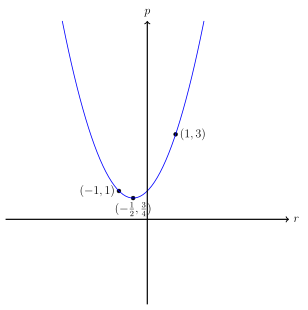
- Let \(r\) be a real number with \(\vert r \vert<1\) and let \[ S = \sum_{n=0}^\infty r^n\,. \] You may assume without proof that \(S = \displaystyle \frac{1}{1-r}\, \). Let \(p= 1 + r +r^2\). Sketch the graph of the function \(1+r+r^2\) and deduce that \(\frac{3}{4} \le p < 3\,\). Show that, if \(1 < p < 3\), then the value of \( p\) determines \(r\), and hence \(S\), uniquely. Show also that, if \(\frac{3}{4} < p < 1\), then there are two possible values of \(S\) and these values satisfy the equation \((3-p)S^2-3S+1=0\).
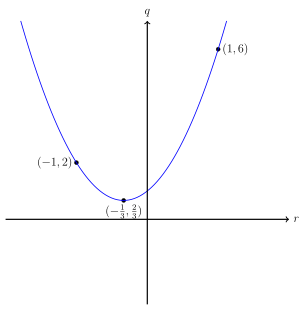
- Let \(r\) be a real number with \(\vert r \vert<1\) and let \[ T =\sum_{n=1}^\infty nr^{n-1}\,. \] You may assume without proof that \(T = \displaystyle \dfrac{1}{(1-r)^2}\,.\) Let \( q= 1+2r+3r^2\). Find the set of values of \( q\) that determine \(T\) uniquely. Find the set of values of \(q\) for which \(T\) has two possible values. Find also a quadratic equation, with coefficients depending on \( q\), that is satisfied by these two values.
Solution
- \(\,\)
Notice that \(1+r+r^2\) ranges from \(\frac34\) to \(3\) over \((-1,1)\) therefore \(\frac34 \leq p < 3\) attaining its minimum but not its maximum. If \(p > 1\) we know we must be on the right branch and hence we can determine \(r\) and \(S\) uniquely. If \(\frac34 < p < 1\) then we must have two possible values for \(r\), satisfying \(r_i^2 + r+1 = p\) and so our two possible values for \(S_i = \frac{1}{1-r_i}\) or \(r_i = 1-\frac{1}{S_i}\) and so \begin{align*} && p &= \left ( 1 - \frac{1}{S} \right)^2 + 1 - \frac1S + 1 \\ \Rightarrow && pS^2 &= (S-1)^2 + S^2-S + S^2 \\ \Rightarrow && 0 &= (3-p)S^2 -3S + 1 \end{align*}
- \(\,\)
So \(\frac23 \leq q < 6\) and \(r\) and hence \(T\) is uniquely determined if \(2 \leq q < 6\). if \(\frac23
Examiner's report
— 2017 STEP 1, Question 4The pure questions were again the most popular of the paper with questions 1 and 3 being attempted by almost all candidates. The least popular questions on the paper were questions 10, 11, 12 and 13 and a significant proportion of attempts at these were brief, attracting few or no marks. Candidates generally demonstrated a high level of competence when completing the standard processes and there were many good attempts made when questions required explanations to be given, particularly within the pure questions. A common feature of the stronger responses to questions was the inclusion of diagrams.
Rating Information
Difficulty Rating: 1500.0
Difficulty Comparisons: 0
Banger Rating: 1516.0
Banger Comparisons: 1
Show LaTeX source
Problem source
\begin{questionparts}
\item Let $r$ be a real number with $\vert r \vert<1$ and let
\[ S = \sum_{n=0}^\infty r^n\,. \]
 You may assume  without proof that $S = \displaystyle \frac{1}{1-r}\, $.
Let $p= 1 + r +r^2$. Sketch the graph of the function $1+r+r^2$ and deduce that $\frac{3}{4} \le  p < 3\,$. Show that, if $1 <  p < 3$, then the value of $ p$  determines $r$, and hence $S$, uniquely.
Show also that, if $\frac{3}{4} <  p < 1$, then there are two possible values of  $S$ and these values  satisfy the equation $(3-p)S^2-3S+1=0$.
\item Let $r$ be a real number with $\vert r \vert<1$ and let
\[ T =\sum_{n=1}^\infty nr^{n-1}\,. \]

You may assume without proof that $T = \displaystyle \dfrac{1}{(1-r)^2}\,.$
Let $ q= 1+2r+3r^2$. Find the set of values of $ q$ that  determine $T$ uniquely. Find the set of values of $q$ for which $T$ has two possible values. Find also a quadratic equation, with coefficients depending on $ q$, that is satisfied by these two values.
\end{questionparts}
Solution source
\begin{questionparts}

\item $\,$

\begin{center}
    \begin{tikzpicture}
    \def\functionf(#1){1+(#1)+(#1)^2};
    \def\xl{-5};
    \def\xu{5};
    \def\yl{-3};
    \def\yu{7};

    % Calculate scaling factors to make the plot square
    \pgfmathsetmacro{\xrange}{\xu-\xl}
    \pgfmathsetmacro{\yrange}{\yu-\yl}
    \pgfmathsetmacro{\xscale}{10/\xrange}
    \pgfmathsetmacro{\yscale}{10/\yrange}

    % Define the styles for the axes and grid
    \tikzset{
        axis/.style={very thick, ->},
        grid/.style={thin, gray!30},
        x=\xscale cm,
        y=\yscale cm
    }

    % Define the bounding region with clip
    \begin{scope}
        % You can modify these values to change your plotting region
        \clip (\xl,\yl) rectangle (\xu,\yu);


        \filldraw (-.5, 0.75) circle (2pt) node[below] {$(-\tfrac12, \tfrac34)$};
        % \filldraw (0, 1) circle (2pt) node[right] {$1$};
        \filldraw (1, 3) circle (2pt) node[right] {$(1,3)$};
        \filldraw (-1, 1) circle (2pt) node[left] {$(-1,1)$};

        \draw[thick, blue, smooth, domain=\xl:\xu, samples=100]
            plot (\x, {\functionf(\x)});

    \end{scope}

    % Set up axes
    \draw[axis] (\xl,0) -- (\xu,0) node[right] {$r$};
    \draw[axis] (0,\yl) -- (0,\yu) node[above] {$p$};

    \end{tikzpicture}
\end{center}

Notice that $1+r+r^2$ ranges from $\frac34$ to $3$ over $(-1,1)$ therefore $\frac34 \leq p < 3$ attaining its minimum but not its maximum.

If $p > 1$ we know we must be on the right branch and hence we can determine $r$ and $S$ uniquely.

If $\frac34 < p < 1$ then we must have two possible values for $r$, satisfying $r_i^2 + r+1 = p$ and so our two possible values for $S_i = \frac{1}{1-r_i}$ or $r_i = 1-\frac{1}{S_i}$ and so

\begin{align*}
&& p &= \left ( 1 - \frac{1}{S} \right)^2 + 1 - \frac1S + 1 \\
\Rightarrow && pS^2 &= (S-1)^2 + S^2-S + S^2 \\
\Rightarrow && 0 &= (3-p)S^2 -3S + 1
\end{align*}

\item $\,$


\begin{center}
    \begin{tikzpicture}
    \def\functionf(#1){1+2*(#1)+3*(#1)^2};
    \def\xl{-2};
    \def\xu{2};
    \def\yl{-3};
    \def\yu{7};

    % Calculate scaling factors to make the plot square
    \pgfmathsetmacro{\xrange}{\xu-\xl}
    \pgfmathsetmacro{\yrange}{\yu-\yl}
    \pgfmathsetmacro{\xscale}{10/\xrange}
    \pgfmathsetmacro{\yscale}{10/\yrange}

    % Define the styles for the axes and grid
    \tikzset{
        axis/.style={very thick, ->},
        grid/.style={thin, gray!30},
        x=\xscale cm,
        y=\yscale cm
    }

    % Define the bounding region with clip
    \begin{scope}
        % You can modify these values to change your plotting region
        \clip (\xl,\yl) rectangle (\xu,\yu);


        \filldraw ({-1/3}, {2/3}) circle (2pt) node[below] {$(-\tfrac13, \tfrac23)$};
        % \filldraw (0, 1) circle (2pt) node[right] {$1$};
        \filldraw (1, 6) circle (2pt) node[right] {$(1,6)$};
        \filldraw (-1, 2) circle (2pt) node[left] {$(-1,2)$};

        \draw[thick, blue, smooth, domain=\xl:\xu, samples=100]
            plot (\x, {\functionf(\x)});

    \end{scope}

    % Set up axes
    \draw[axis] (\xl,0) -- (\xu,0) node[right] {$r$};
    \draw[axis] (0,\yl) -- (0,\yu) node[above] {$q$};

    \end{tikzpicture}
\end{center}

So $\frac23 \leq q < 6$ and $r$ and hence $T$ is uniquely determined if $2 \leq q < 6$. if $\frac23 <q < 2$ then there are two possible values, and they must satisfy:

$r= 1-1/\sqrt{T}$ so
\begin{align*}
&& q &= 1 +2 \left( 1-\frac{1}{\sqrt{T}} \right)+3\left (  1-\frac{1}{\sqrt{T}} \right)^2 \\
&&&= 6 - \frac{2}{\sqrt{T}} - \frac{6}{\sqrt{T}} + \frac{3}{T} \\
&&&= 6 - \frac{8}{\sqrt{T}} + \frac3T \\
\Rightarrow && (q-6)T-3 &= -8\sqrt{T} \\
\Rightarrow && (q-6)^2T^2-6(q-6)T+9 &= 64T \\
\Rightarrow && 0 &= (q-6)^2T^2 -(6q+28)T+9
\end{align*}

\end{questionparts}
This question was attempted by just over half of the candidates. The sketch required in the first part was generally very well done and most candidates were able to identify the appropriate features of their graph to explain the number of possible values for . Many candidates were then also able to perform the appropriate substitutions to reach the required equation. When tackling part (ii) many candidates were able to see how to apply the same line of reasoning to the amended situation. In many cases this was completed successfully, but a number of candidates failed to include the value of that corresponds to the minimum point of the graph in the set of values that determine uniquely. When trying to find the equation at the end of this part of the question some candidates struggled with rearranging to achieve a quadratic equation.