Problems
Filters
15 problems found
2021 Paper 3 Q9
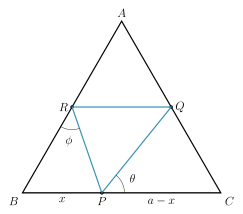
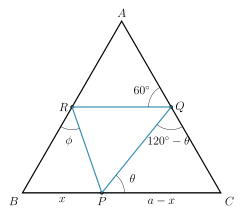
An equilateral triangle \(ABC\) has sides of length \(a\). The points \(P\), \(Q\) and \(R\) lie on the sides \(BC\), \(CA\) and \(AB\), respectively, such that the length \(BP\) is \(x\) and \(QR\) is parallel to \(CB\). Show that \[ (\sqrt{3}\cot\phi + 1)(\sqrt{3}\cot\theta + 1)x = 4(a - x), \] where \(\theta = \angle CPQ\) and \(\phi = \angle BRP\). A horizontal triangular frame with sides of length \(a\) and vertices \(A\), \(B\) and \(C\) is fixed on a smooth horizontal table. A small ball is placed at a point \(P\) inside the frame, in contact with side \(BC\) at a distance \(x\) from \(B\). It is struck so that it moves round the triangle \(PQR\) described above, bouncing off the frame at \(Q\) and then \(R\) before returning to point \(P\). The frame is smooth and the coefficient of restitution between the ball and the frame is \(e\). Show that \[ x = \frac{ae}{1 + e}. \] Show further that if the ball continues to move round \(PQR\) after returning to \(P\), then \(e = 1\).
Solution:
2020 Paper 3 Q3
Given distinct points \(A\) and \(B\) in the complex plane, the point \(G_{AB}\) is defined to be the centroid of the triangle \(ABK\), where the point \(K\) is the image of \(B\) under rotation about \(A\) through a clockwise angle of \(\frac{1}{3}\pi\). Note: if the points \(P\), \(Q\) and \(R\) are represented in the complex plane by \(p\), \(q\) and \(r\), the centroid of triangle \(PQR\) is defined to be the point represented by \(\frac{1}{3}(p+q+r)\).
- If \(A\), \(B\) and \(G_{AB}\) are represented in the complex plane by \(a\), \(b\) and \(g_{ab}\), show that \[ g_{ab} = \frac{1}{\sqrt{3}}(\omega a + \omega^* b), \] where \(\omega = \mathrm{e}^{\frac{\mathrm{i}\pi}{6}}\).
- The quadrilateral \(Q_1\) has vertices \(A\), \(B\), \(C\) and \(D\), in that order, and the quadrilateral \(Q_2\) has vertices \(G_{AB}\), \(G_{BC}\), \(G_{CD}\) and \(G_{DA}\), in that order. Using the result in part (i), show that \(Q_1\) is a parallelogram if and only if \(Q_2\) is a parallelogram.
- The triangle \(T_1\) has vertices \(A\), \(B\) and \(C\) and the triangle \(T_2\) has vertices \(G_{AB}\), \(G_{BC}\) and \(G_{CA}\). Using the result in part (i), show that \(T_2\) is always an equilateral triangle.
Solution:
- Note that the vector \(\overrightarrow{AB}\) is \(b-a\), and if we rotate this by \(\frac13\pi\) we get \(e^{-i\pi/3}(b-a)\) after rotating it. Therefore the point \(K\) is represented by \(a + e^{-i\pi/3}(b-a)\) and so \(G_{AB}\) is \begin{align*} && g_{ab} &= \tfrac13(a + b + a + e^{-i\pi/3}(b-a)) \\ &&&= \tfrac13((1+ e^{-i\pi/3})b+(2-e^{-i\pi/3})a)\\ &&&= \tfrac13((1+\tfrac12 - \tfrac{\sqrt3}{2}i)b + ((2-\tfrac12+\tfrac{\sqrt3}{2}i)a) \\ &&&= \tfrac13((\tfrac32 - \tfrac{\sqrt3}{2}i)b + ((\tfrac32+\tfrac{\sqrt3}{2}i)a) \\ &&&= \tfrac1{\sqrt3}((\tfrac{\sqrt3}2 - \tfrac{1}{2}i)b + ((\tfrac{\sqrt3}2+\tfrac{1}{2}i)a) \\ &&&= \frac{1}{\sqrt3}(\omega^* b + \omega a) \end{align*}
- First note that \(Q_1\) is a parallelogram iff \(c - a = (b-a) + (d-a)\) ie \(a + c = b+d\) (indeed this is true for all quadrilaterals), so. \begin{align*} && Q_1 &\text{ is a parallelogram} \\ \Longleftrightarrow && a + b &= c + d \\ \Longleftrightarrow && \frac{1}{\sqrt{3}}(\omega - \omega^*)(a + c) &= \frac{1}{\sqrt{3}}(\omega -\omega^*)(b + d) \\ \Longleftrightarrow && \frac{1}{\sqrt{3}}(\omega a + \omega^*b)+\frac{1}{\sqrt{3}}(\omega c + \omega^*d) &=\frac{1}{\sqrt{3}}(\omega b + \omega^*c)+\frac{1}{\sqrt{3}}(\omega d + \omega^*a) \\ \Longleftrightarrow && g_{ab}+g_{cd} &=g_{bc}+g_{da} \\ \Longleftrightarrow && Q_2 &\text{ is a parallelogram} \\ \end{align*}
- We consider \(\frac{g_{ab}-g_{bc}}{g_{ca}-g_{bc}}\) so \begin{align*} && \frac{g_{ab}-g_{bc}}{g_{ca}-g_{bc}} &= \frac{(\omega a + \omega^*b)-(\omega b + \omega^* c)}{(\omega c + \omega^*a)-(\omega b + \omega^* c)} \\ &&&= \frac{\omega a- \omega^* c -(\omega- \omega^*)b }{\omega^*a-\omega b -(\omega^* -\omega )c} \\ &&&= \frac{\omega^2 a- c -(\omega^2- 1)b }{a-\omega^2 b -(1 -\omega^2 )c} \\ &&&=\omega^2\frac{ a- \omega^4 c -(1- \omega^4)b }{a-\omega^2 b -(1 -\omega^2 )c} \\ &&&=\omega^2\frac{ a- (1-\omega^2) c -\omega^2b }{a-\omega^2 b -(1 -\omega^2 )c} \\ &&&= \omega^2 \end{align*} Therefore the triangle is equilateral.
2019 Paper 2 Q7
- The points \(A\), \(B\) and \(C\) have position vectors \(\mathbf{a}\), \(\mathbf{b}\) and \(\mathbf{c}\), respectively. Each of these vectors is a unit vector (so \(\mathbf{a} \cdot \mathbf{a} = 1\), for example) and $$\mathbf{a} + \mathbf{b} + \mathbf{c} = \mathbf{0}.$$ Show that \(\mathbf{a} \cdot \mathbf{b} = -\frac{1}{2}\). What can be said about the triangle ABC? You should justify your answer.
- The four distinct points \(A_i\) (\(i = 1, 2, 3, 4\)) have unit position vectors \(\mathbf{a}_i\) and
$$\sum_{i=1}^{4} \mathbf{a}_i = \mathbf{0}.$$
Show that \(\mathbf{a}_1 \cdot \mathbf{a}_2 = \mathbf{a}_3 \cdot \mathbf{a}_4\).
- Given that the four points lie in a plane, determine the shape of the quadrilateral with vertices \(A_1\), \(A_2\), \(A_3\) and \(A_4\).
- Given instead that the four points are the vertices of a regular tetrahedron, find the length of the sides of this tetrahedron.
Solution:
- Given \(\mathbf{a} + \mathbf{b} + \mathbf{c} = \mathbf{0}\), we can form the following results: \begin{align*} && \begin{cases} \mathbf{a} \cdot (\mathbf{a} + \mathbf{b} + \mathbf{c}) &= 0 \\ \mathbf{b} \cdot (\mathbf{a} + \mathbf{b} + \mathbf{c}) &= 0 \\ \mathbf{c} \cdot (\mathbf{a} + \mathbf{b} + \mathbf{c}) &= 0 \\ \end{cases} \\ \Rightarrow && \begin{cases} \mathbf{a} \cdot \mathbf{a} + \mathbf{a} \cdot\mathbf{b} + \mathbf{a} \cdot\mathbf{c} &= 0 \\ \mathbf{b} \cdot \mathbf{a} + \mathbf{b} \cdot \mathbf{b} + \mathbf{b} \cdot \mathbf{c} &= 0 \\ \mathbf{c} \cdot \mathbf{a} + \mathbf{c} \cdot \mathbf{b} + \mathbf{c} \cdot \mathbf{c} &= 0 \\ \end{cases} \\ \Rightarrow && \begin{cases} \mathbf{a} \cdot\mathbf{b} + \mathbf{a} \cdot\mathbf{c} &= -1 \\ \mathbf{a} \cdot \mathbf{b} + \mathbf{b} \cdot \mathbf{c} &= -1 \\ \mathbf{a} \cdot \mathbf{c} + \mathbf{b} \cdot \mathbf{c} &= -1 \\ \end{cases} \\ \Rightarrow && \begin{cases} \mathbf{a} \cdot\mathbf{b} + \mathbf{a} \cdot\mathbf{c} &= -1 \\ \mathbf{a} \cdot \mathbf{b} + \mathbf{b} \cdot \mathbf{c} &= -1 \\ \mathbf{a} \cdot \mathbf{c} + \mathbf{b} \cdot \mathbf{c} &= -1 \\ \mathbf{a} \cdot \mathbf{b} +\mathbf{a} \cdot \mathbf{c} + \mathbf{b} \cdot \mathbf{c} &= -\frac12 \\ \end{cases} \\ \Rightarrow && \begin{cases} \mathbf{a} \cdot \mathbf{b} = -\frac12 \\ \mathbf{a} \cdot \mathbf{c} = -\frac12 \\ \mathbf{b} \cdot \mathbf{c} = -\frac12 \\ \end{cases} \end{align*} The triangle must be equilateral since the angles between each vertex are the same.
- We have \(\displaystyle \sum_{i=1}^{4} \mathbf{a}_i = \mathbf{0}\) so \(\displaystyle \mathbf{a}_i \cdot \sum_{i=1}^{4} \mathbf{a}_i = 0\) or for each \(i\), \(\displaystyle \sum_{j \neq i} \mathbf{a}_i \cdot \mathbf{a}_j = -1\).
\begin{align*}
&& \begin{cases}
\mathbf{a}_1 \cdot \mathbf{a}_2 + \mathbf{a}_1 \cdot \mathbf{a}_3 + \mathbf{a}_1 \cdot \mathbf{a}_4 = -1 \\
\mathbf{a}_1 \cdot \mathbf{a}_2 + \mathbf{a}_2 \cdot \mathbf{a}_3 + \mathbf{a}_2 \cdot \mathbf{a}_4 = -1 \\
\mathbf{a}_1 \cdot \mathbf{a}_3 + \mathbf{a}_2 \cdot \mathbf{a}_3 + \mathbf{a}_3 \cdot \mathbf{a}_4 = -1 \\
\mathbf{a}_2 \cdot \mathbf{a}_4 + \mathbf{a}_2 \cdot \mathbf{a}_4 + \mathbf{a}_3 \cdot \mathbf{a}_4 = -1 \\
\end{cases} \\
&& \text{adding the first two, subtracting the last two} \\
\Rightarrow && \begin{cases}
\mathbf{a}_1 \cdot \mathbf{a}_2 +\cancel{\mathbf{a}_1 \cdot \mathbf{a}_3} + \cancel{\mathbf{a}_1 \cdot \mathbf{a}_4} = -1 \\
\mathbf{a}_1 \cdot \mathbf{a}_2 + \cancel{\mathbf{a}_2 \cdot \mathbf{a}_3} + \cancel{\mathbf{a}_2 \cdot \mathbf{a}_4} = -1 \\
\cancel{\mathbf{a}_1 \cdot \mathbf{a}_3} + \cancel{\mathbf{a}_2 \cdot \mathbf{a}_3} + \mathbf{a}_3 \cdot \mathbf{a}_4 = -1 \\
\cancel{\mathbf{a}_1 \cdot \mathbf{a}_4} + \cancel{\mathbf{a}_2 \cdot \mathbf{a}_4} + \mathbf{a}_3 \cdot \mathbf{a}_4 = -1 \\
\end{cases} \\
\Rightarrow && 2 (\mathbf{a}_1 \cdot \mathbf{a}_2) - 2(\mathbf{a}_3 \cdot \mathbf{a}_4) = 0
\end{align*}
Rather than adding the first two and last two, we could have done any pair, resulting in the relations:
\begin{align*}
\mathbf{a}_1 \cdot \mathbf{a}_2 &= \mathbf{a}_3 \cdot \mathbf{a}_4 \\
\mathbf{a}_1 \cdot \mathbf{a}_3 &= \mathbf{a}_2 \cdot \mathbf{a}_4 \\
\mathbf{a}_1 \cdot \mathbf{a}_4 &= \mathbf{a}_2 \cdot \mathbf{a}_3
\end{align*}
- The shape must be a parallelogram (from the angle requirement, but also cyclic quadrilateral (since all vectors are unit length), therefore it must be a rectangle
- Given it's a regular tetrahedron, \(\mathbf{a}_i \cdot \mathbf{a}_j\) must be the same for all \(i \neq j\), ie \(-\frac13\). We are interested in \(|\mathbf{a}_i - \mathbf{a}_j|\) so consider, \begin{align*} |\mathbf{a}_i - \mathbf{a}_j|^2 &= (\mathbf{a}_i - \mathbf{a}_j) \cdot (\mathbf{a}_i - \mathbf{a}_j) \\ &= \mathbf{a}_i \cdot \mathbf{a}_i - 2 \mathbf{a}_i \cdot \mathbf{a}_j + \mathbf{a}_j \cdot \mathbf{a}_j \\ &= 1 - \frac23 + 1 \\ &= \frac43 \end{align*} Therefore the unit side lengths are \(\frac{2}{\sqrt{3}}\)
2017 Paper 1 Q7
The triangle \(ABC\) has side lengths \(\left| BC \right| = a\), \(\left| CA \right| = b\) and \(\left| AB \right| = c\). Equilateral triangles \(BXC\), \(CYA\) and \(AZB\) are erected on the sides of the triangle \(ABC\), with \(X\) on the other side of \(BC\) from \(A\), and similarly for \(Y\) and \(Z\). Points \(L\), \(M\) and \(N\) are the centres of rotational symmetry of triangles \(BXC\), \(CY\!A\) and \(AZB\) respectively.
- Show that \(| CM| = \dfrac {\ b} {\sqrt3} \,\) and write down the corresponding expression for \(| CL|\).
- Use the cosine rule to show that \[ 6 \left| LM \right|^2 = a^2+b^2+c^2 + 4\sqrt3 \, \Delta \,, \] where \(\Delta\) is the area of triangle \(ABC\). Deduce that \(LMN\) is an equilateral triangle. Show further that the areas of triangles \(LMN\) and \(ABC\) are equal if and only if \[ a^2+b^2 +c^2 = 4\sqrt3 \, \Delta \,. \]
- Show that the conditions \[ (a -b)^2 = -2ab \big( 1 -\cos(C-60^\circ)\big) \,\] and \[ a^2+b^2 +c^2 = 4\sqrt3 \, \Delta \] are equivalent. Deduce that the areas of triangles \(LMN\) and \(ABC\) are equal if and only if \(ABC\) is equilateral.
Solution:
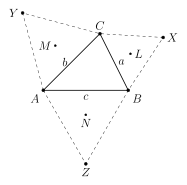
- Consider the equilateral triangle \(CYA\), notice that \(YM\) is a vertical line of symmetry, and \(\angle ACM = 30^\circ\) therefore \(\frac{AC/2}{CM} = \cos 30^\circ \Rightarrow |CM| = \frac{b}{2} \cdot \frac{2}{\sqrt{3}} = \frac{b}{\sqrt{3}}\). Similarly \(|CL| = \frac{a}{\sqrt{3}}\)
- \(\,\) \begin{align*} && |LM|^2 &= |CM|^2 + |CL|^2 - 2 \cdot |CM| \cdot |CL| \cdot \cos \angle MCL \\ &&&= \frac{b^2}{3} + \frac{a^2}{3} - 2 \frac{ab}{3} \cos \left (\angle CMA + \angle CAB + \angle BCL \right) \\ &&&= \frac13 \left (b^2 + a^2 - 2ab \cos \left ( \frac{\pi}{3} + \angle CAB \right) \right) \\ &&&= \frac13 \left (b^2 + a^2 - ab \cos \left ( \angle CAB \right) + \sqrt{3}ab \sin \angle CAB \right) \\ &&&= \frac13 \left (b^2 + a^2 - ab \cos \angle CAB + 2\sqrt{3} \Delta\right) \\ &&&= \frac13 \left (b^2 + a^2 - ab \left (\frac{a^2+b^2-c^2}{2ab} \right) + 2\sqrt{3} \Delta\right) \\ &&&= \frac13 \left ( \frac12(a^2+b^2+c^2) + 2\sqrt{3}\Delta \right) \\ \Rightarrow && 6|LM|^2 &= a^2 + b^2 + c^2 + 4\sqrt{3} \Delta \end{align*} However, nothing in our reasoning here was special about \(LM\), therefore \(LN\) and \(MN\) also equal this value, and we find that the triangle is equilateral. The area of equilateral triangle [LMN] is \(\frac{\sqrt{3}}4 |LM|^2\), ie \begin{align*} &&& \text{areas are equal} \\ \Leftrightarrow && \Delta &= \frac{\sqrt{3}}4 |LM|^2 \\ &&&= \frac{\sqrt{3}}4 \frac{a^2+b^2+c^2+4\sqrt{3}\Delta}{6} \\ &&&= \frac{\sqrt{3}}{24} (a^2+b^2+c^2) + \frac12 \Delta \\ \Leftrightarrow && \Delta &= \frac{\sqrt{3}}{12}(a^2+b^2+c^2)\\ \Leftrightarrow && 4\sqrt{3}\Delta &=a^2+b^2+c^2\\ \end{align*}
- \(\,\) \begin{align*} && (a-b)^2 &= -2ab(1 - \cos(C - 60^{\circ})) \\ \Leftrightarrow && a^2+b^2 - 2ab &=-2ab + 2ab \cos(C - 60^{\circ}) \\ \Leftrightarrow && a^2+b^2 &= ab \cos C+\sqrt{3}ab\sin C \\ \Leftrightarrow && a^2+b^2 &= ab \frac{a^2+b^2-c^2}{2ab} + 2\sqrt{3} \Delta \\ \Leftrightarrow && a^2+b^2+c^2 &= 4\sqrt{3}\Delta \end{align*} Since the LHS is non-positive, and the RHS is positive, the only way they can be equal is if they are both \(0\), ie \(a=b\) and \(C = 60^{\circ}\) ie \(ABC\) is equilateral.
2016 Paper 3 Q9
Three pegs \(P\), \(Q\) and \(R\) are fixed on a smooth horizontal table in such a way that they form the vertices of an equilateral triangle of side \(2a\). A particle \(X\) of mass \(m\) lies on the table. It is attached to the pegs by three springs, \(PX\), \(QX\) and \(RX\), each of modulus of elasticity \(\lambda\) and natural length \(l\), where \(l < \frac{ \ 2 }{\sqrt3}\, a\). Initially the particle is in equilibrium. Show that the extension in each spring is \(\frac{\ 2}{\sqrt3}\,a -l\,\). The particle is then pulled a small distance directly towards \(P\) and released. Show that the tension \(T\) in the spring \(RX\) is given by \[ T= \frac {\lambda} l \left( \sqrt{\frac {4a^2}3 + \frac{2ax}{\sqrt3} +x^2\; }\; -l\right) , \] where \(x\) is the displacement of \(X\) from its equilibrium position. Show further that the particle performs approximate simple harmonic motion with period \[ 2\pi \sqrt{ \frac{4mla}{3 (4a-\sqrt3 \, l)\lambda } \; }\,. \]
2015 Paper 2 Q9
An equilateral triangle \(ABC\) is made of three light rods each of length \(a\). It is free to rotate in a vertical plane about a horizontal axis through \(A\). Particles of mass \(3m\) and \(5m\) are attached to \(B\) and \(C\) respectively. Initially, the system hangs in equilibrium with \(BC\) below \(A\).
- Show that, initially, the angle \(\theta\) that \(BC\) makes with the horizontal is given by \(\sin\theta = \frac17\).
- The triangle receives an impulse that imparts a speed \(v\) to the particle \(B\). Find the minimum speed \(v_0\) such that the system will perform complete rotations if \(v>v_0\).
Solution:
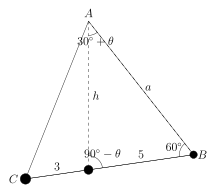
- The sine rule tells us: \begin{align*} && \frac{\frac58 a}{\sin(30^\circ + \theta)} &= \frac{a}{\sin(90^{\circ}-\theta)} \\ \Rightarrow &&\frac58 \cos \theta &= \frac12 \cos \theta+ \frac{\sqrt{3}}2 \sin \theta \\ \Rightarrow && \frac{1}{4\sqrt{3}} &= \tan \theta \\ \Rightarrow && \sin \theta &= \sqrt{\frac{1}{48+1}} = \frac17 \end{align*}
- \(\,\) \begin{align*} && \text{initial energy} &= \frac12(5m)v^2 + \frac12 (3m)v^2 - 3m \cdot g \cdot a \cos(30^{\circ}+\theta) -5m \cdot g \cdot a\cos(30^\circ - \theta) \\ &&&= 4m v^2 - amg(4\sqrt{3} \cos \theta + \sin \theta) \\ &&&= 4mv^2 - 7amg \\ && \text{energy at top} &= \frac12 m v_{top}^2 + 7amg \end{align*} We need this equation to be positive for all values of \(v_{top} \geq 0\), so \(4mv^2 \geq 14amg \Rightarrow v_0 = \sqrt{\frac{7ag}2}\)
2012 Paper 3 Q12
- A point \(P\) lies in an equilateral triangle \(ABC\) of height 1. The perpendicular distances from \(P\) to the sides \(AB\), \(BC\) and \(CA\) are \(x_1\), \(x_2\) and \(x_3\), respectively. By considering the areas of triangles with one vertex at \(P\), show that \(x_1+x_2+x_3=1\). Suppose now that \(P\) is placed at random in the equilateral triangle (so that the probability of it lying in any given region of the triangle is proportional to the area of that region). The perpendicular distances from \(P\) to the sides \(AB\), \(BC\) and \(CA\) are random variables \(X_1\), \(X_2\) and \(X_3\), respectively. In the case \(X_1= \min(X_1,X_2,X_3)\), give a sketch showing the region of the triangle in which \(P\) lies. Let \(X= \min(X_1,X_2,X_3)\). Show that the probability density function for \(X\) is given by \[ \f(x) = \begin{cases} 6(1-3x) & 0 \le x \le \frac13\,, \\ 0 & \text{otherwise}\,. \end{cases} \] Find the expected value of \(X\).
- A point is chosen at random in a regular tetrahedron of height 1. Find the expected value of the distance from the point to the closest face. \newline [The volume of a tetrahedron is \(\frac13 \times \text{area of base}\times\text{height}\) and its centroid is a distance \(\frac14\times \text{height}\) from the base.]
2008 Paper 1 Q7
The point \(P\) has coordinates \((x,y)\) with respect to the origin \(O\). By writing \(x=r\cos\theta\) and \(y=r\sin\theta\), or otherwise, show that, if the line \(OP\) is rotated by \(60^\circ\) clockwise about \(O\), the new \(y\)-coordinate of \(P\) is \(\frac12(y-\sqrt3\,x)\). What is the new \(y\)-coordinate in the case of an anti-clockwise rotation by \(60^\circ\,\)? An equilateral triangle \(OBC\) has vertices at \(O\), \((1,0)\) and \((\frac12,\frac12 \sqrt3)\), respectively. The point \(P\) has coordinates \((x,y)\). The perpendicular distance from \(P\) to the line through \(C\) and \(O\) is \(h_1\); the perpendicular distance from \(P\) to the line through \(O\) and \(B\) is \(h_2\); and the perpendicular distance from \(P\) to the line through \(B\) and \(C\) is \(h_3\). Show that \(h_1=\frac12 \big\vert y-\sqrt3\,x\big\vert\) and find expressions for \(h_2\) and \(h_3\). Show that \(h_1+h_2+h_3=\frac12 \sqrt3\) if and only if \(P\) lies on or in the triangle \(OBC\).
2008 Paper 3 Q7
The points \(A\), \(B\) and \(C\) in the Argand diagram are the vertices of an equilateral triangle described anticlockwise. Show that the complex numbers \(a\), \(b\) and \(c\) representing \(A\), \(B\) and \(C\) satisfy \[2c= (a+b) +\mathrm{i}\sqrt3(b-a).\] Find a similar relation in the case that \(A\), \(B\) and \(C\) are the vertices of an equilateral triangle described clockwise.
- The quadrilateral \(DEFG\) lies in the Argand diagram. Show that points \(P\), \(Q\), \(R\) and \(S\) can be chosen so that \(PDE\), \(QEF\), \(RFG\) and \(SGD\) are equilateral triangles and \(PQRS\) is a parallelogram.
- The triangle \(LMN\) lies in the Argand diagram. Show that the centroids \(U\), \(V\) and \(W\) of the equilateral triangles drawn externally on the sides of \(LMN\) are the vertices of an equilateral triangle. \noindent [{\bf Note:} The {\em centroid} of a triangle with vertices represented by the complex numbers \(x\),~\(y\) and~\(z\) is the point represented by \(\frac13(x+y+z)\,\).]
2006 Paper 3 Q5
Show that the distinct complex numbers \(\alpha\), \(\beta\) and \(\gamma\) represent the vertices of an equilateral triangle (in clockwise or anti-clockwise order) if and only if \[ \alpha^2 + \beta^2 +\gamma^2 -\beta\gamma - \gamma \alpha -\alpha\beta =0\,. \] Show that the roots of the equation \begin{equation*} z^3 +az^2 +bz +c=0 \tag{\(*\)} \end{equation*} represent the vertices of an equilateral triangle if and only if \(a^2=3b\). Under the transformation \(z=pw+q\), where \(p\) and \(q\) are given complex numbers with \(p\ne0\), the equation (\(*\)) becomes \[ w^3 +Aw^2 +Bw +C=0\,. \tag{\(**\)} \] Show that if the roots of equation \((*)\) represent the vertices of an equilateral triangle, then the roots of equation \((**)\) also represent the vertices of an equilateral triangle.
Solution: The complex numbers represent an equilateral triangle iff \(\gamma\) is a \(\pm 60^\circ\) rotation of \(\beta\) around \(\alpha\), ie \begin{align*} && \gamma - \alpha &= \omega(\beta - \alpha) \\ \Leftrightarrow && \omega &= \frac{\gamma - \alpha}{\beta - \alpha} \\ \Leftrightarrow && -1 &= \left (\frac{\gamma - \alpha}{\beta - \alpha} \right)^3 \\ \Leftrightarrow && -(\beta - \alpha)^3 &=(\gamma - \alpha)^3 \\ \Leftrightarrow && 0 &= (\gamma-\alpha)^3+(\beta-\alpha)^3 \\ &&&= \gamma^3-3\gamma^2\alpha +3\gamma\alpha^2-\alpha^3 +\beta^3-3\beta^2\alpha+3\beta\alpha^2-\alpha^3 \\ &&&= (\beta + \gamma - 2\alpha)(\alpha^2+\beta^2+\gamma^2 - \alpha\beta - \beta\gamma - \gamma \delta) \\ \Leftrightarrow && 0 &= \alpha^2+\beta^2+\gamma^2 - \alpha\beta - \beta\gamma - \gamma \delta \end{align*} The roots of the equation \(z^3+az^2+bz+c = 0\) represents the vertices of an equilateral triangle iff \(a^2-3b = (\alpha+\beta+\gamma^2) - 3(\alpha\beta+\beta\gamma+\gamma\alpha) = \alpha^2+\beta^2+\gamma^2 - \alpha\beta - \beta\gamma - \gamma \delta = 0\) as erquired. Suppose \(a^2 = 3b\), then consider \(z = pw +q\), we must have \begin{align*} && 0 &= (pw+q)^3+a(pw+q)^2 + b(pw+q)+c \\ &&&= p^3w^3 +(3p^2q+ap^2)w^2+(3pq^2+2apq+bp)w+(q^3+aq^2+bq+c) \\ &&&= p^3w^3+p^2(3q+a)w^2+p(3q^2+2aq+b)w+(q^3+aq^2+bq+c) \\ \end{align*} We need to check if \(\left(\frac{3q+a}{p} \right)^2 = 3 \left (\frac{3q^2+2qa+b}{p^2} \right)\). Clearly the denominators match, so consider the numerators \begin{align*} && (3q+a)^2 &= 9q^2+6aq+a^2 \\ &&&= 9q^2+6aq+3b \\ &&&= 3(3q^2+2qa+b) \end{align*} as required
2002 Paper 1 Q6
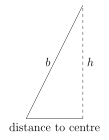
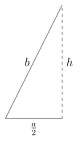
A pyramid stands on horizontal ground. Its base is an equilateral triangle with sides of length~\(a\), the other three sides of the pyramid are of length \(b\) and its volume is \(V\). Given that the formula for the volume of any pyramid is $ \textstyle \frac13 \times \mbox{area of base} \times \mbox {height} \,, $ show that \[ V= \frac1{12} {a^2(3b^2-a^2)}^{\frac12}\;. \] The pyramid is then placed so that a non-equilateral face lies on the ground. Show that the new height, \(h\), of the pyramid is given by \[ h^2 = \frac{a^2(3b^2-a^2)}{4b^2-a^2}\;. \] Find, in terms of \(a\) and \(b\,\), the angle between the equilateral triangle and the horizontal.
Solution: First let's consider the area of the base. It is an equilateral triangle with side length \(a\), so \(\frac12 a^2 \sin 60^\circ = \frac{\sqrt{3}}4a^2\).
2000 Paper 3 Q3
Given that \(\alpha = \e^{\mathrm{i} \pi/3}\) , prove that \(1 + \alpha^2 = \alpha\). A triangle in the Argand plane has vertices \(A\), \(B\), and \(C\) represented by the complex numbers \(p\), \(q\alpha^2\) and \(- r\alpha\) respectively, where \(p\), \(q\) and \(r\) are positive real numbers. Sketch the triangle~\(ABC\). Three equilateral triangles \(ABL\), \(BCM\) and \(CAN\) (each lettered clockwise) are erected on sides \(AB\), \(BC\) and \(CA\) respectively. Show that the complex number representing \(N\) is \mbox{\(( 1 - \alpha) p- \alpha^2 r\)} and find similar expressions for the complex numbers representing \(L\) and \(M\). Show that lines \(LC\), \(MA\) and \(NB\) all meet at the origin, and that these three line segments have the common length \(p+q+r\).
1999 Paper 1 Q11
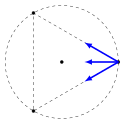
The force of attraction between two stars of masses \(m_{1}\) and \(m_{2}\) a distance \(r\) apart is \(\gamma m_{1}m_{2}/r^{2}\). The Starmakers of Kryton place three stars of equal mass \(m\) at the corners of an equilateral triangle of side \(a\). Show that it is possible for each star to revolve round the centre of mass of the system with angular velocity \((3\gamma m/a^{3})^{1/2}\). Find a corresponding result if the Starmakers place a fourth star, of mass \(\lambda m\), at the centre of mass of the system.
Solution: The net force on the planets will always be towards the centre of mass (by symmetry or similar arguments). Therefore it suffices to check whether we can find a speed where the planets follow uniform circular motion, ie \(F = mr \omega^2\). (But clearly this is possible, we just need to find the speed)

1991 Paper 3 Q2
The distinct points \(P_{1},P_{2},P_{3},Q_{1},Q_{2}\) and \(Q_{3}\) in the Argand diagram are represented by the complex numbers \(z_{1},z_{2},z_{3},w_{1},w_{2}\) and \(w_{3}\) respectively. Show that the triangles \(P_{1}P_{2}P_{3}\) and \(Q_{1}Q_{2}Q_{3}\) are similar, with \(P_{i}\) corresponding to \(Q_{i}\) (\(i=1,2,3\)) and the rotation from \(1\) to \(2\) to \(3\) being in the same sense for both triangles, if and only if \[ \frac{z_{1}-z_{2}}{z_{2}-z_{3}}=\frac{w_{1}-w_{2}}{w_{1}-w_{3}}. \] Verify that this condition may be written \[ \det\begin{pmatrix}z_{1} & z_{2} & z_{3}\\ w_{1} & w_{2} & w_{3}\\ 1 & 1 & 1 \end{pmatrix}=0. \]
- Show that if \(w_{i}=z_{i}^{2}\) (\(i=1,2,3\)) then triangle \(P_{1}P_{2}P_{3}\) is not similar to triangle \(Q_{1}Q_{2}Q_{3}.\)
- Show that if \(w_{i}=z_{i}^{3}\) (\(i=1,2,3\)) then triangle \(P_{1}P_{2}P_{3}\) is similar to triangle \(Q_{1}Q_{2}Q_{3}\) if and only if the centroid of triangle \(P_{1}P_{2}P_{3}\) is the origin. {[}The centroid of triangle \(P_{1}P_{2}P_{3}\) is represented by the complex number \(\frac{1}{3}(z_{1}+z_{2}+z_{3})\).{]}
- Show that the triangle \(P_{1}P_{2}P_{3}\) is equilateral if and only if \[ z_{2}z_{3}+z_{3}z_{1}+z_{1}z_{2}=z_{1}^{2}+z_{2}^{2}+z_{3}^{2}. \]
1987 Paper 2 Q4
Explain the geometrical relationship between the points in the Argand diagram represented by the complex numbers \(z\) and \(z\mathrm{e}^{\mathrm{i}\theta}.\) Write down necessary and sufficient conditions that the distinct complex numbers \(\alpha,\beta\) and \(\gamma\) represent the vertices of an equilateral triangle taken in anticlockwise order. Show that \(\alpha,\beta\) and \(\gamma\) represent the vertices of an equilateral triangle (taken in any order) if and only if \[ \alpha^{2}+\beta^{2}+\gamma^{2}-\beta\gamma-\gamma\alpha-\alpha\beta=0. \] Find necessary and sufficient conditions on the complex coefficients \(a,b\) and \(c\) for the roots of the equation \[ z^{3}+az^{2}+bz+c=0 \] to lie at the vertices of an equilateral triangle in the Argand digram.
Solution: The point \(ze^{i\theta}\) is obtained by rotating the point \(z\) about \(0\) by an angle \(\theta\) anticlockwise. The complex numbers \(\alpha, \beta\) and \(\gamma\) will form an equilateral triangle iff the angles between each side are \(\frac{\pi}{3}\), ie \begin{align*} \begin{cases}{\gamma - \beta} &= e^{i \frac{\pi}{3}}({\beta - \alpha}) \\ {\alpha- \gamma} &= e^{i \frac{\pi}{3}}({\gamma- \beta}) \\ {\beta- \alpha} &= e^{i \frac{\pi}{3}}({\alpha- \gamma})\end{cases} \end{align*} We don't need all these equations, since the first two are equivalent to the third. Combining the first two equations, we have \begin{align*} && \frac{\gamma - \beta}{\beta-\alpha} &= \frac{\alpha-\gamma}{\gamma - \beta} \\ \Leftrightarrow && (\gamma - \beta)^2 &= (\alpha-\gamma)(\beta-\alpha) \\ \Leftrightarrow && \gamma^2 +\beta^2 - 2\gamma \beta &= \alpha\beta-\alpha^2-\gamma\beta+\gamma\alpha \\ \Leftrightarrow && \alpha^{2}+\beta^{2}+\gamma^{2}-\beta\gamma-\gamma\alpha-\alpha\beta&=0 \end{align*} as required. If the roots of \(z^{3}+az^{2}+bz+c=0\) are \(\alpha, \beta, \gamma\) then \(\alpha+\beta+\gamma = -a\) and \(\beta\gamma+\gamma\alpha+\alpha\beta = b\). We also have that \(a^2 - 2b = \alpha^2+\beta^2+\gamma^2\). Therefore there roots will lie at the vertices of an equilateral triangle iff \(a^2-3b = 0\)