2017 Paper 1 Q7
Year: 2017
Paper: 1
Question Number: 7
Course: LFM Pure
Section: Introduction to trig
Problem
- Show that \(| CM| = \dfrac {\ b} {\sqrt3} \,\) and write down the corresponding expression for \(| CL|\).
- Use the cosine rule to show that \[ 6 \left| LM \right|^2 = a^2+b^2+c^2 + 4\sqrt3 \, \Delta \,, \] where \(\Delta\) is the area of triangle \(ABC\). Deduce that \(LMN\) is an equilateral triangle. Show further that the areas of triangles \(LMN\) and \(ABC\) are equal if and only if \[ a^2+b^2 +c^2 = 4\sqrt3 \, \Delta \,. \]
- Show that the conditions \[ (a -b)^2 = -2ab \big( 1 -\cos(C-60^\circ)\big) \,\] and \[ a^2+b^2 +c^2 = 4\sqrt3 \, \Delta \] are equivalent. Deduce that the areas of triangles \(LMN\) and \(ABC\) are equal if and only if \(ABC\) is equilateral.
Solution
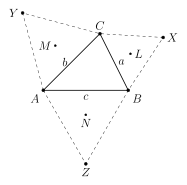
- Consider the equilateral triangle \(CYA\), notice that \(YM\) is a vertical line of symmetry, and \(\angle ACM = 30^\circ\) therefore \(\frac{AC/2}{CM} = \cos 30^\circ \Rightarrow |CM| = \frac{b}{2} \cdot \frac{2}{\sqrt{3}} = \frac{b}{\sqrt{3}}\). Similarly \(|CL| = \frac{a}{\sqrt{3}}\)
- \(\,\) \begin{align*} && |LM|^2 &= |CM|^2 + |CL|^2 - 2 \cdot |CM| \cdot |CL| \cdot \cos \angle MCL \\ &&&= \frac{b^2}{3} + \frac{a^2}{3} - 2 \frac{ab}{3} \cos \left (\angle CMA + \angle CAB + \angle BCL \right) \\ &&&= \frac13 \left (b^2 + a^2 - 2ab \cos \left ( \frac{\pi}{3} + \angle CAB \right) \right) \\ &&&= \frac13 \left (b^2 + a^2 - ab \cos \left ( \angle CAB \right) + \sqrt{3}ab \sin \angle CAB \right) \\ &&&= \frac13 \left (b^2 + a^2 - ab \cos \angle CAB + 2\sqrt{3} \Delta\right) \\ &&&= \frac13 \left (b^2 + a^2 - ab \left (\frac{a^2+b^2-c^2}{2ab} \right) + 2\sqrt{3} \Delta\right) \\ &&&= \frac13 \left ( \frac12(a^2+b^2+c^2) + 2\sqrt{3}\Delta \right) \\ \Rightarrow && 6|LM|^2 &= a^2 + b^2 + c^2 + 4\sqrt{3} \Delta \end{align*} However, nothing in our reasoning here was special about \(LM\), therefore \(LN\) and \(MN\) also equal this value, and we find that the triangle is equilateral. The area of equilateral triangle [LMN] is \(\frac{\sqrt{3}}4 |LM|^2\), ie \begin{align*} &&& \text{areas are equal} \\ \Leftrightarrow && \Delta &= \frac{\sqrt{3}}4 |LM|^2 \\ &&&= \frac{\sqrt{3}}4 \frac{a^2+b^2+c^2+4\sqrt{3}\Delta}{6} \\ &&&= \frac{\sqrt{3}}{24} (a^2+b^2+c^2) + \frac12 \Delta \\ \Leftrightarrow && \Delta &= \frac{\sqrt{3}}{12}(a^2+b^2+c^2)\\ \Leftrightarrow && 4\sqrt{3}\Delta &=a^2+b^2+c^2\\ \end{align*}
- \(\,\) \begin{align*} && (a-b)^2 &= -2ab(1 - \cos(C - 60^{\circ})) \\ \Leftrightarrow && a^2+b^2 - 2ab &=-2ab + 2ab \cos(C - 60^{\circ}) \\ \Leftrightarrow && a^2+b^2 &= ab \cos C+\sqrt{3}ab\sin C \\ \Leftrightarrow && a^2+b^2 &= ab \frac{a^2+b^2-c^2}{2ab} + 2\sqrt{3} \Delta \\ \Leftrightarrow && a^2+b^2+c^2 &= 4\sqrt{3}\Delta \end{align*} Since the LHS is non-positive, and the RHS is positive, the only way they can be equal is if they are both \(0\), ie \(a=b\) and \(C = 60^{\circ}\) ie \(ABC\) is equilateral.
Examiner's report
— 2017 STEP 1, Question 7The pure questions were again the most popular of the paper with questions 1 and 3 being attempted by almost all candidates. The least popular questions on the paper were questions 10, 11, 12 and 13 and a significant proportion of attempts at these were brief, attracting few or no marks. Candidates generally demonstrated a high level of competence when completing the standard processes and there were many good attempts made when questions required explanations to be given, particularly within the pure questions. A common feature of the stronger responses to questions was the inclusion of diagrams.
Rating Information
Difficulty Rating: 1500.0
Difficulty Comparisons: 0
Banger Rating: 1516.0
Banger Comparisons: 1
Show LaTeX source
Problem source
The triangle $ABC$ has side lengths $\left| BC \right| = a$, $\left| CA \right| = b$ and $\left| AB \right| = c$. Equilateral triangles $BXC$, $CYA$  and  $AZB$ are erected on the sides of the  triangle $ABC$, with $X$ on the other side of $BC$ from $A$, and similarly for $Y$ and $Z$.
Points $L$, $M$ and $N$ are the centres  of rotational symmetry of triangles $BXC$, $CY\!A$ and $AZB$ respectively.

\begin{questionparts}
\item Show that $| CM| =  \dfrac {\ b} {\sqrt3} \,$ and write down the corresponding expression for $| CL|$.
\item Use the cosine rule to show that
\[ 6 \left| LM \right|^2 = a^2+b^2+c^2 + 4\sqrt3 \, \Delta \,, \]
where  $\Delta$ is the area of triangle $ABC$.
Deduce that $LMN$ is an equilateral triangle.
Show further that the areas of triangles $LMN$ and $ABC$ are equal if and only if
\[ a^2+b^2 +c^2 = 4\sqrt3 \, \Delta \,. \]
\item Show that  the conditions
\[ (a -b)^2 = -2ab \big( 1 -\cos(C-60^\circ)\big) \,\]
and
\[ a^2+b^2 +c^2 = 4\sqrt3 \, \Delta \]
are equivalent.
Deduce that the areas of triangles $LMN$ and $ABC$ are equal if and only if $ABC$ is equilateral.
\end{questionparts}
Solution source
\begin{center}
    \begin{tikzpicture}

        \coordinate (A) at (0,0);

        \coordinate (B) at (3,0);
        \coordinate (C) at (2, 2);

        \coordinate (X) at ($(B)!1!-60:(C)$);
        \coordinate (Y) at ($(C)!1!-60:(A)$);
        \coordinate (Z) at ($(A)!1!-60:(B)$);

        \coordinate (L) at ($ 1/3*(B) + 1/3*(X) + 1/3*(C) $);
        \coordinate (M) at ($ 1/3*(C) + 1/3*(Y) + 1/3*(A) $);
        \coordinate (N) at ($ 1/3*(A) + 1/3*(Z) + 1/3*(B) $);

        \filldraw (A) circle (1.5pt) node[below left] {$A$};
        \filldraw (B) circle (1.5pt) node[below right] {$B$};
        \filldraw (C) circle (1.5pt) node[above] {$C$};
        \filldraw (X) circle (1.5pt) node[right] {$X$};
        \filldraw (Y) circle (1.5pt) node[left] {$Y$};
        \filldraw (Z) circle (1.5pt) node[below] {$Z$};

        \draw[thick] (A) -- (B) node[pos=0.5, below] {$c$};
        \draw[thick] (B) -- (C) node[pos=0.5, right] {$a$};
        \draw[thick] (A) -- (C) node[pos=0.5, left] {$b$};

        \draw[dashed] (A) -- (Z) -- (B) -- (X) -- (C) -- (Y) -- (A);

        \filldraw (L) circle (1pt) node[right] {$L$};
        \filldraw (M) circle (1pt) node[left] {$M$};
        \filldraw (N) circle (1pt) node[below] {$N$};

    \end{tikzpicture}
\end{center}

\begin{questionparts}
\item Consider the equilateral triangle $CYA$, notice that $YM$ is a vertical line of symmetry, and $\angle ACM = 30^\circ$ therefore $\frac{AC/2}{CM} = \cos 30^\circ \Rightarrow |CM| = \frac{b}{2} \cdot \frac{2}{\sqrt{3}} = \frac{b}{\sqrt{3}}$. Similarly $|CL| = \frac{a}{\sqrt{3}}$

\item $\,$ \begin{align*}
&& |LM|^2 &= |CM|^2 + |CL|^2 - 2 \cdot |CM| \cdot |CL| \cdot \cos \angle MCL \\
&&&= \frac{b^2}{3} + \frac{a^2}{3} - 2 \frac{ab}{3} \cos \left (\angle CMA + \angle CAB + \angle BCL \right) \\
&&&= \frac13 \left (b^2 + a^2 - 2ab \cos \left ( \frac{\pi}{3} + \angle CAB \right) \right) \\
&&&= \frac13 \left (b^2 + a^2 - ab \cos \left ( \angle CAB \right) + \sqrt{3}ab \sin \angle CAB \right) \\
&&&= \frac13 \left (b^2 + a^2 - ab \cos  \angle CAB  + 2\sqrt{3} \Delta\right) \\
&&&= \frac13 \left (b^2 + a^2 - ab \left (\frac{a^2+b^2-c^2}{2ab} \right)  + 2\sqrt{3} \Delta\right) \\
&&&= \frac13 \left ( \frac12(a^2+b^2+c^2) + 2\sqrt{3}\Delta \right) \\
\Rightarrow && 6|LM|^2 &= a^2 + b^2 + c^2 + 4\sqrt{3} \Delta
\end{align*}

However, nothing in our reasoning here was special about $LM$, therefore $LN$ and $MN$ also equal this value, and we find that the triangle is equilateral.

The area of equilateral triangle [LMN] is $\frac{\sqrt{3}}4 |LM|^2$, ie

\begin{align*}
&&& \text{areas are equal} \\
\Leftrightarrow && \Delta &= \frac{\sqrt{3}}4 |LM|^2 \\
&&&= \frac{\sqrt{3}}4 \frac{a^2+b^2+c^2+4\sqrt{3}\Delta}{6} \\
&&&= \frac{\sqrt{3}}{24} (a^2+b^2+c^2) + \frac12 \Delta \\
\Leftrightarrow && \Delta &= \frac{\sqrt{3}}{12}(a^2+b^2+c^2)\\
\Leftrightarrow && 4\sqrt{3}\Delta &=a^2+b^2+c^2\\
\end{align*}

\item $\,$ \begin{align*}
&& (a-b)^2 &= -2ab(1 - \cos(C - 60^{\circ})) \\
\Leftrightarrow && a^2+b^2 - 2ab &=-2ab + 2ab \cos(C - 60^{\circ}) \\
\Leftrightarrow && a^2+b^2 &= ab \cos C+\sqrt{3}ab\sin C \\
\Leftrightarrow && a^2+b^2 &= ab \frac{a^2+b^2-c^2}{2ab} + 2\sqrt{3} \Delta \\
\Leftrightarrow && a^2+b^2+c^2 &= 4\sqrt{3}\Delta
\end{align*}

Since the LHS is non-positive, and the RHS is positive, the only way they can be equal is if they are both $0$, ie $a=b$ and $C = 60^{\circ}$ ie $ABC$ is equilateral.

\end{questionparts}
As with questions 5 and 6, question 7 attracted a small number of attempts compared to the other pure questions. It again received quite a low average mark, partly due to a large number of brief attempts which did not score any marks before the question was abandoned. Diagrams again proved very useful in tackling this question and many candidates were able to solve part (i) correctly. The first equation to be shown in part (ii) was often reached accurately, providing that the relevant formulae were remembered correctly and many candidates were able to see how this led to the conclusion that the triangle is equilateral. In part (iii) many candidates were able to show that the first condition implied the second, but there were some solutions that did not make it clear that the required implications worked in both directions for this part of the question.