2002 Paper 1 Q6
Year: 2002
Paper: 1
Question Number: 6
Course: LFM Pure
Section: Coordinate Geometry
Difficulty: 1500.0
Banger: 1500.0
coordinate geometry
pyramid
equilateral triangle
volume
3D geometry
Pythagoras
angle between planes
trigonometry
Problem
A pyramid stands on horizontal ground. Its base is an equilateral triangle with sides of length~\(a\), the other three
sides of the pyramid are of length \(b\) and its volume is \(V\). Given that the
formula for the volume of any pyramid is
$
\textstyle
\frac13 \times \mbox{area of base} \times \mbox {height} \,,
$
show that
\[
V= \frac1{12} {a^2(3b^2-a^2)}^{\frac12}\;.
\]
The pyramid is then placed so that a non-equilateral face lies on the ground.
Show that the new height, \(h\), of the pyramid is given by
\[
h^2 = \frac{a^2(3b^2-a^2)}{4b^2-a^2}\;.
\]
Find, in terms of \(a\) and \(b\,\), the angle between the
equilateral triangle and the horizontal.
Solution
First let's consider the area of the base. It is an equilateral triangle with side length \(a\), so \(\frac12 a^2 \sin 60^\circ = \frac{\sqrt{3}}4a^2\).
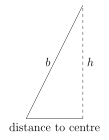 Let's consider the height. The distance to the centre \(\frac23 \frac{\sqrt{3}}2 a = \frac{a}{\sqrt{3}}\) so \(h = \sqrt{b^2 - \frac{a^2}{3}}\) and therefore the volume is:
\begin{align*}
V &= \frac13 \times \mbox{area of base} \times \mbox {height} \\
&= \frac13 \frac{\sqrt{3}}{4}a^2 \sqrt{\frac{3b^2-a^2}{3}} \\
&= \frac1{12}a^2 (3b^2-a^2)^{\frac12}
\end{align*}
The area of an isoceles triangle with sides \(a,b,b\) can be found by considering the perpendicular:
Let's consider the height. The distance to the centre \(\frac23 \frac{\sqrt{3}}2 a = \frac{a}{\sqrt{3}}\) so \(h = \sqrt{b^2 - \frac{a^2}{3}}\) and therefore the volume is:
\begin{align*}
V &= \frac13 \times \mbox{area of base} \times \mbox {height} \\
&= \frac13 \frac{\sqrt{3}}{4}a^2 \sqrt{\frac{3b^2-a^2}{3}} \\
&= \frac1{12}a^2 (3b^2-a^2)^{\frac12}
\end{align*}
The area of an isoceles triangle with sides \(a,b,b\) can be found by considering the perpendicular:
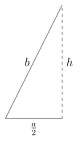 ie \(\frac{a}{4} \sqrt{b^2-\frac{a^2}{4}} = \frac{a\sqrt{4b^2-a^2}}{8}\).
Therefore by considering the volume, we must have
\begin{align*}
&& V &= \frac13 \times \mbox{area of base} \times \mbox {height} \\
\Rightarrow && \frac1{12}a^2 (3b^2-a^2)^{\frac12} &= \frac13 \frac{a\sqrt{4b^2-a^2}}{8} h \\
\Rightarrow && h &= \frac{2a(3b^2-a^2)}{(4b^2-a^2)^{\frac12}} \\
\Rightarrow && h^2 &= \frac{4a^2(3b^2-a^2)}{4b^2-a^2}
\end{align*}
ie \(\frac{a}{4} \sqrt{b^2-\frac{a^2}{4}} = \frac{a\sqrt{4b^2-a^2}}{8}\).
Therefore by considering the volume, we must have
\begin{align*}
&& V &= \frac13 \times \mbox{area of base} \times \mbox {height} \\
\Rightarrow && \frac1{12}a^2 (3b^2-a^2)^{\frac12} &= \frac13 \frac{a\sqrt{4b^2-a^2}}{8} h \\
\Rightarrow && h &= \frac{2a(3b^2-a^2)}{(4b^2-a^2)^{\frac12}} \\
\Rightarrow && h^2 &= \frac{4a^2(3b^2-a^2)}{4b^2-a^2}
\end{align*}
Rating Information
Difficulty Rating: 1500.0
Difficulty Comparisons: 0
Banger Rating: 1500.0
Banger Comparisons: 0
Show LaTeX source
Problem source
A   pyramid stands on horizontal ground. Its base is an equilateral triangle with sides of length~$a$,  the other three
 sides of the pyramid are of length $b$ and its volume is $V$. Given that the
formula for the volume of any pyramid is
$
 \textstyle
\frac13 \times \mbox{area of base} \times \mbox {height} \,,
$
show that
\[
V= \frac1{12} {a^2(3b^2-a^2)}^{\frac12}\;.
\]
The pyramid is then placed  so that a non-equilateral face  lies on the ground.
Show that the new height, $h$, of the pyramid is given by
\[
h^2 = \frac{a^2(3b^2-a^2)}{4b^2-a^2}\;.
\]
Find, in terms of $a$ and $b\,$, the angle between the
equilateral triangle and the horizontal.
Solution source
First let's consider the area of the base. It is an equilateral triangle with side length $a$, so $\frac12 a^2 \sin 60^\circ = \frac{\sqrt{3}}4a^2$.

\begin{center}
    \begin{tikzpicture}
        \draw (2,0) -- (0,0) node[pos=0.5, below] {distance to centre};
        \draw (0,0) -- (2, 4) node[pos=0.5, left] {$b$};
        \draw[dashed] (2,0) -- (2,4) node[pos=0.5, right] {$h$};
    \end{tikzpicture}
\end{center}

Let's consider the height. The distance to the centre $\frac23 \frac{\sqrt{3}}2 a = \frac{a}{\sqrt{3}}$ so $h = \sqrt{b^2 - \frac{a^2}{3}}$ and therefore the volume is:

\begin{align*}
V &= \frac13 \times \mbox{area of base} \times \mbox {height} \\
&= \frac13 \frac{\sqrt{3}}{4}a^2 \sqrt{\frac{3b^2-a^2}{3}} \\
&= \frac1{12}a^2 (3b^2-a^2)^{\frac12}
\end{align*}

The area of an isoceles triangle with sides $a,b,b$ can be found by considering the perpendicular:

\begin{center}
    \begin{tikzpicture}
        \draw (2,0) -- (0,0) node[pos=0.5, below] {$\frac{a}2$};
        \draw (0,0) -- (2, 4) node[pos=0.5, left] {$b$};
        \draw[dashed] (2,0) -- (2,4) node[pos=0.5, right] {$h$};
    \end{tikzpicture}
\end{center}

ie $\frac{a}{4} \sqrt{b^2-\frac{a^2}{4}} = \frac{a\sqrt{4b^2-a^2}}{8}$.

Therefore by considering the volume, we must have

\begin{align*}
&& V &= \frac13 \times \mbox{area of base} \times \mbox {height} \\
\Rightarrow && \frac1{12}a^2 (3b^2-a^2)^{\frac12} &= \frac13  \frac{a\sqrt{4b^2-a^2}}{8} h \\
\Rightarrow && h &= \frac{2a(3b^2-a^2)}{(4b^2-a^2)^{\frac12}} \\
\Rightarrow && h^2 &= \frac{4a^2(3b^2-a^2)}{4b^2-a^2}
\end{align*}