Problems
Filters
17 problems found
2025 Paper 3 Q4
- \(x_2\) and \(y_2\) are defined in terms of \(x_1\) and \(y_1\) by the equation $$\begin{pmatrix} x_2 \\ y_2 \end{pmatrix} = \begin{pmatrix} \frac{1}{\sqrt{2}} & -\frac{1}{\sqrt{2}} \\ \frac{1}{\sqrt{2}} & \frac{1}{\sqrt{2}} \end{pmatrix} \begin{pmatrix} x_1 \\ y_1 \end{pmatrix}$$ \(G_1\) is the graph with equation $$\frac{x^2}{9} + \frac{y^2}{4} = 1$$ and \(G_2\) is the graph with equation $$\frac{\left(\frac{x}{\sqrt{2}} + \frac{y}{\sqrt{2}}\right)^2}{9} + \frac{\left(-\frac{x}{\sqrt{2}} + \frac{y}{\sqrt{2}}\right)^2}{4} = 1$$ Show that, if \((x_1, y_1)\) is a point on \(G_1\), then \((x_2, y_2)\) is a point on \(G_2\). Show that \(G_2\) is an anti-clockwise rotation of \(G_1\) through \(45^\circ\) about the origin.
- The matrix $$\begin{pmatrix} -0.6 & 0.8 \\ 0.8 & 0.6 \end{pmatrix}$$ represents a reflection. Find the line of invariant points of this matrix.
- Sketch, on the same axes, the graphs with equations $$y = 2^x \text{ and } 0.8x + 0.6y = 2^{-0.6x+0.8y}$$
- Sketch, on the same axes, for \(0 \leq x \leq 2\pi\), the graphs with equations $$y = \sin x \text{ and } y = \sin(x - 2y)$$ You should determine the exact co-ordinates of the points on the graph with equation \(y = \sin(x - 2y)\) where the tangent is horizontal and those where it is vertical.
Solution:
- Suppose \begin{align*} && \begin{pmatrix} x_2 \\ y_2 \end{pmatrix} &= \begin{pmatrix} \frac{1}{\sqrt{2}} & -\frac{1}{\sqrt{2}} \\ \frac{1}{\sqrt{2}} & \frac{1}{\sqrt{2}} \end{pmatrix} \begin{pmatrix} x_1 \\ y_1 \end{pmatrix} \\ \Rightarrow && \binom{x_1}{y_1} &= \begin{pmatrix} \frac{1}{\sqrt{2}} & \frac{1}{\sqrt{2}} \\ -\frac{1}{\sqrt{2}} & \frac{1}{\sqrt{2}} \end{pmatrix} \binom{x_2}{y_2} \end{align*} Therefore if \(\frac{x_1^2}9+\frac{y_1^2}{4} = 1\) we must have \begin{align*} \frac{(\frac{x_2}{\sqrt{2}}+\frac{y_2}{\sqrt{2}})^2 }{9} + \frac{(-\frac{x_2}{\sqrt{2}}+\frac{y_2}{\sqrt{2}})^2}{4} = 1 \end{align*} but this is precisely the statement that \((x_1, y_1)\) is on \(G_1\) is equivalent to \((x_2,y_2)\) being on the \(G_2\). Since the point \((x_2,y_2)\) is a \(45^{\circ}\) rotation of \((x_1,y_1)\) anticlockwise about the origin, this means \(G_2\) is a \(45^{\circ}\) anticlockwise rotation of \(G_1\).
- \begin{align*} && \begin{pmatrix} -0.6 & 0.8 \\ 0.8 & 0.6 \end{pmatrix} \begin{pmatrix} x \\ y \end{pmatrix} &= \begin{pmatrix} x \\ y \end{pmatrix} \\ \Rightarrow && \begin{pmatrix} -0.6 x + 0.8y \\ 0.8x + 0.6y \end{pmatrix} &= \begin{pmatrix} x \\ y \end{pmatrix} \\ \Rightarrow && \begin{pmatrix} -1.6 x + 0.8y \\ 0.8x -0.4y \end{pmatrix} &= \begin{pmatrix} 0 \\ 0 \end{pmatrix} \\ \Rightarrow && y &=2 x \end{align*}

- Consider the transformation \(\begin{pmatrix} 1 & 2 \\ 0 & 1 \end{pmatrix}\) which is a shear, leaving the \(x\)-axis invariant. Then we must have:
Since the shear leaves lines of the form \(y = k\) invariant, the points where \(\frac{\d y}{\d x} = 0\) must also map to points where this is true, ie \((\tfrac{\pi}{2}, 1), (\tfrac{3\pi}{2}, -1)\) map to points \((\tfrac{\pi}{2}+2,1), (\tfrac{3\pi}{2} -2,-1)\) where the tangent is horizontal. The line \(x = c\) map back to lines \(\begin{pmatrix} 1 & -2 \\ 0 & 1\end{pmatrix} \begin{pmatrix} c \\ t\end{pmatrix} = \begin{pmatrix}c - 2t \\ t \end{pmatrix}\), ie \(y = -\frac12 x- \frac{c}{2}\). Therefore we are interested in points on the original curve where the gradient is \(-\frac12\), ie \((\frac{2\pi}{3}, \frac{\sqrt{3}}{2}), (\frac{4\pi}{3}, -\frac{\sqrt{3}}{2})\), these map to \((\frac{2\pi}{3}+\sqrt{3},\frac{\sqrt{3}}{2}), (\frac{4\pi}{3}-\sqrt{3}, -\frac{\sqrt{3}}{2})\)

2017 Paper 3 Q7
Show that the point \(T\) with coordinates \[ \left( \frac{a(1-t^2)}{1+t^2} \; , \; \frac{2bt}{1+t^2}\right) \tag{\(*\)} \] (where \(a\) and \(b\) are non-zero) lies on the ellipse \[ \frac{x^2}{a^2} + \frac{y^2}{b^2} =1 \,. \]
- The line \(L\) is the tangent to the ellipse at \(T\). The point \((X,Y)\) lies on \(L\), and \(X^2\ne a^2\). Show that \[ (a+X)bt^2 -2aYt +b(a-X) =0 \,.\] Deduce that if \(a^2Y^2>(a^2-X^2)b^2\), then there are two distinct lines through \((X,Y)\) that are tangents to the ellipse. Interpret this result geometrically. Show, by means of a sketch, that the result holds also if \(X^2=a^2\,\).
- The distinct points \(P\) and \(Q\) are given by \((*)\), with \(t=p\) and \(t=q\), respectively. The tangents to the ellipse at \(P\) and \(Q\) meet at the point with coordinates \((X,Y)\), where \(X^2\ne a^2\,\). Show that \[ (a+X)pq = a-X\] and find an expression for \(p+q\) in terms of \(a\), \(b\), \(X\) and \(Y\). Given that the tangents meet the \(y\)-axis at points \((0,y_1)\) and \((0,y_2)\), where \(y_1+y_2 = 2b\,\), show that \[ \frac{X^2}{a^2} +\frac{Y}{b}= 1 \,. \]
Solution:
- The tangent has equation:
\begin{align*}
&& 0 &= \frac{Xx}{a^2} + \frac{Yy}{b^2} -1 \\
\Rightarrow &&&= \frac{Xa(1-t^2)}{a^2(1+t^2)} + \frac{Y2bt}{b^2(1+t^2)} - 1 \\
\Rightarrow &&0&= Xb(1-t^2) + Y2at - ab(1+t^2)\\
&&&= -(b(a+X)t^2 -2aYt +b(a-X)) \\
\Rightarrow && 0 &= (a+X)bt^2-2aYt+b(a-X) \\
\\
&& 0 <\Delta &= 4a^2Y^2 - 4(a+X)b(a-X)b \\
&&&= 4(a^2Y^2-b^2(a^2-X^2)) \\
\Leftrightarrow && a^2Y^2 &> (a^2-X^2)b^2
\end{align*}
Therefore there are two roots to the quadratic, ie two values of the parameter \(t\) which works. The condition is equivalent to \(\frac{X^2}{a^2} + \frac{Y^2}{b^2} > 1\). ie from any point outside the ellipse there are two tangent lies.
Clearly there are two tangents when \(X = \pm a\) (except \((X,Y) = (\pm a, 0)\).
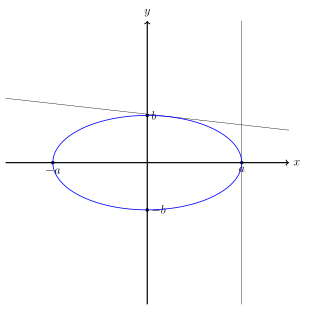
- We must have \(p\) and \(q\) are roots of \(0 = (a+X)bt^2-2aYt+b(a-X)\), ie \(pq = \frac{b(a-X)}{(a+X)b} \Rightarrow (a+X)pq = a-X\). Similarly \(p+q = \frac{2aY}{(a+X)b}\) Given that the tangents meet the \(y\)-axis at \((0, y_i)\) we must have \(abt^2-2ay_it + ab = 0\), so \begin{align*} && 0 &= abp^2-2ay_1p + ab \\ && 0 &= abq^2-2ay_2q + ab \\ \Rightarrow && y_1 &= \frac{ab(p^2+1)}{2ap} \\ && y_2 &= \frac{ab(q^2+1)}{2aq} \\ \Rightarrow && 2b &= \frac{ab(p^2+1)}{2ap} +\frac{ab(q^2+1)}{2aq} \\ &&&= \frac{ab(pq(p+q)+p+q)}{2apq} \\ \Rightarrow && 4pq &= pq(p+q)+p+q \\ \Rightarrow && 4 \frac{b(a-X)}{(a+X)b} &= \frac{2aY}{(a+X)b} \left ( \frac{b(a-X)}{(a+X)b} + 1 \right) \\ && &= \frac{2aY}{(a+X)b} \frac{2ab}{(a+X)b} \\ \Rightarrow && 4b^2(a^2-X^2) &= 4a^2bY \\ \Rightarrow && 1 &= \frac{Y}{b} + \frac{X^2}{a^2} \end{align*} as required.
2013 Paper 3 Q8
Evaluate \(\displaystyle \sum_{r=0}^{n-1} \e^{2i(\alpha + r\pi/n)}\) where \(\alpha\) is a fixed angle and \(n\ge2\). The fixed point \(O\) is a distance \(d\) from a fixed line \(D\). For any point \(P\), let \(s\) be the distance from \(P\) to \(D\) and let \(r\) be the distance from \(P\) to \(O\). Write down an expression for \(s\) in terms of \(d\), \(r\) and the angle \(\theta\), where \(\theta\) is as shown in the diagram below.

Solution: \begin{align*} \sum_{r=0}^{n-1} \e^{2i(\alpha + r\pi/n)} &= e^{2i\alpha} \sum_{r=0}^{n-1} \left (\e^{2i\pi/n} \right)^r \\ &= e^{2i\alpha} \frac{1-\left (\e^{2i\pi/n} \right)^n}{1-\e^{2i\pi/n} } \\ &= 0 \end{align*} \(d = s + r \cos \theta\) ie \(s = d - r \cos \theta\) Therefore \(d = \frac{r}{k} + r \cos \theta \Rightarrow r = \frac{kd}{1+k \cos \theta}\). The \(l_j\) will come from \(r(\alpha + \frac{j \pi}{n} )+r(\alpha + \pi + \frac{j \pi}{n} )\) \begin{align*} && l_j &= r(\alpha + \frac{(j-1) \pi}{n} )+r(\alpha + \pi + \frac{(j-1) \pi}{n} ) \\ &&&= \frac{kd}{1+k \cos \left ( \alpha + \frac{(j-1) \pi}{n}\right)}+\frac{kd}{1+k \cos \left ( \alpha+\pi+ \frac{(j-1) \pi}{n}\right)}\\ &&&= \frac{kd}{1+k \cos \left ( \alpha + \frac{(j-1) \pi}{n}\right)}+\frac{kd}{1-k \cos \left ( \alpha+ \frac{(j-1) \pi}{n}\right)}\\ &&&= \frac{2kd}{1-k^2 \cos^2 \left ( \alpha + \frac{(j-1) \pi}{n}\right)}\\ \Rightarrow && \sum_{j=1}^n \frac 1 {l_j} &= \sum_{j=0}^{n-1} \frac{1-k^2 \cos^2 \left ( \alpha + \frac{j \pi}{n}\right)}{2kd} \\ &&&= \frac{n}{2kd}-\frac{k^2}{2kd} \sum_{j=0}^{n-1} \cos^2 \left ( \alpha + \frac{j \pi}{n}\right) \\ &&&= \frac{n}{2kd}-\frac{k^2}{2kd} \sum_{j=0}^{n-1} \frac{1+ \cos \left ( 2\alpha + \frac{2j \pi}{n}\right)}{2} \\ &&&= \frac{n}{2kd}-\frac{nk^2}{2kd}-\frac{k^2}{4kd} \sum_{j=0}^{n-1}\cos \left ( 2\alpha + \frac{2j \pi}{n}\right) \\ &&&= \frac{n}{2kd}-\frac{nk^2}{2kd}-\frac{k^2}{4kd} \underbrace{\textrm{Re} \left ( \sum_{j=0}^{n-1}e^{ 2i(\alpha + \frac{j \pi}{n})} \right)}_{=0} \\ &&&= \frac{n}{2kd} - \frac{nk^2}{4kd} \\ &&&= \frac{n(2-k^2)}{4kd} \end{align*}
2010 Paper 1 Q3
Show that \[ \sin(x+y) -\sin(x-y) = 2 \cos x \, \sin y \] and deduce that \[ \sin A - \sin B = 2 \cos \tfrac12 (A+B) \, \sin\tfrac12 (A-B) \,. \] Show also that \[ \cos A - \cos B = -2 \sin \tfrac12(A+B) \, \sin\tfrac12(A-B)\,. \] The points \(P\), \(Q\), \(R\) and \(S\) have coordinates \(\left(a\cos p,b\sin p\right)\), \(\left(a\cos q,b\sin q\right)\), \(\left(a\cos r,b\sin r\right)\) and \(\left(a\cos s,b\sin s\right)\) respectively, where \(0\le p < q < r < s <2\pi\), and \(a\) and \(b\) are positive. Given that neither of the lines \(PQ\) and \(SR\) is vertical, show that these lines are parallel if and only if \[ r+s-p-q = 2\pi\,. \]
Solution: \begin{align*} && \sin(x+y) - \sin(x-y) &= \sin x \cos y + \cos x \sin y - (\sin x \cos y - \cos x \sin y )\\ &&&= 2 \cos x \sin y \\ \\ && A &= x+y \\ && B &= x - y \\ \Rightarrow && x = \frac12(A+B) &\quad y = \frac12(A-B) \\ \Rightarrow && \sin A - \sin B &= 2 \cos \tfrac12(A+B) \sin \tfrac12(A-B) \\ \\ && \cos (x+y) - \cos (x-y) &= \cos x \cos y - \sin x \sin y -(\cos x \cos y + \sin x \sin y ) \\ &&&= -2 \sin x \sin y \\ \Rightarrow && \cos A - \cos B &= - 2 \sin \tfrac12 (A+B) \sin \tfrac12 (A-B) \end{align*} \begin{align*} && \text{Gradient of }PQ &= \frac{b \sin q - b \sin p}{a \cos q - a \cos p } \\ && \text{Gradient of }SR &= \frac{b \sin s - b \sin r}{a \cos s - a \cos r} \\ PQ \parallel SR \Rightarrow && \frac{b \sin q - b \sin p}{a \cos q - a \cos p } &= \frac{b \sin s - b \sin r}{a \cos s - a \cos r} \\ \Rightarrow && (\sin q - \sin p)(\cos s - \cos r) &= (\sin s - \sin r)(\cos q - \cos r) \\ \Rightarrow && -4 \cos \tfrac12(p+q) \sin\tfrac12(q-p) \sin \tfrac12(s+r) \sin \tfrac12(s-r) &= -4 \cos \tfrac12(s+r) \sin \tfrac12(s-r) \sin \tfrac12 (p+q) \sin\tfrac12 (q-p) \\ \Rightarrow && 0 &= \sin \tfrac12(s-r)\sin\tfrac12(p-q) \left ( \cos \tfrac12(p+q)\sin \tfrac12(s+r) - \sin \tfrac12 (p+q)\cos \tfrac12(s+r) \right) \\ &&&= \sin \tfrac12(s-r)\sin\tfrac12(p-q) \sin \left ( \frac12 (s+r -(p+q))\right) \end{align*} Since \(s \neq r\) and \(p \neq q\) (neither line vertical) we must have \(\frac12 (s+r -(p+q)) = n \pi \Rightarrow s+r - p - q = 0, 2\pi, 4\pi, \cdots\) but given the range constraints it must be \(2 \pi\)
2008 Paper 3 Q3
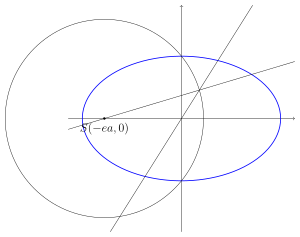
The point \(P(a\cos\theta\,,\, b\sin\theta)\), where \(a>b>0\), lies on the ellipse \[\dfrac {x^2}{a^2} + \dfrac {y^2}{b^2}=1\,.\] The point \(S(-ea\,,\,0)\), where \(b^2=a^2(1-e^2)\,\), is a focus of the ellipse. The point \(N\) is the foot of the perpendicular from the origin, \(O\), to the tangent to the ellipse at \(P\). The lines \(SP\) and \(ON\) intersect at \(T\). Show that the \(y\)-coordinate of \(T\) is \[\dfrac{b\sin\theta}{1+e\cos\theta}\,.\] Show that \(T\) lies on the circle with centre \(S\) and radius \(a\).
Solution: Find the gradient of the tangent of the ellipse at \(P\): \begin{align*} && \frac{2x}{a^2} + \frac{2y}{b^2} \frac{\d y}{\d x} &= 0 \\ \Rightarrow && \frac{\d y}{\d x} &= - \frac{2xb^2}{2ya^2} \\ &&&=- \frac{a \cos \theta b^2}{b \sin \theta a^2} \\ &&&=-\frac{b}{a} \cot \theta \end{align*} Therefore the gradient of \(ON\) is \(\frac{a}{b} \tan \theta\). \begin{align*} && y &= \frac{a}{b} \tan \theta x \\ && \frac{y-0}{x-(-ea)} &= \frac{b\sin \theta-0}{a\cos \theta -(-ea)} \\ && y &= \frac{b \sin \theta}{a(e+\cos \theta)}(x+ea) \\ \Rightarrow && y &= \frac{b \sin \theta}{a(\cos \theta+e)}\frac{b}{a} \cot \theta y+ \frac{eb \sin \theta}{\cos \theta + e} \\ &&&= \frac{b^2 \cos \theta}{a^2(\cos \theta +e)}y + \frac{eb \sin \theta}{\cos \theta + e} \\ \Rightarrow && (\cos \theta+e)y &= (1-e^2)\cos \theta y +eb \sin \theta\\ && e(1+e\cos \theta)y &= eb \sin \theta \\ \Rightarrow && y &= \frac{b \sin \theta}{1+e\cos \theta} \\ && x &= \frac{b \sin \theta}{1+e\cos \theta} \frac{b}{a} \cot \theta \\ &&&= \frac{b^2 \cos \theta}{a(1+e\cos \theta)} \end{align*} Therefore \(\displaystyle T\left (\frac{b^2 \cos \theta}{a(1+e\cos \theta)}, \frac{b \sin \theta}{1+e\cos \theta} \right)\). Finally, we can look at the distance of \(T\) from \(S\) \begin{align*} && d^2 &= \left (\frac{b^2 \cos \theta}{a(1+e\cos \theta)}-(-ea) \right)^2 + \left (\frac{b \sin \theta}{1+e\cos \theta} -0\right)^2 \\ &&&= \frac{\left (b^2 \cos \theta+ea^2(1+e\cos\theta)\right)^2 + \left ( ab \sin \theta\right)^2}{a^2(1+e\cos \theta)^2} \\ &&&= \frac{b^4\cos^2\theta+e^2a^4(1+e\cos\theta)^2+2ea^2b^2(1+e\cos\theta)+a^2b^2\sin^2\theta}{a^2(1+e\cos\theta)^2} \\ &&&= \frac{a^4(1-e^2)^2\cos^2\theta+e^2a^4(1+e\cos\theta)^2+2ea^2a^2(1-e^2)(1+e\cos\theta)+a^4(1-e^2)\sin^2\theta}{a^2(1+e\cos\theta)^2} \\ &&&= a^2 \left ( \frac{(1-e^2)^2\cos^2\theta+e^2(1+e\cos\theta)^2+2e(1-e^2)(1+e\cos\theta)+(1-e^2)(1-\cos^2\theta)}{(1+e\cos\theta)^2} \right) \\ &&&= a^2 \left ( \frac{e^2(1+e\cos\theta)^2+(1-e^2)((1-e^2)\cos^2\theta+2e(1+e\cos\theta)+(1-\cos^2\theta))}{(1+e\cos\theta)^2} \right) \\ &&&= a^2 \left ( \frac{e^2(1+e\cos\theta)^2+(1-e^2)(1+e\cos\theta)^2}{(1+e\cos\theta)^2} \right) \\ &&&= a^2 \end{align*} Therefore a circle radius \(a\) centre \(S\).
2006 Paper 2 Q7
An ellipse has equation $\dfrac{x^2}{a^2} +\dfrac {y^2}{b^2} = 1$. Show that the equation of the tangent at the point \((a\cos\alpha, b\sin\alpha)\) is \[ y=- \frac {b \cot \alpha} a \, x + b\, {\rm cosec\,}\alpha\,. \] The point \(A\) has coordinates \((-a,-b)\), where \(a\) and \(b\) are positive. The point \(E\) has coordinates \((-a,0)\) and the point \(P\) has coordinates \((a,kb)\), where \(0 < k < 1\). The line through \(E\) parallel to \(AP\) meets the line \(y=b\) at the point \(Q\). Show that the line \(PQ\) is tangent to the above ellipse at the point given by \(\tan(\alpha/2)=k\). Determine by means of sketches, or otherwise, whether this result holds also for \(k=0\) and \(k=1\).
2005 Paper 1 Q8
Show that, if \(y^2 = x^k \f(x)\), then $\displaystyle 2xy \frac{\mathrm{d}y }{ \mathrm{d}x} = ky^2 + x^{k+1} \frac{\mathrm{d}\f }{ \mathrm{d}x}$\,.
- By setting \(k=1\) in this result, find the solution of the differential equation \[ \displaystyle 2xy \frac{\mathrm{d}y }{ \mathrm{d}x} = y^2 + x^2 - 1 \] for which \(y=2\) when \(x=1\). Describe geometrically this solution.
- Find the solution of the differential equation \[ 2x^2y\displaystyle \frac{\mathrm{d}y}{\mathrm{d}x} = 2 \ln(x) - xy^2 \] for which \(y=1\) when \(x=1\,\).
2002 Paper 1 Q1
Show that the equation of any circle passing through the points of intersection of the ellipse \((x+2)^2 +2y^2 =18\) and the ellipse \(9(x-1)^2 +16y^2 = 25\) can be written in the form \[ x^2-2ax +y^2 =5-4a\;. \]
Solution: \begin{align*} && (x+2)^2 +2y^2 &=18 \\ && 9(x-1)^2 +16y^2 &= 25 \\ \Rightarrow && 2y^2 &= 18 - (x+2)^2 \\ && 16y^2 &= 25 - 9(x-1)^2 \\ \Rightarrow && 25-9(x-1)^2 &= 8 \cdot 18 - 8(x+2)^2 \\ \Rightarrow && 25 -9+18x-9x^2 &= 144 -32- 32x +8x^2 \\ \Rightarrow && 0 &= 96 - 50x+x^2 \\ &&&= (x-48)(x-2) \\ \Rightarrow && x &= 2,48 \\ \Rightarrow && 2y^2 &= 2, 18-50^2 \\ \Rightarrow && (x,y) &= (2,\pm1) \end{align*} Therefore any circle must have it's centre on there perpendicular bisector of \((2, \pm 1)\), ie on the \(x\)-axis. Therefore it will have equation \((x-a)^2+y^2 = r^2\) and also contain the point \((2,1)\), therefore: \begin{align*} r^2 &= (2-a)^2 + 1^2 \\ &= 4 -2a+a^2 + 1 \\ &= 5-2a+a^2 \end{align*} and the equation is: \begin{align*} && (x-a)^2 + y^2 &= 5-4a+a^2 \\ \Rightarrow && x^2-2ax+a^2 +y^2 &= 5-4a+a^2 \\ \Rightarrow && x^2-2ax+y^2 &= 5-4a \end{align*} as required.
2001 Paper 3 Q2
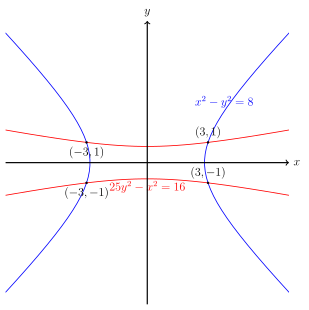
Show that \( \cosh^{-1} x = \ln ( x + \sqrt{x^2-1})\). Show that the area of the region defined by the inequalities \(\displaystyle y^2 \ge x^2-8\) and \(\displaystyle x^2\ge 25y^2 -16 \) is \((72/5) \ln 2\).
Solution: \begin{align*} && x &= \cosh y \\ \Rightarrow && x &= \tfrac12 (e^y + e^{-y} ) \\ \Rightarrow && 0 &= e^{2y} - 2xe^y + 1 \\ \Rightarrow && e^y &= \frac{2x \pm \sqrt{4x^2-4}}{2} \\ &&&= x \pm \sqrt{x^2-1} \\ \Rightarrow &&e^y &= x + \sqrt{x^2-1} \tag{by convention \(\cosh^{-1} > 0\)} \\ \Rightarrow && y &= \ln (x + \sqrt{x^2-1}) \end{align*}
1997 Paper 3 Q8
Let \(R_{\alpha}\) be the \(2\times2\) matrix that represents a rotation through the angle \(\alpha\) and let $$A=\begin{pmatrix}a&b\\b&c\end{pmatrix}.$$
- Find in terms of \(a\), \(b\) and \(c\) an angle \(\alpha\) such that \(R_{-\alpha}AR_{\alpha}\) is a diagonal matrix (i.e. has the value zero in top-right and bottom-left positions).
- Find values of \(a\), \(b\) and \(c\) such that the equation of the ellipse \[x^2+(y+2x\cot2\theta)^2=1\qquad(0 < \theta < \tfrac{1}{4}\pi)\] can be expressed in the form \[\begin{pmatrix}x&y\end{pmatrix}A\begin{pmatrix}x\\y\end{pmatrix}=1.\] Show that, for this \(A\), \(R_{-\alpha}AR_{\alpha}\) is diagonal if \(\alpha=\theta\). Express the non--zero elements of this matrix in terms of \(\theta\).
- Deduce, or show otherwise, that the minimum and maximum distances from the centre to the circumference of this ellipse are \(\tan\theta\) and \(\cot\theta\).
Solution: \begin{questionparts} \item \begin{align*} R_{-\alpha}AR_{\alpha} &= \begin{pmatrix} \cos \alpha & \sin\alpha \\ -\sin \alpha & \cos \alpha \end{pmatrix}\begin{pmatrix} a & b \\ b & c \end{pmatrix} \begin{pmatrix} \cos \alpha & -\sin\alpha \\ \sin \alpha & \cos \alpha \end{pmatrix} \\ &= \begin{pmatrix} \cos \alpha & \sin\alpha \\ -\sin \alpha & \cos \alpha \end{pmatrix} \begin{pmatrix} a\cos \alpha + b \sin \alpha & -a\sin\alpha + b \cos\alpha \\ b\cos\alpha + c \sin\alpha & c\cos\alpha-b\sin\alpha \end{pmatrix} \\ &= \begin{pmatrix} a\cos^2\alpha+2b\sin\alpha\cos\alpha+c\sin^2\alpha & -a\sin\alpha\cos \alpha+b\cos^2\alpha +c\sin\alpha\cos\alpha-b\sin^2 \alpha\\ (c-a)\sin\alpha\cos \alpha +b(\cos^2\alpha-\sin^2 \alpha) & a\sin^2 \alpha -2b\sin\alpha\cos\alpha+c\cos^2\alpha \end{pmatrix} \\ &= \begin{pmatrix} * & \frac{c-a}{2}\sin2\alpha+b \cos 2\alpha\\\frac{c-a}{2}\sin2\alpha+b \cos 2\alpha & * \end{pmatrix} \end{align*} Therefore this will be diagonal if \(\tan 2\alpha = \frac{2b}{a-c} \Rightarrow \alpha = \frac12 \tan^{-1} \l \frac{2b}{a-c} \r\) \item \begin{align*} x^2+(y+2x\cot2\theta)^2 &= x^2(1 + 4\cot^22\theta) + 4\cot2\theta xy + y^2 \\ &= \begin{pmatrix}x&y\end{pmatrix}\begin{pmatrix} 1 + 4\cot^22\theta & 2\cot 2\theta \\ 2\cot 2\theta & 1 \end{pmatrix}\begin{pmatrix}x\\y\end{pmatrix} \end{align*} Plugging this \(\mathbf{A}\) in our result from before we discover \begin{align*} \frac12 \tan^{-1} \l \frac{2b}{a-c} \r &= \frac12 \tan^{-1} \l \frac{4\cot 2\theta}{1 + 4\cot^22\theta-1} \r \\ &= \frac12 \tan^{-1} \l \tan 2 \theta \r \\ &= \theta \end{align*} Therefore, the matrix will be: \begin{align*} & \textrm{diag}\begin{pmatrix} (1+4\cot^2 2\theta)\cos^2 \theta + 4\cot2\theta \sin\theta\cos\theta + \sin^2 \theta \\ (1+4\cot^2 2\theta)\sin^2 \theta - 4\cot2\theta \sin\theta\cos\theta + \cos^2 \theta \end{pmatrix} \\ =& \textrm{diag}\begin{pmatrix} \cos^2\theta + \frac{\cos^2 2\theta}{\sin^2 \theta} + 2\cos 2\theta + \sin^2 \theta \\ \sin^2\theta + \frac{\cos^2 2\theta}{\cos^2 \theta} - 2\cos 2\theta + \cos^2 \theta \end{pmatrix} \\ =& \textrm{diag}\begin{pmatrix} 1 + \cos 2\theta \l \frac{\cos2\theta}{\sin^2 \theta} + 2\r \\ 1 + \cos 2\theta \l \frac{\cos2\theta}{\cos^2 \theta} - 2\r \\ \end{pmatrix} \\ =& \textrm{diag}\begin{pmatrix} 1 + \cos 2\theta \l \frac{\cos^2 \theta + \sin^2 \theta}{\sin^2 \theta}\r \\ 1 -\cos 2\theta \l \frac{-\cos^2 \theta - \sin^2 \theta}{\cos^2 \theta}\r \\ \end{pmatrix} \\ =& \textrm{diag}\begin{pmatrix} 1 + (\cos^2\theta - \sin^2 \theta) \cosec^2 \theta \\ 1 - (\cos^2\theta - \sin^2 \theta) \sec^2 \theta \\ \end{pmatrix} \\ =& \textrm{diag}\begin{pmatrix} \cot^2 \theta \\ \tan^2 \theta \\ \end{pmatrix} \\ \end{align*} Therefore this is a rotation of an ellipse with equation: \((\cot \theta x)^2 + (\tan \theta y)^2 = 1\), ie the shortest side and longest side are \(\cot \theta\) and \(\tan \theta\) respectively, but we know since \(0 < \theta < \tfrac{1}{4}\pi\) the shortest will be \(\tan \theta\) and the longest \(\cot \theta\).
1994 Paper 2 Q4
By considering the area of the region defined in terms of Cartesian coordinates \((x,y)\) by \[ \{(x,y):\ x^{2}+y^{2}=1,\ 0\leqslant y,\ 0\leqslant x\leqslant c\}, \] show that \[ \int_{0}^{c}(1-x^{2})^{\frac{1}{2}}\,\mathrm{d}x=\tfrac{1}{2}[c(1-c^{2})^{\frac{1}{2}}+\sin^{-1}c], \] if \(0 < c\leqslant1.\) Show that the area of the region defined by \[ \left\{ (x,y):\ \frac{x^{2}}{a^{2}}+\frac{y^{2}}{b^{2}}=1,\ 0\leqslant y,\ 0\leqslant x\leqslant c\right\} , \] is \[ \frac{ab}{2}\left[\frac{c}{a}\left(1-\frac{c^{2}}{a^{2}}\right)^{\frac{1}{2}}+\sin^{-1}\left(\frac{c}{a}\right)\right], \] if \(0 < c\leqslant a\) and \(0 < b.\) Suppose that \(0 < b\leqslant a.\) Show that the area of intersection \(E\cap F\) of the two regions defined by \[ E=\left\{ (x,y):\ \frac{x^{2}}{a^{2}}+\frac{y^{2}}{b^{2}}\leqslant1\right\} \qquad\mbox{ and }\qquad F=\left\{ (x,y):\ \frac{x^{2}}{b^{2}}+\frac{y^{2}}{a^{2}}\leqslant1\right\} \] is \[ 4ab\sin^{-1}\left(\frac{b}{\sqrt{a^{2}+b^{2}}}\right). \]
1992 Paper 3 Q9
The straight line \(OSA,\) where \(O\) is the origin, bisects the angle between the positive \(x\) and \(y\) axes. The ellipse \(E\) has \(S\) as focus. In polar coordinates with \(S\) as pole and \(SA\) as the initial line, \(E\) has equation \(\ell=r(1+e\cos\theta).\) Show that, at the point on \(E\) given by \(\theta=\alpha,\) the gradient of the tangent to the ellipse is given by \[ \frac{\mathrm{d}y}{\mathrm{d}x}=\frac{\sin\alpha-\cos\alpha-e}{\sin\alpha+\cos\alpha+e}. \] The points on \(E\) given by \(\theta=\alpha\) and \(\theta=\beta\) are the ends of a diameter of \(E\). Show that \[ \tan(\alpha/2)\tan(\beta/2)=-\frac{1+e}{1-e}. \] [Hint. A diameter of an ellipse is a chord through its centre.]
Solution:

1992 Paper 3 Q10
Sketch the curve \(C\) whose polar equation is \[ r=4a\cos2\theta\qquad\mbox{ for }-\tfrac{1}{4}\pi<\theta<\tfrac{1}{4}\pi. \] The ellipse \(E\) has parametric equations \[ x=2a\cos\phi,\qquad y=a\sin\phi. \] Show, without evaluating the integrals, that the perimeters of \(C\) and \(E\) are equal. Show also that the areas of the regions enclosed by \(C\) and \(E\) are equal.
Solution:

1991 Paper 3 Q9
The parametric equations \(E_{1}\) and \(E_{2}\) define the same ellipse, in terms of the parameters \(\theta_{1}\) and \(\theta_{2}\), (though not referred to the same coordinate axes). \begin{alignat*}{2} E_{1}:\qquad & x=a\cos\theta_{1}, & \quad & y=b\sin\theta_{1},\\ E_{2}:\qquad & x=\dfrac{k\cos\theta_{2}}{1+e\cos\theta_{2}}, & \quad & y=\dfrac{k\sin\theta_{2}}{1+e\cos\theta_{2}}, \end{alignat*} where \(0< b< a,\) \(0< e< 1\) and \(0< k\). Find the position of the axes for \(E_{2}\) relative to the axes for \(E_{1}\) and show that \(k=a(1-e^{2})\) and \(b^{2}=a^{2}(1-e^{2}).\) {[}The standard polar equation of an ellipse is \(r=\dfrac{\ell}{1+e\cos\theta}.]\) By considering expressions for the length of the perimeter of the ellipse, or otherwise, prove that \[ \int_{0}^{\pi}\sqrt{1-e^{2}\cos^{2}\theta}\,\mathrm{d}\theta=\int_{0}^{\pi}\frac{1-e^{2}}{(1+e\cos\theta)^{2}}\sqrt{1+e^{2}+2e\cos\theta}\,\mathrm{d}\theta. \] Given that \(e\) is so small that \(e^{6}\) may be neglected, show that the value of either integral is \[ \tfrac{1}{64}\pi(64-16e^{2}-3e^{4}). \]
1991 Paper 3 Q12
A smooth tube whose axis is horizontal has an elliptic cross-section in the form of the curve with parametric equations \[ x=a\cos\theta\qquad y=b\sin\theta \] where the \(x\)-axis is horizontal and the \(y\)-axis is vertically upwards. A particle moves freely under gravity on the inside of the tube in the plane of this cross-section. By first finding \(\ddot{x}\) and \(\ddot{y},\) or otherwise, show that the acceleration along the inward normal at the point with parameter \(\theta\) is \[ \frac{ab\dot{\theta}^{2}}{\sqrt{a^{2}\sin^{2}\theta+b^{2}\cos^{2}\theta}}. \] The particle is projected along the surface in the vertical cross-section plane, with speed \(2\sqrt{bg},\) from the lowest point. Given that \(2a=3b,\) show that it will leave the surface at the point with parameter \(\theta\) where \[ 5\sin^{3}\theta+12\sin\theta-8=0. \]