2001 Paper 3 Q2
Year: 2001
Paper: 3
Question Number: 2
Course: UFM Pure
Section: Integration using inverse trig and hyperbolic functions
Difficulty: 1700.0
Banger: 1484.0
integration
inverse hyperbolic functions
cosh inverse
logarithmic form
area between curves
hyperbola
ellipse
definite integral
Problem
Show that \( \cosh^{-1} x = \ln ( x + \sqrt{x^2-1})\).
Show that the area of the region defined by the inequalities \(\displaystyle y^2 \ge x^2-8\) and \(\displaystyle x^2\ge 25y^2 -16 \) is \((72/5) \ln 2\).
Solution
\begin{align*}
&& x &= \cosh y \\
\Rightarrow && x &= \tfrac12 (e^y + e^{-y} ) \\
\Rightarrow && 0 &= e^{2y} - 2xe^y + 1 \\
\Rightarrow && e^y &= \frac{2x \pm \sqrt{4x^2-4}}{2} \\
&&&= x \pm \sqrt{x^2-1} \\
\Rightarrow &&e^y &= x + \sqrt{x^2-1} \tag{by convention \(\cosh^{-1} > 0\)} \\
\Rightarrow && y &= \ln (x + \sqrt{x^2-1})
\end{align*}
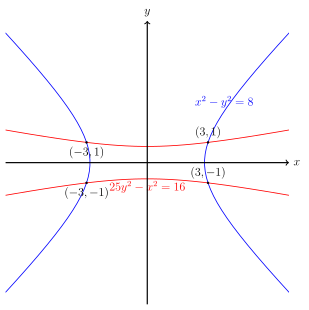 \begin{align*}
&& A &= 4 \left ( \int_0^3 \frac15\sqrt{16+x^2} \d x - \int_{2\sqrt{2}}^3\sqrt{x^2-8} \d x \right) \\
\\
x = 4\sinh u: && \int_0^3 \sqrt{4^2+x^2} \d x &= \int_{u=0}^{u=\sinh^{-1}(3/4)} \sqrt{4^2 (1+\sinh^2 u)} 4 \cosh u \d u \\
&&&= \int_0^{\sinh^{-1}(3/4)} 16 \cosh^{2}u \d u \\
&&&= 8\int_0^{\sinh^{-1}(3/4)} (1+\cosh 2u) \d u \\
&&&= 8 \left[u + \frac12 \sinh 2u\right]_0^{\sinh^{-1}(3/4)} \\
&&&= 8 \left (\sinh^{-1}(3/4) + \frac12 \sinh \left ( 2 \sinh^{-1}(3/4) \right) \right) \\
\\
&& \sinh^{-1}(3/4) &= \ln\left ( \frac34 + \sqrt{\left ( \frac{3}{4} \right)^2 + 1} \right) \\
&&&= \ln \left ( \frac34 +\frac{5}{4} \right) \\
&&&= \ln 2 \\
\\
\Rightarrow && \int_0^3 \sqrt{4^2+x^2} \d x &= 8 \ln 2 + 4 \left ( \frac{e^{2 \ln 2} - e^{-2\ln2}}{2} \right) \\
&&&= 8 \ln 2 + 2 \cdot 4 - 2\cdot \frac{1}{4} \\
&&&= 8 \ln 2 + \frac{15}{2}
\end{align*}
\begin{align*}
x = 2\sqrt{2} \cosh u: && \int_{2\sqrt{2}}^3\sqrt{x^2-8} \d x &= \int_{u=0}^{u = \cosh^{-1} \frac{3}{2\sqrt{2}}} \sqrt{8(\cosh^2 u - 1)} 2 \sqrt{2} \sinh u \d u \\
&&&= \int_0^{ \cosh^{-1} \frac{3}{2\sqrt{2}}} 8\sinh^2 u \d u \\
&&&= 4 \int_0^{ \cosh^{-1} \frac{3}{2\sqrt{2}}} 2\sinh^2 u \d u \\
&&&= 4 \int_0^{ \cosh^{-1} \frac{3}{2\sqrt{2}}} \cosh 2 u -1 \d u \\
&&&= 4 \left [\frac12 \sinh 2u - u \right]_0^{ \cosh^{-1} \frac{3}{2\sqrt{2}}} \\
\\
&& \cosh^{-1} \frac{3}{2\sqrt{2}} &= \ln \left ( \frac{3}{2\sqrt{2}} + \sqrt{\left ( \frac{3}{2\sqrt{2}} \right)^2-1} \right) \\
&&&= \ln \left ( \frac{3}{2\sqrt{2}} + \sqrt{\frac{9}{8} - 1} \right) \\
&&&= \ln \left ( \frac{3}{2\sqrt{2}} + \sqrt{\frac{1}{8} } \right) \\
&&&= \ln \frac{4}{2\sqrt{2}} \\
&&&= \frac12 \ln 2 \\
\\
&& \int_{2\sqrt{2}}^3\sqrt{x^2-8} \d x &= 4 \left ( \frac12 \frac{e^{\ln2} - e^{-\ln2}}{2} - \frac12 \ln 2\right) \\
&&&= 2 - \frac12 -2 \ln 2 \\
&&&= \frac32 - 2 \ln 2
\end{align*}
\begin{align*}
A &= 4 \left (\frac15\left(8\ln 2 + \frac{15}2 \right)- \left ( \frac32 - 2 \ln 2\right)\right) \\
&=4\cdot \left( \frac{8}{5} + 2 \right) \ln 2 \\
&= \frac{72}{5} \ln 2
\end{align*}
\begin{align*}
&& A &= 4 \left ( \int_0^3 \frac15\sqrt{16+x^2} \d x - \int_{2\sqrt{2}}^3\sqrt{x^2-8} \d x \right) \\
\\
x = 4\sinh u: && \int_0^3 \sqrt{4^2+x^2} \d x &= \int_{u=0}^{u=\sinh^{-1}(3/4)} \sqrt{4^2 (1+\sinh^2 u)} 4 \cosh u \d u \\
&&&= \int_0^{\sinh^{-1}(3/4)} 16 \cosh^{2}u \d u \\
&&&= 8\int_0^{\sinh^{-1}(3/4)} (1+\cosh 2u) \d u \\
&&&= 8 \left[u + \frac12 \sinh 2u\right]_0^{\sinh^{-1}(3/4)} \\
&&&= 8 \left (\sinh^{-1}(3/4) + \frac12 \sinh \left ( 2 \sinh^{-1}(3/4) \right) \right) \\
\\
&& \sinh^{-1}(3/4) &= \ln\left ( \frac34 + \sqrt{\left ( \frac{3}{4} \right)^2 + 1} \right) \\
&&&= \ln \left ( \frac34 +\frac{5}{4} \right) \\
&&&= \ln 2 \\
\\
\Rightarrow && \int_0^3 \sqrt{4^2+x^2} \d x &= 8 \ln 2 + 4 \left ( \frac{e^{2 \ln 2} - e^{-2\ln2}}{2} \right) \\
&&&= 8 \ln 2 + 2 \cdot 4 - 2\cdot \frac{1}{4} \\
&&&= 8 \ln 2 + \frac{15}{2}
\end{align*}
\begin{align*}
x = 2\sqrt{2} \cosh u: && \int_{2\sqrt{2}}^3\sqrt{x^2-8} \d x &= \int_{u=0}^{u = \cosh^{-1} \frac{3}{2\sqrt{2}}} \sqrt{8(\cosh^2 u - 1)} 2 \sqrt{2} \sinh u \d u \\
&&&= \int_0^{ \cosh^{-1} \frac{3}{2\sqrt{2}}} 8\sinh^2 u \d u \\
&&&= 4 \int_0^{ \cosh^{-1} \frac{3}{2\sqrt{2}}} 2\sinh^2 u \d u \\
&&&= 4 \int_0^{ \cosh^{-1} \frac{3}{2\sqrt{2}}} \cosh 2 u -1 \d u \\
&&&= 4 \left [\frac12 \sinh 2u - u \right]_0^{ \cosh^{-1} \frac{3}{2\sqrt{2}}} \\
\\
&& \cosh^{-1} \frac{3}{2\sqrt{2}} &= \ln \left ( \frac{3}{2\sqrt{2}} + \sqrt{\left ( \frac{3}{2\sqrt{2}} \right)^2-1} \right) \\
&&&= \ln \left ( \frac{3}{2\sqrt{2}} + \sqrt{\frac{9}{8} - 1} \right) \\
&&&= \ln \left ( \frac{3}{2\sqrt{2}} + \sqrt{\frac{1}{8} } \right) \\
&&&= \ln \frac{4}{2\sqrt{2}} \\
&&&= \frac12 \ln 2 \\
\\
&& \int_{2\sqrt{2}}^3\sqrt{x^2-8} \d x &= 4 \left ( \frac12 \frac{e^{\ln2} - e^{-\ln2}}{2} - \frac12 \ln 2\right) \\
&&&= 2 - \frac12 -2 \ln 2 \\
&&&= \frac32 - 2 \ln 2
\end{align*}
\begin{align*}
A &= 4 \left (\frac15\left(8\ln 2 + \frac{15}2 \right)- \left ( \frac32 - 2 \ln 2\right)\right) \\
&=4\cdot \left( \frac{8}{5} + 2 \right) \ln 2 \\
&= \frac{72}{5} \ln 2
\end{align*}
Rating Information
Difficulty Rating: 1700.0
Difficulty Comparisons: 0
Banger Rating: 1484.0
Banger Comparisons: 1
Show LaTeX source
Problem source
Show that  $ \cosh^{-1} x = \ln ( x + \sqrt{x^2-1})$.
Show that the area of the region defined by the inequalities $\displaystyle y^2 \ge x^2-8$  and $\displaystyle x^2\ge 25y^2 -16 $ is $(72/5) \ln 2$.
Solution source
\begin{align*}
&& x &= \cosh y \\
\Rightarrow && x &= \tfrac12 (e^y + e^{-y} ) \\
\Rightarrow && 0 &= e^{2y} - 2xe^y + 1 \\
\Rightarrow && e^y &= \frac{2x \pm \sqrt{4x^2-4}}{2} \\
&&&= x \pm \sqrt{x^2-1} \\
\Rightarrow &&e^y &= x + \sqrt{x^2-1} \tag{by convention $\cosh^{-1} > 0$} \\
\Rightarrow && y &= \ln (x + \sqrt{x^2-1})
\end{align*}


\begin{center}
    \begin{tikzpicture}
    % \def\functionf(#1){2*(#1)*((#1)^2 - 5)/((#1)^2-4)};
    \def\xl{-7};
    \def\xu{7};
    \def\yl{-7};
    \def\yu{7};

    % Calculate scaling factors to make the plot square
    \pgfmathsetmacro{\xrange}{\xu-\xl}
    \pgfmathsetmacro{\yrange}{\yu-\yl}
    \pgfmathsetmacro{\xscale}{10/\xrange}
    \pgfmathsetmacro{\yscale}{10/\yrange}

    % Define the styles for the axes and grid
    \tikzset{
        axis/.style={very thick, ->},
        grid/.style={thin, gray!30},
        x=\xscale cm,
        y=\yscale cm
    }

    % Define the bounding region with clip
    \begin{scope}
        % You can modify these values to change your plotting region
        \clip (\xl,\yl) rectangle (\xu,\yu);

        % Draw a grid (optional)
        % \draw[grid] (-5,-3) grid (5,3);

        \draw[thick, blue, smooth, domain=-5:5, samples=100]
            plot ({2*sqrt(2)*cosh(\x)}, {2*sqrt(2)*sinh(\x)});
        \draw[thick, blue, smooth, domain=-5:5, samples=100]
            plot ({-2*sqrt(2)*cosh(\x)}, {2*sqrt(2)*sinh(\x)});
        \draw[thick, red, smooth, domain=-5:5, samples=100]
            plot ({4*sinh(\x)}, {4/5*cosh(\x)});
        \draw[thick, red, smooth, domain=-5:5, samples=100]
            plot ({4*sinh(\x)}, {-4/5*cosh(\x)});
    \end{scope}

    \filldraw (3,1) circle (1pt) node[above] {$(3,1)$};
    \filldraw (3,-1) circle (1pt) node[above] {$(3,-1)$};
    \filldraw (-3,1) circle (1pt) node[below] {$(-3,1)$};
    \filldraw (-3,-1) circle (1pt) node[below] {$(-3,-1)$};

    \node[blue] at (3.8,3) {$x^2-y^2 = 8$};
    \node[red] at (0,-1.2) {$25y^2-x^2 = 16$};

    % Set up axes
    \draw[axis] (\xl,0) -- (\xu,0) node[right] {$x$};
    \draw[axis] (0,\yl) -- (0,\yu) node[above] {$y$};

    \end{tikzpicture}
\end{center}

\begin{align*}
&& A &= 4 \left ( \int_0^3 \frac15\sqrt{16+x^2} \d x - \int_{2\sqrt{2}}^3\sqrt{x^2-8} \d x \right) \\
\\
x = 4\sinh u: && \int_0^3 \sqrt{4^2+x^2} \d x &= \int_{u=0}^{u=\sinh^{-1}(3/4)} \sqrt{4^2 (1+\sinh^2 u)} 4 \cosh u \d u \\
&&&= \int_0^{\sinh^{-1}(3/4)} 16 \cosh^{2}u \d u \\
&&&= 8\int_0^{\sinh^{-1}(3/4)} (1+\cosh 2u) \d u \\
&&&= 8 \left[u + \frac12 \sinh 2u\right]_0^{\sinh^{-1}(3/4)} \\
&&&= 8 \left (\sinh^{-1}(3/4) + \frac12 \sinh \left ( 2 \sinh^{-1}(3/4) \right) \right) \\
\\
&& \sinh^{-1}(3/4) &= \ln\left ( \frac34 + \sqrt{\left ( \frac{3}{4} \right)^2 + 1} \right) \\
&&&= \ln \left ( \frac34 +\frac{5}{4} \right) \\
&&&= \ln 2 \\
\\
\Rightarrow && \int_0^3 \sqrt{4^2+x^2} \d x &= 8 \ln 2 + 4 \left ( \frac{e^{2 \ln 2} - e^{-2\ln2}}{2} \right) \\
&&&= 8 \ln 2 + 2 \cdot 4 - 2\cdot \frac{1}{4} \\
&&&= 8 \ln 2 + \frac{15}{2}
\end{align*}

\begin{align*}
x = 2\sqrt{2} \cosh u: && \int_{2\sqrt{2}}^3\sqrt{x^2-8} \d x  &= \int_{u=0}^{u = \cosh^{-1} \frac{3}{2\sqrt{2}}} \sqrt{8(\cosh^2 u - 1)} 2 \sqrt{2} \sinh u \d u \\
&&&= \int_0^{ \cosh^{-1} \frac{3}{2\sqrt{2}}} 8\sinh^2 u \d u \\
&&&= 4 \int_0^{ \cosh^{-1} \frac{3}{2\sqrt{2}}} 2\sinh^2 u \d u \\
&&&= 4 \int_0^{ \cosh^{-1} \frac{3}{2\sqrt{2}}} \cosh 2 u -1 \d u \\
&&&= 4 \left [\frac12 \sinh 2u - u \right]_0^{ \cosh^{-1} \frac{3}{2\sqrt{2}}} \\
\\
&& \cosh^{-1}  \frac{3}{2\sqrt{2}} &= \ln \left ( \frac{3}{2\sqrt{2}} + \sqrt{\left ( \frac{3}{2\sqrt{2}} \right)^2-1} \right) \\
&&&= \ln \left ( \frac{3}{2\sqrt{2}} + \sqrt{\frac{9}{8} - 1} \right) \\
&&&= \ln \left ( \frac{3}{2\sqrt{2}} + \sqrt{\frac{1}{8} } \right) \\
&&&= \ln \frac{4}{2\sqrt{2}} \\
&&&= \frac12 \ln 2 \\
\\
&& \int_{2\sqrt{2}}^3\sqrt{x^2-8} \d x  &= 4 \left ( \frac12 \frac{e^{\ln2} - e^{-\ln2}}{2} - \frac12 \ln 2\right) \\
&&&= 2 - \frac12 -2 \ln 2 \\
&&&= \frac32 - 2 \ln 2
\end{align*}

\begin{align*}
A &= 4 \left (\frac15\left(8\ln 2 + \frac{15}2 \right)-  \left ( \frac32 - 2 \ln 2\right)\right) \\
&=4\cdot \left( \frac{8}{5} + 2 \right) \ln 2 \\
&= \frac{72}{5} \ln 2
\end{align*}