Problems
Filters
91 problems found
2025 Paper 2 Q3
- Sketch a graph of \(y = \frac{\ln x}{x}\) for \(x > 0\).
- Use your graph to show the following.
- \(3^{\pi} > \pi^3\)
- \(\left(\frac{9}{4}\right)^{\sqrt{5}} > \sqrt{5}^{\frac{9}{4}}\)
- Given that \(1 < x < 2\), decide, with justification, which is the larger of \(x^{x+2}\) or \((x+2)^x\).
- Show that the inequalities \(9^{\sqrt{2}} > \sqrt{2}^9\) and \(3^{2\sqrt{2}} > (2\sqrt{2})^3\) are equivalent. Given that \(e^2 < 8\), decide, with justification, which is the larger of \(9^{\sqrt{2}}\) and \(\sqrt{2}^9\).
- Decide, with justification, which is the larger of \(8^{\sqrt[4]{3}}\) and \(\sqrt[3]{8}\).
Solution:

- \begin{enumerate}
- since \(\frac{\ln x}{x}\) is decreasing on \((e, \infty)\) we must have that \(\frac{\ln 3}{3} > \frac{\ln \pi}{\pi} \Rightarrow e^\pi > \pi^3\)
- similarly, since \(\frac{\ln x}{x}\) is increasing on \((0, e)\) we must have that \(\frac{\ln \sqrt{5}}{\sqrt{5}} < \frac{\ln 9/4}{9/4} \Rightarrow \left(\frac{9}{4}\right)^{\sqrt{5}} > \sqrt{5}^{\frac{9}{4}}\)
- Since \(2^4 = 4^2\) notice also that:
from the graph we must have the green area between \(1\) and \(2\) mapping to the (higher) green area between \(3\) and \(4\). Therefore \((x+2)^x > x^{x+2}\) for \(1 < x < 2\)

- \begin{align*} && 9^{\sqrt 2} & \stackrel{?}{>} \sqrt{2}^9 \\ \Leftrightarrow && (3^2)^{\sqrt2} &\stackrel{?}{>} (\sqrt{2}^3)^3 \\ \Leftrightarrow && 3^{2 \sqrt2} &\stackrel{?}{>} (2\sqrt2)^3 \end{align*} Since \(e^2 < 8 < 9\Rightarrow e < 2\sqrt2 < 3\) therefore: \begin{align*} && \frac{\ln 2 \sqrt2}{2 \sqrt 2} &> \frac{\ln 3}{3} \\ \Leftrightarrow && (2 \sqrt{2})^3 &> 3^{2 \sqrt{2}} \\ \Leftrightarrow && \sqrt{2}^9 &> 9^{\sqrt 2} \\ \end{align*}
- \begin{align*} && 8^{\sqrt[3]{3}} & \stackrel{?}{>} \sqrt[3]{3}^8 \\ \Leftrightarrow && 2^{3 \sqrt[3] 3} & \stackrel{?}{>} (\sqrt[3]{3}^4)^2 \\ \Leftrightarrow && 2^{3 \sqrt[3] 3} & \stackrel{?}{>} (3\sqrt[3]{3})^2 \\ \end{align*} Since \(3\sqrt[3]{3} > 4\) we have \begin{align*} && \frac{\ln (3 \sqrt[3]3)}{3 \sqrt[3]3} &< \frac{\ln 4}{4} \\ &&&= \frac{\ln 2}{2}\\ \Rightarrow && (3 \sqrt[3]{3})^2 &< 2^{3 \sqrt[3]{3}} \\ \Rightarrow && \sqrt[3]3^8 &< 8^{\sqrt[3]3} \end{align*}
2025 Paper 2 Q6
- The circle \(x^2 + (y-a)^2 = r^2\) touches the parabola \(2ky = x^2\), where \(k > 0\), tangentially at two points. Show that \(r^2 = k(2a - k)\). Show further that if \(r^2 = k(2a - k)\) and \(a > k > 0\), then the circle \(x^2 + (y-a)^2 = r^2\) touches the parabola \(2ky = x^2\) tangentially at two points.
- The lines \(y = c \pm x\) are tangents to the circle \(x^2 + (y-a)^2 = r^2\). Find \(r^2\), and the coordinates of the points of contact, in terms of \(a\) and \(c\).
- \(C_1\) and \(C_2\) are circles with equations \(x^2 + (y-a_1)^2 = r_1^2\) and \(x^2 + (y-a_2)^2 = r_2^2\) respectively, where \(a_1 \neq a_2\) and \(r_1 \neq r_2\).
Each circle touches the parabola \(2ky = x^2\) tangentially at two points and the lines \(y = c \pm x\) are tangents to both circles.
- Show that \(a_1 + a_2 = 2c + 4k\) and that \(a_1^2 + a_2^2 = 2c^2 + 16kc + 12k^2\).
- The circle \(x^2 + (y-d)^2 = p^2\) passes through the four points of tangency of the lines \(y = c \pm x\) to the two circles, \(C_1\) and \(C_2\). Find \(d\) and \(p^2\) in terms of \(k\) and \(c\).
- Show that the circle \(x^2 + (y-d)^2 = p^2\) also touches the parabola \(2ky = x^2\) tangentially at two points.
Solution:
- By symmetry we can observe that the parabola and circle will intersect \(0, 1\) (at the base), \(2, 4\) times. So setting up our system of equations we have: \begin{align*} &&& \begin{cases} x^2 + (y-a)^2 &= r^2 \\ 2ky &= x^2 \end{cases} \\ \Rightarrow && r^2 &= x^2 + \left (\frac{x^2}{2k} - a \right )^2 \\ \Rightarrow &&r^2 &= x^2 + a^2 - \frac{ax^2}{k} + \frac{x^4}{4k^2} \\ \Rightarrow &&0 &= \frac{1}{4k^2} x^4 + \left ( 1 - \frac{a}{k} \right) x^2 + a^2 - r^2 \\ \Rightarrow && \Delta &= \left ( 1 - \frac{a}{k} \right)^2-4 \cdot \frac{1}{4k^2} (a^2 - r^2) \\ &&&= 1 - \frac{2a}{k} + \frac{a^2}{k^2} - \frac{a^2}{k^2} + \frac{r^2}{k^2} \\ &&&= \frac{k^2-2ka+r^2}{k^2} \end{align*} Since there will be (at most) two solutions if \(\Delta = 0\) we must have if the circle and parabola are tangent \(r^2 - 2ka + k^2 = 0 \Rightarrow r^2 = k(2a-k)\). So long as there is a solution \(x^2 > 0\) there will be two tangent points, so if \(-\left(1 - \frac{a}{k}\right) > 0\) or \(a > k > 0\)

- Since \(y = c \pm x\) are tangent to the circle with radius \(r\) and centre \((0,a)\) we have the following equations: \begin{align*} &&& \begin{cases} x^2 + (y-a)^2 &= r^2 \\ c \pm x &= y \end{cases} \\ \Rightarrow && r^2 &= x^2 + (c -a\pm x)^2 \\ &&&= 2x^2+(c-a)^2 \pm 2x(c-a) \\ \Rightarrow && \Delta &= 4(c-a)^2 -4 \cdot 2 \left ( (c-a)^2 -r^2 \right)\\ &&&= 8r^2-4(c-a)^2 \\ \Rightarrow && x &= \frac{\mp 2(c-a) \pm \sqrt{\Delta}}{4} \\ &&&= \mp \frac12 (c-a) \\ && y &= \pm \frac12 (c+a) \\ && (x,y) &= \left (\frac12 (c-a), \frac12 (c+a)\right), \left (-\frac12 (c-a), -\frac12 (c+a)\right) \end{align*}
2024 Paper 2 Q11
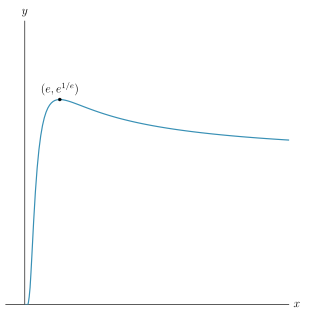
- Sketch a graph of \(y = x^{\frac{1}{x}}\) for \(x > 0\), showing the location of any turning points. Find the maximum value of \(n^{\frac{1}{n}}\), where \(n\) is a positive integer.
- The people to be tested are split into \(r\) groups of size \(k\), with \(k > 1\) and \(rk = N\).
- In every group, a sample from each person in that group is mixed into one large sample, which is then tested.
- If the enzyme is not present in the combined sample from a group, no further testing of the people in that group is needed.
- If the enzyme is present in the combined sample from a group, a second sample from each person in that group is tested separately.
- Find, in terms of \(N\), \(k\) and \(p\), the expected number of tests.
- Given that \(N\) is a multiple of \(3\), find the largest value of \(p\) for which it is possible to find an integer value of \(k\) such that \(k > 1\) and the expected number of tests is at most \(N\). Show that this value of \(p\) is greater than \(\frac{1}{4}\).
- Show that, if \(pk\) is sufficiently small, the expected number of tests is approximately \[ N\!\left(\frac{1}{k} + pk\right). \] In the case where \(p = 0.01\), show that choosing \(k = 10\) gives an expected number of tests which is only about \(20\%\) of \(N\).
Solution:
- \(\,\)
\begin{align*} && y & = x^{1/x} = \exp \left ( \tfrac1x \ln x \right ) \\ \Rightarrow && y' &= \exp \left ( \tfrac1x \ln x \right ) \cdot \left ( \frac{1}{x^2} - \frac{\ln x}{x^2} \right ) \\ &&&= \frac{\exp \left ( \tfrac1x \ln x \right ) }{x^2}(1 - \ln x) \\ y' =0: && x &= e \end{align*} Therefore the largest integer values will be \(2\) or \(3\). Comparing \((2^{\frac12})^6 = 8 < 9 = (3^{1/3})^6\) we see the maximum value of \(n^{1/n}\) where \(n\) is an integer is \(\sqrt[3]{3}\)
- The number of tests is \(r\) plus however many groups fail times \(k\). The probability of a group failing is \(g = 1-(1-p)^k\) and the number of failing groups is \(\sim B(r, g)\) so the expected number of additional groups is \(rg\) and the expected total number of tests is \[ \frac{N}{k} + N(1-(1-p)^k) \]
- \(\,\) \begin{align*} && N &\geq E = \frac{N}{k} + N(1-(1-p)^k) \\ \Rightarrow && 1 &\geq \frac{1}{k} + 1-(1-p)^k \\ \Rightarrow && (1-p)^k &\geq \frac1k \\ \Rightarrow && k \ln(1-p) &\geq - \ln k \\ \Rightarrow && \ln(1 - p) &\geq -\frac{1}{k} \ln k \geq -\frac13 \ln 3 \\ \Rightarrow && 1-p &\geq \frac{1}{\sqrt[3]{3}} \\ \Rightarrow && p &\leq 1-\frac{1}{\sqrt[3]{3}} \end{align*} (taking \(k=3\)) Claim: \(1 - \frac{1}{\sqrt[3]{3}} > \frac14\) Proof: This is equivalent to \(\sqrt[3]{3} > \frac43\) or \(81 > 4^3 = 64\) which is clearly true.
- If \(pk\) is small then \((1-p)^k \approx 1 - pk\) and so we obtain \(N \left ( \frac1k +pk \right)\) as required. If \(p = 0.01\) and \(k = 10\) then \(\frac{1}{10} + 0.01 \cdot 10 = 0.2\) so the expected number of tests is \(\sim 20\%\) of \(N\)
2024 Paper 3 Q3
Throughout this question, consider only \(x > 0\).
- Let
\[\mathrm{g}(x) = \ln\left(1 + \frac{1}{x}\right) - \frac{x+c}{x(x+1)}\]
where \(c \geqslant 0\).
- Show that \(y = \mathrm{g}(x)\) has positive gradient for all \(x > 0\) when \(c \geqslant \frac{1}{2}\).
- Find the values of \(x\) for which \(y = \mathrm{g}(x)\) has negative gradient when \(0 \leqslant c < \frac{1}{2}\).
- It is given that, for all \(c > 0\), \(\mathrm{g}(x) \to -\infty\) as \(x \to 0\).
Sketch, for \(x > 0\), the graphs of
\[y = \mathrm{g}(x)\]
in the cases
- \(c = \frac{3}{4}\),
- \(c = \frac{1}{4}\).
- The function \(\mathrm{f}\) is defined as
\[\mathrm{f}(x) = \left(1 + \frac{1}{x}\right)^{x+c}.\]
Show that, for \(x > 0\),
- \(\mathrm{f}\) is a decreasing function when \(c \geqslant \frac{1}{2}\);
- \(\mathrm{f}\) has a turning point when \(0 < c < \frac{1}{2}\);
- \(\mathrm{f}\) is an increasing function when \(c = 0\).
2023 Paper 2 Q3
Let \(\mathrm{p}(x)\) be a polynomial of degree \(n\) with \(\mathrm{p}(x) > 0\) for all \(x\) and let \[\mathrm{q}(x) = \sum_{k=0}^{n} \mathrm{p}^{(k)}(x)\,,\] where \(\mathrm{p}^{(k)}(x) \equiv \dfrac{\mathrm{d}^k \mathrm{p}(x)}{\mathrm{d}x^k}\) for \(k \geqslant 1\) and \(\mathrm{p}^{(0)}(x) \equiv \mathrm{p}(x)\).
- Explain why \(n\) must be even and show that \(\mathrm{q}(x)\) takes positive values for some values of \(x\).
- Show that \(\mathrm{q}'(x) = \mathrm{q}(x) - \mathrm{p}(x)\).
- In this part you will be asked to show the same result in three different ways.
- Show that the curves \(y = \mathrm{p}(x)\) and \(y = \mathrm{q}(x)\) meet at every stationary point of \(y = \mathrm{q}(x)\). Hence show that \(\mathrm{q}(x) > 0\) for all \(x\).
- Show that \(\mathrm{e}^{-x}\mathrm{q}(x)\) is a decreasing function. Hence show that \(\mathrm{q}(x) > 0\) for all \(x\).
- Show that \[\int_0^{\infty} \mathrm{p}(x+t)\mathrm{e}^{-t}\,\mathrm{d}t = \mathrm{p}(x) + \int_0^{\infty} \mathrm{p}^{(1)}(x+t)\mathrm{e}^{-t}\,\mathrm{d}t\,.\] Show further that \[\int_0^{\infty} \mathrm{p}(x+t)\mathrm{e}^{-t}\,\mathrm{d}t = \mathrm{q}(x)\,.\] Hence show that \(\mathrm{q}(x) > 0\) for all \(x\).
2023 Paper 3 Q6
- By considering the Maclaurin series for \(\mathrm{e}^x\), show that for all real \(x\), \[\cosh^2 x \geqslant 1 + x^2.\] Hence show that the function \(\mathrm{f}\), defined for all real \(x\) by \(\mathrm{f}(x) = \tan^{-1} x - \tanh x\), is an increasing function. Sketch the graph \(y = \mathrm{f}(x)\).
- Function \(\mathrm{g}\) is defined for all real \(x\) by \(\mathrm{g}(x) = \tan^{-1} x - \frac{1}{2}\pi \tanh x\).
- Show that \(\mathrm{g}\) has at least two stationary points.
- Show, by considering its derivative, that \((1+x^2)\sinh x - x\cosh x\) is non-negative for \(x \geqslant 0\).
- Show that \(\dfrac{\cosh^2 x}{1+x^2}\) is an increasing function for \(x \geqslant 0\).
- Hence or otherwise show that \(\mathrm{g}\) has exactly two stationary points.
- Sketch the graph \(y = \mathrm{g}(x)\).
2021 Paper 2 Q8
- Show that, for \(n = 2, 3, 4, \ldots\), \[ \frac{d^2}{dt^2}\bigl[t^n(1-t)^n\bigr] = n\,t^{n-2}(1-t)^{n-2}\bigl[(n-1) - 2(2n-1)t(1-t)\bigr]. \]
- The sequence \(T_0, T_1, \ldots\) is defined by \[ T_n = \int_0^1 \frac{t^n(1-t)^n}{n!}\,e^t\,dt. \] Show that, for \(n \geqslant 2\), \[ T_n = T_{n-2} - 2(2n-1)T_{n-1}. \]
- Evaluate \(T_0\) and \(T_1\) and deduce that, for \(n \geqslant 0\), \(T_n\) can be written in the form \[ T_n = a_n + b_n e, \] where \(a_n\) and \(b_n\) are integers (which you should not attempt to evaluate).
- Show that \(0 < T_n < \dfrac{e}{n!}\) for \(n \geqslant 0\). Given that \(b_n\) is non-zero for all~\(n\), deduce that \(\dfrac{-a_n}{b_n}\) tends to \(e\) as \(n\) tends to infinity.
2021 Paper 3 Q6
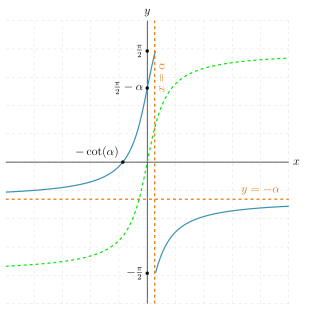
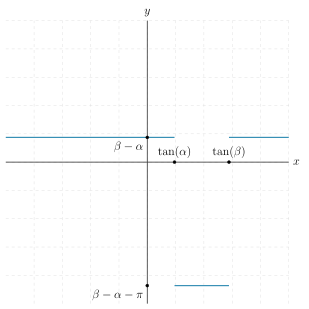
- For \(x \neq \tan\alpha\), the function \(f_\alpha\) is defined by \[ f_\alpha(x) = \tan^{-1}\!\left(\frac{x\tan\alpha + 1}{\tan\alpha - x}\right) \] where \(0 < \alpha < \tfrac{1}{2}\pi\). Show that \(f_\alpha'(x) = \dfrac{1}{1 + x^2}\). Hence sketch \(y = f_\alpha(x)\). On a separate diagram, sketch \(y = f_\alpha(x) - f_\beta(x)\) where \(0 < \alpha < \beta < \tfrac{1}{2}\pi\).
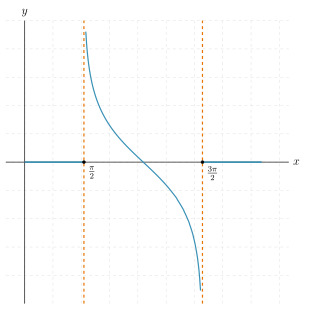
- For \(0 \leqslant x \leqslant 2\pi\) and \(x \neq \tfrac{1}{2}\pi,\, \tfrac{3}{2}\pi\), the function \(g(x)\) is defined by \[ g(x) = \tanh^{-1}(\sin x) - \sinh^{-1}(\tan x). \] For \(\tfrac{1}{2}\pi < x < \tfrac{3}{2}\pi\), show that \(g'(x) = 2\sec x\). Use this result to sketch \(y = g(x)\) for \(0 \leqslant x \leqslant 2\pi\).
Solution:
- \(\,\) \begin{align*}
&& f_\alpha(x) &= \tan^{-1}\!\left(\frac{x\tan\alpha + 1}{\tan\alpha - x}\right) \\
&& f'_\alpha(x) &= \frac{1}{1 + \left(\frac{x\tan\alpha + 1}{\tan\alpha - x}\right) ^2} \cdot \frac{\tan \alpha \cdot (\tan \alpha - x) - (x \tan \alpha + 1) \cdot (-1)}{(\tan \alpha - x)^2} \\
&&&= \frac{\tan^2 \alpha -1}{(\tan \alpha - x)^2 + (x \tan \alpha +1)^2} \\
&&&= \frac{\tan^2 \alpha +1}{\tan^2 \alpha - 2x \tan \alpha + x^2 + x^2 \tan^2 \alpha + 2 x \tan \alpha + 1} \\
&&&= \frac{1+\tan^2 \alpha}{(1+\tan^2 \alpha(x^2 + 1)} = \frac{1}{1+x^2}
\end{align*}
- Let \(g(x) = \tanh^{-1}(\sin x) - \sinh^{-1}(\tan x)\) then
\begin{align*}
&& g'(x) &= \frac{1}{1-\sin^2 x} \cdot \cos x - \frac{1}{\sqrt{\tan^2 +1}} \cdot \sec^2 x \\
&&&= \sec x - \frac{\sec^2 x}{|\sec x|} \\
&&& = \begin{cases} 0 &\text{if } \sec x \geq 0 \\
2 \sec x &\text{ otherwise}
\end{cases}
\end{align*}
Therefore \(g'(x) = 2\sec x\) if \(\tfrac12 \pi < x < \tfrac32\pi\)
Therefore $\displaystyle g(x) = \begin{cases} 0 & \text{if } x \in [0, \frac{\pi}{2}] \cup [\frac{3\pi}{2}, 2\pi] \\
\ln( (\tan x + \sec x)^2) + C &\text{otherwise} \end{cases}$
2020 Paper 3 Q5
Show that for positive integer \(n\), \(x^n - y^n = (x-y)\displaystyle\sum_{r=1}^{n} x^{n-r} y^{r-1}\).
- Let \(\mathrm{F}\) be defined by
\[ \mathrm{F}(x) = \frac{1}{x^n(x-k)} \quad \text{for } x \neq 0,\, k \]
where \(n\) is a positive integer and \(k \neq 0\).
- Given that \[ \mathrm{F}(x) = \frac{A}{x-k} + \frac{\mathrm{f}(x)}{x^n}, \] where \(A\) is a constant and \(\mathrm{f}(x)\) is a polynomial, show that \[ \mathrm{f}(x) = \frac{1}{x-k}\left(1 - \left(\frac{x}{k}\right)^n\right). \] Deduce that \[ \mathrm{F}(x) = \frac{1}{k^n(x-k)} - \frac{1}{k}\sum_{r=1}^{n} \frac{1}{k^{n-r}x^r}. \]
- By differentiating \(x^n \mathrm{F}(x)\), prove that \[ \frac{1}{x^n(x-k)^2} = \frac{1}{k^n(x-k)^2} - \frac{n}{xk^n(x-k)} + \sum_{r=1}^{n} \frac{n-r}{k^{n+1-r}x^{r+1}}. \]
- Hence evaluate the limit of \[ \int_2^N \frac{1}{x^3(x-1)^2} \; \mathrm{d}x \] as \(N \to \infty\), justifying your answer.
2019 Paper 1 Q1
A straight line passes through the fixed point \((1 , k)\) and has gradient \(- \tan \theta\), where \(k > 0\) and \(0 < \theta < \frac{1}{2}\pi\). Find, in terms of \(\theta\) and \(k\), the coordinates of the points \(X\) and \(Y\) where the line meets the \(x\)-axis and the \(y\)-axis respectively.
- Find an expression for the area \(A\) of triangle \(OXY\) in terms of \(k\) and \(\theta\). (The point \(O\) is the origin.) You are given that, as \(\theta\) varies, \(A\) has a minimum value. Find an expression in terms of \(k\) for this minimum value.
- Show that the length \(L\) of the perimeter of triangle \(OXY\) is given by $$L = 1 + \tan \theta + \sec \theta + k(1 + \cot \theta + \cosec \theta).$$ You are given that, as \(\theta\) varies, \(L\) has a minimum value. Show that this minimum value occurs when \(\theta = \alpha\) where $$\frac{1 - \cos \alpha}{1 - \sin \alpha} = k.$$ Find and simplify an expression for the minimum value of \(L\) in terms of \(\alpha\).
Solution: \(y = (-\tan \theta)(x-1)+k\) so when \(x = 0\), \(y = k + \tan \theta\), so \(Y = (0, k+\tan \theta)\). When \(y = 0\), \(x = 1 + \frac{k}{\tan \theta}\)
- \(A = \frac12 (k+\tan \theta)\left ( 1 + \frac{k}{\tan \theta} \right) = k + \frac12 \left (\tan \theta + \frac{k^2}{\tan \theta} \right)\) Notice that \(x + \frac{k^2}{x} \geq 2 k\) by AM-GM, so the minimum is \(k + \frac12 \cdot 2k = 2k\)
- \(\,\) \begin{align*} L &= k + \tan \theta + 1 + k \cot \theta + \sqrt{(k + \tan \theta)^2 + \left (1 + \frac{k}{\tan \theta} \right)^2} \\ &= k + \tan \theta + 1 + k \cot \theta + \sqrt{k^2 + 2 k \tan \theta +\tan^2 \theta + 1 + 2k \cot \theta + k^2\cot^2 \theta} \\ &= k + \tan \theta + 1 + k \cot \theta + \sqrt{\sec^2 \theta+ 2k \sec\theta\cosec \theta + k^2\cosec^2 \theta} \\ &= k + \tan \theta + 1 + k \cot \theta +\sec \theta + k\cosec \theta\\ &= 1 + \tan \theta + \sec \theta + k (1 + \cot \theta + \cosec \theta) \end{align*} \begin{align*} && \frac{\d L}{\d \theta} &= \sec^2 \theta + \tan \theta \sec \theta + k(-\cosec^2 \theta - \cot \theta \cosec \theta ) \\ \Rightarrow && 0 &=\sec^2 \alpha+ \tan \theta \sec \alpha+ k(-\cosec^2 \alpha- \cot \alpha\cosec \alpha) \\ \Rightarrow && k &= \frac{\sec^2 \alpha+ \tan \alpha\sec \alpha}{\cosec^2 \alpha+ \cot \alpha\cosec \alpha} \\ &&&= \frac{\sin^2 \alpha(1 + \sin \alpha)}{\cos^2 \alpha (1+ \cos \alpha)} \\ &&&= \frac{(1-\cos^2 \alpha)(1 + \sin \alpha)}{(1-\sin^2 \alpha )(1+ \cos \alpha)} \\ &&&= \frac{1-\cos \alpha}{1-\sin \alpha} \\ \Rightarrow && L &= 1 + \tan \alpha + \sec \alpha + \frac{1-\cos \alpha}{1-\sin \alpha} \left (1 + \cot \alpha + \cosec \alpha \right) \\ &&&= \frac{1+\tan \alpha + \sec \alpha -\sin \alpha-\sin \alpha \tan \alpha-\tan \alpha}{1-\sin \alpha} + \\ &&&\quad \quad \frac{1+\cot \alpha + \cosec \alpha-\cos \alpha-\cos \alpha \cot \alpha -\cot \alpha}{1-\sin \alpha} \\ &&&= \frac{2+\sec \alpha(1-\sin^2 \alpha)-\sin \alpha + \cosec \alpha(1-\cos^2 \alpha)-\cos \alpha}{1-\sin \alpha} \\ &&&= \frac{2+\cos\alpha-\sin \alpha + \sin\alpha-\cos \alpha}{1-\sin \alpha} \\ &&&= \frac{2}{1-\sin \alpha} \end{align*}
2019 Paper 2 Q4
You are not required to consider issues of convergence in this question. For any sequence of numbers \(a_1, a_2, \ldots, a_m, \ldots, a_n\), the notation \(\prod_{i=m}^{n} a_i\) denotes the product \(a_m a_{m+1} \cdots a_n\).
- Use the identity \(2 \cos x \sin x = \sin(2x)\) to evaluate the product \(\cos(\frac{\pi}{9}) \cos(\frac{2\pi}{9}) \cos(\frac{4\pi}{9})\).
- Simplify the expression $$\prod_{k=0}^{n} \cos\left(\frac{x}{2^k}\right) \quad (0 < x < \frac{1}{2}\pi).$$ Using differentiation, or otherwise, show that, for \(0 < x < \frac{1}{2}\pi\), $$\sum_{k=0}^{n} \frac{1}{2^k} \tan\left(\frac{x}{2^k}\right) = \frac{1}{2^n} \cot\left(\frac{x}{2^n}\right) - 2 \cot(2x).$$
- Using the results \(\lim_{\theta\to 0} \frac{\sin \theta}{\theta} = 1\) and \(\lim_{\theta\to 0} \frac{\tan \theta}{\theta} = 1\), show that $$\prod_{k=1}^{\infty} \cos\left(\frac{x}{2^k}\right) = \frac{\sin x}{x}$$ and evaluate $$\sum_{j=2}^{\infty} \frac{1}{2^{j-2}} \tan\left(\frac{\pi}{2^j}\right).$$
Solution:
- \begin{align*}\cos(\frac{\pi}{9}) \cos(\frac{2\pi}{9}) \cos(\frac{4\pi}{9}) &= \frac{\sin(\frac{2\pi}{9}) \cos(\frac{2\pi}{9}) \cos(\frac{4\pi}{9})}{2 \sin \frac{\pi}{9}} \\ &= \frac{\sin(\frac{4\pi}{9})\cos(\frac{4\pi}{9})}{4 \sin \frac{\pi}{9}} \\ &= \frac{\sin(\frac{8\pi}{9})}{8 \sin \frac{\pi}{9}} \\ &= \frac{1}{8} \end{align*}
- Let \(\displaystyle P_n = \prod_{k=0}^{n} \cos\left(\frac{x}{2^k}\right)\). Claim: \(P_n = \frac{\sin 2x}{2^{n+1} \sin \l \frac{x}{2^n} \r}\). Proof: This is true for \(n = 0\), assume true for \(n-1\) \begin{align*} \sin\l \frac{x}{2^{n}} \r P_n &= P_{n-1} \cos\l \frac{x}{2^{n}} \r \sin\l \frac{x}{2^{n}} \r \\ &= P_{n-1} \frac{1}{2} \sin\l \frac{x}{2^{n-1}} \r \\ &= \frac{\sin 2x}{2^{n} \sin \l \frac{x}{2^{n-1}}\r} \frac{1}{2} \sin\l \frac{x}{2^{n}} \r \\ &= \frac{\sin 2x}{2^{n+1}} \end{align*} Hence \(P_n = \frac{\sin 2x}{2^{n+1} \sin \l \frac{x}{2^n}\r}\) Taking logs, we determine that: \begin{align*} && \sum_{k=0}^n \ln \cos \l \frac{x}{2^k} \r &= \ln \sin 2x - \ln \sin \l \frac{x}{2^n} \r - (n+1) \ln 2 \\ \Rightarrow && \sum_{k=0}^n \frac{1}{2^k} \tan \l \frac{x}{2^k} \r &= -2 \cot 2x + \frac{1}{2^n} \cot \l \frac{x}{2^n} \r - 0 \\ \end{align*} as required.
- As \(n \to \infty\) \(\frac{x}{2^n} \to 0\), so \(\frac{\sin \frac{x}{2^n}}{\frac{x}{2^n}} = \frac{2^n \sin \frac{x}{2^n}}{x} \to 1\) \begin{align*}\prod_{k=1}^{\infty} \cos\left(\frac{x}{2^k}\right) &= \lim_{n \to \infty} \frac{\sin x}{2^n \sin \l \frac{x}{2^n} \r} \\ &= \lim_{n \to \infty} \frac{\sin x}{x \frac{2^n \sin \l \frac{x}{2^n} \r}{x} } \\ &= \lim_{n \to \infty} \frac{\sin x}{x} \\ \end{align*} \begin{align*} \sum_{j=2}^{\infty} \frac{1}{2^{j-2}} \tan\left(\frac{\pi}{2^j}\right) &= \sum_{j=0}^{\infty} \frac{1}{2^{j}} \tan\left(\frac{1}{2^j}\frac{\pi}{4}\right) \\ &= \lim_{n \to \infty} \l -2 \cot \frac{\pi}{2} + \frac{1}{2^n} \cot \l \frac{\pi}{4 \cdot 2^n} \r\r \\ &= \frac{4}{\pi} \lim_{n \to \infty} \l \frac{1}{2^n} \frac{\pi}{4} \cot \l \frac{\pi}{4 \cdot 2^n} \r\r \\ &\to \frac{\pi}{4} \end{align*}
2018 Paper 1 Q4
The function \(\f\) is defined by \[ \phantom{\ \ \ \ \ \ \ \ \ \ \ \ (x>0, \ \ x\ne1)} \f(x) = \frac{1}{x\ln x} \left(1 - (\ln x)^2 \right)^2 \ \ \ \ \ \ \ \ \ \ \ \ (x>0, \ \ x\ne1) \,.\] Show that, when \(( \ln x )^2 = 1\,\), both \(\f(x)=0\) and \(\f'(x)=0\,\). The function \(F\) is defined by \begin{align*} F(x) = \begin{cases} \displaystyle \int_{ 1/\text{e}}^x \f(t) \; \mathrm{d}t & \text{ for } 0 < x < 1\,, \\[7mm] \displaystyle \int_{\text{e}}^x \f(t) \; \mathrm{d}t & \text{ for } x > 1\,. \\ \end{cases} \end{align*}
- Find \(F(x)\) explicitly and hence show that \(F(x^{-1})=F(x)\,\).
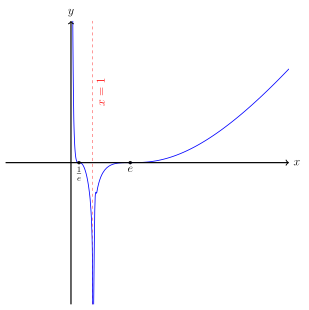
- Sketch the curve with equation \(y=F(x)\,\). [You may assume that \(\dfrac{ (\ln x)^k} x\to 0\) as \(x\to\infty\) for any constant \(k\).]
Solution: When \((\ln x)^2 = 1\) we have \(f(x) = \frac{1}{x\ln x}(1 - 1^2)^2 = 0\) \(f'(x) = \frac{2(1 - (\ln x)^2) \cdot (-2 \ln x ) \cdot \frac1x \cdot (x \ln x) - (\ln x +1)(1-(\ln x)^2)^2}{(x\ln x)^2} = \frac{2\cdot 0 \cdot (-2 \ln x ) \cdot \frac1x \cdot (x \ln x) - (\ln x +1) \cdot 0}{(x\ln x)^2} = 0\)
- First consider \(0 < x < 1\), so \begin{align*} && F(x) &= \int_{1/e}^x f(t) \d t \\ &&&= \int_{1/e}^x \frac{1}{t\ln t} \left(1 - (\ln t)^2 \right)^2 \d t \\ u = \ln t, \d u = \frac1t \d t: &&&= \int_{u=-1}^{u=\ln x} \frac{1}{u}(1-u^2)^2 \d u \\ &&&= \int_{-1}^{\ln x} \left ( u^3 - 2u+\frac1u \right) \d u \\ &&&= \left [ \frac{u^4}{4} - u^2+ \ln |u| \right]_{-1}^{\ln x} \\ &&&= \frac{(\ln x)^4}{4} -(\ln x)^2 + \ln |\ln x| - \frac14+1 \end{align*} Now consider \(x > 1\) \begin{align*} && F(x) &= \int_{e}^x f(t) \d t \\ &&&= \int_{e}^x \frac{1}{t\ln t} \left(1 - (\ln t)^2 \right)^2 \d t \\ u = \ln t, \d u = \frac1t \d t: &&&= \int_{u=1}^{u=\ln x} \frac{1}{u}(1-u^2)^2 \d u \\ &&&= \int_{1}^{\ln x} \left ( u^3 - 2u+\frac1u \right) \d u \\ &&&= \left [ \frac{u^4}{4} - u^2+ \ln |u| \right]_{1}^{\ln x} \\ &&&= \frac{(\ln x)^4}{4} -(\ln x)^2 + \ln| \ln x| - \frac14+1 \end{align*} Notice that \begin{align*} F(x^{-1}) &= \frac{(\ln x^{-1})^4}{4} -(\ln x^{-1})^2 + \ln| \ln x^{-1}| - \frac14+1 \\ &= \frac{(-\ln x)^4}{4} -(-\ln x)^2 + \ln| -\ln x| - \frac14+1 \\ &= \frac{(\ln x)^4}{4} -(\ln x)^2 + \ln| \ln x| - \frac14+1 \\ &= F(x) \end{align*}
- \(\,\)
2018 Paper 2 Q3
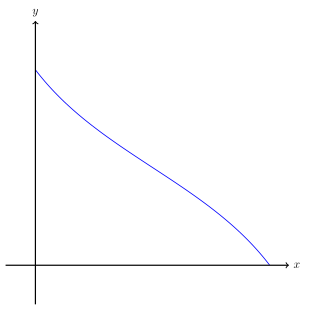
- Let \[ \f(x) = \frac 1 {1+\tan x} \] for \(0\le x < \frac12\pi\,\). Show that \(\f'(x)= -\dfrac{1}{1+\sin 2x}\) and hence find the range of \(\f'(x)\). Sketch the curve \(y=\f(x)\).
- The function \(\g(x)\) is continuous for \(-1\le x \le 1\,\). Show that the curve \(y=\g(x)\) has rotational symmetry of order 2 about the point \((a,b)\) on the curve if and only if \[ \g(x) + \g(2a-x) = 2b\,. \] Given that the curve \(y=\g(x)\) passes through the origin and has rotational symmetry of order 2 about the origin, write down the value of \[\displaystyle \int_{-1}^1 \g(x)\,\d x\,. \]
- Show that the curve \(y=\dfrac{1}{1+\tan^kx}\,\), where \(k\) is a positive constant and \(0 < x < \frac12\pi\,\), has rotational symmetry of order 2 about a certain point (which you should specify) and evaluate \[ \int_{\frac16\pi}^{\frac13\pi} \frac 1 {1+\tan^kx} \, \d x \,. \]
Solution:
- \(\,\) \begin{align*}
&& f(x) &= \frac1{1+\tan x} \\
&& f'(x) &=-(1+\tan x)^{-2} \cdot \sec^2 x \\
&&&= - (\cos x+ \sin x)^{-2} \\
&&&= - (1 + 2 \sin x \cos x)^{-1} \\
&&&= - \frac{1}{1+\sin 2x}
\end{align*}
\(\sin 2x \in [0, 1]\) so \(1+\sin 2x \in [1,2]\) and \(f'(x) \in [-1, -\tfrac12]\)
- \(\displaystyle \int_{-1}^1 g(x) \d x = 2g(0) \)
- Let \(g(x) = \frac{1}{1 + \tan^k x}\) then \(g(x)\) has rotational symmetry of order \(2\) about the point \((\frac{\pi}{4}, \frac12)\) which we can see since \begin{align*} g(x) + g(\tfrac12\pi - x) &= \frac{1}{1 + \tan^k x} + \frac{1}{1 + \tan^k(\tfrac12\pi - x)} \\ &= \frac{1}{1+\tan^k x} + \frac{1}{1+\cot^k x} \\ &= \frac{1}{1+\tan^k x} + \frac{\tan^k x}{\tan^k x + 1} \\ &= 1 = 2 \cdot \tfrac12 \end{align*} Therefore \[ \int_{\frac16\pi}^{\frac13\pi} \frac 1 {1+\tan^kx} \, \d x = \frac{\pi}{6} \cdot \frac12 = \frac{\pi}{12}\]
2018 Paper 3 Q2
The sequence of functions \(y_0\), \(y_1\), \(y_2\), \(\ldots\,\) is defined by \(y_0=1\) and, for \(n\ge1\,\), \[ y_n = (-1)^n \frac {1}{z} \, \frac{\d^{n} z}{\d x^n} \,, \] where \(z= \e^{-x^2}\!\).
- Show that \(\dfrac{\d y_n}{\hspace{-4.7pt}\d x} = 2x y_n -y_{n+1}\,\) for \(n\ge1\,\).
- Prove by induction that, for \(n\ge1\,\), \[ y_{n+1} = 2x y_n -2ny_{n-1} \,. \] Deduce that, for \(n\ge1\,\), \[ y_{n+1}^2 - {y}_n {y}_{n+2} = 2n (y_n^2 - y_{n-1}y_{n+1}) + 2 y_n^2 \,. \]
- Hence show that $y_{n}^2 - y^2_{n-1} y^2_{n+1} > 0\( for \)n \ge 1$.
Solution:
- \begin{align*} \frac{\d y_n}{\d x} &= \frac{\d}{\d x} \l (-1)^n e^{x^2} \frac{\d^n}{\d x^{n}} \l e^{-x^2}\r \r \\ &= (-1)^n 2xe^{x^2} \frac{\d^n}{\d x^{n}} \l e^{-x^2}\r + (-1)^n e^{x^2} \frac{\d^{n+1}}{\d x^{n+1}} \l e^{-x^2}\r \\ &= 2xy_n - (-1)^{n+1} e^{x^2} \frac{\d^{n+1}}{\d x^{n+1}} \l e^{-x^2}\r \\ &= 2xy_n - y_{n+1} \end{align*}
- \(y_0 = 1\), \(y_1 = (-1) e^{x^2} \cdot (-2x) \cdot e^{-x^2} = 2x\), \(y_2 = e^{x^2} \frac{\d^2}{\d x^2} \l e^{-x^2}\r = e^{x^2} \frac{\d }{\d x}\l -2xe^{-x^2} \r = e^{x^2} \l -2e^{-x^2}+4x^2e^{-x^2}\r = 4x^2-2\). Therefore \(2xy_1 - 2y_0 = 2x \cdot 2x - 2\cdot1 = 4x^2-2 = y_2\) so our statement is true for \(n=1\). Assume the statement is true for \(n=k\), then \begin{align*} && y_{k+1} &= 2xy_k - 2ky_{k-1} \\ \frac{\d }{\d x}: && \frac{\d y_{k+1}}{\d x} &= 2\frac{\d}{\d x}\l xy_k \r - 2k\frac{\d y_{k-1}}{\d x} \\ \Rightarrow && 2xy_{k+1}-y_{k+2} &= 2y_k+2x \l 2xy_k-y_{k+1}\r - 2k \l 2xy_{k-1}-y_k \r \\ \Rightarrow && y_{k+2} &=2y_k+ 4x \cdot y_{k+1}-(4x^2+2k)y_k+2x \cdot 2k y_{k-1} \\ &&&= 4x \cdot y_{k+1}-(4x^2+2(k+1))y_k+2x \l2xy_k - y_{k+1} \r \\ &&&= 2x \cdot y_{k+1} -2(k+1)y_k \end{align*} Therefore since our statement is true for \(n=1\) and if it is true for \(n=k\) it is true for \(n=k=1\), therefore by the principle of mathematical induction it is true for all \(n \geq 1\). Since \(2x = \frac{y_{n+1}+2ny_{n-1}}{y_n}\) for all \(n\), we must have \begin{align*} && \frac{y_{n+1}+2ny_{n-1}}{y_n} &= \frac{y_{n+2}+2(n+1)y_{n}}{y_{n+1}} \\ \Leftrightarrow && y_{n+1}^2+2ny_{n-1}y_{n+1} &= y_ny_{n+2}+2ny_n^2+2y_n^2 \\ \Leftrightarrow && y_{n+1}^2-y_ny_{n+2} &= 2n(y_n^2-y_{n-1}y_{n+1})+2y_n^2 \end{align*}
- Consider the functions \(f_n(x) = y_{n}^2-y_{n-1}y_{n+1}\) then clearly \(f_{n+1} = 2nf_{n} + 2y_n^2 \geq f_{n}\) so to prove \(f_n(x) > 0\) for \(n \geq 1\) it suffices to prove it for \(n = 1\). But \(f_1 = y_1^2 - y_0y_{2} = (2x)^2-(4x^2-2) = 2 > 0\) so we are done.
2017 Paper 1 Q5
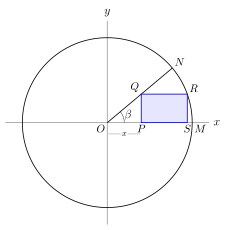
A circle of radius \(a\) is centred at the origin \(O\). A rectangle \(PQRS\) lies in the minor sector \(OMN\) of this circle where \(M\) is \((a,0)\) and \(N\) is \((a \cos \beta, a \sin \beta)\), and \(\beta\) is a constant with \(0 < \beta < \frac{\pi}{2}\,\). Vertex \(P\) lies on the positive \(x\)-axis at \((x,0)\); vertex \(Q\) lies on \(ON\); vertex \(R\) lies on the arc of the circle between \(M\) and \(N\); and vertex \(S\) lies on the positive \(x\)-axis at \((s,0)\). Show that the area \(A\) of the rectangle can be written in the form \[ A= x(s-x)\tan\beta \,. \] Obtain an expression for \(s\) in terms of \(a\), \(x\) and \(\beta\), and use it to show that \[ \frac{\d A}{\d x} = (s-2x) \tan \beta - \frac {x^2} s \tan^3\beta \,. \] Deduce that the greatest possible area of rectangle \(PQRS\) occurs when \(s= x(1+\sec\beta)\) and show that this greatest area is \(\tfrac12 a^2 \tan \frac12 \beta\,\). Show also that this greatest area occurs when \(\angle ROS = \frac12\beta\,\).
Solution: