2018 Paper 2 Q3
Year: 2018
Paper: 2
Question Number: 3
Course: LFM Pure
Section: Integration
Problem
- Let \[ \f(x) = \frac 1 {1+\tan x} \] for \(0\le x < \frac12\pi\,\). Show that \(\f'(x)= -\dfrac{1}{1+\sin 2x}\) and hence find the range of \(\f'(x)\). Sketch the curve \(y=\f(x)\).
- The function \(\g(x)\) is continuous for \(-1\le x \le 1\,\). Show that the curve \(y=\g(x)\) has rotational symmetry of order 2 about the point \((a,b)\) on the curve if and only if \[ \g(x) + \g(2a-x) = 2b\,. \] Given that the curve \(y=\g(x)\) passes through the origin and has rotational symmetry of order 2 about the origin, write down the value of \[\displaystyle \int_{-1}^1 \g(x)\,\d x\,. \]
- Show that the curve \(y=\dfrac{1}{1+\tan^kx}\,\), where \(k\) is a positive constant and \(0 < x < \frac12\pi\,\), has rotational symmetry of order 2 about a certain point (which you should specify) and evaluate \[ \int_{\frac16\pi}^{\frac13\pi} \frac 1 {1+\tan^kx} \, \d x \,. \]
Solution
- \(\,\) \begin{align*}
&& f(x) &= \frac1{1+\tan x} \\
&& f'(x) &=-(1+\tan x)^{-2} \cdot \sec^2 x \\
&&&= - (\cos x+ \sin x)^{-2} \\
&&&= - (1 + 2 \sin x \cos x)^{-1} \\
&&&= - \frac{1}{1+\sin 2x}
\end{align*}
\(\sin 2x \in [0, 1]\) so \(1+\sin 2x \in [1,2]\) and \(f'(x) \in [-1, -\tfrac12]\)
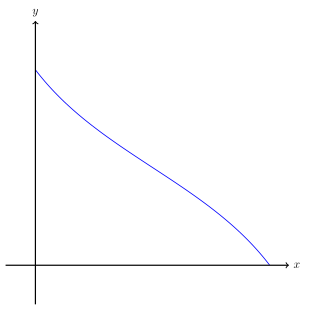
- \(\displaystyle \int_{-1}^1 g(x) \d x = 2g(0) \)
- Let \(g(x) = \frac{1}{1 + \tan^k x}\) then \(g(x)\) has rotational symmetry of order \(2\) about the point \((\frac{\pi}{4}, \frac12)\) which we can see since \begin{align*} g(x) + g(\tfrac12\pi - x) &= \frac{1}{1 + \tan^k x} + \frac{1}{1 + \tan^k(\tfrac12\pi - x)} \\ &= \frac{1}{1+\tan^k x} + \frac{1}{1+\cot^k x} \\ &= \frac{1}{1+\tan^k x} + \frac{\tan^k x}{\tan^k x + 1} \\ &= 1 = 2 \cdot \tfrac12 \end{align*} Therefore \[ \int_{\frac16\pi}^{\frac13\pi} \frac 1 {1+\tan^kx} \, \d x = \frac{\pi}{6} \cdot \frac12 = \frac{\pi}{12}\]
Examiner's report
— 2018 STEP 2, Question 3The pure questions were again the most popular of the paper, with only two of those questions being attempted by fewer than half of the candidates (none of the other questions was attempted by more than half of the candidates). Good responses were seen to all of the questions, but in many cases, explanations lacked sufficient detail to be awarded full marks. Candidates should ensure that they are demonstrating that the results that they are attempting to apply are valid in the cases being considered. In several of the questions, later parts involve finding solutions to situations that are similar to earlier parts of the question. In general candidates struggled to recognise these similarities and therefore spent a lot of time repeating work that had already been done, rather than simply observing what the result must be.
Rating Information
Difficulty Rating: 1600.0
Difficulty Comparisons: 0
Banger Rating: 1529.7
Banger Comparisons: 6
Show LaTeX source
Problem source
\begin{questionparts}
\item
Let
\[
\f(x)
 = \frac 1 {1+\tan x}
\]
for $0\le x < \frac12\pi\,$.
Show that $\f'(x)= -\dfrac{1}{1+\sin 2x}$ and hence find the
range of $\f'(x)$.
Sketch the curve $y=\f(x)$.
\item The function $\g(x)$ is continuous for $-1\le x \le 1\,$.
Show that the curve $y=\g(x)$ has  rotational
 symmetry of order 2
about
the point $(a,b)$ on the curve if and only if
\[
\g(x) + \g(2a-x) = 2b\,.
\]
Given that the curve $y=\g(x)$
passes through the origin and
has rotational
 symmetry of order 2
about the origin,
write
down the value of
\[\displaystyle \int_{-1}^1 \g(x)\,\d x\,.
\]
\item
Show that the curve $y=\dfrac{1}{1+\tan^kx}\,$,
where $k$ is a positive constant and $0  < x < \frac12\pi\,$,
 has rotational
symmetry of
order 2 about a certain point (which you should specify) and evaluate
\[
\int_{\frac16\pi}^{\frac13\pi} \frac 1 {1+\tan^kx} \, \d x
\,.
\]
\end{questionparts}
Solution source
\begin{questionparts}
\item $\,$ \begin{align*}
&& f(x) &= \frac1{1+\tan x} \\
&& f'(x) &=-(1+\tan x)^{-2} \cdot \sec^2 x \\
&&&= - (\cos x+ \sin x)^{-2} \\
&&&= - (1 + 2 \sin x \cos x)^{-1} \\
&&&= - \frac{1}{1+\sin 2x}
\end{align*}

$\sin 2x \in [0, 1]$ so $1+\sin 2x \in [1,2]$ and $f'(x) \in [-1, -\tfrac12]$


\begin{center}
    \begin{tikzpicture}
    \def\functionf(#1){1/(1+tan(deg(#1)))};
    \def\xl{-0.2};
    \def\xu{1.7};
    \def\yl{-.2};
    \def\yu{1.25};

    % Calculate scaling factors to make the plot square
    \pgfmathsetmacro{\xrange}{\xu-\xl}
    \pgfmathsetmacro{\yrange}{\yu-\yl}
    \pgfmathsetmacro{\xscale}{10/\xrange}
    \pgfmathsetmacro{\yscale}{10/\yrange}

    % Define the styles for the axes and grid
    \tikzset{
        axis/.style={very thick, ->},
        grid/.style={thin, gray!30},
        x=\xscale cm,
        y=\yscale cm
    }

    % Define the bounding region with clip
    \begin{scope}
        % You can modify these values to change your plotting region
        \clip (\xl,\yl) rectangle (\xu,\yu);

        % Draw a grid (optional)
        % \draw[grid] (-5,-3) grid (5,3);


        \draw[thick, blue, smooth, domain=0:{pi/2}, samples=100]
            plot (\x, {\functionf(\x)});

    \end{scope}

    % Set up axes
    \draw[axis] (\xl,0) -- (\xu,0) node[right] {$x$};
    \draw[axis] (0,\yl) -- (0,\yu) node[above] {$y$};

    \end{tikzpicture}
\end{center}

\item $\displaystyle \int_{-1}^1 g(x) \d x = 2g(0) $

\item Let $g(x) = \frac{1}{1 + \tan^k x}$ then $g(x)$ has rotational symmetry of order $2$ about the point $(\frac{\pi}{4}, \frac12)$ which we can see since

\begin{align*}
g(x) + g(\tfrac12\pi - x) &= \frac{1}{1 + \tan^k x} + \frac{1}{1 + \tan^k(\tfrac12\pi - x)} \\
&= \frac{1}{1+\tan^k x} + \frac{1}{1+\cot^k x} \\
&= \frac{1}{1+\tan^k x} + \frac{\tan^k x}{\tan^k x + 1} \\
&= 1 = 2 \cdot \tfrac12
\end{align*}

Therefore
\[ \int_{\frac16\pi}^{\frac13\pi} \frac 1 {1+\tan^kx} \, \d x = \frac{\pi}{6} \cdot \frac12 = \frac{\pi}{12}\]
\end{questionparts}
The first part of this question was well attempted in general, although some solutions required more care to be taken to check whether or not the extreme values are included within the range or not. Many solutions to part (ii) did not generally include very clear explanations of the method and candidates often did not make it clear that they had demonstrated the result in both directions. For the final part, candidates often did not find the "certain point" referred to in the question and instead tried to work with a general point ( , ). Some candidates also attempted to calculate the integral directly rather than making use of the fact that the graph has rotational symmetry.