Problems
Filters
107 problems found
2025 Paper 2 Q7
The differential equation \[\frac{d^2x}{dt^2} = 2x\frac{dx}{dt}\] describes the motion of a particle with position \(x(t)\) at time \(t\). At \(t = 0\), \(x = a\), where \(a > 0\).
- Solve the differential equation in the case where \(\frac{dx}{dt} = a^2\) when \(t = 0\). What happens to the particle as \(t\) increases from 0?
- Solve the differential equation in the case where \(\frac{dx}{dt} = a^2 + p\) when \(t = 0\), where \(p > 0\). What happens to the particle as \(t\) increases from 0?
- Solve the differential equation in the case where \(\frac{dx}{dt} = a^2 - q^2\) when \(t = 0\), where \(q > 0\). What happens to the particle as \(t\) increases from 0? Give conditions on \(a\) and \(q\) for the different cases which arise.
Solution: Let \(v = \frac{\d x}{\d t}\) and notice that \(\frac{\d}{\d t} \left ( \frac{\d x}{\d t} \right) = \frac{\d }{\d x} \left ( v \right) \frac{\d x}{\d t} = v \frac{\d v}{\d x}\). Also notice that: \begin{align*} && v \frac{\d v}{\d x} &= 2x v \\ \Rightarrow && \frac{\d v}{\d x} &= 2x \\ \Rightarrow && v &= x^2 + C \\ \Rightarrow && \frac{\d x}{\d t} &= x^2 + C \\ \end{align*}
- When \(t = 0, \frac{\d x}{\d t} = a^2\) so \(C = 0\), therefore \(\frac{\d x}{\d t} = x^2 \Rightarrow t = -x^{-1} + k\) and so \(k = a^{-1}\) and \(x = \frac{a}{1-at}\). As \(t\) increases from \(0\) the particle heads to infinity at an increasing rate, `reaching' infinity around \(t=\frac{1}{a}\)
- When \(t = 0, \frac{\d x}{\d t} = a^2 + p\) so \(C = p\). Therefore \(\frac{\d x}{\d t} = x^2 + p \Rightarrow t = \frac{1}{\sqrt{p}} \tan^{-1} \left ( \frac{x}{\sqrt{p}} \right) + c\). When \(c = - \frac{1}{\sqrt{p}} \tan^{-1} \left ( \frac{a}{\sqrt{p}} \right)\), so \begin{align*} && t &= \frac{1}{\sqrt{p}} \tan^{-1} \left ( \frac{x}{\sqrt{p}} \right) - \frac{1}{\sqrt{p}} \tan^{-1} \left ( \frac{a}{\sqrt{p}} \right) \\ &&&= \frac{1}{\sqrt{p}} \tan^{-1} \left ( \frac{\sqrt{p}(x-a)}{\sqrt{p}-ax} \right) \\ \Rightarrow && \frac{\sqrt{p}(x-a)}{\sqrt{p}-ax} &= \tan (\sqrt{p} t) \\ \Leftrightarrow && \sqrt{p}(x-a) &= \tan (\sqrt{p} t)(\sqrt{p}-ax) \\ \Leftrightarrow && x(\sqrt{p}+a\tan (\sqrt{p} t)) &= \sqrt{p} (\tan(\sqrt{p}t) + a) \\ \Leftrightarrow && x &= \frac{\sqrt{p} (\tan(\sqrt{p}t) + a)}{\sqrt{p}+a\tan (\sqrt{p} t)} \end{align*} The particle heads to \(\frac{\sqrt{p}}{a}\).
- When \(t = 0, \frac{\d x}{\d t} = a^2-q^2\) so \(C = -q^2\). Therefore \begin{align*} && \frac{\d x}{\d t} &= x^2 -q^2 \\ \Rightarrow && \int \d t &= \int \frac{1}{(x-q)(x+q)} \d x \\ &&&= \frac{1}{2q} \int \left ( \frac{1}{x-q}- \frac{1}{x+q} \right )\d x \\ &&&= \frac{1}{2q} \left ( \ln (x-q) - \ln(x+q) \right) \\ &&&= \frac{1}{2q} \ln \left ( \frac{x-q}{x+q} \right)\\ \Rightarrow && \frac{x-q}{x+q} &= Ae^{2qt} \\ \underbrace{\Rightarrow}_{t= 0} && A &= \frac{a-q}{a+q} \\ \Rightarrow && x-q &= \frac{a-q}{a+q}e^{2qt}(x+q) \\ \Leftrightarrow && x\left (1-\frac{a-q}{a+q}e^{2qt} \right) &= q\left (1 + \frac{a-q}{a+q}e^{2qt} \right) \\ \Leftrightarrow && x &= q \frac{1 + \frac{a-q}{a+q}e^{2qt}}{1-\frac{a-q}{a+q}e^{2qt}} \end{align*}
2025 Paper 3 Q10
A plank \(AB\) of length \(L\) initially lies horizontally at rest along the \(x\)-axis on a flat surface, with \(A\) at the origin. Point \(C\) on the plank is such that \(AC\) has length \(sL\), where \(0 < s < 1\). End \(A\) is then raised vertically along the \(y\)-axis so that its height above the horizontal surface at time \(t\) is \(h(t)\), while end \(B\) remains in contact with the flat surface and on the \(x\)-axis. The function \(h(t)\) satisfies the differential equation $$\frac{d^2h}{dt^2} = -\omega^2 h, \text{ with } h(0) = 0 \text{ and } \frac{dh}{dt} = \omega L \text{ at } t = 0$$ where \(\omega\) is a positive constant. A particle \(P\) of mass \(m\) remains in contact with the plank at point \(C\).
- Show that the \(x\)-coordinate of \(P\) is \(sL\cos\omega t\), and find a similar expression for its \(y\)-coordinate.
- Find expressions for the \(x\)- and \(y\)-components of the acceleration of the particle.
- \(N\) and \(F\) are the upward normal and frictional components, respectively, of the force of the plank on the particle. Show that $$N = mg(1 - k\sin\omega t)\cos\omega t$$ and that $$F = mgsk\frac{\omega^2}{g}\tan\omega t$$ where \(k = \frac{L\omega^2}{g}\).
- The coefficient of friction between the particle and the plank is \(\tan\alpha\), where \(\alpha\) is an acute angle.
Show that the particle will not slip initially, provided \(sk < \tan\alpha\).
Show further that, in this case, the particle will slip
- while \(N\) is still positive,
- when the plank makes an angle less than \(\alpha\) to the horizontal.
Solution:
- Since we have \(h'' + \omega^2 h = 0\) we must have that \(h(t) = A \cos \omega t + B \sin \omega t\). The initial conditions tell us that \(A = 0\) and \(B = L\), so \(h(t) = L \sin \omega t\).
Therefore we can see the angle at \(B\) is \(\omega t\) and so \(P\) has \(y\)-coordinate \((1-s)L \sin \omega t\) and \(x\)-coordinate \(sL \cos \omega t\)
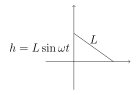
- If the position is \(\binom{sL \cos \omega t}{(1-s) L \sin \omega t}\) then the acceleration is \(-\omega^2 \binom{sL \cos \omega t}{(1-s) L \sin \omega t}\)
- \begin{align*} \text{N2}(\rightarrow): && - F\cos \omega t + N \sin \omega t &= -m\omega^2 sL \cos \omega t\\ \text{N2}(\uparrow): && -mg + F\sin \omega t + N \cos \omega t &= -m\omega^2 (1-s) L \sin \omega t \\ \Rightarrow && \begin{pmatrix} \cos \omega t & -\sin \omega t \\ \sin \omega t & \cos \omega t \end{pmatrix} \begin{pmatrix} F \\ N \end{pmatrix} &= \begin{pmatrix} m\omega^2 s L \cos \omega t \\ mg - m\omega^2(1-s)L \sin \omega t \end{pmatrix} \\ \Rightarrow && \begin{pmatrix}F \\ N \end{pmatrix} &= \begin{pmatrix} \cos \omega t & \sin \omega t \\ -\sin \omega t & \cos \omega t \end{pmatrix} \begin{pmatrix} m\omega^2 s L \cos \omega t \\ mg - m\omega^2(1-s)L \sin \omega t \end{pmatrix} \\ \Rightarrow && N &= m \omega^2 s L (-\sin \omega t \cos \omega t) + mg \cos \omega t - m \omega^2 (1-s)L \sin \omega t \cos \omega t \\ &&&=mg \cos \omega t - m \omega^2 L \sin \omega t \cos \omega t \\ &&&= mg \cos \omega t \left (1 - \frac{L \omega^2}{g} \sin \omega t \right) \\ &&&= mg (1 - k \sin \omega t) \cos \omega t \\ \Rightarrow && F &= m \omega^2 s L \cos^2 \omega t + mg \sin \omega t - m \omega^2 (1-s) L \sin ^2 \omega t \\ &&&= m \omega^2 s L + mg \sin \omega t - m \omega^2 L \sin^2 \omega t \\ &&&= mg \frac{\omega^2 L}{g} s + mg(1-\frac{\omega^2 L}{g} \sin \omega t)\sin \omega t \\ &&&= mg sk + mg(1-k \sin \omega t) \cos \omega t \tan \omega t \\ &&&= mgsk + N \tan \omega t \end{align*}
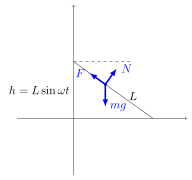
- The particle will not slip if \(F < \tan \alpha N\). When \(t = 0\), \(N = mg, F = mgsk\), but clearly \(sk < \tan \alpha \Rightarrow mgsk = F < \tan \alpha mg = \tan \alpha N\). The particle will slip when: \(F > \tan \alpha N\), but we have \(F = mgsk + N \tan \omega t\). Clearly when \(\omega t = \alpha\) we have reached a point where \(F > \tan \alpha N\). Therefore we must slip before we reach this point, ie at a point where the plank makes an angle of less than \(\alpha\) to the horizontal. Notice also that \(N\) changes sign when \(1-k \sin \omega t = 0\), however, to do this \(N\) must become very small, smaller than \(mgsk\), therefore we must slip before this point too. Since we slip before either condition occurs, we must be in a position when \(N\) is positive AND the plank still makes a shallow angle.
2019 Paper 2 Q6
Note: You may assume that if the functions \(y_1(x)\) and \(y_2(x)\) both satisfy one of the differential equations in this question, then the curves \(y = y_1(x)\) and \(y = y_2(x)\) do not intersect.
- Find the solution of the differential equation $$\frac{dy}{dx} = y + x + 1$$ that has the form \(y = mx + c\), where \(m\) and \(c\) are constants. Let \(y_3(x)\) be the solution of this differential equation with \(y_3(0) = k\). Show that any stationary point on the curve \(y = y_3(x)\) lies on the line \(y = -x - 1\). Deduce that solution curves with \(k < -2\) cannot have any stationary points. Show further that any stationary point on the solution curve is a local minimum. Use the substitution \(Y = y + x\) to solve the differential equation, and sketch, on the same axes, the solutions with \(k = 0\), \(k = -2\) and \(k = -3\).
- Find the two solutions of the differential equation $$\frac{dy}{dx} = x^2 + y^2 - 2xy - 4x + 4y + 3$$ that have the form \(y = mx + c\). Let \(y_4(x)\) be the solution of this differential equation with \(y_4(0) = -2\). (Do not attempt to find this solution.) Show that any stationary point on the curve \(y = y_4(x)\) lies on one of two lines that you should identify. What can be said about the gradient of the curve at points between these lines? Sketch the curve \(y = y_4(x)\). You should include on your sketch the two straight line solutions and the two lines of stationary points.
Solution:
- Looking for solution of the form \(y = mx+c\) we find that \(m = mx+c+x+1 \Rightarrow m = -1, c = -2\).
At stationary points \(\frac{\d y}{\d x} = 0 \Rightarrow y = -x-1\).
If \(y_3(0)= k < -2\) then the solution curve lies below \(y = -x-2\) and therefore it cannot cross \(y = -x -2\) to reach \(y = -x-1\) for a stationary point.
Suppose \(Y = y+x\) then \(\frac{\d Y}{\d x} = \frac{\d y}{\d x} + 1=Y+2 \Rightarrow Y = Ae^x-2 \Rightarrow y= (k+2)e^x-x-2\)

- \(\,\)
\begin{align*}
&& m &= x^2 + (mx+c)^2 -2x(mx+c) - 4x+4(mx+c) + 3 \\
&&0&= (m^2-2m+1)x^2+(2mc-2c-4+4m)x + (c^2+4c+3-m)\\
\Rightarrow && m &= 1 \\
\Rightarrow && 0 &= c^2+4c+2 \\
\Rightarrow &&&= (c+2)^2-2 \\
\Rightarrow && c &= -2 \pm \sqrt{2}
\end{align*}
Therefore the lines are \(y = x -2-\sqrt{2}\) and \(y = x -2+\sqrt{2}\).
Any stationary point will satisfy \(y' = 0\), ie \(0 = x^2+y^2-2xy-4x+4y+3 = (x-y)^2-4(x-y)+3 = (x-y-3)(x-y-1)\) therefore they must lie on \(y = x-1\) or \(y = x-3\). Any point between these lines must have negative gradient (since one factor is positive and one factor is negative).

2019 Paper 3 Q1
The coordinates of a particle at time \(t\) are \(x\) and \(y\). For \(t \geq 0\), they satisfy the pair of coupled differential equations \[ \begin{cases} \dot{x} &= -x -ky \\ \dot{y} &= x - y \end{cases}\] where \(k\) is a constant. When \(t = 0\), \(x = 1\) and \(y = 0\).
- Let \(k = 1\). Find \(x\) and \(y\) in terms of \(t\) and sketch \(y\) as a function of \(t\). Sketch the path of the particle in the \(x\)-\(y\) plane, giving the coordinates of the point at which \(y\) is greatest and the coordinates of the point at which \(x\) is least.
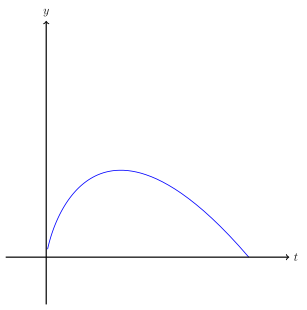
- Instead, let \(k = 0\). Find \(x\) and \(y\) in terms of \(t\) and sketch the path of the particle in the \(x\)-\(y\) plane.
Solution:
- Let \(k = 1\), then
\begin{align*}
\dot{x} &= - x - y \\
\dot{y} &= x - y \\
\dot{x}-\dot{y} &= -2x \\
\ddot{x} &= -\dot{x}-\dot{y} \\
&= -\dot{x} - (\dot{x}+2x) \\
&= -2\dot{x}- 2x \\
\dot{x}+\dot{y} &= -2y \\
\ddot{y} &= \dot{x}-\dot{y} \\
&= -2y-2\dot{y}
\end{align*}
So we have an auxiliary equation for \(x\) and \(y\) which is \(\lambda^2 + 2 \lambda+2 = 0 \Rightarrow \lambda = -1 \pm i\).
Therefore \(x = Ae^{-t} \cos t + B e^{-t} \sin t, y = Ce^{-t}\cos t + De^{-t} \sin t\). We also must have that, \(A = 1, C = 0\), so \(x = e^{-t} \cos t + Be^{-t} \sin t\) and \(y = De^{-t} \sin x\).
\begin{align*}
\dot{y} &= -De^{-t} \sin t +De^{-t} \cos t \\
&= e^{-t} \cos x + Be^{-t} \sin t- De^{-t} \sin t \\
\end{align*}
therefore \(B = 0, D = 1\) and \(x = e^{-t} \cos t, y = e^{-t} \sin t\)
\begin{align*} y &= e^{-t} \sin t \\ \dot{y} &= -e^{-t} \sin t + e^{-t} \cos t \\ \dot{x} &= e^{-t} \cos t -e^{-t} \sin t \end{align*}

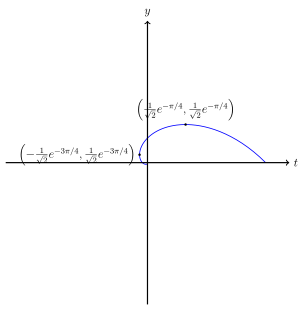
- \begin{align*}
\dot{x} = -x \\
\dot{y} = x-y
\end{align*}
So \(x = e^{-t}\). \(\dot{y} + y = e^{-t}\) so \(y = (t+B)e^{-t}\) and so \(y =te^{-t}\).
2019 Paper 3 Q2
The definition of the derivative \(f'\) of a (differentiable) function f is $$f'(x) = \lim_{h\to 0} \frac{f(x + h) - f(x)}{h}. \quad (*)$$
- The function f has derivative \(f'\) and satisfies $$f(x + y) = f(x)f(y)$$ for all \(x\) and \(y\), and \(f'(0) = k\) where \(k \neq 0\). Show that \(f(0) = 1\). Using \((*)\), show that \(f'(x) = kf(x)\) and find \(f(x)\) in terms of \(x\) and \(k\).
- The function g has derivative \(g'\) and satisfies $$g(x + y) = \frac{g(x) + g(y)}{1 + g(x)g(y)}$$ for all \(x\) and \(y\), \(|g(x)| < 1\) for all \(x\), and \(g'(0) = k\) where \(k \neq 0\). Find \(g'(x)\) in terms of \(g(x)\) and \(k\), and hence find \(g(x)\) in terms of \(x\) and \(k\).
Solution:
- \(\,\) \begin{align*} && f(0+x) &= f(0)f(x) \\ \Rightarrow && f(0) &= 0, 1\\ &&\text{since }f'(0) \neq 0 & \text{ there is some non-zero } f(x) \\ \Rightarrow && f(0) &= 1 \end{align*} \begin{align*} && f'(x) &= \lim_{h\to 0} \frac{f(x+h)-f(x)}{h} \\ &&&= \lim_{h\to 0} \frac{f(x)f(h)-f(x)}{h} \\ &&&= f(x) \cdot \lim_{h\to 0} \frac{f(h)-1}{h} \\ &&&= f(x) \cdot \lim_{h\to 0} \frac{f(0+h)-f(0)}{h} \\ &&&= f(x) \cdot f'(0) \\ &&&= kf(x) \end{align*} Since \(f'(x) = kf(x)\) we must have \(\frac{f'(x)}{f(x)} = k \Rightarrow \ln f(x) = kx + c \Rightarrow f(x) = Ae^{kx}\) but \(f(0) = 1\) so \(f(x) = e^{kx}\)
- Consider \begin{align*} && g(0+0) &= \frac{g(0)+g(0)}{1+(g(0))^2} \\ \Rightarrow && g(0)(1+(g(0))^2)&= 2g(0) \\ \Rightarrow && 0 &= g(0)\left (1- (g(0))^2 \right) \\ \Rightarrow && g(0) &= -1, 0, 1 \\ \Rightarrow && g(0) &= 0 \tag{\(|g(0)| < 1\)} \end{align*} \begin{align*} && g'(x) &=\lim_{h\to 0} \frac{g(x+h)-g(x)}{h} \\ &&&= \lim_{h\to 0} \frac{\frac{g(x)+g(h)}{1+g(x)g(h)}-g(x)}{h} \\ &&&= \lim_{h\to 0} \frac{g(x)+g(h)-g(x)(1+g(x)g(h))}{h(1+g(x)g(h))} \\ &&&= \lim_{h\to 0} \frac{g(h)-g(x)(g(x)g(h))}{h(1+g(x)g(h))} \\ &&&= (1-(g(x))^2) \cdot \lim_{h \to 0} \frac{1}{1+g(x)g(h)} \cdot \lim_{h \to 0} \frac{g(h)}{h} \\ &&&= (1-(g(x))^2) \cdot \frac{1}{1+g(x)\cdot 0} \cdot \lim_{h \to 0} \frac{g(h) - g(0)}{h} \\ &&&= (1-(g(x))^2) \cdot g'(0)\\ &&&= k (1-(g(x))^2) \\ \end{align*} Let \(y = g(x)\) so \begin{align*} && y' &= k(1-y^2) \\ \Rightarrow && kx &= \int \frac{1}{1-y^2} \d y \\ \Rightarrow &&&= \int \frac12\left ( \frac{1}{1-y} + \frac{1}{1+y} \right) \d y \\ &&&= \frac12\ln \left ( \frac{1+y}{1-y} \right) + C \\ x = 0, y = 0: && 0 &= \ln 1 + C \\ \Rightarrow && C &= 0 \\ \Rightarrow && \frac{1+y}{1-y} &= e^{2kx} \\ \Rightarrow && 1+y &= e^{2kx} - e^{2kx}y \\ \Rightarrow && y &= \frac{e^{2kx}-1}{e^{2kx}+1} \\ &&&= \tanh kx \end{align*}
2018 Paper 1 Q8
The functions \(\s\) and \(\c\) satisfy \(\s(0)= 0\,\), \(\c(0)=1\,\) and \[ \s'(x) = \c(x)^2 ,\] \[ \c'(x)=-\s(x)^2. \] You may assume that \(\s\) and \(\c\) are uniquely defined by these conditions.
- Show that \(\s(x)^3+\c(x)^3\) is constant, and deduce that \(\s(x)^3+\c(x)^3=1\,\).
- Show that \[ \frac{\d }{\d x} \, \Big( \s(x) \c(x) \Big) = 2\c(x)^3-1 \] and find (and simplify) an expression in terms of \(\c(x)\) for $\dfrac{\d }{\d x} \left( \dfrac{\s(x)}{\c(x)} \right) $.
- Find the integrals \[ \int \s(x)^2 \, \d x \ \ \ \ \ \ \text{and} \ \ \ \ \ \ \int \s(x)^5 \, \d x \,. \]
- Given that \(\s\) has an inverse function, \(\s^{-1}\), use the substitution \(u = \s(x)\) to show that \[ \int \frac{1}{(1-u^3)^{\frac{2}{3}}} \, \d u = \s^{-1}(u) \, + \text{constant}. \]
- Find, in terms of \(u\), the integrals \[ \int \frac{1}{{(1-u^3)}^{\frac{4}{3}}} \, \d u \ \ \ \ \ \ \text{and} \ \ \ \ \ \ \int {(1-u^3)}^{\frac{1}{3}} \, \d u \,. \]
Solution: \begin{questionparts} \item \begin{align*} && \dfrac{\d }{\d x} \left( \s(x)^3 + \c(x)^3 \right) &= 3\s(x)^2\s'(x) + 3\c(x)^2 \c'(x) \\ &&&= 3\s(x)^2\c(x)^2 - 3\c(x)^2\s(x)^2 \\ &&&= 0 \\ \\ \Rightarrow && \s(x)^3 + \c(x)^3 &= \text{constant} \\ &&&= \s(0)^3 + \c(0)^3 \\ &&&= 1 \end{align*} \item \begin{align*} \frac{\d }{\d x} \, \Big( \s(x) \c(x) \Big) &= \s'(x) \c(x) + \s(x)\c'(x) \\ &= \c(x)^3 - \s(x)^3 \\ &= \c(x)^3 - (1-\c(x)^3) \\ &= 2\c(x)^3 - 1 \\ \\ \dfrac{\d }{\d x} \left( \dfrac{\s(x)}{\c(x)} \right) &= \frac{\s'(x)\c(x) - \s(x)\c'(x)}{\c(x)^2} \\ &= \frac{\c(x)^3 + \s(x)^3}{\c(x)^2} \\ &= \frac{1}{\c(x)^2} \\ \end{align*} \item \begin{align*} \int \s(x)^2 \d x &= -\int -\s(x)^2 \d x \\ &= -\int \c'(x) \d x \\ &= - \s(x) +C \\ \\ \int \s(x)^5 \, \d x &= \int \s(x)^2 \s(x)^3 \d x \\ &= \int \s(x)^2 (1 - \c(x)^3) \d x \\ &= -\int \c'(x) (1 - \c(x)^3) \d x \\ &= - c(x) + \frac{\c(x)^4}{4} + C \end{align*} \item If \(u = \s(x), \frac{\d u}{\d x} = \c(x)^2\) \begin{align*} \int \frac{1}{(1-u^3)^{\frac{2}{3}}} \, \d u &= \int \frac{1}{(1-\s(x)^3)^{\frac{2}{3}}} \c(x)^2 \d x \\ &= \int 1 \d x \\ &= x + C \\ &= \s^{-1}(u) + C \\ \\ \int \frac{1}{{(1-u^3)^{\frac{4}{3}}}} \d u &= \int \frac1{(1-\s(x)^3)^{\frac43} }\c(x)^2 \d x \\ &= \int \frac1{(\c(x)^3)^{\frac43}} \c(x)^2 \d x \\ &= \int \frac1{\c(x)^2} \d x \\ &= \frac{\s(x)}{\c(x)} + C \\ &= \frac{u}{(1-u^3)^{\frac13}} + C \\ \end{align*} \begin{align*} && \int {(1-u^3)}^{\frac{1}{3}} \, \d u &= \int (1-s(x)^3)^{\frac13} c(x)^2 \d x \\ &&&= \int \c(x)^3 \d x = I\\ &&&= \int \c(x) s'(x) \d x \\ &&&= \left [\c(x) \s(x) \right] + \int \s(x)^2 s(x) \d x \\ &&&= \c(x) \s(x) + \int (1 - \c(x)^3) \d x + C \\ &&&= \c(x) \s(x) + x - I + C \\ \Rightarrow && I &= \frac{x + \c(x) \s(x)}{2} + k \\ \Rightarrow && &= \frac12 \l \s^{-1}(u) + u \sqrt[3](1-u^3)\r + k \end{align*}
2018 Paper 2 Q8
- Use the substitution \(v= \sqrt y\) to solve the differential equation \[ \frac{\d y}{\d t} = \alpha y^{\frac12} - \beta y \ \ \ \ \ \ \ \ \ \ (y\ge0, \ \ t\ge0) \,, \] where \(\alpha\) and \(\beta\) are positive constants. Find the non-constant solution \(y_1(x)\) that satisfies \(y_1(0)=0\,\).
- Solve the differential equation \[ \frac{\d y}{\d t} = \alpha y^{\frac23} - \beta y \ \ \ \ \ \ \ \ \ \ (y\ge0, \ \ t\ge0) \,, \] where \(\alpha\) and \(\beta\) are positive constants. Find the non-constant solution \(y_2(x)\) that satisfies \(y_2(0)=0\,\).
- In the case \(\alpha=\beta\), sketch \(y_1(x)\) and \(y_2(x)\) on the same axes, indicating clearly which is \(y_1(x)\) and which is \(y_2(x)\). You should explain how you determined the positions of the curves relative to each other.
Solution:
- Suppose \(v = \sqrt{y} \Rightarrow v^2 = y \Rightarrow 2v v' = y'\) so \begin{align*} && 2vv' &= \alpha v-\beta v^2 \\ \Rightarrow && 2v' &= \alpha - \beta v \\ \Rightarrow && v' + \frac{\beta}{2} v &= \frac{\alpha}{2} \\ \Rightarrow && \frac{\d}{\d t} \left (e^{\beta t/2} v \right) &= \frac{\alpha}{2} e^{\beta t/2} \\ \Rightarrow && e^{\beta t/2} v &=C+ \frac{\alpha}{\beta}e^{\beta t /2} \\ \Rightarrow && v &= Ce^{-\beta t/2} + \frac{\alpha}{\beta} \\ \Rightarrow && \sqrt{y} &= Ce^{-\beta t/2} + \frac{\alpha}{\beta} \\ y(0) = 0: && 0 &= C+\frac{\alpha}{\beta} \\ \Rightarrow && \sqrt{y} &= \frac{\alpha}{\beta} \left (1-e^{-\beta t/2} \right) \\ \Rightarrow && y &= \frac{ \alpha^2}{\beta^2} \left (1-e^{-\beta t/2} \right)^2 \end{align*}
- Try \(v = y^{1/3} \Rightarrow v^3 = y \Rightarrow 3v^2 v' = y'\) so \begin{align*} && y' &= \alpha v^2 - \beta y \\ \Rightarrow && 3v^2v' &= \alpha v^2 - \beta v^3 \\ \Rightarrow && v' +\frac{\beta}{3} v &= \frac{\alpha}{3} \\ \Rightarrow && (v e^{\beta t/3})' &= \frac{\alpha}{3}e^{\beta t/3} \\ \Rightarrow && v &= Ce^{-\beta t/3} + \frac{\alpha}{\beta} \\ v(0) = 0: && v &= \frac{\alpha}{\beta} \left (1 - e^{-\beta t/3} \right) \\ \Rightarrow && y &= \frac{\alpha^3}{\beta^3} \left (1 - e^{-\beta t/3} \right) ^3 \end{align*}
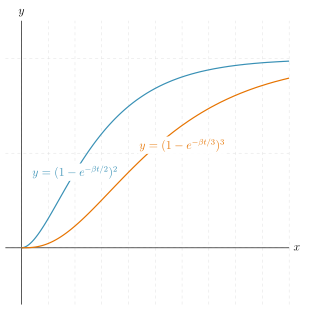
- \(y_1 = (1-e^{-\beta t/2})^2, y_2 = (1-e^{-\beta t/3})^3\)
By considering the differential equation, notice that \(0 < y_i < 1\) so \(y^{1/2} > y^{2/3}\) and therefore \(y_1' > y_2'\) and so \(y_1\) increases faster.
2018 Paper 3 Q3
Show that the second-order differential equation \[ x^2y''+(1-2p) x\, y' + (p^2-q^2) \, y= \f(x) \,, \] where \(p\) and \(q\) are constants, can be written in the form \[ x^a \big(x^b (x^cy)'\big)' = \f(x) \,, \tag{\(*\)} \] where \(a\), \(b\) and \(c\) are constants.
- Use \((*)\) to derive the general solution of the equation \[ x^{2}y''+(1-2p)xy'+(p^2-q^{2})y=0 \] in the different cases that arise according to the values of \(p\) and \(q\).
- Use \((*)\) to derive the general solution of the equation \[ x^{2}y''+(1-2p)xy'+p^2y=x^{n} \] in the different cases that arise according to the values of \(p\) and \(n\).
Solution: Consider $x^a \big(x^b (x^cy)'\big)'$ then \begin{align*} x^a \big(x^b (x^cy)'\big)' &= x^a \big (bx^{b-1}(x^c y)'+x^b(x^cy)'' \big ) \\ &= x^a \big (bx^{b-1} (cx^{c-1}y + x^c y') + x^b(c(c-1)x^{c-2}y + 2cx^{c-1}y' + x^cy'') \\ &= x^{a+b+c}y'' + (2cx^{c-1+b+a}+bx^{c+b-1+a})y'+(c(b+c-1))x^{a+b+c-2} y \end{align*} So we need: \begin{align*} &&& \begin{cases} a+b+c &= 2 \\ 2c+b &= 1-2p \\ c(b+c-1) &= p^2-q^2 \end{cases} \\ \Rightarrow && c((1-2p)-2c+c-1) &=p^2-q^2 \\ \Rightarrow && c^2+2pc &= q^2-p^2 \end{align*}
2017 Paper 3 Q5
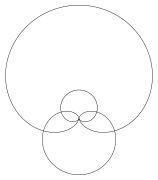
The point with cartesian coordinates \((x,y)\) lies on a curve with polar equation \(r=\f(\theta)\,\). Find an expression for \(\dfrac{\d y}{\d x}\) in terms of \(\f(\theta)\), \(\f'(\theta)\) and \(\tan\theta\,\). Two curves, with polar equations \(r=\f(\theta)\) and \(r=\g(\theta)\), meet at right angles. Show that where they meet \[ \f'(\theta) \g'(\theta) +\f(\theta)\g(\theta) = 0 \,. \] The curve \(C\) has polar equation \(r=\f(\theta)\) and passes through the point given by \(r=4\), \(\theta = - \frac12\pi\). For each positive value of \(a\), the curve with polar equation \(r= a(1+\sin\theta)\) meets~\(C\) at right angles. Find \(\f(\theta)\,\). Sketch on a single diagram the three curves with polar equations \(r= 1+\sin\theta\,\), \ \(r= 4(1+\sin\theta)\) and \(r=\f(\theta)\,\).
Solution: \((x, y) = (f(\theta)\cos(\theta), f(\theta)\sin(\theta))\) so \begin{align*} \frac{dy}{d\theta} &= -f(\theta)\sin(\theta) + f'(\theta)\cos(\theta) \\ \frac{dx}{d\theta} &= f(\theta)\cos(\theta) + f'(\theta)\sin(\theta) \\ \frac{dy}{dx} &= \frac{-f(\theta)\sin(\theta) + f'(\theta)\cos(\theta)}{f(\theta)\cos(\theta) + f'(\theta)\sin(\theta) } \\ &= \frac{-f(\theta)\tan(\theta) + f'(\theta)}{f(\theta) + f'(\theta)\tan(\theta) } \end{align*} If the curves meet at right angles then the product of their gradients is \(-1\), ie \begin{align*} \frac{-f(\theta)\tan(\theta) + f'(\theta)}{f(\theta) + f'(\theta)\tan(\theta) } \cdot \frac{-g(\theta)\tan(\theta) + g'(\theta)}{g(\theta) + g'(\theta)\tan(\theta) } &= -1 \\ f(\theta)g(\theta)\tan^2 \theta - f(\theta)g'(\theta)\tan \theta - f'(\theta)g(\theta)\tan \theta + f'(\theta)g'(\theta) &= \\ \quad - \l f(\theta)g(\theta) + f(\theta)g'(\theta)\tan(\theta) + f'(\theta)g(\theta)\tan(\theta) + f'(\theta)g'(\theta)\tan^2 \theta \r \\ \tan^2\theta \l f(\theta)g(\theta) + f'(\theta)g'(\theta) \r + f'(\theta)g'(\theta) + f(\theta)g(\theta) &= 0 \\ (\tan^2\theta + 1) \l f(\theta)g(\theta) + f'(\theta)g'(\theta) \r &= 0 \\ f(\theta)g(\theta) + f'(\theta)g'(\theta) &= 0 \end{align*} \(g(\theta) = a(1+\sin\theta), g'(\theta) = a\cos\theta\) Therefore \(f'(\theta)a\cos \theta+f(\theta)a(1+\sin(\theta)) = 0\) \begin{align*} && \frac{f'(\theta)}{f(\theta)} &= -\sec(\theta) - \tan(\theta) \\ \Rightarrow && \ln(f(\theta)) &= -\ln |\tan(\theta) + \sec(\theta)| + \ln |\cos(\theta)| + C \\ \Rightarrow && f(\theta) &= A \frac{\cos \theta}{\tan \theta + \sec \theta} \\ &&&= A \frac{\cos^2 \theta}{\sin \theta + 1} \\ &&&= A \frac{1-\sin^2 \theta}{\sin \theta + 1} \\ &&&= A (1-\sin \theta) \end{align*} When \(\theta = -\frac12 \pi, r = 4\), so \(A = 2\).
2016 Paper 2 Q6
This question concerns solutions of the differential equation \[ (1-x^2) \left(\frac{\d y}{\d x}\right)^2 + k^2 y^2 = k^2\, \tag{\(*\)} \] where \(k\) is a positive integer. For each value of \(k\), let \(y_k(x)\) be the solution of \((*)\) that satisfies \(y_k(1)=1\); you may assume that there is only one such solution for each value of \(k\).
- Write down the differential equation satisfied by \(y_1(x)\) and verify that \(y_1(x) = x\,\).
- Write down the differential equation satisfied by \(y_2(x)\) and verify that \(y_2(x) = 2x^2-1\,\).
- Let \(z(x) = 2\big(y_n(x)\big)^2 -1\). Show that \[ (1-x^2) \left(\frac{\d z}{\d x}\right)^2 +4n^2 z^2 = 4n^2\, \] and hence obtain an expression for \(y_{2n}(x)\) in terms of \(y_n(x)\).
- Let \(v(x) = y_n\big(y_m(x)\big)\,\). Show that \(v(x) = y_{mn}(x)\,\).
Solution:
- When \(k =1\), we have \((1-x^2)(y')^2 + y^2 = 1\). Notice that if \(y_1 = x\) we have \(y_1' = 1\) and \((1-x^2) \cdot 1 + x^2 = 1\) so \(y_1\) is a solution, and we are allowed to assume this is the only solution. And notice that \(y_1(1) = 1\).
- When \(k = 2\) we have \((1-x^2)(y')^2 + 4y^2 = 4\). Trying \(y_2 = 2x^2-1\) we see that \(y_2' = 4x\) and \((1-x^2)(4x)^2 + 4(2x^2-1)^2 = 16x^2-16x^4+16x^4-16x^2+4 = 4\). We can also check that \(y(1) = 2 \cdot 1^2 - 1 = 1\)
- Let \(z(x) = 2(y_n(x))^2-1\), then \begin{align*} && \frac{\d z}{\d x} &= 4y'_n(x)y_n(x) \\ \Rightarrow && LHS &= (1-x^2)\left ( \frac{\d z}{\d x} \right)^2 + 4n^2 z^2 \\ &&&= (1-x^2)16(y'_n(x))^2(y_n(x))^2 + 4n^2(2(y_n(x))^2-1)^2 \\ &&&= 16y_n^2(1-x^2) \left [\frac{n^2-n^2y_n^2}{(1-x^2)} \right] + 16n^2y_n^4-16n^2y_n^2+4n^2 \\ &&&= 4n^2 = RHS \end{align*} Therefore \(y_{2n}(x) = 2(y_n(x))^2-1 = y_2(y_n(x))\) (notice also that \(z(1) = 2(y_n(1))^2-1 = 2-1 = 1\)).
- Let \(v(x) = y_n(y_m(x))\) so \begin{align*} && (y_m')^2 &= \frac{m^2(1-y_m^2)}{1-x^2} \\ && (y_n')^2 &= \frac{n^2(1-y_n^2)}{1-x^2} \\ \\ && \frac{\d v}{\d x} &= y_n'(y_m(x)) \cdot y_m'(x) \\ && (1-x^2)(v')^2 &= (1-x^2) \cdot (y_n'(y_m(x)))^2 (y_m')^2 \\ &&&= (1-x^2) \cdot (y_n'(y_m(x)))^2 \left ( \frac{m^2(1-y_m^2)}{1-x^2} \right) \\ &&&= (y_n'(y_m(x)))^2 m^2(1-y_m^2) \\ &&&= \frac{n^2(1-(y_n(y_m(x)))^2)}{1-y_m^2}m^2(1-y_m^2) \\ &&&= n^2m^2(1-v^2) \end{align*} Therefore \(v\) satisfies our differential equation and \(v(1) = y_n(y_m(1)) = y_n(1) = 1\) so it must be our desired solution.
2015 Paper 3 Q8
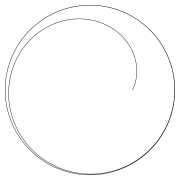
- Show that under the changes of variable \(x= r\cos\theta\) and \(y = r\sin\theta\), where \(r\) is a function of \(\theta\) with \(r>0\), the differential equation \[ (y+x)\frac{\d y}{\d x} = y-x \] becomes \[ \frac{\d r}{\d\theta} + r=0 \,. \] Sketch a solution in the \(x\)-\(y\) plane.
- Show that the solutions of \[ \left( y+x -x(x^2+y^2) \right) \, \frac{\d y }{\d x} = y-x - y(x^2+y^2) \] can be written in the form \\ \[ r^2 = \dfrac 1 {1+A\e^{2\theta}}\, \]\\ and sketch the different forms of solution that arise according to the value of \(A\).
Solution:
- \begin{align*}
&& (y+x)\frac{\d y}{\d x} &= y-x \\
\Rightarrow && (r \sin \theta + r \cos\theta) \frac{\frac{dy}{d\theta}}{\frac{dx}{d\theta}} &= (r \sin\theta - r \cos\theta) \\
\Rightarrow && ( \sin \theta + \cos\theta) \frac{dy}{d\theta} &= (\sin\theta - \cos\theta){\frac{dx}{d\theta}} \\
\Rightarrow && ( \sin \theta + \cos\theta) \left ( \frac{dr}{d\theta} \cos \theta - r \sin \theta\right ) &= (\sin\theta - \cos\theta)\left ( \frac{dr}{d\theta} \sin\theta + r \cos \theta\right) \\
\Rightarrow && \frac{dr}{d\theta} \left (\sin \theta \cos \theta + \cos^2 \theta - \sin^2 \theta + \sin \theta \cos \theta \right)&= r \left (\sin \theta \cos \theta - \cos^2 \theta + \sin^2 \theta + \sin\theta \cos \theta\right) \\
\Rightarrow && \frac{dr}{d\theta}&= -r \\
\end{align*}
Therefore \(r = Ae^{-\theta}\)

- \begin{align*}
&& \left( y+x -x(x^2+y^2) \right) \, \frac{\d y }{\d x} &= y-x - y(x^2+y^2) \\
\Rightarrow && \left( r \sin \theta+r\cos \theta -r^3\cos \theta \right) \, \frac{\d y }{\d \theta} &= \left ( r \sin \theta- r \cos \theta- r^3\sin \theta \right)\frac{\d x }{\d \theta} \\
\Rightarrow && \left( r \sin \theta+r\cos \theta -r^3\cos \theta \right) \, \left (\frac{\d r}{\d \theta} \sin \theta + r \cos \theta \right) &= \\
&& \left ( r \sin \theta- r \cos \theta- r^3\sin \theta \right)&\left (\frac{\d r}{\d \theta} \cos \theta - r \sin \theta \right) \\
\Rightarrow && \frac{\d r}{\d \theta} \left (\sin \theta ( \sin \theta + \cos \theta - r^2 \cos \theta) - \cos \theta (\sin \theta - \cos \theta - r^2 \sin \theta) \right) &= \\
&& r ( -\sin \theta (\sin \theta - \cos \theta - r^2 \sin \theta) - \cos \theta ( \sin \theta + \cos \theta &- r^2 \cos \theta)) \\
\Rightarrow && \frac{\d r}{\d \theta} &= r ( -1 +r^2) \\
\Rightarrow && \int \frac{1}{r(r-1)(r+1)} \d r &= \int \d \theta \\
\Rightarrow && \int \l \frac{-1}{r} + \frac{1}{2(r-1)} + \frac{1}{2(r+1)} \r \d r &= \int \d \theta \\
\Rightarrow && \l -\log r+ \frac12 \log (1+r)+ \frac12 \log (1-r)\r + C &= \theta \\
\Rightarrow && \frac12 \log \left (\frac{1-r^2}{r^2} \right) + C &= \theta \\
\Rightarrow && \log \left (\frac{1}{r^2}-1 \right) + C &= 2\theta \\
\Rightarrow && r &= \frac{1}{1 + Ae^{2\theta}} \\
\end{align*}


2014 Paper 2 Q3
- Show, geometrically or otherwise, that the shortest distance between the origin and the line \(y= mx+c\), where \(c\ge0\), is \(c(m^2+1)^{-\frac12}\).
- The curve \(C\) lies in the \(x\)-\(y\) plane. Let the line \(L\) be tangent to \(C\) at a point \(P\) on \(C\), and let \(a\) be the shortest distance between the origin and \(L\). The curve \(C\) has the property that the distance \(a\) is the same for all points \(P\) on \(C\). Let \(P\) be the point on \(C\) with coordinates \((x,y(x))\). Given that the tangent to \(C\) at \(P\) is not vertical, show that \begin{equation} (y-xy')^2 = a^2\big (1+(y')^2 \big) \,. \tag{\(*\)} \end{equation} By first differentiating \((*)\) with respect to \(x\), show that either \(y= mx \pm a(1+m^2)^{\frac12}\) for some \(m\) or \(x^2+y^2 =a^2\).
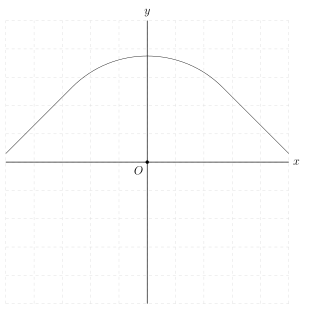
- Now suppose that \(C\) (as defined above) is a continuous curve for \(-\infty < x < \infty\), consisting of the arc of a circle and two straight lines. Sketch an example of such a curve which has a non-vertical tangent at each point.
Solution:
- \(\,\)
Note that we have a right angled triangle, with the sides in a ratio of \(m\). So if our target length is \(x\) we have \(x^2 + (mx)^2 = c^2\) and so \(x = c(m^2+1)^{-\frac12}\)
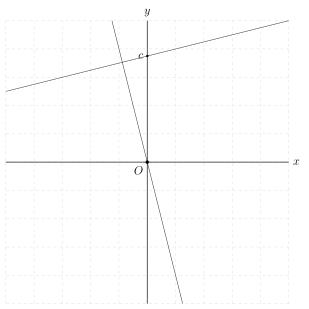
- The distance from the origin to \(L\) is \(a = c(m^2+1)^{-\frac12}\) so \begin{align*} && a^2(m^2+1) &= c^2 \\ && \frac{c-y(x)}{0-x} &= y' \\ \Rightarrow && c-y &= -xy' \\ \Rightarrow && a^2((y')^2+1) &= (y-xy')^2 \\ \\ && 2a^2y'y'' &= 2(y-xy')(y'-xy''-y') \\ &&&= 2(xy'-y)xy'' \\ \Rightarrow && y'' &= 0 \\ \text{ or } && 2a^2y' &= 2(xy'-y)x \end{align*} If \(y'' = 0\) then \(y = mx + c\) and the result follows immediately. \begin{align*} && 0 &= (a^2-x^2)y' + yx \\ \Rightarrow &&\frac1{y} y' &= -\frac{x}{a^2-x^2} \\ \Rightarrow && \ln y &= \frac12\ln (a^2-x^2) + K \\ \Rightarrow && y^2 &= M(a^2-x^2) \\ \Rightarrow && x^2 + y^2 &= a^2 \end{align*} Where in the last step we know the tangents from an ellipse are not all equidistant to the origin.
2014 Paper 2 Q5
Given that \(y=xu\), where \(u\) is a function of \(x\), write down an expression for \(\dfrac {\d y}{\d x}\).
- Use the substitution \(y=xu\) to solve \[ \frac {\d y}{\d x} = \frac {2y+x}{y-2x} \] given that the solution curve passes through the point \((1,1)\). Give your answer in the form of a quadratic in \(x\) and \(y\).
- Using the substitutions \(x=X+a\) and \(y=Y+b\) for appropriate values of \(a\) and \(b\), or otherwise, solve \[ \frac {\d y}{\d x} = \frac {x-2y-4} {2x+y-3}\,, \] given that the solution curve passes through the point \((1,1)\).
Solution: \begin{align*} \frac{\d y}{\d x} &= \frac{\d }{\d x} \l y \r \\ &= \frac{\d }{\d x} \l xu \r \\ &\underbrace{=}_{\text{product rule}} \frac{\d}{\d x} \l x \r u + x \frac{\d}{\d x} \l u \r \\ &= u + x \frac{\d u}{\d x} \end{align*} \begin{questionparts} \item \begin{align*} && \frac{\d y}{\d x} &= \frac{2y + x}{y - 2x} \\ && u + x \frac{\d u}{\d x} &= \frac{2u + 1}{u - 2} \\ && x \frac{\d u}{\d x} &= \frac{2u-1-u^2+2u}{u-2} \\ \Rightarrow && \int \frac{2-u}{u^2-4u+1} \d u &= \int \frac{1}{x} \d x \\ && \int \frac{2-u}{(u-2)^2-5} \d u &= \int \frac1x \d x \\ && -\frac12\ln| (u-2)^2 - 5| &= \ln x + C \\ (x,y) = (1,1): && - \ln 2 &= C \\ \Rightarrow && \ln x^2 &= \ln 4 - \ln |5 - (u-2)^2| \\ \Rightarrow && x^2 &= \frac{4}{5- (u-2)^2} \\ \Rightarrow && 4 & = x^2(5 - (\frac{y}{x} - 2)^2) \\ &&&= 5x^2 - (y-2x)^2 \\ &&&= x^2+4xy-y^2 \end{align*} \item It would be convienient if \(x-2y -4 = X-2Y\) and \(2x+y-3 = 2X+Y\), ie \(a-2b = 4\) and \(2a+b = 3\), ie \(a = 2, b = -1\). Now our differential equation is: \begin{align*} && \frac{\d Y}{\d X} &= \frac{X - 2Y}{2X+Y} \\ && \frac{\d X}{\d Y} &= \frac{2X + Y}{X-2Y} \end{align*} This is the same differential equation we have already solved, just with the roles of \(x\) and \(y\) interchanged with \(Y\) and \(X\) and with the point \((0,3)\) being on the curve, ie: \(Y^2 + 4XY-X^2 = c\) and \(c = 9\), therefore our equation is: \[ (y-1)^2 + 4(y-1)(x+2)-(x+2)^2 = 9\]
2014 Paper 2 Q12
The lifetime of a fly (measured in hours) is given by the continuous random variable \(T\) with probability density function \(f(t)\) and cumulative distribution function \(F(t)\). The hazard function, \(h(t)\), is defined, for \(F(t) < 1\), by \[ h(t) = \frac{f(t)}{1-F(t)}\,. \]
- Given that the fly lives to at least time \(t\), show that the probability of its dying within the following \(\delta t\) is approximately \(h (t) \, \delta t\) for small values of \(\delta t\).
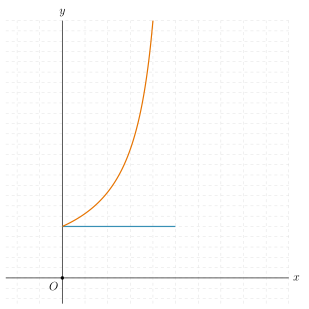
- Find the hazard function in the case \(F(t) = t/a\) for \(0< t < a\). Sketch \(f(t)\) and \(h(t)\) in this case.
- The random variable \(T\) is distributed on the interval \(t > a\), where \(a>0\), and its hazard function is \(t^{-1}\). Determine the probability density function for \(T\).
- Show that \(h(t)\) is constant for \(t > b\) and zero otherwise if and only if \(f(t) =ke^{-k(t-b)}\) for \(t > b\), where \(k\) is a positive constant.
- The random variable \(T\) is distributed on the interval \(t > 0\) and its hazard function is given by \[ h(t) = \left(\frac{\lambda}{\theta^\lambda}\right)t^{\lambda-1}\,, \] where \(\lambda\) and \(\theta\) are positive constants. Find the probability density function for \(T\).
Solution:
- \(\,\) \begin{align*} && \mathbb{P}(T > t + \delta t | T > t) &= \frac{\mathbb{P}(T < t + \delta t)}{\mathbb{P}(T > t )} \\ &&&= \frac{\int_t^{t+\delta t} f(s) \d s}{1-F(t)} \\ &&&\approx \frac{f(t)\delta t}{1-F(t)} \\ &&&= h(t) \delta t \end{align*}
- If \(F(t) = t/a\) then \(f(t) = 1/a\) and \(h(t) = \frac{1/a}{1-t/a} = \frac{1}{a-t}\)
- \(\,\) \begin{align*} && \frac{F'}{1-F} &= \frac{1}{t} \\ \Rightarrow && -\ln (1-F) &= \ln t + C\\ \Rightarrow && 1-F &= \frac{A}{t} \\ && F &= 1 - \frac{A}{t} \\ F(a) = 0: && F &= 1 - \frac{a}{t} \\ && f(t) &= \frac{a}{t^2} \end{align*}
- (\(\Rightarrow\)) \begin{align*} && \frac{F'}{1-F} &= k \\ \Rightarrow && -\ln(1-F) &= kt+C \\ \Rightarrow && 1-F &= Ae^{-kt} \\ F(b) = 0: && 1 &= Ae^{-kb} \\ \Rightarrow && 1-F &= e^{-k(t-b)}\\ \Rightarrow && f &= ke^{-k(t-b)} \\ \end{align*} (\(\Leftarrow\)) \(f(t) = ke^{-k(t-b)} \Rightarrow F(t) = 1-e^{-k(t-b)}\) and the result is clear.
- \(\,\) \begin{align*} && \frac{F'}{1-F} &= \left ( \frac{\lambda}{\theta^{\lambda}} \right) t^{\lambda-1} \\ \Rightarrow && -\ln(1-F) &= \left ( \frac{t}{\theta} \right)^{\lambda} +C\\ \Rightarrow && F &= 1-A\exp \left (- \left ( \frac{t}{\theta} \right)^{\lambda} \right) \\ F(0) = 0: && 0 &= 1-A \\ \Rightarrow && F &= 1 - \exp \left (- \left ( \frac{t}{\theta} \right)^{\lambda} \right) \\ \Rightarrow && f &= \lambda t^{\lambda -1} \theta^{-\lambda} \exp \left (- \left ( \frac{t}{\theta} \right)^{\lambda} \right) \end{align*}
2014 Paper 3 Q4
- Let \[ I = \int_0^1 \bigl((y')^2 -y^2\bigr)\d x \qquad\text{and}\qquad I_1=\int_0^1 (y'+y\tan x)^2 \d x \,, \] where \(y\) is a given function of \(x\) satisfying \(y=0\) at \(x=1\). Show that \(I-I_1=0\) and deduce that \(I\ge0\). Show further that \(I=0\) only if \(y=0\) for all \(x\) (\(0\le x \le 1\)).
- Let \[ J = \int_0^1 \bigl((y')^2 -a^2y^2\bigr)\d x \,, \] where \(a\) is a given positive constant and \(y\) is a given function of \(x\), not identically zero, satisfying \(y=0\) at \(x=1\). By considering an integral of the form \[ \int_0^1 (y'+ay\tan bx)^2 \d x \,, \] where \(b\) is suitably chosen, show that \(J\ge0\). You should state the range of values of \(a\), in the form \(a < k\), for which your proof is valid. In the case \(a=k\), find a function \(y\) (not everywhere zero) such that \(J=0\).
Solution:
- \begin{align*} && I - I_1 &= \int_0^1 \left ( \left ( y' \right)^2 - y^2 \right) \d x - \int_0^1 \left ( y' + y \tan x \right)^2 \d x\\ &&&= \int_0^1 \left ( \left ( y' \right)^2 - y^2 \right) - \left ( y' + y \tan x \right)^2 \d x\\ &&&= \int_0^1 \left (-y^2-2yy' \tan x - y^2 \tan^2 x \right) \d x\\ &&&= \int_0^1 \left (-2yy' \tan x - y^2(1+ \tan^2 x )\right) \d x\\ &&&= \int_0^1 \left (-2yy' \tan x - y^2 \sec^2 x\right) \d x\\ &&&= \int_0^1 -\frac{\d}{\d x} \left (y^2 \tan x \right) \d x\\ &&&= \left [-y^2 \tan x \right]_0^1 \\ &&&= 0 \\ \\ \Rightarrow && I &= I_1 = \int_0^1 \left ( y' + y \tan x \right)^2 d x \geq 0 \end{align*} The only way \(I_0 = 0\) is is \(y' + y \tan x =0\), so \begin{align*} && \frac{\d y}{\d x} &= - y \tan x \\ \Rightarrow && \int \frac{1}{y} &= \int -\tan x \d x \\ \Rightarrow && \ln |y| &= \ln |\cos x| + C \\ \Rightarrow && y &= A \cos x \\ \Rightarrow && A &= 0 \Rightarrow y = 0 \end{align*}
- Let \(J_1 = \int_0^1 (y'+ay\tan ax)^2 \d x\), then \begin{align*} && J-J_1 &= \int_0^1 \left ( \left ( y' \right)^2 - a^2y^2 \right) - \left ( y' + ya \tan ax \right)^2 \d x\\ &&&= \int_0^1 \left (-a^2y^2-2yy' a \tan a x-y^2a^2 \tan^2 ax \right) \d x \\ &&&= \int_0^1 \left (-2yy' a \tan ax - a^2y^2(1+\tan^2 ax) \right) \d x \\ &&&= \int_0^1 \left (-2yy' a \tan ax - a^2y^2\sec^2 ax \right) \d x \\ &&&= \left [ - a y^2 \tan a x \right]_0^1 = 0 \end{align*} This is true if \(a < \frac{\pi}{2}\), since otherwise we might care about the order of the zero for \(y\) at \(x = 1\). Consider \(y = \cos \frac{\pi}{2} x\), then \(y' = -\frac{\pi}{2} \sin^2\frac{\pi}{2} x\) and \begin{align*} && \int_0^1 \frac{\pi^2}{4} \left (\sin^2 \frac{\pi}{2}x - \cos^2 \frac{\pi}{2} x \right) \d x &= -\frac{\pi^2}{4} \int_0^1 \cos(\pi x) \d x \\ &&&= 0 \end{align*}