Problems
Filters
25 problems found
2025 Paper 2 Q6
- The circle \(x^2 + (y-a)^2 = r^2\) touches the parabola \(2ky = x^2\), where \(k > 0\), tangentially at two points. Show that \(r^2 = k(2a - k)\). Show further that if \(r^2 = k(2a - k)\) and \(a > k > 0\), then the circle \(x^2 + (y-a)^2 = r^2\) touches the parabola \(2ky = x^2\) tangentially at two points.
- The lines \(y = c \pm x\) are tangents to the circle \(x^2 + (y-a)^2 = r^2\). Find \(r^2\), and the coordinates of the points of contact, in terms of \(a\) and \(c\).
- \(C_1\) and \(C_2\) are circles with equations \(x^2 + (y-a_1)^2 = r_1^2\) and \(x^2 + (y-a_2)^2 = r_2^2\) respectively, where \(a_1 \neq a_2\) and \(r_1 \neq r_2\).
Each circle touches the parabola \(2ky = x^2\) tangentially at two points and the lines \(y = c \pm x\) are tangents to both circles.
- Show that \(a_1 + a_2 = 2c + 4k\) and that \(a_1^2 + a_2^2 = 2c^2 + 16kc + 12k^2\).
- The circle \(x^2 + (y-d)^2 = p^2\) passes through the four points of tangency of the lines \(y = c \pm x\) to the two circles, \(C_1\) and \(C_2\). Find \(d\) and \(p^2\) in terms of \(k\) and \(c\).
- Show that the circle \(x^2 + (y-d)^2 = p^2\) also touches the parabola \(2ky = x^2\) tangentially at two points.
Solution:
- By symmetry we can observe that the parabola and circle will intersect \(0, 1\) (at the base), \(2, 4\) times. So setting up our system of equations we have: \begin{align*} &&& \begin{cases} x^2 + (y-a)^2 &= r^2 \\ 2ky &= x^2 \end{cases} \\ \Rightarrow && r^2 &= x^2 + \left (\frac{x^2}{2k} - a \right )^2 \\ \Rightarrow &&r^2 &= x^2 + a^2 - \frac{ax^2}{k} + \frac{x^4}{4k^2} \\ \Rightarrow &&0 &= \frac{1}{4k^2} x^4 + \left ( 1 - \frac{a}{k} \right) x^2 + a^2 - r^2 \\ \Rightarrow && \Delta &= \left ( 1 - \frac{a}{k} \right)^2-4 \cdot \frac{1}{4k^2} (a^2 - r^2) \\ &&&= 1 - \frac{2a}{k} + \frac{a^2}{k^2} - \frac{a^2}{k^2} + \frac{r^2}{k^2} \\ &&&= \frac{k^2-2ka+r^2}{k^2} \end{align*} Since there will be (at most) two solutions if \(\Delta = 0\) we must have if the circle and parabola are tangent \(r^2 - 2ka + k^2 = 0 \Rightarrow r^2 = k(2a-k)\). So long as there is a solution \(x^2 > 0\) there will be two tangent points, so if \(-\left(1 - \frac{a}{k}\right) > 0\) or \(a > k > 0\)

- Since \(y = c \pm x\) are tangent to the circle with radius \(r\) and centre \((0,a)\) we have the following equations: \begin{align*} &&& \begin{cases} x^2 + (y-a)^2 &= r^2 \\ c \pm x &= y \end{cases} \\ \Rightarrow && r^2 &= x^2 + (c -a\pm x)^2 \\ &&&= 2x^2+(c-a)^2 \pm 2x(c-a) \\ \Rightarrow && \Delta &= 4(c-a)^2 -4 \cdot 2 \left ( (c-a)^2 -r^2 \right)\\ &&&= 8r^2-4(c-a)^2 \\ \Rightarrow && x &= \frac{\mp 2(c-a) \pm \sqrt{\Delta}}{4} \\ &&&= \mp \frac12 (c-a) \\ && y &= \pm \frac12 (c+a) \\ && (x,y) &= \left (\frac12 (c-a), \frac12 (c+a)\right), \left (-\frac12 (c-a), -\frac12 (c+a)\right) \end{align*}
2025 Paper 3 Q4
- \(x_2\) and \(y_2\) are defined in terms of \(x_1\) and \(y_1\) by the equation $$\begin{pmatrix} x_2 \\ y_2 \end{pmatrix} = \begin{pmatrix} \frac{1}{\sqrt{2}} & -\frac{1}{\sqrt{2}} \\ \frac{1}{\sqrt{2}} & \frac{1}{\sqrt{2}} \end{pmatrix} \begin{pmatrix} x_1 \\ y_1 \end{pmatrix}$$ \(G_1\) is the graph with equation $$\frac{x^2}{9} + \frac{y^2}{4} = 1$$ and \(G_2\) is the graph with equation $$\frac{\left(\frac{x}{\sqrt{2}} + \frac{y}{\sqrt{2}}\right)^2}{9} + \frac{\left(-\frac{x}{\sqrt{2}} + \frac{y}{\sqrt{2}}\right)^2}{4} = 1$$ Show that, if \((x_1, y_1)\) is a point on \(G_1\), then \((x_2, y_2)\) is a point on \(G_2\). Show that \(G_2\) is an anti-clockwise rotation of \(G_1\) through \(45^\circ\) about the origin.
- The matrix $$\begin{pmatrix} -0.6 & 0.8 \\ 0.8 & 0.6 \end{pmatrix}$$ represents a reflection. Find the line of invariant points of this matrix.
- Sketch, on the same axes, the graphs with equations $$y = 2^x \text{ and } 0.8x + 0.6y = 2^{-0.6x+0.8y}$$
- Sketch, on the same axes, for \(0 \leq x \leq 2\pi\), the graphs with equations $$y = \sin x \text{ and } y = \sin(x - 2y)$$ You should determine the exact co-ordinates of the points on the graph with equation \(y = \sin(x - 2y)\) where the tangent is horizontal and those where it is vertical.
Solution:
- Suppose \begin{align*} && \begin{pmatrix} x_2 \\ y_2 \end{pmatrix} &= \begin{pmatrix} \frac{1}{\sqrt{2}} & -\frac{1}{\sqrt{2}} \\ \frac{1}{\sqrt{2}} & \frac{1}{\sqrt{2}} \end{pmatrix} \begin{pmatrix} x_1 \\ y_1 \end{pmatrix} \\ \Rightarrow && \binom{x_1}{y_1} &= \begin{pmatrix} \frac{1}{\sqrt{2}} & \frac{1}{\sqrt{2}} \\ -\frac{1}{\sqrt{2}} & \frac{1}{\sqrt{2}} \end{pmatrix} \binom{x_2}{y_2} \end{align*} Therefore if \(\frac{x_1^2}9+\frac{y_1^2}{4} = 1\) we must have \begin{align*} \frac{(\frac{x_2}{\sqrt{2}}+\frac{y_2}{\sqrt{2}})^2 }{9} + \frac{(-\frac{x_2}{\sqrt{2}}+\frac{y_2}{\sqrt{2}})^2}{4} = 1 \end{align*} but this is precisely the statement that \((x_1, y_1)\) is on \(G_1\) is equivalent to \((x_2,y_2)\) being on the \(G_2\). Since the point \((x_2,y_2)\) is a \(45^{\circ}\) rotation of \((x_1,y_1)\) anticlockwise about the origin, this means \(G_2\) is a \(45^{\circ}\) anticlockwise rotation of \(G_1\).
- \begin{align*} && \begin{pmatrix} -0.6 & 0.8 \\ 0.8 & 0.6 \end{pmatrix} \begin{pmatrix} x \\ y \end{pmatrix} &= \begin{pmatrix} x \\ y \end{pmatrix} \\ \Rightarrow && \begin{pmatrix} -0.6 x + 0.8y \\ 0.8x + 0.6y \end{pmatrix} &= \begin{pmatrix} x \\ y \end{pmatrix} \\ \Rightarrow && \begin{pmatrix} -1.6 x + 0.8y \\ 0.8x -0.4y \end{pmatrix} &= \begin{pmatrix} 0 \\ 0 \end{pmatrix} \\ \Rightarrow && y &=2 x \end{align*}

- Consider the transformation \(\begin{pmatrix} 1 & 2 \\ 0 & 1 \end{pmatrix}\) which is a shear, leaving the \(x\)-axis invariant. Then we must have:
Since the shear leaves lines of the form \(y = k\) invariant, the points where \(\frac{\d y}{\d x} = 0\) must also map to points where this is true, ie \((\tfrac{\pi}{2}, 1), (\tfrac{3\pi}{2}, -1)\) map to points \((\tfrac{\pi}{2}+2,1), (\tfrac{3\pi}{2} -2,-1)\) where the tangent is horizontal. The line \(x = c\) map back to lines \(\begin{pmatrix} 1 & -2 \\ 0 & 1\end{pmatrix} \begin{pmatrix} c \\ t\end{pmatrix} = \begin{pmatrix}c - 2t \\ t \end{pmatrix}\), ie \(y = -\frac12 x- \frac{c}{2}\). Therefore we are interested in points on the original curve where the gradient is \(-\frac12\), ie \((\frac{2\pi}{3}, \frac{\sqrt{3}}{2}), (\frac{4\pi}{3}, -\frac{\sqrt{3}}{2})\), these map to \((\frac{2\pi}{3}+\sqrt{3},\frac{\sqrt{3}}{2}), (\frac{4\pi}{3}-\sqrt{3}, -\frac{\sqrt{3}}{2})\)

2018 Paper 3 Q4
The point \(P(a\sec \theta, b\tan \theta )\) lies on the hyperbola \[ \dfrac{x^{2}}{a^{2}}-\dfrac{y^{2}}{b^{2}}=1\,, \] where \(a>b>0\,\). Show that the equation of the tangent to the hyperbola at \(P\) can be written as \[ bx- ay \sin\theta = ab \cos\theta \,. \]
- This tangent meets the lines \(\dfrac x a = \dfrac yb\) and \(\dfrac x a =- \dfrac y b\) at \(S\) and \(T\), respectively. How is the mid-point of \(ST\) related to \(P\)?
- The point \(Q(a\sec \phi, b\tan \phi)\) also lies on the hyperbola and the tangents to the hyperbola at \(P\) and \(Q\) are perpendicular. These two tangents intersect at \((x,y)\). Obtain expressions for \(x^2\) and \(y^2\) in terms of \(a\), \(\theta\) and \(\phi\). Hence, or otherwise, show that \(x^2+y^2 = a^2 -b^2\).
Solution: Note that \begin{align*} && \frac{\d a \sec \theta}{\d \theta} &= a \sec \theta \tan \theta \\ && \frac{\d b \tan \theta}{\d \theta} &= b \sec^2 \theta \\ \Rightarrow && \frac{\d y}{\d x} &= \frac{b \sec^2 \theta}{a \sec \theta \tan \theta} \\ &&&= \frac{b}{a} \frac{1}{\sin \theta} \\ \Rightarrow && \frac{y-b \tan \theta}{x - a \sec \theta} &= \frac{b}{a} \frac{1}{\sin \theta} \\ \Rightarrow && a \sin \theta y - ab \tan \theta \sin \theta &= bx -ab \sec \theta \\ \Rightarrow && bx-ay\sin \theta &= ab \sec x (1 - \sin ^2 \theta) \\ &&&= ab \cos \theta \end{align*}
- \begin{align*} S: &&& \begin{cases} bx-ay &= 0 \\ bx-ay \sin \theta &= ab \cos \theta \end{cases} \\ \Rightarrow && ay(1-\sin \theta) &= ab \cos \theta \\ \Rightarrow && y &= \frac{b \cos \theta}{1-\sin \theta} \\ &&x &=\frac{a\cos \theta}{1-\sin \theta} \\ T: &&& \begin{cases} bx+ay &= 0 \\ bx-ay \sin \theta &= ab \cos \theta \end{cases} \\ \Rightarrow && ay(1+\sin \theta) &= -ab \cos \theta \\ \Rightarrow && y &= \frac{-b \cos \theta}{1+\sin \theta} \\ &&x &=\frac{a\cos \theta}{1+\sin \theta} \\ M: && x &= \frac{a \cos \theta}{2} \frac{2}{1-\sin^2 \theta} \\ &&&= a \sec \theta \\ && y &= \frac{b \cos \theta}{2} \frac{2 \sin \theta}{1-\sin^2 \theta} \\ &&&= b \tan \theta \end{align*} The midpoint of \(ST\) is the same as \(P\).
- The tangents are perpendicular, therefore \(\frac{b}{a} \cosec \theta = - \frac{a}{b} \sin \phi\), ie \(b^2 = -a^2 \sin \phi \sin \theta\) The will intersect at: \begin{align*} &&& \begin{cases} bx - ay \sin \theta &= ab \cos \theta \\ bx - ay \sin \phi &= ab \cos \phi \end{cases} \\ \Rightarrow && ay ( \sin \theta - \sin \phi) &= ab(\cos \phi - \cos \theta) \\ \Rightarrow && y &= \frac{b(\cos \phi - \cos \theta)}{(\sin \theta - \sin \phi)} \\ && y^2 &= \frac{-a^2 \sin \phi \sin \theta (\cos\phi - \cos \theta)^2}{(\sin \theta - \sin \phi)^2} \\ \Rightarrow && bx(\sin \phi - \sin \theta) &= ab(\cos \theta \sin \phi - \cos \phi \sin \theta) \\ \Rightarrow && x &= \frac{a(\cos \theta \sin \phi - \cos \phi \sin \theta)}{\sin \phi - \sin \theta} \\ &&&= \frac{a^2(\cos \theta \sin \phi - \cos \phi \sin \theta)^2}{(\sin \phi - \sin \theta)^2} \end{align*} Therefore \begin{align*} && x^2+y^2 &= \frac{a^2}{(\sin \phi - \sin \theta)^2} \l (\cos \theta \sin \phi- \cos \phi \sin \theta)^2 - \sin \phi \sin \theta (\cos\phi - \cos \theta)^2 \r \\ &&&= \frac{a^2}{(\sin \phi - \sin \theta)^2} \l (\sin \phi - \sin \theta)(\cos^2 \theta \sin \phi - \sin \theta \cos^2 \phi) \r \\ &&&=a^2-b^2 \end{align*}
2017 Paper 1 Q3
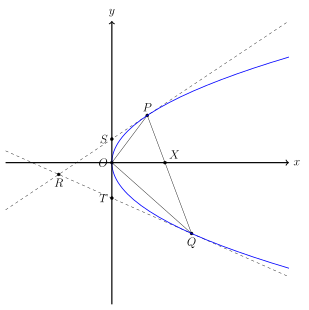
The points \(P(ap^2, 2ap)\) and \(Q(aq^2, 2aq)\), where \(p>0\) and \(q<0\), lie on the curve \(C\) with equation $$y^2= 4ax\,,$$ where \(a>0\,\). Show that the equation of the tangent to \(C\) at \(P\) is $$y= \frac 1 p \, x +ap\,.$$ The tangents to the curve at \(P\) and at \(Q \) meet at \(R\). These tangents meet the \(y\)-axis at \(S\) and \(T\) respectively, and \(O\) is the origin. Prove that the area of triangle \(OPQ\) is twice the area of triangle \(RST\).
Solution: \begin{align*} && 2yy' &= 4a \\ \Rightarrow && y' &= \frac{2a}{y} = \frac{2a}{2ap} = \frac1p \\ \Rightarrow && \frac{y-2ap}{x-ap^2} &= \frac1p \\ \Rightarrow && y &= \frac1p x +ap \end{align*} The other tangent will be \(y = \frac1qx+aq\) \begin{align*} &&& \begin{cases} py-x &= ap^2 \\ qy - x &= aq^2 \end{cases} \\ \Rightarrow && y(p-q) &= a(p^2-q^2) \\ \Rightarrow && y &= a(p+q) \\ && x &= apq \end{align*} Therefore \(R(apq, a(p+q)), S(0, ap), T(0, aq)\).
2017 Paper 2 Q5
A curve \(C\) is determined by the parametric equations \[ x=at^2 \, , \; y = 2at\,, \] where \(a > 0\).
- Show that the normal to \(C\) at a point \(P\), with non-zero parameter \(p\), meets \(C\) again at a point \(N\), with parameter \(n\), where \[ n= - \left( p + \frac{2}{p} \right). \]
- Show that the distance \(\left| PN \right|\) is given by \[ \vert PN\vert^2 = 16a^2\frac{(p^2+1)^3}{p^4} \] and that this is minimised when \(p^2=2\,\).
- The point \(Q\), with parameter \(q\), is the point at which the circle with diameter \(PN\) cuts \(C\) again. By considering the gradients of \(QP\) and \(QN\), show that \[ 2 = p^2-q^2 + \frac{2q}p. \] Deduce that \(\left| PN \right|\) is at its minimum when \(Q\) is at the origin.
Solution:
- \(\,\) \begin{align*} && \frac{\d x}{\d t} &= 2at \\ && \frac{\d y}{\d t} &= 2a \\ \Rightarrow && \frac{\d y}{\d x} &= \frac1t \\ && -p &= \text{grad of normal} \\ &&&= \frac{y-2ap}{x-ap^2} \\ \Rightarrow && y &= -px + ap^3+2ap \\ && 2an &= -pan^2 + ap^3 + 2ap \\ \Rightarrow && 0 &= pan^2+2an-ap(2+p^2) \\ \Rightarrow && n &= p, -\left ( p + \frac2{p}\right) \\ \Rightarrow && n &= -\left ( p + \frac2{p}\right) \end{align*}
- \(\,\) \begin{align*} && |PN|^2 &= (ap^2-an^2)^2 +(2ap-2an)^2 \\ &&&= a^2(p-n)^2(p+n)^2+4a^2(p-n)^2 \\ &&&= a^2(p-n)^2((p+n)^2+4) \\ &&&= a^2\left(p+p+\frac2p \right)^2 \left ( \left ( -\frac2p\right)^2+4\right)\\ &&&= a^2\left(\frac{2p^2+2}p \right)^2 \left ( \frac{4}{p^2}+4\right)\\ &&&= 16a^2 \frac{(p^2+1)^3}{p^4} \\ \\ && \frac{\d |PN|^2}{\d p^2} &= 16a^2\frac{3(p^2+1)^2p^4-2(p^2+1)^3p^2}{p^8} \\ &&&= 16a^2(p^2+1)^2 \frac{3p^2-2(p^2+1)}{p^6} \\ &&&= 16a^2(p^2+1)^2 \frac{p^2-2}{p^6} \end{align*} Therefore minimized when \(p^2=2\) (clearly a minimum by considering behaviour as \(p^2 \to 0, \infty\))
- If \(PN\) is the diameter of \(PNQ\) then \(QP\) and \(QN\) are perpendicular, ie \begin{align*} && -1 &= \frac{2ap-2aq}{ap^2-aq^2} \cdot \frac{2aq-2an}{aq^2-an^2} \\ &&&= \frac{2}{p+q} \cdot \frac{2}{q+n} \\ &&&= \frac{2}{p+q} \cdot \frac{2}{q - p -\frac{2}{p}} \\ \Rightarrow && 4 &= (p+q)(p+\frac2{p}-q) \\ &&&= p^2-q^2 + \frac{2q}{p} + 2 \\ \Rightarrow && 2 &= p^2 - q^2 + \frac{2q}{p} \end{align*} Therefore \(q = 0 \Rightarrow p^2 = 2 \Rightarrow |PN|\) is at it's minimum.
2017 Paper 3 Q7
Show that the point \(T\) with coordinates \[ \left( \frac{a(1-t^2)}{1+t^2} \; , \; \frac{2bt}{1+t^2}\right) \tag{\(*\)} \] (where \(a\) and \(b\) are non-zero) lies on the ellipse \[ \frac{x^2}{a^2} + \frac{y^2}{b^2} =1 \,. \]
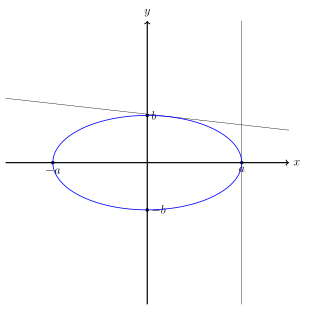
- The line \(L\) is the tangent to the ellipse at \(T\). The point \((X,Y)\) lies on \(L\), and \(X^2\ne a^2\). Show that \[ (a+X)bt^2 -2aYt +b(a-X) =0 \,.\] Deduce that if \(a^2Y^2>(a^2-X^2)b^2\), then there are two distinct lines through \((X,Y)\) that are tangents to the ellipse. Interpret this result geometrically. Show, by means of a sketch, that the result holds also if \(X^2=a^2\,\).
- The distinct points \(P\) and \(Q\) are given by \((*)\), with \(t=p\) and \(t=q\), respectively. The tangents to the ellipse at \(P\) and \(Q\) meet at the point with coordinates \((X,Y)\), where \(X^2\ne a^2\,\). Show that \[ (a+X)pq = a-X\] and find an expression for \(p+q\) in terms of \(a\), \(b\), \(X\) and \(Y\). Given that the tangents meet the \(y\)-axis at points \((0,y_1)\) and \((0,y_2)\), where \(y_1+y_2 = 2b\,\), show that \[ \frac{X^2}{a^2} +\frac{Y}{b}= 1 \,. \]
Solution:
- The tangent has equation:
\begin{align*}
&& 0 &= \frac{Xx}{a^2} + \frac{Yy}{b^2} -1 \\
\Rightarrow &&&= \frac{Xa(1-t^2)}{a^2(1+t^2)} + \frac{Y2bt}{b^2(1+t^2)} - 1 \\
\Rightarrow &&0&= Xb(1-t^2) + Y2at - ab(1+t^2)\\
&&&= -(b(a+X)t^2 -2aYt +b(a-X)) \\
\Rightarrow && 0 &= (a+X)bt^2-2aYt+b(a-X) \\
\\
&& 0 <\Delta &= 4a^2Y^2 - 4(a+X)b(a-X)b \\
&&&= 4(a^2Y^2-b^2(a^2-X^2)) \\
\Leftrightarrow && a^2Y^2 &> (a^2-X^2)b^2
\end{align*}
Therefore there are two roots to the quadratic, ie two values of the parameter \(t\) which works. The condition is equivalent to \(\frac{X^2}{a^2} + \frac{Y^2}{b^2} > 1\). ie from any point outside the ellipse there are two tangent lies.
Clearly there are two tangents when \(X = \pm a\) (except \((X,Y) = (\pm a, 0)\).
- We must have \(p\) and \(q\) are roots of \(0 = (a+X)bt^2-2aYt+b(a-X)\), ie \(pq = \frac{b(a-X)}{(a+X)b} \Rightarrow (a+X)pq = a-X\). Similarly \(p+q = \frac{2aY}{(a+X)b}\) Given that the tangents meet the \(y\)-axis at \((0, y_i)\) we must have \(abt^2-2ay_it + ab = 0\), so \begin{align*} && 0 &= abp^2-2ay_1p + ab \\ && 0 &= abq^2-2ay_2q + ab \\ \Rightarrow && y_1 &= \frac{ab(p^2+1)}{2ap} \\ && y_2 &= \frac{ab(q^2+1)}{2aq} \\ \Rightarrow && 2b &= \frac{ab(p^2+1)}{2ap} +\frac{ab(q^2+1)}{2aq} \\ &&&= \frac{ab(pq(p+q)+p+q)}{2apq} \\ \Rightarrow && 4pq &= pq(p+q)+p+q \\ \Rightarrow && 4 \frac{b(a-X)}{(a+X)b} &= \frac{2aY}{(a+X)b} \left ( \frac{b(a-X)}{(a+X)b} + 1 \right) \\ && &= \frac{2aY}{(a+X)b} \frac{2ab}{(a+X)b} \\ \Rightarrow && 4b^2(a^2-X^2) &= 4a^2bY \\ \Rightarrow && 1 &= \frac{Y}{b} + \frac{X^2}{a^2} \end{align*} as required.
2016 Paper 3 Q2
The distinct points \(P(ap^2 , 2ap)\), \(Q(aq^2 , 2aq)\) and \(R(ar^2,2ar)\) lie on the parabola \(y^2 = 4ax\), where \(a>0\). The points are such that the normal to the parabola at \(Q\) and the normal to the parabola at \(R\) both pass through \(P\).
- Show that \(q^2 +qp + 2 = 0\).
- Show that \(QR\) passes through a certain point that is independent of the choice of \(P\).
- Let \(T\) be the point of intersection of \(OP\) and \(QR\), where \(O\) is the coordinate origin. Show that \(T\) lies on a line that is independent of the choice of \(P\). Show further that the distance from the \(x\)-axis to \(T\) is less than \(\dfrac {\;a}{\sqrt2}\,\).
Solution:
- \begin{align*} && 2y \frac{\d y}{\d x} &= 4a \\ \Rightarrow && \frac{\d y}{\d x} &= \frac{2a}{y} \end{align*} Therefore we must have \begin{align*} && \underbrace{-\frac{2aq}{2a}}_{\text{gradient of normal}} &= \underbrace{\frac{2ap-2aq}{ap^2-aq^2}}_{\Delta y / \Delta x} \\ \Rightarrow && -q &= \frac{2}{p+q} \\ && 0 &= 2 + pq+q^2 \end{align*}
- We must have that \(q,r\) are the two roots of \(x^2+px+2 = 0\) \(QR\) has the equation: \begin{align*} && \frac{y-2aq}{x-aq^2} &= \frac{2ar-2aq}{ar^2-aq^2} \\ \Rightarrow && \frac{y-2aq}{x-aq^2} &= \frac{2}{r+q} \\ \Rightarrow && y &= \frac{2}{q+r}(x-aq^2) +2aq \\ && y &= -\frac{2}{p}x+2a\left(q-\frac{q^2}{q+r} \right) \\ &&y&= -\frac{2}{p}x+2a \frac{qr}{q+r} \\ && y &= -\frac{2}{p}x - 2a \frac{2}{p} \\ && y & = -\frac{2}{p}(x+2a) \end{align*} Therefore the point \((-2a,0)\) lies on all such lines.
- \(OP\) has equation \(y = \frac{2}{p} x\) \begin{align*} && y &= \frac{2}{p} x \\ && y & = -\frac{2}{p}(x+2a) \\ && 2y &= -\frac{4a}{p} \\ \Rightarrow && y &= -\frac{2a}{p} \\ && x &= -a \end{align*} Therefore \(T\left (-a, -\frac{2a}{p} \right)\) always lies on the line \(x = -a\) The distance to the \(x\)-axis from \(T\) is \(\frac{2a}{|p|}\). We need to show that \(p\) can't be too small. Specifically \(x^2+px+2 = 0\) must have \(2\) real roots, ie \(\Delta = p^2-8 \geq 0 \Rightarrow |p| \geq 2\sqrt{2}\), ie \(\frac{2a}{|p|} \leq \frac{2a}{2\sqrt{2}} = \frac{a}{\sqrt{2}}\) as required.
2014 Paper 3 Q3
- The line \(L\) has equation \(y=mx+c\), where \(m > 0\) and \(c > 0\). Show that, in the case \(mc > a > 0\), the shortest distance between \(L\) and the parabola \(y^2=4ax\) is \[ \frac{mc-a}{m\sqrt{m^2+1}}\,.\] What is the shortest distance in the case that \(mc\le a\)?
- Find the shortest distance between the point \((p,0)\), where \(p > 0\), and the parabola \(y^2=4ax\), where \(a > 0\), in the different cases that arise according to the value of \(p/a\). [You may wish to use the parametric coordinates \((at^2, 2at)\) of points on the parabola.] Hence find the shortest distance between the circle \((x-p)^2 + y^2 =b^2\), where \(p > 0\) and \(b > 0\), and the parabola \(y^2=4ax\), where \(a > 0\), in the different cases that arise according to the values of \(p\), \(a\) and \(b\).
Solution:
- Suppose we have the shortest distance between the two curves, and the path between the points is not a normal to both curves. Then we could shift the endpoints to reduce the distance. (Assuming we're not at a point of intersection). Therefore, the normal to the curves must be the same (or in other words) the gradients of the curves must be the same. ie we are at a point where \(2y y' = 4a\) we must have \(y' = m\), so \(y = \frac{2a}{m}\) and \(x = \frac{a}{m^2}\) and the distance from this point to the line \(y=mx+c\) is \(\frac{|m \frac{a}{m^2} - \frac{2a}{m}+c|}{\sqrt{m^2+1}} = \frac{|mc-a|}{m\sqrt{m^2+1}} = \frac{mc-a}{m\sqrt{m^2+1}}\). If \(mc \leq a\) then we find \(\frac{a-mc}{m\sqrt{m^2+1}}\) However, we must check that the two curves do not intersect (otherwise the closest distace is \(0\)). ie we need to check if \((mx+c)^2 = 4ax\) has any solutions, this quadratic has discriminant \((2mc-4a)^2 - 4 \cdot m^2 \cdot c^2 = 16a^2-16amc = 16a(a-mc)\) which is clearly greater than \(0\) when \(a \geq mc\). Therefore the shortest distance in this case is \(0\).
- The distance squared between the point \((p,0)\) and a point of the form \((at^2,2at)\) is \(D^2 = (at^2-p)^2+4a^2t^2 = a^2t^4+(4a^2-2ap)t^2+p^2\) \begin{align*} && \frac{D^2}{a^2} &= t^4 + 2\left(2-\frac{p}{a}\right)t^2 + \frac{p^2}{a^2} \\ &&&= \left (t^2 - \left (\frac{p}{a}-2 \right)\right)^2 + \frac{p^2}{a^2} - \left (2-\frac{p}{a} \right)^2 \\ &&&= \left (t^2 - \left (\frac{p}{a}-2 \right)\right)^2 +\frac{4p}{a} -4 \\ \end{align*} Therefore if \(2 \leq \frac{p}{a}\) then we can find a \(t\) such that we attain the minimum for \(D^2/a^2\) of \(\frac{4p}{a}-4\) and so \(D = \sqrt{4pa-4a^2} = 2\sqrt{a(p-a)}\) . If not the smallest value will be when \(t = 0\) and we will have \(|p|\) Now consider all the lines joining points on the parabola to the centre of the circle. The shortest distance from the parabola to the circle will be normal to the circle and therefore will also be a line through the center. Therefore we need only consider the shortest distance from \((p,0)\) to the parabola \(-b\). Case 1: If \(p \geq 2a\) we have \(2\sqrt{a(p-a)} - b\) or \(0\) if \(b \geq 2\sqrt{a(p-a)}\) Case 2: If \(p < 2a\) we have \(p-b\) or \(0\) if \(b \geq p\)
2013 Paper 3 Q8
Evaluate \(\displaystyle \sum_{r=0}^{n-1} \e^{2i(\alpha + r\pi/n)}\) where \(\alpha\) is a fixed angle and \(n\ge2\). The fixed point \(O\) is a distance \(d\) from a fixed line \(D\). For any point \(P\), let \(s\) be the distance from \(P\) to \(D\) and let \(r\) be the distance from \(P\) to \(O\). Write down an expression for \(s\) in terms of \(d\), \(r\) and the angle \(\theta\), where \(\theta\) is as shown in the diagram below.

Solution: \begin{align*} \sum_{r=0}^{n-1} \e^{2i(\alpha + r\pi/n)} &= e^{2i\alpha} \sum_{r=0}^{n-1} \left (\e^{2i\pi/n} \right)^r \\ &= e^{2i\alpha} \frac{1-\left (\e^{2i\pi/n} \right)^n}{1-\e^{2i\pi/n} } \\ &= 0 \end{align*} \(d = s + r \cos \theta\) ie \(s = d - r \cos \theta\) Therefore \(d = \frac{r}{k} + r \cos \theta \Rightarrow r = \frac{kd}{1+k \cos \theta}\). The \(l_j\) will come from \(r(\alpha + \frac{j \pi}{n} )+r(\alpha + \pi + \frac{j \pi}{n} )\) \begin{align*} && l_j &= r(\alpha + \frac{(j-1) \pi}{n} )+r(\alpha + \pi + \frac{(j-1) \pi}{n} ) \\ &&&= \frac{kd}{1+k \cos \left ( \alpha + \frac{(j-1) \pi}{n}\right)}+\frac{kd}{1+k \cos \left ( \alpha+\pi+ \frac{(j-1) \pi}{n}\right)}\\ &&&= \frac{kd}{1+k \cos \left ( \alpha + \frac{(j-1) \pi}{n}\right)}+\frac{kd}{1-k \cos \left ( \alpha+ \frac{(j-1) \pi}{n}\right)}\\ &&&= \frac{2kd}{1-k^2 \cos^2 \left ( \alpha + \frac{(j-1) \pi}{n}\right)}\\ \Rightarrow && \sum_{j=1}^n \frac 1 {l_j} &= \sum_{j=0}^{n-1} \frac{1-k^2 \cos^2 \left ( \alpha + \frac{j \pi}{n}\right)}{2kd} \\ &&&= \frac{n}{2kd}-\frac{k^2}{2kd} \sum_{j=0}^{n-1} \cos^2 \left ( \alpha + \frac{j \pi}{n}\right) \\ &&&= \frac{n}{2kd}-\frac{k^2}{2kd} \sum_{j=0}^{n-1} \frac{1+ \cos \left ( 2\alpha + \frac{2j \pi}{n}\right)}{2} \\ &&&= \frac{n}{2kd}-\frac{nk^2}{2kd}-\frac{k^2}{4kd} \sum_{j=0}^{n-1}\cos \left ( 2\alpha + \frac{2j \pi}{n}\right) \\ &&&= \frac{n}{2kd}-\frac{nk^2}{2kd}-\frac{k^2}{4kd} \underbrace{\textrm{Re} \left ( \sum_{j=0}^{n-1}e^{ 2i(\alpha + \frac{j \pi}{n})} \right)}_{=0} \\ &&&= \frac{n}{2kd} - \frac{nk^2}{4kd} \\ &&&= \frac{n(2-k^2)}{4kd} \end{align*}
2012 Paper 1 Q4
The curve \(C\) has equation \(xy = \frac12\). The tangents to \(C\) at the distinct points \(P\big(p, \frac1{2p}\big)\) and \(Q\big(q, \frac1{2q}\big)\) where \(p\) and \(q\) are positive, intersect at \(T\) and the normals to \(C\) at these points intersect at \(N\). Show that \(T\) is the point \[ \left( \frac{2pq}{p+q}\,,\, \frac 1 {p+q}\right)\!. \] In the case \(pq=\frac12\), find the coordinates of \(N\). Show (in this case) that \(T\) and \(N\) lie on the line \(y=x\) and are such that the product of their distances from the origin is constant.
Solution: \begin{align*} && \frac{\d y}{\d x} &= -\frac1{2x^2} \\ \Rightarrow && \frac{y - \frac{1}{2p}}{x - p} &= - \frac{1}{2p^2} \\ \Rightarrow && y - \frac1{2p} &= -\frac{1}{2p^2}x +\frac1{2p} \\ \Rightarrow && y +\frac{1}{2p^2}x &= \frac1p \\ \Rightarrow && 2p^2 y + x &= 2p\\ \Rightarrow && 2q^2 y + x &= 2q \\ \Rightarrow && (p^2-q^2)y &= p-q \\ \Rightarrow && y &= \frac{1}{p+q} \\ && x &= \frac{2pq}{p+q} \end{align*} \begin{align*} \text{normal}: && \frac{y-\frac1{2p}}{x-p} &= 2p^2 \\ \Rightarrow && y - \frac1{2p} &= 2p^2x - 2p^3 \\ \Rightarrow && 2py -4p^3x &= 1-4p^4 \\ \Rightarrow && 2qy -4q^3x &= 1-4q^4 \\ pq = \tfrac12: && y - 2p^2 x &= q-2p^3 \\ && y - 2q^2 x &= p-2q^3 \\ \Rightarrow && (2q^2-2p^2)x &= q-p +2q^3-2p^3 \\ &&&= (q-p)(q+p+2q^2+1+2p^2) \\ \Rightarrow && x &= \frac{1+2(p^2+q^2)+1}{2(p+q)} \\ &&&= \frac{1+2(p^2+q^2+2pq-1)+1}{2(p+q)} \\ &&&= p+q\\ && y &= 2p^2 \left ( p+q \right) + q - 2p^3 \\ &&&= p+q \end{align*} So \(N(p+q, p+q)\) and \(T\left (\frac{1}{p+q}, \frac{1}{p+q} \right)\), so both points lie on \(y = x\). \[ OT \cdot ON = \frac{\sqrt{2}}{p+q} \cdot (p+q)\sqrt{2} = 2 \] which is clearly constant.
2011 Paper 1 Q4
The distinct points \(P\) and \(Q\), with coordinates \((ap^2,2ap)\) and \((aq^2,2aq)\) respectively, lie on the curve \(y^2=4ax\). The tangents to the curve at \(P\) and \(Q\) meet at the point \(T\). Show that \(T\) has coordinates \(\big(apq, a(p+q)\big)\). You may assume that \(p\ne0\) and \(q\ne0\). The point \(F\) has coordinates \((a,0)\) and \(\phi\) is the angle \(TFP\). Show that \[ \cos\phi = \frac{pq+1}{\sqrt{(p^2+1)(q^2+1)}\ } \] and deduce that the line \(FT\) bisects the angle \(PFQ\).
Solution: The tangent at \((at^2, 2at)\) can be found \begin{align*} && \frac{\d y}{\d x} &= \frac{\dot{y}}{\dot{x}} \\ &&&= \frac{2a}{2at} = \frac1t \\ \Rightarrow && \frac{y-2at}{x-at^2} &= \frac1t \\ \Rightarrow && ty -x &= at^2 \\ \\ PT: && py - x &= ap^2 \\ QT: && qy - x &= aq^2 \\ \Rightarrow && (p-q)y &= a(p^2-q^2) \\ \Rightarrow && y &= a(p+q) \\ && x &= aq(p+q) - aq^2 \\ &&&= apq \end{align*} By the cosine rule: \begin{align*} && TP^2 &= FT^2 + FP^2 - 2 \cdot FT \cdot FP \cdot \cos \phi \\ && (apq - ap^2)^2 + (a(p+q)-2ap)^2 &= (a-apq)^2+(a(p+q))^2 + \\ &&&\quad + (a-ap^2) + (2ap)^2 - 2 \cdot FT \cdot FP \cdot \cos \phi \\ \Rightarrow && a^2p^2(q-p)^2 + a^2(q-p)^2 &= a^2(1-pq)^2+a^2(p+q)^2 + \\ &&&\quad + a^2(1-p^2)^2+4a^2p^2 - 2 \cdot FT \cdot FP \cdot \cos \phi \\ && a^2(p^2+1)(q-p)^2 &= a^2(1+p^2)(1+q^2) + a^2(1+p^2)^2 + \\ &&&\quad - 2 \cdot a^2(1+p^2)\sqrt{(1+p^2)(1+q^2)} \cos \phi \\ \Rightarrow && \cos \phi &= \frac{a^2(1+p^2)(2+q^2+p^2-(q-p)^2)}{2 a^2 (1+p^2)\sqrt{(1+p^2)(1+q^2)}} \\ &&&= \frac{1+pq}{\sqrt{(1+p^2)(1+q^2)}} \end{align*} As required. Notice that by symmetry, \(\cos \angle TFQ = \frac{1+qp}{\sqrt{(1+q^2)(1+p^2)}} = \cos \phi\). Therefore they have the same angle and \(FT\) bisects \(PFQ\)
2008 Paper 3 Q3
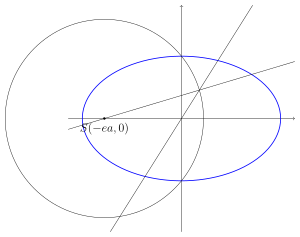
The point \(P(a\cos\theta\,,\, b\sin\theta)\), where \(a>b>0\), lies on the ellipse \[\dfrac {x^2}{a^2} + \dfrac {y^2}{b^2}=1\,.\] The point \(S(-ea\,,\,0)\), where \(b^2=a^2(1-e^2)\,\), is a focus of the ellipse. The point \(N\) is the foot of the perpendicular from the origin, \(O\), to the tangent to the ellipse at \(P\). The lines \(SP\) and \(ON\) intersect at \(T\). Show that the \(y\)-coordinate of \(T\) is \[\dfrac{b\sin\theta}{1+e\cos\theta}\,.\] Show that \(T\) lies on the circle with centre \(S\) and radius \(a\).
Solution: Find the gradient of the tangent of the ellipse at \(P\): \begin{align*} && \frac{2x}{a^2} + \frac{2y}{b^2} \frac{\d y}{\d x} &= 0 \\ \Rightarrow && \frac{\d y}{\d x} &= - \frac{2xb^2}{2ya^2} \\ &&&=- \frac{a \cos \theta b^2}{b \sin \theta a^2} \\ &&&=-\frac{b}{a} \cot \theta \end{align*} Therefore the gradient of \(ON\) is \(\frac{a}{b} \tan \theta\). \begin{align*} && y &= \frac{a}{b} \tan \theta x \\ && \frac{y-0}{x-(-ea)} &= \frac{b\sin \theta-0}{a\cos \theta -(-ea)} \\ && y &= \frac{b \sin \theta}{a(e+\cos \theta)}(x+ea) \\ \Rightarrow && y &= \frac{b \sin \theta}{a(\cos \theta+e)}\frac{b}{a} \cot \theta y+ \frac{eb \sin \theta}{\cos \theta + e} \\ &&&= \frac{b^2 \cos \theta}{a^2(\cos \theta +e)}y + \frac{eb \sin \theta}{\cos \theta + e} \\ \Rightarrow && (\cos \theta+e)y &= (1-e^2)\cos \theta y +eb \sin \theta\\ && e(1+e\cos \theta)y &= eb \sin \theta \\ \Rightarrow && y &= \frac{b \sin \theta}{1+e\cos \theta} \\ && x &= \frac{b \sin \theta}{1+e\cos \theta} \frac{b}{a} \cot \theta \\ &&&= \frac{b^2 \cos \theta}{a(1+e\cos \theta)} \end{align*} Therefore \(\displaystyle T\left (\frac{b^2 \cos \theta}{a(1+e\cos \theta)}, \frac{b \sin \theta}{1+e\cos \theta} \right)\). Finally, we can look at the distance of \(T\) from \(S\) \begin{align*} && d^2 &= \left (\frac{b^2 \cos \theta}{a(1+e\cos \theta)}-(-ea) \right)^2 + \left (\frac{b \sin \theta}{1+e\cos \theta} -0\right)^2 \\ &&&= \frac{\left (b^2 \cos \theta+ea^2(1+e\cos\theta)\right)^2 + \left ( ab \sin \theta\right)^2}{a^2(1+e\cos \theta)^2} \\ &&&= \frac{b^4\cos^2\theta+e^2a^4(1+e\cos\theta)^2+2ea^2b^2(1+e\cos\theta)+a^2b^2\sin^2\theta}{a^2(1+e\cos\theta)^2} \\ &&&= \frac{a^4(1-e^2)^2\cos^2\theta+e^2a^4(1+e\cos\theta)^2+2ea^2a^2(1-e^2)(1+e\cos\theta)+a^4(1-e^2)\sin^2\theta}{a^2(1+e\cos\theta)^2} \\ &&&= a^2 \left ( \frac{(1-e^2)^2\cos^2\theta+e^2(1+e\cos\theta)^2+2e(1-e^2)(1+e\cos\theta)+(1-e^2)(1-\cos^2\theta)}{(1+e\cos\theta)^2} \right) \\ &&&= a^2 \left ( \frac{e^2(1+e\cos\theta)^2+(1-e^2)((1-e^2)\cos^2\theta+2e(1+e\cos\theta)+(1-\cos^2\theta))}{(1+e\cos\theta)^2} \right) \\ &&&= a^2 \left ( \frac{e^2(1+e\cos\theta)^2+(1-e^2)(1+e\cos\theta)^2}{(1+e\cos\theta)^2} \right) \\ &&&= a^2 \end{align*} Therefore a circle radius \(a\) centre \(S\).
2006 Paper 2 Q7
An ellipse has equation $\dfrac{x^2}{a^2} +\dfrac {y^2}{b^2} = 1$. Show that the equation of the tangent at the point \((a\cos\alpha, b\sin\alpha)\) is \[ y=- \frac {b \cot \alpha} a \, x + b\, {\rm cosec\,}\alpha\,. \] The point \(A\) has coordinates \((-a,-b)\), where \(a\) and \(b\) are positive. The point \(E\) has coordinates \((-a,0)\) and the point \(P\) has coordinates \((a,kb)\), where \(0 < k < 1\). The line through \(E\) parallel to \(AP\) meets the line \(y=b\) at the point \(Q\). Show that the line \(PQ\) is tangent to the above ellipse at the point given by \(\tan(\alpha/2)=k\). Determine by means of sketches, or otherwise, whether this result holds also for \(k=0\) and \(k=1\).
2005 Paper 1 Q2
The point \(P\) has coordinates \(\l p^2 , 2p \r\) and the point \(Q\) has coordinates \(\l q^2 , 2q \r\), where \(p\) and~\(q\) are non-zero and \(p \neq q\). The curve \(C\) is given by \(y^2 = 4x\,\). The point \(R\) is the intersection of the tangent to \(C\) at \(P\) and the tangent to \(C\) at \(Q\). Show that \(R\) has coordinates \(\l pq , p+q \r\). The point \(S\) is the intersection of the normal to \(C\) at \(P\) and the normal to \(C\) at \(Q\). If \(p\) and \(q\) are such that \(\l 1 , 0 \r\) lies on the line \(PQ\), show that \(S\) has coordinates \(\l p^2 + q^2 + 1 , \, p+q \r\), and that the quadrilateral \(PSQR\) is a rectangle.
2005 Paper 3 Q5
Let \(P\) be the point on the curve \(y=ax^2+bx+c\) (where \(a\) is non-zero) at which the gradient is \(m\). Show that the equation of the tangent at \(P\) is \[ y-mx=c-\frac{(m-b)^2}{4a}\;. \] Show that the curves \(y=a_1 x^2+b_1 x+c_1\) and \(y=a_2 x^2+b_2 x+c_2\) (where \(a_1\) and \(a_2\) are non-zero) have a common tangent with gradient \(m\) if and only if \[ (a_2 -a_1 )m^2 + 2(a_1 b_2-a_2 b_1)m + 4a_1 a_2(c_2-c_1)+ a_2 b_1^2-a_1 b_2 ^2=0\;. \] Show that, in the case \(a_1 \ne a_2 \,\), the two curves have exactly one common tangent if and only if they touch each other. In the case \(a_1 =a_2\,\), find a necessary and sufficient condition for the two curves to have exactly one common tangent.
Solution: \begin{align*} && y' &= 2ax+b \\ \Rightarrow && m &= 2ax_t+b \\ \Rightarrow && x_t &= \frac{m-b}{2a} \end{align*} Therefore we must have \begin{align*} mx_t &= 2ax_t^2+bx_t \\ y - mx &= ax_t^2+bx_t+c - mx_t \\ &= ax_t^2+bx_t+c - (2ax_t^2+bx_t) \\ &= c - ax_t^2 \\ &= c-a\left (\frac{m-b}{2a} \right)^2 \\ &= c - \frac{(m-b)^2}{4a} \end{align*} They will have a common tangent if and only if the constant terms are equal, ie \begin{align*} && c_1 - \frac{(m-b_1)^2}{4a_1} &= c_2 - \frac{(m-b_2)^2}{4a_2} \\ \Leftrightarrow && (c_1-c_2) &= \frac{(m-b_1)^2}{4a_1} -\frac{(m-b_2)^2}{4a_2} \\ \Leftrightarrow && 4a_1a_2(c_1-c_2) &= a_2(m-b_1)^2-a_1(m-b_2)^2 \\ &&&= (a_2-a_1)m^2+2(a_1b_2-a_2b_1)m+a_2b_1^2-a_1b_2^2 \end{align*} as required. Treating this as a polynomial in \(m\), we can see that the two curves will have exactly one common tangent iff \(\Delta = 0\), ie: \begin{align*} && 0 &= \Delta \\ &&&= (2(a_1b_2-a_2b_1))^2 - 4 (a_2-a_1)(4a_1 a_2(c_2-c_1)+ a_2 b_1^2-a_1 b_2 ^2) \\ &&&= 4a_1^2b_2^2-8a_1a_2b_1b_2+4a_2b_1^2 - 4a_2^2b_1^2-4a_1^2b_2^2 + 4a_1a_2(b_1^2+b_2^2)-16(a_2-a_1)a_1a_2(c_2-c_1) \\ &&&=-8a_1a_2b_1b_2+4a_1a_2(b_1^2+b_2^2)-16(a_2-a_1)a_1a_2(c_2-c_1) \\ &&&=a_1a_2(4(b_1-b_2)^2-16(a_2-a_1)(c_2-c_1)) \\ &&&= 4a_1a_2((b_2-b_1)^2 - 4(a_2-a_1)(c_2-c_1) \end{align*} But this is just the discriminant of the difference, ie equivalent to the two parabolas just touching. (Assuming \(a_1-a_2 \neq 0\) and we do end up with a quadratic). If \(a_1 = a_2 = a\) then we need exactly one solution to \(2a(b_1-b_2)m +4a^2(c_2-c_1)+a(b_1^2-b_2^2) = 0\), ie \(b_1 \neq b_2\).