Problems
Filters
29 problems found
2019 Paper 3 Q8
A pyramid has a horizontal rectangular base \(ABCD\) and its vertex \(V\) is vertically above the centre of the base. The acute angle between the face \(AVB\) and the base is \(\alpha\), the acute angle between the face \(BVC\) and the base is \(\beta\) and the obtuse angle between the faces \(AVB\) and \(BVC\) is \(\pi - \theta\).
- The edges \(AB\) and \(BC\) are parallel to the unit vectors \(\mathbf{i}\) and \(\mathbf{j}\), respectively, and the unit vector \(\mathbf{k}\) is vertical. Find a unit vector that is perpendicular to the face \(AVB\). Show that $$\cos \theta = \cos \alpha \cos \beta.$$
- The edge \(BV\) makes an angle \(\phi\) with the base. Show that $$\cot^2 \phi = \cot^2 \alpha + \cot^2 \beta.$$ Show also that $$\cos^2 \phi = \frac{\cos^2 \alpha + \cos^2 \beta - 2 \cos^2 \theta}{1 - \cos^2 \theta} \geq \frac{2 \cos \theta - 2 \cos^2 \theta}{1 - \cos^2 \theta}$$ and deduce that \(\phi < \theta\).
Solution:
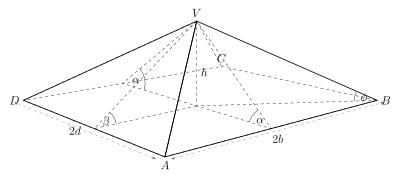
- Let \(A = (0,0,0)\) and then \(B = 22b \mathbf{i}, D = 2d\mathbf{j}, C = 2b\mathbf{i}+2d\mathbf{j}\) and \(V = b \mathbf{i} + d\mathbf{j} + h\mathbf{k}\) We also have \begin{align*} && \tan \alpha &= \frac{h}{d}\\ && \tan \beta &= \frac{d}{b} \\ && \vec{AV} \times \vec{VB} &= \begin{pmatrix} b \\ d \\ h \end{pmatrix} \times \begin{pmatrix} -b \\ d \\ h \end{pmatrix} \\ &&&= \begin{pmatrix} 0 \\ -2bh \\ 2db \end{pmatrix} \\ &&&= 2b \begin{pmatrix} 0 \\ -d \tan \alpha \\ d \end{pmatrix} \\ &&&= k \begin{pmatrix} 0 \\ - \sin \alpha \\ \cos \alpha \end{pmatrix} \end{align*} similarly for the vector perpendicular to the other face it must be \(\begin{pmatrix}-\sin \beta \\ 0 \\ \cos \beta \end{pmatrix}\) Looking at the angle between these perpendicular (to find the angles between the faces we see: \begin{align*} \begin{pmatrix} 0 \\ - \sin \alpha \\ \cos \alpha \end{pmatrix} \cdot \begin{pmatrix}-\sin \beta \\ 0 \\ \cos \beta \end{pmatrix} &= \cos \alpha \cos \beta \end{align*} But this is also \(\pi -\) the angle between the planes, ie \(\cos \theta = \cos \alpha \cos \beta\)
- \(\,\) \begin{align*} && \cot^2 \phi &= \frac{b^2+d^2}{h^2} \\ && \cot^2 \alpha &= \frac{d^2}{h^2} \\ && \cot^2 \beta &= \frac{b^2}{h^2} \\ \Rightarrow && cot^2 \phi &= \cot^2 \beta+\cot^2 \alpha \end{align*} \begin{align*} && \cos^2 \phi &= \frac{b^2+d^2}{b^2+d^2+h^2} \\ && \cos^2 \alpha &= \frac{d^2}{d^2+h^2} \\ && \cos^2 \beta &= \frac{b^2}{b^2+h^2} \\ && \frac{\cos^2 \alpha + \cos^2 \beta - 2 \cos^2 \theta}{1-\cos^2 \theta} &= \frac{\frac{d^2}{d^2+h^2}+\frac{b^2}{b^2+h^2}-2\cdot \frac{d^2}{d^2+h^2} \cdot \frac{b^2}{b^2+h^2}}{1 - \frac{d^2}{d^2+h^2} \cdot\frac{b^2}{b^2+h^2}} \\ &&&= \frac{d^2(b^2+h^2)+b^2(d^2+h^2)-2d^2b^2}{(d^2+h^2)(b^2+h^2)-d^2b^2} \\ &&&= \frac{h^2(b^2+d^2)}{h^2(b^2+d^2+h^2)} \\ &&&= \frac{b^2+d^2}{b^2+d^2+h^2} \\ &&&= \cos^2\phi \end{align*} Also notice that \begin{align*} && \cos^2 \alpha + \cos^2 \beta &\underbrace{\geq}_{AM-GM} 2 \cos \alpha \cos \beta \\ &&&= 2 \cos \theta \\ \Rightarrow && \frac{\cos^2 \alpha + \cos^2 \beta - 2 \cos^2 \theta}{1-\cos^2 \theta} &\geq \frac{2 \cos \theta - 2\cos^2 \theta}{1-\cos^2 \theta} \\ &&&= \frac{2\cos \theta}{1+\cos \theta} = \cos \theta \frac{2}{1+\cos \theta} \\ &&&> \cos^2 \theta \\ \Rightarrow && \phi &< \theta \end{align*}
2011 Paper 2 Q11
Three non-collinear points \(A\), \(B\) and \(C\) lie in a horizontal ceiling. A particle \(P\) of weight \(W\) is suspended from this ceiling by means of three light inextensible strings \(AP\), \(BP\) and \(CP\), as shown in the diagram. The point \(O\) lies vertically above \(P\) in the ceiling.
- Show that the unit vector in the direction \(PB\) can be written in the form \[ -\frac13\, {\bf i} - \frac{\sqrt2\,}3\, {\bf j} + \frac{\sqrt2\, }{\sqrt3 \,} \,{\bf k} \,,\] where \(\bf i\,\), \(\, \bf j\) and \(\bf k\) are the usual mutually perpendicular unit vectors with \(\bf j\) parallel to \(OA\) and \(\bf k\) vertically upwards.
- Find expressions in vector form for the forces acting on \(P\).
- Show that \(U=\sqrt6 V\) and find \(T\), \(U\) and \(V\) in terms of \(W\).
2010 Paper 2 Q6
Each edge of the tetrahedron \(ABCD\) has unit length. The face \(ABC\) is horizontal, and \(P\) is the point in \(ABC\) that is vertically below \(D\).
- Find the length of \(PD\).
- Show that the cosine of the angle between adjacent faces of the tetrahedron is \(1/3\).
- Find the radius of the largest sphere that can fit inside the tetrahedron.
Solution:
- \(D\) must be above the centre (of any kind) of the equilateral triangle \(ABC\). Therefore it is a distance \(\frac23 \frac{\sqrt{3}}2 = \frac{\sqrt{3}}3\) from \(A\). \(D\) is \(1\) from \(A\), therefore by Pythagoras \(PD = \sqrt{1-\frac13} = \sqrt{\frac23}\)
- We can place \(D\) at \(\langle 0,0,\sqrt{\frac23}\rangle\) and \(A'\) (the midpoint of \(BC\)) at \(\langle-\frac{\sqrt{3}}{6},0,0 \rangle\) and we find: \begin{align*} && \cos \theta &= \frac{(\mathbf{a}'-\mathbf{d})\cdot \mathbf{a}'}{|\mathbf{a}'-\mathbf{d}|| \mathbf{a}'|} \\ &&&= \frac{|\mathbf{a}'|}{|\mathbf{a}'-\mathbf{d}|} \\ &&&= \frac{\frac{\sqrt{3}}{6}}{\sqrt{\frac23+\frac{3}{36}}} = \frac13 \end{align*}
- We have And therefore we must have \(\tan \frac{\cos^{-1} \frac13}{2} = \frac{r}{\frac{\sqrt{3}}{6}}\) therefore \begin{align*} && r &= \frac{\sqrt{3}}{6} \tan \left (\frac{\cos^{-1} \frac13}{2} \right) \\ &&&= \frac{\sqrt{3}}6 \sqrt{\frac{1-\cos(\cos^{-1}\frac13)}{1+\cos(\cos^{-1}\frac13)}} \\ &&&= \frac{\sqrt{3}}6 \sqrt{\frac{\frac23}{\frac43}} \\ &&&= \frac{\sqrt{6}}{12} \end{align*}

2009 Paper 2 Q9
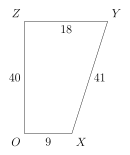
- A uniform lamina \(OXYZ\) is in the shape of the trapezium shown in the diagram. It is right-angled at \(O\) and \(Z\), and \(OX\) is parallel to \(YZ\). The lengths of the sides are given by \(OX=9\,\)cm, \(XY=41\,\)cm, \(YZ=18\,\)cm and \(ZO=40\,\)cm. Show that its centre of mass is a distance \(7\,\)cm from the edge \(OZ\).
- The diagram shows a tank with no lid made of thin sheet metal. The base \(OXUT\), the back \(OTWZ\) and the front \(XUVY\) are rectangular, and each end is a trapezium as in part (i). The width of the tank is \(d\,\)cm.
Show that the centre of mass of the tank, when empty, is a distance \[ \frac {3(140+11d)}{5(12+d)}\,\text{cm} \] from the back of the tank. The tank is then filled with a liquid. The mass per unit volume of this liquid is \(k\) times the mass per unit area of the sheet metal. In the case \(d=20\), find an expression for the distance of the centre of mass of the filled tank from the back of the tank.

Solution:
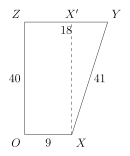
- \begin{array}{c|c|c|c} & OXX'Z & XX'Y & OXYZ \\ \hline \text{Area} & 360 & 180 & 540\\ \text{COM} & \binom{4.5}{20} & \binom{12}{\frac{80}{3}} & \binom{\overline{x}}{\overline{y}} \end{array} \begin{align*} && 2 \binom{3}{20} + \binom{12}{\frac{80}{3}} &= 3 \binom{\overline{x}}{\overline{y}} \\ \Rightarrow && \binom{\overline{x}}{\overline{y}} &= \frac13 \binom{21}{\frac{200}{3}} \\ &&&= \binom{7}{\frac{200}{9}} \end{align*} ie, the centre of mass is \(7\text{ cm}\) from \(OZ\)
- \begin{align*} && \underbrace{540 \cdot 7}_{OXYZ} + \underbrace{540 \cdot 7}_{TUVW} + \underbrace{40d\cdot 0}_{OTWZ} + \underbrace{9d\cdot 4.5}_{OXUT} + \underbrace{41d \cdot 13.5}_{XUVY} &= (540+540+40d+9d+41d) \overline{x} \\ \Rightarrow && \overline{x} &= \frac{540\cdot 14 + 50d \cdot 4.5 + 41d \cdot 9}{1080 + 90d} \\ &&&= \frac{90 \cdot 84 + 225d + 369d}{1080+90d} \\ &&&= \frac{90 \cdot 84 + 594d}{1080+90d} \\ &&&= \frac{54(140+11d)}{90(12+d)} \\ &&&= \frac{3(140+11d)}{5(12+d)} \end{align*} The volume of the prizm is \(540d\), it's center of mass is \(7\). For the tank, it COM is \(\frac{3(140+11\cdot20)}{5(12+20)} = \frac{27}4\) and area is \(2880\) Therefore for the combined shape we have: \begin{align*} && 540dk \cdot 7 + 2880 \cdot \frac{27}{4} &= (540 \cdot20 k+2880) \overline{x} \\ \Rightarrow && \overline{x} &= \frac{720(150k+27)}{720(15k + 4)} \\ &&&= \frac{3(50k+9)}{15k+4} \end{align*} \begin{align*} && \end{align*}
2007 Paper 1 Q5
Note: a regular octahedron is a polyhedron with eight faces each of which is an equilateral triangle.
- Show that the angle between any two faces of a regular octahedron is \(\arccos \left( -{\frac1 3} \right)\).
- Find the ratio of the volume of a regular octahedron to the volume of the cube whose vertices are the centres of the faces of the octahedron.
Solution:
- Suppose the vertices are \((\pm1, 0,0), (0,\pm1,0), (0,0,\pm1)\), then clearly this is an octahedron. We can measure the angle between the faces, by looking at vectors in the same plane and also in two of the faces: \(\langle \frac12, \frac12, - 1\rangle\) and \(\langle \frac12, \frac12, 1\rangle\), then by considering the dot product: \begin{align*} && \cos \theta &= \frac{\frac14+\frac14-1}{\frac14+\frac14+1} \\ &&&= \frac{-2}{6} = -\frac13 \end{align*}
- The volume of our octahedron is \(2 \cdot \frac13 \cdot \underbrace{\sqrt{2}^2}_{\text{base}} \cdot \underbrace{1}_{\text{height}} = \frac43\). The centre of two touching faces are \(\langle \frac13, \frac13, \frac13 \rangle\) and \(\langle \frac13, \frac13, -\frac13 \rangle\) and so the length of the side of the cube is \(\frac23\) and so the volume of the cube is \(\frac8{27}\). Therefore the ratio is \(\frac{2}{9}\)
2006 Paper 1 Q8
{\it Note that the volume of a tetrahedron is equal to \(\frac1 3\) \(\times\) the area of the base \(\times\) the height.} The points \(O\), \(A\), \(B\) and \(C\) have coordinates \((0,0,0)\), \((a,0,0)\), \((0,b,0)\) and \((0,0,c)\), respectively, where \(a\), \(b\) and \(c\) are positive.
- Find, in terms of \(a\), \(b\) and \(c\), the volume of the tetrahedron \(OABC\).
- Let angle \(ACB = \theta\). Show that \[ \cos\theta = \frac {c^2} { { \sqrt{\vphantom{ \dot b} (a^2+c^2)(b^2+c^2)} } ^{\vphantom A} \ } \] and find, in terms of \(a\), \(b\) and \(c\), the area of triangle \(ABC\). % is %\(\displaystyle \tfrac12 \sqrt{ \vphantom{\dot A } a^2b^2 +b^2c^2 + c^2 a^2 \;} \;\).
2005 Paper 2 Q7
The position vectors, relative to an origin \(O\), at time \(t\) of the particles \(P\) and \(Q\) are $$\cos t \; {\bf i} + \sin t\;{\bf j} + 0 \; {\bf k} \text{ and } \cos (t+\tfrac14{\pi})\, \big[{\tfrac32}{\bf i} + { \tfrac {3\sqrt{3}}2} {\bf k}\big] + 3\sin(t+\tfrac14{\pi}) \; {\bf j}\;,$$ respectively, where \(0\le t \le 2\pi\,\).
- Give a geometrical description of the motion of \(P\) and \(Q\).
- Let \(\theta\) be the angle \(POQ\) at time \(t\) that satisfies \(0\le\theta\le\pi\,\). Show that \[ \cos\theta = \tfrac{3\surd2}{8} -\tfrac14 \cos( 2t +\tfrac14 \pi)\;. \]
- Show that the total time for which \(\theta \ge \frac14 \pi\) is \(\tfrac32 \pi\,\).
Solution:
- \(P\) is travelling in a unit circle about the origin in the \(\mathbf{i}-\mathbf{j}\) plane. \(Q\) is travelling in a circle (also about the origin, but in a different plane with radius \(3\)).
- \(\,\) \begin{align*} && \mathbf{p}\cdot \mathbf{q} &= |\mathbf{p}||\mathbf{q}| \cos \theta \\ \Rightarrow && \cos \theta &= \frac{\tfrac32\cos t \cos(t + \tfrac{\pi}4)+3\sin t \sin (t + \tfrac{\pi}{4})}{3} \\ &&&= \tfrac12\cos t \cos(t + \tfrac{\pi}4)+\sin t \sin (t + \tfrac{\pi}{4}) \\ &&&= \tfrac14 (\cos (2t + \tfrac{\pi}{4}) + \cos(\tfrac{\pi}{4} ))+\tfrac12(\cos(\tfrac{\pi}{4})-\cos(2t + \tfrac{\pi}{4})) \\ &&&= \tfrac{3\sqrt{2}}8 - \tfrac14 \cos ( 2t +\tfrac{\pi}{4}) \end{align*}
- If \(\theta \geq \frac14\pi\), then \(\cos \theta \leq \frac{\sqrt{2}}2\) \begin{align*} && \frac{\sqrt{2}}2 & \geq \frac{3\sqrt{2}}8 - \frac14 \cos ( 2t +\tfrac{\pi}{4}) \\ \Rightarrow && \frac{\sqrt{2}}2 &\geq -\cos(2t + \tfrac{\pi}{4}) \\ \Rightarrow && \cos(2t + \tfrac{\pi}{4}) &\geq -\frac{1}{\sqrt{2}} \\ \Rightarrow && 2t + \tfrac{\pi}{4} &\not\in (\tfrac{3\pi}{4},\tfrac{5\pi}{4}) \cup (\tfrac{11\pi}{4},\tfrac{13\pi}{4}) \\ \Rightarrow && t &\not\in (\tfrac{\pi}{4}, \tfrac{\pi}{2})\cup (\tfrac{5\pi}{4}, \tfrac{3\pi}{2}) \end{align*} which is is a time of \(\frac{\pi}{2}\), therefore the left over time is \(\frac32\pi\)
2003 Paper 2 Q5
The position vectors of the points \(A\,\), \(B\,\) and \(P\) with respect to an origin \(O\) are \(a{\bf i}\,\), \(b{\bf j}\,\) and \(l{\bf i}+m{\bf j}+n{\bf k}\,\), respectively, where \(a\), \(b\), and \(n\) are all non-zero. The points \(E\), \(F\), \(G\) and \(H\) are the midpoints of \(OA\), \(BP\), \(OB\) and \(AP\), respectively. Show that the lines \(EF\) and \(GH\) intersect. Let \(D\) be the point with position vector \(d{\bf k}\), where \(d\) is non-zero, and let \(S\) be the point of intersection of \(EF\) and \(GH.\) The point \(T\) is such that the mid-point of \(DT\) is \(S\). Find the position vector of \(T\) and hence find \(d\) in terms of \(n\) if \(T\) lies in the plane \(OAB\).
Solution: \(E = \langle \frac{a}{2}, 0,0 \rangle, F = \langle \frac{l}{2}, \frac{m+b}{2}, \frac{n}{2} \rangle, G = \langle 0, \frac{b}{2}, 0 \rangle, H = \langle \frac{a+l}{2}, \frac{m}{2}, \frac{n}{2} \rangle\) Note that the midpoint of \(EF\) and \(GH\) are both $\langle \frac{a+l}{4}, \frac{m+b}{4}, \frac{n}{4} \rangle$, so clearly they must intersect at this point. The vector we just found is \(S\), and \(\mathbf{t} = \mathbf{d} + 2(\mathbf{s}-\mathbf{d}) = 2\mathbf{s} - \mathbf{d}\). Therefore \(T = \langle \frac{a+l}{2}, \frac{m+b}{2}, \frac{n-2d}{2} \rangle\). If \(T\) lies in the plane \(OAB\) then \(n - 2d = 0\) ie \(d = \frac{n}{2}\)
2002 Paper 1 Q6
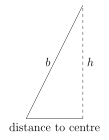
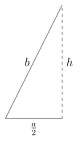
A pyramid stands on horizontal ground. Its base is an equilateral triangle with sides of length~\(a\), the other three sides of the pyramid are of length \(b\) and its volume is \(V\). Given that the formula for the volume of any pyramid is $ \textstyle \frac13 \times \mbox{area of base} \times \mbox {height} \,, $ show that \[ V= \frac1{12} {a^2(3b^2-a^2)}^{\frac12}\;. \] The pyramid is then placed so that a non-equilateral face lies on the ground. Show that the new height, \(h\), of the pyramid is given by \[ h^2 = \frac{a^2(3b^2-a^2)}{4b^2-a^2}\;. \] Find, in terms of \(a\) and \(b\,\), the angle between the equilateral triangle and the horizontal.
Solution: First let's consider the area of the base. It is an equilateral triangle with side length \(a\), so \(\frac12 a^2 \sin 60^\circ = \frac{\sqrt{3}}4a^2\).
2002 Paper 2 Q6
The lines \(l_1\), \(l_2\) and \(l_3\) lie in an inclined plane \(P\) and pass through a common point \(A\). The line \(l_2\) is a line of greatest slope in \(P\). The line \(l_1\) is perpendicular to \(l_3\) and makes an acute angle \(\alpha\) with \(l_2\). The angles between the horizontal and \(l_1\), \(l_2\) and \(l_3\) are \(\pi/6\), \(\beta\) and \(\pi/4\), respectively. Show that \(\cos\alpha\sin\beta = \frac12\,\) and find the value of \(\sin\alpha \sin\beta\,\). Deduce that \(\beta = \pi/3\,\). The lines \(l_1\) and \(l_3\) are rotated in \(P\) about \(A\) so that \(l_1\) and \(l_3\) remain perpendicular to each other. The new acute angle between \(l_1\) and \(l_2\) is \(\theta\). The new angles which \(l_1\) and \(l_3\) make with the horizontal are \(\phi\) and \(2\phi\), respectively. Show that \[ \tan^2\theta = \frac{3+\sqrt{13}}2\;. \]
2002 Paper 2 Q7
In 3-dimensional space, the lines \(m_1\) and \(m_2\) pass through the origin and have directions \(\bf i + j\) and \(\bf i +k \), respectively. Find the directions of the two lines \(m_3\) and \(m_4\) that pass through the origin and make angles of \(\pi/4\) with both \(m_1\) and \(m_2\). Find also the cosine of the acute angle between \(m_3\) and \(m_4\). The points \(A\) and \(B\) lie on \(m_1\) and \(m_2\) respectively, and are each at distance \(\lambda \surd2\) units from~\(O\). The points \(P\) and \(Q\) lie on \(m_3\) and \(m_4\) respectively, and are each at distance \(1\) unit from~\(O\). If all the coordinates (with respect to axes \(\bf i\), \(\bf j\) and \(\bf k\)) of \(A\), \(B\), \(P\) and \(Q\) are non-negative, prove that:
- there are only two values of \(\lambda\) for which \(AQ\) is perpendicular to \(BP\,\);
- there are no non-zero values of \(\lambda\) for which \(AQ\) and \(BP\) intersect.
2001 Paper 3 Q6
The plane \[ {x \over a} + {y \over b} +{z \over c} = 1 \] meets the co-ordinate axes at the points \(A\), \(B\) and \(C\,\). The point \(M\) has coordinates \(\left( \frac12 a, \frac12 b, \frac 12 c \right)\) and \(O\) is the origin. Show that \(OM\) meets the plane at the centroid \(\left( \frac13 a, \frac13 b, \frac 13 c \right)\) of triangle \(ABC\). Show also that the perpendiculars to the plane from \(O\) and from \(M\) meet the plane at the orthocentre and at the circumcentre of triangle \(ABC\) respectively. Hence prove that the centroid of a triangle lies on the line segment joining its orthocentre and circumcentre, and that it divides this line segment in the ratio \(2 : 1\,\). [The orthocentre of a triangle is the point at which the three altitudes intersect; the circumcentre of a triangle is the point equidistant from the three vertices.]
Solution: The line \(OM\) is \(\lambda \begin{pmatrix} a \\ b \\ c \end{pmatrix}\), then we need \(1 = \lambda \begin{pmatrix} a \\ b \\ c \end{pmatrix} \cdot \begin{pmatrix} \frac1{a} \\ \frac1b \\ \frac1c \end{pmatrix} = 3 \lambda \Rightarrow \lambda = \frac13\). Therefore \(OM\) meets the plane at the centroid. The orthocentre is the point \(\mathbf{h}\) such that \((\mathbf{a}-\mathbf{b}) \cdot (\mathbf{c} - \mathbf{h}) = 0 \Leftrightarrow \begin{pmatrix} a \\ -b \\ 0 \end{pmatrix} \cdot \begin{pmatrix} -p \\ -q \\ c-r \end{pmatrix} \Leftrightarrow ap-bq = 0\) \((\mathbf{b}-\mathbf{c}) \cdot (\mathbf{a} - \mathbf{h}) = 0 \Leftrightarrow \begin{pmatrix} 0 \\ b \\ -c \end{pmatrix} \cdot \begin{pmatrix} a-p \\ -q \\ -r \end{pmatrix} \Leftrightarrow bq-cr = 0\) \((\mathbf{c}-\mathbf{a}) \cdot (\mathbf{b} - \mathbf{h}) = 0 \Leftrightarrow \begin{pmatrix} -a \\ 0 \\ c \end{pmatrix} \cdot \begin{pmatrix} -p \\ b-q \\ -r \end{pmatrix} \Leftrightarrow cr-ap = 0\) ie \(ap = bq = cr\) but this is clearly on the line \(\lambda \begin{pmatrix} \frac1{a} \\ \frac1b \\ \frac1c \end{pmatrix}\) therefore the orthocentre is on the perpendicular from \(O\) \(M-A = \begin{pmatrix} -a/2 \\ b/2 \\ c/2 \end{pmatrix}\) so \(|M-A|=|M-B|=|M-C|\) Also by pythagoras the point of intersection satisfies \(|M-P|^2 + |P-A|^2 = |M-A|^2\) so \(|P-A|^2 = |P-B|^2 = |P-C|^2\), therefore \(P\) is the circumcentre. Since all these points are in the same plane and \(OGM\) is a line, we have the points are in a line. Similar triangles gives the desired ratio
2000 Paper 1 Q5
Arthur and Bertha stand at a point \(O\) on an inclined plane. The steepest line in the plane through \(O\) makes an angle \(\theta\) with the horizontal. Arthur walks uphill at a steady pace in a straight line which makes an angle \(\alpha\) with the steepest line. Bertha walks uphill at the same speed in a straight line which makes an angle \(\beta\) with the steepest line (and is on the same side of the steepest line as Arthur). Show that, when Arthur has walked a distance \(d\), the distance between Arthur and Bertha is \(2d \vert\sin\frac12(\alpha-\beta)\vert\). Show also that, if \(\alpha\ne\beta\), the line joining Arthur and Bertha makes an angle \(\phi\) with the vertical, where \[ \cos\phi = \sin\theta \sin \frac12(\alpha+\beta). \]
1998 Paper 2 Q8
Points \(\mathbf{A},\mathbf{B},\mathbf{C}\) in three dimensions have coordinate vectors \(\mathbf{a},\mathbf{b},\mathbf{c}\), respectively. Show that the lines joining the vertices of the triangle \(ABC\) to the mid-points of the opposite sides meet at a point \(R\). \(P\) is a point which is {\bf not} in the plane \(ABC\). Lines are drawn through the mid-points of \(BC\), \(CA\) and \(AB\) parallel to \(PA\), \(PB\) and \(PC\) respectively. Write down the vector equations of the lines and show by inspection that these lines meet at a common point \(Q\). Prove further that the line \(PQ\) meets the plane \(ABC\) at \(R\).
1998 Paper 3 Q6
- Show that four vertices of a cube, no two of which are adjacent, form the vertices of a regular tetrahedron. Hence, or otherwise, find the volume of a regular tetrahedron whose edges are of unit length.
- Find the volume of a regular octahedron whose edges are of unit length.
- Show that the centres of the faces of a cube form the vertices of a regular octahedron. Show that its volume is half that of the tetrahedron whose vertices are the vertices of the cube.