Problems
Filters
298 problems found
2025 Paper 2 Q2
- Show that if the complex number \(z\) satisfies the equation \[z^2 + |z + b| = a,\] where \(a\) and \(b\) are real numbers, then \(z\) must be either purely real or purely imaginary.
- Show that the equation \[z^2 + \left|z + \frac{5}{2}\right| = \frac{7}{2}\] has no purely imaginary roots.
- Show that the equation \[z^2 + \left|z + \frac{7}{2}\right| = \frac{5}{2}\] has no purely real roots.
- Show that, when \(\frac{1}{2} < b < \frac{3}{4}\), the equation \[z^2 + |z + b| = \frac{1}{2}\] will have at least one purely imaginary root and at least one purely real root.
- Solve the equation \[z^3 + |z + 2|^2 = 4.\]
Solution:
- Suppose \(z^2 + |z + b| = a\), then \(z^2 = a- |z + b| \in \mathbb{R}\), since \(a \in \mathbb{R}\). Since the square root of a real number is either purely real or purely imaginary, \(z\) is purely real or purely imaginary.
- Suppose \(z = it\) for some \(t \in \mathbb{R}\), then \begin{align*} && \frac72 &= -t^2 +\sqrt{t^2 + \frac{25}{4}} \\ \Rightarrow && \left ( \frac72 + t^2\right)^2 &= t^2 + \frac{25}{4} \\ \Rightarrow && t^4 + 7t^2 + \frac{49}{4} &= t^2 + \frac{25}{4} \\ \Rightarrow && t^4 + 6t^2 + 6 &= 0 \end{align*} but since \(\Delta = 6^2 - 4 \cdot 1 \cdot 6 < 0\) there are no real solutions.
- Suppose \(z = t\) for some \(t \in \mathbb{R}\), then either \(t^2 + t + \frac72 = \frac52 \Rightarrow t^2 + t + 1 = 0\) (no solutions) or \(t^2 - t - \frac72 = \frac52 \Rightarrow t^2 - t - 6 = (t-3)(t+2) = 0\). When \(t = 3\) then we must take the positive part for \(|z + \frac72|\) so this cannot work. When \(t = -2\) we also have \(\frac72-2 > 0\) so we are still taking the positive part. Hence no solutions
- Suppose \(\frac{1}{2} < b < \frac{3}{4}\), the equation then consider \(z^2 + |z + b| = \frac{1}{2}\). Case 1: \(z = t \in \mathbb{R}\), then we have two cases: Case 1a: \(z+b > 0\). \(z^2 + z + b = \frac12 \Rightarrow z = \frac{-1 \pm \sqrt{1-4b+2}}{2}\) which clearly is a valid real number an \(z + b > 0\). Case 1b: \(z+b < 0\) \(z^2 - z - b = \frac12 \Rightarrow z = \frac{1 \pm \sqrt{1+4b-2}}{2}\)
- Let \(\omega\) be a (primitive) cube root of unity. \begin{align*} && z^3 &= 4 - |z+2|^2 \\ \Rightarrow && z &\in \mathbb{R} \cup \omega \mathbb{R} \cup \omega^2 \mathbb{R} \end{align*} Case 1:
2025 Paper 2 Q3
- Sketch a graph of \(y = \frac{\ln x}{x}\) for \(x > 0\).
- Use your graph to show the following.
- \(3^{\pi} > \pi^3\)
- \(\left(\frac{9}{4}\right)^{\sqrt{5}} > \sqrt{5}^{\frac{9}{4}}\)
- Given that \(1 < x < 2\), decide, with justification, which is the larger of \(x^{x+2}\) or \((x+2)^x\).
- Show that the inequalities \(9^{\sqrt{2}} > \sqrt{2}^9\) and \(3^{2\sqrt{2}} > (2\sqrt{2})^3\) are equivalent. Given that \(e^2 < 8\), decide, with justification, which is the larger of \(9^{\sqrt{2}}\) and \(\sqrt{2}^9\).
- Decide, with justification, which is the larger of \(8^{\sqrt[4]{3}}\) and \(\sqrt[3]{8}\).
Solution:

- \begin{enumerate}
- since \(\frac{\ln x}{x}\) is decreasing on \((e, \infty)\) we must have that \(\frac{\ln 3}{3} > \frac{\ln \pi}{\pi} \Rightarrow e^\pi > \pi^3\)
- similarly, since \(\frac{\ln x}{x}\) is increasing on \((0, e)\) we must have that \(\frac{\ln \sqrt{5}}{\sqrt{5}} < \frac{\ln 9/4}{9/4} \Rightarrow \left(\frac{9}{4}\right)^{\sqrt{5}} > \sqrt{5}^{\frac{9}{4}}\)
- Since \(2^4 = 4^2\) notice also that:
from the graph we must have the green area between \(1\) and \(2\) mapping to the (higher) green area between \(3\) and \(4\). Therefore \((x+2)^x > x^{x+2}\) for \(1 < x < 2\)

- \begin{align*} && 9^{\sqrt 2} & \stackrel{?}{>} \sqrt{2}^9 \\ \Leftrightarrow && (3^2)^{\sqrt2} &\stackrel{?}{>} (\sqrt{2}^3)^3 \\ \Leftrightarrow && 3^{2 \sqrt2} &\stackrel{?}{>} (2\sqrt2)^3 \end{align*} Since \(e^2 < 8 < 9\Rightarrow e < 2\sqrt2 < 3\) therefore: \begin{align*} && \frac{\ln 2 \sqrt2}{2 \sqrt 2} &> \frac{\ln 3}{3} \\ \Leftrightarrow && (2 \sqrt{2})^3 &> 3^{2 \sqrt{2}} \\ \Leftrightarrow && \sqrt{2}^9 &> 9^{\sqrt 2} \\ \end{align*}
- \begin{align*} && 8^{\sqrt[3]{3}} & \stackrel{?}{>} \sqrt[3]{3}^8 \\ \Leftrightarrow && 2^{3 \sqrt[3] 3} & \stackrel{?}{>} (\sqrt[3]{3}^4)^2 \\ \Leftrightarrow && 2^{3 \sqrt[3] 3} & \stackrel{?}{>} (3\sqrt[3]{3})^2 \\ \end{align*} Since \(3\sqrt[3]{3} > 4\) we have \begin{align*} && \frac{\ln (3 \sqrt[3]3)}{3 \sqrt[3]3} &< \frac{\ln 4}{4} \\ &&&= \frac{\ln 2}{2}\\ \Rightarrow && (3 \sqrt[3]{3})^2 &< 2^{3 \sqrt[3]{3}} \\ \Rightarrow && \sqrt[3]3^8 &< 8^{\sqrt[3]3} \end{align*}
2025 Paper 2 Q10
The lower end of a rigid uniform rod of mass \(m\) and length \(a\) rests at point \(M\) on rough horizontal ground. Each of two elastic strings, of natural length \(\ell\) and modulus of elasticity \(\lambda\), is attached at one end to the top of the rod. Their lower ends are attached to points \(A\) and \(B\) on the ground, which are a distance \(2a\) apart. \(M\) is the midpoint of \(AB\). \(P\) is the point at the top of the rod and lies in the vertical plane through \(AMB\). Suppose that the rod is in equilibrium with angle \(PMB = 2\theta\), where \(\theta < 45°\) and \(\theta\) is such that both strings are in tension.
- Show that angle \(APB\) is a right angle.
Show that the force exerted on the rod by the elastic strings can be written as the sum of
- a force of magnitude \(\frac{2a\lambda}{\ell}\) parallel to the rod
- and a force of magnitude \(\sqrt{2}\lambda\) acting along the bisector of angle \(APB\).
- By taking moments about point \(M\), or otherwise, show that \(\cos\theta + \sin\theta = \frac{2\lambda}{mg}\). Deduce that it is necessary that \(\frac{1}{2}mg < \lambda < \frac{1}{2}\sqrt{2}mg\).
- \(N\) and \(F\) are the magnitudes of the normal and frictional forces, respectively, exerted on the rod by the ground at \(M\). Show, by taking moments about an appropriate point, or otherwise, that \[N - F\tan 2\theta = \frac{1}{2}mg.\]
Solution:

- Notice that \(AM = MB = MP\) in particular \(P\) lies on a semi-circle of radius \(a\) and therefore by Thales' theorem \(\angle APB = 90^{\circ}\). Notice that by angles in a triangle and the angles adding to \(90^{\circ}\), \(\angle APM = \theta\). Therefore, \begin{align*} && |PB| &= 2a \sin \theta \\ && |PA| &= 2a \cos \theta \\ && T_A &= \frac{\lambda}{l} \left (2a \cos \theta -l \right) \\ && T_B &= \frac{\lambda}{l} \left (2a \sin\theta -l \right) \\ \end{align*} Since \(T_A\) and \(T_B\) are perpendicular, we can consider the forces as having vector \(\frac{\lambda}{l}\binom{2a\cos \theta-l}{2a\sin \theta - l}\) in this coordinate system, ie the sum of a vector \(\frac{2\lambda a}{l}\binom{\cos \theta}{\sin \theta}\) and \(\displaystyle -\sqrt{2}\lambda \binom{\frac1{\sqrt{2}}}{\frac1{\sqrt{2}}}\) which are unit vectors parallel to the rod and along the bisector of \(APB\) respectively.
- \begin{align*} \overset{\curvearrowright}{M}: && 0 &= \frac{a}{2} \cdot mg \cos 2 \theta - a\cdot \sqrt{2}\lambda \cos (90-(45-\theta))\\ \Rightarrow && \cos 2 \theta &= \frac{\lambda}{mg} 2 \sqrt{2} \cos (45 + \theta) \\ \Rightarrow && \cos^2 \theta - \sin^2 \theta &= \frac{2\lambda}{mg} (\cos \theta - \sin \theta) \\ \underbrace{\Rightarrow}_{\theta < 45^{\circ}} && \cos \theta + \sin \theta &= \frac{2\lambda}{mg} \end{align*} Over \((0, 45^{\circ})\), \(\cos \theta + \sin \theta\) ranges from \(1\) to \(\sqrt{2}\), therefore \(1 < \frac{2 \lambda}{mg} < \sqrt{2} \Rightarrow \frac12 mg < \lambda < \frac12 \sqrt{2} mg\) as required.
- \begin{align*} \overset{\curvearrowright}{P}: && 0 &=- \frac{a}{2} \cdot \left ( mg \cos 2\theta \right) - a \cdot F \sin 2 \theta + a \cdot N \cos 2 \theta \\ \Rightarrow && \frac12 mg &= N - F \tan 2 \theta \end{align*} as required.
2025 Paper 2 Q12
Let \(X\) be a Poisson random variable with mean \(\lambda\) and let \(p_r = P(X = r)\), for \(r = 0, 1, 2, \ldots\). Neither \(\lambda\) nor \(\lambda + \frac{1}{2} + \sqrt{\lambda + \frac{1}{4}}\) is an integer.
- Show, by considering the sequence \(d_r \equiv p_r - p_{r-1}\) for \(r = 1, 2, \ldots\), that there is a unique integer \(m\) such that \(P(X = r) \leq P(X = m)\) for all \(r = 0, 1, 2, \ldots\), and that \[\lambda - 1 < m < \lambda.\]
- Show that the minimum value of \(d_r\) occurs at \(r = k\), where \(k\) is such that \[k < \lambda + \frac{1}{2} + \sqrt{\lambda + \frac{1}{4}} < k + 1.\]
- Show that the condition for the maximum value of \(d_r\) to occur at \(r = 1\) is \[1 < \lambda < 2 + \sqrt{2}.\]
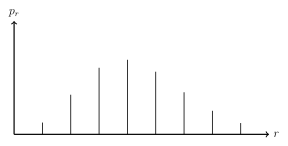
- In the case \(\lambda = 3.36\), sketch a graph of \(p_r\) against \(r\) for \(r = 0, 1, 2, \ldots, 6, 7\).
Solution:
- Suppose \(d_r = p_r - p_{r-1}\) then \begin{align*} d_r &= p_r - p_{r-1} \\ &= \mathbb{P}(X = r) - \mathbb{P}(X = r-1) \\ &= e^{-\lambda} \left ( \frac{\lambda^r}{r!} - \frac{\lambda^{r-1}}{(r-1)!} \right) \\ &= e^{-\lambda} \frac{\lambda^{r-1}}{(r-1)!} \left ( \frac{\lambda}{r} - 1\right) \end{align*} Therefore \(d_r > 0 \Leftrightarrow \lambda > r\)ie, \(p_r\) is increasing while \(r < \lambda\) and reaches a (unique) maximum when \(r = \lfloor \lambda \rfloor\).
- Let \(dd_r = d_r - d_{r-1}\), so: \begin{align*} dd_r &= d_r - d_{r-1} \\ &= p_r - 2p_{r-1} + p_{r-2} \\ &= e^{-\lambda} \frac{\lambda^{r-2}}{r!} \left ( \lambda^2 - 2 \lambda r + r(r-1)\right ) \end{align*} Therefore \(dd_r < 0 \Leftrightarrow \lambda^2 - 2\lambda r +r(r-1) < 0 \Leftrightarrow r^2 -(1+2\lambda)r + \lambda^2 < 0\), but this has roots \(r = \frac{(1+2\lambda) \pm \sqrt{(1+2\lambda)^2-4\lambda^2}}{2} = \lambda + \frac12 \pm \sqrt{\lambda + \frac14}\). Therefore \(d_r\) is decreasing when \(r \in \left (\lambda + \frac12 -\sqrt{\lambda + \frac14},\lambda + \frac12 + \sqrt{\lambda + \frac14} \right)\), therefore the possible minimums are \(d_1\) and \(d_k\) where \(k < \lambda + \frac{1}{2} + \sqrt{\lambda + \frac{1}{4}} < k + 1\). \(d_1 = e^{-\lambda}(\lambda - 1)\), \(d_k = e^{-\lambda} \frac{\lambda^{k-1}}{(k-1)!}(\frac{\lambda}{k}-1)\)
- If the maximum value of \(d_r\) is \(r = 1\) then \(d_r\) must be decreasing, ie considering \(dd_2\) we have \(\lambda^2 -4\lambda + 2< 0 \Leftrightarrow 2 - \sqrt{2} < \lambda < 2 + \sqrt{2}\). It must also be the case that it doesn't get beaten as \(\lambda \to \infty\). In this case \(d_r \to 0\), so we need \(d_1 > 0\), ie \(\lambda > 1\). Therefore \(1 < \lambda < 2 + \sqrt{2}\)
2025 Paper 3 Q3
Let \(f(x)\) be defined and positive for \(x > 0\). Let \(a\) and \(b\) be real numbers with \(0 < a < b\) and define the points \(A = (a, f(a))\) and \(B = (b, -f(b))\). Let \(X = (m,0)\) be the point of intersection of line \(AB\) with the \(x\)-axis.
- Find an expression for \(m\) in terms of \(a\), \(b\), \(f(a)\) and \(f(b)\).
- Show that, if \(f(x) = \sqrt{x}\), then \(m = \sqrt{ab}\). Find, in terms of \(n\), \(a\) function \(f(x)\) such that \(m = \frac{a^{n+1} + b^{n+1}}{a^n + b^n}\).
- Let \(g_1(x)\) and \(g_2(x)\) be defined and positive for \(x > 0\). Let \(m = M_1\) when \(f(x) = g_1(x)\) and let \(m = M_2\) when \(f(x) = g_2(x)\). Show that if \(\frac{g_1(x)}{g_2(x)}\) is a decreasing function then \(M_1 > M_2\). Hence show that $$\frac{a+b}{2} > \sqrt{ab} > \frac{2ab}{a+b}$$
- Let \(p\) and \(c\) be chosen so that the curve \(y = p(c-x)^3\) passes through both \(A\) and \(B\). Show that $$\frac{c-a}{b-c} = \left(\frac{f(a)}{f(b)}\right)^{1/3}$$ and hence determine \(c\) in terms of \(a\), \(b\), \(f(a)\) and \(f(b)\). Show that if \(f\) is a decreasing function, then \(c < m\).
Solution:
- The line \(AB\) has equation: \begin{align*} && \frac{y+f(b)}{x-b} &= \frac{f(a)+f(b)}{a-b} \\ \Rightarrow && \frac{f(b)}{m-b} &= \frac{f(a)+f(b)}{a-b} \\ \Rightarrow && m &= \frac{a-b}{f(a)+f(b)}f(b) + b \\ &&&= \frac{af(b)+bf(a)}{f(a)+f(b)} \end{align*}
- Suppose \(f(x) = \sqrt{x}\) then \begin{align*} m &= \frac{a\sqrt{b}+b\sqrt{a}}{\sqrt{a}+\sqrt{b}} \\ &= \frac{\sqrt{ab}(\sqrt{a}+\sqrt{b})}{\sqrt{a}+\sqrt{b}} \\ &= \sqrt{ab} \end{align*} Suppose \(f(x) = x^{-n}\) then \begin{align*} m &= \frac{a b^{-n}+ba^{-n}}{a^{-n}+b^{-n}} \\ &= \frac{a^{n+1}+b^{n+1}}{b^n + a^n} \\ \end{align*}
- Without loss of generality, we can scale \(g_1(x)\) and \(g_2(x)\) so that \(g_1(a) = g_2(a)\) and \(m\) won't change for either of them. Then since \(\frac{g_1(b)}{g_2(b)} < 1\) (this function is decreasing) our line connecting \((a,g_i(a))\) and \((b,-g_i(b))\) must interect the axis first for \(g_2\), in particular \(M_1 > M_2\). Suppose \(g_1(x) =1, g_2(x) = \sqrt{x}, g_3(x) = x^{-1}\), the notice that \(\frac{g_1(x)}{g_2(x)} =\frac{g_2(x)}{g_3(x)}= x^{-1/2}\) are decreasing, therefore: \begin{align*} \frac{a+b}{1+1} &> \sqrt{ab} > \frac{1+1}{a^{-1}+b^{-1}} \\ \frac{a+b}{2} &> \sqrt{ab} > \frac{2ab}{a+b} \\ \end{align*}
- We must have: \begin{align*} && p(c-a)^3 &= f(a) \\ && p(c-b)^3 &= -f(b) \\ \Rightarrow &&\left ( \frac{c-a}{c-b} \right)^3 &= -\frac{f(a)}{f(b)} \\ \Rightarrow && \frac{c-a}{b-c} &= \left (\frac{f(a)}{f(b)} \right)^{\tfrac13} \\ \Rightarrow && c-a &= \left (\frac{f(a)}{f(b)} \right)^{\tfrac13}(b-c)\\ \Rightarrow && c \left (1 + \left (\frac{f(a)}{f(b)} \right)^{\tfrac13} \right) &= \left (\frac{f(a)}{f(b)} \right)^{\tfrac13}b + a \\ \Rightarrow && c &= \frac{\left (\frac{f(a)}{f(b)} \right)^{\tfrac13}b + a}{1 + \left (\frac{f(a)}{f(b)} \right)^{\tfrac13}} \\ &&&= \frac{b[f(a)]^\tfrac13+a[f(b)]^\tfrac13}{[f(a)]^\tfrac13+[f(b)]^\tfrac13} \end{align*} We have that \(\frac{c-a}{b-c} = \left (\frac{f(a)}{f(b)} \right)^{\tfrac13} \) and \(\frac{m-a}{b-c} = \frac{f(a)}{f(b)}\). Since \(f\) is decreasing, \(\frac{f(a)}{f(b)} > 1\) and so \(\left (\frac{f(a)}{f(b)} \right)^{\tfrac13} < \frac{f(a)}{f(b)}\), therefore \(m > c\).
2025 Paper 3 Q6
- Let \(a\), \(b\) and \(c\) be three non-zero complex numbers with the properties \(a + b + c = 0\) and \(a^2 + b^2 + c^2 = 0\). Show that \(a\), \(b\) and \(c\) cannot all be real. Show further that \(a\), \(b\) and \(c\) all have the same modulus.
- Show that it is not possible to find three non-zero complex numbers \(a\), \(b\) and \(c\) with the properties \(a + b + c = 0\) and \(a^3 + b^3 + c^3 = 0\).
- Show that if any four non-zero complex numbers \(a\), \(b\), \(c\) and \(d\) have the properties \(a + b + c + d = 0\) and \(a^3 + b^3 + c^3 + d^3 = 0\), then at least two of them must have the same modulus.
- Show, by taking \(c = 1\), \(d = -2\) and \(e = 3\) that it is possible to find five real numbers \(a\), \(b\), \(c\), \(d\) and \(e\) with distinct magnitudes and with the properties \(a + b + c + d + e = 0\) and \(a^3 + b^3 + c^3 + d^3 + e^3 = 0\).
Solution:
- If \(a,b,c\) were all real then \(a^2+b^2+c^2 = 0 \Rightarrow a,b,c = 0\) but they are non-zero. Therefore they cannot all be real. Since \((a+b+c)^2 = 0\) we must have \(ab+bc+ca = 0\). Therefore \(a,b,c\) must satisfy \(x^3 -abc = 0 \Rightarrow\) they all have the same modulus, since they are all cube roots of the same number.
- Notice that \(a^3+b^3+c^3 - 3abc = (a+b+c)(a^2+b^2+c^2 - ab-bc-ca) \Rightarrow abc = 0\) but therefore they cannot all be non-zero.
- Suppose \(a+b+c+d = 0\) then note that \(\displaystyle a^2+b^2+c^2+d^2 = (a+b+c+d)^2 - 2\sum_{sym} ab\) and \(\displaystyle a^3+b^3+c^3+d^3 = (a+b+c+d)^3 - 3(a+b+c+d)(ab+ac+ad+bc+bd+cd) + 3(abc+abd+acd+bcd) \Rightarrow abc+abd+acd+bcd = 0\). Therefore \(a,b,c,d\) are roots of a polynomial of the form \(x^4 -kx^2 + l = 0\), but this means they must come in pairs with the same modulus.
- Suppose \(c = 1, d = -2, e = 3\) so \(c+d+e = 2\) and \(c^3 + d^3 + e^3 = 1 - 8 + 27 = 20\), so we need to find \(a,b\) satisfying \(a+b = -2, a^2+b^2 = -20\), ie \(4 = (a+b)^2 = -20 + 2ab \Rightarrow ab = 12\), so we need the roots of \(x^2 +2x + 12= 0\) which clearly have different modulus.
2024 Paper 2 Q5
- The functions \(\mathrm{f}_1\) and \(\mathrm{F}_1\), each with domain \(\mathbb{Z}\), are defined by \[ \mathrm{f}_1(n) = n^2 + 6n + 11, \] \[ \mathrm{F}_1(n) = n^2 + 2. \] Show that \(\mathrm{F}_1\) has the same range as \(\mathrm{f}_1\).
- The function \(\mathrm{g}_1\), with domain \(\mathbb{Z}\), is defined by \[ \mathrm{g}_1(n) = n^2 - 2n + 5. \] Show that the ranges of \(\mathrm{f}_1\) and \(\mathrm{g}_1\) have empty intersection.
- The functions \(\mathrm{f}_2\) and \(\mathrm{g}_2\), each with domain \(\mathbb{Z}\), are defined by \[ \mathrm{f}_2(n) = n^2 - 2n - 6, \] \[ \mathrm{g}_2(n) = n^2 - 4n + 2. \] Find any integers that lie in the intersection of the ranges of the two functions.
- Show that \(p^2 + pq + q^2 \geqslant 0\) for all real \(p\) and \(q\). The functions \(\mathrm{f}_3\) and \(\mathrm{g}_3\), each with domain \(\mathbb{Z}\), are defined by \[ \mathrm{f}_3(n) = n^3 - 3n^2 + 7n, \] \[ \mathrm{g}_3(n) = n^3 + 4n - 6. \] Find any integers that lie in the intersection of the ranges of the two functions.
Solution:
- \(\,\) \begin{align*} && f_1(n) &= n^2 + 6n + 11 \\ &&&= (n+3)^2 + 2 \\ &&&=F_1(n+3) \end{align*} Since \(n \mapsto n+3\) is a bijection on \(\mathbb{Z}\) both functions must have exactly the same range.
- \(g_1(n) = n^2-2n+5 = (n-1)^2 + 4\). Since squares are always \(0, 1 \pmod{4}\) it's impossible for \(f_1\) and \(g_1\) to take the same value therefore the ranges have empty intersection.
- \(\,\) \begin{align*} && f_2(n) &= n^2-2n - 6 \\ &&&= (n-1)^2-7 \\ && g_2(n) &= n^2-4n+2 \\ &&&= (n-2)^2 - 2 \end{align*} so suppose \(x^2 - 7 = y^2 - 2\) then \begin{align*} && x^2 - 7 &= y^2 -2 \\ \Rightarrow && 5 &= y^2 - x^2 \\ &&&= (y-x)(y+x) \end{align*} So we have cases: \(y-x = -5, y + x = -1 \Rightarrow y = -3\) and the output is \(7\) \(y-x=-1, y+x = -5 \Rightarrow y = -3\) same output \(y-x=1, y+x = 5 \Rightarrow y = 3\) same output \(y-x=5, y-x = 1 \Rightarrow y = 3\) same ouput.
- \begin{align*} && 0 &\leq \frac12(p^2+q^2)+\frac12(p+q)^2 \\ &&&= p^2 + q^2 + pq \end{align*} Looking at \(f_3\) we see \begin{align*} && f_3(n) &= n^3 - 3n^2 + 7n \\ &&&= (n-1)^3 -3n + 7n +1 \\ &&&= (n-1)^3 +4(n-1) -3 \\ &&&= g_3(n-1) + 3 \end{align*} So suppose we have two values which are equal, ie \begin{align*} && x^3 + 4x -3 &= y^3 +4y -6 \\ \Rightarrow && 3 &= y^3-x^3+4y-4x \\ &&&= (y-x)(y^2+xy+x^2+4) \end{align*} Since \(x^2+xy+y^2 \geq 0\) then the right hand factor is always a positive integer bigger than \(3\) and in particular there will be no solutions and hence no integers in the intersection of the ranges.
2024 Paper 2 Q7
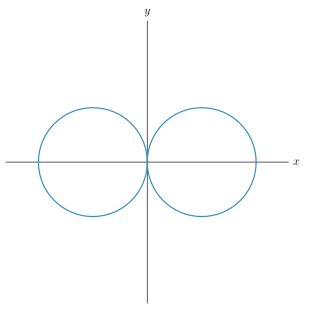
- Sketch the curve \(C_1\) with equation \[ \left(y^2 + (x-1)^2 - 1\right)\left(y^2 + (x+1)^2 - 1\right) = 0. \]
- Consider the curve \(C_2\) with equation
\[ \left(y^2 + (x-1)^2 - 1\right)\left(y^2 + (x+1)^2 - 1\right) = \tfrac{1}{16}. \]
- Show that the line \(y = k\) meets the curve \(C_2\) at points for which \[ x^4 + 2(k^2 - 2)x^2 + \left(k^4 - \tfrac{1}{16}\right) = 0. \] Hence determine the number of intersections between curve \(C_2\) and the line \(y = k\) for each positive value of \(k\).
- Determine whether the points on curve \(C_2\) with the greatest possible \(y\)-coordinate are further from, or closer to, the \(y\)-axis than those on curve \(C_1\).
- Show that it is not possible for both \(y^2 + (x-1)^2 - 1\) and \(y^2 + (x+1)^2 - 1\) to be negative, and deduce that curve \(C_2\) lies entirely outside curve \(C_1\).
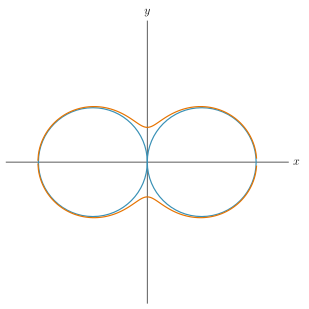
- Sketch the curves \(C_1\) and \(C_2\) on the same axes.
Solution:
- \(\,\)
- Suppose \(y=k\) meets the curve \(C_2\) then \begin{align*} && \tfrac1{16} &= (k^2+(x-1)^2-1)(k^2+(x+1)^2-1) \\ &&&= (k^2+x^2-2x)(k^2+x^2+2x) \\ &&&= k^4+2k^2x^2+x^4-4x^2 \\ &&&= x^4+(2k^2-4)x^2+k^4 \\ \Rightarrow && 0 &= x^4+(2k^2-4)x^2+(k^4-\tfrac1{16}) \\ \\ && \Delta &= 4(k^2-2)^2 - 4 \cdot 1 \cdot (k^4-\tfrac1{16}) \\ &&&= 4(k^4-4k^2+4 - k^4 +\tfrac{1}{16}) \\ &&&= 16(1+\tfrac{1}{64} - k^2) \\ &&&= 16(\tfrac{65}{64} - k^2) \end{align*} Therefore if \(|k| < \frac{\sqrt{65}}{8}\) there are \(4\) intersections. If \(|k| = \frac{\sqrt{65}}{8}\) there are \(2\) intersections, otherwise there are \(0\).
- The greatest possible \(y\) value is \( \frac{\sqrt{65}}{8}\) and at this point \(x^2 = \frac{2(2-\frac{65}{64}}{2} =1 - \frac{1}{64} < 1\) so they are close to the \(y\)-axis.
- The regions where \(y^2+(x-1)^2-1 < 0\) and \(y^2+(x+1)^2-1 < 0\) is the interior of the two circles from the first part. However, since they don't overlap they can never both be negative. Therefore in our equation both are positive and therefore \(C_2\) is entirely outside \(C_1\)
- \(\,\)
2024 Paper 2 Q8
In this question, the following theorem may be used without proof. Let \(u_1, u_2, \ldots\) be a sequence of real numbers. If the sequence is
- bounded above, so \(u_n \leqslant b\) for all \(n\), where \(b\) is some fixed number
- and increasing, so \(u_n \leqslant u_{n+1}\) for all \(n\)
- By considering \((\sqrt{x_n} - \sqrt{y_n})^2\), show that \(y_{n+1} < x_{n+1}\), for \(n \geqslant 0\). Show further that, for \(n \geqslant 0\)
- \(x_{n+1} < x_n\)
- \(y_n < y_{n+1}\).
- Let \[ \mathrm{I}(p,q) = \int_0^{\infty} \frac{1}{\sqrt{(p^2 + x^2)(q^2 + x^2)}}\,\mathrm{d}x, \] where \(p\) and \(q\) are positive real numbers with \(q < p\). Show, using the substitution \(t = \frac{1}{2}\!\left(x - \dfrac{pq}{x}\right)\) in the integral \[ \int_{-\infty}^{\infty} \frac{1}{\sqrt{\left(\frac{1}{4}(p+q)^2 + t^2\right)(pq + t^2)}}\,\mathrm{d}t, \] that \[ \mathrm{I}(p,q) = \mathrm{I}\!\left(\mathrm{a}(p,q),\, \mathrm{g}(p,q)\right). \] Hence evaluate \(\mathrm{I}(x_0, y_0)\) in terms of \(M\).
2024 Paper 2 Q9
A long straight trench, with rectangular cross section, has been dug in otherwise horizontal ground. The width of the trench is \(d\) and its depth \(2d\). A particle is projected at speed \(v\), where \(v^2 = \lambda dg\), at an angle \(\alpha\) to the horizontal, from a point on the ground a distance \(d\) from the nearer edge of the trench. The vertical plane in which it moves is perpendicular to the trench.
- The particle lands on the base of the trench without first touching either of its sides.
- By considering the vertical displacement of the particle when its horizontal displacement is \(d\), show that \((\tan\alpha - \lambda)^2 < \lambda^2 - 1\) and deduce that \(\lambda > 1\).
- Show also that \((2\tan\alpha - \lambda)^2 > \lambda^2 + 4(\lambda - 1)\) and deduce that \(\alpha > 45^\circ\).
- Show that, provided \(\lambda > 1\), \(\alpha\) can always be chosen so that the particle lands on the base of the trench without first touching either of its sides.
2024 Paper 3 Q2
- Solve the inequalities
- \(\sqrt{4x^2 - 8x + 64} \leqslant |x+8|\,\),
- \(\sqrt{4x^2 - 8x + 64} \leqslant |3x-8|\,\).
- Let \(\mathrm{f}(x) = \sqrt{4x^2 - 8x + 64} - 2(x-1)\). Show, by considering \(\bigl(\sqrt{4x^2 - 8x + 64} + 2(x-1)\bigr)\mathrm{f}(x)\) or otherwise, that \(\mathrm{f}(x) \to 0\) as \(x \to \infty\).
- Sketch \(y = \sqrt{4x^2 - 8x + 64}\) and \(y = 2(x-1)\) on the same axes.
- Find a value of \(m\) and the corresponding value of \(c\) such that the solution set of the inequality \[\sqrt{4x^2 - 5x + 4} \leqslant |mx + c|\] is \(\{x : x \geqslant 3\}\).
- Find values of \(p\), \(q\), \(m\) and \(c\) such that the solution set of the inequality \[|x^2 + px + q| \leqslant mx + c\] is \(\{x : -5 \leqslant x \leqslant 1\} \cup \{x : 5 \leqslant x \leqslant 7\}\).
2024 Paper 3 Q7
In this question, you need not consider issues of convergence. For positive integer \(n\) let \[\mathrm{f}(n) = \frac{1}{n+1} + \frac{1}{(n+1)(n+2)} + \frac{1}{(n+1)(n+2)(n+3)} + \ldots\] and \[\mathrm{g}(n) = \frac{1}{n+1} - \frac{1}{(n+1)(n+2)} + \frac{1}{(n+1)(n+2)(n+3)} - \ldots\,.\]
- Show, by considering a geometric series, that \(0 < \mathrm{f}(n) < \dfrac{1}{n}\).
- Show, by comparing consecutive terms, that \(0 < \mathrm{g}(n) < \dfrac{1}{n+1}\).
- Show, for positive integer \(n\), that \((2n)!\,\mathrm{e} - \mathrm{f}(2n)\) and \(\dfrac{(2n)!}{\mathrm{e}} + \mathrm{g}(2n)\) are both integers.
- Show that if \(q\,\mathrm{e} = \dfrac{p}{\mathrm{e}}\) for some positive integers \(p\) and \(q\), then \(q\,\mathrm{f}(2n) + p\,\mathrm{g}(2n)\) is an integer for all positive integers \(n\).
- Hence show that the number \(\mathrm{e}^2\) is irrational.
2023 Paper 2 Q5
- The sequence \(x_n\) for \(n = 0, 1, 2, \ldots\) is defined by \(x_0 = 1\) and by
\[x_{n+1} = \frac{x_n + 2}{x_n + 1}\]
for \(n \geqslant 0\).
- Explain briefly why \(x_n \geqslant 1\) for all \(n\).
- Show that \(x_{n+1}^2 - 2\) and \(x_n^2 - 2\) have opposite sign, and that \[\left|x_{n+1}^2 - 2\right| \leqslant \tfrac{1}{4}\left|x_n^2 - 2\right|\,.\]
- Show that \[2 - 10^{-6} \leqslant x_{10}^2 \leqslant 2\,.\]
- The sequence \(y_n\) for \(n = 0, 1, 2, \ldots\) is defined by \(y_0 = 1\) and by
\[y_{n+1} = \frac{y_n^2 + 2}{2y_n}\]
for \(n \geqslant 0\).
- Show that, for \(n \geqslant 0\), \[y_{n+1} - \sqrt{2} = \frac{(y_n - \sqrt{2})^2}{2y_n}\] and deduce that \(y_n \geqslant 1\) for \(n \geqslant 0\).
- Show that \[y_n - \sqrt{2} \leqslant 2\left(\frac{\sqrt{2}-1}{2}\right)^{2^n}\] for \(n \geqslant 1\).
- Using the fact that \[\sqrt{2} - 1 < \tfrac{1}{2}\,,\] or otherwise, show that \[\sqrt{2} \leqslant y_{10} \leqslant \sqrt{2} + 10^{-600}\,.\]
2023 Paper 2 Q9
A truck of mass \(M\) is connected by a light, rigid tow-bar, which is parallel to the ground, to a trailer of mass \(kM\). A constant driving force \(D\) which is parallel to the ground acts on the truck, and the only resistance to motion is a frictional force acting on the trailer, with coefficient of friction \(\mu\).
- When the truck pulls the trailer up a slope which makes an angle \(\alpha\) to the horizontal, the acceleration is \(a_1\) and there is a tension \(T_1\) in the tow-bar.
- When the truck pulls the trailer on horizontal ground, the acceleration is \(a_2\) and there is a tension \(T_2\) in the tow-bar.
- When the truck pulls the trailer down a slope which makes an angle \(\alpha\) to the horizontal, the acceleration is \(a_3\) and there is a tension \(T_3\) in the tow-bar.
- Show that \(T_1 = T_3\) and that \(M(a_1 + a_3 - 2a_2) = 2(T_2 - T_1)\).
- It is given that \(\mu < 1\).
- Show that \[a_2 < \tfrac{1}{2}(a_1 + a_3) < a_3\,.\]
- Show further that \[a_1 < a_2\,.\]
2023 Paper 3 Q3
- Show that, if \(a\) and \(b\) are complex numbers, with \(b \neq 0\), and \(s\) is a positive real number, then the points in the Argand diagram representing the complex numbers \(a + sbi\), \(a - sbi\) and \(a + b\) form an isosceles triangle. Given three points which form an isosceles triangle in the Argand diagram, explain with the aid of a diagram how to determine the values of \(a\), \(b\) and \(s\) so that the vertices of the triangle represent complex numbers \(a + sbi\), \(a - sbi\) and \(a + b\).
- Show that, if the roots of the equation \(z^3 + pz + q = 0\), where \(p\) and \(q\) are complex numbers, are represented in the Argand diagram by the vertices of an isosceles triangle, then there is a non-zero real number \(s\) such that \[\frac{p^3}{q^2} = \frac{27(3s^2 - 1)^3}{4(9s^2 + 1)^2}\,.\]
- Sketch the graph \(y = \dfrac{(3x-1)^3}{(9x+1)^2}\), identifying any stationary points.
- Show that if the roots of the equation \(z^3 + pz + q = 0\) are represented in the Argand diagram by the vertices of an isosceles triangle then \(\dfrac{p^3}{q^2}\) is a real number and \(\dfrac{p^3}{q^2} > -\dfrac{27}{4}\).