Problems
Filters
233 problems found
2025 Paper 2 Q5
You need not consider the convergence of the improper integrals in this question.
- Use the substitution \(x = u^{-1}\) to show that \[\int_0^{\infty} \frac{\sqrt{x}-1}{\sqrt{x(x^3+1)}} \, dx = 0.\]
- Use the substitution \(x = u^{-2}\) to show that \[\int_0^{\infty} \frac{1}{\sqrt{x^3+1}} \, dx = 2\int_0^{\infty} \frac{1}{\sqrt{x^6+1}} \, dx.\]
- Find, in terms of \(p\) and \(s\), a value of \(r\) for which \[\int_0^{\infty} \frac{x^r - 1}{\sqrt{x^s(x^p+1)}} \, dx = 0,\] given that \(p\) and \(s\) are fixed values for which the required integrals converge.
- Show that, for any positive value of \(k\), it is possible to find values of \(p\) and \(q\) for which \[\int_0^{\infty} \frac{1}{\sqrt{x^p+1}} \, dx = k\int_0^{\infty} \frac{1}{\sqrt{x^q+1}} \, dx.\]
Solution:
- \begin{align*} && I &= \int_0^{\infty} \frac{\sqrt{x}-1}{\sqrt{x(x^3+1)}} \, dx \\ x = u^{-1}, \d x = -u^{-2} \d u: && &= \int_{u=\infty}^{u = 0} \frac{u^{-1/2} - 1}{\sqrt{u^{-1}(u^{-3}+1)}} (-u^{-2}) \d u \\ &&&= \int_0^\infty \frac{u^{-1/2} -1}{\sqrt{1+u^3}} \d u \\ &&&= \int_0^\infty \frac{1-\sqrt{u}}{\sqrt{u(u^3+1)}} \d u \\ &&&= -I \\ \Rightarrow && I &= 0 \end{align*}
- \begin{align*} && I &= \int_0^{\infty} \frac{1}{\sqrt{x^3+1}} \, dx \\ x = u^{-2}, \d x = -2u^{-3} \d u: && &= \int_{u = \infty}^{u = 0} \frac{1}{\sqrt{u^{-6}+1}} (-2u^{-3}) \d u \\ &&&= \int_0^\infty \frac{2}{\sqrt{1+u^6}} \d u \\ &&&= 2\int_0^{\infty} \frac{1}{\sqrt{x^6+1}} \, \d x \end{align*}
- \begin{align*} && I &= \int_0^{\infty} \frac{x^r - 1}{\sqrt{x^s(x^p+1)}} \, dx \\ x = u^{-1}, \d x = - u^{-2} \d t: &&&= \int_{u=\infty}^{u = 0} \frac{u^{-r}-1}{\sqrt{u^{-s}(u^{-p}+1)}} (- u^{-2}) \d u \\ &&&= \int_0^\infty \frac{u^{-r}-1}{\sqrt{u^{4-s}(u^{-p}+1)}} \d u \\ &&&= \int_0^\infty \frac{1-u^{r}}{\sqrt{u^{4-s+2r}(u^{-p}+1)}} \d u \\ &&&= \int_0^\infty \frac{1-u^{r}}{\sqrt{u^{4-s+2r-p}(1+u^p)}} \d u \\ \end{align*} Therefore if \(4-s+2r-p = s\) or \(r = \frac{p}2+s-2\) we have \(I = -I\), ie \(I = 0\).
- \begin{align*} && I &= \int_0^{\infty} \frac{1}{\sqrt{x^p+1}} \, dx \\ x = u^{-t}, \d x = -t u^{-t-1}:&&&= \int_{u = -\infty}^{u = 0} \frac{1}{\sqrt{u^{-pt}+1}} (-t u^{-t-1}) \d u \\ &&&= t \int_0^\infty \frac1{\sqrt{u^{-pt+2t+2}+u^{2t+2}}} \d u \end{align*} Therefore if \(\begin{cases} 2t+2 &= q \\ 2t+2 -pt &= 0 \end{cases}\), ie \(q = 2t+2, p = 2 + 2/t\) we will have found the \(p, q\) desired for any \(t\) (or \(k\)). [Alternatively] Let \(\displaystyle I(p) =\int_0^{\infty} \frac{1}{\sqrt{x^p+1}} \, dx\), then clearly \(I(p)\) is decreasing and as \(p \to \infty\) \(I(p) \to 1\), so our integral can take any values on \((1, \infty)\) and so for any positive value we can find two values with a given ratio. In particular given \(k\) and \(p\) we can find a suitable \(q\).
2025 Paper 3 Q1
You need not consider the convergence of the improper integrals in this question. For \(p, q > 0\), define $$b(p,q) = \int_0^1 x^{p-1}(1-x)^{q-1} \, dx$$
- Show that \(b(p,q) = b(q,p)\).
- Show that \(b(p+1,q) = b(p,q) - b(p,q+1)\) and hence that \(b(p+1,p) = \frac{1}{2}b(p,p)\).
- Show that $$b(p,q) = 2\int_0^{\pi/2} (\sin\theta)^{2p-1}(\cos\theta)^{2q-1} \, d\theta$$ Hence show that \(b(p,p) = \frac{1}{2^{2p-1}}b(p,\frac{1}{2})\).
- Show that $$b(p,q) = \int_0^\infty \frac{t^{p-1}}{(1+t)^{p+q}} \, dt$$
- Evaluate $$\int_0^\infty \frac{t^{3/2}}{(1+t)^6} \, dt$$
Solution:
- \begin{align*} && b(p,q) &= \int_0^1 x^{p-1}(1-x)^{q-1}\, \d x \\ u = 1-x, \d u = -\d x && &= \int_{u=1}^{u = 0} (1-u)^{p-1}u^{q-1} (-1) \, \d u \\ &&&= \int_0^1 (1-u)^{p-1}u^{q-1} \d u \\ &&&= \int_0^1 u^{q-1}(1-u)^{p-1} \d u \\ &&&= b(q,p) \end{align*}
- \begin{align*} b(p+1,q) + b(p,q+1) &= \int_0^1 x^p(1-x)^{q-1} \d x + \int_0^1 x^{p-1}(1-x)^{q} \d x \\ &= \int_0^1 \left (x^p(1-x)^{q-1} + x^{p-1}(1-x)^{q}\right) \d x \\ &= \int_0^1 x^{p-1}(1-x)^{q-1} \left (x + (1-x) \right) \d x \\ &= \int_0^1 x^{p-1}(1-x)^{q-1} \d x \\ &= b(p,q) \end{align*} Therefore \(b(p+1,q) = b(p,q) - b(p,q+1)\), in particular \(2b(p+1,p) = b(p+1,p)+b(p,p+1) = b(p,p) \Rightarrow b(p+1,p) = \frac12 b(p,p)\) as required.
- \begin{align*} && b(p,q) &= \int_0^1 x^{p-1} (1-x)^{q-1} \d x \\ x = \sin^2 \theta, \d x = 2 \sin \theta \cos \theta \d \theta && &= \int_{u=0}^{u = \pi/2} \sin^{2p-2} \theta (1-\sin^2 \theta)^{q-1} \cdot 2 \sin \theta \cos \theta \d \theta \\ &&&= 2 \int_0^{\pi/2} \sin^{2p-1} \theta \cos^{2q-2} \cos \theta \d \theta \\ &&&= 2 \int_0^{\pi/2} \sin^{2p-1} \theta \cos^{2q-1} \theta \d \theta \end{align*} \begin{align*} b(p,p) &= 2\int_0^{\pi/2} (\sin \theta)^{2p-1}(\cos \theta)^{2p-1} \d \theta \\ &= 2 \int_0^{\pi/2} \left (\frac12 \sin 2\theta \right)^{2p-1} \d \theta \\ &= \frac1{2^{2p-1}} 2 \int_0^{\pi/2} (\sin 2 \theta)^{2p-1} \d \theta \\ &= \frac1{2^{2p-1}} 2 \int_{x=0}^{x=\pi} (\sin x)^{2p-1} 2 \d x\\ &= \frac1{2^{2p-1}} 2 \int_{x=0}^{x=\pi/2} (\sin x)^{2p-1} \d x\\ &= \frac1{2^{2p-1}} 2 \int_{0}^{\pi/2} (\sin x)^{2p-1} (\cos x)^{0} \d x\\ &= \frac1{2^{2p-1}} b(p,\tfrac12) \end{align*}
- \begin{align*} &&b(p,q) &= \int_0^1 x^{p-1}(1-x)^{q-1} \d x \\ t = \frac{x}{1-x}, \d t = (1-x)^{-2} \d x &&&= \int_{t=0}^{t = \infty} \left ( \frac{t}{1+t} \right)^{p-1} \left ( 1-\frac{t}{1+t} \right)^{q+1} \d t\\ x = \frac{t}{1+t} && &=\int_0^\infty t^{p-1} (1+t)^{-(p-1)-(q+1)} \d t \\ &&&= \int_0^{\infty} \frac{t^{p-1}}{(1+t)^{p+q}} \d t \end{align*}
- \begin{align*} I &= \int_0^\infty \frac{t^{3/2}}{(1+t)^6} \, dt \\ &= b( \tfrac52, \tfrac72) \\ &= b( \tfrac52, \tfrac52+1) \\ &= \tfrac12 b( \tfrac52, \tfrac52) \\ &= \frac12 \cdot \frac1{2^{4}} b(\tfrac52, \tfrac12) \\ &= \frac{1}{2^5} \cdot 2 \int_0^{\pi/2} (\sin \theta)^{4} \d \theta \\ &= \frac1{2^4} \int_0^{\pi/2}\left (\frac{1-\cos 2 \theta}{2} \right)^2 \d \theta \\ &= \frac1{2^6} \int_0^{\pi/2}\left (1 - 2 \cos 2 \theta + \cos^{2} 2 \theta \right) \d \theta \\ &= \frac1{2^6} \int_0^{\pi/2}\left (1 - 2 \cos 2 \theta + \frac{\cos 4 \theta + 1}{2} \right) \d \theta \\ &= \frac1{2^6} \left [\frac32 \theta - \sin 2 \theta + \frac18 \sin 4 \theta \right]_0^{\pi/2} \\ &= \frac1{2^6} \frac{3 \pi}{4} \\ &= \frac{3 \pi}{2^8} \end{align*}
2025 Paper 3 Q7
Let \(f(x) = \sqrt{x^2 + 1} - x\).
- Using a binomial series, or otherwise, show that, for large \(|x|\), \(\sqrt{x^2 + 1} \approx |x| + \frac{1}{2|x|}\). Sketch the graph \(y = f(x)\).
- Let \(g(x) = \tan^{-1} f(x)\) and, for \(x \neq 0\), let \(k(x) = \frac{1}{2}\tan^{-1}\frac{1}{x}\).
- Show that \(g(x) + g(-x) = \frac{1}{2}\pi\).
- Show that \(k(x) + k(-x) = 0\).
- Show that \(\tan k(x) = \tan g(x)\) for \(x > 0\).
- Sketch the graphs \(y = g(x)\) and \(y = k(x)\) on the same axes.
- Evaluate \(\int_0^1 k(x) \, dx\) and hence write down the value of \(\int_{-1}^0 g(x) \, dx\).
Solution:
- \begin{align*}
\sqrt{x^2+1} &= |x|\sqrt{1+\frac{1}{x^2}} \\
&=|x| \left (1 + \frac12 \frac{1}{x^2} + \cdots \right) & \text{if } \left (\frac{1}{x^2} < 1 \right) \\
&= |x| + \frac12 \frac{1}{|x|} + \cdots \\
&\approx |x| + \frac{1}{2|x|}
\end{align*}
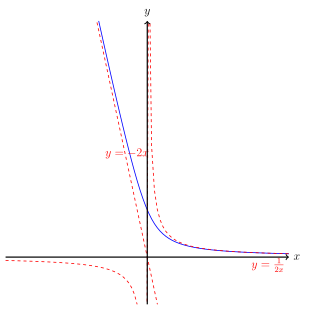
- \begin{align*} && \tan( g(x) + g(-x)) &= \tan \left ( \tan^{-1}(\sqrt{x^2+1}-x) + \tan^{-1}(\sqrt{x^2+1}+x) \right) \\ &&&= \frac{\sqrt{x^2+1}-x+\sqrt{x^2+1}+x}{1-1} \\ \Rightarrow && g(x) + g(-x) &\in \left \{\cdots, -\frac{\pi}{2}, \frac{\pi}{2}, \cdots \right\} \end{align*} But \(g(x), g(-x) > 0\) and \(g(x), g(-x) \in (-\frac{\pi}{2}, \frac{\pi}{2})\), therefore it must be \(\frac{\pi}{2}\).
- \begin{align*} && \tan(2(k(x) + k(-x))) &= \tan(\tan^{-1}x + \tan^{-1}(-x)) \\ &&&= 0 \\ \Rightarrow && k(x)+k(-x) &\in \left \{\cdots, -\frac{\pi}{2}, 0, \frac{\pi}{2}, \cdots \right\} \\ \end{align*} But \(k(x) \in (-\frac{\pi}{4}, \frac{\pi}{4})\), therefore \(k(x) + k(-x) = 0\).
- Let \(t = \tan k(x)\). \begin{align*} && \tan \left ( \tan^{-1} \frac{1}{x} \right) &= \frac{2 \tan\left ( \frac12 \tan^{-1} \frac1x \right)}{ 1-\tan^2\left ( \frac12 \tan^{-1} \frac1x \right)} \\ \Rightarrow && \frac1x &= \frac{2t}{1-t^2} \\ \Rightarrow && 1-t^2 &= 2tx \\ \Rightarrow && 0 &= t^2+2tx - 1 \\ \Rightarrow && 0 &= (t+x)^2 - 1-x^2 \\ \Rightarrow && t &= -x \pm \sqrt{1+x^2} \end{align*} Since \(t > 0\), \(t = \sqrt{1+x^2}-x = f(x) = \tan g(x)\)
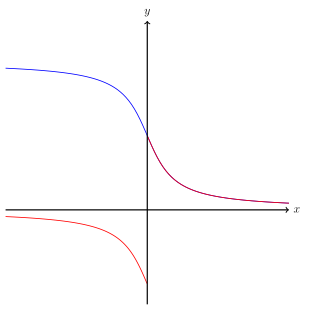
- \begin{align*} \int_0^1 k(x) \d x &= \int_0^1 \frac12 \tan^{-1} \left ( \frac1x \right) \d x \\ &= \left [ \frac{x}{2} \tan^{-1}\left ( \frac1x \right) \right]_0^1 - \int_0^1 \frac{x}{2} \frac{-1/x^2}{1+1/x^2} \d x \\ &= \left [ \frac{x}{2} \tan^{-1}\left ( \frac1x \right) \right]_0^1 + \frac14 \int_0^1 \frac{2x}{1+x^2} \d x \\ &= \frac12 \frac{\pi}{4} + \frac14 \ln(2) \\ &= \frac{\pi + \ln 4}{8}\end{align*} Therefore \(\displaystyle \int_{-1}^0 g(x) \d x = -\frac{\pi + \ln 4}{8}\)
2025 Paper 3 Q9
In this question, \(n \geq 2\).
- A solid, of uniform density, is formed by rotating through \(360°\) about the \(y\)-axis the region bounded by the part of the curve \(r^{n-1}y = r^n - x^n\) with \(0 \leq x \leq r\), and the \(x\)- and \(y\)-axes. Show that the \(y\)-coordinate of the centre of mass of this solid is \(\frac{nr}{2(n+1)}\).
- Show that the normal to the curve \(r^{n-1}y = r^n - x^n\) at the point \((rp, r(1-p^n))\), where \(0 < p < 1\), meets the \(y\)-axis at \((0, Y)\), where \(Y = r\left(1 - p^n - \frac{1}{np^{n-2}}\right)\). In the case \(n = 4\), show that the greatest value of \(Y\) is \(\frac{1}{4}r\).
- A solid is formed by rotating through \(360°\) about the \(y\)-axis the region bounded by the curves \(r^3y = r^4 - x^4\) and \(ry = -(r^2 - x^2)\), both for \(0 \leq x \leq r\). \(A\) and \(B\) are the points \((0, -r)\) and \((0, r)\), respectively, on the surface of the solid. Show that the solid can rest in equilibrium on a horizontal surface with the vector \(\overrightarrow{AB}\) at three different, non-zero, angles to the upward vertical. You should not attempt to find these angles.
Solution:
- By symmetry, the centre of mass will lie on the \(y\) axis. Notice that a single slice (when revolved around the \(y\)-axis) has volume \(y \cdot \pi \cdot ((x+ \delta x)^2 - x^2) = 2 \pi x y \delta x\), and COM at height \(\frac12 y\) so we can conclude: \[ \overline{y} \sum_{\delta x} 2 \pi x y \delta x = \sum_{\delta x} \pi xy^2 \delta x\] \begin{align*} && \overline{y} \int_0^r 2xy \d x &= \int_0^r y^2 x \d x \\ \Rightarrow && \overline{y} 2\int_0^r \left (r - \frac{x^n}{r^{n-1}} \right)x \d x &= \int_0^r \left (r - \frac{x^n}{r^{n-1}} \right)^2 x \d x \\ \Rightarrow && \overline{y} \left [r \frac{x^2}{2} - \frac{1}{r^{n-1}} \frac{x^{n+2}}{n+2} \right]_0^r &= \left [r^2 \frac{x^2}{2} - \frac{2}{r^{n-2}} \frac{x^{n+2}}{n+2} + \frac{1}{r^{2n-2}} \frac{x^{2n+2}}{2n+2} \right]_0^r \\ \Rightarrow && 2\overline{y} \left (\frac{r^3}{2} - \frac{r^3}{n+2} \right) &= \left (\frac12 r^4 - \frac{2}{n+2}r^4 + \frac{1}{2n+2}r^4 \right) \\ \Rightarrow && \overline{y}r^3 \frac{n}{(n+2)} &= r^4\frac{(n+1)(n+2)-2\cdot2\cdot(n+1)+(n+2)}{2(n+1)(n+2)} \\ \Rightarrow && \overline{y} \frac{n}{(n+2)} &= r \left ( \frac{n^2}{2(n+1)(n+2)} \right) \\ \Rightarrow && \overline{y} &= \frac{nr}{2(n+1)} \\ &&&= r \left (1 -p^n \right) \end{align*} as required.

- \begin{align*} && r^{n-1}y &= r^n - x^n \\ \frac{\d}{\d x}: && r^{n-1} \frac{\d y}{\d x} &= -n x^{n-1} \\ && \frac{\d y}{\d x} &= -np^{n-1} \end{align*} Therefor the normal has the equation: \begin{align*} && \frac{y-r(1-p^n)}{x-rp} &= \frac{1}{np^{n-1}} \\ \Rightarrow && Y &= \frac{-rp}{np^{n-1}} + r(1-p^n) \\ &&&= r \left (1 - p^n - \frac{1}{np^{n-2}} \right) \end{align*} If \(n = 4\) then \begin{align*} && Y &= r\left (1 - p^4 - \frac{1}{4p^{2}} \right) \\ \Rightarrow && \frac{\d Y}{\d p} &= r \left (-4p^3 + \frac{1}{2p^3} \right) \end{align*} Therefore there is a stationary point if \(p^6 = \frac18 \Rightarrow p =2^{-1/2}\). Clearly this will be a maximum (sketch or second derivative) therefore, \(Y = r(1 - \frac14 - \frac{2}{4}) = \frac14 r\)
- The centre of mass of this shape can be found using this table: \begin{array}{|c|c|c|} \hline \text{} & \overline{y} & \text{mass} \\ \hline r^3y = r^4 - x^4 & \frac{2r}{5} & \frac{4\pi r^3}{6} = \frac23 \pi r^3\\ ry = -(r^2 - x^2) & -\frac{r}{3}& \frac{2 \pi r^3}{4}=\frac12\pi r^3 \\ \text{combined} & \frac{(\frac25 \cdot \frac23-\frac13 \cdot \frac12)r^4}{\frac76 r^3} = \frac3{35}r & \frac76 \pi r^3\\ \hline \end{array} Normals to the surface through points on the upper surface will meet the \(y\)-axis between \((-\infty, \frac14 r)\), and since \(p = 0 \to -\infty\) and \(p = 1 \to -\frac14 r\), so normals will pass through \((0, \frac3{35}r)\) from two different points. Normals to the surface through points on the lower surface will go through \(-r(1 - p^2 - \frac12) =- r(\frac12 -p^2)\) which ranges monotonically from \(\frac12 r \to -\frac12 r\) so there will be one point where the normal goes through \(\frac3{35}r\). Therefore there are three angles where the vector \(\overrightarrow{AB}\) is not vertical but the normal to the surfaces runs through the centre of mass (ie the the solid can rest in equilibrium)
2024 Paper 2 Q2
In this question, you need not consider issues of convergence.
- Find the binomial series expansion of \((8 + x^3)^{-1}\), valid for \(|x| < 2\). Hence show that, for each integer \(m \geqslant 0\), \[ \int_0^1 \frac{x^m}{8 + x^3}\,\mathrm{d}x = \sum_{k=0}^{\infty} \left( \frac{(-1)^k}{2^{3(k+1)}} \cdot \frac{1}{3k + m + 1} \right). \]
- Show that \[ \sum_{k=0}^{\infty} \frac{(-1)^k}{2^{3(k+1)}} \left( \frac{1}{3k+3} - \frac{2}{3k+2} + \frac{4}{3k+1} \right) = \int_0^1 \frac{1}{x+2}\,\mathrm{d}x\,, \] and evaluate the integral.
- Show that \[ \sum_{k=0}^{\infty} \frac{(-1)^k}{2^{3(k+1)}} \left( \frac{72(2k+1)}{(3k+1)(3k+2)} \right) = \pi\sqrt{a} - \ln b\,, \] where \(a\) and \(b\) are integers which you should determine.
Solution:
- Note that \(\,\) \begin{align*} && (8+x^3)^{-1} &= \tfrac18(1 + \tfrac18x^3)^{-1} \\ &&&= \tfrac18( 1 - \left (\tfrac{x}{2} \right)^3 + \left (\tfrac{x}{2} \right)^6 -\left (\tfrac{x}{2} \right)^9 + \cdots ) \end{align*} So \begin{align*} && \int_0^1 \frac{x^m}{8+x^3} \d x &= \int_0^1 x^m \sum_{k=0}^{\infty} \frac{1}{2^3} \left ( - \frac{x}{2} \right)^{3k} \d x \\ &&&= \sum_{k=0}^{\infty} (-1)^k \frac{1}{2^{3(k+1)}} \int_0^1 x^{m+3k} \d x \\ &&&= \sum_{k=0}^{\infty} \frac{(-1)^k}{2^{3(k+1)}} \frac{1}{3k+m+1} \\ \end{align*}
- Notice that \begin{align*} && S &= \sum_{k=0}^{\infty} \frac{(-1)^k}{2^{3(k+1)}} \left( \frac{1}{3k+3} - \frac{2}{3k+2} + \frac{4}{3k+1} \right) \\ &&&= \int_0^1 \frac{x^2}{8+x^3} \d x - 2\int_0^1 \frac{x^1}{8+x^3}+4\int_0^1 \frac{x^0}{8+x^3} \d x \\ &&&= \int_0^1 \frac{x^2-2x+4}{x^3+8} \d x \\ &&&= \int_0^1 \frac{1}{x+2} \d x = \left[ \ln(x+2)\right]_0^1 \\ &&&= \ln 3 - \ln 2 = \ln \tfrac32 \end{align*}
- Firstly, note that \begin{align*} && \frac{2k+1}{(3k+1)(3k+2)} &= \frac13 \left ( \frac{1}{3k+1} +\frac{1}{3k+2} \right) \end{align*} so \begin{align*} && S_2 &= \sum_{k=0}^{\infty} \frac{(-1)^k}{2^{3(k+1)}} \left( \frac{72(2k+1)}{(3k+1)(3k+2)} \right) \\ &&&= \sum_{k=0}^{\infty} \frac{(-1)^k}{2^{3(k+1)}} 24 \left ( \frac{1}{3k+1} +\frac{1}{3k+2} \right) \\ &&&= 24 \left [ \int_0^1 \frac{x^0}{8+x^3} \d x + \int_0^1 \frac{x^1}{8+x^3} \d x \right] \\ &&&= 24 \left [ \int_0^1 \frac{1+x}{(x+2)(x^2-2x+4)} \d x \right] \\ &&&= 24 \left [ \int_0^1 \frac{x+8}{12(x^2-2x+4)}-\frac{1}{12(x+2)} \d x \right] \\ &&&= 2\left [ \int_0^1 \frac{x+8}{x^2-2x+4}-\frac{1}{x+2} \d x \right] \\ &&&= 2\left [ \int_0^1 \frac{x-1}{x^2-2x+4}+ \frac{9}{(x-1)^2+3}-\frac{1}{x+2} \d x \right] \\ &&&=2 \left [ \int_0^1 \frac12\ln(x^2-2x+4)+3\sqrt{3}\arctan \frac{x-1}{\sqrt{3}} -\ln(x+2) \right]_0^1 \\ &&&=2 \left ( \frac12 \ln3+3\sqrt3 \arctan 0 - \ln 3 \right) - 2\left (\frac12 \ln 4-3\sqrt3 \arctan \frac{1}{\sqrt3} - \ln 2 \right) \\ &&&=\sqrt3 \pi - \ln3 \end{align*}
2024 Paper 3 Q12
- A point is chosen at random in the square \(0 \leqslant x \leqslant 1\), \(0 \leqslant y \leqslant 1\), so that the probability that a point lies in any region is equal to the area of that region. \(R\) is the random variable giving the distance of the point from the origin. Show that the cumulative distribution function of \(R\) is given by \[\mathrm{P}(R \leqslant r) = \sqrt{r^2 - 1} + \tfrac{1}{4}\pi r^2 - r^2 \cos^{-1}(r^{-1}),\] when \(1 \leqslant r \leqslant \sqrt{2}\). What is the cumulative distribution function when \(0 \leqslant r \leqslant 1\)?
- Show that \(\displaystyle\mathrm{E}(R) = \frac{2}{3}\int_1^{\sqrt{2}} \frac{r^2}{\sqrt{r^2-1}}\,\mathrm{d}r\).
- Show further that \(\mathrm{E}(R) = \frac{1}{3}\Bigl(\sqrt{2} + \ln\bigl(\sqrt{2}+1\bigr)\Bigr)\).
2023 Paper 2 Q1
- Show that making the substitution \(x = \frac{1}{t}\) in the integral \[\int_a^b \frac{1}{(1+x^2)^{\frac{3}{2}}}\,\mathrm{d}x\,,\] where \(b > a > 0\), gives the integral \[\int_{b^{-1}}^{a^{-1}} \frac{-t}{(1+t^2)^{\frac{3}{2}}}\,\mathrm{d}t\,.\]
- Evaluate:
- \(\displaystyle\int_{\frac{1}{2}}^{2} \frac{1}{(1+x^2)^{\frac{3}{2}}}\,\mathrm{d}x\,;\)
- \(\displaystyle\int_{-2}^{2} \frac{1}{(1+x^2)^{\frac{3}{2}}}\,\mathrm{d}x\,.\)
- Show that \[\int_{\frac{1}{2}}^{2} \frac{1}{(1+x^2)^2}\,\mathrm{d}x = \int_{\frac{1}{2}}^{2} \frac{x^2}{(1+x^2)^2}\,\mathrm{d}x = \frac{1}{2}\int_{\frac{1}{2}}^{2} \frac{1}{1+x^2}\,\mathrm{d}x\,,\] and hence evaluate \[\int_{\frac{1}{2}}^{2} \frac{1}{(1+x^2)^2}\,\mathrm{d}x\,.\]
- Evaluate \[\int_{\frac{1}{2}}^{2} \frac{1-x}{x(1+x^2)^{\frac{1}{2}}}\,\mathrm{d}x\,.\]
2023 Paper 2 Q12
Each of the independent random variables \(X_1, X_2, \ldots, X_n\) has the probability density function \(\mathrm{f}(x) = \frac{1}{2}\sin x\) for \(0 \leqslant x \leqslant \pi\) (and zero otherwise). Let \(Y\) be the random variable whose value is the maximum of the values of \(X_1, X_2, \ldots, X_n\).
- Explain why \(\mathrm{P}(Y \leqslant t) = \big[\mathrm{P}(X_1 \leqslant t)\big]^n\) and hence, or otherwise, find the probability density function of \(Y\).
- Find an expression for \(m(n)\) in terms of \(n\). How does \(m(n)\) change as \(n\) increases?
- Show that
\[\mu(n) = \pi - \frac{1}{2^n}\int_0^{\pi} (1-\cos x)^n\,\mathrm{d}x\,.\]
- Show that \(\mu(n)\) increases with \(n\).
- Show that \(\mu(2) < m(2)\).
2023 Paper 3 Q2
The polar curves \(C_1\) and \(C_2\) are defined for \(0 \leqslant \theta \leqslant \pi\) by \[r = k(1 + \sin\theta)\] \[r = k + \cos\theta\] respectively, where \(k\) is a constant greater than \(1\).
- Sketch the curves on the same diagram. Show that if \(\theta = \alpha\) at the point where the curves intersect, \(\tan\alpha = \dfrac{1}{k}\).
- The region A is defined by the inequalities \[0 \leqslant \theta \leqslant \alpha \quad \text{and} \quad r \leqslant k(1+\sin\theta)\,.\] Show that the area of A can be written as \[\frac{k^2}{4}(3\alpha - \sin\alpha\cos\alpha) + k^2(1 - \cos\alpha)\,.\]
- The region B is defined by the inequalities \[\alpha \leqslant \theta \leqslant \pi \quad \text{and} \quad r \leqslant k + \cos\theta\,.\] Find an expression in terms of \(k\) and \(\alpha\) for the area of B.
- The total area of regions A and B is denoted by \(R\). The area of the region enclosed by \(C_1\) and the lines \(\theta = 0\) and \(\theta = \pi\) is denoted by \(S\). The area of the region enclosed by \(C_2\) and the lines \(\theta = 0\) and \(\theta = \pi\) is denoted by \(T\). Show that as \(k \to \infty\), \[\frac{R}{T} \to 1\] and find the limit of \[\frac{R}{S}\] as \(k \to \infty\).
2023 Paper 3 Q7
- Let \(\mathrm{f}\) be a continuous function defined for \(0 \leqslant x \leqslant 1\). Show that \[\int_0^1 \mathrm{f}(\sqrt{x})\,\mathrm{d}x = 2\int_0^1 x\,\mathrm{f}(x)\,\mathrm{d}x\,.\]
- Let \(\mathrm{g}\) be a continuous function defined for \(0 \leqslant x \leqslant 1\) such that \[\int_0^1 \big(\mathrm{g}(x)\big)^2\,\mathrm{d}x = \int_0^1 \mathrm{g}(\sqrt{x})\,\mathrm{d}x - \frac{1}{3}\,.\] Show that \(\displaystyle\int_0^1 \big(\mathrm{g}(x) - x\big)^2\,\mathrm{d}x = 0\) and explain why \(\mathrm{g}(x) = x\) for \(0 \leqslant x \leqslant 1\).
- Let \(\mathrm{h}\) be a continuous function defined for \(0 \leqslant x \leqslant 1\) with derivative \(\mathrm{h}'\) such that \[\int_0^1 \big(\mathrm{h}'(x)\big)^2\,\mathrm{d}x = 2\mathrm{h}(1) - 2\int_0^1 \mathrm{h}(x)\,\mathrm{d}x - \frac{1}{3}\,.\] Given that \(\mathrm{h}(0) = 0\), find \(\mathrm{h}\).
- Let \(\mathrm{k}\) be a continuous function defined for \(0 \leqslant x \leqslant 1\) and \(a\) be a real number, such that \[\int_0^1 \mathrm{e}^{ax}\big(\mathrm{k}(x)\big)^2\,\mathrm{d}x = 2\int_0^1 \mathrm{k}(x)\,\mathrm{d}x + \frac{\mathrm{e}^{-a}}{a} - \frac{1}{a^2} - \frac{1}{4}\,.\] Show that \(a\) must be equal to \(2\) and find \(\mathrm{k}\).
2022 Paper 3 Q5
- Show that \[ \int_{-a}^{a} \frac{1}{1+\mathrm{e}^x}\,\mathrm{d}x = a \quad \text{for all } a \geqslant 0. \]
- Explain why, if \(\mathrm{g}\) is a continuous function and \[ \int_0^a \mathrm{g}(x)\,\mathrm{d}x = 0 \quad \text{for all } a \geqslant 0, \] then \(\mathrm{g}(x) = 0\) for all \(x \geqslant 0\). Let \(\mathrm{f}\) be a continuous function with \(\mathrm{f}(x) \geqslant 0\) for all \(x\). Show that \[ \int_{-a}^{a} \frac{1}{1+\mathrm{f}(x)}\,\mathrm{d}x = a \quad \text{for all } a \geqslant 0 \] if and only if \[ \frac{1}{1+\mathrm{f}(x)} + \frac{1}{1+\mathrm{f}(-x)} - 1 = 0 \quad \text{for all } x \geqslant 0, \] and hence if and only if \(\mathrm{f}(x)\mathrm{f}(-x) = 1\) for all \(x\).
- Let \(\mathrm{f}\) be a continuous function such that, for all \(x\), \(\mathrm{f}(x) \geqslant 0\) and \(\mathrm{f}(x)\mathrm{f}(-x) = 1\). Show that, if \(\mathrm{h}\) is a continuous function with \(\mathrm{h}(x) = \mathrm{h}(-x)\) for all \(x\), then \[ \int_{-a}^{a} \frac{\mathrm{h}(x)}{1+\mathrm{f}(x)}\,\mathrm{d}x = \int_0^a \mathrm{h}(x)\,\mathrm{d}x\,. \]
- Hence find the exact value of \[ \int_{-\frac{1}{2}\pi}^{\frac{1}{2}\pi} \frac{\mathrm{e}^{-x}\cos x}{\cosh x}\,\mathrm{d}x\,. \]
Solution:
- \(\,\) \begin{align*} && I &= \int_{-a}^a \frac{1}{1+e^x} \d x \\ &&&= \int_{-a}^a \frac{e^{-x}}{e^{-x}+1} \d x \\ &&&= \left [ -\ln(1 + e^{-x} ) \right ]_{-a}^a \\ &&&= \ln(1 + e^a) - \ln(1 + e^{-a}) \\ &&&= \ln \left ( \frac{1+e^a}{1+e^{-a}} \right) \\ &&&= \ln \left ( e^a \frac{1+e^a}{e^a+1} \right) \\ &&& = a \end{align*}
- Suppose \(g\) is continuous and \(\int_0^a g(x) \d x = 0\) for all \(a \geq 0\) then \(g(x) = 0\) for all \(x\). Proof: Differentiate with respect to \(a\) to obtain \(g(a) = 0\) for all \(a\) as required. \begin{align*} && a &= \int_{-a}^a \frac{1}{1+ f(x)} \d x \\ \Leftrightarrow && 1 &= \frac{1}{1 + f(a)} + \frac{1}{1 + f(-a)} \tag{FTC} \\ \Leftrightarrow && (1+f(x))(1+f(-x)) &= 2+f(-x) + f(x) \\ \Leftrightarrow && f(x) f(-x) & = 1 \end{align*}
- \(\,\) \begin{align*} && J &= \int_{-a}^a \frac{h(x)}{1 + f(x)} \d x \\ y = - x: &&&=\int_{-a}^a \frac{h(-y)}{1 + f(-y)} \d y \\ &&&= \int_{-a}^a \frac{h(y)}{1 + f(-y)} \d y \\ \Rightarrow && 2J &= \int_{-a}^a h(x) \left ( \frac{1}{1+f(x)} + \frac{1}{1+f(-x)} \right) \d x \\ &&&= \int_{-a}^a h(x) \d x \\ &&&= \int_{-a}^0 h(x) \d x + \int_0^a h(x) \d x\\ &&&= \int_0^a h(-x) \d x + \int_0^a h(x) \d x \\ &&&= 2 \int_0^a h(x) \d x \\ \Rightarrow && J &= \int_0^a h(x) \d x \end{align*}
- First notice that \(h(x) = \cos x = h(-x)\). Also notice that if \(f(x) = e^{2x}\) then \(f(x)f(-x) = 1\) so \begin{align*} && K &= \int_{-\frac12 \pi}^{\frac12\pi} \frac{e^{-x}\cos x}{\cosh x} \d x \\ &&&= \int_{-\frac12 \pi}^{\frac12\pi} \frac{2h(x)}{1+f(x)} \d x \\ &&&= 2 \int_0^{\frac12 \pi} h(x) \d x \\ &&&= 2 \int_0^{\frac12 \pi} \cos x \d x \\ &&&= 2 \end{align*}
2022 Paper 3 Q12
- The point \(A\) lies on the circumference of a circle of radius \(a\) and centre \(O\). The point \(B\) is chosen at random on the circumference, so that the angle \(AOB\) has a uniform distribution on \([0, 2\pi]\). Find the expected length of the chord \(AB\).
- The point \(C\) is chosen at random in the interior of a circle of radius \(a\) and centre \(O\), so that the probability that it lies in any given region is proportional to the area of the region. The random variable \(R\) is defined as the distance between \(C\) and \(O\). Find the probability density function of \(R\). Obtain a formula in terms of \(a\), \(R\) and \(t\) for the length of a chord through \(C\) that makes an acute angle of \(t\) with \(OC\). Show that as \(C\) varies (with \(t\) fixed), the expected length \(\mathrm{L}(t)\) of such chords is given by \[ \mathrm{L}(t) = \frac{4a(1-\cos^3 t)}{3\sin^2 t}\,. \] Show further that \[ \mathrm{L}(t) = \frac{4a}{3}\left(\cos t + \tfrac{1}{2}\sec^2(\tfrac{1}{2}t)\right). \]
- The random variable \(T\) is uniformly distributed on \([0, \frac{1}{2}\pi]\). Find the expected value of \(\mathrm{L}(T)\).
2021 Paper 3 Q3
- Let \(\displaystyle I_n = \int_0^{\beta} (\sec x + \tan x)^n \, dx\), where \(n\) is a non-negative integer and \(0 < \beta < \dfrac{\pi}{2}\). For \(n \geqslant 1\), show that \[ \tfrac{1}{2}(I_{n+1} + I_{n-1}) = \frac{1}{n}\bigl[(\sec\beta + \tan\beta)^n - 1\bigr]. \] Show also that \[ I_n < \frac{1}{n}\bigl[(\sec\beta + \tan\beta)^n - 1\bigr]. \]
- Let \(\displaystyle J_n = \int_0^{\beta} (\sec x \cos\beta + \tan x)^n \, dx\), where \(n\) is a non-negative integer and \(0 < \beta < \dfrac{\pi}{2}\). For \(n \geqslant 1\), show that \[ J_n < \frac{1}{n}\bigl[(1 + \tan\beta)^n - \cos^n\beta\bigr]. \]
Solution: \begin{questionparts} \item \(\,\) \begin{align*} && I_n &= \int_0^{\beta} (\sec x + \tan x)^n \, \d x \\ && \tfrac12(I_{n+1}+I_{n-1}) &= \tfrac12\int_0^{\beta} \left ( (\sec x + \tan x)^{n+1}+(\sec x + \tan x)^{n-1}\right) \, \d x \\ && \tfrac12(I_{n+1}+I_{n-1}) &= \tfrac12\int_0^{\beta} (\sec x + \tan x)^{n-1}\left ( (\sec x + \tan x)^{2}+1\right) \, \d x \\ && \tfrac12(I_{n+1}+I_{n-1}) &= \tfrac12\int_0^{\beta} (\sec x + \tan x)^{n-1}\left ( \sec^2 x + \tan^2 x + 2\sec x \tan x + 1\right) \, \d x \\ && \tfrac12(I_{n+1}+I_{n-1}) &= \tfrac12\int_0^{\beta} (\sec x + \tan x)^{n-1}\left ( 2\sec x \tan x +2\sec^2 x \right) \, \d x \\ &&& = \left [\frac1n(\sec x + \tan x)^{n} \right]_0^{\beta} \\ &&&= \frac1n[(\sec \beta + \tan \beta)^n - 1] \end{align*} Notice that by AM-GM \(\tfrac12( ( (\sec x + \tan x)^{n+1}+(\sec x + \tan x)^{n-1}) \geq (\sec x + \tan x)^{n}\) with equality not holding most of the time. Integrating we obtain our result. \item \(\,\) \begin{align*} && J_n &= \int_0^{\beta} (\sec x \cos \beta + \tan x )^n \d x \\ && \tfrac12( J_{n+1} + J_{n-1}) &= \tfrac12 \int_0^{\beta} \left ( (\sec x \cos \beta + \tan x )^{n+1} +(\sec x \cos \beta + \tan x )^{n-1}\right ) \d x \\ && &= \tfrac12 \int_0^{\beta}(\sec x \cos \beta + \tan x )^{n-1} \left ( (\sec x \cos \beta + \tan x )^{2} + \right ) \d x \\ && &= \tfrac12 \int_0^{\beta}(\sec x \cos \beta + \tan x )^{n-1} \left ( \sec^2 x \cos^2 \beta + \tan^2 x+ 2\sec x \tan x \cos \beta +1 \right ) \d x \\ && &= \int_0^{\beta}(\sec x \cos \beta + \tan x )^{n-1} \left ( \sec x \tan x \cos \beta +\tfrac12(\cos^2 \beta +1)\sec^2 x \right ) \d x \\ && &< \int_0^{\beta}(\sec x \cos \beta + \tan x )^{n-1} \left ( \sec x \tan x \cos \beta +\sec^2 x \right ) \d x \\ &&&= \left [\frac1n (\sec x \cos \beta + \tan x)^{n} \right]_0^{\beta} \\ &&&= \frac1n[ (1 + \tan \beta)^n - \cos^n \beta] \end{align*} But notice we can use the same AM-GM argument from before to show that \(J_n < \tfrac12( J_{n+1} + J_{n-1}) < \frac1n[ (1 + \tan \beta)^n - \cos^n \beta]\)
2020 Paper 2 Q1
- Use the substitution \(x = \dfrac{1}{1-u}\), where \(0 < u < 1\), to find in terms of \(x\) the integral \[\int \frac{1}{x^{\frac{3}{2}}(x-1)^{\frac{1}{2}}}\,\mathrm{d}x \quad \text{(where } x > 1\text{).}\]
- Find in terms of \(x\) the integral \[\int \frac{1}{(x-2)^{\frac{3}{2}}(x+1)^{\frac{1}{2}}}\,\mathrm{d}x \quad \text{(where } x > 2\text{).}\]
- Show that \[\int_2^{\infty} \frac{1}{(x-1)(x-2)^{\frac{1}{2}}(3x-2)^{\frac{1}{2}}}\,\mathrm{d}x = \tfrac{1}{3}\pi.\]
Solution:
- \(\,\) \begin{align*} && x &= \frac1{1-u} \\ \Rightarrow && \d x &= \frac{1}{(1-u)^2} \d u \\ && I &= \int \frac{1}{x^{\frac32}(x-1)^{\frac12} } \d x \\ &&&= \int \frac1{(1-u)^{-\frac32}u^{\frac12}(1-u)^{-\frac12}} (1-u)^{-2} \d u \\ &&&= \int u^{-\frac12} \d u \\ &&&= 2\sqrt{u} + C \\ &&&= 2\sqrt{1-\frac{1}{x}} + C \end{align*}
- \(\,\) \begin{align*} && J &= \int \frac{1}{(x-2)^{\frac32}(x+1)^{\frac12}} \d x \\ y = x+1: &&&= \int \frac{1}{(y-3)^{\frac32}y^{\frac12}} \d y \\ y = 9(3-u)^{-1}: &&&= \int \frac1{\left (9(3-u)^{-1}-3 \right)^{\frac32}3(3-u)^{-\frac12}} \frac{9}{(3-u)^2} \d u \\ &&&= \int \frac1{\left (3u(3-u)^{-1} \right)^{\frac32}3(3-u)^{-\frac12}} \frac{9}{(3-u)^2} \d u \\ &&&= \frac{1}{\sqrt3} \int u^{-\frac32} \d u \\ &&&= -\frac2{\sqrt3} u^{-\frac12} + C \\ &&&= -\frac2{\sqrt3} \sqrt{\frac{y}{3(y-3)}} + C \\ &&&= -\frac2{3} \sqrt{\frac{x+1}{x-2}} + C \\ \end{align*}
- \(\,\) \begin{align*} && K &= \int_2^{\infty} \frac{1}{(x-1)(x-2)^{\frac12}(3x-2)^{\frac12}} \d x \\ y = x - 1: &&&=\int_{y=1}^{\infty} \frac{1}{y(y-1)^{\frac12}(3y+1)^{\frac12}} \d y \\ y = (1-u)^{-1}: &&&= \int_{u=0}^{u=1} \frac{1}{(1-u)^{-1}(u(1-u)^{-1})^{\frac12}((4-u)(1-u)^{-1})^{\frac12}} \frac{1}{(1-u)^2} \d u \\ &&&= \int_0^1 \frac{1}{u^{\frac12}(4-u)^{\frac12}} \d u \\ &&&= \int_0^1 \frac{1}{\sqrt{4-(u-2)^2}} \d u \\ &&&= \left [-\sin^{-1} \left ( \frac{2-u}{2} \right) \right]_0^1 \\ &&&= \sin^{-1} 1 - \sin^{-1} \tfrac12 \\ &&&= \frac{\pi}{2} - \frac{\pi}{6} = \frac{\pi}{3} \end{align*}
2020 Paper 2 Q8
In this question, \(\mathrm{f}(x)\) is a quartic polynomial where the coefficient of \(x^4\) is equal to \(1\), and which has four real roots, \(0\), \(a\), \(b\) and \(c\), where \(0 < a < b < c\). \(\mathrm{F}(x)\) is defined by \(\mathrm{F}(x) = \displaystyle\int_0^x \mathrm{f}(t)\,\mathrm{d}t\). The area enclosed by the curve \(y = \mathrm{f}(x)\) and the \(x\)-axis between \(0\) and \(a\) is equal to that between \(b\) and \(c\), and half that between \(a\) and \(b\).
- Sketch the curve \(y = \mathrm{F}(x)\), showing the \(x\) co-ordinates of its turning points. Explain why \(\mathrm{F}(x)\) must have the form \(\mathrm{F}(x) = \frac{1}{5}x^2(x-c)^2(x-h)\), where \(0 < h < c\). Find, in factorised form, an expression for \(\mathrm{F}(x) + \mathrm{F}(c-x)\) in terms of \(c\), \(h\) and \(x\).
- If \(0 \leqslant x \leqslant c\), explain why \(\mathrm{F}(b) + \mathrm{F}(x) \geqslant 0\) and why \(\mathrm{F}(b) + \mathrm{F}(x) > 0\) if \(x \neq a\). Hence show that \(c - b = a\) or \(c > 2h\). By considering also \(\mathrm{F}(a) + \mathrm{F}(x)\), show that \(c = a + b\) and that \(c = 2h\).
- Find an expression for \(\mathrm{f}(x)\) in terms of \(c\) and \(x\) only. Show that the points of inflection on \(y = \mathrm{f}(x)\) lie on the \(x\)-axis.