Problems
Filters
1 problem found
2013 Paper 2 Q8
D: 1600.0
B: 1484.0
integration
optimisation
curve sketching
inequality
area under curve
differentiation
strictly decreasing function
geometric proof
The function \(\f\) satisfies \(\f(x)>0\) for \(x\ge0\) and is strictly decreasing (which means that \(\f(b)<\f(a)\) for \(b>a\)).
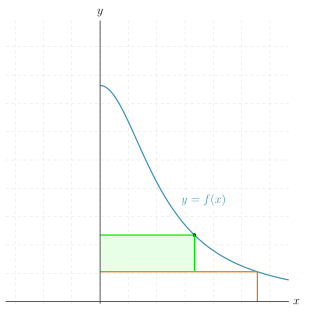
- For \(t\ge0\), let \(A_0(t)\) be the area of the largest rectangle with sides parallel to the coordinate axes that can fit in the region bounded by the curve \(y=\f(x)\), the \(y\)-axis and the line \(y=\f(t)\). Show that \(A_0(t)\) can be written in the form \[ A_0(t) =x_0\left( \f(x_0) -\f(t)\right), \] where \(x_0\) satisfies \(x_0 \f'(x_0) +\f(x_0) = \f(t)\,\).
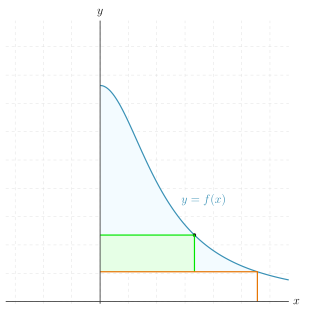
- The function g is defined, for \(t> 0\), by \[ \g(t) =\frac 1t \int_0^t \f(x) \d x\,. \] Show that \(t \g'(t) = \f(t) -\g(t)\,\). Making use of a sketch show that, for \(t>0\), \[ \int_0^t \left( \f(x) - \f(t)\right) \d x > A_0(t) \] and deduce that \(-t^2 \g'(t)> A_0(t)\).
- In the case \(\f(x)= \dfrac 1 {1+x}\,\), use the above to establish the inequality \[ \ln \sqrt{1+t} > 1 - \frac 1 {\sqrt{1+t}} \,, \] for \(t>0\).
Solution:
- First, not that the point must be ony the curve:
Since otherwise it's pretty clear we could make the area of the rectangle larger by moving the point onto the curve. Therefore \(A = x(f(x)-f(t))\). To maximise this we need \(xf'(x) + f(x)-f(t) = 0\), ie \(x_0f'(x_0) + f(x_0) = f(t)\)
- Suppose \(\displaystyle \g(t) =\frac 1t \int_0^t \f(x) \d x\) then
\begin{align*}
&& \g(t) &=\frac 1t \int_0^t \f(x) \d x\\
\Rightarrow && tg(t) &= \int_0^t \f(x) \d x \\
\Rightarrow && tg'(t) +g(t) &= f(t) \\
\Rightarrow && tg'(t) &= f(t) - g(t)
\end{align*}
Clearly the blue area + green area is larger than the green area. So \(\displaystyle \int_0^t (f(x) - f(t))\d x > A_0(t)\). Notice that \(f(t) = \frac1{t} \int_0^t f(t) \d x \) so \(-t^2g'(t) = \int_0^t f(x) \d x > A_0(t)\)
- Not that if \(f(x) = \dfrac{1}{1+x}\), the \(f'(x) = -\frac{1}{(1+x)^2}\) and so \begin{align*} && -\frac{x_0}{(1+x_0)^2} + \frac{1}{1+x_0} &= \frac{1}{1+t} \\ && \frac{1}{(1+x_0)^2} &= \frac{1}{1+t} \\ \Rightarrow && x_0 &= \sqrt{1+t} - 1 \\ && A_0(t) &= (\sqrt{1+t} - 1) \left ( \frac{1}{\sqrt{1+t}} - \frac{1}{t+1} \right) \\ &&&= 1 - \frac{1}{\sqrt{1+t}} - \frac{1}{\sqrt{1+t}} + \frac{1}{1+t} \\ &&&= \frac{2+t}{1+t} - \frac{2}{\sqrt{1+t}} \\ && g(t) &= \frac{1}{t} \int_0^t \frac{1}{1+x} \d x \\ &&&= \frac{\ln(1+t)}{t} \\ \Rightarrow && g'(t) &= \frac{\frac{t}{1+t} - \ln(1+t)}{t^2} \\ \Rightarrow && -t^2g(t) &= \ln(1+t) - \frac{t}{1+t} \\ \Rightarrow && \ln(1+t) - \frac{t}{1+t} &> \frac{2+t}{1+t} - \frac{2}{\sqrt{1+t}} \\ \Rightarrow && \ln \sqrt{1+t} & > 1 - \frac{1}{\sqrt{1+t}} \end{align*}