Hyperbolic functions
- By considering the Maclaurin series for \(\mathrm{e}^x\), show that for all real \(x\), \[\cosh^2 x \geqslant 1 + x^2.\] Hence show that the function \(\mathrm{f}\), defined for all real \(x\) by \(\mathrm{f}(x) = \tan^{-1} x - \tanh x\), is an increasing function. Sketch the graph \(y = \mathrm{f}(x)\).
- Function \(\mathrm{g}\) is defined for all real \(x\) by \(\mathrm{g}(x) = \tan^{-1} x - \frac{1}{2}\pi \tanh x\).
- Show that \(\mathrm{g}\) has at least two stationary points.
- Show, by considering its derivative, that \((1+x^2)\sinh x - x\cosh x\) is non-negative for \(x \geqslant 0\).
- Show that \(\dfrac{\cosh^2 x}{1+x^2}\) is an increasing function for \(x \geqslant 0\).
- Hence or otherwise show that \(\mathrm{g}\) has exactly two stationary points.
- Sketch the graph \(y = \mathrm{g}(x)\).
You may assume that all infinite sums and products in this question converge.
- Prove by induction that for all positive integers \(n\), \[ \sinh x = 2^n \cosh\!\left(\frac{x}{2}\right) \cosh\!\left(\frac{x}{4}\right) \cdots \cosh\!\left(\frac{x}{2^n}\right) \sinh\!\left(\frac{x}{2^n}\right) \] and deduce that, for \(x \neq 0\), \[ \frac{\sinh x}{x} \cdot \frac{\dfrac{x}{2^n}}{\sinh\!\left(\dfrac{x}{2^n}\right)} = \cosh\!\left(\frac{x}{2}\right) \cosh\!\left(\frac{x}{4}\right) \cdots \cosh\!\left(\frac{x}{2^n}\right)\,. \]
- You are given that the Maclaurin series for \(\sinh x\) is \[ \sinh x = \sum_{r=0}^{\infty} \frac{x^{2r+1}}{(2r+1)!}\,. \] Use this result to show that, as \(y\) tends to \(0\), \(\dfrac{y}{\sinh y}\) tends to \(1\). Deduce that, for \(x \neq 0\), \[ \frac{\sinh x}{x} = \cosh\!\left(\frac{x}{2}\right) \cosh\!\left(\frac{x}{4}\right) \cdots \cosh\!\left(\frac{x}{2^n}\right) \cdots\,. \]
- Let \(x = \ln 2\). Evaluate \(\cosh\!\left(\dfrac{x}{2}\right)\) and show that \[ \cosh\!\left(\frac{x}{4}\right) = \frac{1 + 2^{\frac{1}{2}}}{2 \times 2^{\frac{1}{4}}}\,. \] Use part (ii) to show that \[ \frac{1}{\ln 2} = \frac{1 + 2^{\frac{1}{2}}}{2} \times \frac{1 + 2^{\frac{1}{4}}}{2} \times \frac{1 + 2^{\frac{1}{8}}}{2} \cdots\,. \]
- Show that \[ \frac{2}{\pi} = \frac{\sqrt{2}}{2} \times \frac{\sqrt{2+\sqrt{2}}}{2} \times \frac{\sqrt{2+\sqrt{2+\sqrt{2}}}}{2} \cdots\,. \]
- For \(x \neq \tan\alpha\), the function \(f_\alpha\) is defined by \[ f_\alpha(x) = \tan^{-1}\!\left(\frac{x\tan\alpha + 1}{\tan\alpha - x}\right) \] where \(0 < \alpha < \tfrac{1}{2}\pi\). Show that \(f_\alpha'(x) = \dfrac{1}{1 + x^2}\). Hence sketch \(y = f_\alpha(x)\). On a separate diagram, sketch \(y = f_\alpha(x) - f_\beta(x)\) where \(0 < \alpha < \beta < \tfrac{1}{2}\pi\).
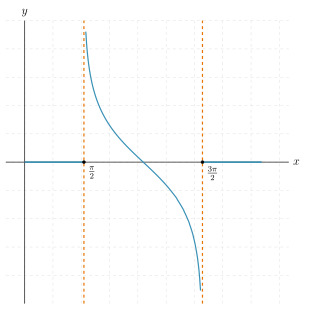
- For \(0 \leqslant x \leqslant 2\pi\) and \(x \neq \tfrac{1}{2}\pi,\, \tfrac{3}{2}\pi\), the function \(g(x)\) is defined by \[ g(x) = \tanh^{-1}(\sin x) - \sinh^{-1}(\tan x). \] For \(\tfrac{1}{2}\pi < x < \tfrac{3}{2}\pi\), show that \(g'(x) = 2\sec x\). Use this result to sketch \(y = g(x)\) for \(0 \leqslant x \leqslant 2\pi\).
- \(\,\) \begin{align*}
&& f_\alpha(x) &= \tan^{-1}\!\left(\frac{x\tan\alpha + 1}{\tan\alpha - x}\right) \\
&& f'_\alpha(x) &= \frac{1}{1 + \left(\frac{x\tan\alpha + 1}{\tan\alpha - x}\right) ^2} \cdot \frac{\tan \alpha \cdot (\tan \alpha - x) - (x \tan \alpha + 1) \cdot (-1)}{(\tan \alpha - x)^2} \\
&&&= \frac{\tan^2 \alpha -1}{(\tan \alpha - x)^2 + (x \tan \alpha +1)^2} \\
&&&= \frac{\tan^2 \alpha +1}{\tan^2 \alpha - 2x \tan \alpha + x^2 + x^2 \tan^2 \alpha + 2 x \tan \alpha + 1} \\
&&&= \frac{1+\tan^2 \alpha}{(1+\tan^2 \alpha(x^2 + 1)} = \frac{1}{1+x^2}
\end{align*}
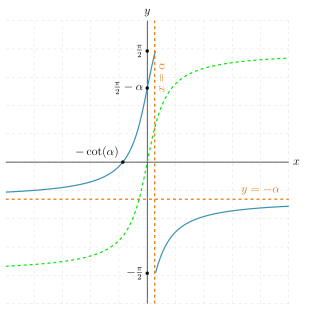
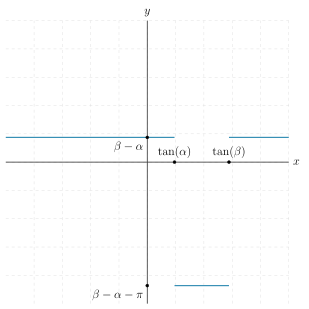
- Let \(g(x) = \tanh^{-1}(\sin x) - \sinh^{-1}(\tan x)\) then
\begin{align*}
&& g'(x) &= \frac{1}{1-\sin^2 x} \cdot \cos x - \frac{1}{\sqrt{\tan^2 +1}} \cdot \sec^2 x \\
&&&= \sec x - \frac{\sec^2 x}{|\sec x|} \\
&&& = \begin{cases} 0 &\text{if } \sec x \geq 0 \\
2 \sec x &\text{ otherwise}
\end{cases}
\end{align*}
Therefore \(g'(x) = 2\sec x\) if \(\tfrac12 \pi < x < \tfrac32\pi\)
Therefore $\displaystyle g(x) = \begin{cases} 0 & \text{if } x \in [0, \frac{\pi}{2}] \cup [\frac{3\pi}{2}, 2\pi] \\
\ln( (\tan x + \sec x)^2) + C &\text{otherwise} \end{cases}$
The curve \(C\) has equation \(\sinh x + \sinh y = 2k\), where \(k\) is a positive constant.
- Show that the curve \(C\) has no stationary points and that \(\dfrac{\mathrm{d}^2 y}{\mathrm{d}x^2} = 0\) at the point \((x,y)\) on the curve if and only if \[ 1 + \sinh x \sinh y = 0. \] Find the co-ordinates of the points of inflection on the curve \(C\), leaving your answers in terms of inverse hyperbolic functions.
- Show that if \((x,y)\) lies on the curve \(C\) and on the line \(x + y = a\), then \[ \mathrm{e}^{2x}(1 - \mathrm{e}^{-a}) - 4k\mathrm{e}^x + (\mathrm{e}^a - 1) = 0 \] and deduce that \(1 < \cosh a \leqslant 2k^2 + 1\).
- Sketch the curve \(C\).
Show, by finding \(R\) and \(\gamma\), that \(A \sinh x + B\cosh x \) can be written in the form \(R\cosh (x+\gamma)\) if \(B>A>0\). Determine the corresponding forms in the other cases that arise, for \(A>0\), according to the value of \(B\). Two curves have equations \(y = \textrm{sech} x\) and \(y = a\tanh x + b\,\), where \(a>0\).
- In the case \(b>a\), show that if the curves intersect then the \(x\)-coordinates of the points of intersection can be written in the form \[ \pm\textrm{arcosh} \left( \frac 1 {\sqrt{b^2-a^2}}\right) - {\rm artanh \,} \frac a b .\]
- Find the corresponding result in the case \(a>b>0\,\).
- Find necessary and sufficient conditions on \(a\) and \(b\) for the curves to intersect at two distinct points.
- Find necessary and sufficient conditions on \(a\) and \(b\) for the curves to touch and, given that they touch, express the \(y\)-coordinate of the point of contact in terms of \(a\).
- Suppose \(y \cosh x = 1\) and \(y \cosh x = a \sinh x +b \cosh x\) so \begin{align*} && 1 & = a \sinh x + b \cosh x \\ &&&= \sqrt{b^2-a^2} \cosh(x + \textrm{artanh} \frac{a}{b} ) \\ \Rightarrow && x + \textrm{artanh} \frac{a}{b} &= \pm \textrm{arcosh} \left ( \frac{1}{\sqrt{b^2-a^2}} \right) \\ \Rightarrow && x &= \pm \textrm{arcosh} \left ( \frac{1}{\sqrt{b^2-a^2}} \right) -\textrm{artanh} \frac{a}{b} \end{align*}
- If \( a > b > 0\) we have \begin{align*} && 1 & = \sqrt{a^2-b^2} \sinh \left ( x - \textrm{artanh} \frac{b}{a} \right) \\ \Rightarrow && x &= \textrm{arsinh} \left ( \frac{1}{\sqrt{a^2-b^2}} \right) + \textrm{artanh} \left ( \frac{b}{a} \right) \end{align*}
- To intersect at distinct points we must have \(b > a\) and \(\textrm{arcosh} \left ( \frac{1}{\sqrt{b^2-a^2}} \right) \neq 0\) which is always true.
- For the curves to touch, we need them to intersect and have matching derivatives, ie \begin{align*} && -\tanh x \cdot \textrm{sech}x &= a\textrm{sech}^2 x \\ \Rightarrow && 0 &= \textrm{sech}^2 x (a + \sinh x) \\ \Rightarrow && x &= -\textrm{arsinh} \, a\\ \Rightarrow && \sinh x &= - a\\ \Rightarrow &&\cosh x &= \sqrt{1 + a^2} \\ \end{align*} So if the curves touch, we must have \(1 = -a^2+b\sqrt{1+a^2} \Rightarrow b = \sqrt{1+a^2}\) and since this does work it is a necessary and sufficient condition. We will also have the \(y\) coordinate is \(\frac{1}{\sqrt{1+a^2}}\)
Starting from the result that \[ \.h(t) >0\ \mathrm{for}\ 0< t < x \Longrightarrow \int_0^x \.h(t)\ud t > 0 \,, \] show that, if \(\.f''(t) > 0\) for \(0 < t < x_0\) and \(\.f(0)=\.f'(0) =0\), then \(\.f(t)>0\) for \(0 < t < x_0\).
- Show that, for \(0 < x < \frac12\pi\), \[ \cos x \cosh x <1 \,. \]
- Show that, for \(0 < x < \frac12\pi\), \[ \frac 1 {\cosh x} < \frac {\sin x} x < \frac x {\sinh x} \,. \] %
- Show that, for \(0 < x < \frac12\pi\), \(\tanh x < \tan x\).
Let \(y = \ln (x^2-1)\,\), where \(x >1\), and let \(r\) and \(\theta\) be functions of \(x\) determined by \(r= \sqrt{x^2-1}\) and \(\coth\theta= x\). Show that \[ \frac {\d y}{\d x} = \frac {2\cosh \theta}{r} \text{ and } \frac {\d^2 y}{\d x^2} = -\frac {2 \cosh 2\theta}{r^2}\,, \] and find an expression in terms of \(r\) and \(\theta\) for \(\dfrac {\d^3 y}{\d x^3}\,\). Find, with proof, a similar formula for \(\dfrac{\d^n y}{\d x^n}\) in terms of \(r\) and \(\theta\).
Show Solution- Solve the equation \(u^2+2u\sinh x -1=0\) giving \(u\) in terms of \(x\). Find the solution of the differential equation \[ \left( \frac{\d y}{\d x}\right)^{\!2} +2 \frac{\d y}{\d x} \sinh x -1 = 0 \] that satisfies \(y=0\) and \(\dfrac {\d y}{\d x} >0\) at \(x=0\).
- Find the solution, not identically zero, of the differential equation \[ \sinh y \left( \frac{\d y}{\d x}\right)^{\!2} +2 \frac{\d y}{\d x} -\sinh y = 0 \] that satisfies \(y=0\) at \(x=0\), expressing your solution in the form \(\cosh y=\f(x)\). Show that the asymptotes to the solution curve are \(y=\pm(-x+\ln 4)\).
Define \(\cosh x\) and \(\sinh x\) in terms of exponentials and prove, from your definitions, that \[ \cosh^{4}x-\sinh^{4}x=\cosh2x \] and \[ \cosh^{4}x+\sinh^{4}x=\tfrac{1}{4}\cosh4x+\tfrac{3}{4}. \] Find \(a_{0},a_{1},\ldots,a_{n}\) in terms of \(n\) such that \[ \cosh^{n}x=a_{0}+a_{1}\cosh x+a_{2}\cosh2x+\cdots+a_{n}\cosh nx. \] Hence, or otherwise, find expressions for \(\cosh^{2m}x-\sinh^{2m}x\) and \(\cosh^{2m}x+\sinh^{2m}x,\) in terms of \(\cosh kx,\) where \(k=0,\ldots,2m.\)
Show SolutionThe real numbers \(x\) and \(y\) satisfy the simultaneous equations $$ \sinh (2x) = \cosh y \qquad\hbox{and}\qquad \sinh(2y) = 2 \cosh x. $$ Show that \(\sinh^2 y\) is a root of the equation $$ 4t^3 + 4t^2 -4t -1=0 $$ and demonstrate that this gives at most one valid solution for \(y\). Show that the relevant value of \(t\) lies between \(0.7\) and \(0.8\), and use an iterative process to find \(t\) to 6 decimal places. Find \(y\) and hence find \(x\), checking your answers and stating the final answers to four decimal places.
Show Solution- Given that \[ \mathrm{f}(x)=\ln(1+\mathrm{e}^{x}), \] prove that \(\ln[\mathrm{f}'(x)]=x-\mathrm{f}(x)\) and that \(\mathrm{f}''(x)=\mathrm{f}'(x)-[\mathrm{f}'(x)]^{2}.\) Hence, or otherwise, expand \(\mathrm{f}(x)\) as a series in powers of \(x\) up to the term in \(x^{4}.\)
- Given that \[ \mathrm{g}(x)=\frac{1}{\sinh x\cosh2x}, \] explain why \(\mathrm{g}(x)\) can not be expanded as a series of non-negative powers of \(x\) but that \(x\mathrm{g}(x)\) can be so expanded. Explain also why this latter expansion will consist of even powers of \(x\) only. Expand \(x\mathrm{g}(x)\) as a series as far as the term in \(x^{4}.\)
- \begin{align*} && f(x) &= \ln (1+e^x) \\ && f'(x) &= \frac{1}{1+e^x} \cdot e^x \\ &&&= \frac{e^x}{1+e^x} \\ \Rightarrow && \ln [f'(x)] &= x - \ln (1+e^x) \\ &&&= x - f(x) \\ \\ \Rightarrow && \frac{f''(x)}{f'(x)} &= 1 - f'(x) \\ \Rightarrow && f''(x) &= f'(x) - [f'(x)]^2 \\ && f'''(x) &= f''(x) - 2f'(x) f''(x) \\ && f^{(4)}(x) &= f'''(x) - 2[f''(x)]^2-2f'(x)f'''(x) \end{align*} \begin{align*} f(0) &= \ln 2 \\ f'(0) &= \tfrac12 \\ f''(0) &= \tfrac12 -\tfrac14 \\ &= \tfrac 14 \\ f'''(0) &= \tfrac14 - 2 \tfrac12 \tfrac 14 \\ &= 0 \\ f^{(4)}(0) &= -2 \cdot \tfrac1{16} \\ &= -\frac18 \end{align*} Therefore \(f(x) = \ln 2 + \tfrac12 x + \tfrac18 x^2 - \frac1{8 \cdot 4!} x^4 + O(x^5)\)
- As \(x \to 0\), \(g(x) \to \infty\) therefore there can be no power series about \(0\). But as \(x \to 0, x g(x) \not \to \infty\) as \(\frac{x}{\sinh x}\) is well behaved. We can also notice that \(x g(x)\) is an even function, since \(\cosh x\) is even and \(\frac{x}{\sinh x}\) is even, therefore the power series will consist of even powers of \(x\) \begin{align*} \lim_{x \to 0} \frac{x}{\sinh x \cosh 2 x} &= \lim_{x \to 0} \frac{x}{\sinh x} \cdot \lim_{x \to 0} \frac{1}{\cosh2 x} \\ &= 1 \end{align*} Notice that \begin{align*} \frac{x}{\sinh x \cosh 2 x} &= \frac{4x}{(e^x - e^{-x})(e^{2x}+e^{-2x})} \\ &= \frac{4x}{(2x + \frac{x^3}{3} + \cdots)(2 + 4x^2 + \frac43 x^4 + \cdots )} \\ &= \frac{1}{1+\frac{x^2}{6}+\frac{x^4}{5!} + \cdots } \frac{1}{1 + 2x^2 + \frac23 x^4 + \cdots } \\ &= \left (1-(\frac{x^2}{6} + \frac{x^4}{5!})+ (\frac{x^2}{6} )^2 + O(x^6)\right) \left (1-(2x^2+\frac23 x^4)+ (2x^2)^2 + O(x^6)\right) \\ &= \left (1 - \frac16 x^2 + \frac{7}{360} x^4 + O(x^6) \right) \left (1 - 2x^2+ \frac{10}3x^4 + O(x^6) \right) \\ &= 1 - \frac{13}{6} x^2 + \frac{1327}{360}x^4 + O(x^6) \end{align*}
Solve the quadratic equation \(u^{2}+2u\sinh x-1=0\), giving \(u\) in terms of \(x\). Find the solution of the differential equation \[ \left(\frac{\mathrm{d}y}{\mathrm{d}x}\right)^{2}+2\frac{\mathrm{d}y}{\mathrm{d}x}\sinh x-1=0 \] which satisfies \(y=0\) and \(y'>0\) at \(x=0\). Find the solution of the differential equation \[ \sinh x\left(\frac{\mathrm{d}y}{\mathrm{d}x}\right)^{2}+2\frac{\mathrm{d}y}{\mathrm{d}x}-\sinh x=0 \] which satisfies \(y=0\) at \(x=0\).
Show SolutionThe transformation \(T\) from \(\binom{x}{y}\) to \(\binom{x'}{y'}\) in two-dimensional space is given by \[ \begin{pmatrix}x'\\ y' \end{pmatrix}=\begin{pmatrix}\cosh u & \sinh u\\ \sinh u & \cosh u \end{pmatrix}\begin{pmatrix}x\\ y \end{pmatrix}, \] where \(u\) is a positive real constant. Show that the curve with equation \(x^{2}-y^{2}=1\) is transformed into itself. Find the equations of two straight lines through the origin which transform into themselves. A line, not necessary through the origin, which has gradient \(\tanh v\) transforms under \(T\) into a line with gradient \(\tanh v'\). Show that \(v'=v+u\). The lines \(\ell_{1}\) and \(\ell_{2}\) with gradients \(\tanh v_{1}\) and \(\tanh v_{2}\) transform under \(T\) into lines with gradients \(\tanh v_{1}'\) and \(\tanh v_{2}'\) respectively. Find the relation satisfied by \(v_{1}\) and \(v_{2}\) that is the necessary and sufficient for \(\ell_{1}\) and \(\ell_{2}\) to intersect at the same angle as their transforms. In the case when \(\ell_{1}\) and \(\ell_{2}\) meet at the origin, illustrate in a diagram the relation between \(\ell_{1}\), \(\ell_{2}\) and their transforms.
The real variables \(\theta\) and \(u\) are related by the equation \(\tan\theta=\sinh u\) and \(0\leqslant\theta<\frac{1}{2}\pi.\) Let \(v=\mathrm{sech}u.\) Prove that
- \(v=\cos\theta;\)
- \(\dfrac{\mathrm{d}\theta}{\mathrm{d}u}=v;\)
- \(\sin2\theta=-2\dfrac{\mathrm{d}v}{\mathrm{d}u}\quad\) and \(\quad\cos2\theta=-\cosh u\dfrac{\mathrm{d}^{2}v}{\mathrm{d}u^{2}};\)
- \({\displaystyle \frac{\mathrm{d}u}{\mathrm{d}\theta}\frac{\mathrm{d}^{2}v}{\mathrm{d}\theta^{2}}+\frac{\mathrm{d}v}{\mathrm{d}\theta}\frac{\mathrm{d}^{2}u}{\mathrm{d}\theta^{2}}+\left(\frac{\mathrm{d}u}{\mathrm{d}\theta}\right)^{2}=0.}\)
- \begin{align*} v &= \mathrm{sech} u \\ &= \frac{1}{\mathrm{cosh } u} \\ &= \frac{1}{\sqrt{1+\mathrm{sinh}^2 u}} \tag{\(u > 0\)} \\ &= \frac{1}{\sqrt{1+\tan^2 \theta}} \\ &= \frac{1}{\sqrt{\mathrm{sec}^2 \theta}} \\ &= \cos \theta \tag{\(0 < \theta < \tfrac{\pi}{2}\)} \end{align*}
- \begin{align*} && \tan \theta &= \textrm{sinh} u \\ \underbrace{\Rightarrow}_{\frac{\d}{\d u}} && \sec^2 \theta \cdot \frac{\d \theta}{\d u} &= \cosh u \\ \Rightarrow && \frac{\d \theta}{\d u} &=\cosh u \cdot \cos^2 \theta \\ &&&= \frac{1}{v} \cdot v^2 \\ &&&=v \end{align*}
- \begin{align*} \sin 2 \theta &= 2 \sin \theta \cos \theta \\ &= 2 \sin \theta \cdot \frac{\d \theta}{\d u} \\ &= -2 \frac{\d v}{\d \theta} \cdot \frac{\d \theta}{\d u} \tag{\(\cos \theta = v\)} \\ &= -2 \frac{\d v}{\d u} \end{align*} \begin{align*} && \sin 2 \theta &= -2 \frac{\d v}{\d u} \\ \underbrace{\Rightarrow}_{\frac{\d}{\d u}} && 2 \cos 2 \theta \cdot \frac{\d \theta}{\d u} &= -2 \frac{\d^2 v}{\d u^2} \\ \Rightarrow && \cos 2 \theta &= - \frac{\d^2 v}{\d u^2} \frac{1}{v} \\ &&&= -\frac{\d ^2v}{\d u^2} \cosh u \end{align*}
- \begin{align*} && \frac{\d u}{\d \theta} &= \frac{1}{v} \\ \Rightarrow && \frac{\d^2 u}{\d \theta^2} &= -\frac{1}{v^2} \frac{\d v}{\d \theta} \\ &&&= \frac{1}{v^2} \sin \theta \\ && \frac{\d v}{\d \theta} &= -\sin \theta \\ \Rightarrow && \frac{\d^2 v}{\d \theta^2} &= -\cos \theta \\ &&&= - v \\ \end{align*} Therefore \begin{align*} \frac{\mathrm{d}u}{\mathrm{d}\theta}\frac{\mathrm{d}^{2}v}{\mathrm{d}\theta^{2}}+\frac{\mathrm{d}v}{\mathrm{d}\theta}\frac{\mathrm{d}^{2}u}{\mathrm{d}\theta^{2}}+\left(\frac{\mathrm{d}u}{\mathrm{d}\theta}\right)^{2} &= \frac{1}{v} \cdot \left (-v\right) + \left ( - \sin \theta \right ) \cdot \left (\frac{1}{v^2} \sin \theta \right) + \frac{1}{v^2} \\ &= -1 + \frac{1-\sin^2 \theta}{v^2} \\ &= -1 + \frac{\cos^2 \theta}{v^2} \\ &= -1 + 1 \\ &= 0 \end{align*}
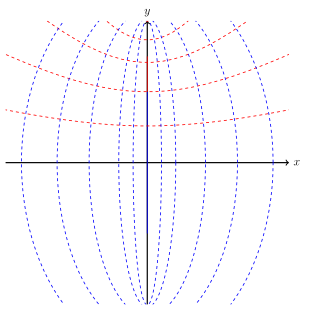
The real numbers \(x\) and \(y\) are related to the real numbers \(u\) and \(v\) by \[ 2(u+\mathrm{i}v)=\mathrm{e}^{x+\mathrm{i}y}-\mathrm{e}^{-x-\mathrm{i}y}. \] Show that the line in the \(x\)-\(y\) plane given by \(x=a\), where \(a\) is a positive constant, corresponds to the ellipse \[ \left(\frac{u}{\sinh a}\right)^{2}+\left(\frac{v}{\cosh a}\right)^{2}=1 \] in the \(u\)-\(v\) plane. Show also that the line given by \(y=b\), where \(b\) is a constant and \(0<\sin b<1,\) corresponds to one branch of a hyperbola in the \(u\)-\(v\) plane. Write down the \(u\) and \(v\) coordinates of one point of intersection of the ellipse and hyperbola branch, and show that the curves intersect at right-angles at this point. Make a sketch of the \(u\)-\(v\) plane showing the ellipse, the hyperbola branch and the line segments corresponding to:
- \(x=0\);
- \(y=\frac{1}{2}\pi,\) \(\quad 0\leqslant x\leqslant a.\)
Given that \(y=\cosh(n\cosh^{-1}x),\) for \(x\geqslant1,\) prove that \[ y=\frac{(x+\sqrt{x^{2}-1})^{n}+(x-\sqrt{x^{2}-1})^{n}}{2}. \] Explain why, when \(n=2k+1\) and \(k\in\mathbb{Z}^{+},\) \(y\) can also be expressed as the polynomial \[ a_{0}x+a_{1}x^{3}+a_{2}x^{5}+\cdots+a_{k}x^{2k+1}. \] Find \(a_{0},\) and show that
- \(a_{1}=(-1)^{k-1}2k(k+1)(2k+1)/3\);
- \(a_{2}=(-1)^{k}2(k-1)k(k+2)(2k+1)/15.\)
- \begin{align*} a_1 &= \binom{2k+1}{2k}\binom{k}{1}(-1)^{k-1}+\binom{2k+1}{2(k-1)}(-1)^{k-1} \\ &=(-1)^{k-1}\cdot ( (2k+1)k + \frac{(2k+1)\cdot 2k \cdot (2k-1)}{3!}) \\ &= (-1)^{k-1}(2k+1)k\frac{3 + 2k-1}{3} \\ &= (-1)^{k-1}2(2k+1)k (k+1) \end{align*}
- \begin{align*} a_2 &= \binom{2k+1}{2k} \binom{k}{2}(-1)^{k-2} + \binom{2k+1}{2(k-1)} \binom{k-1}{1} (-1)^{k-2}+\binom{2k+1}{2(k-2)} (-1)^{k-2} \\ &= \binom{2k+1}{1} \binom{k}{2}(-1)^{k-2} + \binom{2k+1}{3} \binom{k-1}{1} (-1)^{k-2}+\binom{2k+1}{5} (-1)^{k-2} \\ &= (-1)^{k} \left (\binom{2k+1}{1} \frac{k(k-1)}{2} + \binom{2k+1}{3}(k-1)+\binom{2k+1}{5} \right) \\ &= (-1)^{k} \left ( \frac{(2k+1)k(k-1)}{2} + \frac{(2k+1)k(2k-1)}{3} + \frac{(2k+1)k(2k-1)(k-1)(2k-3)}{5\cdot2\cdot3} \right) \\ &= (-1)^k (2k+1)k\frac{1}{30} \left ( 15(k-1) + 10(2k-1)+(2k-1)(k-1)(2k-3) \right) \end{align*}
Show that the following functions are positive when \(x\) is positive:
- [ \(x-\tanh x\)
- \(x\sinh x-2\cosh x+2\)
- \(2x\cosh2x-3\sinh2x+4x\).
- Notice that \(f(x) = x - \tanh x\) has \(f'(x) = 1-\textrm{sech}^2 x = \tanh^2 x > 0\) so \(f(x)\) is strictly increasing on \((0, \infty)\) and \(f(0) = 0\) therefore \(f(x)\) is positive for all \(x\) positive
- Let \(f(x) = x\sinh x-2\cosh x+2\) then \(f'(x) = \sinh x +x \cosh x - 2 \sinh x = x \cosh x -\sinh x = \cosh x ( x - \tanh x) > 0\) by the first part. \(f(0) = 0\) so \(f(x)\) is positive for all \(x\) positive.
- Let \(f(x) = 2x\cosh2x-3\sinh2x+4x\) then \begin{align*} f'(x) &= 2\cosh 2x +4x\sinh 2x - 6 \cosh 2x + 4 \\ &= 4( x\sinh 2x-\cosh 2x +1) \\ &= 4(x2\cosh x \sinh x -2\cosh^2x ) \\ &= 8 \cosh^2 x (x - \tanh x) \end{align*} Which is always positive when \(x\) > 0, \(f(0) = 0\) so \(f(x) > 0\) for all positive \(x\).