Trigonometry 2
Reciprocal trig, addition formulae, double angle formula, product to sum, sum to product formulae, harmonic formulae, inverse functions
- The real numbers \(x\), \(y\) and \(z\) satisfy the equations \[y = \frac{2x}{1-x^2}\,,\qquad z = \frac{2y}{1-y^2}\,,\qquad x = \frac{2z}{1-z^2}\,.\] Let \(x = \tan\alpha\). Deduce that \(y = \tan 2\alpha\) and show that \(\tan\alpha = \tan 8\alpha\). Find all solutions of the equations, giving each value of \(x\), \(y\) and \(z\) in the form \(\tan\theta\) where \(-\frac{1}{2}\pi < \theta < \frac{1}{2}\pi\).
- Determine the number of real solutions of the simultaneous equations \[y = \frac{3x - x^3}{1-3x^2}\,,\qquad z = \frac{3y - y^3}{1-3y^2}\,,\qquad x = \frac{3z - z^3}{1-3z^2}\,.\]
- Consider the simultaneous equations
\[y = 2x^2 - 1\,,\qquad z = 2y^2 - 1\,,\qquad x = 2z^2 - 1\,.\]
- Determine the number of real solutions of these simultaneous equations with \(|x| \leqslant 1\), \(|y| \leqslant 1\), \(|z| \leqslant 1\).
- By finding the degree of a single polynomial equation which is satisfied by \(x\), show that all solutions of these simultaneous equations have \(|x| \leqslant 1\), \(|y| \leqslant 1\), \(|z| \leqslant 1\).
Prove, from the identities for \(\cos(A \pm B)\), that \[ \cos a \cos 3a \equiv \tfrac{1}{2}(\cos 4a + \cos 2a). \] Find a similar identity for \(\sin a \cos 3a\).
- Solve the equation \[ 4\cos x \cos 2x \cos 3x = 1 \] for \(0 \leqslant x \leqslant \pi\).
- Prove that if \[ \tan x = \tan 2x \tan 3x \tan 4x \qquad (\dagger) \] then \(\cos 6x = \tfrac{1}{2}\) or \(\sin 4x = 0\). Hence determine the solutions of equation \((\dagger)\) with \(0 \leqslant x \leqslant \pi\).
- \(\,\) \begin{align*} && 1 &= 4 \cos x \cos 2x \cos 3x \\ &&&= 2(\cos 4x +\cos 2x)\cos 2x \\ c = \cos 2x:&&&= 2(2c^2-1+c)c \\ \Rightarrow && 0 &= 4c^3+2c^2-2c-1 \\ &&&= (2c+1)(2c^2-1) \\ \Rightarrow && \cos 2x &= -\frac12 \\ \Rightarrow && x &= \frac{\pi}{3}, \frac{2\pi}{3} \\ && \cos 2x &= \pm \frac1{\sqrt2} \\ \Rightarrow && x&= \frac{\pi}{8}, \frac{3\pi}{8}, \frac{5\pi}{8}, \frac{7\pi}{8} \end{align*}
- \(\,\) \begin{align*} && \tan x &= \tan 2x \tan 3x \tan 4x \\ \Rightarrow &&1 &= \frac{\cos x\sin 2x \sin 3x \sin 4x}{\sin x \cos 2x \cos 3x \cos 4x} \\ &&&= \frac{\sin 2x \sin 4x (\sin4 x + \sin 2x)}{\cos 2x \cos 4x (\sin 4x - \sin 2x)} \\ &&&= \frac{(\cos 2x - \cos 6x) (\sin4 x + \sin 2x)}{(\cos 6x + \cos 2x) (\sin 4x - \sin 2x)} \\ \Rightarrow && 0 &= 2\cos 6x \sin 4x - 2\cos 2x \sin 2 x\\ &&&= \sin 4 x (2 \cos 6x - 1) \\ \Rightarrow && \sin 4x &= 0 \\ \text{ or }&& \cos 6x &= \frac12 \end{align*} \(\sin 4x = 0 \Rightarrow x = 0, \frac{\pi}{4}, \frac{\pi}{2}, \frac{3\pi}{4}, \pi\) \(\cos 6x = \frac12 \Rightarrow x = \frac{\pi}{18}, \frac{5\pi}{18},\frac{7\pi}{18}, \frac{11\pi}{18}, \frac{13\pi}{18}, \frac{17\pi}{18}\). We should verify these work, since not all of them will, especially where \(\sin 4x = 0\), so our final answer is \(x = 0, \pi, \frac{\pi}{18}, \frac{5\pi}{18},\frac{7\pi}{18}, \frac{11\pi}{18}, \frac{13\pi}{18}, \frac{17\pi}{18}\)
You are not required to consider issues of convergence in this question. For any sequence of numbers \(a_1, a_2, \ldots, a_m, \ldots, a_n\), the notation \(\prod_{i=m}^{n} a_i\) denotes the product \(a_m a_{m+1} \cdots a_n\).
- Use the identity \(2 \cos x \sin x = \sin(2x)\) to evaluate the product \(\cos(\frac{\pi}{9}) \cos(\frac{2\pi}{9}) \cos(\frac{4\pi}{9})\).
- Simplify the expression $$\prod_{k=0}^{n} \cos\left(\frac{x}{2^k}\right) \quad (0 < x < \frac{1}{2}\pi).$$ Using differentiation, or otherwise, show that, for \(0 < x < \frac{1}{2}\pi\), $$\sum_{k=0}^{n} \frac{1}{2^k} \tan\left(\frac{x}{2^k}\right) = \frac{1}{2^n} \cot\left(\frac{x}{2^n}\right) - 2 \cot(2x).$$
- Using the results \(\lim_{\theta\to 0} \frac{\sin \theta}{\theta} = 1\) and \(\lim_{\theta\to 0} \frac{\tan \theta}{\theta} = 1\), show that $$\prod_{k=1}^{\infty} \cos\left(\frac{x}{2^k}\right) = \frac{\sin x}{x}$$ and evaluate $$\sum_{j=2}^{\infty} \frac{1}{2^{j-2}} \tan\left(\frac{\pi}{2^j}\right).$$
- \begin{align*}\cos(\frac{\pi}{9}) \cos(\frac{2\pi}{9}) \cos(\frac{4\pi}{9}) &= \frac{\sin(\frac{2\pi}{9}) \cos(\frac{2\pi}{9}) \cos(\frac{4\pi}{9})}{2 \sin \frac{\pi}{9}} \\ &= \frac{\sin(\frac{4\pi}{9})\cos(\frac{4\pi}{9})}{4 \sin \frac{\pi}{9}} \\ &= \frac{\sin(\frac{8\pi}{9})}{8 \sin \frac{\pi}{9}} \\ &= \frac{1}{8} \end{align*}
- Let \(\displaystyle P_n = \prod_{k=0}^{n} \cos\left(\frac{x}{2^k}\right)\). Claim: \(P_n = \frac{\sin 2x}{2^{n+1} \sin \l \frac{x}{2^n} \r}\). Proof: This is true for \(n = 0\), assume true for \(n-1\) \begin{align*} \sin\l \frac{x}{2^{n}} \r P_n &= P_{n-1} \cos\l \frac{x}{2^{n}} \r \sin\l \frac{x}{2^{n}} \r \\ &= P_{n-1} \frac{1}{2} \sin\l \frac{x}{2^{n-1}} \r \\ &= \frac{\sin 2x}{2^{n} \sin \l \frac{x}{2^{n-1}}\r} \frac{1}{2} \sin\l \frac{x}{2^{n}} \r \\ &= \frac{\sin 2x}{2^{n+1}} \end{align*} Hence \(P_n = \frac{\sin 2x}{2^{n+1} \sin \l \frac{x}{2^n}\r}\) Taking logs, we determine that: \begin{align*} && \sum_{k=0}^n \ln \cos \l \frac{x}{2^k} \r &= \ln \sin 2x - \ln \sin \l \frac{x}{2^n} \r - (n+1) \ln 2 \\ \Rightarrow && \sum_{k=0}^n \frac{1}{2^k} \tan \l \frac{x}{2^k} \r &= -2 \cot 2x + \frac{1}{2^n} \cot \l \frac{x}{2^n} \r - 0 \\ \end{align*} as required.
- As \(n \to \infty\) \(\frac{x}{2^n} \to 0\), so \(\frac{\sin \frac{x}{2^n}}{\frac{x}{2^n}} = \frac{2^n \sin \frac{x}{2^n}}{x} \to 1\) \begin{align*}\prod_{k=1}^{\infty} \cos\left(\frac{x}{2^k}\right) &= \lim_{n \to \infty} \frac{\sin x}{2^n \sin \l \frac{x}{2^n} \r} \\ &= \lim_{n \to \infty} \frac{\sin x}{x \frac{2^n \sin \l \frac{x}{2^n} \r}{x} } \\ &= \lim_{n \to \infty} \frac{\sin x}{x} \\ \end{align*} \begin{align*} \sum_{j=2}^{\infty} \frac{1}{2^{j-2}} \tan\left(\frac{\pi}{2^j}\right) &= \sum_{j=0}^{\infty} \frac{1}{2^{j}} \tan\left(\frac{1}{2^j}\frac{\pi}{4}\right) \\ &= \lim_{n \to \infty} \l -2 \cot \frac{\pi}{2} + \frac{1}{2^n} \cot \l \frac{\pi}{4 \cdot 2^n} \r\r \\ &= \frac{4}{\pi} \lim_{n \to \infty} \l \frac{1}{2^n} \frac{\pi}{4} \cot \l \frac{\pi}{4 \cdot 2^n} \r\r \\ &\to \frac{\pi}{4} \end{align*}
A pyramid has a horizontal rectangular base \(ABCD\) and its vertex \(V\) is vertically above the centre of the base. The acute angle between the face \(AVB\) and the base is \(\alpha\), the acute angle between the face \(BVC\) and the base is \(\beta\) and the obtuse angle between the faces \(AVB\) and \(BVC\) is \(\pi - \theta\).
- The edges \(AB\) and \(BC\) are parallel to the unit vectors \(\mathbf{i}\) and \(\mathbf{j}\), respectively, and the unit vector \(\mathbf{k}\) is vertical. Find a unit vector that is perpendicular to the face \(AVB\). Show that $$\cos \theta = \cos \alpha \cos \beta.$$
- The edge \(BV\) makes an angle \(\phi\) with the base. Show that $$\cot^2 \phi = \cot^2 \alpha + \cot^2 \beta.$$ Show also that $$\cos^2 \phi = \frac{\cos^2 \alpha + \cos^2 \beta - 2 \cos^2 \theta}{1 - \cos^2 \theta} \geq \frac{2 \cos \theta - 2 \cos^2 \theta}{1 - \cos^2 \theta}$$ and deduce that \(\phi < \theta\).
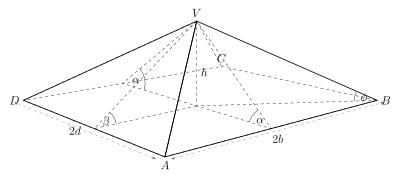
- Let \(A = (0,0,0)\) and then \(B = 22b \mathbf{i}, D = 2d\mathbf{j}, C = 2b\mathbf{i}+2d\mathbf{j}\) and \(V = b \mathbf{i} + d\mathbf{j} + h\mathbf{k}\) We also have \begin{align*} && \tan \alpha &= \frac{h}{d}\\ && \tan \beta &= \frac{d}{b} \\ && \vec{AV} \times \vec{VB} &= \begin{pmatrix} b \\ d \\ h \end{pmatrix} \times \begin{pmatrix} -b \\ d \\ h \end{pmatrix} \\ &&&= \begin{pmatrix} 0 \\ -2bh \\ 2db \end{pmatrix} \\ &&&= 2b \begin{pmatrix} 0 \\ -d \tan \alpha \\ d \end{pmatrix} \\ &&&= k \begin{pmatrix} 0 \\ - \sin \alpha \\ \cos \alpha \end{pmatrix} \end{align*} similarly for the vector perpendicular to the other face it must be \(\begin{pmatrix}-\sin \beta \\ 0 \\ \cos \beta \end{pmatrix}\) Looking at the angle between these perpendicular (to find the angles between the faces we see: \begin{align*} \begin{pmatrix} 0 \\ - \sin \alpha \\ \cos \alpha \end{pmatrix} \cdot \begin{pmatrix}-\sin \beta \\ 0 \\ \cos \beta \end{pmatrix} &= \cos \alpha \cos \beta \end{align*} But this is also \(\pi -\) the angle between the planes, ie \(\cos \theta = \cos \alpha \cos \beta\)
- \(\,\) \begin{align*} && \cot^2 \phi &= \frac{b^2+d^2}{h^2} \\ && \cot^2 \alpha &= \frac{d^2}{h^2} \\ && \cot^2 \beta &= \frac{b^2}{h^2} \\ \Rightarrow && cot^2 \phi &= \cot^2 \beta+\cot^2 \alpha \end{align*} \begin{align*} && \cos^2 \phi &= \frac{b^2+d^2}{b^2+d^2+h^2} \\ && \cos^2 \alpha &= \frac{d^2}{d^2+h^2} \\ && \cos^2 \beta &= \frac{b^2}{b^2+h^2} \\ && \frac{\cos^2 \alpha + \cos^2 \beta - 2 \cos^2 \theta}{1-\cos^2 \theta} &= \frac{\frac{d^2}{d^2+h^2}+\frac{b^2}{b^2+h^2}-2\cdot \frac{d^2}{d^2+h^2} \cdot \frac{b^2}{b^2+h^2}}{1 - \frac{d^2}{d^2+h^2} \cdot\frac{b^2}{b^2+h^2}} \\ &&&= \frac{d^2(b^2+h^2)+b^2(d^2+h^2)-2d^2b^2}{(d^2+h^2)(b^2+h^2)-d^2b^2} \\ &&&= \frac{h^2(b^2+d^2)}{h^2(b^2+d^2+h^2)} \\ &&&= \frac{b^2+d^2}{b^2+d^2+h^2} \\ &&&= \cos^2\phi \end{align*} Also notice that \begin{align*} && \cos^2 \alpha + \cos^2 \beta &\underbrace{\geq}_{AM-GM} 2 \cos \alpha \cos \beta \\ &&&= 2 \cos \theta \\ \Rightarrow && \frac{\cos^2 \alpha + \cos^2 \beta - 2 \cos^2 \theta}{1-\cos^2 \theta} &\geq \frac{2 \cos \theta - 2\cos^2 \theta}{1-\cos^2 \theta} \\ &&&= \frac{2\cos \theta}{1+\cos \theta} = \cos \theta \frac{2}{1+\cos \theta} \\ &&&> \cos^2 \theta \\ \Rightarrow && \phi &< \theta \end{align*}
The points \(R\) and \(S\) have coordinates \((-a,\, 0)\) and \((2a,\, 0)\), respectively, where \(a > 0\,\). The point \(P\) has coordinates \((x,\, y)\) where \(y > 0\) and \(x < 2a\). Let \(\angle PRS = \alpha \) and \(\angle PSR = \beta\,\).
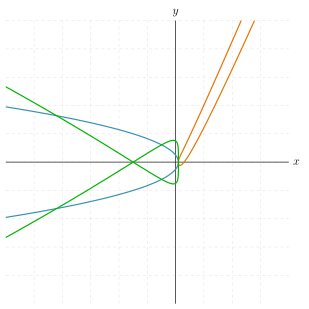
- Show that, if \(\beta = 2 \alpha\,\), then \(P\) lies on the curve \(y^2=3(x^2-a^2)\,\).
- Find the possible relationships between \(\alpha\) and \(\beta\) when \(0 < \alpha < \pi\,\) and \(P\) lies on the curve \(y^2=3(x^2-a^2)\,\).

- \begin{align*} &&\tan \beta &= \frac{y}{2a - x} \\ &&\tan \alpha &= \frac{y}{x+a} \\ && \tan \beta &= \tan 2 \alpha \\ && &= \frac{\tan \alpha}{1 - \tan^2 (\alpha)} \\ \Leftrightarrow && \frac{y}{2a-x}&= \frac{\l \frac{y}{x+a} \r}{1 - \l \frac{y}{x+a} \r^2} \\ && &= \frac{2y(x+a)}{(x+a)^2 - y^2} \\ \Leftrightarrow && (x+a)^2 - y^2 &= 2(x+a)(2a-x) \tag{\(y \neq 0\)} \\ \Leftrightarrow && x^2 + 2ax + a^2 - y^2 &= -2x^2 + 2ax - 4a^2 \\ \Leftrightarrow && y^2 &= 3(x^2-a^2) \end{align*}
- Therefore if \(y^2 = 3(x^2-a^2)\) we know that \(\tan \beta = \tan 2\alpha\), so \(2\alpha = \beta + n \pi\). Since \(0 < \alpha + \beta < \pi\) (since they are angles in a triangle we must have that \(0 < \alpha + 2\alpha - n \pi = 3\alpha - n\pi < \pi\), so \(0 < \alpha - \frac{n\pi}{3} < \frac{\pi}3\), therefore we have \(3\) cases:
Use the identity \[ 2 \sin P\,\sin Q = \cos(Q-P)-\cos(Q+P)\, \] to show that \[ 2\sin\theta \,\big (\sin\theta + \sin 3\theta + \cdots + \sin (2n-1)\theta\,\big ) = 1-\cos 2n\theta \,. \]
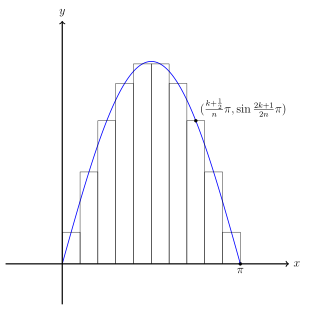
- Let \(A_n\) be the approximation to the area under the curve \(y=\sin x\) from \(x=0\) to \(x=\pi\), using \(n\) rectangular strips each of width \(\frac{{\displaystyle \pi}}{\displaystyle n}\), such that the midpoint of the top of each strip lies on the curve. Show that \[ A_n \sin \left( \frac{\pi}{2n} \right) = \frac \pi n\,. \]
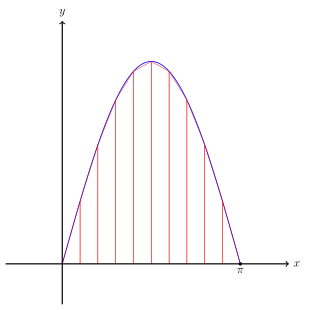
- Let \(B_n\) be the approximation to the area under the curve \(y=\sin x\) from \(x=0\) to \(x=\pi\,\), using the trapezium rule with \(n\) strips each of width \(\frac{\displaystyle \pi}{ \displaystyle n}\). Show that \[B_n \sin \left( \frac{\pi}{2n} \right) = \frac{\pi}{n} \cos \left( \frac{\pi}{2n} \right) . \]
- Show that \[ \frac{1}{2}(A_n + B_n) = B_{2n}\,, \] and that \[ A_n B_{2n} = A^2_{2n}\, . \]
- \(\,\)
Therefore the area is: \begin{align*} A_n &= \frac{\pi}{n} \sin \left ( \frac{\pi}{2n} \right) + \frac{\pi}{n} \sin \left ( \frac{3\pi}{2n} \right) + \frac{\pi}{n} \sin \left ( \frac{5\pi}{2n} \right) + \cdots \frac{\pi}{n} \sin \left ( \frac{(2n-1)\pi}{2n} \right) \\ &= \frac{\pi}{n} \left( \frac{1-\cos \frac{2n \pi}{2n}}{2\sin \frac{\pi}{2n}} \right) \\ &= \frac{\pi}{n} \frac{1}{\sin \frac{\pi}{2n}} \end{align*} as required
- Therefore the area is: \begin{align*} && B_n &= \frac{\pi}{n} \frac{\sin(0)+\sin(\frac{\pi}{n})}{2}+\frac{\pi}{n} \frac{\sin(\frac{\pi}n)+\sin(\frac{2\pi}{n})}{2} + \cdots \frac{\pi}{n} \frac{\sin(\frac{(n-1)\pi}{n})+\sin(\frac{n\pi}{n})}{2} \\ &&&= \frac{\pi}{n} \left ( \sin \frac{\pi}{n} + \sin \frac{2\pi}{n} + \cdots+\sin \frac{(n-1)\pi}{n} \right) \\ \Rightarrow && 2\sin \left ( \frac{\pi}{2n} \right)B_n &= \frac{\pi}{2} \left (2\sin \left ( \frac{\pi}{2n} \right)\sin \frac{\pi}{n} + 2\sin \left ( \frac{\pi}{2n} \right)\sin \frac{2\pi}{n} + \cdots+2\sin \left ( \frac{\pi}{2n} \right)\sin \frac{(n-1)\pi}{n} \right) \\ &&&= \frac{\pi}2 \left ( \cos \frac{\pi}{2n} - \cos \frac{3\pi}{n} + \cos\frac{3\pi}{2n} - \cos \frac{5\pi}{2n} + \cos \frac{(2n-3)\pi}{2n} - \cos \frac{(2n-1)\pi}{2n} \right) \\ &&&= \frac{\pi}{n} \left ( \cos \frac{\pi}{2n} - \cos \left ( \pi - \frac{\pi}{2n} \right) \right) \\ &&&= 2 \frac{\pi}{n} \cos \frac{\pi}{2n} \\ \Rightarrow && \sin \left ( \frac{\pi}{2n} \right)B_n &= \frac{\pi}n \cos \frac{\pi}{2n} \end{align*} as required
- \begin{align*} \frac12(A_n+B_n) &= \frac12 \frac{\pi}{n} \frac{1}{\sin \frac{\pi}{2n}} \left ( 1 + \cos \frac{\pi}{2n} \right) \\ &= \frac{\pi}{n}\frac1{2 \sin \frac{\pi}{2n}} \left (2 \cos^2 \frac{\pi}{4n} \right) \\ &=\frac{\pi}{n} \frac{1}{4 \sin \frac{\pi}{4n} \cos \frac{\pi}{4n}} \left (2 \cos^2 \frac{\pi}{4n} \right) \\ &= \frac{\pi}{2n} \frac{\cos \frac{\pi}{4n}}{\sin \frac{\pi}{4n}} \\ &= B_{2n} \\ \\ A_nB_{2n} &= \frac{\pi}{n\sin \frac{\pi}{2n}} \cdot \frac{\pi}{2n} \frac{\cos \frac{\pi}{4n}}{\sin \frac{\pi}{4n}} \\ &= \frac{\pi^2}{(2n)^2} \frac{\cos \frac{\pi}{4n}}{\sin^2 \frac{\pi}{4n} \cos \frac{\pi}{4n}} \\ &= \left ( \frac{\pi}{2n} \frac{1}{\sin \frac{\pi}{4n}}\right)^2 \\ &= A_{2n}^2 \end{align*}
A function \(\f(x)\) is said to be concave for \(a< x < b\) if \[ \ t\,\f(x_1) +(1-t)\,\f(x_2) \le \f\big(tx_1+ (1-t)x_2\big) \, ,\] for \(a< x_1 < b\,\), \(a< x_2< b\) and \(0\le t \le 1\,\). Illustrate this definition by means of a sketch, showing the chord joining the points \(\big(x_1, \f(x_1)\big) \) and \(\big(x_2, \f(x_2)\big) \), in the case \(x_1 < x_2\) and \(\f(x_1)< \f(x_2)\,\). Explain why a function \(\f(x)\) satisfying \(\f''(x)<0\) for \(a< x < b\) is concave for \(a< x < b\,\).
- By choosing \(t\), \(x_1\) and \(x_2\) suitably, show that, if \(\f(x)\) is concave for \(a< x < b\,\), then \[ \f\Big(\frac{u+ v+w}3\Big) \ge \frac{ \f(u) +\f(v) +\f(w)}3 \, ,\] for \(a< u < b\,\), \(a< v < b\,\) and \(a< w < b\,\).
- Show that, if \(A\), \(B\) and \(C\) are the angles of a triangle, then \[ \sin A +\sin B + \sin C \le \frac{3\sqrt3}2 \,. \]
- By considering \(\ln (\sin x)\), show that, if \(A\), \(B\) and \(C\) are the angles of a triangle, then \[ \sin A \times \sin B \times \sin C \le \frac {3 \sqrt 3} 8 \,. \]
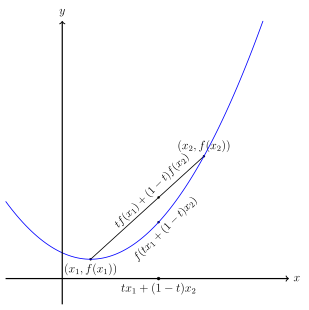
- \(\,\) \begin{align*} && f \left ( \frac{u+v+w}{3} \right) &= f \left ( \frac{2}{3}\cdot \frac{u+v}2+\frac{1}{3}w \right) \\ &&&\geq \frac23 f \left ( \frac{u+v}{2} \right) + \frac13 f(w) \\ &&&\geq \frac23 \left (\frac12 f(u) + \frac12 f(v) \right) + \frac13 f(w) \\ &&&= \frac{f(u)+f(v)+f(w)}{3} \end{align*}
- Notice that if \(A, B, C\) are angles in a triangle then they add to \(\pi\) \(0 < A,B,C < \pi\). We also have \(f(x) = \sin x \Rightarrow f''(x) = - \sin x < 0\) on this interval. Therefore \(\sin A + \sin B + \sin C \leq 3 \sin \frac{A+B+C}{3} = 3 \sin \frac{\pi}{3} = \frac{3\sqrt{3}}2\)
- Also notice that \begin{align*} && f(x) &= \ln ( \sin x) \\ \Rightarrow && f'(x) &= \frac{\cos x}{ \sin x} \\ && f''(x) &= -\textrm{cosec}^2 x < 0 \\ \\ \Rightarrow && \ln( \sin A) + \ln (\sin B) + \ln (\sin C) &\leq 3 \ln \left (\sin \left ( \frac{A + B+ C}{3} \right) \right) \\ &&&= 3 \ln \left ( \frac{\sqrt{3}}{2} \right) = \ln \frac{3\sqrt{3}}{8} \\ \Rightarrow && \sin A \sin B \sin C &\leq \frac{3\sqrt{3}}8 \end{align*}
In this question, you may use the following identity without proof: \[ \cos A + \cos B = 2\cos\tfrac12(A+B) \, \cos \tfrac12(A-B) \;. \]
- Given that \(0\le x \le 2\pi\), find all the values of \(x\) that satisfy the equation \[ \cos x + 3\cos 2x + 3\cos 3 x + \cos 4x= 0 \,. \]
- Given that \(0\le x \le \pi\) and \(0\le y \le \pi\) and that \[ \cos (x+y) + \cos (x-y) -\cos2x = 1 \,, \] show that either \(x=y\) or \(x\) takes one specific value which you should find.
- Given that \(0\le x \le \pi\) and \(0\le y \le \pi\,\), find the values of \(x\) and \(y\) that satisfy the equation \[ \cos x + \cos y -\cos (x+y) = \tfrac32 \,. \]
- \(\,\) \begin{align*} && 0 &= \cos x + 3 \cos 2x + 3 \cos 3x + \cos 4 x \\ &&&= \cos x + \cos 4x + 3 \left (\cos 2x + \cos 3 x \right) \\ &&&= 2 \cos \frac{5x}{2} \cos \frac{3x}{2} + 6 \cos \frac{x}{2}\cos\frac{5x}{2} \\ &&&= 2 \cos \frac{5x}{2} \left (\cos \frac{3x}{2} + 3 \cos \frac{x}{2} \right)\\ &&&= 2 \cos \frac{5x}{2} \left ( \cos \frac{2x}{2}\cos \frac{x}{2} - \sin \frac{2x}{2} \sin \frac{x}{2}+3 \cos \frac{x}{2} \right) \\ &&&= 2 \cos \frac{5x}{2} \left ( \left (2\cos^2 \frac{x}{2} - 1 \right)\cos \frac{x}{2} - 2\sin \frac{x}{2} \cos \frac{x}{2} \sin \frac{x}{2}+3 \cos \frac{x}{2} \right) \\ &&&= 2 \cos \frac{5x}{2} \left ( 4\cos^3 \frac{x}{2} \right) \\ &&&= 8 \cos \frac{5x}{2} \cos^3 \frac{x}{2} \\ \Rightarrow && \frac{x}{2} &= \frac{\pi}{2}, \frac{3\pi}{2}, \cdots \\ && \frac{5x}{2} &= \frac{\pi}{2}, \frac{3\pi}{2}, \cdots \\ \Rightarrow && x &= \frac{\pi}{5}, \frac{3\pi}{5}, \pi, \frac{7\pi}{5}, \frac{9\pi}{5} \end{align*}
- \(\,\) \begin{align*} && 1 &= \cos (x + y) + \cos(x-y) - \cos 2x \\ &&&= 2 \cos x \cos y - 2\cos^2 x + 1 \\ \Rightarrow && 0 &= \cos x (\cos y - \cos x) \\ \Rightarrow && 0 &=\cos x \left ( \cos y + \cos (\pi - x) \right) \\ &&&= 2\cos x \cos \frac{y+x-\pi}{2} \cos \frac{y-x+\pi}{2} \\ \Rightarrow && x &= \frac{\pi}{2} \\ && y+x - \pi&= \pi ,3\pi, \cdots \\ && y-x + \pi&=\pi, 3 \pi, \cdots \\ \Rightarrow && x &= \frac{\pi}{2} \\ && y+x &= 2\pi \Rightarrow x = y = \pi \\ && y&= x \end{align*} So the only solutions are \(x =y\) and \(x = \frac{\pi}{2}\)
- \(\,\) \begin{align*} && \frac32 &= \cos x + \cos y - \cos (x+y) \\ &&&= 2 \cos \frac{x+y}{2} \cos \frac{x-y}{2} - 2 \cos^2 \frac{x+y}{2} + 1 \\ \Rightarrow && \frac14 &= \cos \frac{x+y}{2} \left ( \cos \frac{x-y}{2} - \cos \frac{x+y}{2} \right) \\ \Rightarrow && 0 &= \cos^2 \frac{x+y}{2} - \cos \frac{x-y}{2}\cos \frac{x+y}{2} + \frac14 \\ \Rightarrow && \cos \frac{x+y}{2} &= \frac{\cos \frac{x-y}{2} \pm \sqrt{\cos^2 \frac{x-y}{2}-1}}{2} \\ \Rightarrow && \cos \frac{x-y}{2} &= \pm 1\\ && \cos \frac{x+y}{2} &= \pm \frac12 \\ \Rightarrow && x-y &= -4\pi, 0, 4\pi, \cdots \\ \Rightarrow && x &= y \\ \Rightarrow && \cos x &= \frac12 \\ \Rightarrow && x &= \frac{\pi}{3} \\ \Rightarrow && (x, y) &= \left ( \frac{\pi}{3}, \frac{\pi}{3}\right) \end{align*}
- Show that \(\cos 15^\circ = \dfrac{\sqrt3 +1}{2\sqrt2}\) and find a similar expression for \(\sin 15^\circ\).
- Show that \(\cos \alpha\) is a root of the equation \[ 4x^3-3 x -\cos 3\alpha =0\,, \] and find the other two roots in terms of \(\cos\alpha\) and \(\sin\alpha\).
- Use parts (i) and (ii) to solve the equation \(y^3-3y -\sqrt2 =0\,\), giving your answers in surd form.
- \begin{align*} \cos 15^{\circ} &= \cos (45^{\circ} - 30^{\circ}) \\ &= \cos 45^{\circ} \cos 30^{\circ} + \sin 45^{\circ} \sin 30^{\circ} \\ &= \frac{1}{\sqrt{2}}\frac{\sqrt{3}}{2} + \frac{1}{\sqrt{2}}\frac{1}{2} \\ &= \frac{\sqrt{3}+1}{2\sqrt{2}} \\ \\ \sin15^{\circ} &= \sin(45^{\circ} - 30^{\circ}) \\ &= \sin45^{\circ} \cos 30^{\circ} - \cos 45^{\circ} \sin 30^{\circ} \\ &= \frac{1}{\sqrt{2}}\frac{\sqrt{3}}{2} - \frac{1}{\sqrt{2}}\frac{1}{2} \\ &= \frac{\sqrt{3}-1}{2\sqrt{2}} \\ \end{align*}
- \begin{align*} \cos 3 \alpha &= \cos 2\alpha \cos \alpha - \sin2\alpha \sin \alpha \\ &= (2\cos^2 \alpha -1)\cos \alpha - 2 \cos \alpha \sin^2 \alpha \\ &= 2\cos^3 \alpha - \cos \alpha - 2\cos \alpha (1-\cos^2 \alpha) \\ &= 4\cos^2 \alpha - 3\cos \alpha \end{align*} Therefore if \(x = \cos \alpha\) then \(4x^3 - 3x-\cos3\alpha = 0\). \begin{align*} 0 &= 4x^3 - 3x-\cos3\alpha \\ &= 4x^3 - 3x - 4\cos^3\alpha+ 3\cos \alpha \\ &= 4(x-\cos\alpha)(x^2+x\cos\alpha+\cos^2\alpha)-3(x-\cos\alpha)\\ &= (x - \cos \alpha)(4x^2+4x\cos\alpha+4\cos^2\alpha-3) \end{align*} Therefore the other roots will be solutions to the second quadratic which are: \begin{align*} \frac{-4\cos \alpha \pm \sqrt{16\cos^2\alpha - 16(4\cos^2\alpha-3)}}{8} &= \frac{-\cos \alpha \pm \sqrt{3(1-\cos^2\alpha)}}{2} \\ &= \frac{-\cos \alpha \pm \sqrt{3} \sin \alpha}{2} \end{align*}
- Suppose \(y^3-3y-\sqrt{2} = 0\) then \(4\l \frac{y}{2} \r ^3-3(\frac{y}{2}) -\frac{\sqrt{2}}{2} = 0\) or alternatively, if \(x = \frac{y}{2}\), \(4x^3-3x-\cos 45^{\circ} = 0\). Therefore \(x = \cos 15^{\circ}, \frac{-\cos 15^{\circ} \pm \sqrt{3} \sin 15^{\circ}}{2}\) Therefore \(y =2\cos 15^{\circ}, -\cos 15^{\circ} \pm \sqrt{3} \sin 15^{\circ}\) or \(y = \frac{\sqrt{6}+\sqrt{2}}{2}\), \begin{align*} y &= -\frac{\sqrt{3}+1}{2\sqrt{2}} \pm \frac{3-\sqrt{3}}{2\sqrt{2}} \\ &= \frac{-4}{2\sqrt{2}}, \frac{-2\sqrt{3}}{2\sqrt{2}} \\ &= -\sqrt{2}, -\frac{\sqrt{6}-\sqrt{2}}{2} \end{align*}
- The continuous function \(\f\) is defined by \[ \tan \f(x) = x \ \ \ \ \ (-\infty < x <\infty) \] and \(\f(0)=\pi\). Sketch the curve \(y=\f(x)\).
- The continuous function \(\g\) is defined by \[ \tan \g(x) = \frac x {1+x^2} \ \ \ \ \ \ (-\infty < x <\infty) \] and \(\g(0)=\pi\). Sketch the curves \(y= \dfrac x {1+x^2} \ \) and \(y=\g(x)\).
- The continuous function \(\h \) is defined by \(\h (0)=\pi\) and \[ \tan \h (x)= \frac x {1-x^2}\, \ \ \ \ \ (x \ne \pm 1) \,. \] (The values of \(\h (x)\) at \(x=\pm1\) are such that \(\h (x)\) is continuous at these points.) Sketch the curves \(y= \dfrac x {1-x^2} \ \) and \(y=\h (x)\).
- [Not on original exam] The continuous functions \(\h_1\) and \(\h_2\) are defined by: \(\h_1(0)=\h_2(0)=\pi \), \[ \tan \h_1(x) = \frac {x+x^4} {1+x^2+x^4} \ \ \ \ \ \text{and} \ \ \ \ \ \ \tan \h_2(x) = \frac {4x-x^3} {1-x^4} \,. \] for values of \(x\) at which the right hand sides are defined. Find \(\lim\limits_{x\to\infty}\h_1(x)\) and \(\lim\limits_{x\to\infty}\h_2(x)\,\).
- \(\,\)
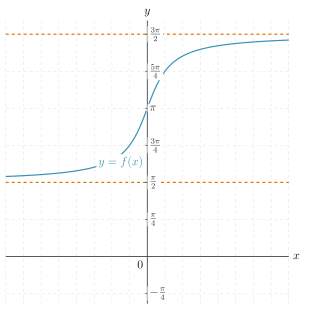
- \(\,\)
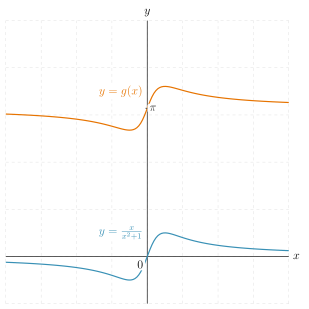
- \(\,\)
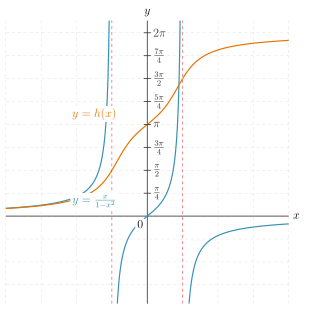
- Note that \(\frac{x+x^4}{1+x^2+x^4}\) is continuous, and nicely behaved on \((-\infty, \infty)\) so we can see that \(\lim_{x \to \infty} h_1(x) = \pi + \frac{\pi}{4} = \frac{5\pi}{4}\). \(\frac{4x-x^3}{1-x^4}\) on the other hand has asymptotes at \(\pm 1\). So as as \(x \to 1\), \(h_1(x) \to \pi + \frac{\pi}{2} = \frac{3\pi}{2}\). Then as \(x \to \infty\) we increase by another \(\frac{\pi}{2}\), so \(\lim_{x \to \infty} h_2(x) = 2\pi\)
In this question, the \(\mathrm{arctan}\) function satisfies \(0\le \arctan x <\frac12 \pi\) for \(x\ge0\,\).
- Let \[ S_n= \sum_{m=1}^n \arctan \left(\frac1 {2m^2}\right) \,, \] for \(n=1, 2, 3, \ldots\) . Prove by induction that \[ \tan S_n = \frac n {n+1} \,. \] Prove also that \[ S_n = \arctan \frac n {n+1} \,. \]
- In a triangle \(ABC\), the lengths of the sides \(AB\) and \(BC\) are \(4n^2\) and \(4n^4-1\), respectively, and the angle at \(B\) is a right angle. Let \(\angle BCA = 2\alpha_n\). Show that \[ \sum_{n=1}^\infty \alpha_n = \tfrac14\pi \,. \]
- Claim: \(\tan S_n = \frac n {n+1}\) Proof: (By Induction) Base case: (\(n=1\)): \begin{align*} && \tan \left ( \sum_{m=1}^1 \arctan \left ( \frac{1}{2m^2} \right) \right) &= \tan \left ( \arctan \left ( \frac{1}{2} \right) \right) \\ &&&= \frac12 = \frac{1}{1+1} \end{align*} Therefore the base case is true. Inductive step: Suppose our statement is true for some \(n = k\), ie \begin{align*} && \frac{k}{k+1} &= \tan \left ( \sum_{m=1}^k \arctan \left ( \frac{1}{2m^2} \right) \right) \\ \Rightarrow && \tan S_{k+1} &= \tan \left ( \sum_{m=1}^k \arctan \left ( \frac{1}{2m^2} \right) + \arctan \left ( \frac{1}{2 (k+1)^2} \right) \right) \\ &&&= \frac{\tan S_k + \tan \left ( \arctan \left ( \frac{1}{2 (k+1)^2} \right) \right)}{1-\tan S_k \tan \left ( \arctan \left ( \frac{1}{2 (k+1)^2} \right) \right)} \\ &&&= \frac{\frac{k}{k+1} + \frac{1}{2(k+1)^2}}{1-\frac{k}{k+1} \frac{1}{2(k+1)^2}} \\ &&&= \frac{2k(k+1)^2+(k+1)}{2(k+1)^3-k} \\ &&&= \frac{k+1}{(k+1)+1} \end{align*} Therefore it is true for \(n=k+1\). Conclusion: Therefore by the principle of mathematical induction since our statement is true for \(n=1\) and if it is true for \(n=k\) it is true for \(n=k+1\) it is true for all \(n\geq1\) Since \(S_n < \frac12 \pi\) for all \(n\), we must have \(\arctan \frac{n}{n+1} = S_n\)
- \(\tan (2\alpha_n) = \frac{4n^2}{4n^4-1} = \frac{2n^2+2n^2}{(2n^2)(2n^2)-1} = \frac{\frac{1}{2n^2}+\frac{1}{2n^2}}{1-\frac{1}{2n^2}\frac{1}{2n^2}} \Rightarrow \tan (\alpha_n) = \arctan \frac{1}{2n^2}\). In particular \(\displaystyle \sum_{n=1}^{N} \alpha_n = \arctan \frac{n}{n+1} \Rightarrow \sum_{n=1}^{\infty} \alpha_n \to \arctan 1 = \frac{\pi}{4} \)
- The sequence of numbers \(u_0, u_1, \ldots \) is given by \(u_0=u\) and, for \(n\ge 0\), \begin{equation} u_{n+1} =4u_n(1- u_n)\,. \tag{\(*\)} \end{equation} In the case \(u= \sin^2\theta\) for some given angle \(\theta\), write down and simplify expressions for \(u_1\) and \(u_2\) in terms of \(\theta\). Conjecture an expression for \(u_n\) and prove your conjecture.
- The sequence of numbers \(v_0, v_1, \ldots\) is given by $v_0= v \text{ and, for }n\ge 0$, \[ v_{n+1} = -pv_n^2 +qv_n +r\,, \] where \(p\), \(q\) and \(r\) are given numbers, with \(p\ne0\). Show that a substitution of the form \(v_n =\alpha u_n +\beta\), where \(\alpha\) and \(\beta\) are suitably chosen, results in the sequence \((*)\) provided that \[ 4pr = 8 +2q -q^2 \,. \] Hence obtain the sequence satisfying \(v_0=1\) and, for \(n\ge0\), \(v_{n+1} = -v_n^2 +2 v_n +2 \,\).
- Suppose \(u_0 = u = \sin^2 \theta\) then \begin{align*} && u_1 &= 4 u_0 (1-u_0) \\ &&&= 4 \sin^2 \theta ( 1- \sin^2 \theta) \\ &&&= 4 \sin^2 \theta \cos^2 \theta \\ &&&= (2 \sin \theta \cos \theta)^2 \\ &&&= (\sin 2 \theta)^2 = \sin^2 2 \theta \\ \\ && u_2 & = 4u_1 (1-u_1) \\ &&&= 4 \sin^2 2\theta \cos^2 2 \theta \\ &&&= \sin^2 4 \theta \end{align*} Claim: \(u_n = \sin^2 2^n \theta\). Proof: (By Induction) Base case is clear, suppose it's true for \(n=k\), then \begin{align*} && u_{k+1} &= 4u_k(1-u_k) \\ &&&= 4 \sin^2 2^k \theta(1-\sin^2 2^k \theta) \\ &&&= (2 \sin 2^k \theta \cos 2^k \theta)^2 \\ &&&= (\sin 2^{k+1} \theta)^2 \\ &&&= \sin^2 2^{k+1} \theta \end{align*} Therefore since it is true for \(n = 1\) and if it's true for \(n = k\) it is true for \(n=k+1\) it must be true for all \(k\).
- Suppose \(v_n = \alpha u_n + \beta\) then \begin{align*} && (\alpha u_{n+1}+\beta) &= -p(\alpha u_n + \beta)^2 + q(\alpha u_n + \beta) + r \\ &&&= -p\alpha^2u_n^2+\alpha(q-2p\beta) u_n -p \beta^2 +q \beta+r \\ \Rightarrow && u_{n+1} &= u_n(q-2p\beta -p \alpha u_n) -(p\beta^2-(q-1)\beta-r) \end{align*} So if \(\alpha = \frac{4}{p}\) and \(q-2p\beta = 4\) ie \(\beta = \frac{q-4}{2p}\) then we also need the constant term to vanish, ie \begin{align*} 0 &&&= p\beta^2-(q-1)\beta+r \\ &&&= p \left (\frac{q-4}{2p} \right)^2 - (q-1) \frac{q-4}{2p} - r \\ \Rightarrow && 0 &= p(q-4)^2 -(q-1)(q-4)2p - 4p^2r \\ \Rightarrow && 0 &= (q-4)^2-2(q-1)(q-4)-4pr \\ &&&= q^2-8q+16-2q^2+10q-8-4pr \\ \Rightarrow && 4pr &= -q^2+2q+8 \end{align*} Suppose \(v_{n+1} = -v_n^2 + 2v_n +2\) then since \(4\cdot 1 \cdot 2 = 8\) and \(8 + 4 -4 = 8\) we can apply our method. \(v_n = 4u_n + \frac{-2}{2} = 4u_n -1 = 4\sin^2 (2^{n-1} \pi)-1\)
A thin circular path with diameter \(AB\) is laid on horizontal ground. A vertical flagpole is erected with its base at a point \(D\) on the diameter \(AB\). The angles of elevation of the top of the flagpole from \(A\) and \(B\) are \(\alpha\) and \(\beta\) respectively (both are acute). The point \(C\) lies on the circular path with \(DC\) perpendicular to \(AB\) and the angle of elevation of the top of the flagpole from \(C\) is \(\phi\). Show that \(\cot\alpha\cot \beta = \cot^2\phi\). Show that, for any \(p\) and \(q\), \[ \cos p \cos q \sin^2\tfrac12(p+q) - \sin p\sin q \cos^2 \tfrac12 (p+q) = \tfrac12 \cos(p+q) -\tfrac12 \cos(p+q)\cos(p-q) .\] Deduce that, if \(p\) and \(q\) are positive and \( p+q \le \tfrac12 \pi\), then \[ \cot p\cot q\, \ge \cot^2 \tfrac12(p+q) \, \] and hence show that \(\phi \le \tfrac12(\alpha+\beta)\) when \( \alpha +\beta \le \tfrac12 \pi\,\).
Show Solution
- The point with coordinates \((a, b)\), where \(a\) and \(b\) are rational numbers,is called an integer rational point if both \(a\) and \(b\) are integers; a non-integer rational point if neither \(a\) nor \(b\) is an integer.
- \(\bf (a)\) Write down an integer rational point and a non-integer rational point on the circle \(x^2+y^2 =1\).
- [\bf (b)] Write down an integer rational point on the circle \(x^2+y^2=2\). Simplify \[ (\cos\theta + \sqrt m \sin\theta)^2 + (\sin\theta - \sqrt m \cos\theta)^2 \, \] and hence obtain a non-integer rational point on the circle \(x^2+y^2=2\,\).
- The point with coordinates \((p+\sqrt 2 \, q\,,\, r+\sqrt 2 \, s)\), where \(p\), \(q\), \(r\) and \(s\) are rational numbers, is called: an integer \(2\)-rational point if all of \(p\), \(q\), \(r\) and \(s\) are integers; a non-integer \(2\)-rational point if none of \(p\), \(q\), \(r\) and \(s\) is an integer.
- \(\bf (a)\) Write down an integer \(2\)-rational point, and obtain a non-integer \(2\)-rational point, on the circle \(x^2+y^2=3\,\).
- [\bf(b)] Obtain a non-integer \(2\)-rational point on the circle \(x^2+y^2=11\,\).
- [\bf(c)]Obtain a non-integer \(2\)-rational point on the hyperbola \(x^2-y^2 =7 \).
- \(\bf (a)\) \((1, \sqrt2)\) is an integer \(2\)-rational point. \((\frac35 + \frac45\sqrt2, \frac45 - \frac{3}{5}\sqrt2)\) is a non-integer \(2\)-rational point.
- [\bf(b)] First notice that \((\sqrt2)^2 +3^2 = 11\) so then consider \((1 + \tfrac32\sqrt2, 1-\tfrac32\sqrt2)\) will work as \(\pi/4\) degree rotation.
- [\bf(c)] First notice \(3^2-(\sqrt2)^2 = 2\). Notice that \((k\sec \theta + \sqrt{m} \tan \theta)^2 - (k\tan \theta + \sqrt{m} \sec \theta)^2 = k^2-m\). Taking \(k= 3\) we have \((3 \cdot \frac{13}{5} + \frac{12}{5}\sqrt{2}, 3\cdot\frac{12}5+\frac{13}{5}\sqrt2)\)
Prove the identity \[ 4\sin\theta \sin(\tfrac13\pi-\theta) \sin (\tfrac13\pi+\theta)= \sin 3\theta\, . \tag{\(*\)}\]
- By differentiating \((*)\), or otherwise, show that \[ \cot \tfrac19\pi - \cot \tfrac29\pi + \cot \tfrac49\pi = \sqrt3\,. \]
- By setting \(\theta = \frac16\pi-\phi\) in \((*)\), or otherwise, obtain a similar identity for \(\cos3\theta\) and deduce that \[ \cot \theta \cot (\tfrac13\pi-\theta) \cot (\tfrac13\pi+\theta) =\cot3\theta\,. \] Show that \[ \cosec \tfrac19\pi -\cosec \tfrac59\pi +\cosec \tfrac79\pi = 2\sqrt3\,. \]
- \(\,\) \begin{align*} && 3 \cos 3 \theta &= \sin 3 \theta \left (\cot \theta - \cot (\tfrac13\pi - \theta) + \cot (\tfrac13\pi + \theta) \right) \\ \Rightarrow && 3 \cot 3\theta &= \cot \theta - \cot (\tfrac13\pi - \theta) + \cot (\tfrac13\pi + \theta) \\ \theta = \tfrac{\pi}{9}: && 3\cot \frac{\pi}{3} &= \cot \tfrac{\pi}{9} - \cot \tfrac{2}{9}\pi + \cot \tfrac49 \pi \\ \Rightarrow && \sqrt{3} &= \cot \tfrac{\pi}{9} - \cot \tfrac{2}{9}\pi + \cot \tfrac49 \pi \end{align*}
- \(\,\) \begin{align*} \theta = \tfrac16\pi - \phi && \sin(\tfrac12\pi - 3\phi) &= 4\sin(\tfrac16\pi - \phi)\sin(\phi+\tfrac16\pi)\sin(\tfrac12\pi - \phi) \\ \Rightarrow && \cos 3\phi &= 4\cos(\phi - \tfrac13\pi)\cos(\tfrac13\pi - \phi)\cos\phi \\ \Rightarrow && \cot 3\theta &= \cot \theta\cot(\phi - \tfrac13\pi)\cot(\tfrac13\pi - \phi) \tag{dividing by (\(*\))} \\ \\ \frac{\d}{\d \theta}:&& -\csc^2 3\phi &= \cot3\phi \left (-\csc^2 \phi\tan \phi+\csc^2 (\tfrac13\pi - \phi) \tan (\tfrac13\pi - \phi) -\csc^2(\phi - \tfrac13\pi)\tan (\phi - \tfrac13\pi) \right) \\ \Rightarrow && \csc^23\phi\tan3\phi & = 2( \csc2\phi- \csc(\tfrac{2}{3}\pi - 2\phi)+\csc(\phi - \tfrac23\pi)) \\ \phi = \frac{1}{18}\pi: && 4\sqrt{3} &= 2(\csc \tfrac{1}{9}\pi - \csc \tfrac59\pi + \csc \tfrac79 \pi) \\ \end{align*} and the result follows.
- Find all the values of \(\theta\), in the range \(0^\circ < \theta < 180^\circ\), for which \(\cos\theta=\sin 4\theta\). Hence show that \[ \sin 18^\circ = \frac14\left( \sqrt 5 -1\right). \]
- Given that \[ 4\sin^2 x + 1 = 4\sin^2 2x \,, \] find all possible values of \(\sin x\,\), giving your answers in the form \(p+q\sqrt5\) where \(p\) and \(q\) are rational numbers.
- Hence find two values of \(\alpha\) with \(0^\circ < \alpha < 90^\circ\) for which \[ \sin^23\alpha + \sin^25\alpha = \sin^2 6\alpha\,. \]
- Note that \(\cos \theta = \sin (90^\circ - \theta)\) so \begin{align*} && \sin(90^\circ - \theta) &= \sin 4 \theta\\ && 90^\circ - \theta &= 4\theta +360^{\circ}k \\ && 90^\circ + \theta &= 4\theta +360^{\circ}k \\ \Rightarrow && 5\theta &= 90^\circ, 450^\circ, 810^\circ, \cdots \\ && 3 \theta &= 90^\circ, 450^\circ, \cdots \\ \Rightarrow && \theta &= 18^\circ, 90^\circ, 162^\circ, \ldots \\ && \theta &= 30^\circ, 150^\circ, \ldots \end{align*} Therefore \(\theta = 8^\circ, 30^\circ, 90^\circ, 150^\circ, 162^\circ\). Note also that: \begin{align*} && 0 &= \sin 4 \theta - \cos \theta \\ &&&= 2 \sin 2 \theta \cos 2 \theta- \cos \theta \\ &&&= 4 \sin \theta \cos \theta \cos 2 \theta - \cos \theta \\ &&&= \cos \theta \left (4 \sin \theta (1- 2\sin^2 \theta) - 1 \right) \\ &&&= \cos \theta \left (-8\sin^3 \theta +4\sin \theta - 1 \right) \\ &&&= \cos \theta (1 - 2 \sin \theta)(4 \sin^2 \theta+2\sin \theta -1)\\ \cos \theta = 0: && \theta &= 90^\circ \\ \sin \theta = \frac12: && \theta &= 30^{\circ} \\ && \theta &= \sin^{-1} \left ( \frac{-1\pm \sqrt5}{4} \right) \end{align*} Therefore \(\sin 18^{\circ} = \frac{\pm \sqrt{5}-1}{4}\), but since \(\sin 18^{\circ} > 0\) it must be the positive version.
- \(\,\) \begin{align*} && 4 \sin^2 x + 1 &= 4 \sin^2 2 x \\ &&&= 16 \sin^2 x \cos^2 x \\ &&&= 16 \sin^2 x (1- \sin^2 x) \\ \Rightarrow && 0 &= 16y^2 -12y+1 \\ \Rightarrow && \sin^2 x &= \frac{3\pm \sqrt5}{8} \\ &&&= \left ( \frac{1 \pm \sqrt5}{4} \right)^2 \\ \Rightarrow && \sin x &= \pm \frac{1 \pm \sqrt{5}}{4} \end{align*}
- \(\,\) \begin{align*} && \sin^2 x + \frac1{2^2} &= \sin^2 2x \end{align*} So if we can have \(\sin 5x = \pm \frac12\) and \(\sin 3x = \pm \frac{1 \pm \sqrt5}{4}\) then we are good, ie \begin{align*} && 5x &= 30^{\circ}, 150^{\circ}, 210^{\circ}, 330^{\circ}, 390^{\circ}, \cdots \\ \Rightarrow && x &= 6^{\circ}, 30^{\circ}, 42^{\circ}, 66^{\circ}, 78^{\circ} \\ \Rightarrow && 3x &= \boxed{18^{\circ}}, \cancel{90^{\circ}}, \boxed{126^{\circ}}, \boxed{198^{\circ}}, \boxed{78^{\circ}} \end{align*} So our solutions are \(x = 6^{\circ}, 42^{\circ}, 66^{\circ}, 78^{\circ}\) although it's interesting to note that \(x = 45^{\circ}\) is another solution
Show that \[ \sin(x+y) -\sin(x-y) = 2 \cos x \, \sin y \] and deduce that \[ \sin A - \sin B = 2 \cos \tfrac12 (A+B) \, \sin\tfrac12 (A-B) \,. \] Show also that \[ \cos A - \cos B = -2 \sin \tfrac12(A+B) \, \sin\tfrac12(A-B)\,. \] The points \(P\), \(Q\), \(R\) and \(S\) have coordinates \(\left(a\cos p,b\sin p\right)\), \(\left(a\cos q,b\sin q\right)\), \(\left(a\cos r,b\sin r\right)\) and \(\left(a\cos s,b\sin s\right)\) respectively, where \(0\le p < q < r < s <2\pi\), and \(a\) and \(b\) are positive. Given that neither of the lines \(PQ\) and \(SR\) is vertical, show that these lines are parallel if and only if \[ r+s-p-q = 2\pi\,. \]
Show SolutionThe points \(P\), \(Q\) and \(R\) lie on a sphere of unit radius centred at the origin, \(O\), which is fixed. Initially, \(P\) is at \(P_0(1, 0, 0)\), \(Q\) is at \(Q_0(0, 1, 0)\) and \(R\) is at \(R_0(0, 0, 1)\).
- The sphere is then rotated about the \(z\)-axis, so that the line \(OP\) turns directly towards the positive \(y\)-axis through an angle \(\phi\). The position of \(P\) after this rotation is denoted by \(P_1\). Write down the coordinates of \(P_1\).
- The sphere is now rotated about the line in the \(x\)-\(y\) plane perpendicular to \(OP_1\), so that the line \(OP\) turns directly towards the positive \(z\)-axis through an angle \(\lambda\). The position of \(P\) after this rotation is denoted by \(P_2\). Find the coordinates of \(P_2\). Find also the coordinates of the points \(Q_2\) and \(R_2\), which are the positions of \(Q\) and \(R\) after the two rotations.
- The sphere is now rotated for a third time, so that \(P\) returns from \(P_2\) to its original position~\(P_0\). During the rotation, \(P\) remains in the plane containing \(P_0\), \(P_2\) and \(O\). Show that the angle of this rotation, \(\theta\), satisfies \[ \cos\theta = \cos\phi \cos\lambda\,, \] and find a vector in the direction of the axis about which this rotation takes place.
The point \(P\) has coordinates \((x,y)\) with respect to the origin \(O\). By writing \(x=r\cos\theta\) and \(y=r\sin\theta\), or otherwise, show that, if the line \(OP\) is rotated by \(60^\circ\) clockwise about \(O\), the new \(y\)-coordinate of \(P\) is \(\frac12(y-\sqrt3\,x)\). What is the new \(y\)-coordinate in the case of an anti-clockwise rotation by \(60^\circ\,\)? An equilateral triangle \(OBC\) has vertices at \(O\), \((1,0)\) and \((\frac12,\frac12 \sqrt3)\), respectively. The point \(P\) has coordinates \((x,y)\). The perpendicular distance from \(P\) to the line through \(C\) and \(O\) is \(h_1\); the perpendicular distance from \(P\) to the line through \(O\) and \(B\) is \(h_2\); and the perpendicular distance from \(P\) to the line through \(B\) and \(C\) is \(h_3\). Show that \(h_1=\frac12 \big\vert y-\sqrt3\,x\big\vert\) and find expressions for \(h_2\) and \(h_3\). Show that \(h_1+h_2+h_3=\frac12 \sqrt3\) if and only if \(P\) lies on or in the triangle \(OBC\).
A curve has the equation \(y=\f(x)\), where \[ \f(x) = \cos \Big( 2x+ \frac \pi 3\Big) + \sin \Big ( \frac{3x}2 - \frac \pi 4\Big). \]
- Find the period of \(\f(x)\).
- Determine all values of \(x\) in the interval \(-\pi\le x \le \pi\) for which \(\f(x)=0\). Find a value of \(x\) in this interval at which the curve touches the \(x\)-axis without crossing it.
- Find the value or values of \(x\) in the interval \(0\le x \le 2\pi\) for which \(\f(x)=2\,\).
- The period of \(f\) will be the LCM of \(\frac{2\pi}{\pi}\) and \(\frac{2\pi}{\frac32} = \frac{4\pi}{3}\) which is \(4\pi\). (This is also clear from the factorised form).
- \(f(x) = 0\) means one of those two factors is zero, ie \begin{align*} \text{first factor}: && 0 &= \cos \left (\frac{x}{4}+ \frac {13\pi}{24} \right) \\ &&n\pi + \frac{\pi}{2}&= \frac{x}{4}+ \frac {13\pi}{24} \\ \Rightarrow && x &= 4n\pi - \frac{\pi}{6} \\ \Rightarrow && x &= -\frac{\pi}{6} \\ \\ \text{second factor}: && 0 &= \cos \left ( \frac{7x}{4}- \frac {5\pi}{24} \right) \\ && n\pi + \frac{\pi}{2} &= \frac{7x}{4}- \frac {5\pi}{24} \\ \Rightarrow && 7x &= 4n\pi + \frac{17}{6}\pi \\ \Rightarrow && x &= \frac{4n}7\pi + \frac{17}{42}\pi \\ \Rightarrow && x &= -\frac{31}{42} \pi, -\frac16\pi, \frac{17}{42}\pi, \frac{41}{42}\pi \end{align*} Therefore all solutions are \(-\frac{31}{42} \pi, -\frac16\pi, \frac{17}{42}\pi, \frac{41}{42}\pi\) We can see that \(-\frac{\pi}{6}\) is a repeated root, therefore it touches the axis and does not cross.
- \(f(x) = 2\) requires both factors to be \(1\) or \(-1\). \begin{align*} \text{first factor}: && \pm1 &= \cos \left (\frac{x}{4}+ \frac {13\pi}{24} \right) \\ &&n\pi &= \frac{x}{4}+ \frac {13\pi}{24} \\ \Rightarrow && x &= 4n\pi - \frac{13\pi}{6} \\ \Rightarrow && x &= \frac{11}{6}\pi \\ \end{align*} We only need to test this value, where it's \(-1\), so we look at \( \cos \left ( \frac{77\pi}{24}- \frac {5\pi}{24} \right) = \cos (3\pi) = -1\), so the only value is \(\frac{11}{6}\pi\)
- Given that \(A = \arctan \frac12\) and that \(B = \arctan\frac13\,\) (where \(A\) and \(B\) are acute) show, by considering \(\tan \left( A + B \right)\), that \(A + B = {\frac{1}{4}\pi }\). The non-zero integers \(p\) and \(q\) satisfy \[ \displaystyle \arctan {\frac1 p} + \arctan {\frac1 q} = {\frac\pi 4}\,. \] Show that \( \left ( p-1 \right) \left(q-1 \right) = 2\) and hence determine \(p\) and \(q\).
- Let \(r\), \(s\) and \(t\) be positive integers such that the highest common factor of \(s\) and \(t\) is \(1\). Show that, if \[ \arctan {\frac1 r} + \arctan \frac s {s+t} = {\frac\pi 4}\,, \] then there are only two possible values for \(t\), and give \(r\) in terms of \(s\) in each case.
- \begin{align*} && \tan (A+B) &= \frac{\tan A + \tan B}{1-\tan A \tan B}\\ &&&= \frac{\tan \arctan \frac12 + \tan \arctan \frac13}{1-\tan \arctan \frac12 \tan \arctan \frac13}\\ &&&= \frac{\frac12+\frac13}{1-\frac16} \\ &&&= \frac{3+2}{5} \\ &&&= 1 \\ \Rightarrow && A+B &= \frac{\pi}{4} + n \pi \end{align*} but since \(A,B\) are acute \(0 < A+B < \pi\), so \(A+B = \frac{\pi}{4}\) \begin{align*} && 1 &= \tan \frac{\pi}{4} \\ &&&= \tan \left ( \arctan {\frac1 p} + \arctan {\frac1 q}\right) \\ &&&= \frac{\frac1p + \frac1q}{1-\frac1{pq}} \\ &&&= \frac{q+p}{pq-1} \\ \Rightarrow && pq-1 &= q+p \\ \Rightarrow && 0 &= pq-q-p-q \\ &&&= (p-1)(q-1)-2 \\ \Rightarrow && 2 &= (p-1)(q-1) \end{align*} But \(p\),\(q\) are integers, so \(p-1 \in \{-2,-1,1,1\} \Rightarrow p \in \{-1,0,2,3\}\) but we cannot have \(p= 0\), so we must have \((p,q) = (2,3), (3,2)\)
- \begin{align*} && 1 &= \tan \frac{\pi}{4} \\ &&&= \tan \left ( \arctan {\frac1 r} + \arctan \frac s {s+t} \right) \\ &&&= \frac{\frac1r + \frac{s}{s+t}}{1-\frac{s}{r(s+t)}} \\ &&&= \frac{s+t+sr}{r(s+t)-s} \\ \Rightarrow && rs+rt-s &= s+t + sr \\ \Rightarrow && 0 &= rt-2s-t \\ &&2s&= t(r-1) \end{align*} Since \((s,t) =1\), we must have \(t \mid 2\), so \( t = 1,2\) and \(r = 2s+1\) or \(r=s+1\) respectively.
Given that \(\cos A\), \(\cos B\) and \(\beta\) are non-zero, show that the equation \[ \alpha \sin(A-B) + \beta \cos(A+B) = \gamma \sin(A+B) \] reduces to the form \[ (\tan A-m)(\tan B-n)=0\,, \] where \(m\) and \(n\) are independent of \(A\) and \(B\), if and only if \(\alpha^2=\beta^2+\gamma^2\). Determine all values of \(x\), in the range \(0\le x <2\pi\), for which:
- $2\sin(x-\frac14\pi) + \sqrt{3} \cos(x+\frac14\pi) = \sin(x+\frac14\pi)\(
- \)2\sin(x-\frac16\pi) + \sqrt{3} \cos(x+\frac16\pi) = \sin(x+\frac16\pi)\(
- \)2\sin(x+\frac13\pi) + \sqrt{3} \cos(3x) = \sin(3x)$
- \(\,\) \begin{align*} && 2\sin(x-\tfrac14\pi) + \sqrt 3 \cos(x+\tfrac14\pi) &=\sin(x+\tfrac14\pi) \\ && 3 + 1 &= 4 \\ \Rightarrow && \left (\tan x + \frac{1+2}{\sqrt3} \right) \left ( \tan \frac{\pi}{4} + \frac{1-2}{\sqrt3}\right) &= 0\\ \Rightarrow && \tan x &= -\sqrt3 \\ \Rightarrow && x &= \tfrac23\pi, \tfrac53\pi \end{align*}
- \(\,\) \begin{align*} && 2\sin(x-\frac16\pi) + \sqrt 3 \cos(x+\frac16\pi) &=\sin(x+\frac16\pi) \\ \Leftrightarrow && \left (\tan x + \frac{1+2}{\sqrt3} \right) \left ( \tan \frac{\pi}{3} + \frac{1-2}{\sqrt3}\right) &= 0\\ && x &\in [0, 2\pi) \end{align*}
- \(\,\) \begin{align*} && 2\sin(x+\frac13\pi) + \sqrt 3 \cos(3x) = \sin(3x) \\ && A-B =x + \tfrac13\pi, A+B &= 3x \\ \Rightarrow && A = 2x + \tfrac\pi6, B &= x-\tfrac{\pi}{6} \\ \Rightarrow && \tan (2x+\tfrac\pi6)&=-\sqrt3 \\ && 2x + \tfrac{\pi}{6} &= \tfrac23\pi, \tfrac53\pi, \tfrac83 \pi, \tfrac{11}3\pi \\ && x &= \tfrac{\pi}{4}, \tfrac{3\pi}{4}, \tfrac{5\pi}{4}, \tfrac{7\pi}{4} \\ && \tan(-x-\tfrac{\pi}{6}) &= \frac1{\sqrt{3}} \\ \Rightarrow && x-\tfrac{\pi}{6} &= \ldots, \tfrac{\pi}{6}, \tfrac{7\pi}{6}, \ldots \\ \Rightarrow && x &= \tfrac{\pi}3, \tfrac{4\pi}{3} \\ \\ \Rightarrow && x &= \tfrac{\pi}{4}, \tfrac{3\pi}{4}, \tfrac{5\pi}{4}, \tfrac{7\pi}{4} , \tfrac{\pi}3, \tfrac{4\pi}{3} \end{align*}
In this question, \(\f^2(x)\) denotes \(\f(\f(x))\), \(\f^3(x)\) denotes \(\f( \f (\f(x)))\,\), and so on.
- The function \(\f\) is defined, for \(x\ne \pm 1/ \sqrt3\,\), by $$ \f(x) = \ds \frac{x+\sqrt3} {1-\sqrt3\, x }\,. $$ Find by direct calculation \(\f^2(x) \) and \(\f^3(x)\), and determine \(\f^{2007}(x)\,\).
- Show that \(\f^n(x) = \tan(\theta + \frac 13 n\pi)\), where \(x=\tan\theta\) and \(n\) is any positive integer.
- The function \(\g(t)\) is defined, for \(\vert t\vert\le1\) by \(\g(t) = \frac {\sqrt3}2 t + \frac 12 \sqrt {1-t^2}\,\). Find an expression for \(\g^n(t)\) for any positive integer \(n\).
- \(\,\) \begin{align*} && f(x) &= \frac{x+\sqrt3}{1-\sqrt3x} \\ \Rightarrow && f(f(x)) &= \frac{f(x)+\sqrt3}{1-\sqrt3f(x)} \\ &&&= \frac{\frac{x+\sqrt3}{1-\sqrt3x}+\sqrt3}{1-\sqrt3 \frac{x+\sqrt3}{1-\sqrt3x}} \\ &&&= \frac{x+\sqrt{3}+\sqrt3(1-\sqrt3x)}{1-\sqrt3x-\sqrt3(x+\sqrt3)} \\ &&&= \frac{-2x+2\sqrt3}{-2-2\sqrt3x} \\ &&&= \frac{x-\sqrt3}{1+\sqrt3 x} \\ \\ && f^3(x) &= f^2(f(x)) \\ &&&= \frac{f(x)-\sqrt3}{1+\sqrt3 f(x)} \\ &&&=\frac{\frac{x+\sqrt3}{1-\sqrt3x}-\sqrt3}{1+\sqrt3 \frac{x+\sqrt3}{1-\sqrt3x}} \\ &&&= \frac{(x+\sqrt3)-\sqrt3(1-\sqrt3 x)}{(1-\sqrt3x)+\sqrt3 (x+\sqrt3)} \\ &&&= \frac{-2x}{-2} = x \\ \\ && f^{2007}(x) &= x \end{align*}
- If \(x = \tan \theta\) then \(f(x) = \frac{\tan \theta + \tan \frac{\pi}{3}}{1 - \tan \frac{\pi}{3} \tan \theta} = \tan (\theta + \frac{\pi}{3})\) and hence \(f^n(x) = \tan (\theta + \frac{n \pi}{3})\)
- Note that if \(t = \sin \theta\) then \(g(t) = \cos \frac{\pi}{6} t\sin \theta + \frac12 \cos \theta = \sin(\theta + \frac{\pi}6)\) therefore \(g^n(t) = \sin(\sin^{-1}(t) + \frac{n\pi}{6})\)
- Given that \(\displaystyle \cos \theta = \frac35\) and that \(\displaystyle \frac{3\pi }{ 2} \le \theta \le 2\pi\), show that \(\displaystyle \sin 2 \theta = -\frac{24}{25}\), and evaluate \(\cos 3 \theta\).
- Prove the identity \(\displaystyle \tan 3\theta \equiv \frac {3 \tan \theta - \tan^3 \theta}{1 - 3 \tan^2 \theta}\). Hence evaluate \(\tan \theta\), given that \(\displaystyle \tan 3\theta = \frac{11}{ 2}\) and that \(\displaystyle \frac{\pi}{ 4} \le \theta \le \frac{\pi}{2}\).
- Since \(\cos^2 \theta + \sin^2 \theta \equiv 1\), \(\sin \theta = \pm \frac45\) and since \(\displaystyle \frac{3\pi }{ 2} \le \theta \le 2\pi\) it must be the case that \(\sin\) is negative, ie \(\sin \theta = -\frac45\). Therefore \(\sin 2 \theta = 2 \sin \theta \cos \theta = 2 \cdot \frac35 \cdot (-\frac45) = -\frac{24}{25}\). \begin{align*} \cos 3 \theta &= \cos 2 \theta \cos \theta - \sin 2\theta \sin \theta \\ &= (\cos^2 \theta - \sin^2 \theta) \cos \theta - \sin 2 \theta \sin \theta \\ &= (\frac{9}{25} - \frac{16}{25}) \frac35 + \frac{24}{25} \cdot (-\frac{4}{5}) \\ &= -\frac{21}{125} - \frac{96}{125} \\ &= -\frac{117}{125} \end{align*}
- \begin{align*} \tan 3 \theta &\equiv \frac{\tan 2 \theta + \tan \theta}{1 - \tan 2 \theta \tan \theta} \\ &\equiv \frac{\frac{2 \tan \theta}{1- \tan^2 \theta} + \tan \theta}{1 - \frac{2 \tan^2 \theta}{1- \tan^2 \theta}} \\ &\equiv \frac{2\tan \theta + \tan \theta -\tan^3 \theta}{1 - \tan^2 \theta - 2 \tan^2 \theta} \\ &\equiv \frac {3 \tan \theta - \tan^3 \theta}{1 - 3 \tan^2 \theta} \end{align*} Let \(t = \tan \theta\), then \begin{align*} && \frac{11}{2} &= \frac{3t - t^3}{1-3t^2} \\ \Leftrightarrow && 11 - 33t^2 &= 6t -2t^3 \\ \Leftrightarrow && 0 &= 2t^3-33t^2-6t+11 \\ \Leftrightarrow && 0 &= (2t-1)(t^2-16t-11) \end{align*} Therefore \(\tan \theta = \frac12, \tan \theta = \frac{16 \pm \sqrt{16^2+4 \cdot 1 \cdot 11}}{2} = \frac{16\pm10\sqrt{3}}{2} = 8 \pm 5 \sqrt{3}\). Since \(\displaystyle \frac{\pi}{ 4} \le \theta \le \frac{\pi}{2}\) we must have that \(\tan\) is both positive and \(\geq 1\), therefore \(\tan \theta = 8 + 5 \sqrt{3}\)
The notation \(\displaystyle \prod^n_{r=1} \f (r)\) denotes the product $\f (1) \times \f (2) \times \f(3) \times \cdots \times \f(n)$. %For example, \(\displaystyle \prod_{r=1}^4 r = 24\). %Simplify \(\displaystyle \prod^n_{r=1} \frac{\g (r) }{ \g (r-1) }\). %You may assume that \(\g (r) \neq 0\) for any integer \(0 \le r \le n \). Simplify the following products as far as possible:
- \(\displaystyle \prod^n_{r=1} \l \frac{r+ 1 }{ r } \r\,\);
- \(\displaystyle \prod^n_{r=2} \l \frac{r^2 -1}{r^2 } \r\,\);
- $\displaystyle \prod^n_{r=1} \l {\cos \frac{2\pi }{ n} + \sin \frac{2\pi}{ n} \cot \frac{\l 2r-1 \r \pi }{ n} }\r\,$, where \(n\) is even.
- \(\,\) \begin{align*} \prod^n_{r=1} \left ( \frac{r+ 1 }{ r } \right) &= \frac{2}{1} \cdot \frac{3}{2} \cdot \frac{4}{3} \cdots \frac{n-1}{n-2} \cdot \frac{n}{n-1} \cdot \frac{n+1}{n} \\ &= \frac{n+1}{1} = n+1 \end{align*}
- \(\,\) \begin{align*} \prod^n_{r=2} \left ( \frac{r^2 -1}{r^2 } \right) &= \prod^n_{r=2} \left ( \frac{(r -1)(r+1)}{r^2 } \right) \\ &= \left ( \frac{1}{2} \cdot \frac{3}{2} \right) \cdot \left ( \frac{2}{3} \cdot \frac{4}{3} \right) \cdots \left ( \frac{r-1}{r} \cdot \frac{r+1}{r}\right) \cdots \frac{n-1}{n} \cdot \frac{n+1}{n} \\ &= \frac{1}{n} \cdot \frac{n+1}{2} \\ &= \frac{n+1}{2n} \end{align*}
- When \(n\) is odd, the product is undefined, since we have a \(\cot \pi\) lurking in there. \begin{align*} \prod^n_{r=1} \left ( {\cos \frac{2\pi }{ n} + \sin \frac{2\pi}{ n} \cot \frac{ (2r-1 ) \pi }{ n} } \right) &= \prod^n_{r=1} \left ( {\cos \frac{2\pi }{ n} + \sin \frac{2\pi}{ n} \frac{\cos \frac{ (2r-1 ) \pi }{ n}}{\sin\frac{ (2r-1 ) \pi }{ n}} } \right) \\ &= \prod^n_{r=1} \frac{1}{\sin\frac{ (2r-1 ) \pi }{ n}} \left ( {\cos \frac{2\pi }{ n} \sin\frac{ (2r-1 ) \pi }{ n} + \sin \frac{2\pi}{ n} \cos \frac{ (2r-1 ) \pi }{ n} } \right) \\ &= \prod^n_{r=1} \frac{1}{\sin\frac{ (2r-1 ) \pi }{ n}} \sin \left ( \frac{2\pi}{n} + \frac{(2r-1)\pi}{n} \right) \\ &= \prod^n_{r=1} \frac{1}{\sin\frac{ (2r-1 ) \pi }{ n}} \sin \left ( \frac{(2r+1)\pi}{n} \right) \\ &= \frac{\sin \frac{3\pi}{n}}{\sin \frac{\pi}{n}} \cdot \frac{\sin \frac{5\pi}{n}}{\sin \frac{3\pi}{n}} \cdots \frac{\sin \frac{(2n+1)\pi}{n}}{\sin \frac{(2n-1)\pi}{n}} \\ &= \frac{\sin \frac{(2n+1)\pi}{n}}{\sin \frac{\pi}{n}} \\ &= 1 \end{align*}