2018 Paper 2 Q2
Year: 2018
Paper: 2
Question Number: 2
Course: LFM Pure
Section: Trigonometry 2
Problem
- By choosing \(t\), \(x_1\) and \(x_2\) suitably, show that, if \(\f(x)\) is concave for \(a< x < b\,\), then \[ \f\Big(\frac{u+ v+w}3\Big) \ge \frac{ \f(u) +\f(v) +\f(w)}3 \, ,\] for \(a< u < b\,\), \(a< v < b\,\) and \(a< w < b\,\).
- Show that, if \(A\), \(B\) and \(C\) are the angles of a triangle, then \[ \sin A +\sin B + \sin C \le \frac{3\sqrt3}2 \,. \]
- By considering \(\ln (\sin x)\), show that, if \(A\), \(B\) and \(C\) are the angles of a triangle, then \[ \sin A \times \sin B \times \sin C \le \frac {3 \sqrt 3} 8 \,. \]
Solution
- \(\,\) \begin{align*} && f \left ( \frac{u+v+w}{3} \right) &= f \left ( \frac{2}{3}\cdot \frac{u+v}2+\frac{1}{3}w \right) \\ &&&\geq \frac23 f \left ( \frac{u+v}{2} \right) + \frac13 f(w) \\ &&&\geq \frac23 \left (\frac12 f(u) + \frac12 f(v) \right) + \frac13 f(w) \\ &&&= \frac{f(u)+f(v)+f(w)}{3} \end{align*}
- Notice that if \(A, B, C\) are angles in a triangle then they add to \(\pi\) \(0 < A,B,C < \pi\). We also have \(f(x) = \sin x \Rightarrow f''(x) = - \sin x < 0\) on this interval. Therefore \(\sin A + \sin B + \sin C \leq 3 \sin \frac{A+B+C}{3} = 3 \sin \frac{\pi}{3} = \frac{3\sqrt{3}}2\)
- Also notice that \begin{align*} && f(x) &= \ln ( \sin x) \\ \Rightarrow && f'(x) &= \frac{\cos x}{ \sin x} \\ && f''(x) &= -\textrm{cosec}^2 x < 0 \\ \\ \Rightarrow && \ln( \sin A) + \ln (\sin B) + \ln (\sin C) &\leq 3 \ln \left (\sin \left ( \frac{A + B+ C}{3} \right) \right) \\ &&&= 3 \ln \left ( \frac{\sqrt{3}}{2} \right) = \ln \frac{3\sqrt{3}}{8} \\ \Rightarrow && \sin A \sin B \sin C &\leq \frac{3\sqrt{3}}8 \end{align*}
Examiner's report
— 2018 STEP 2, Question 2The pure questions were again the most popular of the paper, with only two of those questions being attempted by fewer than half of the candidates (none of the other questions was attempted by more than half of the candidates). Good responses were seen to all of the questions, but in many cases, explanations lacked sufficient detail to be awarded full marks. Candidates should ensure that they are demonstrating that the results that they are attempting to apply are valid in the cases being considered. In several of the questions, later parts involve finding solutions to situations that are similar to earlier parts of the question. In general candidates struggled to recognise these similarities and therefore spent a lot of time repeating work that had already been done, rather than simply observing what the result must be.
Rating Information
Difficulty Rating: 1600.0
Difficulty Comparisons: 0
Banger Rating: 1516.0
Banger Comparisons: 1
Show LaTeX source
Problem source
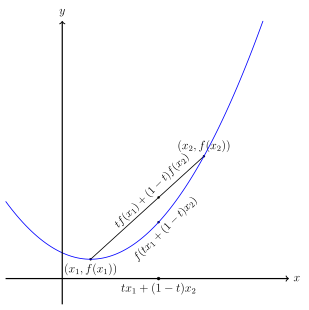
A  function $\f(x)$ is said to be \textit{concave} for $a<   x <   b$
if
\[
 \ t\,\f(x_1) +(1-t)\,\f(x_2)
\le
\f\big(tx_1+ (1-t)x_2\big)
\,
,\]   for $a< x_1 < b\,$, $a<   x_2<   b$ and $0\le t \le 1\,$.
Illustrate this definition by means of a sketch, showing the chord joining the points $\big(x_1, \f(x_1)\big) $ and $\big(x_2, \f(x_2)\big) $, in the case $x_1 < x_2$ and $\f(x_1)< \f(x_2)\,$.
Explain why a function $\f(x)$ satisfying  $\f''(x)<0$ for $a<   x <   b$  is concave for $a<   x <   b\,$.
\begin{questionparts}
\item
 By choosing $t$, $x_1$ and $x_2$ suitably, show that, if $\f(x)$ is
concave for $a<   x <   b\,$, then
\[
\f\Big(\frac{u+ v+w}3\Big) \ge \frac{ \f(u) +\f(v) +\f(w)}3
\,
,\]
for  $a<   u <   b\,$,  $a<   v <   b\,$ and  $a<   w <   b\,$.
\item
Show that,  if $A$, $B$ and $C$ are the  angles of a triangle, then
\[
\sin A +\sin B + \sin C \le \frac{3\sqrt3}2
\,.
\]
\item By considering $\ln (\sin x)$, show that, if $A$, $B$ and $C$ are the  angles of a triangle, then
\[
\sin A \times \sin B \times \sin C \le \frac {3 \sqrt 3}  8 \,.
\]
\end{questionparts}
Solution source
\begin{center}
    \begin{tikzpicture}
    \def\functionf(#1){(#1)^2-(#1)+1};
    \def\xl{-1};
    \def\xu{4};
    \def\yl{-1};
    \def\yu{10};

    % Calculate scaling factors to make the plot square
    \pgfmathsetmacro{\xrange}{\xu-\xl}
    \pgfmathsetmacro{\yrange}{\yu-\yl}
    \pgfmathsetmacro{\xscale}{10/\xrange}
    \pgfmathsetmacro{\yscale}{10/\yrange}

    % Define the styles for the axes and grid
    \tikzset{
        axis/.style={very thick, ->},
        grid/.style={thin, gray!30},
        x=\xscale cm,
        y=\yscale cm
    }

    % Define the bounding region with clip
    \begin{scope}
        % You can modify these values to change your plotting region
        \clip (\xl,\yl) rectangle (\xu,\yu);

        % Draw a grid (optional)
        % \draw[grid] (-5,-3) grid (5,3);

        \filldraw (0.5, {\functionf(0.5)}) circle (1pt) node[below] {$(x_1, f(x_1))$};
        \filldraw (2.5, {\functionf(2.5)}) circle (1pt) node[above] {$(x_2, f(x_2))$};

        \filldraw (0.4 * 0.5 + 0.6 * 2.5, 0) circle (1.5pt) node[below] {$tx_1+(1-t)x_2$};
        \filldraw (0.4 * 0.5 + 0.6 * 2.5, {0.4 * (\functionf(0.5)) + 0.6 * (\functionf(2.5))}) circle (1pt) node[above, rotate=45] {\small $tf(x_1)+(1-t)f(x_2)$};
        \filldraw (0.4 * 0.5 + 0.6 * 2.5, {\functionf(0.4 * 0.5 + 0.6 * 2.5)}) circle (1pt) node[below, rotate=45] {\small $ f(tx_1+(1-t)x_2)$};

        \draw[thick] (0.5, {\functionf(0.5)}) -- (2.5, {\functionf(2.5)});
        \draw[thick, blue, smooth, domain=\xl:\xu, samples=100]
            plot (\x, {\functionf(\x)});

    \end{scope}

    % Set up axes
    \draw[axis] (\xl,0) -- (\xu,0) node[right] {$x$};
    \draw[axis] (0,\yl) -- (0,\yu) node[above] {$y$};

    \end{tikzpicture}
\end{center}


Consider the function $g(t) = f(tx_1 + (1-t)x_2) - tf(x_1) - (1-t)f(x_2)$, notice that $g(0) = g(1) = 0$. Since $g''(x) < 0$ over the whole interval, we must have two things:

1. $g'(x)$ is increasing.
2. It $g'(x) = 0$ can have at most one solution.

Therefore $g'(x)$ is initially $0$, we have exactly one turning point. Therefore the function is initially decreasing and then increasing, therefore it is always negative and our inequality holds.

\begin{questionparts}

\item $\,$
\begin{align*}
&& f \left ( \frac{u+v+w}{3} \right) &= f \left ( \frac{2}{3}\cdot \frac{u+v}2+\frac{1}{3}w \right) \\
&&&\geq \frac23 f \left ( \frac{u+v}{2} \right) + \frac13 f(w) \\
&&&\geq \frac23 \left (\frac12 f(u) + \frac12 f(v) \right) + \frac13 f(w) \\
&&&= \frac{f(u)+f(v)+f(w)}{3}
\end{align*}

\item Notice that if $A, B, C$ are angles in a triangle then they add to $\pi$ $0 < A,B,C < \pi$. We also have $f(x) = \sin x \Rightarrow f''(x) = - \sin x < 0$ on this interval. Therefore $\sin A + \sin B + \sin C \leq 3 \sin \frac{A+B+C}{3} = 3 \sin \frac{\pi}{3} = \frac{3\sqrt{3}}2$

\item Also notice that
\begin{align*}
&& f(x) &= \ln ( \sin x) \\
\Rightarrow && f'(x) &= \frac{\cos x}{ \sin x} \\
&& f''(x) &= -\textrm{cosec}^2 x < 0 \\
\\
\Rightarrow && \ln( \sin A) + \ln (\sin B) + \ln (\sin C) &\leq 3 \ln \left (\sin \left ( \frac{A + B+ C}{3} \right) \right) \\
&&&= 3 \ln \left ( \frac{\sqrt{3}}{2} \right) = \ln \frac{3\sqrt{3}}{8} \\
\Rightarrow && \sin A \sin B \sin C &\leq \frac{3\sqrt{3}}8
\end{align*}
\end{questionparts}
This was the least popular of the pure questions on the paper, attempted by only 35% of the candidates. Very few candidates were able to score full marks and a fairly high proportion scored 0 on this question. In the first part of the question, a significant number of candidates sketched convex functions and so had sketches that did not match the inequality. Most candidates were able to identify many of the key points required for the final section of this introductory part, but many could not explain it clearly enough for full marks in this section. Most candidates made good attempts at the next section, but again the presentations often lacked enough clarity about how the inequalities were being linked together to be awarded full marks. In some cases, the choices for and were not within the interval ( , ) and so these candidates lost marks. Candidates who attempted to complete the final parts of the question were generally confident about how the results from the first part were to be applied, but a significant number omitted to demonstrate that the function being used was concave and so were not able to achieve full marks here.