Centre of Mass 2
In this question, \(n \geq 2\).
- A solid, of uniform density, is formed by rotating through \(360°\) about the \(y\)-axis the region bounded by the part of the curve \(r^{n-1}y = r^n - x^n\) with \(0 \leq x \leq r\), and the \(x\)- and \(y\)-axes. Show that the \(y\)-coordinate of the centre of mass of this solid is \(\frac{nr}{2(n+1)}\).
- Show that the normal to the curve \(r^{n-1}y = r^n - x^n\) at the point \((rp, r(1-p^n))\), where \(0 < p < 1\), meets the \(y\)-axis at \((0, Y)\), where \(Y = r\left(1 - p^n - \frac{1}{np^{n-2}}\right)\). In the case \(n = 4\), show that the greatest value of \(Y\) is \(\frac{1}{4}r\).
- A solid is formed by rotating through \(360°\) about the \(y\)-axis the region bounded by the curves \(r^3y = r^4 - x^4\) and \(ry = -(r^2 - x^2)\), both for \(0 \leq x \leq r\). \(A\) and \(B\) are the points \((0, -r)\) and \((0, r)\), respectively, on the surface of the solid. Show that the solid can rest in equilibrium on a horizontal surface with the vector \(\overrightarrow{AB}\) at three different, non-zero, angles to the upward vertical. You should not attempt to find these angles.
- By symmetry, the centre of mass will lie on the \(y\) axis. Notice that a single slice (when revolved around the \(y\)-axis) has volume \(y \cdot \pi \cdot ((x+ \delta x)^2 - x^2) = 2 \pi x y \delta x\), and COM at height \(\frac12 y\) so we can conclude: \[ \overline{y} \sum_{\delta x} 2 \pi x y \delta x = \sum_{\delta x} \pi xy^2 \delta x\] \begin{align*} && \overline{y} \int_0^r 2xy \d x &= \int_0^r y^2 x \d x \\ \Rightarrow && \overline{y} 2\int_0^r \left (r - \frac{x^n}{r^{n-1}} \right)x \d x &= \int_0^r \left (r - \frac{x^n}{r^{n-1}} \right)^2 x \d x \\ \Rightarrow && \overline{y} \left [r \frac{x^2}{2} - \frac{1}{r^{n-1}} \frac{x^{n+2}}{n+2} \right]_0^r &= \left [r^2 \frac{x^2}{2} - \frac{2}{r^{n-2}} \frac{x^{n+2}}{n+2} + \frac{1}{r^{2n-2}} \frac{x^{2n+2}}{2n+2} \right]_0^r \\ \Rightarrow && 2\overline{y} \left (\frac{r^3}{2} - \frac{r^3}{n+2} \right) &= \left (\frac12 r^4 - \frac{2}{n+2}r^4 + \frac{1}{2n+2}r^4 \right) \\ \Rightarrow && \overline{y}r^3 \frac{n}{(n+2)} &= r^4\frac{(n+1)(n+2)-2\cdot2\cdot(n+1)+(n+2)}{2(n+1)(n+2)} \\ \Rightarrow && \overline{y} \frac{n}{(n+2)} &= r \left ( \frac{n^2}{2(n+1)(n+2)} \right) \\ \Rightarrow && \overline{y} &= \frac{nr}{2(n+1)} \\ &&&= r \left (1 -p^n \right) \end{align*} as required.

- \begin{align*} && r^{n-1}y &= r^n - x^n \\ \frac{\d}{\d x}: && r^{n-1} \frac{\d y}{\d x} &= -n x^{n-1} \\ && \frac{\d y}{\d x} &= -np^{n-1} \end{align*} Therefor the normal has the equation: \begin{align*} && \frac{y-r(1-p^n)}{x-rp} &= \frac{1}{np^{n-1}} \\ \Rightarrow && Y &= \frac{-rp}{np^{n-1}} + r(1-p^n) \\ &&&= r \left (1 - p^n - \frac{1}{np^{n-2}} \right) \end{align*} If \(n = 4\) then \begin{align*} && Y &= r\left (1 - p^4 - \frac{1}{4p^{2}} \right) \\ \Rightarrow && \frac{\d Y}{\d p} &= r \left (-4p^3 + \frac{1}{2p^3} \right) \end{align*} Therefore there is a stationary point if \(p^6 = \frac18 \Rightarrow p =2^{-1/2}\). Clearly this will be a maximum (sketch or second derivative) therefore, \(Y = r(1 - \frac14 - \frac{2}{4}) = \frac14 r\)
- The centre of mass of this shape can be found using this table: \begin{array}{|c|c|c|} \hline \text{} & \overline{y} & \text{mass} \\ \hline r^3y = r^4 - x^4 & \frac{2r}{5} & \frac{4\pi r^3}{6} = \frac23 \pi r^3\\ ry = -(r^2 - x^2) & -\frac{r}{3}& \frac{2 \pi r^3}{4}=\frac12\pi r^3 \\ \text{combined} & \frac{(\frac25 \cdot \frac23-\frac13 \cdot \frac12)r^4}{\frac76 r^3} = \frac3{35}r & \frac76 \pi r^3\\ \hline \end{array} Normals to the surface through points on the upper surface will meet the \(y\)-axis between \((-\infty, \frac14 r)\), and since \(p = 0 \to -\infty\) and \(p = 1 \to -\frac14 r\), so normals will pass through \((0, \frac3{35}r)\) from two different points. Normals to the surface through points on the lower surface will go through \(-r(1 - p^2 - \frac12) =- r(\frac12 -p^2)\) which ranges monotonically from \(\frac12 r \to -\frac12 r\) so there will be one point where the normal goes through \(\frac3{35}r\). Therefore there are three angles where the vector \(\overrightarrow{AB}\) is not vertical but the normal to the surfaces runs through the centre of mass (ie the the solid can rest in equilibrium)
The end \(A\) of an inextensible string \(AB\) of length \(\pi\) is attached to a point on the circumference of a fixed circle of unit radius and centre \(O\). Initially the string is straight and tangent to the circle. The string is then wrapped round the circle until the end \(B\) comes into contact with the circle. The string remains taut during the motion, so that a section of the string is in contact with the circumference and the remaining section is straight. Taking \(O\) to be the origin of cartesian coordinates with \(A\) at \((-1,0)\) and \(B\) initially at \((-1, \pi)\), show that the curve described by \(B\) is given parametrically by \[ x= \cos t + t\sin t\,, \ \ \ \ \ \ y= \sin t - t\cos t\,, \] where \(t\) is the angle shown in the diagram.
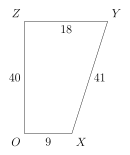
- A uniform lamina \(OXYZ\) is in the shape of the trapezium shown in the diagram. It is right-angled at \(O\) and \(Z\), and \(OX\) is parallel to \(YZ\). The lengths of the sides are given by \(OX=9\,\)cm, \(XY=41\,\)cm, \(YZ=18\,\)cm and \(ZO=40\,\)cm. Show that its centre of mass is a distance \(7\,\)cm from the edge \(OZ\).
- The diagram shows a tank with no lid made of thin sheet metal. The base \(OXUT\), the back \(OTWZ\) and the front \(XUVY\) are rectangular, and each end is a trapezium as in part (i). The width of the tank is \(d\,\)cm.
Show that the centre of mass of the tank, when empty, is a distance \[ \frac {3(140+11d)}{5(12+d)}\,\text{cm} \] from the back of the tank. The tank is then filled with a liquid. The mass per unit volume of this liquid is \(k\) times the mass per unit area of the sheet metal. In the case \(d=20\), find an expression for the distance of the centre of mass of the filled tank from the back of the tank.

- \begin{array}{c|c|c|c} & OXX'Z & XX'Y & OXYZ \\ \hline \text{Area} & 360 & 180 & 540\\ \text{COM} & \binom{4.5}{20} & \binom{12}{\frac{80}{3}} & \binom{\overline{x}}{\overline{y}} \end{array} \begin{align*} && 2 \binom{3}{20} + \binom{12}{\frac{80}{3}} &= 3 \binom{\overline{x}}{\overline{y}} \\ \Rightarrow && \binom{\overline{x}}{\overline{y}} &= \frac13 \binom{21}{\frac{200}{3}} \\ &&&= \binom{7}{\frac{200}{9}} \end{align*} ie, the centre of mass is \(7\text{ cm}\) from \(OZ\)
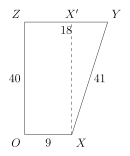
- \begin{align*} && \underbrace{540 \cdot 7}_{OXYZ} + \underbrace{540 \cdot 7}_{TUVW} + \underbrace{40d\cdot 0}_{OTWZ} + \underbrace{9d\cdot 4.5}_{OXUT} + \underbrace{41d \cdot 13.5}_{XUVY} &= (540+540+40d+9d+41d) \overline{x} \\ \Rightarrow && \overline{x} &= \frac{540\cdot 14 + 50d \cdot 4.5 + 41d \cdot 9}{1080 + 90d} \\ &&&= \frac{90 \cdot 84 + 225d + 369d}{1080+90d} \\ &&&= \frac{90 \cdot 84 + 594d}{1080+90d} \\ &&&= \frac{54(140+11d)}{90(12+d)} \\ &&&= \frac{3(140+11d)}{5(12+d)} \end{align*} The volume of the prizm is \(540d\), it's center of mass is \(7\). For the tank, it COM is \(\frac{3(140+11\cdot20)}{5(12+20)} = \frac{27}4\) and area is \(2880\) Therefore for the combined shape we have: \begin{align*} && 540dk \cdot 7 + 2880 \cdot \frac{27}{4} &= (540 \cdot20 k+2880) \overline{x} \\ \Rightarrow && \overline{x} &= \frac{720(150k+27)}{720(15k + 4)} \\ &&&= \frac{3(50k+9)}{15k+4} \end{align*} \begin{align*} && \end{align*}
A solid figure is composed of a uniform solid cylinder of density \(\rho\) and a uniform solid hemisphere of density \(3\rho\). The cylinder has circular cross-section, with radius \(r\), and height \(3r\), and the hemisphere has radius \(r\). The flat face of the hemisphere is joined to one end of the cylinder, so that their centres coincide. The figure is held in equilibrium by a force \(P\) so that one point of its flat base is in contact with a rough horizontal plane and its base is inclined at an angle \(\alpha\) to the horizontal. The force \(P\) is horizontal and acts through the highest point of the base. The coefficient of friction between the solid and the plane is \(\mu\). Show that \[\mu \ge \left\vert \tfrac98 -\tfrac12 \cot\alpha\right\vert\,. \]
Show Solution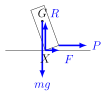
The base of a non-uniform solid hemisphere, of mass \(M,\) has radius \(r.\) The distance of the centre of gravity, \(G\), of the hemisphere from the base is \(p\) and from the centre of the base is \(\sqrt{p^2 + q^2} \,\). The hemisphere rests in equilibrium with its curved surface on a horizontal plane. A particle of mass \(m,\,\) where \(m\) is small, is attached to \(A\,\), the lowest point of the circumference of the base. In the new position of equilibrium, find the angle, \(\alpha\), that the base makes with the horizontal. The particle is removed and attached to the point \(B\) of the base which is at the other end of the diameter through \(A\,\). In the new position of equilibrium the base makes an angle \({\beta}\) with the horizontal. Show that $$\tan(\alpha-\beta)= \frac{2mMrp} {M^2\left(p^2+q^2\right)-m^2r^2}\;.$$
Show Solution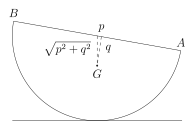
A tall container made of light material of negligible thickness has the form of a prism, with a square base of area \(a^2\). It contains a volume \(ka^3\) of fluid of uniform density. The container is held so that it stands on a rough plane, which is inclined at angle \(\theta\) to the horizontal, with two of the edges of the base of the container horizontal. In the case \(k > \frac12 \tan\theta\), show that the centre of mass of the fluid is at a distance \(x\) from the lower side of the container and at a distance \(y\) from the base of the container, where \[ \frac x a = \frac12 - \frac {\tan\theta}{12k}\;, \ \ \ \ \ \ \frac y a = \frac k 2 + \frac{\tan^2\theta}{24k}\;. \] Determine the corresponding coordinates in the case \(k < \frac12 \tan\theta\). The container is now released. Given that \(k < \frac12\), show that the container will topple if \(\theta >45^\circ\).
Show Solution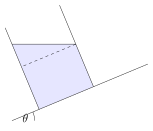
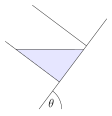
A child's toy consists of a solid cone of height \(\lambda a\) and a solid hemisphere of radius \(a\), made out of the same uniform material and fastened together so that their plane faces coincide. (Thus the diameter of the hemisphere is equal to that of the base of the cone.) Show that if \(\lambda < \sqrt{3}\) the toy will always move to an upright position if placed with the surface of the hemisphere on a horizontal table, but that if \(\lambda > \sqrt{3}\) the toy may overbalance. Show, however, that if the toy is placed with the surface of the cone touching the table it will remain there whatever the value of \(\lambda\). [The centre of gravity of a uniform solid cone of height \(h\) is a height \(h/4\) above its base. The centre of gravity of a uniform solid hemisphere of radius \(a\) is at distance \(3a/8\) from the centre of its base.]
Show Solution

A uniform rectangular lamina of sides \(2a\) and \(2b\) rests in a vertical plane. It is supported in equilibrium by two smooth pegs fixed in the same horizontal plane, a distance \(d\) apart, so that one corner of the lamina is below the level of the pegs. Show that if the distance between this (lowest) corner and the peg upon which the side of length \(2a\) rests is less than \(a\), then the distance between this corner and the other peg is less than \(b\). Show also that \[ b\cos\theta-a\sin\theta=d\cos2\theta, \] where \(\theta\) is the acute angle which the sides of length \(2b\) make with the horizontal.
Show Solution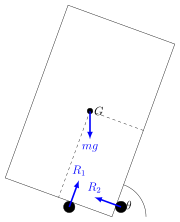
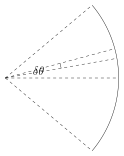
Derive a formula for the position of the centre of mass of a uniform circular arc of radius \(r\) which subtends an angle \(2\theta\) at the centre.


It is given that the gravitational force between a disc, of radius \(a,\) thickness \(\delta x\) and uniform density \(\rho,\) and a particle of mass \(m\) at a distance \(b(\geqslant0)\) from the disc on its axis is \[ 2\pi mk\rho\delta x\left(1-\frac{b}{(a^{2}+b^{2})^{\frac{1}{2}}}\right), \] where \(k\) is a constant. Show that the gravitational force on a particle of mass \(m\) at the surface of a uniform sphere of mass \(M\) and radius \(r\) is \(kmM/r^{2}.\) Deduce that in a spherical cloud of particles of uniform density, which all attract one another gravitationally, the radius \(r\) and inward velocity \(v=-\dfrac{\d r}{\d t}\) of a particle at the surface satisfy the equation \[ v\frac{\mathrm{d}v}{\mathrm{d}r}=-\frac{kM}{r^{2}}, \] where \(M\) is the mass of the cloud. At time \(t=0\), the cloud is instantaneously at rest and has radius \(R\). Show that \(r=R\cos^{2}\alpha\) after a time \[ \left(\frac{R^{3}}{2kM}\right)^{\frac{1}{2}}(\alpha+\tfrac{1}{2}\sin2\alpha). \]
Show Solution