1988 Paper 1 Q11
Year: 1988
Paper: 1
Question Number: 11
Course: UFM Mechanics
Section: Centre of Mass 2
Difficulty: 1484.0
Banger: 1500.0
Problem
Derive a formula for the position of the centre of mass of a uniform circular arc of radius \(r\) which subtends an angle \(2\theta\) at the centre.
 A plane framework consisting of a rectangle and a semicircle, as in the above diagram, is constructed of uniform thin rods. It can stand in equilibrium if it is placed in a vertical plane with any point of the semicircle in contact with a horizontal floor. Express \(h\) in terms of \(r\).
Solution

Rating Information
Difficulty Rating: 1484.0
Difficulty Comparisons: 1
Banger Rating: 1500.0
Banger Comparisons: 0
Show LaTeX source
Problem source
Derive a formula for the position of the centre of mass of a uniform circular arc of radius $r$ which subtends an angle $2\theta$ at the centre.
\begin{center}
\begin{tikzpicture}[scale=0.8]
    % Rectangle
    \draw (-2,2) -- (2,2) -- (2,-3) -- (-2,-3) -- cycle;

    % Semi-circle at the bottom
    \draw[domain = 180:360, samples=50, variable = \x]  plot ({2*cos(\x)},{-3+2*sin(\x)});

    % Arrows with labels
    \draw[<->] (0,-3) -- (-1.15,-4.63) node[midway, left] {$r$};

    \draw[<->] (0,-2.52) -- (-2,-2.52) node[midway, above] {$r$};
    \draw[<->] (0,-2.52) -- (2,-2.52) node[midway, above] {$r$};

    \draw[<->] (2.42,1.96) -- (2.42,-3) node[midway, right] {$2h$};

    \draw[<->] (-1.96,2.36) -- (1.95,2.37) node[midway, above] {$2r$};
\end{tikzpicture}
\end{center}
A plane framework consisting of a rectangle and a semicircle, as in the above diagram, is constructed of uniform thin rods. It can stand in equilibrium if it is placed in a vertical plane with any point of the semicircle in contact with a horizontal floor. Express $h$ in terms of $r$.
Solution source
\begin{center}
\begin{tikzpicture}[scale=2]
    % Rectangle
    \def\t{40};
    \def\r{2};
    \def\s{15};
    \def\ss{10};
    \coordinate (O) at (0,0);
    \coordinate (X) at ({\r*cos(\s)},{\r*sin(\s)})
    \coordinate (Y) at  ({\r*cos(\ss)},{\r*sin(\ss)});

     \draw[domain = -1:1, samples=50, variable = \x]  plot ({\r*cos(\t*\x)},{\r*sin(\t*\x)});

     \draw[dashed] (O) -- ({\r*cos(-\t)},{\r*sin(-\t)});
     \draw[dashed] (O) -- ({\r*cos(\t)},{\r*sin(\t)});
     \draw[dashed] (O) -- (\r, 0);


     \draw[dashed] (O) -- (X);
     \draw[dashed] (O) -- (Y);
    \pic [draw, angle radius=2cm, "$\delta \theta$"] {angle = Y--O--X};


\end{tikzpicture}
\end{center}

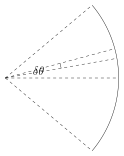
Splitting the arc up into strips of width $\delta \theta$, then we must have
\begin{align*} && \sum r\cos \theta (r \delta \theta) &= \bar{x}\sum (r \delta  \theta) \\
\lim_{\delta \theta \to 0}: && \int_{-\theta}^{\theta} r^2 \cos \theta \d \theta &= \bar{x}2 \theta r \\
\Rightarrow && 2r^2 \sin \theta &= \bar{x} 2 \theta r \\
\Rightarrow && \bar{x} &= \frac{r\sin \theta}{\theta}
\end{align*}

\begin{center}
\begin{tikzpicture}[scale=0.8]
    % Rectangle
    % \draw (-2,2) -- (2,2) -- (2,-3) -- (-2,-3) -- cycle;

    % Semi-circle at the bottom
    \draw[domain = 210:390, samples=50, variable = \x]  plot ({2*cos(\x)},{-3+2*sin(\x)});

    \coordinate (A) at ({2*cos(210)},{-3+2*sin(210)});
    \coordinate (B) at ({2*cos(390)},{-3+2*sin(390)});
    \coordinate (C) at ({2*cos(390)-sin(390)*3},{-3+2*sin(390)+3*cos(390)});
    \coordinate (D) at ($(A)+(C)-(B)$);

    \draw (A) -- (B) -- (C) -- (D) -- cycle;

    \draw (-2, -5) -- (2, -5);
    \draw[dashed] (0, -5) -- (0, -3);

\end{tikzpicture}
\end{center}

The centre of mass will lie on the line of symmetry. It also must lie at the center of the base of the semi-circle (see diagram). Using a coordinate frame where that point is the origin we must have

\begin{align*}
&& 0 &= -2r \cdot 2h - 4h \cdot h + \pi r \frac{r}{\frac{\pi}{2}} \\
&&&= -4rh-4h^2+2r^2\\
\Rightarrow && 0 &= r^2-2rh-h^2 \\
\Rightarrow && \frac{r}{h} &= 1 \pm \sqrt{3} \\
\Rightarrow && r &= (1+\sqrt{3})h \\
&& h & = \frac12 (\sqrt{3}-1) r
\end{align*}