Work, energy and Power 2
The lower end of a rigid uniform rod of mass \(m\) and length \(a\) rests at point \(M\) on rough horizontal ground. Each of two elastic strings, of natural length \(\ell\) and modulus of elasticity \(\lambda\), is attached at one end to the top of the rod. Their lower ends are attached to points \(A\) and \(B\) on the ground, which are a distance \(2a\) apart. \(M\) is the midpoint of \(AB\). \(P\) is the point at the top of the rod and lies in the vertical plane through \(AMB\). Suppose that the rod is in equilibrium with angle \(PMB = 2\theta\), where \(\theta < 45°\) and \(\theta\) is such that both strings are in tension.
- Show that angle \(APB\) is a right angle.
Show that the force exerted on the rod by the elastic strings can be written as the sum of
- a force of magnitude \(\frac{2a\lambda}{\ell}\) parallel to the rod
- and a force of magnitude \(\sqrt{2}\lambda\) acting along the bisector of angle \(APB\).
- By taking moments about point \(M\), or otherwise, show that \(\cos\theta + \sin\theta = \frac{2\lambda}{mg}\). Deduce that it is necessary that \(\frac{1}{2}mg < \lambda < \frac{1}{2}\sqrt{2}mg\).
- \(N\) and \(F\) are the magnitudes of the normal and frictional forces, respectively, exerted on the rod by the ground at \(M\). Show, by taking moments about an appropriate point, or otherwise, that \[N - F\tan 2\theta = \frac{1}{2}mg.\]

- Notice that \(AM = MB = MP\) in particular \(P\) lies on a semi-circle of radius \(a\) and therefore by Thales' theorem \(\angle APB = 90^{\circ}\). Notice that by angles in a triangle and the angles adding to \(90^{\circ}\), \(\angle APM = \theta\). Therefore, \begin{align*} && |PB| &= 2a \sin \theta \\ && |PA| &= 2a \cos \theta \\ && T_A &= \frac{\lambda}{l} \left (2a \cos \theta -l \right) \\ && T_B &= \frac{\lambda}{l} \left (2a \sin\theta -l \right) \\ \end{align*} Since \(T_A\) and \(T_B\) are perpendicular, we can consider the forces as having vector \(\frac{\lambda}{l}\binom{2a\cos \theta-l}{2a\sin \theta - l}\) in this coordinate system, ie the sum of a vector \(\frac{2\lambda a}{l}\binom{\cos \theta}{\sin \theta}\) and \(\displaystyle -\sqrt{2}\lambda \binom{\frac1{\sqrt{2}}}{\frac1{\sqrt{2}}}\) which are unit vectors parallel to the rod and along the bisector of \(APB\) respectively.
- \begin{align*} \overset{\curvearrowright}{M}: && 0 &= \frac{a}{2} \cdot mg \cos 2 \theta - a\cdot \sqrt{2}\lambda \cos (90-(45-\theta))\\ \Rightarrow && \cos 2 \theta &= \frac{\lambda}{mg} 2 \sqrt{2} \cos (45 + \theta) \\ \Rightarrow && \cos^2 \theta - \sin^2 \theta &= \frac{2\lambda}{mg} (\cos \theta - \sin \theta) \\ \underbrace{\Rightarrow}_{\theta < 45^{\circ}} && \cos \theta + \sin \theta &= \frac{2\lambda}{mg} \end{align*} Over \((0, 45^{\circ})\), \(\cos \theta + \sin \theta\) ranges from \(1\) to \(\sqrt{2}\), therefore \(1 < \frac{2 \lambda}{mg} < \sqrt{2} \Rightarrow \frac12 mg < \lambda < \frac12 \sqrt{2} mg\) as required.
- \begin{align*} \overset{\curvearrowright}{P}: && 0 &=- \frac{a}{2} \cdot \left ( mg \cos 2\theta \right) - a \cdot F \sin 2 \theta + a \cdot N \cos 2 \theta \\ \Rightarrow && \frac12 mg &= N - F \tan 2 \theta \end{align*} as required.
Two particles \(A\) and \(B\) of masses \(m\) and \(2 m\), respectively, are connected by a light spring of natural length \(a\) and modulus of elasticity \(\lambda\). They are placed on a smooth horizontal table with \(AB\) perpendicular to the edge of the table, and \(A\) is held on the edge of the table. Initially the spring is at its natural length. Particle \(A\) is released. At a time \(t\) later, particle \(A\) has dropped a distance \(y\) and particle \( B\) has moved a distance \(x\) from its initial position (where \(x < a\)). Show that \( y + 2x= \frac12 gt^2\). The value of \(\lambda\) is such that particle \(B\) reaches the edge of the table at a time \(T\) given by \(T= \sqrt{6a/g\,}\,\). By considering the total energy of the system (without solving any differential equations), show that the speed of particle \(B\) at this time is \(\sqrt{2ag/3\,}\,\).
Show SolutionThree pegs \(P\), \(Q\) and \(R\) are fixed on a smooth horizontal table in such a way that they form the vertices of an equilateral triangle of side \(2a\). A particle \(X\) of mass \(m\) lies on the table. It is attached to the pegs by three springs, \(PX\), \(QX\) and \(RX\), each of modulus of elasticity \(\lambda\) and natural length \(l\), where \(l < \frac{ \ 2 }{\sqrt3}\, a\). Initially the particle is in equilibrium. Show that the extension in each spring is \(\frac{\ 2}{\sqrt3}\,a -l\,\). The particle is then pulled a small distance directly towards \(P\) and released. Show that the tension \(T\) in the spring \(RX\) is given by \[ T= \frac {\lambda} l \left( \sqrt{\frac {4a^2}3 + \frac{2ax}{\sqrt3} +x^2\; }\; -l\right) , \] where \(x\) is the displacement of \(X\) from its equilibrium position. Show further that the particle performs approximate simple harmonic motion with period \[ 2\pi \sqrt{ \frac{4mla}{3 (4a-\sqrt3 \, l)\lambda } \; }\,. \]
An equilateral triangle, comprising three light rods each of length \(\sqrt3a\), has a particle of mass \(m\) attached to each of its vertices. The triangle is suspended horizontally from a point vertically above its centre by three identical springs, so that the springs and rods form a tetrahedron. Each spring has natural length \(a\) and modulus of elasticity \(kmg\), and is light. Show that when the springs make an angle \(\theta\) with the horizontal the tension in each spring is \[ \frac{ kmg(1-\cos\theta)}{\cos\theta}\,. \] Given that the triangle is in equilibrium when \(\theta = \frac16 \pi\), show that \(k=4\sqrt3 +6\). The triangle is released from rest from the position at which \(\theta=\frac13\pi\). Show that when it passes through the equilibrium position its speed \(V\) satisfies \[ V^2 = \frac{4ag}3(6+\sqrt3)\,. \]
One end of a thin heavy uniform inextensible perfectly flexible rope of length \(2L\) and mass \(2M\) is attached to a fixed point \(P\). A particle of mass \(m\) is attached to the other end. Initially, the particle is held at \(P\) and the rope hangs vertically in a loop below \(P\). The particle is then released so that it and a section of the rope (of decreasing length) fall vertically as shown in the diagram.
Particles \(P\) and \(Q\), each of mass \(m\), lie initially at rest a distance \(a\) apart on a smooth horizontal plane. They are connected by a light elastic string of natural length \(a\) and modulus of elasticity \(\frac12 m a \omega^2\), where \(\omega\) is a constant. Then \(P\) receives an impulse which gives it a velocity \(u\) directly away from \(Q\). Show that when the string next returns to length \(a\), the particles have travelled a distance \(\frac12 \pi u/\omega\,\), and find the speed of each particle. Find also the total time between the impulse and the subsequent collision of the particles.
A train consists of an engine and \(n\) trucks. It is travelling along a straight horizontal section of track. The mass of the engine and of each truck is \(M\). The resistance to motion of the engine and of each truck is \(R\), which is constant. The maximum power at which the engine can work is \(P\). Obtain an expression for the acceleration of the train when its speed is \(v\) and the engine is working at maximum power. The train starts from rest with the engine working at maximum power. Obtain an expression for the time \(T\) taken to reach a given speed \(V\), and show that this speed is only achievable if \[ P>(n+1)RV\,. \]
- In the case when \((n+1) RV/P\) is small, use the approximation \(\ln (1-x) \approx -x -\frac12 x^2\) (valid for small \( x \)) to obtain the approximation \[ PT\approx \tfrac 12 (n+1) MV^2\, \] and interpret this result.
- In the general case, the distance moved from rest in time \(T\) is \(X\). {\em Write down}, with explanation, an equation relating \(P\), \(T\), \(X\), \(M\), \(V\), \(R\) and \(n\) and hence show that \[ X= \frac{2PT - (n+1)MV^2}{2(n+1)R} \,. \]
A long string consists of \(n\) short light strings joined together, each of natural length \(\ell\) and modulus of elasticity \(\lambda\). It hangs vertically at rest, suspended from one end. Each of the short strings has a particle of mass \(m\) attached to its lower end. The short strings are numbered \(1\) to \(n\), the \(n\)th short string being at the top. By considering the tension in the \(r\)th short string, determine the length of the long string. Find also the elastic energy stored in the long string. A uniform heavy rope of mass \(M\) and natural length \(L_0\) has modulus of elasticity \(\lambda\). The rope hangs vertically at rest, suspended from one end. Show that the length, \(L\), of the rope is given by \[ L=L_0\biggl(1+ \frac{Mg}{2\lambda}\biggr), \] and find an expression in terms of \(L\), \(L_0\) and \(\lambda\) for the elastic energy stored in the rope.
Two small beads, \(A\) and \(B\), each of mass \(m\), are threaded on a smooth horizontal circular hoop of radius \(a\) and centre \(O\). The angle \(\theta\) is the acute angle determined by \(2\theta = \angle AOB\). The beads are connected by a light straight spring. The energy stored in the spring is \[ mk^2 a^2(\theta - \alpha)^2, \] where \(k\) and \(\alpha\) are constants satisfying \(k>0\) and \(\frac \pi 4< \alpha<\frac\pi2\). The spring is held in compression with \(\theta =\beta\) and then released. Find the period of oscillations in the two cases that arise according to the value of \(\beta\) and state the value of \(\beta\) for which oscillations do not occur.
A long, light, inextensible string passes through a small, smooth ring fixed at the point \(O\). One end of the string is attached to a particle \(P\) of mass \(m\) which hangs freely below \(O\). The other end is attached to a bead, \(B\), also of mass \(m\), which is threaded on a smooth rigid wire fixed in the same vertical plane as \(O\). The distance \(OB\) is \(r\), the distance \(OH\) is \(h\) and the height of the bead above the horizontal plane through~\(O\) is \(y\), as shown in the diagram.
Two thin discs, each of radius \(r\) and mass \(m\), are held on a rough horizontal surface with their centres a distance \(6r\) apart. A thin light elastic band, of natural length \(2\pi r\) and modulus \(\dfrac{\pi mg}{12}\), is wrapped once round the discs, its straight sections being parallel. The contact between the elastic band and the discs is smooth. The coefficient of static friction between each disc and the horizontal surface is \(\mu\), and each disc experiences a force due to friction equal to \(\mu mg\) when it is sliding. The discs are released simultaneously. If the discs collide, they rebound and a half of their total kinetic energy is lost in the collision.
- Show that the discs start sliding, but come to rest before colliding, if and only if \mbox{\(\frac23 <\mu <1\)}.
- Show that, if the discs collide at least once, their total kinetic energy just before the first collision is \(\frac43 mgr(2-3\mu)\).
- Show that if \(\frac 4 9 > \mu^2 >\frac{5}{27}\) the discs come to rest exactly once after the first collision.
A smooth cylinder with circular cross-section of radius \(a\) is held with its axis horizontal. A~light elastic band of unstretched length \(2\pi a\) and modulus of elasticity \(\lambda\) is wrapped round the circumference of the cylinder, so that it forms a circle in a plane perpendicular to the axis of the cylinder. A particle of mass \(m\) is then attached to the rubber band at its lowest point and released from rest.
- Given that the particle falls to a distance \(2a\) below the below the axis of the cylinder, but no further, show that \[ \lambda = \frac{9\pi m g}{(3\sqrt3-\pi)^2} \;. \]
- Given instead that the particle reaches its maximum speed at a distance \(2a\) below the axis of the cylinder, find a similar expression for \(\lambda\)\,.
A uniform rigid rod \(BC\) is suspended from a fixed point \(A\) by light stretched springs \(AB,AC\). The springs are of different natural lengths but the ratio of tension to extension is the same constant \(\kappa\) for each. The rod is not hanging vertically. Show that the ratio of the lengths of the stretched springs is equal to the ratio of the natural lengths of the unstretched springs.
Show Solution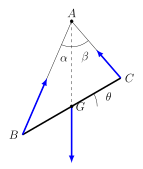
A bungee-jumper of mass \(m\) is attached by means of a light rope of natural length \(l\) and modulus of elasticity \(mg/k,\) where \(k\) is a constant, to a bridge over a ravine. She jumps from the bridge and falls vertically towards the ground. If she only just avoids hitting the ground, show that the height \(h\) of the bridge above the floor of the ravine satisfies \[ h^{2}-2hl(k+1)+l^{2}=0, \] and hence find \(h.\) Show that the maximum speed \(v\) which she attains during her fall satisfies \[ v^{2}=(k+2)gl. \]
Show SolutionA small ball of mass \(m\) is suspended in equilibrium by a light elastic string of natural length \(l\) and modulus of elasticity \(\lambda.\) Show that the total length of the string in equilibrium is \(l(1+mg/\lambda).\) If the ball is now projected downwards from the equilibrium position with speed \(u_{0},\) show that the speed \(v\) of the ball at distance \(x\) below the equilibrium position is given by \[ v^{2}+\frac{\lambda}{lm}x^{2}=u_{0}^{2}. \] At distance \(h\), where \(\lambda h^{2} < lmu_{0}^{2},\) below the equilibrium position is a horizontal surface on which the ball bounces with a coefficient of restitution \(e\). Show that after one bounce the velocity \(u_{1}\) at \(x=0\) is given by \[ u_{1}^{2}=e^{2}u_{0}^{2}+\frac{\lambda}{lm}h^{2}(1-e^{2}), \] and that after the second bounce the velocity \(u_{2}\) at \(x=0\) is given by \[ u_{2}^{2}=e^{4}u_{0}^{2}+\frac{\lambda}{lm}h^{2}(1-e^{4}). \]
One end \(A\) of a light elastic string of natural length \(l\) and modulus of elasticity \(\lambda\) is fixed and a particle of mass \(m\) is attached to the other end \(B\). The particle moves in a horizontal circle with centre on the vertical through \(A\) with angular velocity \(\omega.\) If \(\theta\) is the angle \(AB\) makes with the downward vertical, find an expression for \(\cos\theta\) in terms of \(m,g,l,\lambda\) and \(\omega.\) Show that the motion described is possible only if \[ \frac{g\lambda}{l(\lambda+mg)}<\omega^{2}<\frac{\lambda}{ml}. \]
A truck is towing a trailer of mass \(m\) across level ground by means of an elastic rope of natural length \(l\) whose modulus of elasticity is \(\lambda.\) At first the rope is slack and the trailer stationary. The truck then accelerates until the rope becomes taut and thereafter the truck travels in a straight line at a constant speed \(u\). Assuming that the effect of friction on the trailer is negligible, show that the trailer will collide with the truck at a time \[ \pi\left(\frac{lm}{\lambda}\right)^{\frac{1}{2}}+\frac{l}{u} \] after the rope first becomes taut.
A step-ladder has two sections \(AB\) and \(AC,\) each of length \(4a,\) smoothly hinged at \(A\) and connected by a light elastic rope \(DE,\) of natural length \(a/4\) and modulus \(W\), where \(D\) is on \(AB,\) \(E\) is on \(AC\) and \(AD=AE=a.\) The section \(AB,\) which contains the steps, is uniform and of weight \(W\) and the weight of \(AC\) is negligible. The step-ladder rests on a smooth horizontal floor and a man of weight \(4W\) carefully ascends it to stand on a rung distant \(\beta a\) from the end of the ladder resting on the floor. Find the height above the floor of the rung on which the man is standing when \(\beta\) is the maximum value at which equilibrium is possible.
Show Solution
A small lamp of mass \(m\) is at the end \(A\) of a light rod \(AB\) of length \(2a\) attached at \(B\) to a vertical wall in such a way that the rod can rotate freely about \(B\) in a vertical plane perpendicular to the wall. A spring \(CD\) of natural length \(a\) and modulus of elasticity \(\lambda\) is joined to the rod at its mid-point \(C\) and to the wall at a point \(D\) a distance \(a\) vertically above \(B\). The arrangement is sketched below. \noindent
\(ABCD\) is a horizontal line with \(AB=CD=a\) and \(BC=6a\). There are fixed smooth pegs at \(B\) and \(C\). A uniform string of natural length \(2a\) and modulus of elasticity \(kmg\) is stretched from \(A\) to \(D\), passing over the pegs at \(B\) and \(C\). A particle of mass \(m\) is attached to the midpoint \(P\) of the string. When the system is in equilibrium, \(P\) is a distance \(a/4\) below \(BC\). Evaluate \(k\). The particle is pulled down to a point \(Q\), which is at a distance \(pa\) below the mid-point of \(BC\), and is released from rest. \(P\) rises to a point \(R\), which is at a distance \(3a\) above \(BC\). Show that \(2p^2-p-17=0\). Show also that the tension in the strings is less when the particle is at \(R\) than when the particle is at \(Q\).
Three light elastic strings \(AB,BC\) and \(CD\), each of natural length \(a\) and modulus of elasticity \(\lambda,\) are joined together as shown in the diagram. \noindent
In the figure, \(W_{1}\) and \(W_{2}\) are wheels, both of radius \(r\). Their centres \(C_{1}\) and \(C_{2}\) are fixed at the same height, a distance \(d\) apart, and each wheel is free to rotate, without friction, about its centre. Both wheels are in the same vertical plane. Particles of mass \(m\) are suspended from \(W_{1}\) and \(W_{2}\) as shown, by light inextensible strings would round the wheels. A light elastic string of natural length \(d\) and modulus elasticity \(\lambda\) is fixed to the rims of the wheels at the points \(P_{1}\) and \(P_{2}.\) The lines joining \(C_{1}\) to \(P_{1}\) and \(C_{2}\) to \(P_{2}\) both make an angle \(\theta\) with the vertical. The system is in equilibrium. \noindent
- sep}{3mm}
- \(\bf (i)\) no equilibrium positions,
- \(\bf (ii)\) just one equilibrium position,
- \(\bf (iii)\) exactly two equilibrium positions,
- \(\bf (iv)\) more than two equilibrium positions?
\(\,\)
\(\,\)
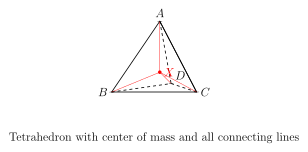
A regular tetrahedron \(ABCD\) of mass \(M\) is made of 6 identical uniform rigid rods, each of length \(2a.\) Four light elastic strings \(XA,XB,XC\) and \(XD\), each of natural length \(a\) and modulus of elasticity \(\lambda,\) are fastened together at \(X\), the other end of each string being attached to the corresponding vertex. Given that \(X\) lies at the centre of mass of the tetrahedron, find the tension in each string. The tetrahedron is at rest on a smooth horizontal table, with \(B,C\) and \(D\) touching the table, and the ends of the strings at \(X\) attached to a point \(O\) fixed in space. Initially the centre of mass of the tetrahedron coincides with \(O.\) Suddenly the string \(XA\) breaks, and the tetrahedron as a result rises vertically off the table. If the maximum height subsequently attained is such that \(BCD\) is level with the fixed point \(O,\) show that (to 2 significant figures) \[ \frac{Mg}{\lambda}=0.098. \]
Show Solution