1989 Paper 1 Q12
Year: 1989
Paper: 1
Question Number: 12
Course: UFM Mechanics
Section: Work, energy and Power 2
Difficulty: 1500.0
Banger: 1504.2
elastic string
energy conservation
tetrahedron
centre of mass
tension
Hooke's law
work-energy theorem
3D geometry
modulus of elasticity
Problem
A regular tetrahedron \(ABCD\) of mass \(M\) is made of 6 identical uniform rigid rods, each of length \(2a.\) Four light elastic strings \(XA,XB,XC\) and \(XD\), each of natural length \(a\) and modulus of elasticity \(\lambda,\) are fastened together at \(X\), the other end
of each string being attached to the corresponding vertex. Given that \(X\) lies at the centre of mass of the tetrahedron, find the tension in each string.
The tetrahedron is at rest on a smooth horizontal table, with \(B,C\) and \(D\) touching the table, and the ends of the strings at \(X\) attached to a point \(O\) fixed in space. Initially the centre of mass of the tetrahedron coincides with \(O.\) Suddenly the string \(XA\) breaks, and the tetrahedron as a result rises vertically off the table. If the maximum height subsequently attained is such that \(BCD\) is level with the fixed point \(O,\) show that (to 2 significant figures)
\[
\frac{Mg}{\lambda}=0.098.
\]
Solution
Rating Information
Difficulty Rating: 1500.0
Difficulty Comparisons: 0
Banger Rating: 1504.2
Banger Comparisons: 2
Show LaTeX source
Problem source
A regular tetrahedron $ABCD$ of mass $M$ is made of 6 identical uniform rigid rods, each of length $2a.$ Four light elastic strings $XA,XB,XC$ and $XD$, each of natural length $a$ and modulus of elasticity $\lambda,$ are fastened together at $X$, the other end
of each string being attached to the corresponding vertex. Given that $X$ lies at the centre of mass of the tetrahedron, find the tension in each string.
The tetrahedron is at rest on a smooth horizontal table, with $B,C$ and $D$ touching the table, and the ends of the strings at $X$ attached to a point $O$ fixed in space. Initially the centre of mass of the tetrahedron coincides with $O.$ Suddenly the string $XA$ breaks, and the tetrahedron as a result rises vertically off the table. If the maximum height subsequently attained is such that $BCD$ is level with the fixed point $O,$ show that (to 2 significant figures)
\[
\frac{Mg}{\lambda}=0.098.
\]
Solution source
\begin{center}
\begin{tikzpicture}[
    % Viewing angle for looking slightly up at the tetrahedron from the side
    x={(1cm,0.cm)},      % Horizontal view (side perspective)
    y={(0.2cm,0.1cm)},    % Very slight vertical compression (looking up)
    z={(0cm,1cm)},   % Strong z-projection to enhance "looking up" effect
    scale=3
]
    % Define the coordinates with B, C, D on a "table" (z=0) and A above
    \coordinate (B) at (0, 0, 0);       % Left front corner on table
    \coordinate (C) at (1, 0, 0);       % Right front corner on table
    \coordinate (D) at (0.5, 1, 0);     % Back corner on table
    \coordinate (A) at (0.5, 0.333, 0.8); % Above the center of the base

    % Calculate the center of mass (centroid)
    \coordinate (CM) at ($0.25*(A)+0.25*(B)+0.25*(C)+0.25*(D)$);

    % Draw the back edges with dashed lines
    \draw[thick] (A) -- (C);
    \draw[thick, dashed] (A) -- (D);
    \draw[thick, dashed] (C) -- (D);

    % Draw the front edges with solid lines
    \draw[thick] (A) -- (B) -- (C) -- cycle;
    \draw[thick, dashed] (B) -- (D);

    % Draw the lines connecting vertices to the center of mass
    \draw[red] (A) -- (CM);
    \draw[red] (B) -- (CM);
    \draw[red] (C) -- (CM);
    \draw[red] (D) -- (CM);

    % Label the vertices and center of mass
    \fill (A) circle (0.03) node[above] {$A$};
    \fill (B) circle (0.03) node[left] {$B$};
    \fill (C) circle (0.03) node[right] {$C$};
    \fill (D) circle (0.03) node[above right] {$D$};
    \fill[red] (CM) circle (0.6pt) node[right] {$X$};

    % Add a caption
    \node[below=1cm] at (current bounding box.south) {Tetrahedron with center of mass and all connecting lines};
\end{tikzpicture}
\end{center}

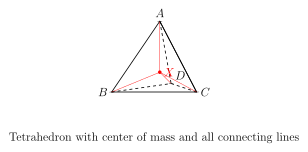
The distance of $A$ to $X$ is $\frac34$ the distance from $A$ to the centre base ($d$)

The distance of $C$ to the centre of the base ($G$) is $\frac{2}{3}$ the height of $BCD$ which is $\frac{\sqrt{3}}{2} \cdot 2a = \sqrt{3} a$.

Therefore we must have $(2a)^2 = d^2 + \frac43a^2 \Rightarrow d = \frac{2\sqrt{2}}{\sqrt{3}}a$ and so $AX = \frac34  \frac{2\sqrt{2}}{\sqrt{3}}a = \sqrt{\frac32}a$

The tension in each string will be $\lambda \left (\sqrt{\frac32}-1 \right)$.


Considering the energy of the system, when the ABCD reaches it's maximum height, it's velocity will be $0$. Therefore the only energies to consider are GPE and EPE.

Assuming the table is $0$, we initially have $EPE$ of

\begin{align*}
3 \cdot \frac12 \lambda \frac{(a(\sqrt{\frac32}-1))^2}{a} = \frac32 \lambda a\left (\frac52-2\sqrt{\frac32} \right )
\end{align*}

When $BCD$ is level with $O$, the height is $\frac{1}{\sqrt{6}}a$ and GPE of $\frac{Mga}{\sqrt{6}}$

The $EPE$ will be:

\begin{align*}
3 \cdot \frac12 \lambda \frac{(a(\frac{2}{\sqrt{3}}-1))^2}{a} &= \frac32 \lambda a \left (\frac73 - \frac{4}{\sqrt{3}}\right )
\end{align*}

So by conservation of energy:

\begin{align*}
&& \frac32 \lambda a\left (\frac52-2\sqrt{\frac32} \right ) &= \frac{Mga}{\sqrt{6}} + \frac32 \lambda a \left (\frac73 - \frac{4}{\sqrt{3}}\right ) \\
\Rightarrow && \frac{Mg}{\lambda} &= \sqrt{6} \left (\frac32 \left (\frac52-2\sqrt{\frac32} \right )  -  \frac32 \left (\frac73 - \frac{4}{\sqrt{3}}\right ) \right) \\
&&&= -9 + 6\sqrt{2}+\sqrt{\frac38} \\
&&&= 0.09765380\ldots \\
&&&= 0.098\, (2\text{ s.f})
\end{align*}