Problems
Filters
142 problems found
2025 Paper 2 Q10
The lower end of a rigid uniform rod of mass \(m\) and length \(a\) rests at point \(M\) on rough horizontal ground. Each of two elastic strings, of natural length \(\ell\) and modulus of elasticity \(\lambda\), is attached at one end to the top of the rod. Their lower ends are attached to points \(A\) and \(B\) on the ground, which are a distance \(2a\) apart. \(M\) is the midpoint of \(AB\). \(P\) is the point at the top of the rod and lies in the vertical plane through \(AMB\). Suppose that the rod is in equilibrium with angle \(PMB = 2\theta\), where \(\theta < 45°\) and \(\theta\) is such that both strings are in tension.
- Show that angle \(APB\) is a right angle.
Show that the force exerted on the rod by the elastic strings can be written as the sum of
- a force of magnitude \(\frac{2a\lambda}{\ell}\) parallel to the rod
- and a force of magnitude \(\sqrt{2}\lambda\) acting along the bisector of angle \(APB\).
- By taking moments about point \(M\), or otherwise, show that \(\cos\theta + \sin\theta = \frac{2\lambda}{mg}\). Deduce that it is necessary that \(\frac{1}{2}mg < \lambda < \frac{1}{2}\sqrt{2}mg\).
- \(N\) and \(F\) are the magnitudes of the normal and frictional forces, respectively, exerted on the rod by the ground at \(M\). Show, by taking moments about an appropriate point, or otherwise, that \[N - F\tan 2\theta = \frac{1}{2}mg.\]
Solution:

- Notice that \(AM = MB = MP\) in particular \(P\) lies on a semi-circle of radius \(a\) and therefore by Thales' theorem \(\angle APB = 90^{\circ}\). Notice that by angles in a triangle and the angles adding to \(90^{\circ}\), \(\angle APM = \theta\). Therefore, \begin{align*} && |PB| &= 2a \sin \theta \\ && |PA| &= 2a \cos \theta \\ && T_A &= \frac{\lambda}{l} \left (2a \cos \theta -l \right) \\ && T_B &= \frac{\lambda}{l} \left (2a \sin\theta -l \right) \\ \end{align*} Since \(T_A\) and \(T_B\) are perpendicular, we can consider the forces as having vector \(\frac{\lambda}{l}\binom{2a\cos \theta-l}{2a\sin \theta - l}\) in this coordinate system, ie the sum of a vector \(\frac{2\lambda a}{l}\binom{\cos \theta}{\sin \theta}\) and \(\displaystyle -\sqrt{2}\lambda \binom{\frac1{\sqrt{2}}}{\frac1{\sqrt{2}}}\) which are unit vectors parallel to the rod and along the bisector of \(APB\) respectively.
- \begin{align*} \overset{\curvearrowright}{M}: && 0 &= \frac{a}{2} \cdot mg \cos 2 \theta - a\cdot \sqrt{2}\lambda \cos (90-(45-\theta))\\ \Rightarrow && \cos 2 \theta &= \frac{\lambda}{mg} 2 \sqrt{2} \cos (45 + \theta) \\ \Rightarrow && \cos^2 \theta - \sin^2 \theta &= \frac{2\lambda}{mg} (\cos \theta - \sin \theta) \\ \underbrace{\Rightarrow}_{\theta < 45^{\circ}} && \cos \theta + \sin \theta &= \frac{2\lambda}{mg} \end{align*} Over \((0, 45^{\circ})\), \(\cos \theta + \sin \theta\) ranges from \(1\) to \(\sqrt{2}\), therefore \(1 < \frac{2 \lambda}{mg} < \sqrt{2} \Rightarrow \frac12 mg < \lambda < \frac12 \sqrt{2} mg\) as required.
- \begin{align*} \overset{\curvearrowright}{P}: && 0 &=- \frac{a}{2} \cdot \left ( mg \cos 2\theta \right) - a \cdot F \sin 2 \theta + a \cdot N \cos 2 \theta \\ \Rightarrow && \frac12 mg &= N - F \tan 2 \theta \end{align*} as required.
2025 Paper 3 Q10
A plank \(AB\) of length \(L\) initially lies horizontally at rest along the \(x\)-axis on a flat surface, with \(A\) at the origin. Point \(C\) on the plank is such that \(AC\) has length \(sL\), where \(0 < s < 1\). End \(A\) is then raised vertically along the \(y\)-axis so that its height above the horizontal surface at time \(t\) is \(h(t)\), while end \(B\) remains in contact with the flat surface and on the \(x\)-axis. The function \(h(t)\) satisfies the differential equation $$\frac{d^2h}{dt^2} = -\omega^2 h, \text{ with } h(0) = 0 \text{ and } \frac{dh}{dt} = \omega L \text{ at } t = 0$$ where \(\omega\) is a positive constant. A particle \(P\) of mass \(m\) remains in contact with the plank at point \(C\).
- Show that the \(x\)-coordinate of \(P\) is \(sL\cos\omega t\), and find a similar expression for its \(y\)-coordinate.
- Find expressions for the \(x\)- and \(y\)-components of the acceleration of the particle.
- \(N\) and \(F\) are the upward normal and frictional components, respectively, of the force of the plank on the particle. Show that $$N = mg(1 - k\sin\omega t)\cos\omega t$$ and that $$F = mgsk\frac{\omega^2}{g}\tan\omega t$$ where \(k = \frac{L\omega^2}{g}\).
- The coefficient of friction between the particle and the plank is \(\tan\alpha\), where \(\alpha\) is an acute angle.
Show that the particle will not slip initially, provided \(sk < \tan\alpha\).
Show further that, in this case, the particle will slip
- while \(N\) is still positive,
- when the plank makes an angle less than \(\alpha\) to the horizontal.
Solution:
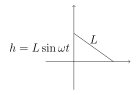
- Since we have \(h'' + \omega^2 h = 0\) we must have that \(h(t) = A \cos \omega t + B \sin \omega t\). The initial conditions tell us that \(A = 0\) and \(B = L\), so \(h(t) = L \sin \omega t\).
Therefore we can see the angle at \(B\) is \(\omega t\) and so \(P\) has \(y\)-coordinate \((1-s)L \sin \omega t\) and \(x\)-coordinate \(sL \cos \omega t\)
- If the position is \(\binom{sL \cos \omega t}{(1-s) L \sin \omega t}\) then the acceleration is \(-\omega^2 \binom{sL \cos \omega t}{(1-s) L \sin \omega t}\)
- \begin{align*} \text{N2}(\rightarrow): && - F\cos \omega t + N \sin \omega t &= -m\omega^2 sL \cos \omega t\\ \text{N2}(\uparrow): && -mg + F\sin \omega t + N \cos \omega t &= -m\omega^2 (1-s) L \sin \omega t \\ \Rightarrow && \begin{pmatrix} \cos \omega t & -\sin \omega t \\ \sin \omega t & \cos \omega t \end{pmatrix} \begin{pmatrix} F \\ N \end{pmatrix} &= \begin{pmatrix} m\omega^2 s L \cos \omega t \\ mg - m\omega^2(1-s)L \sin \omega t \end{pmatrix} \\ \Rightarrow && \begin{pmatrix}F \\ N \end{pmatrix} &= \begin{pmatrix} \cos \omega t & \sin \omega t \\ -\sin \omega t & \cos \omega t \end{pmatrix} \begin{pmatrix} m\omega^2 s L \cos \omega t \\ mg - m\omega^2(1-s)L \sin \omega t \end{pmatrix} \\ \Rightarrow && N &= m \omega^2 s L (-\sin \omega t \cos \omega t) + mg \cos \omega t - m \omega^2 (1-s)L \sin \omega t \cos \omega t \\ &&&=mg \cos \omega t - m \omega^2 L \sin \omega t \cos \omega t \\ &&&= mg \cos \omega t \left (1 - \frac{L \omega^2}{g} \sin \omega t \right) \\ &&&= mg (1 - k \sin \omega t) \cos \omega t \\ \Rightarrow && F &= m \omega^2 s L \cos^2 \omega t + mg \sin \omega t - m \omega^2 (1-s) L \sin ^2 \omega t \\ &&&= m \omega^2 s L + mg \sin \omega t - m \omega^2 L \sin^2 \omega t \\ &&&= mg \frac{\omega^2 L}{g} s + mg(1-\frac{\omega^2 L}{g} \sin \omega t)\sin \omega t \\ &&&= mg sk + mg(1-k \sin \omega t) \cos \omega t \tan \omega t \\ &&&= mgsk + N \tan \omega t \end{align*}
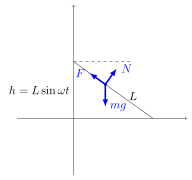
- The particle will not slip if \(F < \tan \alpha N\). When \(t = 0\), \(N = mg, F = mgsk\), but clearly \(sk < \tan \alpha \Rightarrow mgsk = F < \tan \alpha mg = \tan \alpha N\). The particle will slip when: \(F > \tan \alpha N\), but we have \(F = mgsk + N \tan \omega t\). Clearly when \(\omega t = \alpha\) we have reached a point where \(F > \tan \alpha N\). Therefore we must slip before we reach this point, ie at a point where the plank makes an angle of less than \(\alpha\) to the horizontal. Notice also that \(N\) changes sign when \(1-k \sin \omega t = 0\), however, to do this \(N\) must become very small, smaller than \(mgsk\), therefore we must slip before this point too. Since we slip before either condition occurs, we must be in a position when \(N\) is positive AND the plank still makes a shallow angle.
2019 Paper 1 Q1
A straight line passes through the fixed point \((1 , k)\) and has gradient \(- \tan \theta\), where \(k > 0\) and \(0 < \theta < \frac{1}{2}\pi\). Find, in terms of \(\theta\) and \(k\), the coordinates of the points \(X\) and \(Y\) where the line meets the \(x\)-axis and the \(y\)-axis respectively.
- Find an expression for the area \(A\) of triangle \(OXY\) in terms of \(k\) and \(\theta\). (The point \(O\) is the origin.) You are given that, as \(\theta\) varies, \(A\) has a minimum value. Find an expression in terms of \(k\) for this minimum value.
- Show that the length \(L\) of the perimeter of triangle \(OXY\) is given by $$L = 1 + \tan \theta + \sec \theta + k(1 + \cot \theta + \cosec \theta).$$ You are given that, as \(\theta\) varies, \(L\) has a minimum value. Show that this minimum value occurs when \(\theta = \alpha\) where $$\frac{1 - \cos \alpha}{1 - \sin \alpha} = k.$$ Find and simplify an expression for the minimum value of \(L\) in terms of \(\alpha\).
Solution: \(y = (-\tan \theta)(x-1)+k\) so when \(x = 0\), \(y = k + \tan \theta\), so \(Y = (0, k+\tan \theta)\). When \(y = 0\), \(x = 1 + \frac{k}{\tan \theta}\)
- \(A = \frac12 (k+\tan \theta)\left ( 1 + \frac{k}{\tan \theta} \right) = k + \frac12 \left (\tan \theta + \frac{k^2}{\tan \theta} \right)\) Notice that \(x + \frac{k^2}{x} \geq 2 k\) by AM-GM, so the minimum is \(k + \frac12 \cdot 2k = 2k\)
- \(\,\) \begin{align*} L &= k + \tan \theta + 1 + k \cot \theta + \sqrt{(k + \tan \theta)^2 + \left (1 + \frac{k}{\tan \theta} \right)^2} \\ &= k + \tan \theta + 1 + k \cot \theta + \sqrt{k^2 + 2 k \tan \theta +\tan^2 \theta + 1 + 2k \cot \theta + k^2\cot^2 \theta} \\ &= k + \tan \theta + 1 + k \cot \theta + \sqrt{\sec^2 \theta+ 2k \sec\theta\cosec \theta + k^2\cosec^2 \theta} \\ &= k + \tan \theta + 1 + k \cot \theta +\sec \theta + k\cosec \theta\\ &= 1 + \tan \theta + \sec \theta + k (1 + \cot \theta + \cosec \theta) \end{align*} \begin{align*} && \frac{\d L}{\d \theta} &= \sec^2 \theta + \tan \theta \sec \theta + k(-\cosec^2 \theta - \cot \theta \cosec \theta ) \\ \Rightarrow && 0 &=\sec^2 \alpha+ \tan \theta \sec \alpha+ k(-\cosec^2 \alpha- \cot \alpha\cosec \alpha) \\ \Rightarrow && k &= \frac{\sec^2 \alpha+ \tan \alpha\sec \alpha}{\cosec^2 \alpha+ \cot \alpha\cosec \alpha} \\ &&&= \frac{\sin^2 \alpha(1 + \sin \alpha)}{\cos^2 \alpha (1+ \cos \alpha)} \\ &&&= \frac{(1-\cos^2 \alpha)(1 + \sin \alpha)}{(1-\sin^2 \alpha )(1+ \cos \alpha)} \\ &&&= \frac{1-\cos \alpha}{1-\sin \alpha} \\ \Rightarrow && L &= 1 + \tan \alpha + \sec \alpha + \frac{1-\cos \alpha}{1-\sin \alpha} \left (1 + \cot \alpha + \cosec \alpha \right) \\ &&&= \frac{1+\tan \alpha + \sec \alpha -\sin \alpha-\sin \alpha \tan \alpha-\tan \alpha}{1-\sin \alpha} + \\ &&&\quad \quad \frac{1+\cot \alpha + \cosec \alpha-\cos \alpha-\cos \alpha \cot \alpha -\cot \alpha}{1-\sin \alpha} \\ &&&= \frac{2+\sec \alpha(1-\sin^2 \alpha)-\sin \alpha + \cosec \alpha(1-\cos^2 \alpha)-\cos \alpha}{1-\sin \alpha} \\ &&&= \frac{2+\cos\alpha-\sin \alpha + \sin\alpha-\cos \alpha}{1-\sin \alpha} \\ &&&= \frac{2}{1-\sin \alpha} \end{align*}
2019 Paper 1 Q3
By first multiplying the numerator and the denominator of the integrand by \((1 - \sin x)\), evaluate $$\int_0^{\frac{1}{4}\pi} \frac{1}{1 + \sin x} dx.$$ Evaluate also: $$\int_{\frac{1}{4}\pi}^{\frac{1}{3}\pi} \frac{1}{1 + \sec x} dx \quad \text{and} \quad \int_0^{\frac{1}{3}\pi} \frac{1}{(1 + \sin x)^2} dx.$$
Solution: \begin{align*} \int_0^{\frac{1}{4}\pi} \frac{1}{1 + \sin x} dx &= \int_0^{\frac{1}{4}\pi} \frac{1-\sin x}{1 - \sin^2 x} dx \\ &= \int_0^{\frac{1}{4}\pi} \frac{1-\sin x}{\cos^2 x} dx \\ &= \int_0^{\frac{1}{4}\pi} \sec^2 x - \sec x \tan x dx \\ &= \left [\tan x-\sec x \right]_0^{\frac{1}{4}\pi} \\ &= 2 - \frac{1}{\sqrt{2}} \end{align*} \begin{align*} \int_{\frac{1}{4}\pi}^{\frac{1}{3}\pi} \frac{1}{1 + \sec x} \d x &= \int_{\frac{1}{4}\pi}^{\frac{1}{3}\pi} \frac{1-\sec x}{1 - \sec^2 x} \d x \\ &= \int_{\frac{1}{4}\pi}^{\frac{1}{3}\pi} \frac{\sec x-1}{\tan^2 x} \d x \\ &= \int_{\frac{1}{4}\pi}^{\frac{1}{3}\pi} \cot x \cosec x-\cot^2 x\d x \\ &= \left [ -\cosec x +x+\cot x\right]_{\frac{1}{4}\pi}^{\frac{1}{3}\pi} \\ &= \l -\frac{2}{\sqrt3}+\frac{\pi}{3}+\frac{1}{\sqrt{3}}\r - \l-\sqrt{2}+\frac{\pi}{4}+1 \r \\ &= \frac{\pi}{12}-\frac{1}{\sqrt{3}}+\sqrt{2}-1 \end{align*} \begin{align*} \int_0^{\frac{1}{3}\pi} \frac{1}{(1 + \sin x)^2} \d x &= \int_0^{\frac{1}{3}\pi} \frac{1-2\sin x+\sin^2x}{(1-\sin^2 x)^2} \d x \\ &= \int_0^{\frac{1}{3}\pi} \frac{1-2\sin x+\sin^2x}{\cos^4 x} \d x \\ \end{align*} Splitting this up into: \begin{align*} \int_0^{\frac{1}{3}\pi} \frac{-2\sin x}{\cos^4 x} \d x &= -\frac23 \left [ \frac{1}{\cos^3 x}\right]_0^{\frac{1}{3}\pi} \\ &= -\frac{16}3+\frac23 \\ &= -\frac{14}3 \end{align*} and \begin{align*} && \int_0^{\frac{1}{3}\pi} \frac{1+\sin^2x}{\cos^4 x} \d x &= \int_0^{\frac{1}{3}\pi} (\sec^2 x + \tan^2 x) \sec^2 x \d x \\ &&&= \int_0^{\frac{1}{3}\pi} (1+ 2\tan^2 x) \sec^2 x \d x \\ u = \tan x, \d u = \sec^2 x \d x&&&= \int_0^{\sqrt{3}}(1+2u^2) \d u \\ &&&= \left [u + \frac23 u^3 \right]_0^{\sqrt{3}} \\ &&&= \sqrt{3} + 2\sqrt{3} \\ &&&= 3\sqrt{3} \end{align*} And so our complete integral is: \[ \int_0^{\frac{1}{3}\pi} \frac{1}{(1 + \sin x)^2} \d x = 3\sqrt{3} - \frac{14}3\]
2019 Paper 1 Q6
In both parts of this question, \(x\) is real and \(0 < \theta < \pi\).
- By completing the square, find in terms of \(\theta\) the minimum value as \(x\) varies of $$9x^2 - 12x \cos \theta + 4.$$ Find also the maximum value as \(x\) varies of \(12x^2 \sin \theta - 9x^4\). Hence determine the values of \(x\) and \(\theta\) that satisfy the equation $$9x^4 + (9 - 12 \sin \theta)x^2 - 12x \cos \theta + 4 = 0.$$
- Sketch the curve $$y = \frac{x^2}{x - \theta},$$ where \(\theta\) is a constant. Deduce that either \(\frac{x^2}{x - \theta} \leq 0\) or \(\frac{x^2}{x - \theta} \geq 4\theta\). By considering the numerator and denominator separately, or otherwise, show that $$\frac{\sin^2 \theta \cos^2 x}{1 + \cos^2 \theta \sin^2 x} \leq 1.$$ Hence determine the values of \(x\) and \(\theta\) that satisfy the equation $$\frac{x^2}{4\theta(x - \theta)} = \frac{\sin^2 \theta \cos^2 x}{1 + \cos^2 \theta \sin^2 x}.$$
Solution:
- \(\,\) \begin{align*} && y &= 9x^2 - 12x \cos \theta + 4 \\ &&&= (3x-2\cos \theta)^2+4-4\cos^2 \theta \\ &&&= (3x-2\cos \theta)^2 + 4 \sin^2 \theta \end{align*} Therefore the minimum is \(4\sin^2 \theta\) when \(x = \frac23 \cos \theta\). \begin{align*} && y &= 12x^2 \sin \theta - 9x^4 \\ &&&=4\sin^2 \theta -(3x^2-2\sin\theta)^2 \end{align*} Therefore the maximum is \(4\sin^2 \theta\) when \(x^2 = \frac23\sin \theta\) Therefore \begin{align*} && 0 &= 9x^4 + (9 - 12 \sin \theta)x^2 - 12x \cos \theta + 4 \\ && \underbrace{-9x^4+12x^2\sin \theta}_{\leq 4\sin^2 \theta } &= \underbrace{9x^2 - 12x \cos \theta + 4 }_{\geq 4 \sin^2 \theta} \end{align*} Therefore the equality cases must be achieved in both cases, ie \(x = \frac23 \cos \theta\) and \(x^2 = \frac23 \sin \theta\) \begin{align*} && x^2 &= \frac49\cos^2 \theta \\ &&&= \frac49(1-\sin^2 \theta) \\ &&&= \frac49(1-\frac94 x^2) \\ \Rightarrow && 2x^2 &= \frac49 \\ \Rightarrow && x &= \pm \frac{\sqrt{2}}3\\ \Rightarrow && \cos \theta &=\pm \frac32 \frac{\sqrt{2}}3 \\ &&&= \pm \frac{1}{\sqrt{2}} \\ \Rightarrow && \theta &= \frac{\pi}{4}, \frac{3\pi}{4} \\ \Rightarrow && (x, \theta) &= \left (\frac{\sqrt{2}}{3}, \frac{\pi}{4} \right), \left (-\frac{\sqrt{2}}{3}, \frac{3\pi}{4} \right) \end{align*}
- Sketching we obtain, noticing we can find the turning point by:
\begin{align*}
&& \frac{x^2}{x-\theta} &= \lambda \\
\Leftrightarrow && x^2 - \lambda x +\theta \lambda &= 0 \\
\Leftrightarrow && 0 &\leq \Delta = \lambda^2 -4\lambda \theta \\
\Leftrightarrow && \lambda &\geq 4 \theta, \lambda \leq 0
\end{align*}
Notice that \(\sin^2 \theta \cos^2 x \leq 1\) and \(1 + cos^2 \theta \sin^2 x \geq 1\) and therefore we must have the inequality desired. \begin{align*} && \underbrace{\frac{x^2}{4\theta(x - \theta)}}_{\geq 1 \text{ or } \leq 0} &= \underbrace{\frac{\sin^2 \theta \cos^2 x}{1 + \cos^2 \theta \sin^2 x}}_{\in [0,1]} \\ \text{both}=0: && x = 0 &, \sin \theta = 0 \\ \text{both}=1: && x = 2\theta &, \sin^2 \theta = 1,\cos^2 x = 1 \\ && 1 &= \cos^2 2 \theta \\ &&&= (1-2 \sin^2 \theta)^2 \\ &&&= 1 \\ \Rightarrow && (x, \theta) &= \left(\frac{\pi}{2}, \pi\right) \end{align*}

2019 Paper 1 Q10
In this question, the \(x\)-axis is horizontal and the positive \(y\)-axis is vertically upwards. A particle is projected from the origin with speed \(u\) at an angle \(\alpha\) to the vertical. The particle passes through the fixed point \((h \tan \beta, h)\), where \(0 < \beta < 90^{\circ}\) and \(h > 0\).
- Show that
$$c^2 - ck \cot \beta + 1 + k \cot^2 \beta = 0, \quad (*)$$
where \(c = \cot \alpha\) and \(k = \frac{2u^2}{gh}\).
You are given that there are two distinct values of \(\alpha\) that satisfy equation \((*)\). Let \(\alpha_1\) and \(\alpha_2\) be these values.
- Show that $$\cot \alpha_1 + \cot \alpha_2 = k \cot \beta.$$ Show also that $$\alpha_1 + \alpha_2 = \beta.$$
- Show that $$k > 2(1 + \sec \beta).$$
- By considering the greatest height attained by the particle, show that \(k \geq 4 \sec^2 \alpha\).
Solution:
- The horizontal position of the particle at time \(t\) is \(u \sin\alpha t\), so \(T = \frac{h \tan \beta}{u \sin \alpha}\)
The vertical position of the particle at this time \(T\) satisifes:
\begin{align*}
&& h &= u \cos\alpha \frac{h \tan \beta}{u \sin\alpha} - \frac12 g \left ( \frac{h \tan \beta}{u \sin\alpha} \right)^2 \\
&&&= h\cot \alpha \tan \beta - \frac{gh^2}{2u^2} \tan^2 \beta \cosec^2 \beta \\
\Rightarrow && 1 &= c \tan \beta - \frac{1}{k} \tan^2 \beta (1 + c^2) \\
\Rightarrow && k \cot^2 \beta &= kc\cot \beta -1-c^2 \\
\Rightarrow && 0 &= c^2 -ck \cot \beta + 1 + k \cot^2 \beta
\end{align*}
- As a quadratic in \(c\) the sum of the roots is \(k \cot \beta\), therefore \(\cot \alpha_1 + \cot \alpha_2 = k \cot \beta\). We also have that \(\cot \alpha_1 \cot \alpha_2 = 1 + k \cot^2 \beta\), so \begin{align*} && \cot (\alpha_1 + \alpha_2) &= \frac{\cot \alpha_1 \cot \alpha_2-1}{\cot \alpha_1 + \cot \alpha_2} \\ &&&= \frac{1 + k \cot^2 \beta - 1}{k \cot \beta} \\ &&&= \cot \beta \\ \Rightarrow && \beta &= \alpha_1 + \alpha_2 \pmod{\pi} \end{align*} but since \(\alpha_i \in (0, \frac{\pi}{2})\) the equation must hold exactly.
- Since it has two real roots we must have \begin{align*} && 0 &<\Delta = k^2 \cot^2 \beta - 4 (1 + k \cot^2 \beta) \\ &&&= k^2 \cot^2 \beta-4k \cot^2 \beta -4 \\ &&&= \cot^2 \beta (k^2 - 4k - 4(\sec^2 \beta - 1)) \\ &&&= \cot^2 \beta ( (k-2)^2 -4\sec^2 \beta) \\ \Rightarrow && k &> 2 + 2\sec \beta = 2(1+\sec \beta) \end{align*}
- The greatest height will satisfy \(v^2 = u^2 + 2as\) so \(0 = u^2 \cos^2 \alpha - 2gh_{max} \Rightarrow 4\sec^2 \alpha = \frac{2u^2}{gh_{max}} = k_{max}\), but this decreases with \(h\), so the smallest \(k\) can be is \(4\sec^2 \alpha\), ie \(k \geq 4 \sec^2 \alpha\)
2019 Paper 2 Q9
A particle \(P\) is projected from a point \(O\) on horizontal ground with speed \(u\) and angle of projection \(\alpha\), where \(0 < \alpha < \frac{1}{2}\pi\).
- Show that if \(\sin \alpha < \frac{2\sqrt{2}}{3}\), then the distance \(OP\) is increasing throughout the flight. Show also that if \(\sin \alpha > \frac{2\sqrt{2}}{3}\), then \(OP\) will be decreasing at some time before the particle lands.
- At the same time as \(P\) is projected, a particle \(Q\) is projected horizontally from \(O\) with speed \(v\) along the ground in the opposite direction from the trajectory of \(P\). The ground is smooth. Show that if $$2\sqrt{2}v > (\sin \alpha - 2\sqrt{2} \cos \alpha)u,$$ then \(QP\) is increasing throughout the flight of \(P\).
Solution:
- Notice that \(P = \begin{pmatrix} u \cos \alpha t\\ u \sin \alpha t - \frac12 g t^2 \end{pmatrix}\), so \begin{align*} && |OP|^2 &= u^2 \cos^2 \alpha t^2 + \left (u \sin \alpha t - \frac12 g t^2 \right)^2 \\ &&&= u^2 \cos^2 \alpha t^2 +u^2 \sin^2 \alpha t^2 - u \sin \alpha g t^3 +\frac14 g^2 t^4 \\ &&&= u^2 t^2 -u\sin \alpha g t^3 + \frac14g^2t^4 \\ && \frac{\d |OP|^2}{\d t} &= 2u^2 t - 3u \sin \alpha g t^2+g^2 t^3 \\ &&&= t \left (2u^2 - 3u \sin \alpha (gt)+(gt)^2\right) \\ && \Delta &= 9u^2 \sin^2 \alpha -4 \cdot 2u^2 \cdot 1 \\ &&&= u^2 (9\sin^2 \alpha -8) \\ \end{align*} Therefore if \(\sin \alpha < \frac{2\sqrt{2}}3\) the discriminant is negative, the quadratic factor is always positive and the distance \(|OP|\) is always increasing. Similarly, if \(\sin \alpha > \frac{2 \sqrt{2}}3\) then the derivative has a root. This means somewhere on its (possibly extended) trajectory \(OP\) is decreasing. This must be before it lands, since if it were after it 'landed' then both the \(x\) and \(y\) distances are increasing, therefore it cannot occur after it 'lands'.
- Note that \(Q = \begin{pmatrix} -v t \\0 \end{pmatrix}\) \begin{align*} && |QP|^2 &= (u \cos \alpha t+vt)^2 + \left (u \sin \alpha t - \frac12 g t^2 \right)^2 \\ &&&= u^2 \cos^2 \alpha t^2+2u\cos \alpha v t^2 + v^2 t^2 +u^2 \sin^2 \alpha t^2 - u \sin \alpha g t^3 +\frac14 g^2 t^4 \\ &&&= (u^2+2u v \cos \alpha+v^2) t^2 - u \sin \alpha g t^3 + \frac14 g^2 t^4 \\ \\ \Rightarrow && \frac{\d |QP|^2}{\d t} &= 2(u^2+u v \cos \alpha+v^2) t - 3u \sin \alpha g t^2 + g^2 t^3 \\ &&&= t \left ( 2(u^2+2u v \cos \alpha+v^2) - 3u \sin \alpha (g t) + (g t)^2\right) \\ && \Delta &= 9u^2 \sin^2 \alpha - 8(u^2+2u v \cos \alpha+v^2) \\ &&&= (9 \sin^2 \alpha -8)u^2 - 16v \cos \alpha u - 8v^2 \\ &&&= \left (( \sin \alpha-2\sqrt{2}\cos \alpha)u-2\sqrt{2} v \right) \left ( ( \sin \alpha+2\sqrt{2}\cos \alpha)u+2\sqrt{2} v \right) \end{align*} Since the second bracket is clearly positive, the first bracket must be negative (for \(\Delta < 0\) and our derivative to be positive), ie \(2\sqrt{2} v > ( \sin \alpha-2\sqrt{2}\cos \alpha)u\)
2018 Paper 2 Q2
A function \(\f(x)\) is said to be concave for \(a< x < b\) if \[ \ t\,\f(x_1) +(1-t)\,\f(x_2) \le \f\big(tx_1+ (1-t)x_2\big) \, ,\] for \(a< x_1 < b\,\), \(a< x_2< b\) and \(0\le t \le 1\,\). Illustrate this definition by means of a sketch, showing the chord joining the points \(\big(x_1, \f(x_1)\big) \) and \(\big(x_2, \f(x_2)\big) \), in the case \(x_1 < x_2\) and \(\f(x_1)< \f(x_2)\,\). Explain why a function \(\f(x)\) satisfying \(\f''(x)<0\) for \(a< x < b\) is concave for \(a< x < b\,\).
- By choosing \(t\), \(x_1\) and \(x_2\) suitably, show that, if \(\f(x)\) is concave for \(a< x < b\,\), then \[ \f\Big(\frac{u+ v+w}3\Big) \ge \frac{ \f(u) +\f(v) +\f(w)}3 \, ,\] for \(a< u < b\,\), \(a< v < b\,\) and \(a< w < b\,\).
- Show that, if \(A\), \(B\) and \(C\) are the angles of a triangle, then \[ \sin A +\sin B + \sin C \le \frac{3\sqrt3}2 \,. \]
- By considering \(\ln (\sin x)\), show that, if \(A\), \(B\) and \(C\) are the angles of a triangle, then \[ \sin A \times \sin B \times \sin C \le \frac {3 \sqrt 3} 8 \,. \]
Solution:
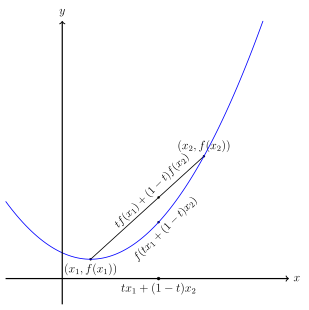
- \(\,\) \begin{align*} && f \left ( \frac{u+v+w}{3} \right) &= f \left ( \frac{2}{3}\cdot \frac{u+v}2+\frac{1}{3}w \right) \\ &&&\geq \frac23 f \left ( \frac{u+v}{2} \right) + \frac13 f(w) \\ &&&\geq \frac23 \left (\frac12 f(u) + \frac12 f(v) \right) + \frac13 f(w) \\ &&&= \frac{f(u)+f(v)+f(w)}{3} \end{align*}
- Notice that if \(A, B, C\) are angles in a triangle then they add to \(\pi\) \(0 < A,B,C < \pi\). We also have \(f(x) = \sin x \Rightarrow f''(x) = - \sin x < 0\) on this interval. Therefore \(\sin A + \sin B + \sin C \leq 3 \sin \frac{A+B+C}{3} = 3 \sin \frac{\pi}{3} = \frac{3\sqrt{3}}2\)
- Also notice that \begin{align*} && f(x) &= \ln ( \sin x) \\ \Rightarrow && f'(x) &= \frac{\cos x}{ \sin x} \\ && f''(x) &= -\textrm{cosec}^2 x < 0 \\ \\ \Rightarrow && \ln( \sin A) + \ln (\sin B) + \ln (\sin C) &\leq 3 \ln \left (\sin \left ( \frac{A + B+ C}{3} \right) \right) \\ &&&= 3 \ln \left ( \frac{\sqrt{3}}{2} \right) = \ln \frac{3\sqrt{3}}{8} \\ \Rightarrow && \sin A \sin B \sin C &\leq \frac{3\sqrt{3}}8 \end{align*}
2018 Paper 2 Q3
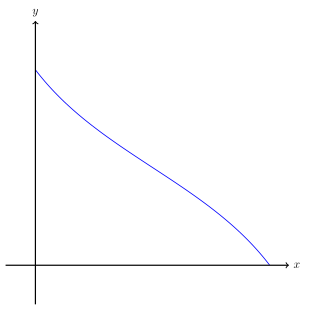
- Let \[ \f(x) = \frac 1 {1+\tan x} \] for \(0\le x < \frac12\pi\,\). Show that \(\f'(x)= -\dfrac{1}{1+\sin 2x}\) and hence find the range of \(\f'(x)\). Sketch the curve \(y=\f(x)\).
- The function \(\g(x)\) is continuous for \(-1\le x \le 1\,\). Show that the curve \(y=\g(x)\) has rotational symmetry of order 2 about the point \((a,b)\) on the curve if and only if \[ \g(x) + \g(2a-x) = 2b\,. \] Given that the curve \(y=\g(x)\) passes through the origin and has rotational symmetry of order 2 about the origin, write down the value of \[\displaystyle \int_{-1}^1 \g(x)\,\d x\,. \]
- Show that the curve \(y=\dfrac{1}{1+\tan^kx}\,\), where \(k\) is a positive constant and \(0 < x < \frac12\pi\,\), has rotational symmetry of order 2 about a certain point (which you should specify) and evaluate \[ \int_{\frac16\pi}^{\frac13\pi} \frac 1 {1+\tan^kx} \, \d x \,. \]
Solution:
- \(\,\) \begin{align*}
&& f(x) &= \frac1{1+\tan x} \\
&& f'(x) &=-(1+\tan x)^{-2} \cdot \sec^2 x \\
&&&= - (\cos x+ \sin x)^{-2} \\
&&&= - (1 + 2 \sin x \cos x)^{-1} \\
&&&= - \frac{1}{1+\sin 2x}
\end{align*}
\(\sin 2x \in [0, 1]\) so \(1+\sin 2x \in [1,2]\) and \(f'(x) \in [-1, -\tfrac12]\)
- \(\displaystyle \int_{-1}^1 g(x) \d x = 2g(0) \)
- Let \(g(x) = \frac{1}{1 + \tan^k x}\) then \(g(x)\) has rotational symmetry of order \(2\) about the point \((\frac{\pi}{4}, \frac12)\) which we can see since \begin{align*} g(x) + g(\tfrac12\pi - x) &= \frac{1}{1 + \tan^k x} + \frac{1}{1 + \tan^k(\tfrac12\pi - x)} \\ &= \frac{1}{1+\tan^k x} + \frac{1}{1+\cot^k x} \\ &= \frac{1}{1+\tan^k x} + \frac{\tan^k x}{\tan^k x + 1} \\ &= 1 = 2 \cdot \tfrac12 \end{align*} Therefore \[ \int_{\frac16\pi}^{\frac13\pi} \frac 1 {1+\tan^kx} \, \d x = \frac{\pi}{6} \cdot \frac12 = \frac{\pi}{12}\]
2018 Paper 3 Q4
The point \(P(a\sec \theta, b\tan \theta )\) lies on the hyperbola \[ \dfrac{x^{2}}{a^{2}}-\dfrac{y^{2}}{b^{2}}=1\,, \] where \(a>b>0\,\). Show that the equation of the tangent to the hyperbola at \(P\) can be written as \[ bx- ay \sin\theta = ab \cos\theta \,. \]
- This tangent meets the lines \(\dfrac x a = \dfrac yb\) and \(\dfrac x a =- \dfrac y b\) at \(S\) and \(T\), respectively. How is the mid-point of \(ST\) related to \(P\)?
- The point \(Q(a\sec \phi, b\tan \phi)\) also lies on the hyperbola and the tangents to the hyperbola at \(P\) and \(Q\) are perpendicular. These two tangents intersect at \((x,y)\). Obtain expressions for \(x^2\) and \(y^2\) in terms of \(a\), \(\theta\) and \(\phi\). Hence, or otherwise, show that \(x^2+y^2 = a^2 -b^2\).
Solution: Note that \begin{align*} && \frac{\d a \sec \theta}{\d \theta} &= a \sec \theta \tan \theta \\ && \frac{\d b \tan \theta}{\d \theta} &= b \sec^2 \theta \\ \Rightarrow && \frac{\d y}{\d x} &= \frac{b \sec^2 \theta}{a \sec \theta \tan \theta} \\ &&&= \frac{b}{a} \frac{1}{\sin \theta} \\ \Rightarrow && \frac{y-b \tan \theta}{x - a \sec \theta} &= \frac{b}{a} \frac{1}{\sin \theta} \\ \Rightarrow && a \sin \theta y - ab \tan \theta \sin \theta &= bx -ab \sec \theta \\ \Rightarrow && bx-ay\sin \theta &= ab \sec x (1 - \sin ^2 \theta) \\ &&&= ab \cos \theta \end{align*}
- \begin{align*} S: &&& \begin{cases} bx-ay &= 0 \\ bx-ay \sin \theta &= ab \cos \theta \end{cases} \\ \Rightarrow && ay(1-\sin \theta) &= ab \cos \theta \\ \Rightarrow && y &= \frac{b \cos \theta}{1-\sin \theta} \\ &&x &=\frac{a\cos \theta}{1-\sin \theta} \\ T: &&& \begin{cases} bx+ay &= 0 \\ bx-ay \sin \theta &= ab \cos \theta \end{cases} \\ \Rightarrow && ay(1+\sin \theta) &= -ab \cos \theta \\ \Rightarrow && y &= \frac{-b \cos \theta}{1+\sin \theta} \\ &&x &=\frac{a\cos \theta}{1+\sin \theta} \\ M: && x &= \frac{a \cos \theta}{2} \frac{2}{1-\sin^2 \theta} \\ &&&= a \sec \theta \\ && y &= \frac{b \cos \theta}{2} \frac{2 \sin \theta}{1-\sin^2 \theta} \\ &&&= b \tan \theta \end{align*} The midpoint of \(ST\) is the same as \(P\).
- The tangents are perpendicular, therefore \(\frac{b}{a} \cosec \theta = - \frac{a}{b} \sin \phi\), ie \(b^2 = -a^2 \sin \phi \sin \theta\) The will intersect at: \begin{align*} &&& \begin{cases} bx - ay \sin \theta &= ab \cos \theta \\ bx - ay \sin \phi &= ab \cos \phi \end{cases} \\ \Rightarrow && ay ( \sin \theta - \sin \phi) &= ab(\cos \phi - \cos \theta) \\ \Rightarrow && y &= \frac{b(\cos \phi - \cos \theta)}{(\sin \theta - \sin \phi)} \\ && y^2 &= \frac{-a^2 \sin \phi \sin \theta (\cos\phi - \cos \theta)^2}{(\sin \theta - \sin \phi)^2} \\ \Rightarrow && bx(\sin \phi - \sin \theta) &= ab(\cos \theta \sin \phi - \cos \phi \sin \theta) \\ \Rightarrow && x &= \frac{a(\cos \theta \sin \phi - \cos \phi \sin \theta)}{\sin \phi - \sin \theta} \\ &&&= \frac{a^2(\cos \theta \sin \phi - \cos \phi \sin \theta)^2}{(\sin \phi - \sin \theta)^2} \end{align*} Therefore \begin{align*} && x^2+y^2 &= \frac{a^2}{(\sin \phi - \sin \theta)^2} \l (\cos \theta \sin \phi- \cos \phi \sin \theta)^2 - \sin \phi \sin \theta (\cos\phi - \cos \theta)^2 \r \\ &&&= \frac{a^2}{(\sin \phi - \sin \theta)^2} \l (\sin \phi - \sin \theta)(\cos^2 \theta \sin \phi - \sin \theta \cos^2 \phi) \r \\ &&&=a^2-b^2 \end{align*}
2017 Paper 1 Q1
- Use the substitution \(u= x\sin x +\cos x\) to find \[ \int \frac{x }{x\tan x +1 } \, \d x \,. \] Find by means of a similar substitution, or otherwise, \[ \int \frac{x }{x\cot x -1 } \, \d x \,. \]
- Use a substitution to find \[ \int \frac{x\sec^2 x \, \tan x}{x\sec^2 x -\tan x} \,\d x \, \] and \[ \int \frac{x\sin x \cos x}{(x-\sin x \cos x)^2} \, \d x \,. \]
Solution:
- \(\,\) \begin{align*} && I &= \int \frac{x}{x \tan x + 1} \d x \\ &&&= \int \frac{x \cos x}{x \sin x + \cos x} \d x \\ u = x \sin x + \cos x , \d u = x \cos x \d x: &&&= \int \frac{\d u}{u} \\ &&&= \ln u + C \\ &&&= \ln (x \sin x + \cos x) + C \\ \\ && J &= \int \frac{x}{x \cot x - 1} \d x \\ &&&= \int \frac{x \sin x }{x \cos x - \sin x} \d x \\ u = x \cos x - \sin x, \d u = x \sin x \d x: &&&= \int \frac{1}{u} \d u \\ &&&= \ln u + K \\ &&&= \ln (x \cos x -\sin x) + K \end{align*}
- \(\,\) \begin{align*} && I &= \int \frac{x \sec^2 x \tan x}{x \sec^2 x - \tan x} \d x \\ u = x\sec^2 x-\tan x, \d u = 2x \sec^2 x \tan x&&&= \frac12 \int \frac{1}{u} \d u \\ &&&= \frac12 \ln (x \sec^2 x - \tan x) + C \\ \\ && J &= \int \frac{x \sin x \cos x}{(x - \sin x \cos x)^2} \d x \\ u = x \sec^2 x -\tan x, \d u=2x \frac{\sin x}{\cos^3 x} &&&= \int \frac{x \sin x \cos x}{\cos^4x(x\sec^2 x -\tan x)^2} \d x \\ &&&= \frac12 \int \frac{1}{u^2} \d u \\ &&&= -\frac12u^{-1} + K \\ &&&= \frac{1}{2(\tan x - x \sec^2 x)} + K \end{align*}
2017 Paper 1 Q5
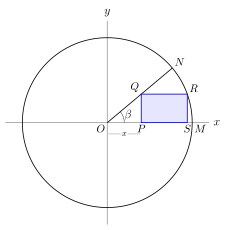
A circle of radius \(a\) is centred at the origin \(O\). A rectangle \(PQRS\) lies in the minor sector \(OMN\) of this circle where \(M\) is \((a,0)\) and \(N\) is \((a \cos \beta, a \sin \beta)\), and \(\beta\) is a constant with \(0 < \beta < \frac{\pi}{2}\,\). Vertex \(P\) lies on the positive \(x\)-axis at \((x,0)\); vertex \(Q\) lies on \(ON\); vertex \(R\) lies on the arc of the circle between \(M\) and \(N\); and vertex \(S\) lies on the positive \(x\)-axis at \((s,0)\). Show that the area \(A\) of the rectangle can be written in the form \[ A= x(s-x)\tan\beta \,. \] Obtain an expression for \(s\) in terms of \(a\), \(x\) and \(\beta\), and use it to show that \[ \frac{\d A}{\d x} = (s-2x) \tan \beta - \frac {x^2} s \tan^3\beta \,. \] Deduce that the greatest possible area of rectangle \(PQRS\) occurs when \(s= x(1+\sec\beta)\) and show that this greatest area is \(\tfrac12 a^2 \tan \frac12 \beta\,\). Show also that this greatest area occurs when \(\angle ROS = \frac12\beta\,\).
Solution:
2017 Paper 1 Q9
A particle is projected at speed \(u\) from a point \(O\) on a horizontal plane. It passes through a fixed point \(P\) which is at a horizontal distance \(d\) from \(O\) and at a height \(d \tan \beta\) above the plane, where \(d>0\) and \(\beta \) is an acute angle. The angle of projection \(\alpha\) is chosen so that \(u\) is as small as possible.
- Show that \(u^2 = gd \tan \alpha\) and \(2\alpha = \beta + 90^\circ\,\).
- At what angle to the horizontal is the particle travelling when it passes through \(P\)? Express your answer in terms of \(\alpha\) in its simplest form.
Solution:
- \(\,\) \begin{align*} && d &= u \cos \alpha t \\ && d \tan \beta &= u \sin \alpha t - \frac12 gt^2 \\ && &= d\tan \alpha - \frac1{2u^2} g d^2 \sec^2 \alpha \\ \Rightarrow && u^2 &= \frac{gd \sec^2 \alpha}{2(\tan \alpha + \tan \beta)} \\ &&&= \frac{gd t^2}{2(t+\tan \beta)} \\ && \frac{\d}{\d t} \left (u^2 \right) &= \frac{2gdt\cdot 2(t+\tan \beta) - gdt^2 \cdot 2}{4(t+\tan \beta)^2} \\ &&&= \frac{2gdt(2t-t+2\tan \beta)}{4(t+\tan \beta)^2} \\ &&&= \frac{gdt(t+2\tan \beta)}{2(t+\tan \beta)^2} \\ \end{align*} So either \(t = 0\) or \(t = -2 \tan \beta\) \begin{align*} && u^2 &= \frac{gd\cdot 4 \tan^2 \beta}{2(-2\tan \beta + \tan \beta)} \\ &&&= \frac{2gd \tan \beta}{-1} \\ &&&= gd (-2\tan \beta) \\ &&&= gd \tan \alpha \end{align*} \begin{align*} && d \tan \beta &= d \tan \alpha - \frac12 \frac{gd^2}{gd \tan \alpha \cdot \cos^2 \alpha } \\ \Rightarrow && \tan \beta&= \tan \alpha - \frac{1}{2\sin \alpha \cos \alpha} \\ &&&= \frac{2 \sin^2 \alpha - 1}{2 \sin \alpha \cos \alpha} \\ &&&= \frac{-\cos 2 \alpha}{\sin 2 \alpha} \\ &&&= -\cot 2 \alpha \\ &&&= \tan (2\alpha - 90^\circ) \\ \Rightarrow && \beta &= 2\alpha - 90^\circ \\ \Rightarrow && 2\alpha &= \beta + 90^\circ \end{align*}
- Suppose the angle to the horizontal is \(\theta\), then \(\tan \theta = \frac{v_y}{v_x}\) so \begin{align*} && \tan \theta &= \frac{u \sin \alpha - gt}{u \cos \alpha} \\ &&&= \frac{u \sin \alpha - \frac12 g \frac{d}{u \cos \alpha}}{u \cos \alpha} \\ &&&= \frac{u^2\sin \alpha \cos \alpha - gd}{u^2 \cos^2 \alpha} \\ &&&= \frac{gd \tan \alpha \sin \alpha \cos \alpha- gd}{ gd \tan \alpha \cdot \cos^2 \alpha} \\ &&&= \frac{\tan \alpha \sin \alpha \cos \alpha - 1}{ \sin \alpha \cos \alpha} \\ &&&= \frac{\sin^2 \alpha - 1}{\sin \alpha \cos \alpha} \\ &&&= -\frac{\cos \alpha}{\sin \alpha}\\ &&&= - \cot \alpha = \tan (\alpha - 90^\circ)\\ \Rightarrow && \theta &= \alpha - 90^\circ \end{align*}
2017 Paper 2 Q3
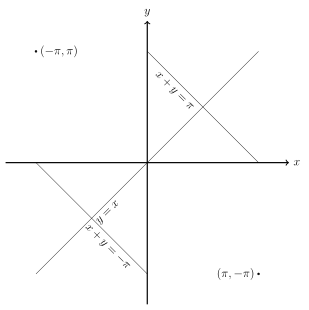
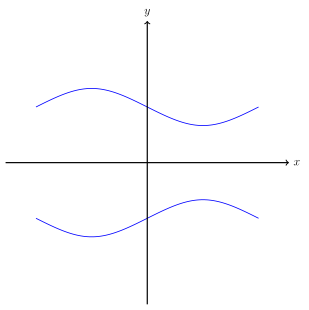
- Sketch, on \(x\)-\(y\) axes, the set of all points satisfying \(\sin y = \sin x\), for \(-\pi \le x \le \pi\) and \(-\pi \le y \le \pi\). You should give the equations of all the lines on your sketch.
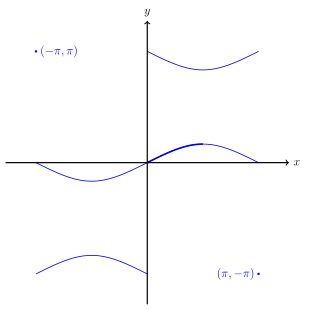
- Given that \[ \sin y = \tfrac12 \sin x \] obtain an expression, in terms of \(x\), for \(y'\) when \(0\le x \le \frac12 \pi\) and \(0\le y \le \frac12 \pi\), and show that \[ y'' = - \frac {3\sin x}{(4-\sin^2 x)^{\frac32}} \;. \] Use these results to sketch the set of all points satisfying \(\sin y = \tfrac12 \sin x\) for \(0 \le x \le \frac12 \pi\) and \(0 \le y \le \frac12 \pi\). Hence sketch the set of all points satisfying \(\sin y = \tfrac12 \sin x\) for \(-\pi\! \le \! x \! \le \! \pi\) and \mbox{\( -\pi \, \le\, y\, \le\, \pi\,\)}.
- Without further calculation, sketch the set of all points satisfying \(\cos y = \tfrac12 \sin x\) for \(- \pi \le x \le \pi\) and \( -\pi \le y \le \pi\).
Solution:
- \(\,\)
- \(\,\) \begin{align*}
&& \sin y &= \tfrac12 \sin x \\
\Rightarrow && \frac{\d y}{\d x} \cos y &= \tfrac12 \cos x \\
\Rightarrow && \frac{\d y}{\d x} &= \frac{\cos x}{2 \cos y} \\
&&&= \frac{\cos x}{2 \sqrt{1-\sin^2 y}} \\
&&&= \frac{\cos x}{2 \sqrt{1-\frac14 \sin^2 x}} \\
&&&= \frac{\cos x}{\sqrt{4-\sin^2 x}} \\
\\
&& y'' &= \frac{-\sin x \cdot (4-\sin^2 x)^{\frac12} - \cos x \cdot (4-\sin^2 x)^{-\frac12} \cdot 2 \sin x \cos x}{(4-\sin^2 x)} \\
&&&= \frac{-\sin x \cdot (4-\sin^2 x) - \cos x \cdot 2 \sin x \cos x}{(4-\sin^2x)^{\frac32}} \\
&&&= \frac{-\sin x \cdot (4-\sin^2 x) - \sin x (1-\sin^2x)}{(4-\sin^2x)^{\frac32}} \\
&&&= \frac{-3\sin x }{(4-\sin^2x)^{\frac32}} \\
\end{align*}
- \(\,\)
2017 Paper 2 Q9
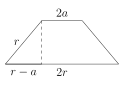
Two identical rough cylinders of radius \(r\) and weight \(W\) rest, not touching each other but a negligible distance apart, on a horizontal floor. A thin flat rough plank of width \(2a\), where \(a < r\), and weight \(kW\) rests symmetrically and horizontally on the cylinders, with its length parallel to the axes of the cylinders and its faces horizontal. A vertical cross-section is shown in the diagram below.
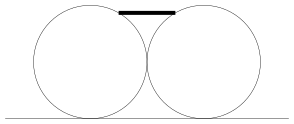
- Let \(F\) be the frictional force between one cylinder and the floor, and let \(R\) be the normal reaction between the plank and one cylinder. Show that \[ R\sin\theta = F(1+\cos\theta)\,, \] where \(\theta\) is the acute angle between the plank and the tangent to the cylinder at the point of contact. Deduce that \(2\sin\theta \le 1+\cos\theta\,\).
- Show that \[ N= \left( 1+\frac2 k\right)\left(\frac{1+\cos\theta}{\sin\theta} \right) F \,, \] where \(N\) is the normal reaction between the floor and one cylinder. Write down the condition that the cylinder does not slip on the floor and show that it is satisfied with no extra restrictions on \(\theta\).
- Show that \(\sin\theta\le\frac45\,\) and hence that \(r\le5a\,\).
Solution:
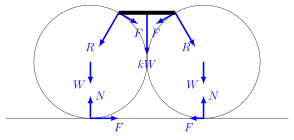
- \(\,\) \begin{align*} \text{N2}(\rightarrow, \text{ one cylinder}): && F\cos \theta + F - R \sin \theta &= 0 \\ \Rightarrow && F(1+\cos \theta) &= R \sin \theta \\ && F \leq \tfrac12 R \\ \Rightarrow && R \sin \theta &\leq \frac12 R(1+\cos \theta) \\ \Rightarrow && 2 \sin \theta &\leq 1 + \cos \theta \end{align*}
- \(\,\) \begin{align*} \text{N2}(\uparrow, \text{system}): && 2N-(k+2)W &= 0 \\ \Rightarrow && W &= \left ( \frac{2}{k+2} \right)N \\ \text{N2}(\uparrow, \text{one cylinder}): && N - W - R\cos \theta -F\sin \theta &= 0 \\ \Rightarrow && N - \left ( \frac{2}{k+2} \right)N - F \left ( \frac{1+\cos \theta}{\sin \theta} \right) \cos \theta - F \sin \theta &= 0 \\ \Rightarrow && \left ( \frac{k}{k+2} \right)N &= \left ( \frac{\cos \theta + \cos^2 \theta + \sin^2 \theta}{\sin \theta} \right) F\\ \Rightarrow && N &= \left ( 1 + \frac2{k} \right) \left ( \frac{\cos \theta + 1}{\sin \theta} \right) F \end{align*} The cylinder does not slip if \(F \leq \tfrac12 N\), ie \begin{align*} && N &\leq \left ( 1 + \frac2{k} \right) \left ( \frac{\cos \theta + 1}{\sin \theta} \right) \frac12 N \\ \Rightarrow && 2\sin \theta &\leq \left ( 1 + \frac2{k} \right) \left ( \cos \theta + 1 \right) \end{align*} but since \(2 \sin \theta \leq (1 + \cos \theta)\) and \((1+\frac2k) > 1\) this inequality is obviously satisfied.
- We can notice that \(2\sin \theta = 1 + \cos \theta\) is satisfied by a \(3-4-5\) triangle, where \(\sin \theta = 4/5, \cos \theta = 3/5\) and hence if \(\sin \theta \leq \frac45\) the condition must hold.
So \(\sin \theta = \frac{r-a}{r} \leq \frac45 \Rightarrow 5r-5a \leq 4r \Rightarrow r \leq 5a\)