Problems
Filters
218 problems found
2005 Paper 2 Q8
For \(x \ge 0\) the curve \(C\) is defined by $$ {\frac{\d y} {\d x}} = \frac{x^3y^2}{(1 + x^2)^{5/2}} $$ with \(y = 1\) when \(x=0\,\). Show that \[ \frac 1 y = \frac {2+3x^2}{3(1+x^2)^{3/2}} +\frac13 \] and hence that for large positive \(x\) $$ y \approx 3 - \frac 9 x\;. $$ Draw a sketch of \(C\). On a separate diagram, draw a sketch of the two curves defined for \(x \ge 0\) by $$ \frac {\d z} {\d x} = \frac{x^3z^3}{2(1 + x^2)^{5/2}} $$ with \(z = 1\) at \(x=0\) on one curve, and \(z = -1\) at \(x=0\) on the other.
Solution: \begin{align*} && {\frac{\d y} {\d x}} &= \frac{x^3y^2}{(1 + x^2)^{5/2}} \\ \Rightarrow &&\int \frac{1}{y^2} \d y &= \int \frac{x^3}{(1+x^2)^{5/2}} \d x \\ \Rightarrow && -\frac1y &= \int \frac{x^3+x-x}{(1+x^2)^{5/2}} \d x \\ &&&= \int \left ( \frac{x}{(1+x^2)^{3/2}}-\frac{x}{(1+x^2)^{5/2}} \right) \d x \\ &&&= \frac{-1}{(1+x^2)^{1/2}} + \frac{1}{3(1+x^2)^{3/2}} + C \\ &&&= \frac{1-3(1+x^2)}{3(1+x^2)^{3/2}} + C \\ &&&= \frac{-3x^2-2}{3(1+x^2)^{3/2}} + C \\ (x,y) = (0,1): &&-1 &= -\frac23 + C \\ \Rightarrow && C &= -\frac13 \\ \Rightarrow && \frac1y &= \frac{3x^2+2}{3(1+x^2)^{3/2}} + \frac13 \end{align*} \begin{align*} y &= \frac{1}{\frac13 +\frac{3x^2+2}{3(1+x^2)^{3/2}} } \\ &= \frac{3}{1+ \frac{3x^2+2}{3(1+x^2)^{3/2}}} \\ &= \frac{3}{1+ \frac{3}{x} + \cdots} \\ &\approx 3 - \frac{9}{x} \end{align*}


2005 Paper 2 Q14
The probability density function \(\f(x)\) of the random variable \(X\) is given by $$\f(x) = k\left[{\phi}(x) + {\lambda}\g(x)\right]$$ where \({\phi}(x)\) is the probability density function of a normal variate with mean 0 and variance 1, \(\lambda \) is a positive constant, and \(\g(x)\) is a probability density function defined by \[ \g(x)= \begin{cases} 1/\lambda & \mbox{for \(0 \le x \le {\lambda}\)}\,;\\ 0& \mbox{otherwise} . \end{cases} \] Find \(\mu\), the mean of \(X\), in terms of \(\lambda\), and prove that \(\sigma\), the standard deviation of \(X\), satisfies. $$\sigma^2 = \frac{\lambda^4 +4{\lambda}^3+12{\lambda}+12} {12(1 + \lambda )^2}\;.$$ In the case \(\lambda=2\):
- draw a sketch of the curve \(y=\f(x)\);
- express the cumulative distribution function of \(X\) in terms of \(\Phi(x)\), the cumulative distribution function corresponding to \(\phi(x)\);
- evaluate \(\P(0 < X < \mu+2\sigma)\), given that \(\Phi (\frac 23 + \frac23 \surd7)=0.9921\).
Solution: \begin{align*} && 1 &= \int_{-\infty}^{\infty} f(x) \d x \\ &&&= k[1 + \lambda] \\ \Rightarrow && k &= \frac{1}{1+\lambda} \\ \\ && \mu &= \int_{-\infty}^\infty x f(x) \d x \\ &&&= k \int_{-\infty}^\infty x \phi(x) \d x + k \lambda \int_{-\infty}^{\infty} x g(x) \d x \\ &&&= k \cdot 0 + k \lambda \cdot \frac{\lambda}{2} \\ &&&= \frac{\lambda^2}{2(1+\lambda)} \\ \\ && \E[X^2] &= \int_{-\infty}^\infty x^2 f(x) \d x \\ &&&= k \int_{-\infty}^\infty x^2 \phi(x) \d x + k \lambda \int_{-\infty}^{\infty} x^2 g(x) \d x \\ &&&= k \cdot 1 + k \lambda \int_0^{\lambda} \frac{x^2}{\lambda} \d \lambda \\ &&&= k + \frac{k \lambda^3}{3} \\ &&&= \frac{3+\lambda^3}{3(1+\lambda)} \\ && \var[X] &= \frac{3+\lambda^3}{3(1+\lambda)} - \frac{\lambda^4}{4(1+\lambda)^2} \\ &&& = \frac{(3+\lambda^3)4(1+\lambda) - 3\lambda^4}{12(1+\lambda)^2} \\ &&&= \frac{\lambda^4+4\lambda^3+12\lambda + 12}{12(1+\lambda)^2} \end{align*}
- \(\,\)
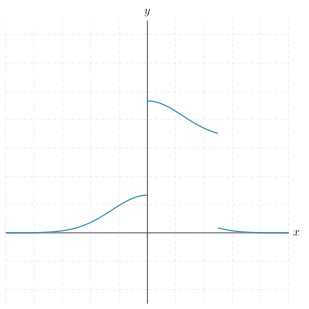
- \(\,\) \begin{align*} && \mathbb{P}(X \leq x) &= \int_{-\infty}^x f(x) \d x \\ &&&= \begin{cases} \frac13 \Phi(x) & \text{if } x < 0 \\ \frac13\Phi(x) + \frac13x & \text{if } 0 \leq x \leq 2 \\ \frac13 \Phi(x) + \frac23 & \text{if } 2 < x \end{cases} \end{align*} When \(\lambda = 2\), \(\mu = \frac{4}{6} = \frac23\), \(\sigma^2 = \frac{16+32+24+12}{12 \cdot 9} = \frac{7}{9}\), so \(\mu + 2 \sigma = \frac23 + \frac{2\sqrt7}{3}>2\). Therefore \begin{align*} && \P(0 < X < \mu + 2\sigma) &= \frac13 \Phi\left (\frac{2+2\sqrt{7}}{3} \right) + \frac23 - \Phi(0) \\ &&&= \tfrac13 \cdot 0.9921 +\tfrac23 - \tfrac12 \\ &&&= 0.4974 \end{align*}
2005 Paper 3 Q1
Show that \(\sin A = \cos B\) if and only if \(A = (4n+1)\frac{\pi}{2}\pm B\) for some integer \(n\). Show also that \(\big\vert\sin x \pm \cos x \big\vert \le \sqrt{2}\) for all values of \(x\) and deduce that there are no solutions to the equation \(\sin\left( \sin x \right) = \cos \left( \cos x \right)\). Sketch, on the same axes, the graphs of \(y= \sin \left( \sin x \right)\) and \(y = \cos \left( \cos x \right)\). Sketch, not on the previous axes, the graph of \(y= \sin \left(2 \sin x \right)\).
Solution: \begin{align*} && \sin A &= \cos B \\ \Leftrightarrow && 0 &= \sin A - \cos B \\ &&&= \sin A - \sin ( \frac{\pi}{2} - B) \\ &&&= 2 \sin \left ( \frac{A + B - \frac{\pi}{2}}{2} \right) \cos \left (\frac{A - B + \frac\pi2}{2} \right) \\ \Leftrightarrow && n \pi &= \frac{A+B - \frac{\pi}{2}}{2}, n\pi + \frac{\pi}{2} = \frac{A-B+\frac{\pi}{2}}{2} \\ \Leftrightarrow && A \pm B &= 2n\pi + \frac{\pi}{2} \\ &&&= (4n+1) \frac{\pi}{2} \end{align*} \begin{align*} |\sin x \pm \cos x| &= | \sqrt{2} \sin(x \pm \frac{\pi}{4} )| \\ & \leq \sqrt{2} \end{align*} Therefore if \(\sin(\sin x) = \cos (\cos x)\) we must have that \(|\sin x \pm \cos x| = |(4n+1) \frac{\pi}{2}| \geq \frac{\pi}{2} > 1.5 > \sqrt{2}\) contradiction.


2005 Paper 3 Q2
Find the general solution of the differential equation \(\displaystyle \frac{\mathrm{d}y}{\mathrm{d}x} = -\frac{xy}{x^2+a^2}\;\), where \(a\ne0\,\), and show that it can be written in the form \(\displaystyle y^2(x^2+a^2)= c^2\,\), where \(c\) is an arbitrary constant. Sketch this curve. Find an expression for \(\displaystyle \frac{\mathrm{d}}{\mathrm{d}x} (x^2+y^2)\) and show that \[ \frac{\mathrm{d^2}}{\mathrm{d}x^2} (x^2+y^2) = 2\left(1 -\frac {c^2}{(x^2+a^2)^2} \right) + \frac{8c^2x^2}{(x^2+a^2)^3}\;. \]
- Show that, if \(0 < c < a^2\), the points on the curve whose distance from the origin is least are \(\displaystyle \l 0\,,\;\pm \frac{c}{a}\r\).
- If \(c > a^2\), determine the points on the curve whose distance from the origin is least.
Solution: \begin{align*} && \frac{\d y}{\d x} &= - \frac{xy}{x^2+a^2} \\ \Rightarrow && \int \frac{1}{y} \d y &= \int -\frac{x}{x^2+a^2} \d x \\ && \ln |y| &= -\frac12 \ln |x^2 + a^2| + C \\ \Rightarrow && C' &= \ln y^2 + \ln (x^2+a^2) \\ \Rightarrow && c^2 &= y^2(x^2+a^2) \end{align*} (where the final constant \(c^2\) can be taken as a square since it is clearly positive).

- The shortest distance from the origin will have the first derivative as \(0\), ie \(x = 0\) or \(x^2 + a^2 = c\), but if \(c < a^2\) this can only occur for \(x = 0\), so the closest to the origin is \((0, \pm \frac{c}{a})\)
- If \(c > a^2\) then we can have \(x = 0\) or \(x = \pm \sqrt{c-a^2}\). Looking at the second derivative, when \(x = 0\) we have \(2(1- \frac{c^2}{a^4}) < 0\) which is a local maximum. When \(x = \pm\sqrt{c-a^2}\) we have \(8(c-a^2)c^2/c^3 > 0\) which is the minimum, therefore the points are \((\pm \sqrt{c-a^2}, c)\)

2004 Paper 1 Q2
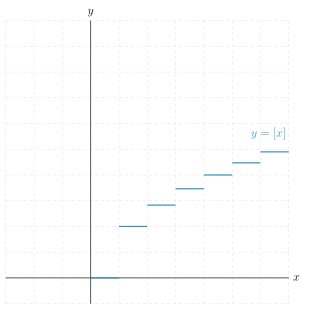
The square bracket notation \(\boldsymbol{[} x\boldsymbol{]}\) means the greatest integer less than or equal to \(x\,\). For example, \(\boldsymbol{[}\pi\boldsymbol{]} = 3\,\), \(\boldsymbol{[}\sqrt{24}\,\boldsymbol{]} = 4\,\) and \(\boldsymbol{[}5\boldsymbol{]}=5\,\).
- Sketch the graph of \(y = \sqrt{\boldsymbol{[}x\boldsymbol{]}}\) and show that \[ \displaystyle \int^a_0 \sqrt{\boldsymbol{[}x\boldsymbol{]}} \; \mathrm{d}x = \sum^{a-1}_{r=0} \sqrt{r} \] when \(a\) is a positive integer.
- Show that $\displaystyle \int^{a}_0 2_{\vphantom{A}}^{\pmb{\boldsymbol {[} } x \pmb{ \boldsymbol{]}} }\; \mathrm{d}x = 2^{a}-1\( when \)a\( is a positive integer.
- Determine an expression for \)\displaystyle \int^{a}_0 2_{\vphantom{\dot A}}^{\pmb{\boldsymbol{[} }x \pmb{ \boldsymbol{]}} } \; \mathrm{d}x\( when \)a$ is positive but not an integer.
Solution:
- \(\,\) \begin{align*} && \int_0^a \sqrt{\boldsymbol{[}x\boldsymbol{]}} \d x &= \sum_{r=0}^{a-1} \int_{x=r}^{x=r+1} \sqrt{\boldsymbol{[}x\boldsymbol{]}} \d x \\ &&&= \sum_{r=0}^{a-1} \int_r^{r+1} \sqrt{r} \d x \\ &&&= \sum_{r=0}^{a-1} \sqrt{r} \\ \end{align*}
- \(\,\) \begin{align*} && \int^{a}_0 2^{\boldsymbol {[} x \boldsymbol{]}} \d x &= \sum_{r=0}^{a-1} \int_{x=r}^{x=r+1} 2^{\boldsymbol {[} x \boldsymbol{]}} \d x \\ &&&= \sum_{r=0}^{a-1} \int_{x=r}^{x=r+1} 2^{r} \d x \\ &&&= \sum_{r=0}^{a-1} 2^{r}\\ &&&= 2^{a}-1 \end{align*}
- \(\,\) \begin{align*} && \int^{a}_0 2^{\boldsymbol {[} x \boldsymbol{]}} \d x &= \int_0^{\boldsymbol {[} a \boldsymbol{]}} 2^{\boldsymbol {[} x \boldsymbol{]}} \d x + \int_{\boldsymbol {[} a \boldsymbol{]}}^a 2^{\boldsymbol {[} x \boldsymbol{]}} \d x \\ &&&= 2^{ \boldsymbol {[} a \boldsymbol{]}}-1 + (a-\boldsymbol {[} a \boldsymbol{]})2^{\boldsymbol {[} a \boldsymbol{]}} \\ &&&= (a-\boldsymbol {[} a \boldsymbol{]}+1)2^{\boldsymbol {[} a \boldsymbol{]}} -1 \end{align*}
2004 Paper 2 Q2
Prove that, if \(\vert \alpha\vert < 2\sqrt{2},\) then there is no value of \(x\) for which \begin{equation} x^2 -{\alpha}\vert x \vert + 2 < 0\;. \tag{\(*\)} \end{equation} Find the solution set of \((*)\) for \({\alpha}=3\,\). For \({\alpha} > 2\sqrt{2}\,\), the sum of the lengths of the intervals in which \(x\) satisfies \((*)\) is denoted by \(S\,\). Find \(S\) in terms of \({\alpha}\) and deduce that \(S < 2{\alpha}\,\). Sketch the graph of \(S\,\) against \(\alpha \,\).
Solution: There are two cases to consider by they are equivalent to \(x^2 \pm \alpha x + 2 < 0\), which has no solution solutions if \(\Delta < 0\), ie if \(\alpha^2 - 4\cdot1\cdot2 < 0 \Leftrightarrow |\alpha| < 2\sqrt{2}\). If \(\alpha = 3\), we have \begin{align*} && 0 & > x^2-3x+2 \\ &&&= (x-2)(x-1) \\ \Rightarrow && x & \in (1,2) \\ \\ && 0 &> x^2+3x+2 \\ &&& = (x+2)(x+1) \\ \Rightarrow && x &\in (-2,-1) \end{align*} Both cases work here, so \(x \in (-2, -1) \cup (1,2)\). \begin{align*} && 0 &> x^2 \pm \alpha x + 2 \\ &&&= (x \pm \tfrac{\alpha}{2})^2 -\frac{\alpha^2-8}{4} \end{align*} The potential intervals therefore are \((\frac{\alpha -\sqrt{\alpha^2-8}}{2}, \frac{\alpha +\sqrt{\alpha^2-8}}{2})\) and \((\frac{-\alpha -\sqrt{\alpha^2-8}}{2}, \frac{-\alpha +\sqrt{\alpha^2-8}}{2})\). Neither of these intervals overlap with \(0\), since \(\alpha^2 > \alpha^2-8\), and their lengths are both \(\sqrt{\alpha^2-8}\), therefore \(S = 2\sqrt{\alpha^2-8} < 2\alpha\)

2004 Paper 2 Q3
The curve \(C\) has equation $$ y = x(x+1)(x-2)^4. $$ Determine the coordinates of all the stationary points of \(C\) and the nature of each. Sketch \(C\). In separate diagrams draw sketches of the curves whose equations are:
- \( y^2 = x(x+1)(x-2)^4\;\);
- \(y = x^2(x^2+1)(x^2-2)^4\,\).
Solution: \begin{align*} && y &= x(x+1)(x-2)^4 \\ \Rightarrow && y' &= (x+1)(x-2)^4+x(x-2)^4+4x(x+1)(x-2)^3 \\ &&&= (x-2)^3 \left ( (2x+1)(x-2)+4x(x+1) \right) \\ &&&= (x-2)^3 \left (2x^2-3x-2+4x^2+4x \right) \\ &&&=(x-2)^3(6x^2+x-2) \\ &&&=(x-2)^3(2x-1)(3x+2) \end{align*} Therefore there are stationary points at \((2,0), (\frac12, -\frac{625}{64}), (-\frac23, -\frac{4078}{81})\) \((0,2)\) is a minimum by considering the sign of \(y'\) either side. \( (-\frac23, \frac{2560}{729})\) is a minimum, since it's the first stationary point. \( (\frac12, \frac{243}{64})\) is a maximum since you can't have consecutive minima and the second derivative is clearly non-zero.

- \(\,\)

- \(\,\)

2004 Paper 2 Q8
Let \(x\) satisfy the differential equation $$ \frac {\d x}{\d t} = {\big( 1-x^n\big)\vphantom{\Big)}}^{\!1/n} $$ and the condition \(x=0\) when \(t=0 \,\).
- Solve the equation in the case \(n=1\) and sketch the graph of the solution for \(t > 0 \,\).
- Prove that \(1-x < (1-x^2)^{1/2} \) for \(0 < x < 1 \,\). Use this result to sketch the graph of the solution in the case \(n=2\) for \(0 < t < \frac12 \pi \,\), using the same axes as your previous sketch. By setting \(x=\sin y\,\), solve the equation in this case.
- Use the result (which you need not prove) \[ (1-x^2)^{1/2} < (1-x^3)^{1/3} \text{ \ \ for \ \ } 0 < x < 1 \;, \] to sketch, without solving the equation, the graph of the solution of the equation in the case \(n=3\) using the same axes as your previous sketches. Use your sketch to show that \(x=1\) at a value of \(t\) less than \(\frac12 \pi \,\).
Solution:
- \(\,\) \begin{align*}
&& \dot{x} &= (1-x) \\
\Rightarrow &&\int \frac{1}{1-x} \d x &= \int \d t \\
\Rightarrow && -\ln |1-x| &= t + C \\
t=0, x = 0: && -\ln 1 &= C \Rightarrow C = 0\\
\Rightarrow && -\ln|1-x| &= t \\
\Rightarrow && 1-x&= e^{-t} \\
\Rightarrow && x &= 1-e^{-t}
\end{align*}

- Notice that \((1-x^2)^{1/2} = (1-x)^{1/2}(1+x)^{1/2} > (1-x)^{1/2} > 1-x\)
\begin{align*} && \dot{x} &= \sqrt{1-x^2} \\ \Rightarrow && \int \frac{1}{\sqrt{1-x^2}} \d x &= t + C \\ x = \sin y, \d x = \cos y && \int \frac{\cos y}{\cos y} \d y &= t + C \\ \Rightarrow && y &= t + C \\ \Rightarrow && \sin^{-1} x &= t + C \\ t = 0, x = 0: && x &= \sin t \end{align*}

- \(\,\)
We know the gradient is steeper, so the solution must always be above \(\sin t\), which means it reaches \(1\) before \(\frac{\pi}{2}\)

2004 Paper 2 Q12
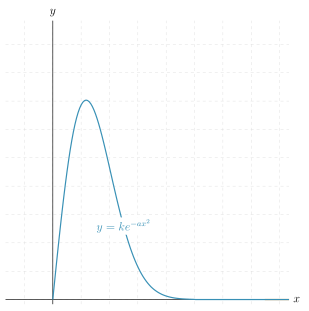
Sketch the graph, for \(x \ge 0\,\), of $$ y = kx\e^{-ax^2} \;, $$ where \(a\) and \(k\) are positive constants. The random variable \(X\) has probability density function \(\f(x)\) given by \begin{equation*} \f(x)= \begin{cases} kx\e^{-ax^2} & \text{for \(0 \le x \le 1\)}\\[3pt] 0 & \text{otherwise}. \end{cases} \end{equation*} Show that \(\displaystyle k=\frac{2a}{1-\e^{-a}}\) and find the mode \(m\) in terms of \(a\,\), distinguishing between the cases \(a < \frac12\) and \(a > \frac12\,\). Find the median \(h\) in terms of \(a\), and show that \(h > m\) if \(a > -\ln\left(2\e^{-1/2} - 1\right).\) Show that, \(-\ln\left(2\e^{-1/2}-1\right)> \frac12 \,\). Show also that, if \(a > -\ln\left(2\e^{-1/2} - 1\right) \,\), then $$ P(X > m \;\vert\; X < h) = {{2\e^{-1/2}-\e^{-a}-1} \over 1-\e^{-a}}\;. $$
Solution:
2004 Paper 3 Q2
The equation of a curve is \(y=\f ( x )\) where \[ \f ( x ) = x-4-\frac{16 \l 2x+1 \r^2}{x^2 \l x - 4 \r} \;. \]
- Write down the equations of the vertical and oblique asymptotes to the curve and show that the oblique asymptote is a tangent to the curve.
- Show that the equation \(\f ( x ) =0\) has a double root.
- Sketch the curve.
Solution:
- Clearly \(x = 0\) and \(x = 4\) are vertical asymptotes. Notice that \(\frac{16 \l 2x+1 \r^2}{x^2 \l x - 4 \r}\) tends to \(0\) as \(x \to \infty\). Therefore the oblique asymptote is \(y = x-4\).
- \begin{align*} && 0 &= \frac{x^2(x-4)^2-4^2(2x+1)^2}{x^2(x-4)} \\ &&&= \frac{(x(x-4)-4(2x+1))(x(x-4)+4(2x+1))}{x^2(x-4)} \\ &&&= \frac{(x^2-12x-4)(x^2+4x+4)}{x^2(x-4)}\\ &&&= \frac{(x^2-12x-4)(x+2)^2}{x^2(x-4)} \end{align*} Therefore \(f(x) = 0\) has a double root at \(x = -2\). Notice it also has roots at \(6 \pm 2\sqrt{10}\)

2004 Paper 3 Q3
Given that \(\f''(x) > 0\) when \(a \le x \le b\,\), explain with the aid of a sketch why \[ (b-a) \, \f \Big( {a+b \over 2} \Big) < \int^b_a \f(x) \, \mathrm{d}x < (b-a) \, \displaystyle \frac{\f(a) + \f(b)}{2} \;. \] By choosing suitable \(a\), \(b\) and \(\f(x)\,\), show that \[ {4 \over (2n-1)^2} < {1 \over n-1} - {1 \over n} < {1 \over 2} \l {1 \over n^2} + {1 \over (n-1)^2}\r \,, \] where \(n\) is an integer greater than 1. Deduce that \[ 4 \l {1 \over 3^2} +{1 \over 5^2} + {1 \over 7^2} + \cdots \r < 1 < {1 \over 2} + \left( {1 \over 2^2} +{1 \over 3^2} + {1 \over 4^2} + \cdots \right)\,. \] Show that \[ {1 \over 2} \l {1 \over 3^2} + {1 \over 4^2} + {1 \over 5^2} + \frac 1 {6^2} + \cdots \r < {1 \over 3^2} +{1 \over 5^2} + {1 \over 7^2} + \cdots \] and hence show that \[ {3 \over 2} \displaystyle < \sum_{n=1}^\infty {1 \over n^2} <{7 \over 4}\;. \]
2004 Paper 3 Q8
Show that if \[ {\mathrm{d}y \over \mathrm{d} x}=\f(x)y + {\g(x) \over y} \] then the substitution \(u = y^2\) gives a linear differential equation for \(u(x)\,\). Hence or otherwise solve the differential equation \[ {\mathrm{d}y \over \mathrm{d} x}={y \over x} - {1 \over y}\;. \] Determine the solution curves of this equation which pass through \((1 \,, 1)\,\), \((2\, , 2)\) and \((4 \, , 4)\) and sketch graphs of all three curves on the same axes.
Solution: \begin{align*} && \frac{\d y}{\d x} &= f(x) y + \frac{g(x)}{y} \\ && y \frac{\d y}{\d x} &= f(x) y^2 + g(x) \\ u = y^2: && \frac12 \frac{\d u}{\d x} &= f(x) u + g(x) \end{align*} Which is a linear differential equation for \(u\). \begin{align*} && \frac12 u' &= \frac1x u -1 \\ \Rightarrow && u' - \frac2xu &= -1 \\ \Rightarrow && \frac{1}{x^2} u' - \frac{2}{x^3} u &= -\frac{1}{x^2} \\ \Rightarrow && (\frac{u}{x^2})' &= - \frac{1}{x^2} \\ \Rightarrow && \frac{u}{x^2} &= \frac1x + C \\ \Rightarrow && u &= Cx^2 + x \\ \Rightarrow && y^2 &= Cx^2 + x \end{align*} If \((1,1)\) is on the curve then \(1 = C + 1 \Rightarrow C = 0 \Rightarrow y^2 = x\). If \((2,2)\) is on the curve then \(4 = 4C + 2 \Rightarrow C = \frac12 \Rightarrow y^2 = x + \frac12 x^2\). If \((3,3)\) is on the curve then \(9 = 9C + 3 \Rightarrow C = \frac23 \Rightarrow y^2 = x + \frac23 x^2\)

2003 Paper 2 Q6
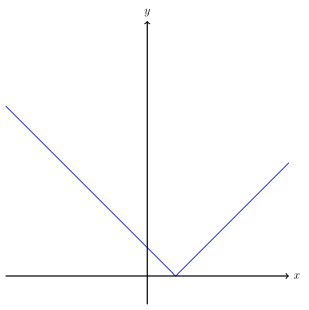
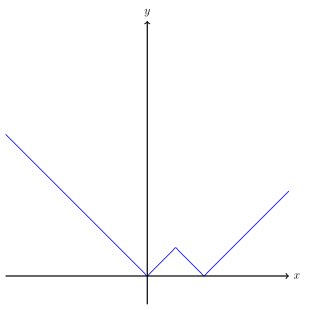
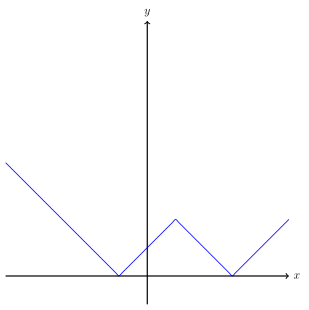
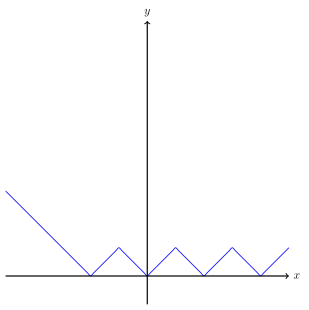
The function \(\f\) is defined by $$ \f(x)= \vert x-1 \vert\;, $$ where the domain is \({\bf R}\,\), the set of all real numbers. The function \(\g_n =\f^n\), with domain \({\bf R}\,\), so for example \(\g_3(x) = \f(\f(\f(x)))\,\). In separate diagrams, sketch graphs of \(\g_1\,\), \(\g_2\,\), \(\g_3\,\) and \(\g_4\,\). The function \(\h\) is defined by \[ \h(x) = |\sin {{{\pi}x} \over 2}|, \] where the domain is \({\bf R}\,\). Show that if \(n\) is even, \[ \int_0^n\,\big( \h(x)-\g_n(x)\big)\,\d x = \frac{2n}{\pi} -\frac{n}2\;. \]
Solution:
2003 Paper 2 Q8
It is given that \(y\) satisfies $$ {{\d y} \over { \d t}} + k\left({{t^2-3t+2} \over {t+1}}\right)y = 0\;, $$ where \(k\) is a constant, and \(y=A \) when \(t=0\,\), where \(A\) is a positive constant. Find \(y\) in terms of \(t\,\), \(k\) and \(A\,\). Show that \(y\) has two stationary values whose ratio is \((3/2)^{6k}\e^{-5{k}/2}.\) Describe the behaviour of \(y\) as \(t \to +\infty\) for the case where \(k> 0\) and for the case where \(k<0\,.\) In separate diagrams, sketch the graph of \(y\) for \(t>0\) for each of these cases.
Solution: \begin{align*} && \frac{\d y}{\d t} &= - k \left (\frac{t^2-3t+2}{t+1} \right) y \\ \Rightarrow && \int \frac1y \d y &= -k\int \left (t-4 + \frac{6}{t+1}\right) \d t \\ \Rightarrow && \ln y &= -k \left ( \frac12 t^2 -4t + 6\ln (t+1) \right) + C \\ (t,y) = (0,A): && \ln A &=C \\ \Rightarrow && \ln y &= -k \left ( \frac12 t^2 -4t + 6\ln (t+1) \right) + \ln A \\ && \ln \left ( \frac{y}{A}(t+1)^{6k} \right) &= -k \l \frac12 t^2 - 4t \r \\ \Rightarrow && y &= A\frac{\exp \l -k(\frac12 t^2-4t)\r}{(t+1)^{6k}} \end{align*} \(y\) wil have stationary values when \(\frac{\d y}{\d t} = 0\), ie \begin{align*} k \left (\frac{t^2-3t+2}{t+1} \right) y &= 0 \\ k \left ( \frac{(t-2)(t-1)}{t+1} \right) y &= 0 \end{align*} ie when \(y = 0, t = 1, t =2\). Clearly \(y = 0\) is not a solution, so \(y\) has the values: \begin{align*} t = 1: && y &= A\frac{\exp \l -k(\frac12 -4)\r}{(2)^{6k}} \\ &&&= A \frac{e^{7/2 k}}{2^{6k}} \\ t = 2: && y &= A\frac{\exp \l -k(2 -8)\r}{(3)^{6k}} \\ &&&= A \frac{e^{6 k}}{3^{6k}} \\ \text{ratio}: && \frac{e^{7/2k}}{2^{6k}} \cdot \frac{3^{6k}}{e^{6k}} &= (3/2)^{6k} e^{-5k/2} \end{align*} If \(k > 0\) as \(t \to \infty\) \(y \to 0\) since the \(e^{-kt^2/2}\) term dominates everything. If \(k < 0\) as \(t \to \infty\) \(y \to \infty\) as since the \(e^{-kt^2}\) term also dominates but now it growing to infinity faster than everything else.

2003 Paper 2 Q14
The probability of throwing a 6 with a biased die is \(p\,\). It is known that \(p\) is equal to one or other of the numbers \(A\) and \(B\) where \(0 < A < B < 1 \,\). Accordingly the following statistical test of the hypothesis \(H_0: \,p=B\) against the alternative hypothesis \(H_1: \,p=A\) is performed. The die is thrown repeatedly until a 6 is obtained. Then if \(X\) is the total number of throws, \(H_0\) is accepted if \(X \le M\,\), where \(M\) is a given positive integer; otherwise \(H_1\) is accepted. Let \({\alpha}\) be the probability that \(H_1\) is accepted if \(H_0\) is true, and let \({\beta}\) be the probability that \(H_0\) is accepted if \(H_1\) is true. Show that \({\beta} = 1- {\alpha}^K,\) where \(K\) is independent of \(M\) and is to be determined in terms of \(A\) and \(B\,\). Sketch the graph of \({\beta}\) against \({\alpha}\,\).
Solution: \(X \sim Geo(p)\). \(\alpha = \mathbb{P}(X > M | p = B) = (1-B)^{M}\) \(\beta = \mathbb{P}(X \leq M | p = A) = 1 - \mathbb{P}(X > M | p = A) = 1 - (1-A)^{M}\) \begin{align*} \ln \alpha &= M \ln(1-B) \\ \ln (1-\beta) &= M \ln(1-A) \\ \frac{\ln \alpha}{\ln (1-\beta)} &= \frac{\ln(1-B)}{\ln(1-A)} \\ \ln(1-\beta) &= \ln \alpha \frac{\ln (1-A)}{\ln(1-B)} \\ \beta &= 1- \alpha^{ \frac{\ln (1-A)}{\ln(1-B)} } \end{align*} and \(K = \frac{\ln (1-A)}{\ln(1-B)} \) Since \(0 < A < B < 1\) we must have that \(0 < 1 - B < 1-A < 1\) and \(\ln(1-B) < \ln(1-A) < 0\) so \(0 < K < 1\)
