2005 Paper 2 Q14
Year: 2005
Paper: 2
Question Number: 14
Course: LFM Stats And Pure
Section: Normal Distribution
Difficulty: 1600.0
Banger: 1469.5
normal distribution
probability density function
mixture distribution
uniform distribution
mean and variance
cumulative distribution function
curve sketching
standard normal
Problem
The probability density function \(\f(x)\) of the random variable \(X\) is given by
$$\f(x) = k\left[{\phi}(x) + {\lambda}\g(x)\right]$$
where \({\phi}(x)\) is the probability density function of a normal variate with mean 0 and variance 1, \(\lambda \) is a positive constant, and \(\g(x)\) is a probability density function defined by
\[ \g(x)= \begin{cases}
1/\lambda & \mbox{for \(0 \le x \le {\lambda}\)}\,;\\
0& \mbox{otherwise} .
\end{cases}
\]
Find \(\mu\), the mean of \(X\), in terms of \(\lambda\), and prove that \(\sigma\), the standard deviation of \(X\), satisfies.
$$\sigma^2 = \frac{\lambda^4 +4{\lambda}^3+12{\lambda}+12}
{12(1 + \lambda )^2}\;.$$
In the case \(\lambda=2\):
- draw a sketch of the curve \(y=\f(x)\);
- express the cumulative distribution function of \(X\) in terms of \(\Phi(x)\), the cumulative distribution function corresponding to \(\phi(x)\);
- evaluate \(\P(0 < X < \mu+2\sigma)\), given that \(\Phi (\frac 23 + \frac23 \surd7)=0.9921\).
Solution
\begin{align*}
&& 1 &= \int_{-\infty}^{\infty} f(x) \d x \\
&&&= k[1 + \lambda] \\
\Rightarrow && k &= \frac{1}{1+\lambda} \\
\\
&& \mu &= \int_{-\infty}^\infty x f(x) \d x \\
&&&= k \int_{-\infty}^\infty x \phi(x) \d x + k \lambda \int_{-\infty}^{\infty} x g(x) \d x \\
&&&= k \cdot 0 + k \lambda \cdot \frac{\lambda}{2} \\
&&&= \frac{\lambda^2}{2(1+\lambda)} \\
\\
&& \E[X^2] &= \int_{-\infty}^\infty x^2 f(x) \d x \\
&&&= k \int_{-\infty}^\infty x^2 \phi(x) \d x + k \lambda \int_{-\infty}^{\infty} x^2 g(x) \d x \\
&&&= k \cdot 1 + k \lambda \int_0^{\lambda} \frac{x^2}{\lambda} \d \lambda \\
&&&= k + \frac{k \lambda^3}{3} \\
&&&= \frac{3+\lambda^3}{3(1+\lambda)} \\
&& \var[X] &= \frac{3+\lambda^3}{3(1+\lambda)} - \frac{\lambda^4}{4(1+\lambda)^2} \\
&&& = \frac{(3+\lambda^3)4(1+\lambda) - 3\lambda^4}{12(1+\lambda)^2} \\
&&&= \frac{\lambda^4+4\lambda^3+12\lambda + 12}{12(1+\lambda)^2}
\end{align*}
- \(\,\)
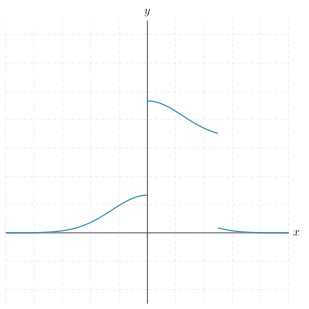
- \(\,\) \begin{align*} && \mathbb{P}(X \leq x) &= \int_{-\infty}^x f(x) \d x \\ &&&= \begin{cases} \frac13 \Phi(x) & \text{if } x < 0 \\ \frac13\Phi(x) + \frac13x & \text{if } 0 \leq x \leq 2 \\ \frac13 \Phi(x) + \frac23 & \text{if } 2 < x \end{cases} \end{align*} When \(\lambda = 2\), \(\mu = \frac{4}{6} = \frac23\), \(\sigma^2 = \frac{16+32+24+12}{12 \cdot 9} = \frac{7}{9}\), so \(\mu + 2 \sigma = \frac23 + \frac{2\sqrt7}{3}>2\). Therefore \begin{align*} && \P(0 < X < \mu + 2\sigma) &= \frac13 \Phi\left (\frac{2+2\sqrt{7}}{3} \right) + \frac23 - \Phi(0) \\ &&&= \tfrac13 \cdot 0.9921 +\tfrac23 - \tfrac12 \\ &&&= 0.4974 \end{align*}
Rating Information
Difficulty Rating: 1600.0
Difficulty Comparisons: 0
Banger Rating: 1469.5
Banger Comparisons: 2
Show LaTeX source
Problem source
The probability density function $\f(x)$ of the random variable $X$ is given by
$$\f(x) = k\left[{\phi}(x) + {\lambda}\g(x)\right]$$
where ${\phi}(x)$ is the probability density function  of a normal variate with mean 0 and variance 1, $\lambda $ is a positive constant, and $\g(x)$ is a probability density function defined by
\[ \g(x)= \begin{cases}
1/\lambda  & \mbox{for $0 \le x \le {\lambda}$}\,;\\
             0& \mbox{otherwise} .
\end{cases}
\]
Find $\mu$, the mean of $X$, in terms of $\lambda$, and prove that $\sigma$, the standard deviation of $X$, satisfies.
$$\sigma^2 = \frac{\lambda^4 +4{\lambda}^3+12{\lambda}+12}
         {12(1 + \lambda )^2}\;.$$
In  the case $\lambda=2$:
\begin{questionparts}
\item draw a sketch of the curve $y=\f(x)$;
\item express the cumulative distribution function of $X$ in terms of $\Phi(x)$, the cumulative distribution function corresponding to $\phi(x)$;
\item evaluate $\P(0 < X < \mu+2\sigma)$, given that
$\Phi (\frac 23 + \frac23 \surd7)=0.9921$.
\end{questionparts}
Solution source
\begin{align*}
&& 1 &= \int_{-\infty}^{\infty} f(x) \d x \\
&&&= k[1 + \lambda] \\
\Rightarrow && k &= \frac{1}{1+\lambda} \\
\\
&& \mu &= \int_{-\infty}^\infty x f(x) \d x \\
&&&= k \int_{-\infty}^\infty x \phi(x) \d x + k \lambda \int_{-\infty}^{\infty} x g(x) \d x \\
&&&= k \cdot 0 + k \lambda \cdot \frac{\lambda}{2} \\
&&&= \frac{\lambda^2}{2(1+\lambda)} \\
\\
&& \E[X^2] &= \int_{-\infty}^\infty x^2 f(x) \d x  \\
&&&= k \int_{-\infty}^\infty x^2 \phi(x) \d x + k \lambda \int_{-\infty}^{\infty} x^2 g(x) \d x \\
&&&= k \cdot 1 + k \lambda \int_0^{\lambda} \frac{x^2}{\lambda} \d \lambda \\
&&&= k + \frac{k \lambda^3}{3} \\
&&&= \frac{3+\lambda^3}{3(1+\lambda)} \\
&& \var[X] &= \frac{3+\lambda^3}{3(1+\lambda)} - \frac{\lambda^4}{4(1+\lambda)^2} \\
&&& = \frac{(3+\lambda^3)4(1+\lambda) - 3\lambda^4}{12(1+\lambda)^2} \\
&&&= \frac{\lambda^4+4\lambda^3+12\lambda + 12}{12(1+\lambda)^2}
\end{align*}

\begin{questionparts}
\item $\,$
\begin{center}
    \begin{tikzpicture}
    \def\functionf(#1){1/sqrt(2*pi)*exp(-(#1)^2/2)};
    % \def\functiong(#1){sin(deg(10*#1))*exp(-#1)};
    \def\xl{-4};
    \def\xu{4};
    \def\yl{-0.25};
    \def\yu{.75};

    % Calculate scaling factors to make the plot square
    \pgfmathsetmacro{\xrange}{\xu-\xl}
    \pgfmathsetmacro{\yrange}{\yu-\yl}
    \pgfmathsetmacro{\xscale}{10/\xrange}
    \pgfmathsetmacro{\yscale}{10/\yrange}

    % Define the reusable styles to keep code clean
    \tikzset{
        x=\xscale cm, y=\yscale cm,
        axis/.style={thick, draw=black!80, -{Stealth[scale=1.2]}},
        grid/.style={thin, dashed, gray!30},
        curveA/.style={very thick, color=cyan!70!black, smooth},
        curveB/.style={very thick, color=orange!90!black, smooth},
        curveC/.style={very thick, color=green!70!black, smooth},
        dot/.style={circle, fill=black, inner sep=1.2pt},
        labelbox/.style={fill=white, inner sep=2pt, rounded corners=2pt} % Protects text from lines
    }


    % Draw background grid
    \draw[grid] (\xl,\yl) grid (\xu,\yu);

    % Set up axes
    \draw[axis] (\xl,0) -- (\xu,0) node[right, black] {$x$};
    \draw[axis] (0,\yl) -- (0,\yu) node[above, black] {$y$};

    % Define the bounding region with clip
    \begin{scope}
        \clip (\xl,\yl) rectangle (\xu,\yu);

        \draw[curveA, domain=\xl:0, samples=450]
            plot ({\x},{1/(1+2)*\functionf(\x)});
        \draw[curveA, domain=2:\xu, samples=450]
            plot ({\x},{1/(1+2)*\functionf(\x)});
        \draw[curveA, domain=0:2, samples=450]
            plot ({\x},{1/(1+2)*\functionf(\x) + 1/(1+2)});

        % \draw[curveB, domain=\xl:\xu, samples=450]
            % plot ({\x},{\functiong(\x)});
    \end{scope}


    \end{tikzpicture}
\end{center}

\item $\,$ \begin{align*} && \mathbb{P}(X \leq x) &= \int_{-\infty}^x f(x) \d x \\
&&&= \begin{cases}
\frac13 \Phi(x) & \text{if } x < 0 \\
\frac13\Phi(x) + \frac13x & \text{if } 0 \leq x \leq 2 \\
\frac13 \Phi(x) + \frac23 & \text{if } 2 < x
\end{cases}
\end{align*}

When $\lambda = 2$, $\mu = \frac{4}{6} = \frac23$, $\sigma^2 = \frac{16+32+24+12}{12 \cdot 9} = \frac{7}{9}$, so $\mu + 2 \sigma = \frac23 + \frac{2\sqrt7}{3}>2$.

Therefore \begin{align*}
&& \P(0 < X < \mu + 2\sigma) &= \frac13 \Phi\left (\frac{2+2\sqrt{7}}{3} \right) + \frac23 - \Phi(0) \\
&&&= \tfrac13 \cdot 0.9921 +\tfrac23 - \tfrac12 \\
&&&= 0.4974
\end{align*}
\end{questionparts}