Problems
Filters
1531 problems found
1997 Paper 2 Q10
\noindent{\it In this question the effect of gravity is to be neglected.} A small body of mass \(M\) is moving with velocity \(v\) along the axis of a long, smooth, fixed, circular cylinder of radius \(L\). An internal explosion splits the body into two spherical fragments, with masses \(qM\) and \((1-q)M\), where \(q\le\frac{1}{2}\). After bouncing perfectly elastically off the cylinder (one bounce each) the fragments collide and coalesce at a point \(\frac{1}{2}L\) from the axis. Show that \(q=\frac{3}{ 8}\). The collision occurs at a time \(5L/v\) after the explosion. Find the energy imparted to the fragments by the explosion, and find the velocity after coalescence.
1997 Paper 2 Q11
A tennis player serves from height \(H\) above horizontal ground, hitting the ball downwards with speed \(v\) at an angle \(\alpha\) below the horizontal. The ball just clears the net of height \(h\) at horizontal distance \(a\) from the server and hits the ground a further horizontal distance \(b\) beyond the net. Show that $$v^2 = \frac{ g(a+b)^2(1+\tan^2\alpha)}{ 2[H-(a+b)\tan\alpha]}$$ and $$\tan\alpha = \frac{2a+b }{ a(a+b)}H - \frac{a+b }{ ab}h \,.$$ By considering the signs of \(v^2\) and \(\tan\alpha\), find upper and lower bounds on \(H\) for such a serve to be possible.
Solution: We have \begin{align*} \rightarrow: && a &= v\cos \alpha t_{net} \\ \Rightarrow && t_{net} &= \frac{a}{v \cos \alpha} \\ \downarrow: && H-h &= v\sin \alpha t_{net} + \frac12 g t_{net}^2 \\ &&&= a \tan \alpha + \frac12 g \frac{a^2}{v^2} \sec^2 \alpha \\ &&&= a \tan \alpha + \frac{a^2g}{2v^2}(1 + \tan^2 \alpha) \tag{*}\\ \\ \rightarrow: && a+b &= v \cos \alpha t_{ground} \\ && t_{ground} &= \frac{a+b}{v \cos \alpha}\\ \downarrow: && H &= v\sin \alpha t_{ground} + \frac12 g t_{ground}^2 \\ &&&= (a+b)\tan \alpha + \frac{(a+b)^2g}{2v^2}(1+\tan^2\alpha) \tag{**} \\ \\ (**): && v^2 &= \frac{g(a+b)^2(1+\tan^2\alpha)}{2[H-(a+b)\tan \alpha]} \\ (a+b)^2(*) - a^2(**): && (a+b)^2(H-h) -a^2H &= [(a+b)^2a - a^2(a+b)]\tan \alpha \\ \Rightarrow && (2ab+b^2)H - (a+b)^2h &= ab(a+b) \tan \alpha \\ \Rightarrow && \tan \alpha &= \frac{2a+b}{a(a+b)}H - \frac{a+b}{ab} h \end{align*} Noting that \(v^2 \geq 0\) and the numerator is positive, we must have \begin{align*} && H &> (a+b)\tan \alpha \\ &&&= \frac{2a+b}{a}H - \frac{(a+b)^2}{ab} h \\ \Rightarrow && \frac{a+b}{a}H &< \frac{(a+b)^2}{ab} h \\ \Rightarrow && H &< \frac{a+b}{b} h \end{align*} Noting that \(\tan \alpha > 0\) we must have \begin{align*} && \frac{2a+b}{a(a+b)} H & > \frac{a+b}{ab} h \\ \Rightarrow && H &> \frac{(a+b)^2}{b(2a+b)}h \end{align*}
1997 Paper 2 Q12
The game of Cambridge Whispers starts with the first participant Albert flipping an un-biased coin and whispering to his neighbour Bertha whether it fell `heads' or `tails'. Bertha then whispers this information to her neighbour, and so on. The game ends when the final player Zebedee whispers to Albert and the game is won, by all players, if what Albert hears is correct. The acoustics are such that the listeners have, independently at each stage, only a probability of 2/3 of hearing correctly what is said. Find the probability that the game is won when there are just three players. By considering the binomial expansion of \((a+b)^n+(a-b)^n\), or otherwise, find a concise expression for the probability \(P\) that the game is won when is it played by \(n\) players each having a probability \(p\) of hearing correctly. % Show in particular that, if \(n\) is even, %\(P(n,1/10) = P(n,9/10)\).% How do you explain this apparent anomaly? To avoid the trauma of a lost game, the rules are now modified to require Albert to whisper to Bertha what he hears from Zebedee, and so keep the game going, if what he hears from Zebedee is not correct. Find the expected total number of times that Albert whispers to Bertha before the modified game ends. \noindent [You may use without proof the fact that \(\sum_1^\infty kx^{k-1}=(1-x)^{-2}\) for \(\vert x\vert<1\).]
1997 Paper 2 Q13
A needle of length two cm is dropped at random onto a large piece of paper ruled with parallel lines two cm apart.
- By considering the angle which the needle makes with the lines, find the probability that the needle crosses the nearest line given that its centre is \(x\) cm from it, where \(0 < x < 1\).
- Given that the centre of the needle is \(x\) cm from the nearest line and that the needle crosses that line, find the cumulative distribution function for the length of the shorter segment of the needle cut off by the line.
- Find the probability that the needle misses all the lines.
Solution:
- Suppose the needle's center is \(x\) cm from the nearest line and makes an angle of \(\theta\). Then if \(\sin \theta > x\) it will cross the line, otherwise it will not. Given that \(\theta \sim U(0, \frac{\pi}{2})\), we can see that \begin{align*} && \mathbb{P}(\text{needle crosses}) &= \mathbb{P}(\sin \theta > x) \\ &&&= \mathbb{P}(\theta > \sin^{-1} x) \\ &&&= 1-\frac{2\sin^{-1} x}{\pi} \end{align*}
- The length of the short segment is \(L = 1 - \frac{x}{\sin \theta}\) and \(\theta \sim U(\sin^{-1} x, \frac{\pi}{2})\). So \begin{align*} && F_L(l) &= \mathbb{P}(L < l) \\ &&&= \mathbb{P}\left (1 - \frac{x} {\sin \theta} < l\right) \\ &&&= \mathbb{P}\left ( \sin \theta < \frac{x}{1-l}\right) \\ &&&= \mathbb{P}\left (\theta < \sin^{-1} \frac{x}{1-l}\right) \\ &&&= \frac{ \sin^{-1} \frac{x}{1-l} - \sin^{-1} x }{\frac{\pi}{2} - \sin^{-1}x} \end{align*}
- The needle (with probability \(1\)) cannot hit \(2\) lines, so let's only consider the line it's nearest too. The distance to this line is uniform on \([0,1]\), and the so we want to calculate. \begin{align*} && \mathbb{P}(\text{needle crosses}) &= \int_0^1 \left (1 - \frac{2\sin^{-1}x}{\pi} \right) \d x \\ &&&= 1 - \frac{2}{\pi} \int_0^1 \sin^{-1} x \d x\\ &&&= 1 - \frac{2}{\pi} \left ( \frac{\pi}{2} - 1 \right) \\ &&&= \frac{2}{\pi} \end{align*} Therefore the probability it misses is \(1 - \frac{\pi}{2}\)
1997 Paper 2 Q14
Traffic enters a tunnel which is 9600 metres long, and in which overtaking is impossible. The number of vehicles which enter in any given time is governed by the Poisson distribution with mean 6 cars per minute. All vehicles travel at a constant speed until forced to slow down on catching up with a slower vehicle ahead. I enter the tunnel travelling at 30 m\(\,\)s\(^{-1}\) and all the other traffic is travelling at 32 m\(\,\)s\(^{-1}\). What is the expected number of vehicles in the queue behind me when I leave the tunnel? Assuming again that I travel at 30 m\(\,\)s\(^{-1}\), but that all the other vehicles are independently equally likely to be travelling at 30 m\(\,\)s\(^{-1}\) or 32 m\(\,\)s\(^{-1}\), find the probability that exactly two vehicles enter the tunnel within 20 seconds of my doing so and catch me up before I leave it. Find also the probability that there are exactly two vehicles queuing behind me when I leave the tunnel. \noindent [Ignore the lengths of the vehicles.]
1997 Paper 3 Q1
- By considering the series expansion of \((x^2+5x+4){\rm \; e}^x\) show that \[10{\rm\, e}=4+\frac{3^2}{1!}+\frac{4^2}{2!}+\frac{5^2}{3!}+\cdots\;.\]
- Show that \[5{\rm\, e}=1+\frac{2^2}{1!}+\frac{3^2}{2!}+\frac{4^2}{3!}+\cdots\;.\]
- Evaluate \[1+\frac{2^3}{1!}+\frac{3^3}{2!}+\frac{4^3}{3!}+\cdots\;.\]
Solution:
- \begin{align*} (x^2+5x+4)e^x &= \sum_{k=0}^\infty \frac{1}{k!} x^{k+2}+\sum_{k=0}^\infty \frac{5}{k!} x^{k+1}+\sum_{k=0}^\infty \frac{4}{k!} x^{k} \\ &= \sum_{k=0}^{\infty} \l \frac{1}{k!}+\frac{5}{(k+1)!}+\frac{4}{(k+2)!} \r x^{k+2} + 5x+4+4x \\ &= 4 + 9x + \sum_{k=0}^{\infty} \l \frac{(k+2)(k+1)}{(k+2)!}+\frac{5(k+2)}{(k+2)!}+\frac{4}{(k+2)!} \r x^{k+2}\\ &= 4 + 9x + \sum_{k=0}^{\infty} \l \frac{k^2+3k+2+5k+10+4}{(k+2)!} \r x^{k+2}\\ &= 4 + 9x + \sum_{k=0}^{\infty} \frac{(k+4)^2}{(k+2)!} x^{k+2}\\ &= 4 + 9x + \sum_{k=2}^{\infty} \frac{(k+2)^2}{k!} x^{k}\\ \end{align*} So when \(x = 1\) we have \[10e = 4 + \frac{3^2}{1!} + \frac{4^2}{2!} + \frac{5^2}{3!} + \cdots \]
- \begin{align*} (x^2+3x+1)e^x &= \sum_{k=0}^\infty \frac{1}{k!}x^{k+2}+\sum_{k=0}^\infty 3\frac{1}{k!}x^{k+1} + \sum_{k=0}^{\infty} \frac{1}{k!} x^k \\ &= 1+3x+\sum_{k=1}^{\infty} \l \frac1{(k-1)!}+\frac{3}{k!} + \frac{1}{(k+1)!} \r x^{k+1} \\ &= 1+3x+\sum_{k=1}^{\infty} \frac{(k+1)k + 3(k+1)+1}{(k+1)!}x^{k+1} \\ &= 1+3x+\sum_{k=1}^{\infty} \frac{k^2+4k+4}{(k+1)!}x^{k+1} \\ &= 1+3x+\sum_{k=0}^{\infty} \frac{(k+2)^2}{(k+1)!}x^{k+1} \\ &=1+3x+ \sum_{k=1}^{\infty} \frac{(k+1)^2}{k!}x^k \end{align*} Plugging in \(x=1\) we get the desired result.
- \begin{align*} && xe^x &= \sum_{k=0}^{\infty} \frac{x^{k+1}}{k!} \\ x\frac{\d}{\d x} : && x(1+x)e^x &= \sum_{k=0}^{\infty} \frac{(k+1)x^{k+1}}{k!} \\ x\frac{\d}{\d x} : && x(x(1+x)+1+2x)e^x &= \sum_{k=0}^{\infty} \frac{(k+1)^2x^{k+1}}{k!} \\ &&(x^3+3x^2+x)e^x &= \sum_{k=0}^{\infty} \frac{(k+1)^2x^{k+1}}{k!} \\ \frac{\d}{\d x} : && e^x(x^3+3x^2+x+3x^2+6x+1) &=\sum_{k=0}^{\infty} \frac{(k+1)^3x^{k}}{k!} \\ \Rightarrow && 15e &= 1 + \frac{2^3}{1!} + \frac{3^3}{2!} + \cdots \end{align*}
1997 Paper 3 Q2
Let \[\mathrm{f}(t)=\frac{\ln t}t\quad\text{ for }t>0.\] Sketch the graph of \(\mathrm{f}(t)\) and find its maximum value. How many positive values of \(t\) correspond to a given value of \(\mathrm f(t)\)? Find how many positive values of \(y\) satisfy \(x^y=y^x\) for a given positive value of \(x\). Sketch the set of points \((x,y)\) which satisfy \(x^y=y^x\) with \(x,y>0\).
1997 Paper 3 Q3
By considering the solutions of the equation \(z^n-1=0\), or otherwise, show that \[(z-\omega)(z-\omega^2)\dots(z-\omega^{n-1})=1+z+z^2+\dots+z^{n-1},\] where \(z\) is any complex number and \(\omega={\rm e}^{2\pi i/n}\). Let \(A_1,A_2,A_3,\dots,A_n\) be points equally spaced around a circle of radius \(r\) centred at \(O\) (so that they are the vertices of a regular \(n\)-sided polygon). Show that \[\overrightarrow{OA_1}+\overrightarrow{OA_2}+\overrightarrow{OA_3} +\dots+\overrightarrow{OA_n}=\mathbf0.\] Deduce, or prove otherwise, that \[\sum_{k=1}^n|A_1A_k|^2=2r^2n.\]
1997 Paper 3 Q4
In this question, you may assume that if \(k_1,\dots,k_n\) are distinct positive real numbers, then \[\frac1n\sum_{r=1}^nk_r>\left({\prod\limits_{r=1}^n} k_r\right )^{\!\! \frac1n},\] i.e. their arithmetic mean is greater than their geometric mean. Suppose that \(a\), \(b\), \(c\) and \(d\) are positive real numbers such that the polynomial \[{\rm f}(x)=x^4-4ax^3+6b^2x^2-4c^3x+d^4\] has four distinct positive roots.
- Show that \(pqr,qrs,rsp\) and \(spq\) are distinct, where \(p,q,r\) and \(s\) are the roots of the polynomial \(\mathrm{f}\).
- By considering the relationship between the coefficients of \(\mathrm{f}\) and its roots, show that \(c > d\).
- Explain why the polynomial \(\mathrm{f}'(x)\) must have three distinct roots.
- By differentiating \(\mathrm{f}\), show that \(b > c\).
- Show that \(a > b\).
Solution:
- Suppose \(pqr = qrs\), since the roots are positive, we can divide by \(qr\) to obtain \(p=s\) (a contradiction. Therefore all those terms are distinct.
- \(4c^3 = pqr+qrs+rsp+spq\), \(d^4 = pqrs\). Applying AM-GM, we obtain: \begin{align*} && c^3 = \frac{ pqr+qrs+rsp+spq}{4} & > \sqrt[4]{p^3q^3r^3s^3} = d^{3} \\ \Rightarrow && c &> d \end{align*}
- There must be a turning point between each root (since there are no repeated roots).
- \(f'(x) = 4x^3-12ax^2+12b^2-4c^3 = 4(x^3-3ax^2+3b^2-c^3)\). Letting the roots of this polynomial be \(\alpha, \beta, \gamma\) and again applying AM-GM, we must have: \begin{align*} && b^2 = \frac{\alpha\beta + \beta \gamma+\gamma \alpha}{3} &> \sqrt[3]{\alpha^2\beta^2\gamma^2} = c^2 \\ \Rightarrow && b &> c \end{align*}
- Again, since there are turning points between the roots of \(f'(x)\) we must have distinct roots for \(f''(x)\), ie: \(f''(x) = 3x^2-6ax+6b^2 = 3(x^2-2ax+b^2)\) has distinct real roots. But for this to occur we must have that \((2a)^2-4b^2 = 4(a^2-b^2) > 0\), ie \(a>b\)
1997 Paper 3 Q5
Find the ratio, over one revolution, of the distance moved by a wheel rolling on a flat surface to the distance traced out by a point on its circumference.
Solution: The point on the circumference will have position \((a\cos t, a \sin t )\) relative to the circumference where \(t \in [0, 2\pi]\). the wheel will travel \(2\pi a\), therefore the position is \((a\cos t + at, a \sin t )\). The total distance travelled can be computed using the arc length: \begin{align*} && s &= \int_0^{2\pi} \sqrt{\left ( \frac{\d y}{\d t} \right)^2 +\left ( \frac{\d x}{\d t} \right)^2} \d t \\ &&&= \int_0^{2\pi} \sqrt{(a - a\sin t)^2 +(a \cos t)^2 } \d t \\ &&&= a \int_0^{2\pi} \sqrt{2 - 2 \sin t } \d t \\ &&&= \sqrt{2}a \int_0^{2 \pi} \sqrt{1 - \sin t} \d t \\ &&&= \sqrt{2}a \int_0^{2 \pi} \frac{|\cos t|}{\sqrt{1 + \sin t}} \d t \\ &&&= 2\sqrt{2} a \int_{-\pi/2}^{\pi/2} \frac{\cos t}{\sqrt{1+\sin t}} \d t \\ &&&= 2\sqrt{2} a \left [ 2\sqrt{1+\sin t} \right]_{-\pi/2}^{\pi/2} \\ &&& = 2\sqrt{2} a 2\sqrt{2} \\ &&&= 8a \end{align*} Therefore the ratio is \(\frac{4}{\pi}\)
1997 Paper 3 Q6
Suppose that \(y_n\) satisfies the equations \[(1-x^2)\frac{{\rm d}^2y_n}{{\rm d}x^2}-x\frac{{\rm d}y_n}{{\rm d}x}+n^2y_n=0,\] \[y_n(1)=1,\quad y_n(x)=(-1)^ny_n(-x).\] If \(x=\cos\theta\), show that \[\frac{{\rm d}^2y_n}{{\rm d}\theta^2}+n^2y_n=0,\] and hence obtain \(y_n\) as a function of \(\theta\). Deduce that for \(|x|\leqslant1\) \[y_0=1,\quad y_1=x,\] \[y_{n+1}-2xy_n+y_{n-1}=0.\]
1997 Paper 3 Q7
For each positive integer \(n\), let \begin{align*} a_n&=\frac1{n+1}+\frac1{(n+1)(n+2)}+\frac1{(n+1)(n+2)(n+3)}+\cdots;\\ b_n&=\frac1{n+1}+\frac1{(n+1)^2}+\frac1{(n+1)^3}+\cdots. \end{align*}
- Evaluate \(b_n\).
- Show that \(0
- Deduce that \(a_n=n!{\rm e}-[n!{\rm e}]\) (where \([x]\) is the integer part of \(x\)).
- Hence show that \(\mathrm{e}\) is irrational.
1997 Paper 3 Q8
Let \(R_{\alpha}\) be the \(2\times2\) matrix that represents a rotation through the angle \(\alpha\) and let $$A=\begin{pmatrix}a&b\\b&c\end{pmatrix}.$$
- Find in terms of \(a\), \(b\) and \(c\) an angle \(\alpha\) such that \(R_{-\alpha}AR_{\alpha}\) is a diagonal matrix (i.e. has the value zero in top-right and bottom-left positions).
- Find values of \(a\), \(b\) and \(c\) such that the equation of the ellipse \[x^2+(y+2x\cot2\theta)^2=1\qquad(0 < \theta < \tfrac{1}{4}\pi)\] can be expressed in the form \[\begin{pmatrix}x&y\end{pmatrix}A\begin{pmatrix}x\\y\end{pmatrix}=1.\] Show that, for this \(A\), \(R_{-\alpha}AR_{\alpha}\) is diagonal if \(\alpha=\theta\). Express the non--zero elements of this matrix in terms of \(\theta\).
- Deduce, or show otherwise, that the minimum and maximum distances from the centre to the circumference of this ellipse are \(\tan\theta\) and \(\cot\theta\).
Solution: \begin{questionparts} \item \begin{align*} R_{-\alpha}AR_{\alpha} &= \begin{pmatrix} \cos \alpha & \sin\alpha \\ -\sin \alpha & \cos \alpha \end{pmatrix}\begin{pmatrix} a & b \\ b & c \end{pmatrix} \begin{pmatrix} \cos \alpha & -\sin\alpha \\ \sin \alpha & \cos \alpha \end{pmatrix} \\ &= \begin{pmatrix} \cos \alpha & \sin\alpha \\ -\sin \alpha & \cos \alpha \end{pmatrix} \begin{pmatrix} a\cos \alpha + b \sin \alpha & -a\sin\alpha + b \cos\alpha \\ b\cos\alpha + c \sin\alpha & c\cos\alpha-b\sin\alpha \end{pmatrix} \\ &= \begin{pmatrix} a\cos^2\alpha+2b\sin\alpha\cos\alpha+c\sin^2\alpha & -a\sin\alpha\cos \alpha+b\cos^2\alpha +c\sin\alpha\cos\alpha-b\sin^2 \alpha\\ (c-a)\sin\alpha\cos \alpha +b(\cos^2\alpha-\sin^2 \alpha) & a\sin^2 \alpha -2b\sin\alpha\cos\alpha+c\cos^2\alpha \end{pmatrix} \\ &= \begin{pmatrix} * & \frac{c-a}{2}\sin2\alpha+b \cos 2\alpha\\\frac{c-a}{2}\sin2\alpha+b \cos 2\alpha & * \end{pmatrix} \end{align*} Therefore this will be diagonal if \(\tan 2\alpha = \frac{2b}{a-c} \Rightarrow \alpha = \frac12 \tan^{-1} \l \frac{2b}{a-c} \r\) \item \begin{align*} x^2+(y+2x\cot2\theta)^2 &= x^2(1 + 4\cot^22\theta) + 4\cot2\theta xy + y^2 \\ &= \begin{pmatrix}x&y\end{pmatrix}\begin{pmatrix} 1 + 4\cot^22\theta & 2\cot 2\theta \\ 2\cot 2\theta & 1 \end{pmatrix}\begin{pmatrix}x\\y\end{pmatrix} \end{align*} Plugging this \(\mathbf{A}\) in our result from before we discover \begin{align*} \frac12 \tan^{-1} \l \frac{2b}{a-c} \r &= \frac12 \tan^{-1} \l \frac{4\cot 2\theta}{1 + 4\cot^22\theta-1} \r \\ &= \frac12 \tan^{-1} \l \tan 2 \theta \r \\ &= \theta \end{align*} Therefore, the matrix will be: \begin{align*} & \textrm{diag}\begin{pmatrix} (1+4\cot^2 2\theta)\cos^2 \theta + 4\cot2\theta \sin\theta\cos\theta + \sin^2 \theta \\ (1+4\cot^2 2\theta)\sin^2 \theta - 4\cot2\theta \sin\theta\cos\theta + \cos^2 \theta \end{pmatrix} \\ =& \textrm{diag}\begin{pmatrix} \cos^2\theta + \frac{\cos^2 2\theta}{\sin^2 \theta} + 2\cos 2\theta + \sin^2 \theta \\ \sin^2\theta + \frac{\cos^2 2\theta}{\cos^2 \theta} - 2\cos 2\theta + \cos^2 \theta \end{pmatrix} \\ =& \textrm{diag}\begin{pmatrix} 1 + \cos 2\theta \l \frac{\cos2\theta}{\sin^2 \theta} + 2\r \\ 1 + \cos 2\theta \l \frac{\cos2\theta}{\cos^2 \theta} - 2\r \\ \end{pmatrix} \\ =& \textrm{diag}\begin{pmatrix} 1 + \cos 2\theta \l \frac{\cos^2 \theta + \sin^2 \theta}{\sin^2 \theta}\r \\ 1 -\cos 2\theta \l \frac{-\cos^2 \theta - \sin^2 \theta}{\cos^2 \theta}\r \\ \end{pmatrix} \\ =& \textrm{diag}\begin{pmatrix} 1 + (\cos^2\theta - \sin^2 \theta) \cosec^2 \theta \\ 1 - (\cos^2\theta - \sin^2 \theta) \sec^2 \theta \\ \end{pmatrix} \\ =& \textrm{diag}\begin{pmatrix} \cot^2 \theta \\ \tan^2 \theta \\ \end{pmatrix} \\ \end{align*} Therefore this is a rotation of an ellipse with equation: \((\cot \theta x)^2 + (\tan \theta y)^2 = 1\), ie the shortest side and longest side are \(\cot \theta\) and \(\tan \theta\) respectively, but we know since \(0 < \theta < \tfrac{1}{4}\pi\) the shortest will be \(\tan \theta\) and the longest \(\cot \theta\).
1997 Paper 3 Q9
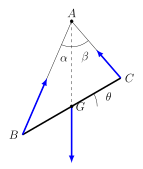
A uniform rigid rod \(BC\) is suspended from a fixed point \(A\) by light stretched springs \(AB,AC\). The springs are of different natural lengths but the ratio of tension to extension is the same constant \(\kappa\) for each. The rod is not hanging vertically. Show that the ratio of the lengths of the stretched springs is equal to the ratio of the natural lengths of the unstretched springs.
Solution:
1997 Paper 3 Q10
By pressing a finger down on it, a uniform spherical marble of radius \(a\) is made to slide along a horizontal table top with an initial linear velocity \(v_0\) and an initial {\em backward} angular velocity \(\omega_0\) about the horizontal axis perpendicular to \(v_0\). The frictional force between the marble and the table is constant (independent of speed). For what value of \(v_0/(a\omega_0)\) does the marble
- slide to a complete stop,
- come to a stop and then roll back towards its initial position with linear speed \(v_0/7\).
Solution:
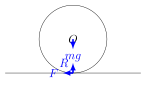
- If the ball completely stops, then \(\omega = v = 0 \Rightarrow \frac{2}{5}a \omega_0 - v_0 = 0 \Rightarrow \frac{v_0}{a \omega_0} = \frac25\).
- If the ball rolls backwards with linear speed \(v_0/7\), \(v = - \frac{v_0}{7}\) and \(a \omega = \frac{v_0}{7}\), \begin{align*} && \frac{2}{5}a \omega_0 - v_0 &= \frac{2}{5} \frac{v_0}{7} + \frac{v_0}{7} \\ && &= \frac{1}{5} v_0 \\ \Rightarrow && \frac{v_0}{a \omega_0} &= \frac{1}{3} \end{align*}