1997 Paper 3 Q10
Year: 1997
Paper: 3
Question Number: 10
Course: zNo longer examinable
Section: Moments of inertia
Difficulty: 1700.0
Banger: 1484.0
moments of inertia
friction
rolling and sliding
sphere
angular momentum
linear momentum
backward spin
rigid body dynamics
Problem
By pressing a finger down on it, a uniform spherical marble of radius \(a\) is made to slide along a horizontal table top with an initial linear velocity \(v_0\) and an initial {\em backward} angular velocity \(\omega_0\) about the horizontal axis perpendicular to \(v_0\). The frictional force between the marble and the table is constant (independent of speed).
For what value of \(v_0/(a\omega_0)\) does the marble
- slide to a complete stop,
- come to a stop and then roll back towards its initial position with linear speed \(v_0/7\).
Solution
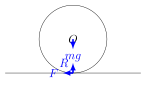
- If the ball completely stops, then \(\omega = v = 0 \Rightarrow \frac{2}{5}a \omega_0 - v_0 = 0 \Rightarrow \frac{v_0}{a \omega_0} = \frac25\).
- If the ball rolls backwards with linear speed \(v_0/7\), \(v = - \frac{v_0}{7}\) and \(a \omega = \frac{v_0}{7}\), \begin{align*} && \frac{2}{5}a \omega_0 - v_0 &= \frac{2}{5} \frac{v_0}{7} + \frac{v_0}{7} \\ && &= \frac{1}{5} v_0 \\ \Rightarrow && \frac{v_0}{a \omega_0} &= \frac{1}{3} \end{align*}
Rating Information
Difficulty Rating: 1700.0
Difficulty Comparisons: 0
Banger Rating: 1484.0
Banger Comparisons: 1
Show LaTeX source
Problem source
By pressing a finger down on it, a uniform spherical marble of radius $a$  is made to slide along a horizontal table top with an initial linear velocity $v_0$ and an initial {\em backward} angular velocity $\omega_0$ about the horizontal axis perpendicular to $v_0$. The frictional force between the marble and the table is constant (independent of speed).
For what value of $v_0/(a\omega_0)$ does the marble
\begin{questionparts}
\item slide to a complete stop,
\item come to a stop and then roll back towards its initial position with linear speed $v_0/7$.
\end{questionparts}
Solution source
\begin{center}
\begin{tikzpicture}[scale=1.2]
    \coordinate (O) at (0,0);
    \coordinate (P) at ({cos(20)}, {sin(20)});
    \coordinate (R) at (1, 0);
    \draw (O) circle (1);
    \draw (-2, -1) -- (2, -1);
    \node at (O) {$O$};
    % \node at (P) [circle,fill,inner sep=1.5pt] {};
    % \draw[dashed] (R) -- (O) -- (P);
    \draw[-latex, blue, ultra thick] (0, -1) -- ++(-0.3, 0) node[left] {$F$};
    \draw[-latex, blue, ultra thick] (0, -1) -- ++(0, 0.3) node[left] {$R$};
    \draw[-latex, blue, ultra thick] (O) -- ++(0, -0.3) node[below] {$mg$};
    % \pic [draw, angle radius=0.8cm, "$\theta$"] {angle = R--O--P};
\end{tikzpicture}
\end{center}
If the frictional force is $F$, then:

\begin{align*}
    L = I\ddot{\theta} && -Fa &= \frac{2}{5}ma^2 \dot{\omega} \\
    \text{N2}(\rightarrow) && -F &= m\dot{v} \\
    \\
    \Rightarrow && \l \frac{2}{5}ma \dot{\omega} - \dot{v} \r &= 0 \\
    \Rightarrow && \frac{2}{5}a \omega - v &= c \\
\end{align*}

\begin{enumerate}[(i)]
    \item If the ball completely stops, then $\omega = v = 0 \Rightarrow \frac{2}{5}a \omega_0 - v_0 = 0 \Rightarrow \frac{v_0}{a \omega_0} = \frac25$.
    \item If the ball rolls backwards with linear speed $v_0/7$, $v = - \frac{v_0}{7}$ and $a \omega = \frac{v_0}{7}$,
    \begin{align*}
        && \frac{2}{5}a \omega_0 - v_0 &= \frac{2}{5} \frac{v_0}{7} + \frac{v_0}{7}  \\
        && &= \frac{1}{5} v_0 \\
        \Rightarrow && \frac{v_0}{a \omega_0} &= \frac{1}{3}
    \end{align*}
\end{enumerate}