Problems
Filters
1531 problems found
1997 Paper 1 Q9
A single stream of cars, each of width \(a\) and exactly in line, is passing along a straight road of breadth \(b\) with speed \(V\). The distance between the successive cars is \(c\).
1997 Paper 1 Q10
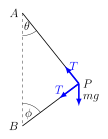
The point \(A\) is vertically above the point \(B\). A light inextensible string, with a smooth ring \(P\) of mass \(m\) threaded onto it, has its ends attached at \(A\) and \(B\). The plane \(APB\) rotates about \(AB\) with constant angular velocity \(\omega\) so that \(P\) describes a horizontal circle of radius \(r\) and the string is taut. The angle \(BAP\) has value \(\theta\) and the angle \(ABP\) has value \(\phi\). Show that \[\tan\frac{\phi-\theta}{2}=\frac{g}{r\omega^{2}}.\] Find the tension in the string in terms of \(m\), \(g\), \(r\), \(\omega\) and \(\sin\frac{1}{2}(\theta+\phi)\). Deduce from your results that if \(r\omega^2\) is small compared with \(g\), then the tension is approximately \(\frac{mg}{2}\)
Solution: None \begin{multicols}{2}
1997 Paper 1 Q11
A particle of unit mass is projected vertically upwards in a medium whose resistance is \(k\) times the square of the velocity of the particle. If the initial velocity is \(u\), prove that the velocity \(v\) after rising through a distance \(s\) satisfies \begin{equation*} v^{2}=u^{2}\e^{-2ks}+\frac{g}{k}(\e^{-2ks}-1). \tag{*} \end{equation*} Find an expression for the maximum height of the particle above he point of projection. Does equation \((*)\) still hold on the downward path? Justify your answer.
Solution: \begin{align*} \text{N2}(\uparrow): && 1 \cdot v\frac{\d v}{\d s} &= -g - kv^2 \\ \Rightarrow && \int \frac{v}{g+kv^2} \d v &= \int -1 \d s \\ \Rightarrow && \frac{1}{2k}\ln(g+kv^2) &= -s + C \\ s =0, v = u: && \frac{1}{2k} \ln(g+ku^2) &= C \\ \Rightarrow && s &= \frac{1}{2k} \ln \frac{g+ku^2}{g+kv^2} \\ \Rightarrow && e^{-2ks} &= \frac{g+kv^2}{g+ku^2} \\ \Rightarrow && v^2 &= u^2e^{-2ks} + \frac{g}{k}(e^{-2ks}-1) \end{align*} The maximum height will be when \(v = 0\), ie \(\displaystyle s = \frac{1}{2k}\ln\left(1 + \frac{k}{g}u^2 \right)\). On the downward path the resistance will be going upwards, ie \begin{align*} \text{N2}(\uparrow): && 1 \cdot v\frac{\d v}{\d s} &= -g + kv^2 \end{align*} but our solution is solving a different differential equation, therefore unless \(k=0\) the equation will be different.
1997 Paper 1 Q12
An experiment produces a random number \(T\) uniformly distributed on \([0,1]\). Let \(X\) be the larger root of the equation \[x^{2}+2x+T=0.\] What is the probability that \(X>-1/3\)? Find \(\mathbb{E}(X)\) and show that \(\mathrm{Var}(X)=1/18\). The experiment is repeated independently 800 times generating the larger roots \(X_{1}, X_{2}, \dots, X_{800}\). If \[Y=X_{1}+X_{2}+\dots+X_{800}.\] find an approximate value for \(K\) such that \[\mathrm{P}(Y\leqslant K)=0.08.\]
Solution: \((x+1)^2+T-1 = 0\) so the larger root is \(-1 + \sqrt{1-T}\) \begin{align*} && \mathbb{P}(X > -1/3) &= \mathbb{P}(-1 + \sqrt{1-T} > -1/3) \\ &&&= \mathbb{P}(\sqrt{1-T} > 2/3)\\ &&&= \mathbb{P}(1-T > 4/9)\\ &&&= \mathbb{P}\left (T < \frac59 \right) = \frac59 \end{align*} Similarly, for \(t \in [-1,0]\) \begin{align*} && \mathbb{P}(X \leq t) &= \mathbb{P}(-1 + \sqrt{1-T} \leq t) \\ &&&= \mathbb{P}(\sqrt{1-T} \leq t+1)\\ &&&= \mathbb{P}(1-T \leq (t+1)^2)\\ &&&= \mathbb{P}\left (T \geq 1-(t+1)^2\right) = (t+1)^2 \\ \Rightarrow && f_X(t) &= 2(t+1) \\ \Rightarrow && \E[X] &= \int_{-1}^0 x \cdot f_X(x) \d x \\ &&&= \int_{-1}^0 x2(x+1) \d x \\ &&&= \left [\frac23x^3+x^2 \right]_{-1}^0 \\ &&&= -\frac13 \\ && \E[X^2] &= \int_{-1}^0 x^2 \cdot f_X(x) \d x \\ &&&= \int_{-1}^0 2x^2(x+1) \d x \\ &&&= \left [ \frac12 x^4 + \frac23x^3\right]_{-1}^0 \\ &&&= \frac16 \\ \Rightarrow && \var[X] &= \E[X^2] - \left (\E[X] \right)^2 \\ &&&= \frac16 - \frac19 = \frac1{18} \end{align*} Notice that by the central limit theorem \(\frac{Y}{800} \approx N( -\tfrac13, \frac{1}{18 \cdot 800})\). Also notice that \(\Phi^{-1}(0.08) \approx -1.4 \approx -\sqrt{2}\) Therefore we are looking for roughly \(800 \cdot (-\frac13 -\frac{1}{\sqrt{18 \cdot 800}} \sqrt{2})) = -267-9 = -276\)
1997 Paper 1 Q13
Mr Blond returns to his flat to find it in complete darkness. He knows that this means that one of four assassins Mr 1, Mr 2, Mr 3 or Mr 4 has set a trap for him. His trained instinct tells him that the probability that Mr \(i\) has set the trap is \(i/10\). His knowledge of their habits tells him that Mr \(i\) uses a deadly trained silent anaconda with probability \((i+1)/10\), a bomb with probability \(i/10\) and a vicious attack canary with probability \((9-2i)/10\) \([i=1,2,3,4]\). He now listens carefully and, hearing no singing, concludes correctly that no canary is involved. If he switches on the light and the trap is a bomb he has probability \(1/2\) of being killed but if the trap is an anaconda he has probability \(2/3\) of survival. If he does not switch on the light and the trap is a bomb he is certain to survive but, if the trap is an anaconda, he has a probability \(1/2\) of being killed. His professional pride means that he must enter the flat. Advise Mr Blond, giving reasons for your advice.
Solution: \begin{array}{c|c|c|c} & A & B & C \\ \hline 1 & \frac{1}{10} \cdot \frac{2}{10} & \frac{1}{10} \cdot \frac{1}{10} & \frac{1}{10} \cdot \frac{7}{10} \\ 2 & \frac{2}{10} \cdot \frac{3}{10} &\frac{2}{10} \cdot \frac{2}{10} &\frac{2}{10} \cdot \frac{5}{10} \\ 3 & \frac{3}{10} \cdot \frac{4}{10} &\frac{3}{10} \cdot \frac{3}{10} &\frac{3}{10} \cdot \frac{3}{10} \\ 4 & \frac{4}{10} \cdot \frac{5}{10} &\frac{4}{10} \cdot \frac{4}{10} &\frac{4}{10} \cdot \frac{1}{10} \\ \hline & \frac{2+6+12+20}{100} & \frac{1 + 4 + 9 + 16}{100} & \frac{7 + 10 + 9 + 4}{100} \end{array} Therefore \(\mathbb{P}(A) = \frac{4}{10}, \mathbb{P}(B) = \frac{3}{10}, \mathbb{P}(C) = \frac{3}{10}\), in particular, \begin{align*} \mathbb{P}(A | \text{not }C) &= \frac{4}{7} \\ \mathbb{P}(B | \text{not }C) &= \frac{3}{7} \\ \end{align*} If he switches the light on, his probability of survival is \(\frac47 \cdot \frac23 + \frac37 \cdot \frac12 = \frac{25}{42}\), if he doesn't his probability is \(\frac12 \cdot \frac47 +\frac37= \frac{5}{7} = \frac{30}{42}\) therefore he shouldn't switch the light on.
1997 Paper 1 Q14
The maximum height \(X\) of flood water each year on a certain river is a random variable with density function \begin{equation*} {\mathrm f}(x)= \begin{cases} \exp(-x)&\text{if \(x\geqslant 0\),}\\ 0&\text{otherwise}. \end{cases} \end{equation*} It costs \(y\) megadollars each year to prepare for flood water of height \(y\) or less. If \(X\leqslant y\) no further costs are incurred but if \(X\geqslant y\) the cost of flood damage is \(r+s(X-y)\) megadollars where \(r,s>0\). The total cost \(T\) megadollars is thus given by \begin{equation*} T= \begin{cases} y&\text{if \(X\leqslant y\)},\\ y+r+s(X-y)&\text{if \(X>y\)}. \end{cases} \end{equation*} Show that we can minimise the expected total cost by taking \[y=\ln(r+s).\]
1997 Paper 2 Q1
Find the sum of those numbers between 1000 and 6000 every one of whose digits is one of the numbers \(0,\,2,\,5\) or \(7\), giving your answer as a product of primes.
Solution: The first digit is \(2\) or \(5\), all the other digits can be any value from \(0,2,5,7\). Therefore we have \begin{align*} S &= 2000 \cdot 4^3+5000 \cdot 4^3 + (200+500+700) \cdot 2 \cdot 4^2 + (20+50+70) \cdot 2 \cdot 4^2 + (2+5+7) \cdot 2 \cdot 4^2 \\ &= 7 \cdot 4^3 \cdot 2^3 \cdot 5^3 + 14 \cdot 2 \cdot 4^2 \cdot 111 \\ &= 2^{9} \cdot5^3 \cdot 7 + 2^{6} \cdot 3 \cdot 7 \cdot 37 \\ &= 2^6 \cdot 7 \cdot (1000+111) \\ &= 2^6 \cdot 7 \cdot 11 \cdot 101 \end{align*} Alternatively, consider adding the first and last terms, and second and second and last terms, etc we obtain \(7777\). There are \(2 \cdot 4^3\) terms so \(7777 \cdot 4^3 = 2^6 \cdot 7 \cdot 11 \cdot 101\)
1997 Paper 2 Q2
Suppose that $$3=\frac{2}{ x_1}=x_1+\frac{2}{ x_2} =x_2+\frac{2}{ x_3}=x_3+\frac{2}{ x_4}=\cdots.$$ Guess an expression, in terms of \(n\), for \(x_n\). Then, by induction or otherwise, prove the correctness of your guess.
Solution: \begin{align*} x_1 &= \frac{2}{3} \\ x_n &= \frac{2}{3-x_{n-1}} \\ x_2 &= \frac{2}{3 - \frac23} \\ &= \frac{6}7 \\ x_3 &= \frac{2}{3-\frac67} \\ &= \frac{14}{15} \\ x_4 &= \frac{2}{3 - \frac{14}{15}} \\ &= \frac{30}{31} \end{align*} Guess: \(x_n = \frac{2^{n+1}-2}{2^{n+1}-1}\). Proof: (By induction) (Base case): We have checked several initial cases. (Inductive step): Suppose our formula is true for \(n = k\), then consider: \begin{align*} x_{k+1} &= \frac{2}{3 - x_{k}} \\ &= \frac{2}{3 - \frac{2^{k+1}-2}{2^{k+1}-1}}\tag{assumption} \\ &= \frac{2\cdot(2^{k+1}-1)}{3 \cdot(2^{k+1}-1) - (2^{k+1}-2) } \\ &= \frac{2^{k+2}-2}{2\cdot 2^{k+1} - 3 + 2 } \\ &= \frac{2^{k+2}-2}{ 2^{k+2} - 1 } \\ \end{align*} Therefore, if our formula is true for \(n = k\) it is true for \(n = k+1\). Therefore by the principle of mathematical induction it is true for \(n \geq 1, n \in \mathbb{Z}\)
1997 Paper 2 Q3
Find constants \(a,\,b,\,c\) and \(d\) such that $$\frac{ax+b}{ x^2+2x+2}+\frac{cx+d}{ x^2-2x+2}= \frac{1}{ x^4+4}.$$ Show that $$\int_0^1\frac {\d x}{ x^4+4}\;= \frac{1}{16} \ln 5 +\frac{1}{8} \tan^{-1}2 .$$
Solution: First notice that \((x^2+2+2x)(x^2+2-2x) = (x^2+2)^2-4x^2 = x^2+4\) and so \begin{align*} && \frac{1}{x^4+4} &= \frac{ax+b}{ x^2+2x+2}+\frac{cx+d}{ x^2-2x+2} \\ \Rightarrow && 1 &= (ax+b)(x^2-2x+2) + (cx+d)(x^2+2x+2) \\ &&&= (a+c)x^3+(b-2a+d+2c)x^2+(2a-2b+2c+2d)x+2b+2d \\ \Rightarrow && 0 &= a+c \\ && 2a &= b+d+2c \\ && b &= a+c+d \\ && \frac12 &= b+d \\ \Rightarrow && c &= -a \\ && 2a &= \frac12+2(-a) \\ \Rightarrow && a &= \frac18, c = -\frac18 \\ && b &= d \\ \Rightarrow && b &= \frac14, d = \frac14 \end{align*} Therefore \begin{align*} \int_0^1\frac {\d x}{ x^4+4} &= \int_0^1 \frac18\left ( \frac{x+2}{x^2+2x+2} -\frac{x-2}{x^2-2x+2}\right) \d x \\ &= \frac1{16}\int_0^1 \left ( \frac{2x+2+2}{x^2+2x+2} -\frac{2x-2-2}{x^2-2x+2}\right) \d x \\ &= \frac1{16} \left [ \ln(x^2+2x+2) -\ln(x^2-2x+2)\right]_0^1 + \frac1{16} \int_0^1 \left ( \frac{2}{(x+1)^2+1} + \frac{2}{(x-1)^2+1} \right) \d x \\ &= \frac1{16} \left (\ln 5 - \ln 1 -(\ln 2-\ln 2) \right) + \frac18 \left [ \tan^{-1} (x+1)+\tan^{-1}(x-1) \right]_0^1 \\ &= \frac1{16} \ln 5 + \frac18 \left (\tan^{-1} 2+\tan^{-1} 0 - \tan^{-1}1-\tan^{-1} (-1) \right) \\ &= \frac1{16} \ln 5+ \frac18 \tan^{-1} 2 \end{align*}
1997 Paper 2 Q4
Show that, when the polynomial \({\rm p} (x)\) is divided by \((x-a)\), where \(a\) is a real number, the remainder is \({\rm p}(a)\).
- When the polynomial \({\rm p}(x)\) is divided by \(x-1,\,x-2,\,x-3\) the remainders are 3,1,5 respectively. Given that $${\rm p}(x)=(x-1)(x-2)(x-3){\rm q}(x)+{\rm r} (x),$$ where \({\rm q}(x)\) and \({\rm r}(x)\) are polynomials with \({\rm r}(x)\) having degree less than three, find \({\rm r}(x)\).
- Find a polynomial \({\rm P}(x)\) of degree \(n+1\), where \(n\) is a given positive integer, such that for each integer \(a\) satisfying \(0\le a\le n\), the remainder when \({\rm P}_n(x)\) is divided by \(x-a\) is \(a\).
Solution: Notice by polynomial division, we can write \(p(x) = (x-a)q(x) + r(x)\) where degree \(r(x) < 1\), ie \(r(x)\) is a constant. Evaluating at \(x = a\), we have \(p(a) = (a-a)q(a) + r(a) = r(a)\). Therefore \(r(a) = p(a)\) and since \(r(x)\) is a constant, it is always \(p(a)\).
- \(\,\) \begin{align*} && p(x) &= (x-1)(x-2)(x-3)q(x) + r(x) \\ && p(1) &= r(1) = 3 \\ && p(2) &= r(2) = 1 \\ && p(3) &= r(3) = 5 \end{align*} Therefore \(r(x)\) is a polynomial of degree \(2\) or less through \((1,3),(2,1), (3, 5)\) we can write this as \begin{align*} && r(x) &= 5\frac{(x-1)(x-2)}{(3-1)(3-2)} + 1\frac{(x-1)(x-3)}{(2-1)(2-3)} + 3\frac{(x-2)(x-3)}{(1-2)(1-3)} \\ &&&= \frac52(x^2-3x+2)-(x^2-4x+3) + \frac32(x^2-5x+6) \\ &&&= 3x^2-11x+11 \end{align*}
- Let \(P_n(x) = x(x-1)\cdots(x-n) + x\), then \(P_n(a) = a\)
1997 Paper 2 Q5
The complex numbers \(w=u+\mathrm{i}v\) and \(z=x+\mathrm{i}y\) are related by the equation $$z= (\cos v+\mathrm{i}\sin v)\mathrm{e}^u.$$ Find all \(w\) which correspond to \(z=\mathrm{i\,e}\). Find the loci in the \(x\)--\(y\) plane corresponding to the lines \(u=\) constant in the \(u\)--\(v\) plane. Find also the loci corresponding to the lines \(v=\) constant. Illustrate your answers with clearly labelled sketches. Identify two subsets \(W_1\) and \(W_2\) of the \(u\)--\(v\) plane each of which is in one-to-one correspondence with the first quadrant \(\{(x,\,y):\,x>0,\,y>0\}\) of the \(x\)--\(y\) plane. Identify also two subsets \(W_3\) and \(W_4\) each of which is in one-to-one correspondence with the set \(\{z\,:0<\,\vert z\vert\,<1\}\). \noindent[{\bf NB} `one-to-one' means here that to each value of \(w\) there is only one corresponding value of \(z\), and vice-versa.]
1997 Paper 2 Q6
Show that, if \(\,\tan^2\phi=2\tan\phi+1\), then \(\tan2\phi=-1\). Find all solutions of the equation $$\tan\theta=2+\tan3\theta$$ which satisfy \(0<\theta< 2\pi\), expressing your answers as rational multiples of \(\pi\). Find all solutions of the equation the equation $$\cot\theta=2+\cot3\theta$$ which satisfy $$-\frac{3\pi}{2}<\theta<\frac{\pi}{2}.$$
1997 Paper 2 Q7
Let $$y^2=x^2(a^2-x^2),$$ where \(a\) is a real constant. Find, in terms of \(a\), the maximum and minimum values of \(y\). Sketch carefully on the same axes the graphs of \(y\) in the cases \(a=1\) and \(a=2\).
Solution: \begin{align*} && y^2 &= x^2a^2-x^2 \\ &&&= \frac{a^4}{4} -\left ( x^2 -\frac{a^2}{2} \right)^2 \end{align*} Therefore the maximum and minimum values of \(y\) are \(\pm \frac{a^2}2\)

1997 Paper 2 Q8
If \({\rm f}(t)\ge {\rm g}(t)\) for \(a\le t\le b\), explain very briefly why \(\displaystyle \int_a^b {\rm f}(t) \d t \ge \int_a^b {\rm g}(t) \d t\). Prove that if \(p>q>0\) and \(x\ge1\) then $$\frac{x^p-1}{ p}\ge\frac{x^q-1}{ q}.$$ Show that this inequality also holds when \(p>q>0\) and \(0\le x\le1\). Prove that, if \(p>q>0\) and \(x\ge0\), then $$\frac{1}{ p}\left(\frac{x^p}{ p+1}-1\right)\ge \frac{1}{q}\left(\frac{x^q}{ q+1}-1\right).$$
Solution: This is just the result that all of the area beneath \(g(t)\) is also below \(f(t)\) If \(p > q > 0, x \geq 1 \Rightarrow x^p \geq x^q\), therefore applying the result we have \begin{align*} && \int_1^x x^p\, \d t & \geq \int_1^x x^q\, \d t \\ \Rightarrow && \frac{x^p-1}{p} & \geq \frac{x^q-1}{q} \end{align*} When \(p > q > 0, 0 \leq x \leq 1\) we have \(x^p \leq x^q\), ie \begin{align*} && \int_x^1 x^q\, \d t & \geq \int_{x}^1 x^p\, \d t \\ \Rightarrow && \frac{1-x^q}{q} & \geq \frac{1-x^p}{p} \\ \Rightarrow && \frac{x^p-1}{p} &\geq \frac{x^q-1}{q} \end{align*} Now looking at the functions \(f(x) = \frac{x^p-1}{p}, g(x) = \frac{x^q-1}{q}\) and \(x \geq 1\) we have \begin{align*} && \int_0^x \frac{t^p-1}{p} \d t & \geq \int_0^x \frac{t^q-1}{q} \d t\\ \Rightarrow &&\frac1p \left[\frac{t^{p+1}}{p+1} - t \right]_0^x &\geq\frac1q \left[\frac{t^{q+1}}{q+1} - t \right]_0^x \\ \Rightarrow &&\frac1p \left(\frac{x^{p+1}}{p+1} -x\right) &\geq\frac1q \left(\frac{x^{q+1}}{q+1} - x \right)\\ \Rightarrow &&\frac1p \left(\frac{x^{p}}{p+1} -1\right) &\geq\frac1q \left(\frac{x^{q}}{q+1} - 1 \right)\\ \end{align*}
1997 Paper 2 Q9
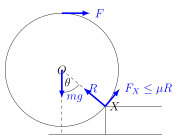
A uniform solid sphere of diameter \(d\) and mass \(m\) is drawn very slowly and without slipping from horizontal ground onto a step of height \(d/4\) by a horizontal force which is always applied to the highest point of the sphere and is always perpendicular to the vertical plane which forms the face of the step. Find the maximum horizontal force throughout the movement, and prove that the coefficient of friction between the sphere and the edge of the step must exceed \(1/\sqrt{3}\).
Solution: