Problems
Filters
218 problems found
2012 Paper 1 Q3
- Sketch the curve \(y=\sin x\) for \(0\le x \le \tfrac12 \pi\) and add to your diagram the tangent to the curve at the origin and the chord joining the origin to the point \((b, \sin b)\), where \(0 < b < \frac12\pi\). By considering areas, show that \[ 1-\tfrac12 b^2 <\cos b < 1-\tfrac 12 b \sin b\,. \]
- By considering the curve \(y=a^x\), where \(a>1\), show that \[ \frac{2(a-1)}{a+1} < \ln a < -1 + \sqrt{2a-1\,}\,. \] [Hint: You may wish to write \(a^x\) as \(\e^{x\ln a}\).]
Solution:
- \(\,\)
The area under the blue curve is \(1-\cos b\). The area under the green line is \(\frac12 b \sin b\) The area under the red line is \(\frac12 b^2\) Therefore \(\frac12 b \sin b < 1- \cos b < \frac12 b^2 \Rightarrow 1- \frac12 b^2 < \cos b < 1 - \frac12 b \sin b\)

- \(\,\)
\begin{align*} &&\text{Area under blue curve}: &= \int_0^1 a^x \d x\\ &&&= \left [ \frac{1}{\ln a}e^{x \ln a} \right]_0^1 \\ &&&= \frac{a-1}{\ln a} \\ \\ &&\text{Area under green line}: &=\frac12 \cdot 1 \cdot (a + 1)\\ &&&= \frac{a+1}{2} \\ \\ &&\text{Area under tangent}: &=\frac12 \cdot 1 \cdot (1+\ln a + 1)\\ &&&= \frac{\ln a+2}{2} \\ \\ \Rightarrow && \frac{a+1}{2} & > \frac{a-1}{\ln a} \\ \Rightarrow && \ln a& > \frac{2(a-1)}{a+1} \\ \\ \Rightarrow && \frac{a-1}{\ln a} &> \frac{\ln a +2}{2} \\ \Rightarrow && 2(a-1) -2\ln a - (\ln a)^2 &> 0 \\ \Rightarrow && \ln a & < -1 + \sqrt{2a-1} \end{align*}

2012 Paper 1 Q4
The curve \(C\) has equation \(xy = \frac12\). The tangents to \(C\) at the distinct points \(P\big(p, \frac1{2p}\big)\) and \(Q\big(q, \frac1{2q}\big)\) where \(p\) and \(q\) are positive, intersect at \(T\) and the normals to \(C\) at these points intersect at \(N\). Show that \(T\) is the point \[ \left( \frac{2pq}{p+q}\,,\, \frac 1 {p+q}\right)\!. \] In the case \(pq=\frac12\), find the coordinates of \(N\). Show (in this case) that \(T\) and \(N\) lie on the line \(y=x\) and are such that the product of their distances from the origin is constant.
Solution: \begin{align*} && \frac{\d y}{\d x} &= -\frac1{2x^2} \\ \Rightarrow && \frac{y - \frac{1}{2p}}{x - p} &= - \frac{1}{2p^2} \\ \Rightarrow && y - \frac1{2p} &= -\frac{1}{2p^2}x +\frac1{2p} \\ \Rightarrow && y +\frac{1}{2p^2}x &= \frac1p \\ \Rightarrow && 2p^2 y + x &= 2p\\ \Rightarrow && 2q^2 y + x &= 2q \\ \Rightarrow && (p^2-q^2)y &= p-q \\ \Rightarrow && y &= \frac{1}{p+q} \\ && x &= \frac{2pq}{p+q} \end{align*} \begin{align*} \text{normal}: && \frac{y-\frac1{2p}}{x-p} &= 2p^2 \\ \Rightarrow && y - \frac1{2p} &= 2p^2x - 2p^3 \\ \Rightarrow && 2py -4p^3x &= 1-4p^4 \\ \Rightarrow && 2qy -4q^3x &= 1-4q^4 \\ pq = \tfrac12: && y - 2p^2 x &= q-2p^3 \\ && y - 2q^2 x &= p-2q^3 \\ \Rightarrow && (2q^2-2p^2)x &= q-p +2q^3-2p^3 \\ &&&= (q-p)(q+p+2q^2+1+2p^2) \\ \Rightarrow && x &= \frac{1+2(p^2+q^2)+1}{2(p+q)} \\ &&&= \frac{1+2(p^2+q^2+2pq-1)+1}{2(p+q)} \\ &&&= p+q\\ && y &= 2p^2 \left ( p+q \right) + q - 2p^3 \\ &&&= p+q \end{align*} So \(N(p+q, p+q)\) and \(T\left (\frac{1}{p+q}, \frac{1}{p+q} \right)\), so both points lie on \(y = x\). \[ OT \cdot ON = \frac{\sqrt{2}}{p+q} \cdot (p+q)\sqrt{2} = 2 \] which is clearly constant.
2012 Paper 2 Q5
- Sketch the curve \(y=\f(x)\), where \[ \f(x) = \frac 1 {(x-a)^2 -1} \hspace{2cm}(x\ne a\pm1), \] and \(a\) is a constant.
- The function \(\g(x)\) is defined by \[ \g(x) = \frac 1 {\big( (x-a)^2-1 \big) \big( (x-b)^2 -1\big)} \hspace{1cm}(x\ne a\pm1, \ x\ne b\pm1), \] where \(a\) and \(b\) are constants, and \(b>a\). Sketch the curves \(y=\g(x)\) in the two cases \(b>a+2\) and \(b=a+2\), finding the values of \(x\) at the stationary points.
Solution:
- \(\,\)

- \(\,\) \begin{align*}
&& \frac{\d}{\d x} \left ( \frac{1}{g(x)} \right) &= \frac{\d }{\d x} \left ( \big( (x-a)^2-1 \big) \big( (x-b)^2 -1\big)\right) \\
&&&= ((x-a)^2-1)(2(x-b))+((x-b)^2-1)(2(x-a)) \\
&&&= 2(2x-a-b)(x^2-(a+b)x+ab-1) \\
\Rightarrow && x &= \frac{a+b}{2}, \frac{a+b \pm \sqrt{(a+b)^2-4ab+4}}{2} \\
&&&= \frac{a+b}{2}, \frac{a+b \pm \sqrt{(a-b)^2+4}}{2}
\end{align*}
If \(b > a+2\):
If \(b = a+2\):


2012 Paper 3 Q3
It is given that the two curves \[ y=4-x^2 \text{ and } m x = k-y^2\,, \] where \(m > 0\), touch exactly once.
- In each of the following four cases, sketch the two curves on a single diagram, noting the coordinates of any intersections with the axes:
- \(k < 0\, \);
- \(0 < k < 16\), \(k/m < 2\,\);
- \(k > 16\), \(k/m > 2\,\);
- \(k > 16\), \(k/m < 2\,\).
- Now set \(m=12\). Show that the \(x\)-coordinate of any point at which the two curves meet satisfies \[ x^4-8x^2 +12x +16-k=0\,. \] Let \(a\) be the value of \(x\) at the point where the curves touch. Show that \(a\) satisfies \[ a^3 -4a +3 =0 \] and hence find the three possible values of \(a\). Derive also the equation \[ k= -4a^2 +9a +16\,. \] Which of the four sketches in part (i) arise?
Solution:
- \(\,\)

- \(\,\)

- \(\,\)

- \(\,\)

- \(\,\)
- Suppose \(m = 12\) \begin{align*} && y &= 4-x^2 \\ && 12x &= k-y^2 \\ \Rightarrow && 12 x&=k-(4-x^2)^2 \\ &&&= k-16+8x^2-x^4 \\ \Rightarrow && 0 &= x^4- 8x^2+12x+16-k \end{align*} When the curves touch, we will have repeated root, ie \(a\) is a root of \(4x^3-16x+12 \Rightarrow a^3-4a+3 =0\). \begin{align*} &&0 &= a^3-4a+3 \\ &&&= (a-1)(a^2+a-3) \\ \Rightarrow &&a &= 1, \frac{-1 \pm \sqrt{13}}{2} \end{align*} \begin{align*} && 0 &= a^4-8a^2+12a+16-k \\ \Rightarrow && k &= a(a^3-8a+12)+16 \\ &&&= a(4a-3-8a+12)+16 \\ &&&= -4a^2+9a+16 \\ \\ \Rightarrow && a = 1& \quad k = 21 \\ && k &= -4(3-a)+9a+16 = 13a+4\\ && a = \frac{-1-\sqrt{13}}2& \quad k = \frac{-5 - 13\sqrt{13}}{2} < 0 \\ && a = \frac{-1+\sqrt{13}}2& \quad k = \frac{-5 + 13\sqrt{13}}{2} \\ \end{align*} So we have type (a), and (d).
2012 Paper 3 Q6
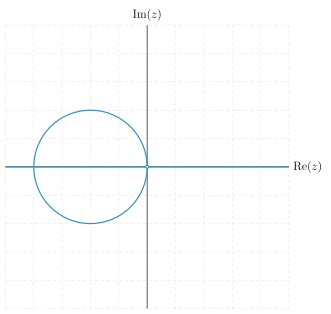
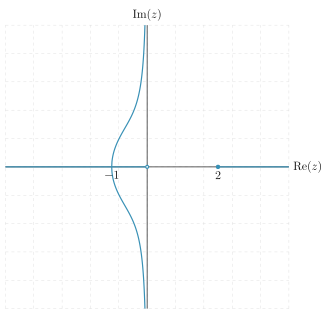
Let \(x+{\rm i} y\) be a root of the quadratic equation \(z^2 + pz +1=0\), where \(p\) is a real number. Show that \(x^2-y^2 +px+1=0\) and \((2x+p)y=0\). Show further that either \(p=-2x\) or \(p=-(x^2+1)/x\) with \(x\ne0\). Hence show that the set of points in the Argand diagram that can (as \(p\) varies) represent roots of the quadratic equation consists of the real axis with one point missing and a circle. This set of points is called the root locus of the quadratic equation. Obtain and sketch in the Argand diagram the root locus of the equation \[ pz^2 +z+1=0\, \] and the root locus of the equation \[ pz^2 + p^2z +2=0\,.\]
Solution: \begin{align*} && 0 &= z^2 + pz + 1\\ &&&= (x+iy)^2 + (x+iy)p + 1 \\ &&& = (x^2-y^2+px+1) + (2xy+py)i \\ \Rightarrow && 0 &= x^2 - y^2 + px + 1 \\ && 0 &= (2x+p)y \\ \Rightarrow && p &= -2x \\ \text{ or } && y &= 0 \\ \Rightarrow && p &= -(x^2+1)/x \end{align*} Therefore as \(p\) varies with either have \(y = 0\) and \(x\) taking any real value except \(0\) ie the real axis minus the origin. Or \(p = -2x\) and \(-y^2-x^2+1 = 0 \Rightarrow x^2 + y^2 = 1\) which is a circle. Suppose \(pz^2 + z + 1 = 0\) \begin{align*} && 0 &= pz^2 + z +1\\ &&&= p(x+iy)^2 + (x+iy) + 1\\ &&&= (px^2-py^2+x+1) + (2xyp + y) i \\ \Rightarrow && 0 &= (2xp+1)y \\ \Rightarrow && y & = 0, p = \frac{-(x+1)}{x^2}, x \neq 0 \\ \text{ or } && p &= -\frac{1}{2x}\\ \Rightarrow && 0 &= -\frac{1}{2}x + \frac{y^2}{2x} + x + 1 \\ &&&= \frac{y^2 - x^2 +2x^2 + 2x}{2x} \\ &&&= \frac{(x+1)^2+y^2-1}{2x} \end{align*} So we either have the real axis (except \(0\)) or a circle radius \(1\) centre \((-1, 0)\) (excluding \(x = 0\)).
2011 Paper 1 Q5
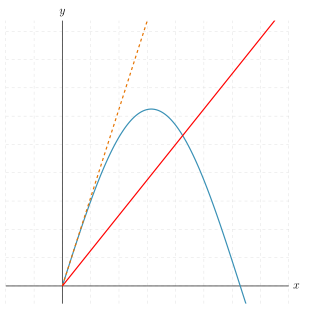
Given that \(0 < k < 1\), show with the help of a sketch that the equation \[ \sin x = k x \tag{\(*\)}\] has a unique solution in the range \(0 < x < \pi\). Let \[ I= \int_0^\pi \big\vert \sin x -kx\big\vert \, \d x\,. \] Show that \[ I= \frac{\pi^2 \sin\alpha }{2\alpha} -2\cos\alpha - \alpha \sin\alpha\,, \] where \(\alpha\) is the unique solution of \((*)\). Show that \(I\), regarded as a function of \(\alpha\), has a unique stationary value and that this stationary value is a minimum. Deduce that the smallest value of \(I\) is \[ -2 \cos \frac{\pi}{\sqrt2}\, .\]
Solution:
2011 Paper 2 Q1
- Sketch the curve \(y=\sqrt{1-x} + \sqrt{3+x}\;\). Use your sketch to show that only one real value of \(x\) satisfies \[ \sqrt{1-x} + \sqrt{3+x} = x+1\,, \] and give this value.
- Determine graphically the number of real values of \(x\) that satisfy \[ 2\sqrt{1-x} = \sqrt{3+x} + \sqrt{3-x}\;. \] Solve this equation.
Solution:
- Clearly the only solution is \(x = 1\)

- There is clearly only one solution, with \(x \approx -2\) \begin{align*} && 4(1-x) &= 6+2\sqrt{9-x^2} \\ && -2x-1 &=\sqrt{9-x^2} \\ \Rightarrow && 4x^2+4x+1 &= 9-x^2 \\ \Rightarrow && 0 &= 5x^2+4x-8 \\ &&x&= \frac{-2\pm 2\sqrt{11}}{5} \\ \Rightarrow && x &= -\left ( \frac{2+2\sqrt{11}}{5} \right) \end{align*}

2011 Paper 2 Q8
The end \(A\) of an inextensible string \(AB\) of length \(\pi\) is attached to a point on the circumference of a fixed circle of unit radius and centre \(O\). Initially the string is straight and tangent to the circle. The string is then wrapped round the circle until the end \(B\) comes into contact with the circle. The string remains taut during the motion, so that a section of the string is in contact with the circumference and the remaining section is straight. Taking \(O\) to be the origin of cartesian coordinates with \(A\) at \((-1,0)\) and \(B\) initially at \((-1, \pi)\), show that the curve described by \(B\) is given parametrically by \[ x= \cos t + t\sin t\,, \ \ \ \ \ \ y= \sin t - t\cos t\,, \] where \(t\) is the angle shown in the diagram.
2011 Paper 3 Q4
The following result applies to any function \(\f\) which is continuous, has positive gradient and satisfies \(\f(0)=0\,\): \[ ab\le \int_0^a\f(x)\, \d x + \int_0^b \f^{-1}(y)\, \d y\,, \tag{\(*\)}\] where \(\f^{-1}\) denotes the inverse function of \(\f\), and \(a\ge 0\) and \(b\ge 0\).
- By considering the graph of \(y=\f(x)\), explain briefly why the inequality \((*)\) holds. In the case \(a>0\) and \(b>0\), state a condition on \(a\) and \(b\) under which equality holds.
- By taking \(\f(x) = x^{p-1}\) in \((*)\), where \(p>1\), show that if \(\displaystyle \frac 1p + \frac 1q =1\) then \[ ab \le \frac{a^p}p + \frac{b^q}q\,. \] Verify that equality holds under the condition you stated above.
- Show that, for \(0\le a \le \frac12 \pi\) and \(0\le b \le 1\), \[ ab \le b\arcsin b + \sqrt{1-b^2} \, - \cos a\,. \] Deduce that, for \(t\ge1\), \[ \arcsin (t^{-1}) \ge t - \sqrt{t^2-1}\,. \]
2010 Paper 1 Q2
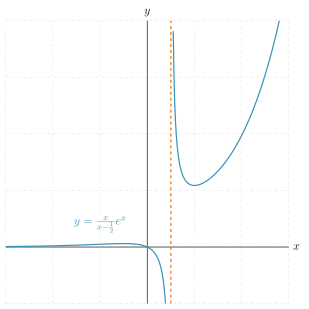
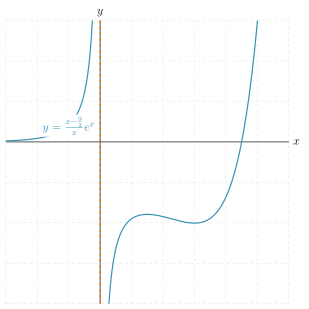
The curve \(\displaystyle y=\Bigl(\frac{x-a}{x-b}\Bigr)\e^{x}\), where \(a\) and \(b\) are constants, has two stationary points. Show that \[ a-b<0 \ \ \ \text{or} \ \ \ a-b>4 \,. \]
- Show that, in the case \(a=0\) and \(b= \frac12\), there is one stationary point on either side of the curve's vertical asymptote, and sketch the curve.
- Sketch the curve in the case \( a=\tfrac{9}{2}\) and \(b=0\,\).
Solution: \begin{align*} && y &= \left ( \frac{x-a}{x-b} \right )e^x \\ &&y'& = \left ( \frac{x-a}{x-b} \right )e^x + \left ( \frac{(x-b)-(x-a)}{(x-b)^2}\right )e^x \\ &&&= \left ( \frac{(x-b)(x-a) +a-b}{(x-b)^2} \right)e^x \\ &&&= \left ( \frac{x^2-(a+b)x+a-b+ab}{(x-b)^2} \right)e^x \\ && 0 &< \Delta = (a+b)^2 - 4 \cdot 1 \cdot (a-b+ab) \\ &&&= a^2+2ab+b^2-4a+4b-4ab \\ &&&= a^2-2ab+b^2-4a+4b\\ &&&= (a-b)^2-4(a-b) \\ &&&= (a-b)(a-b-4) \\ \end{align*} Considered as a quadratic in \(a-b\) we can see \(a-b < 0\) or \(a-b > 4\)
- If \(a = 0, b = \frac12\), we have \(x^2-\frac12x -\frac12 = 0 \Rightarrow (2x+1)(x-1) = 0 \Rightarrow x = -\frac12, x=1\). The asymptote is at \(x = \frac12\) so they are on either side.
- \(\,\)
2010 Paper 1 Q4
Use the substitution \(x=\dfrac{1}{t^{2}-1}\; \), where \(t>1\), to show that, for \( x>0\), \[ \int \frac{1}{\sqrt{x\left(x+1\right) \; } \ }\; \d x =2 \ln \left(\sqrt x+ \sqrt{x +1} \; \right)+c \,. \] Note: You may use without proof the result \(\displaystyle \int \! \frac{1}{t^2-a^2} \, \d t = \frac{1}{2a} \ln \left| \frac{t-a}{t+a}\right| + \rm {constant}\). The section of the curve \[ y=\dfrac{1}{\sqrt{x}\; }-\dfrac{1}{\sqrt{x+1}\; } \] between \(x=\frac{1}{8}\) and \(x=\frac{9}{16}\) is rotated through \(360^{o}\) about the \(x\)-axis. Show that the volume enclosed is \(2\pi \ln \tfrac{5}{4}\,\). \(\phantom{\dfrac AB}\)
Solution: \begin{align*} && x &= \frac{1}{t^2-1} \\ && t &= \sqrt{\frac{x+1}{x}}\\ \Rightarrow && \frac{\d x}{\d t} &= \frac{-2t}{(t^2-1)^2} \\ \Rightarrow && I &= \int \frac{1}{\sqrt{x(x+1)}} \d x \\ &&&= \int \frac{1}{\sqrt{\frac1{t^2-1} \frac{t^2}{t^2-1}}} \cdot \frac{-2 t}{(t^2-1)^2} \d t \\ &&&= \int \frac{t^2-1}{t} \frac{-2t}{(t^2-1)^2} \d t \\ &&&= -\int \frac{2}{t^2-1} \d t \\ &&&= - \frac{2}{2 \cdot 1} \ln \left | \frac{t-1}{t+1} \right| +C \\ &&&= \ln \left | \frac{t+1}{t-1} \right| + C \\ &&&= \ln \left | \frac{\sqrt{\frac{x+1}{x}}+1}{\sqrt{\frac{x+1}{x}}-1} \right| + C \\ &&&= \ln \left | \frac{\sqrt{x+1}+\sqrt{x}}{\sqrt{x+1}-\sqrt{x}} \right| + C \\ &&&= 2\ln \left | \sqrt{x+1}+\sqrt{x}\right| + C \\ &&&= 2\ln \left ( \sqrt{x+1}+\sqrt{x}\right) + C \\ \end{align*} \begin{align*} && V&= \pi \int_{1/8}^{9/16} y^2 \d x \\ &&&= \pi \int_{1/8}^{9/16} \left ( \frac1x + \frac{1}{x+1} - \frac{2}{\sqrt{x(x+1)}}\right) \d x \\ &&&= \pi \left [ \ln x + \ln (x+1) - 4 \ln(\sqrt{x+1} + \sqrt{x}) \right]_{1/8}^{9/16} \\ &&&= \pi \left ( \ln \frac{9}{16} + \ln \frac{25}{16} - 4 \ln \left ( \frac54 + \frac34\right) \right) +\\ &&&\quad -\pi \left ( \ln \frac{1}{8} + \ln \frac{9}{8} - 4 \ln \left ( \frac1{2\sqrt{2}} + \frac3{2\sqrt{2}}\right) \right) \\ &&&= \pi \left ( 2 \ln 3 - 8 \ln 2 + 2 \ln 5 - 4\ln2 \right) - \pi \left ( -6 \ln 2 + 2\ln 3 - 2\ln 2\right) \\ &&&= \pi (2 \ln 5 - 4 \ln 2 ) \\ &&&= 2 \pi \ln \tfrac54 \end{align*}
2010 Paper 1 Q10
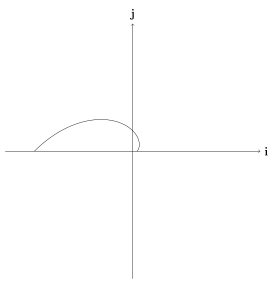
A particle \(P\) moves so that, at time \(t\), its displacement \( \bf r \) from a fixed origin is given by \[ {\bf r} =\left( \e^{t}\cos t \right) {\bf i}+ \left(\e^t \sin t\right) {\bf j}\,.\] Show that the velocity of the particle always makes an angle of \(\frac{\pi}{4}\) with the particle's displacement, and that the acceleration of the particle is always perpendicular to its displacement. Sketch the path of the particle for \(0\le t \le \pi\). A second particle \(Q\) moves on the same path, passing through each point on the path a fixed time \(T\) after \(P\) does. Show that the distance between \(P\) and \(Q\) is proportional to \(\e^{t}\).
Solution: \begin{align*} && {\bf r} &=\left( \e^{t}\cos t \right) {\bf i}+ \left(\e^t \sin t\right) {\bf j} \\ \Rightarrow && \dot{\bf r} &= \left( \e^{t}\cos t -\e^t \sin t\right) {\bf i}+ \left(\e^t \sin t+\e^t \cos t\right) {\bf j} \\ \Rightarrow && \mathbf{r}\cdot\dot{ \mathbf{r}} &= e^{2t}(\cos^2 t - \sin t \cos t) + e^{2t}(\sin^2 t+ \sin t \cos t) \\ &&&= e^{2t} (\cos^2 t + \sin ^2 t)\\ &&&= e^{2t} \\ \\ && | {\bf r}| &= e^{t} \\ && |{\bf \dot{r}}| &= e^t \sqrt{(\cos t - \sin t)^2 + (\sin t + \cos t)^2} \\ &&&= e^t \sqrt{2 \cos^2 t + 2 \sin^2 t} \\ &&&= \sqrt{2} e^t \\ \\ \Rightarrow && \frac{\mathbf{r}\cdot\dot{ \mathbf{r}}}{ |{\bf {r}}| |{\bf \dot{r}}|} &= \frac{e^{2t}}{\sqrt{2}e^te^t} \\ &&&= \frac{1}{\sqrt{2}} \end{align*} Therefore the angle between the velocity and displacement is \(\frac{\pi}{4}\). \begin{align*} && \ddot{\bf{r}} &= \left( \e^{t}(\cos t - \sin t) - \e^t (\sin t + \cos t)\right) {\bf i}+ \left(\e^t (\sin t + \cos t) + \e^t(\cos t - \sin t)\right) {\bf j} \\ &&&= \left ( -2\e^{t} \sin t \right) {\bf i}+ \left ( 2\e^{t} \cos t \right) {\bf j} \\ \Rightarrow && {\bf r} \cdot \ddot{\bf{r}} &= 2e^{2t} \left ( -\sin t \cos t + \sin t \cos t \right) \\ &&&= 0 \end{align*} Therefore the acceleration is perpendicular.
2010 Paper 2 Q7
- By considering the positions of its turning points, show that the curve with equation \[ y=x^3-3qx-q(1+q)\,, \] where \(q>0\) and \(q\ne1\), crosses the \(x\)-axis once only.
- Given that \(x\) satisfies the cubic equation \[ x^3-3qx-q(1+q)=0\,, \] and that \[ x=u+q/u\,, \] obtain a quadratic equation satisfied by \(u^3\). Hence find the real root of the cubic equation in the case \(q>0\), \(q\ne1\).
- The quadratic equation \[ t^2 -pt +q =0\, \] has roots \(\alpha \) and \(\beta\). Show that \[ \alpha^3+\beta^3 = p^3 -3qp\,. \] It is given that one of these roots is the square of the other. By considering the expression \((\alpha^2 -\beta)(\beta^2-\alpha)\), find a relationship between \(p\) and \(q\). Given further that \(q>0\), \(q\ne1\) and \(p\) is real, determine the value of \(p\) in terms of \(q\).
2010 Paper 2 Q8
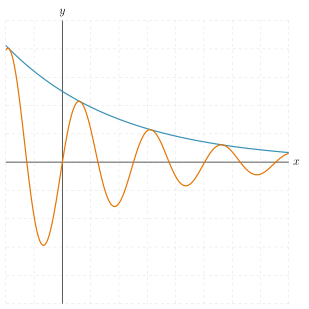
The curves \(C_1\) and \(C_2\) are defined by \[ y= \e^{-x} \quad (x>0) \quad \text{ and } \quad y= \e^{-x}\sin x \quad (x>0), \] respectively. Sketch roughly \(C_1\) and \(C_2\) on the same diagram. Let \(x_n\) denote the \(x\)-coordinate of the \(n\)th point of contact between the two curves, where \(0 < x_1 < x_2 < \cdots\), and let \(A_n\) denote the area of the region enclosed by the two curves between \(x_n\) and \(x_{n+1}\). Show that \[ A_n = \tfrac12(\e^{2\pi}-1) \e^{-(4n+1)\pi/2} \] and hence find \(\displaystyle \sum_{n=1}^\infty A_n\).
Solution:
2009 Paper 2 Q1
Two curves have equations \(\; x^4+y^4=u\;\) and \(\; xy = v\;\), where \(u\) and \(v\) are positive constants. State the equations of the lines of symmetry of each curve. The curves intersect at the distinct points \(A\), \(B\), \(C\) and \(D\) (taken anticlockwise from \(A\)). The coordinates of \(A\) are \((\alpha,\beta)\), where \(\alpha > \beta > 0\). Write down, in terms of \(\alpha\) and \(\beta\), the coordinates of \(B\), \(C\) and \(D\). Show that the quadrilateral \(ABCD\) is a rectangle and find its area in terms of \(u\) and \(v\) only. Verify that, for the case \(u=81\) and \(v=4\), the area is \(14\).
Solution: The curve \(x^4 + y^4 = u\) has lines of symmetry:
- \(y = 0\)
- \(x = 0\)
- \(y = x\)
- \(y = -x\)
- \(y = x\)
- \(y = -x\)
