2010 Paper 2 Q8
Year: 2010
Paper: 2
Question Number: 8
Course: LFM Pure
Section: Integration
Problem
Solution
Examiner's report
— 2010 STEP 2, Question 8There were just under 1000 entries for paper II this year, almost exactly the same number as last year. Of this number, more than 60 scored over 90% while, at the other end of the scale, almost 200 failed to score more than 40 marks. In hindsight, many of the pure maths questions were a little too accessible and lacked a sufficiently tough 'difficulty gradient', so that scores were slightly higher than anticipated. This was reflected in the grade boundaries for the "1" and the "2" (around ten marks higher than is generally planned) in particular. Next year's questions may be expected to be a little bit more demanding, but only in the sense that the final 5 or 6 marks on each question should have rather more bite to them: it should certainly not be the case that all questions are tougher to get into at the outset. Most candidates attempted the requisite number of questions (six), although many of the weaker brethren made seven or eight attempts, most of which were feeble at best and they generally only picked up a maximum of 5 or 6 marks per question. It is a truth universally acknowledged that practice maketh if not perfect then at least a whole lot better prepared, and choosing to waste time on a couple of extra questions is not a good strategy on the STEPs. The major down-side of the present modular examination system is that students are not naturally prepared to approach the subject holistically; ally this to the current practice of setting highly-structured, fully-guided questions requiring no imagination, insight, depth or planning from A-level candidates in a system that fails almost nobody and rewards even the most modestly able with high grades in a manner reminiscent of a dentist giving lollipops to kids who have done little more than been brave and seen the course through, it is even more important to ensure a full and thorough preparation for these papers. The 20% of the entry who seem to be either unprepared for the rigours of a STEP, or unwittingly possessed of only a smattering of basic advanced-level skills, seems to be remarkably steady year-on-year, even in a year when their more suitably prepared compatriots found the paper appreciably easier than usual. As in previous years, the pure maths questions provided the bulk of candidates' work, with relatively few efforts to be found at the applied ones.
Rating Information
Difficulty Rating: 1600.0
Difficulty Comparisons: 0
Banger Rating: 1482.0
Banger Comparisons: 5
Show LaTeX source
Problem source
The curves $C_1$ and $C_2$ are defined by
\[ y= \e^{-x} \quad (x>0)  \quad \text{ and  } \quad y= \e^{-x}\sin x \quad (x>0), \]
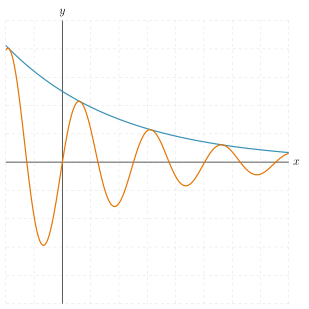
respectively. Sketch roughly $C_1$ and $C_2$ on the same diagram.
Let $x_n$ denote the $x$-coordinate of the $n$th point of contact
between the two curves, where $0 < x_1 < x_2 < \cdots$, and let
$A_n$ denote the area of the region enclosed by the two
curves between $x_n$ and $x_{n+1}$. Show that
\[
A_n = \tfrac12(\e^{2\pi}-1) \e^{-(4n+1)\pi/2}
\]
and hence find $\displaystyle \sum_{n=1}^\infty A_n$.
Solution source
\begin{center}
    \begin{tikzpicture}
    \def\functionf(#1){exp(-#1)};
    \def\functiong(#1){sin(deg(10*#1))*exp(-#1)};
    \def\xl{-.5};
    \def\xu{2};
    \def\yl{-2};
    \def\yu{2};

    % Calculate scaling factors to make the plot square
    \pgfmathsetmacro{\xrange}{\xu-\xl}
    \pgfmathsetmacro{\yrange}{\yu-\yl}
    \pgfmathsetmacro{\xscale}{10/\xrange}
    \pgfmathsetmacro{\yscale}{10/\yrange}

    % Define the reusable styles to keep code clean
    \tikzset{
        x=\xscale cm, y=\yscale cm,
        axis/.style={thick, draw=black!80, -{Stealth[scale=1.2]}},
        grid/.style={thin, dashed, gray!30},
        curveA/.style={very thick, color=cyan!70!black, smooth},
        curveB/.style={very thick, color=orange!90!black, smooth},
        curveC/.style={very thick, color=green!70!black, smooth},
        dot/.style={circle, fill=black, inner sep=1.2pt},
        labelbox/.style={fill=white, inner sep=2pt, rounded corners=2pt} % Protects text from lines
    }


    % Draw background grid
    \draw[grid] (\xl,\yl) grid (\xu,\yu);

    % Set up axes
    \draw[axis] (\xl,0) -- (\xu,0) node[right, black] {$x$};
    \draw[axis] (0,\yl) -- (0,\yu) node[above, black] {$y$};

    % Define the bounding region with clip
    \begin{scope}
        \clip (\xl,\yl) rectangle (\xu,\yu);

        \draw[curveA, domain=\xl:\xu, samples=450]
            plot ({\x},{\functionf(\x)});
        \draw[curveB, domain=\xl:\xu, samples=450]
            plot ({\x},{\functiong(\x)});
    \end{scope}


    \end{tikzpicture}
\end{center}

The curves touch when $\sin x = 1$ ie $x = \frac{4n+1}{2} \pi$. therefore

\begin{align*}
&& I &= \int e^{-x} \sin x \d x \\
&&&=  -e^{-x} \sin x + \int e^{-x} \cos x \d x \\
&&&= -e^{-x} \sin x -e^{-x} \cos x - I \\
&& I &= -\frac{e^{-x}}2 ( \sin x + \cos x)\\
\\
&& A_n &= \int_{\frac{4n+3}{2}\pi}^{\frac{4n-1}{2}\pi} e^{-x} (1-\sin x) \d x \\
&&&= \left [ -e^{-x} - \frac{e^{-x}}2(\sin x + \cos x) \right]_{\frac{4n+1}{2}\pi}^{\frac{4n+5}{2}\pi} \\
&&&= -\frac12\exp \left ( -\frac{4n+1}{2}\pi\right)+ \frac12\exp \left ( -\frac{4n-3}{2}\pi\right) \\
&&&= \frac12 (e^{2 \pi}-1) \left ( -\frac{4n+1}{2}\pi\right) \\
\\
&& \sum_{n=1}^\infty A_n &= \frac12(e^{2\pi}-1)e^{-\pi/2} \sum_{n=1}^\infty e^{-2n\pi} \\
&&&= \frac12(e^{2\pi}-1)e^{-\pi/2} \frac{e^{-2\pi}}{1-e^{-2\pi}} \\
&&&= \frac12e^{-\pi/2}
\end{align*}
This was the sixth most popular of the pure maths questions, with an average score of just under 11. Many of the early marks were easily gained, although the sketches were often unclear enough to warrant a loss of marks – in particular, the fact that the required function oscillates between e⁻ˣ and −e⁻ˣ was seldom made obvious; indeed, a clear indication that the function's zeroes occurred at (regular) intervals of π units on the x-axis was also poorly indicated. Although most candidates were happy to attempt integration by parts successfully, and then subtract areas, the limits of integration, xₙ and xₙ₊₁, were only occasionally correctly identified. This meant that a lot of the following work, whilst correct in method, was seldom likely to get to the correct, given answer. The final piece of work, even though it could be found using this given answer, was poorly attempted.