Problems
Filters
71 problems found
1990 Paper 3 Q13
A particle \(P\) is projected, from the lowest point, along the smooth inside surface of a fixed sphere with centre \(O\). It leaves the surface when \(OP\) makes an angle \(\theta\) with the upward vertical. Find the smallest angle that must be exceeded by \(\theta\) to ensure that \(P\) will strike the surface below the level of \(O\). You may find it helpful to find the time at which the particle strikes the sphere.
Solution:

1989 Paper 1 Q12
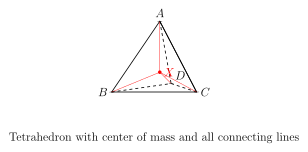
A regular tetrahedron \(ABCD\) of mass \(M\) is made of 6 identical uniform rigid rods, each of length \(2a.\) Four light elastic strings \(XA,XB,XC\) and \(XD\), each of natural length \(a\) and modulus of elasticity \(\lambda,\) are fastened together at \(X\), the other end of each string being attached to the corresponding vertex. Given that \(X\) lies at the centre of mass of the tetrahedron, find the tension in each string. The tetrahedron is at rest on a smooth horizontal table, with \(B,C\) and \(D\) touching the table, and the ends of the strings at \(X\) attached to a point \(O\) fixed in space. Initially the centre of mass of the tetrahedron coincides with \(O.\) Suddenly the string \(XA\) breaks, and the tetrahedron as a result rises vertically off the table. If the maximum height subsequently attained is such that \(BCD\) is level with the fixed point \(O,\) show that (to 2 significant figures) \[ \frac{Mg}{\lambda}=0.098. \]
Solution:
1989 Paper 2 Q14
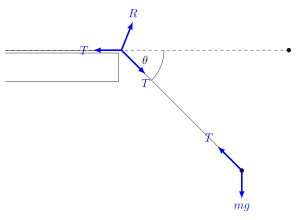
One end of a light inextrnsible string of length \(l\) is fixed to a point on the upper surface of a thin, smooth, horizontal table-top, at a distance \((l-a)\) from one edge of the table-top. A particle of mass \(m\) is fixed to the other end of the string, and held a distance \(a\) away from this edge of the table-top, so that the string is horizontal and taut. The particle is then released. Find the tension in the string after the string has rotated through an angle \(\theta,\) and show that the largest magnitude of the force on the edge of the table top is \(8mg/\sqrt{3}.\)
Solution:
1988 Paper 1 Q10
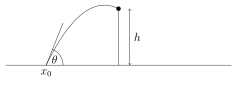
A sniper at the top of a tree of height \(h\) is hit by a bullet fired from the undergrowth covering the horizontal ground below. The position and elevation of the gun which fired the shot are unknown, but it is known that the bullet left the gun with speed \(v\). Show that it must have been fired from a point within a circle centred on the base of the tree and of radius \((v/g)\sqrt{v^{2}-2gh}\). {[}Neglect air resistance.{]}
Solution:
1988 Paper 1 Q13
A piece of circus apparatus consists of a rigid uniform plank of mass 1000\(\,\)kg, suspended in a horizontal position by two equal light vertical ropes attached to the ends. The ropes each have natural length 10\(\,\)m and modulus of elasticity 490\(\,\)000 N. Initially the plank is hanging in equilibrium. Nellie, an elephant of mass 4000\(\,\)kg, lands in the middle of the plank while travelling vertically downwards at speed 5\(\,\)ms\(^{-1}.\) While carrying Nellie, the plank comes instantaneously to rest at a negligible height above the floor, and at this instant Nellie steps nimbly and gently off the plank onto the floor. Assuming that the plank remains horizontal, and the rope remain vertical, throughout the motion, find to three significant figures its initial height above the floor. During the motion after Nellie alights, do the ropes ever become slack? {[}Take \(g\) to be \(9.8\mbox{\,\ ms}^{-1}.\){]}
Solution: In the initial position, since the system is in equilibrium the tension in the two ropes must be \(500g\). Therefore since \(T = \frac{\lambda x}{l} \Rightarrow x = \frac{10 \cdot 500 g}{490\, 000} = \frac1{10}\) so the initial extension is \(\frac1{10}\) By conservation of momentum, if the initial speed of the plank + Nellie is \(V\), we must have \(4000 \cdot 5 = 5000 V \Rightarrow V = 4\) \begin{array}{ccc} & \text{GPE} & \text{EPE} & \text{KE} \\ \hline \text{Initially} & 5000gh & 2 \cdot \frac12 \frac{\lambda}{l} \frac{1}{100} & \frac12 \cdot 5000 \cdot 4^2 \\ & 49\,000h & 490 & 40\,000 \\ \text{Finally} & 0 & 2 \cdot \frac12 \frac{\lambda}{l} (h + \frac1{10})^2 & 0 \\ & 0 & 49\,000 (h+\frac1{10})^2 & 0 \end{array} By conservation of energy, we can set up a quadratic: \begin{align*} && 49\,000 (h+\frac1{10})^2 &= 49\,000h + 40\,490 \\ \Rightarrow && 49\,000(h + \frac1{10})^2 &= 49\,000(h + \frac1{10})+35\, 590 \\ \Rightarrow&& h + \frac1{10} &= 1.488092\cdots \\ \Rightarrow && h &= 1.49 \,\, (3\text{ s.f.}) \end{align*} When she gets off the plank, it will move according to: \begin{align*} \text{N2}(\uparrow): && \frac{\lambda x}{l} -1000g &= -1000 \ddot{x} \\ && 49 x-g &= -\ddot{x} \\ \Rightarrow && x &= A \sin 7t + B \cos 7t + 0.2 \\ && x(0) = 1.49, &x'(0) = 0 \\ \Rightarrow && B = -1.69, & A=0 \end{align*} If we continued under this motion the string would definitely reach a point \(0.1\) above \(0\), and therefore the ropes would go slack.
1988 Paper 2 Q12
One end of a thin uniform inextensible, but perfectly flexible, string of length \(l\) and uniform mass per unit length is held at a point on a smooth table a distance \(d(< l)\) away from a small vertical hole in the surface of the table. The string passes through the hole so that a length \(l-d\) of the string hangs vertically. The string is released from rest. Assuming that the height of the table is greater than \(l\), find the time taken for the end of the string to reach the top of the hole.
Solution: Consider some point once the string is moving, there will be \(x\) above the table and \(l - x\) hanging in the air. For the hanging string we must have \((l-x)mg - T = -(l-x)m\ddot{x}\). For the string on the table we must have that \(T = -xm \ddot{x}\). Eliminating T, we have \((l-x)g = -l \ddot{x}\) Solving the differential equation, we must have \(x = A \cosh \sqrt \frac{g}{l}t+B \sinh\sqrt \frac{g}{l}t+l\), Since \(x(0) = d, \dot{x}(0) = 0 \Rightarrow B = 0, A = (-d)\). Therefore \(x = l-(l-d) \cosh \sqrt \frac{g}{l} t \Rightarrow t =\sqrt \frac{l}{g} \cosh^{-1} \l \frac{l-x}{l-d} \r\) and we go over the edge when \(x = 0\), ie \(\sqrt \frac{l}{g} \cosh^{-1} \l \frac{l}{l-d} \r\)
1988 Paper 3 Q14
A small heavy bead can slide smoothly in a vertical plane on a fixed wire with equation \[ y=x-\frac{x^{2}}{4a}, \] where the \(y\)-axis points vertically upwards and \(a\) is a positive constant. The bead is projected from the origin with initial speed \(V\) along the wire.
- Show that for a suitable value of \(V\), to be determined, a motion is possible throughout which the bead exerts no pressure on the wire.
- Show that \(\theta,\) the angle between the particle's velocity at time \(t\) and the \(x\)-axis, satisfies \[ \frac{4a^{2}\dot{\theta}^{2}}{\cos^{6}\theta}+2ga(1-\tan^{2}\theta)=V^{2}. \]
Solution:
- The condition that the bead exerts no pressure on the wire is equivalent to the condition that the wire exerts no force on the bead. (Newton's Third Law). This is equivalent to the bead being projected under gravity. Notice that the initial projection is at \(45^{\circ}\) since \(\frac{dy}{dx}|_{x=0} = 1\). The position of the particle (under gravity) at time \(t\) is \(x = \frac{1}{\sqrt{2}}Vt\) and \(y = \frac{1}{\sqrt{2}}Vt - \frac12 gt^2 = x - \frac{1}{2}g \frac{2x^2}{V^2} = x - \frac{g}{V^2}x^2\). Therefore they follow the same trajectory if \(\frac{g}{V^2} = \frac{1}{4a} \Leftrightarrow V = 2\sqrt{ag}\)
- First note that the wire does no work as it is perpendicular to the velocity, so it is fine to use conservation of momentum. If we take our \(0\) GPE level to be be \(x = 0\), then we notice the initial energy is \(\frac12mV^2\). Secondly, notice that \(\tan \theta = \frac{\d y}{\d x} = 1- \frac{x}{2a} \Rightarrow x = 2a - 2a \tan \theta\) \begin{align*} y &= 2a(1-\tan \theta) - \frac{4a^2(1-\tan \theta)^2}{4a}\\ &= (1-\tan \theta)(2a-a(1-\tan \theta)) \\ &= a(1-\tan \theta)(1+\tan \theta) \\ &= a(1-\tan^2 \theta) \end{align*} GPE \(mga(1-\tan^2 \theta)\). To calculate the kinetic energy, notice that \(\dot{x} = v \cos \theta \dot{\theta}\) and \(\dot{x} = -2a\sec^2 \theta\dot{\theta} \Rightarrow v = -\frac{2a\dot{\theta} }{\cos^{3} \theta}\). Therefore, energy at time \(t\) is: \begin{align*} && \frac12 m V^2 &= \frac12 m \l - \frac{2a\dot{\theta}}{\cos^3 \theta} \r^2 + mga(1-\tan^2 \theta) \\ \Rightarrow && V^2 &= \frac{4a^2\dot{\theta}^2}{\cos^6 \theta} + 2ag(1-\tan^2 \theta) \end{align*}
1987 Paper 1 Q11
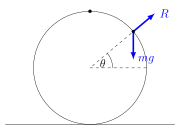
A smooth sphere of radius \(r\) stands fixed on a horizontal floor. A particle of mass \(m\) is displaced gently from equilibrium on top of the sphere. Find the angle its velocity makes with the horizontal when it loses contact with the sphere during the subsequent motion. By energy considerations, or otherwise, find the vertical component of the momentum of the particle as it strikes the floor.
Solution:
1987 Paper 2 Q12
A long, inextensible string passes through a small fixed ring. One end of the string is attached to a particle of mass \(m,\) which hangs freely. The other end is attached to a bead also of mass \(m\) which is threaded on a smooth rigid wire fixed in the same vertical plane as the ring. The curve of the wire is such that the system can be in static equilibrium for all positions of the bead. The shortest distance between the wire and the ring is \(d(>0).\) Using plane polar coordinates centred on the ring, find the equation of the curve. The bead is set in motion. Assuming that the string remains taut, show that the speed of the bead when it is a distance \(r\) from the ring is \[ \left(\frac{r}{2r-d}\right)^{\frac{1}{2}}v, \] where \(v\) is the speed of the bead when \(r=d.\)
Solution:
1987 Paper 3 Q13
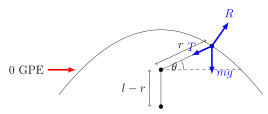
A uniform rod, of mass \(3m\) and length \(2a,\) is freely hinged at one end and held by the other end in a horizontal position. A rough particle, of mass \(m\), is placed on the rod at its mid-point. If the free end is then released, prove that, until the particle begins to slide on the rod, the inclination \(\theta\) of the rod to the horizontal satisfies the equation \[ 5a\dot{\theta}^{2}=8g\sin\theta. \] The coefficient of friction between the particle and the rod is \(\frac{1}{2}.\) Show that, when the particle begins to slide, \(\tan\theta=\frac{1}{26}.\)
Solution:

1987 Paper 3 Q14
It is given that the gravitational force between a disc, of radius \(a,\) thickness \(\delta x\) and uniform density \(\rho,\) and a particle of mass \(m\) at a distance \(b(\geqslant0)\) from the disc on its axis is \[ 2\pi mk\rho\delta x\left(1-\frac{b}{(a^{2}+b^{2})^{\frac{1}{2}}}\right), \] where \(k\) is a constant. Show that the gravitational force on a particle of mass \(m\) at the surface of a uniform sphere of mass \(M\) and radius \(r\) is \(kmM/r^{2}.\) Deduce that in a spherical cloud of particles of uniform density, which all attract one another gravitationally, the radius \(r\) and inward velocity \(v=-\dfrac{\d r}{\d t}\) of a particle at the surface satisfy the equation \[ v\frac{\mathrm{d}v}{\mathrm{d}r}=-\frac{kM}{r^{2}}, \] where \(M\) is the mass of the cloud. At time \(t=0\), the cloud is instantaneously at rest and has radius \(R\). Show that \(r=R\cos^{2}\alpha\) after a time \[ \left(\frac{R^{3}}{2kM}\right)^{\frac{1}{2}}(\alpha+\tfrac{1}{2}\sin2\alpha). \]
Solution: Suppose we divide a sphere of radius \(r\) up into slices of thickness \(\delta x\). Then the force acting on \(P\) will be: \begin{align*} F &= \sum_{\text{slices}} 2\pi mk\rho\delta x\left(1-\frac{b}{(a^{2}+b^{2})^{\frac{1}{2}}}\right) \\ &= \sum_{i=-r/\delta x}^{r/\delta x} 2\pi mk\frac{M}{\frac43 \pi r^3}\delta x\left(1-\frac{i \delta x}{((1-(i\delta x)^2)+(i \delta x)^{2})^{\frac{1}{2}}}\right) \\ &\to \int_{-r}^r \frac{1}{2} \frac{mkM}{r^3}(1-t) \d t \\ &=\frac{mkM}{r^2} \end{align*} We can see that the particle will have a force attracting it towards the centre, with magnitude \(\frac{kmM}{r^2}\), therefore and since \(\frac{\d v}{\d t} = \frac{\d v}{\d r} \frac{\d r}{\d t}\) we must have: \(v \frac{\d v}{\d r}m = - \frac{kmM}{r^2}\) and dividing by \(m\) we get exactly the result we seek. \begin{align*} && v \frac{\d v}{\d r} &= \frac{-kM}{r^2} \\ \Rightarrow && \frac{v^2}{2}+C &= \frac{kM}{r} \\ r = R, v =0: && C &= \frac{kM}{R} \\ \Rightarrow && v^2&= 2kM\left ( \frac1r - \frac1R\right ) \\ \Rightarrow && \frac{\d r}{\d t} &= -\sqrt{2kM\left ( \frac1r - \frac1R\right )} \\ \Rightarrow && -\sqrt{2kM}T &= \int_{r=R}^{r=R\cos^2 \alpha} \frac{1}{\sqrt{\frac1r-\frac1R}} \d r \\ r = R\cos^2 \theta: && -\sqrt{2kM}T &= \int_{\theta = 0}^{\theta = \alpha} \frac{\sqrt{R}}{\sqrt{\sec^2 \theta - 1}} \cdot R \cdot 2 \cdot (-\cos \theta) \cdot \sin \theta \d \theta \\ \Rightarrow && T &= \sqrt{\frac{R^3}{2kM}} \int_0^\alpha \frac{2 \cos \theta \sin \theta}{\sqrt{\sec^2 \theta - 1}} \d \theta \\ &&&= \sqrt{\frac{R^3}{2kM}} \int_0^\alpha \frac{2 \cos \theta \sin \theta}{\tan \theta} \d \theta \\ &&&= \sqrt{\frac{R^3}{2kM}} \int_0^\alpha 2\cos^2 \theta \d \theta \\ &&&= \sqrt{\frac{R^3}{2kM}} \int_0^\alpha 1 + \cos 2 \theta\d \theta \\ &&&= \sqrt{\frac{R^3}{2kM}} \left [1 + \frac12 \sin 2 \theta \right]_0^\alpha \\ &&&= \sqrt{\frac{R^3}{2kM}} \left (\alpha + \frac12 \sin 2 \alpha \right) \\ \end{align*}