1988 Paper 1 Q10
Year: 1988
Paper: 1
Question Number: 10
Course: LFM Pure and Mechanics
Section: Projectiles
Difficulty: 1500.0
Banger: 1500.0
Problem
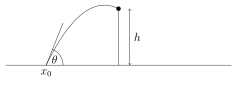
A sniper at the top of a tree of height \(h\) is hit by a bullet fired from the undergrowth covering the horizontal ground below. The position and elevation of the gun which fired the shot are unknown, but it is known that the bullet left the gun with speed \(v\). Show that it must have been fired from a point within a circle centred on the base of the tree and of radius \((v/g)\sqrt{v^{2}-2gh}\).
{[}Neglect air resistance.{]}
Solution
Rating Information
Difficulty Rating: 1500.0
Difficulty Comparisons: 0
Banger Rating: 1500.0
Banger Comparisons: 0
Show LaTeX source
Problem source
A sniper at the top of a tree of height $h$ is hit by a bullet fired from the undergrowth covering the horizontal ground below. The position and elevation of the gun which fired the shot are unknown, but it is known that the bullet left the gun with speed $v$. Show that it must have been fired from a point within a circle centred on the base of the tree and of radius $(v/g)\sqrt{v^{2}-2gh}$.
{[}Neglect air resistance.{]}
Solution source
\begin{center}
    \begin{tikzpicture}[scale=2]
        \def\h{1};
        \draw (0,0) -- (0,\h);

        \draw (-2,0) -- (2,0);
        \def\t{30};

        \filldraw (0,\h) circle (1pt);
        \def\xx{-0.25*(1 + sqrt(16*\h + 1))};
        \draw[domain = 0:1, samples=50, variable = \x]  plot ({\xx*\x},{\h-(\xx*\x)*(0.5+(\xx*\x))});
        % \def\xx{0.25*(1 - sqrt(16*\h + 1))};
        % \draw[domain = 0:1, samples=50, variable = \x]  plot ({\xx*\x},{\h+(\xx*\x)*(0.5-(\xx*\x))});
        \coordinate (O) at (0,0);
        \coordinate (X) at ({\xx}, 0);
        \coordinate (P) at ({\xx+0.3}, {0.5*0.3+0.6});

        \draw[->] (0.2, {\h/2}) -- (0.2, \h);
        \draw[->] (0.2, {\h/2}) -- (0.2, 0);
        \node at (0.2, {\h/2}) [right] {$h$};
        \node at ({\xx}, 0) [below] {$x_0$};

        \draw (X) -- (P);
        \pic [draw, angle radius=0.6cm, "$\theta$"] {angle = O--X--P};
    \end{tikzpicture}
\end{center}

The initial velocity is $\begin{pmatrix} v \cos \theta \\ v \sin \theta \end{pmatrix}$. The trajectory will be:

$\begin{pmatrix} x_0 + (v \cos \theta) t \\ (v \sin \theta)t -\frac12 g t^2 \end{pmatrix}$

we must have that for some time $t$, this is equal to $\begin{pmatrix} 0 \\ h \end{pmatrix}$

So $t = -\frac{x_0}{v \cos \theta}$ and so
\begin{align*}
&&h &= (v \sin \theta)t -\frac12 g t^2 \\
&&&= -x_0\tan \theta - \frac12 g \frac{x_0^2}{v^2 \cos^2 \theta} \\
&&&= -x_0\tan \theta - \frac{g}{2v^2 \cos^2 \theta}x_0^2 \\
&&&= -x_0\tan \theta - \frac{g}{2v^2} \sec^2 \theta x_0^2 \\
&&&= -x_0\tan \theta - \frac{g}{2v^2} (1+\tan^2 \theta )x_0^2 \\
&&&= -\l \frac{\sqrt{g}x_0}{\sqrt{2}v}\tan \theta +\frac{\sqrt{2}v}{2\sqrt{g}}\r^2+\frac{v^2}{2g}-\frac{g}{2v^2}x_0^2 \\
\Rightarrow && \frac{g}{2v^2}x_0^2 &= \frac{v^2}{2g}-h-\l \frac{\sqrt{g}x_0}{\sqrt{2}v}\tan \theta +\frac{\sqrt{2}v}{2\sqrt{g}}\r^2 \\
\Rightarrow && x_0^2 &= \frac{v^2(v^2-2gh)}{g^2}-K^2
\end{align*}

Therefore $\displaystyle |x_0| \leq \frac{v}{g}\sqrt{v^2-2gh}$