Problems
Filters
87 problems found
2005 Paper 3 Q1
Show that \(\sin A = \cos B\) if and only if \(A = (4n+1)\frac{\pi}{2}\pm B\) for some integer \(n\). Show also that \(\big\vert\sin x \pm \cos x \big\vert \le \sqrt{2}\) for all values of \(x\) and deduce that there are no solutions to the equation \(\sin\left( \sin x \right) = \cos \left( \cos x \right)\). Sketch, on the same axes, the graphs of \(y= \sin \left( \sin x \right)\) and \(y = \cos \left( \cos x \right)\). Sketch, not on the previous axes, the graph of \(y= \sin \left(2 \sin x \right)\).
Solution: \begin{align*} && \sin A &= \cos B \\ \Leftrightarrow && 0 &= \sin A - \cos B \\ &&&= \sin A - \sin ( \frac{\pi}{2} - B) \\ &&&= 2 \sin \left ( \frac{A + B - \frac{\pi}{2}}{2} \right) \cos \left (\frac{A - B + \frac\pi2}{2} \right) \\ \Leftrightarrow && n \pi &= \frac{A+B - \frac{\pi}{2}}{2}, n\pi + \frac{\pi}{2} = \frac{A-B+\frac{\pi}{2}}{2} \\ \Leftrightarrow && A \pm B &= 2n\pi + \frac{\pi}{2} \\ &&&= (4n+1) \frac{\pi}{2} \end{align*} \begin{align*} |\sin x \pm \cos x| &= | \sqrt{2} \sin(x \pm \frac{\pi}{4} )| \\ & \leq \sqrt{2} \end{align*} Therefore if \(\sin(\sin x) = \cos (\cos x)\) we must have that \(|\sin x \pm \cos x| = |(4n+1) \frac{\pi}{2}| \geq \frac{\pi}{2} > 1.5 > \sqrt{2}\) contradiction.


2004 Paper 2 Q4
\(\,\) \setlength{\unitlength}{1cm}
- An attempt is made to move a rod of length \(L\) from a corridor of width \(a\) into a corridor of width~\(b\), where \(a \ne b.\) The corridors meet at right angles, as shown in Figure 1 and the rod remains horizontal. Show that if the attempt is to be successful then $$ L \le a \cosec {\alpha} + b \sec {\alpha} \;, $$ where \({\alpha}\) satisfies $$ \tan^3\alpha =\frac a b \;. $$
- An attempt is made to move a rectangular table-top, of width \(w\) and length \(l\), from one corridor to the other, as shown in the Figure 2. The table-top remains horizontal. Show that if the attempt is to be successful then $$ l\le a \cosec {\beta} + b \sec {\beta} -2w \cosec 2{\beta}, $$ where \({\beta}\) satisfies $$ w= \left(\frac {a -b \tan^3 \beta} {1 - \tan^2 \beta} \right) \cos \beta \;. $$
2004 Paper 2 Q9
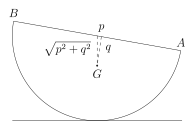
The base of a non-uniform solid hemisphere, of mass \(M,\) has radius \(r.\) The distance of the centre of gravity, \(G\), of the hemisphere from the base is \(p\) and from the centre of the base is \(\sqrt{p^2 + q^2} \,\). The hemisphere rests in equilibrium with its curved surface on a horizontal plane. A particle of mass \(m,\,\) where \(m\) is small, is attached to \(A\,\), the lowest point of the circumference of the base. In the new position of equilibrium, find the angle, \(\alpha\), that the base makes with the horizontal. The particle is removed and attached to the point \(B\) of the base which is at the other end of the diameter through \(A\,\). In the new position of equilibrium the base makes an angle \({\beta}\) with the horizontal. Show that $$\tan(\alpha-\beta)= \frac{2mMrp} {M^2\left(p^2+q^2\right)-m^2r^2}\;.$$
Solution:
2004 Paper 3 Q4
The triangle \(OAB\) is isosceles, with \(OA = OB\) and angle \(AOB = 2 \alpha\) where \(0< \alpha < {\pi \over 2}\,\). The semi-circle \(\mathrm{C}_0\) has its centre at the midpoint of the base \(AB\) of the triangle, and the sides \(OA\) and \(OB\) of the triangle are both tangent to the semi-circle. \(\mathrm{C}_1, \mathrm{C}_2, \mathrm{C}_3, \ldots\) are circles such that \(\mathrm{C}_n\) is tangent to \(\mathrm{C}_{n-1}\) and to sides \(OA\) and \(OB\) of the triangle. Let \(r_n\) be the radius of \(\mathrm{C}_n\,\). Show that \[ \frac{r_{n+1}}{r_n} = \frac{1-\sin\alpha}{1+\sin\alpha}\;. \] Let \(S\) be the total area of the semi-circle \(\mathrm{C}_0\) and the circles \(\mathrm{C}_1\), \(\mathrm{C}_2\), \(\mathrm{C}_3\), \(\ldots\;\). Show that \[ S = {1 + \sin^2 \alpha \over 4 \sin \alpha} \, \pi r_0^2 \;. \] Show that there are values of \(\alpha\) for which \(S\) is more than four fifths of the area of triangle~\(OAB\).
2004 Paper 3 Q5
Show that if \(\, \cos(x - \alpha) = \cos \beta \,\) then either \(\, \tan x = \tan ( \alpha + \beta)\,\) or \(\; \tan x = \tan ( \alpha - \beta)\,\). By choosing suitable values of \(x\), \(\alpha\) and \(\beta\,\), give an example to show that if \(\,\tan x = \tan ( \alpha + \beta)\,\), then \(\,\cos(x - \alpha) \, \) need not equal \( \cos \beta \,\). Let \(\omega\) be the acute angle such that \(\tan \omega = \frac 43\,\).
- For \(0 \le x \le 2 \pi\), solve the equation \[ \cos x -7 \sin x = 5 \] giving both solutions in terms of \(\omega\,\).
- For \(0 \le x \le 2 \pi\), solve the equation \[ 2\cos x + 11 \sin x = 10 \] showing that one solution is twice the other and giving both in terms of \(\omega\,\).
2003 Paper 1 Q3
- Show that \( 2\sin(\frac12\theta)=\sin \theta\) if and only if \(\sin(\frac12\theta)=0\,\).
- Solve the equation \(2\tan (\frac12\theta) = \tan\theta\,\).
- Show that \(2\cos(\frac12\theta)=\cos \theta\) if and only if \(\theta=(4n+2)\pi\pm 2\phi\) where \(\phi\) is defined by \(\cos \phi=\frac12(\sqrt 3-1)\;\), \(0\le \phi\le \frac{1}{2}\pi\), and \(n\) is any integer.
Solution:
- \(\,\) \begin{align*} && 2 \sin (\tfrac12 \theta) &= \sin \theta \\ \Leftrightarrow && 2 \sin (\tfrac12 \theta) &= 2\sin (\tfrac12 \theta) \cos (\tfrac12 \theta) \\ \Leftrightarrow && 0 &= 2\sin(\tfrac12\theta)(1-\cos(\tfrac12 \theta)) \\ \Leftrightarrow && 0 = \sin(\tfrac12 \theta) &\text{ or } 1 = \cos(\tfrac12 \theta) \\ \Leftrightarrow && 0 &= \sin(\tfrac12 \theta) \end{align*}
- Let \(= \tan(\tfrac12 \theta)\), then \begin{align*} && 2t &= \frac{2t}{1-t^2} \\ \Leftrightarrow && 0 &= \frac{2t(1-(1-t^2)}{1-t^2} \\ &&&= \frac{2t^3}{1-t^2} \\ \Leftrightarrow && t&= 0 \\ \Leftrightarrow && \frac12\theta &= n \pi \\ \Leftrightarrow && \theta &= 2n\pi \end{align*}
- Let \(c = \cos(\tfrac12 \theta)\), then \begin{align*} && 2c &= 2c^2 - 1 \\ && 0 &= 2c^2-2c-1 \\ \Leftrightarrow && c &= \frac{2 \pm \sqrt{4+8}}{4} \\ &&&= \frac{1 \pm \sqrt{3}}{2} \\ \Leftrightarrow && c &= \frac{1 - \sqrt{3}}{2} \\ \Leftrightarrow && \frac12 \theta &= \pm \cos^{-1} \frac{1 - \sqrt{3}}{2} + 2n \pi \\ &&&= \mp (\phi+\pi) + 2n \pi \\ \Leftrightarrow && \theta &= (4n+2)\pi \pm 2\phi \end{align*}
2003 Paper 1 Q4
Solve the inequality $$\frac{\sin\theta+1}{\cos\theta}\le1\;$$ where \(0\le\theta<2\pi\,\) and \(\cos\theta\ne0\,\).
Solution:

2003 Paper 2 Q2
Write down a value of \(\theta\,\) in the interval \(\frac{1}{4}\pi< \theta <\frac{1}{2}\pi\) that satisfies the equation \[ 4\cos\theta+ 2\sqrt3\, \sin\theta = 5 \;. \] Hence, or otherwise, show that \[ \pi=3\arccos(5/\sqrt{28}) + 3\arctan(\sqrt3/2)\;. \] Show that \[ \pi=4\arcsin(7\sqrt2/10) - 4\arctan(3/4)\;. \]
Solution: If \(\theta = \frac{\pi}{3}\) then \(\cos \theta = \frac12, \sin \theta = \frac{\sqrt{3}}{2}\) and clearly the equation is satisfied. We can also solve this equation using the harmonic formulae, namely: \begin{align*} && 5 &= 4 \cos \theta + 2\sqrt{3} \sin \theta \\ &&&= \sqrt{4^2+2^2 \cdot 3} \cos \left (\theta -\tan^{-1} \left (\frac{2\sqrt{3}}{4}\right) \right) \\ \Rightarrow && \frac{5}{\sqrt{28}} &= \cos \left ( \frac{\pi}{3} - \tan^{-1} \left (\frac{\sqrt{3}}{2}\right) \right) \\ \Rightarrow && \frac{\pi}{3} &= \arccos\left( \frac{5}{\sqrt{28}}\right) + \arctan \left (\frac{\sqrt{3}}{2}\right) \end{align*} From which the result follows. Similarly, notice that \(3 \cos \theta + 4 \sin \theta = \frac{7}{\sqrt{2}}\) is clearly solved by \(\frac{\pi}{4}\), but also writing it in harmonic form, we have \begin{align*} &&\frac{7}{\sqrt{2}} &= 5 \sin \left (\theta + \tan^{-1} \left ( \frac{3}{4} \right) \right) \\ \Rightarrow && \frac{7\sqrt{2}}{10} &= \sin \left ( \frac{\pi}{4} + \tan^{-1} \left ( \frac{3}{4} \right) \right) \\ \Rightarrow && \frac{\pi}{4} &= \arcsin \left ( \frac{7\sqrt{2}}{10} \right) - \arctan \left ( \frac{3}{4} \right) \end{align*} as required.
2003 Paper 3 Q11
Point \(B\) is a distance \(d\) due south of point \(A\) on a horizontal plane. Particle \(P\) is at rest at \(B\) at \(t=0\), when it begins to move with constant acceleration \(a\) in a straight line with fixed bearing~\(\beta\,\). Particle \(Q\) is projected from point \(A\) at \(t=0\) and moves in a straight line with constant speed \(v\,\). Show that if the direction of projection of \(Q\) can be chosen so that \(Q\) strikes \(P\), then \[ v^2 \ge ad \l 1 - \cos \beta \r\;. \] Show further that if \(v^2 >ad(1-\cos\beta)\) then the direction of projection of \(Q\) can be chosen so that \(Q\) strikes \(P\) before \(P\) has moved a distance \(d\,\).
2002 Paper 1 Q6
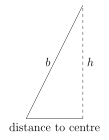
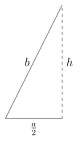
A pyramid stands on horizontal ground. Its base is an equilateral triangle with sides of length~\(a\), the other three sides of the pyramid are of length \(b\) and its volume is \(V\). Given that the formula for the volume of any pyramid is $ \textstyle \frac13 \times \mbox{area of base} \times \mbox {height} \,, $ show that \[ V= \frac1{12} {a^2(3b^2-a^2)}^{\frac12}\;. \] The pyramid is then placed so that a non-equilateral face lies on the ground. Show that the new height, \(h\), of the pyramid is given by \[ h^2 = \frac{a^2(3b^2-a^2)}{4b^2-a^2}\;. \] Find, in terms of \(a\) and \(b\,\), the angle between the equilateral triangle and the horizontal.
Solution: First let's consider the area of the base. It is an equilateral triangle with side length \(a\), so \(\frac12 a^2 \sin 60^\circ = \frac{\sqrt{3}}4a^2\).
2002 Paper 2 Q6
The lines \(l_1\), \(l_2\) and \(l_3\) lie in an inclined plane \(P\) and pass through a common point \(A\). The line \(l_2\) is a line of greatest slope in \(P\). The line \(l_1\) is perpendicular to \(l_3\) and makes an acute angle \(\alpha\) with \(l_2\). The angles between the horizontal and \(l_1\), \(l_2\) and \(l_3\) are \(\pi/6\), \(\beta\) and \(\pi/4\), respectively. Show that \(\cos\alpha\sin\beta = \frac12\,\) and find the value of \(\sin\alpha \sin\beta\,\). Deduce that \(\beta = \pi/3\,\). The lines \(l_1\) and \(l_3\) are rotated in \(P\) about \(A\) so that \(l_1\) and \(l_3\) remain perpendicular to each other. The new acute angle between \(l_1\) and \(l_2\) is \(\theta\). The new angles which \(l_1\) and \(l_3\) make with the horizontal are \(\phi\) and \(2\phi\), respectively. Show that \[ \tan^2\theta = \frac{3+\sqrt{13}}2\;. \]
2002 Paper 3 Q2
Prove that \(\displaystyle \arctan a + \arctan b = \arctan \l {a + b \over 1-ab} \r\,\) when \(0 < a < 1\) and \(0 < b < 1\,\). Prove by induction that, for \(n \ge 1\,\), \[ \sum_{r = 1}^n \arctan \l {1 \over r^2 + r + 1} \r = \arctan \l {n \over n+2} \r \] and hence find \[ \sum_{r = 1}^\infty \arctan \l {1 \over r^2 + r + 1} \r\,. \] Hence prove that \[ \sum_{r = 1}^\infty \arctan \l {1 \over r^2 - r + 1} \r = {\pi \over 2}\,. \]
Solution: \begin{align*} && \arctan a &\in (0, \tfrac{\pi}{4}) \\ && \arctan b &\in (0, \tfrac{\pi}{4}) \\ \Rightarrow && \arctan a+\arctan b &\in (0, \tfrac{\pi}{2}) \\ && \tan \left ( \arctan a+\arctan b \right) &= \frac{\tan \arctan a + \tan \arctan b}{1 - \tan \arctan a \tan \arctan b} \\ &&&= \frac{a+b}{1-ab} \in (0, \infty) \\ \Rightarrow && \arctan \left ( \frac{a+b}{1-ab} \right) &\in (0, \tfrac{\pi}{2}) \\ \Rightarrow && \arctan a + \arctan b &= \arctan \left ( \frac{a+b}{1-ab} \right) \end{align*} Claim: \(\displaystyle \sum_{r = 1}^n \arctan \l {1 \over r^2 + r + 1} \r = \arctan \l {n \over n+2} \r\) Proof: (By Induction): Base case (\(n=1\)): \begin{align*} && LHS &= \sum_{r=1}^1 \arctan \left ( \frac{1}{r^2+r+1} \right) \\ &&&= \arctan \left ( \frac{1}{3} \right) \\ && RHS &= \arctan \left ( \frac{1}{1+2} \right)\\ &&&= \arctan \left ( \frac{1}{3} \right) = LHS \end{align*} Inductive step, suppose true for \(n = k\), ie \begin{align*} && \sum_{r = 1}^k \arctan \l {1 \over r^2 + r + 1} \r &= \arctan \l {k \over k+2} \r \\ \Rightarrow && \sum_{r = 1}^{k+1} \arctan \l {1 \over r^2 + r + 1} \r &= \sum_{r = 1}^k \arctan \l {1 \over r^2 + r + 1} \r+ \arctan \left ( \frac{1}{(k+1)^2+(k+1)+1} \right) \\ &&&= \arctan \l {k \over k+2} \r+\arctan \left ( \frac{1}{(k+1)^2+(k+1)+1} \right) \\ &&&= \arctan \left ( \frac{{k \over k+2}+\frac{1}{(k+1)^2+(k+1)+1} }{1-\frac{k}{k+2}\frac{1}{(k+1)^2+(k+1)+1} } \right) \\ &&&= \arctan \left ( \frac{k((k+1)^2+k+1+k)+(k+2) }{(k+2)((k+1)^2+(k+1)+1)-k} \right) \\ &&&= \arctan \left ( \frac{k^3+3k^2+4k+2 }{k^3+5k^2+8k+6} \right) \\ &&&= \arctan \left ( \frac{(k+1)(k^2+2k+2) }{(k+3)(k^2+2k+2)} \right) \\ &&&= \arctan \left ( \frac{k+1 }{(k+1)+2} \right) \\ \end{align*} Therefore it is true for \(n = k+1\), therefore it is true for all \(n \geq 1\) by the principle of mathematical induction. \begin{align*} && S &= \lim_{n \to \infty} \sum_{r = 1}^n \arctan \l {1 \over r^2 + r + 1} \r \\ &&&= \lim_{n \to \infty} \arctan \l \frac{n}{n+2} \r \\ &&&= \lim_{n \to \infty} \arctan \l \frac{1}{1+2/n} \r \\ &&&=\arctan\l \lim_{n \to \infty} \frac{1}{1+2/n} \r \\ &&&= \frac{\pi}{4} \end{align*} \begin{align*} && \sum_{r = 1}^\infty \arctan \l {1 \over r^2 - r + 1} \r &= \sum_{r = 0}^\infty \arctan \left( \frac{1}{ (r+1)^2 - (r+1) + 1} \right) \\ &&&= \sum_{r = 0}^\infty \arctan \left( \frac{1}{ r^2+r+1} \right) \\ &&&= \arctan \l \frac{1}{0^2+0+1} \r + \frac{\pi}{4} \\ &&&= \frac{\pi}{2} \end{align*}
2002 Paper 3 Q7
Given that \(\alpha\) and \(\beta\) are acute angles, show that \(\alpha + \beta = \tfrac{1}{2}\pi\) if and only if \(\cos^2 \alpha + \cos^2 \beta = 1\). In the \(x\)--\(y\) plane, the point \(A\) has coordinates \((0,s)\) and the point \(C\) has coordinates \((s,0)\), where \(s>0\). The point \(B\) lies in the first quadrant (\(x>0\), \(y>0\)). The lengths of \(AB\), \(OB\) and \(CB\) are respectively \(a\), \(b\) and \(c\). Show that \[ (s^2 +b^2 - a^2)^2 + (s^2 +b^2 -c^2)^2 = 4s^2b^2 \] and hence that \[ (2s^2 -a^2-c^2)^2 + (2b^2 -a^2-c^2)^2 =4a^2c^2\;. \] Deduce that $$ \l a - c \r^2 \le 2b^2 \le \l a + c \r^2\;. $$ %Show, %by considering the case \(a=1+\surd2\,\), \(b=c=1\,\), % that the condition \(\l \ast \r\,\) %is not sufficient to ensure that \(B\) lies in the first quadrant.
2001 Paper 1 Q4
Show that \(\displaystyle \tan 3\theta = \frac{3\tan\theta -\tan^3\theta}{1-3\tan^2\theta}\) . Given that \(\theta= \cos^{-1} (2/\sqrt5)\) and \(0<\theta<\pi/2\), show that \(\tan 3\theta =11/2\) Hence, or otherwise, find all solutions of the equations
- \(\tan(3\cos^{-1} x) =11/2\) ,
- \(\cos ({\frac13}\tan^{-1} y) = 2/\sqrt5\) .
Solution: Let \(\tan \theta = t\) \begin{align*} \tan 3 \theta &\equiv \tan (2 \theta + \theta) \\ &\equiv \frac{\tan 2 \theta +\tan \theta}{1 - \tan 2 \theta \tan \theta} \\ &\equiv \frac{\frac{2t}{1-t^2}+t}{1-\frac{2t^2}{1-t^2}} \\ &\equiv \frac{2t+t-t^3}{1-t^2-2t^2} \\ &\equiv \frac{3t-t^3}{1-3t^3} \\ &\equiv \frac{3\tan \theta - \tan^3 \theta}{1 - 3 \tan^3 \theta} \end{align*} If \(\theta = \cos^{-1} (2/\sqrt{5})\), then \(\sin \theta = 1/\sqrt{5}\) and \(\tan \theta = 1/2\). Hence \begin{align*} \tan 3 \theta &= \frac{3 \cdot \frac12 - \frac18}{1 - \frac34} \\ &= \frac{11}{2} \end{align*}
- Since \(\tan 3 y = 11/2\) has the solution \(y = \cos^{-1} (2/\sqrt{5})\) it will also have the solutions \(y = \cos^{-1}(2/\sqrt{5}) + \frac{\pi}{3}\) and \(y = \cos^{-1}(2/\sqrt{5})+\frac{2\pi}{3}\), therefore \begin{align*} && \cos^{-1} x &= \cos^{-1} (2/\sqrt{5})\\ \Rightarrow && x &= 2/\sqrt{5} \\ && \cos^{-1} x &= \cos^{-1} (2/\sqrt{5}) + \frac{\pi}{3}\\ \Rightarrow && x &= \frac{2}{\sqrt{5}} \frac{1}{2} - \frac{1}{\sqrt{5}} \frac{\sqrt{3}}{2} \\ &&&= \frac{2-\sqrt{3}}{2\sqrt{5}} \\ && \cos^{-1} x &= \cos^{-1} (2/\sqrt{5}) + \frac{2\pi}{3}\\ \Rightarrow && x &= \frac{2}{\sqrt{5}} \left (-\frac{1}{2} \right)- \frac{1}{\sqrt{5}} \frac{\sqrt{3}}{2} \\ &&&= \frac{-\sqrt{3}-2}{2\sqrt{5}} \\ \end{align*}
- Since \(\cos \frac13 x = \frac{2}{\sqrt{5}}\) has the solution \(x = \tan^{-1} \frac{11}{2}\) it will also have the solutions \(x = \tan^{-1} \frac{11}{2} + 2n \pi\) and \(x = -\tan^{-1} \frac{11}{2} + 2n \pi\). \begin{align*} && \tan^{-1} y &= \tan^{-1} \frac{11}{2} \\ \Rightarrow && y &= \frac{11}{2} \\ && \tan^{-1} y &= \tan^{-1} \frac{11}{2} + 2n \pi \\ \Rightarrow && y &= \frac{\frac{11}{2} + 0}{1-0} \\ &&&= \frac{11}{2} \\ && \tan^{-1} y &= -\tan^{-1} \frac{11}{2} + 2n \pi \\ \Rightarrow && y &= \frac{-\frac{11}{2} + 0}{1-0} \\ &&&= -\frac{11}{2} \\ \end{align*} So our two solutions are \(y = \pm \frac{11}{2}\)
2001 Paper 2 Q4
Let $$ \f(x) = P \, {\sin x} + Q\, {\sin 2x} + R\, {\sin 3x} \;. $$ Show that if \(Q^2 < 4R(P-R)\), then the only values of \(x\) for which \(\f(x) = 0\) are given by \(x=m\pi\), where \(m\) is an integer. \newline [You may assume that \(\sin 3x = \sin x(4\cos^2 x -1)\).] Now let $$ \g(x) = {\sin 2nx} + {\sin 4nx} - {\sin 6nx}, $$ where \(n\) is a positive integer and \(0 < x < \frac{1}{2}\pi \). Find an expression for the largest root of the equation \(\g(x)=0\), distinguishing between the cases where \(n\) is even and \(n\) is odd.