Problems
Filters
219 problems found
2014 Paper 2 Q3
- Show, geometrically or otherwise, that the shortest distance between the origin and the line \(y= mx+c\), where \(c\ge0\), is \(c(m^2+1)^{-\frac12}\).
- The curve \(C\) lies in the \(x\)-\(y\) plane. Let the line \(L\) be tangent to \(C\) at a point \(P\) on \(C\), and let \(a\) be the shortest distance between the origin and \(L\). The curve \(C\) has the property that the distance \(a\) is the same for all points \(P\) on \(C\). Let \(P\) be the point on \(C\) with coordinates \((x,y(x))\). Given that the tangent to \(C\) at \(P\) is not vertical, show that \begin{equation} (y-xy')^2 = a^2\big (1+(y')^2 \big) \,. \tag{\(*\)} \end{equation} By first differentiating \((*)\) with respect to \(x\), show that either \(y= mx \pm a(1+m^2)^{\frac12}\) for some \(m\) or \(x^2+y^2 =a^2\).
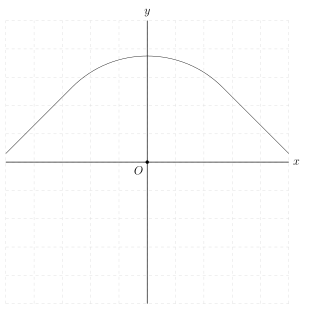
- Now suppose that \(C\) (as defined above) is a continuous curve for \(-\infty < x < \infty\), consisting of the arc of a circle and two straight lines. Sketch an example of such a curve which has a non-vertical tangent at each point.
Solution:
- \(\,\)
Note that we have a right angled triangle, with the sides in a ratio of \(m\). So if our target length is \(x\) we have \(x^2 + (mx)^2 = c^2\) and so \(x = c(m^2+1)^{-\frac12}\)
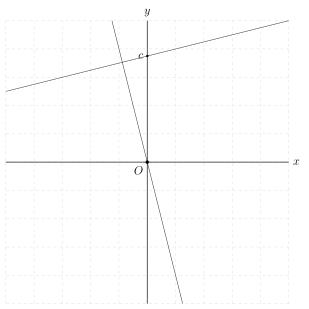
- The distance from the origin to \(L\) is \(a = c(m^2+1)^{-\frac12}\) so \begin{align*} && a^2(m^2+1) &= c^2 \\ && \frac{c-y(x)}{0-x} &= y' \\ \Rightarrow && c-y &= -xy' \\ \Rightarrow && a^2((y')^2+1) &= (y-xy')^2 \\ \\ && 2a^2y'y'' &= 2(y-xy')(y'-xy''-y') \\ &&&= 2(xy'-y)xy'' \\ \Rightarrow && y'' &= 0 \\ \text{ or } && 2a^2y' &= 2(xy'-y)x \end{align*} If \(y'' = 0\) then \(y = mx + c\) and the result follows immediately. \begin{align*} && 0 &= (a^2-x^2)y' + yx \\ \Rightarrow &&\frac1{y} y' &= -\frac{x}{a^2-x^2} \\ \Rightarrow && \ln y &= \frac12\ln (a^2-x^2) + K \\ \Rightarrow && y^2 &= M(a^2-x^2) \\ \Rightarrow && x^2 + y^2 &= a^2 \end{align*} Where in the last step we know the tangents from an ellipse are not all equidistant to the origin.
2014 Paper 2 Q8
For positive integers \(n\), \(a\) and \(b\), the integer \(c_r\) (\(0\le r\le n\)) is defined to be the coefficient of \(x^r\) in the expansion in powers of \(x\) of \((a+bx)^n\). Write down an expression for \(c_r\) in terms of \(r\), \(n\), \(a\) and \(b\). For given \(n\), \(a\) and \(b\), let \(m\) denote a value of \(r\) for which \(c_r\) is greatest (that is, \(c_m \ge c_r\) for \(0\le r\le n\)). Show that \[ \frac{b(n+1)}{a+b} - 1 \le m \le \frac {b(n+1)}{a+b} \,. \] Deduce that \(m\) is either a unique integer or one of two consecutive integers. Let \(G(n,a,b)\) denote the unique value of \(m\) (if there is one) or the larger of the two possible values of \(m\).
- Evaluate \(G(9,1,3)\) and \(G(9,2,3)\).
- For any positive integer \(k\), find \(G(2k,a,a)\) and \(G(2k-1,a,a)\) in terms of \(k\).
- For fixed \(n\) and \(b\), determine a value of \(a\) for which \(G(n,a,b)\) is greatest.
- For fixed \(n\), find the greatest possible value of \(G(n,1,b)\). For which values of \(b\) is this greatest value achieved?
Solution: \(c_r = \binom{n}{r}a^{n-r}b^r\) \begin{align*} && c_m &\geq c_{m+1} \\ \Rightarrow && \binom{n}{m} a^{n-m}b^m &\geq \binom{n}{m+1} a^{n-m-1}b^{m+1} \\ \Rightarrow && \frac{1}{(n-m)}a &\geq \frac{1}{m+1}b \\ \Rightarrow && (m+1)a &\geq (n-m)b \\ \Rightarrow && m(a+b) &\geq nb -a \\ \Rightarrow && m &\geq \frac{n(b+1)-a-b}{a+b}=\frac{n(b+1)}{a+b} - 1 \\ \\ && c_m &\geq c_{m-1} \\ \Rightarrow && \binom{n}{m} a^{n-m}b^m &\geq \binom{n}{m-1} a^{n-m+1}b^{m-1} \\ \Rightarrow && \frac{1}m b &\geq \frac{a}{(n-m+1)} \\ \Rightarrow && (n-m+1)b &\geq ma \\ \Rightarrow && (n+1)b &\geq m(a+b) \\ \Rightarrow && m &\leq \frac{(n+1)b}{a+b} \end{align*} Since \(m\) lies between two values \(1\) apart is is either equal to one of those two values or is the unique integer between them. Let \(\displaystyle G(n,a,b) = \left \lfloor \frac{b(n+1)}{a+b} \right \rfloor\), so
- \(\,\) \begin{align*} && G(9,1,3) &= \left \lfloor \frac{3(9+1)}{1+3} \right \rfloor \\ &&&= \left \lfloor \frac{30}{4} \right \rfloor \\ &&&= 7 \\ \\ && G(9,2,3) &= \left \lfloor \frac{3(9+1)}{2+3} \right \rfloor \\ &&&= \left \lfloor \frac{30}{5} \right \rfloor \\ &&&= 6 \end{align*}
- \(\,\) \begin{align*} && G(2k, a, a) &= \left \lfloor \frac{a(2k+1)}{a+a} \right \rfloor \\ && &= \left \lfloor \frac{2k+1}{2} \right \rfloor \\ &&&= k \\ \\ && G(2k-1, a, a) &= \left \lfloor \frac{a(2k-1+1)}{a+a} \right \rfloor \\ && &= \left \lfloor k\right \rfloor \\ &&&= k \\ \end{align*}
- \(G(n,a,b)\) is decreasing in \(a\), therefore take \(a = 1\).
- For fixed \(n\), we are looking at \(\frac{a(n+1)}{a+b}\) and we want this to be as large as possible. By considering \((n+1) - \frac{b(n+1)}{a+b}\) we can see this is increasing in \(b\) and the largest value possible is \(n\). This is achieved when \begin{align*} && \frac{b(n+1)}{a+b} & \geq n \\ \Leftrightarrow && bn + b &\geq na + bn \\ \Leftrightarrow && b& \geq na \end{align*}
2014 Paper 2 Q10
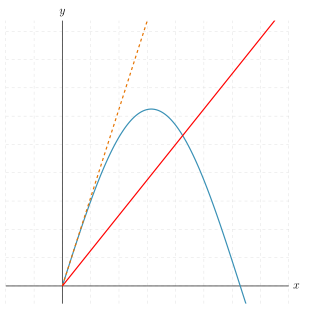
A particle is projected from a point \(O\) on horizontal ground with initial speed \(u\) and at an angle of \(\theta\) above the ground. The motion takes place in the \(x\)-\(y\) plane, where the \(x\)-axis is horizontal, the \(y\)-axis is vertical and the origin is \(O\). Obtain the Cartesian equation of the particle's trajectory in terms of \(u\), \(g\) and~\(\lambda\), where \(\lambda=\tan\theta\). Now consider the trajectories for different values of \(\theta\) with \(u\)~fixed. Show that for a given value of~\(x\), the coordinate~\(y\) can take all values up to a maximum value,~\(Y\), which you should determine as a function of \(x\), \(u\) and~\(g\). Sketch a graph of \(Y\) against \(x\) and indicate on your graph the set of points that can be reached by a particle projected from \(O\) with speed \(u\). Hence find the furthest distance from \(O\) that can be achieved by such a projectile.
2014 Paper 3 Q3
- The line \(L\) has equation \(y=mx+c\), where \(m > 0\) and \(c > 0\). Show that, in the case \(mc > a > 0\), the shortest distance between \(L\) and the parabola \(y^2=4ax\) is \[ \frac{mc-a}{m\sqrt{m^2+1}}\,.\] What is the shortest distance in the case that \(mc\le a\)?
- Find the shortest distance between the point \((p,0)\), where \(p > 0\), and the parabola \(y^2=4ax\), where \(a > 0\), in the different cases that arise according to the value of \(p/a\). [You may wish to use the parametric coordinates \((at^2, 2at)\) of points on the parabola.] Hence find the shortest distance between the circle \((x-p)^2 + y^2 =b^2\), where \(p > 0\) and \(b > 0\), and the parabola \(y^2=4ax\), where \(a > 0\), in the different cases that arise according to the values of \(p\), \(a\) and \(b\).
Solution:
- Suppose we have the shortest distance between the two curves, and the path between the points is not a normal to both curves. Then we could shift the endpoints to reduce the distance. (Assuming we're not at a point of intersection). Therefore, the normal to the curves must be the same (or in other words) the gradients of the curves must be the same. ie we are at a point where \(2y y' = 4a\) we must have \(y' = m\), so \(y = \frac{2a}{m}\) and \(x = \frac{a}{m^2}\) and the distance from this point to the line \(y=mx+c\) is \(\frac{|m \frac{a}{m^2} - \frac{2a}{m}+c|}{\sqrt{m^2+1}} = \frac{|mc-a|}{m\sqrt{m^2+1}} = \frac{mc-a}{m\sqrt{m^2+1}}\). If \(mc \leq a\) then we find \(\frac{a-mc}{m\sqrt{m^2+1}}\) However, we must check that the two curves do not intersect (otherwise the closest distace is \(0\)). ie we need to check if \((mx+c)^2 = 4ax\) has any solutions, this quadratic has discriminant \((2mc-4a)^2 - 4 \cdot m^2 \cdot c^2 = 16a^2-16amc = 16a(a-mc)\) which is clearly greater than \(0\) when \(a \geq mc\). Therefore the shortest distance in this case is \(0\).
- The distance squared between the point \((p,0)\) and a point of the form \((at^2,2at)\) is \(D^2 = (at^2-p)^2+4a^2t^2 = a^2t^4+(4a^2-2ap)t^2+p^2\) \begin{align*} && \frac{D^2}{a^2} &= t^4 + 2\left(2-\frac{p}{a}\right)t^2 + \frac{p^2}{a^2} \\ &&&= \left (t^2 - \left (\frac{p}{a}-2 \right)\right)^2 + \frac{p^2}{a^2} - \left (2-\frac{p}{a} \right)^2 \\ &&&= \left (t^2 - \left (\frac{p}{a}-2 \right)\right)^2 +\frac{4p}{a} -4 \\ \end{align*} Therefore if \(2 \leq \frac{p}{a}\) then we can find a \(t\) such that we attain the minimum for \(D^2/a^2\) of \(\frac{4p}{a}-4\) and so \(D = \sqrt{4pa-4a^2} = 2\sqrt{a(p-a)}\) . If not the smallest value will be when \(t = 0\) and we will have \(|p|\) Now consider all the lines joining points on the parabola to the centre of the circle. The shortest distance from the parabola to the circle will be normal to the circle and therefore will also be a line through the center. Therefore we need only consider the shortest distance from \((p,0)\) to the parabola \(-b\). Case 1: If \(p \geq 2a\) we have \(2\sqrt{a(p-a)} - b\) or \(0\) if \(b \geq 2\sqrt{a(p-a)}\) Case 2: If \(p < 2a\) we have \(p-b\) or \(0\) if \(b \geq p\)
2014 Paper 3 Q4
- Let \[ I = \int_0^1 \bigl((y')^2 -y^2\bigr)\d x \qquad\text{and}\qquad I_1=\int_0^1 (y'+y\tan x)^2 \d x \,, \] where \(y\) is a given function of \(x\) satisfying \(y=0\) at \(x=1\). Show that \(I-I_1=0\) and deduce that \(I\ge0\). Show further that \(I=0\) only if \(y=0\) for all \(x\) (\(0\le x \le 1\)).
- Let \[ J = \int_0^1 \bigl((y')^2 -a^2y^2\bigr)\d x \,, \] where \(a\) is a given positive constant and \(y\) is a given function of \(x\), not identically zero, satisfying \(y=0\) at \(x=1\). By considering an integral of the form \[ \int_0^1 (y'+ay\tan bx)^2 \d x \,, \] where \(b\) is suitably chosen, show that \(J\ge0\). You should state the range of values of \(a\), in the form \(a < k\), for which your proof is valid. In the case \(a=k\), find a function \(y\) (not everywhere zero) such that \(J=0\).
Solution:
- \begin{align*} && I - I_1 &= \int_0^1 \left ( \left ( y' \right)^2 - y^2 \right) \d x - \int_0^1 \left ( y' + y \tan x \right)^2 \d x\\ &&&= \int_0^1 \left ( \left ( y' \right)^2 - y^2 \right) - \left ( y' + y \tan x \right)^2 \d x\\ &&&= \int_0^1 \left (-y^2-2yy' \tan x - y^2 \tan^2 x \right) \d x\\ &&&= \int_0^1 \left (-2yy' \tan x - y^2(1+ \tan^2 x )\right) \d x\\ &&&= \int_0^1 \left (-2yy' \tan x - y^2 \sec^2 x\right) \d x\\ &&&= \int_0^1 -\frac{\d}{\d x} \left (y^2 \tan x \right) \d x\\ &&&= \left [-y^2 \tan x \right]_0^1 \\ &&&= 0 \\ \\ \Rightarrow && I &= I_1 = \int_0^1 \left ( y' + y \tan x \right)^2 d x \geq 0 \end{align*} The only way \(I_0 = 0\) is is \(y' + y \tan x =0\), so \begin{align*} && \frac{\d y}{\d x} &= - y \tan x \\ \Rightarrow && \int \frac{1}{y} &= \int -\tan x \d x \\ \Rightarrow && \ln |y| &= \ln |\cos x| + C \\ \Rightarrow && y &= A \cos x \\ \Rightarrow && A &= 0 \Rightarrow y = 0 \end{align*}
- Let \(J_1 = \int_0^1 (y'+ay\tan ax)^2 \d x\), then \begin{align*} && J-J_1 &= \int_0^1 \left ( \left ( y' \right)^2 - a^2y^2 \right) - \left ( y' + ya \tan ax \right)^2 \d x\\ &&&= \int_0^1 \left (-a^2y^2-2yy' a \tan a x-y^2a^2 \tan^2 ax \right) \d x \\ &&&= \int_0^1 \left (-2yy' a \tan ax - a^2y^2(1+\tan^2 ax) \right) \d x \\ &&&= \int_0^1 \left (-2yy' a \tan ax - a^2y^2\sec^2 ax \right) \d x \\ &&&= \left [ - a y^2 \tan a x \right]_0^1 = 0 \end{align*} This is true if \(a < \frac{\pi}{2}\), since otherwise we might care about the order of the zero for \(y\) at \(x = 1\). Consider \(y = \cos \frac{\pi}{2} x\), then \(y' = -\frac{\pi}{2} \sin^2\frac{\pi}{2} x\) and \begin{align*} && \int_0^1 \frac{\pi^2}{4} \left (\sin^2 \frac{\pi}{2}x - \cos^2 \frac{\pi}{2} x \right) \d x &= -\frac{\pi^2}{4} \int_0^1 \cos(\pi x) \d x \\ &&&= 0 \end{align*}
2014 Paper 3 Q11
A particle \(P\) of mass \(m\) is connected by two light inextensible strings to two fixed points \(A\) and \(B\), with \(A\) vertically above \(B\). The string \(AP\) has length \(x\). The particle is rotating about the vertical through \(A\) and \(B\) with angular velocity \(\omega\), and both strings are taut. Angles \(PAB\) and \(PBA\) are \(\alpha\) and \(\beta\), respectively. Find the tensions \(T_A\) and \(T_B\) in the strings \(AP\) and \(BP\) (respectively), and hence show that \(\omega^2 x\cos\alpha \ge g\). Consider now the case that \(\omega^2 x\cos\alpha = g\). Given that \(AB=h\) and \(BP=d\), where \(h>d\), show that \(h\cos\alpha \ge \sqrt{h^2-d^2}\). Show further that \[ mg < T_A \le \frac{mgh}{\sqrt{h^2-d^2}\,}\,. \] Describe the geometry of the strings when \(T_A\) attains its upper bound.
Solution:


2013 Paper 2 Q1
- Find the value of \(m\) for which the line \(y = mx\) touches the curve \(y = \ln x\,\). If instead the line intersects the curve when \(x = a\) and \(x = b\), where \(a < b\), show that \(a^b = b^a\). Show by means of a sketch that \(a < \e < b\).
- The line \(y=mx+c\), where \(c>0\), intersects the curve \(y=\ln x\) when \(x=p\) and \(x=q\), where \(p < q\). Show by means of a sketch, or otherwise, that \(p^q > q^p\).
- Show by means of a sketch that the straight line through the points \((p, \ln p)\) and \((q, \ln q)\), where \(\e\le p < q\,\), intersects the \(y\)-axis at a positive value of \(y\). Which is greater, \(\pi^\e\) or \(\e^\pi\)?
- Show, using a sketch or otherwise, that if \(0 < p < q\) and \(\dfrac{\ln q - \ln p}{q-p} = \e^{-1}\), then \(q^p > p^q\).
Solution: \begin{questionparts} \item The tangent to \(y = \ln x\) is \begin{align*} && \frac{y - \ln x_1}{x - x_1} &= \frac{1}{x_1} \\ \Rightarrow && \frac{x_1y -x_1 \ln x_1}{ x- x_1} &= 1 \\ \Rightarrow && x_1 y - x_1 \ln x_1 &= x - x_1 \end{align*} So to run through the origin, we need \(\ln x_1 = 1 \Rightarrow x_1 = e\) so the line will be \(y = \frac1{e} x\) If \(ma = \ln a \Rightarrow m = \frac{\ln a}{a} = \frac{\ln b}{b} \Rightarrow b \ln a = a \ln b \Rightarrow a^b = b^a\). \item
2013 Paper 2 Q8
The function \(\f\) satisfies \(\f(x)>0\) for \(x\ge0\) and is strictly decreasing (which means that \(\f(b)<\f(a)\) for \(b>a\)).
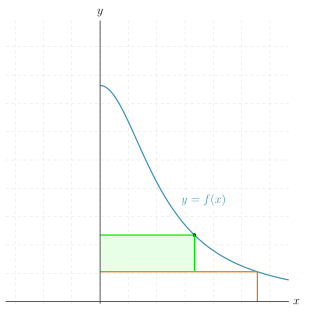
- For \(t\ge0\), let \(A_0(t)\) be the area of the largest rectangle with sides parallel to the coordinate axes that can fit in the region bounded by the curve \(y=\f(x)\), the \(y\)-axis and the line \(y=\f(t)\). Show that \(A_0(t)\) can be written in the form \[ A_0(t) =x_0\left( \f(x_0) -\f(t)\right), \] where \(x_0\) satisfies \(x_0 \f'(x_0) +\f(x_0) = \f(t)\,\).
- The function g is defined, for \(t> 0\), by \[ \g(t) =\frac 1t \int_0^t \f(x) \d x\,. \] Show that \(t \g'(t) = \f(t) -\g(t)\,\). Making use of a sketch show that, for \(t>0\), \[ \int_0^t \left( \f(x) - \f(t)\right) \d x > A_0(t) \] and deduce that \(-t^2 \g'(t)> A_0(t)\).
- In the case \(\f(x)= \dfrac 1 {1+x}\,\), use the above to establish the inequality \[ \ln \sqrt{1+t} > 1 - \frac 1 {\sqrt{1+t}} \,, \] for \(t>0\).
Solution:
- First, not that the point must be ony the curve:
Since otherwise it's pretty clear we could make the area of the rectangle larger by moving the point onto the curve. Therefore \(A = x(f(x)-f(t))\). To maximise this we need \(xf'(x) + f(x)-f(t) = 0\), ie \(x_0f'(x_0) + f(x_0) = f(t)\)
- Suppose \(\displaystyle \g(t) =\frac 1t \int_0^t \f(x) \d x\) then
\begin{align*}
&& \g(t) &=\frac 1t \int_0^t \f(x) \d x\\
\Rightarrow && tg(t) &= \int_0^t \f(x) \d x \\
\Rightarrow && tg'(t) +g(t) &= f(t) \\
\Rightarrow && tg'(t) &= f(t) - g(t)
\end{align*}
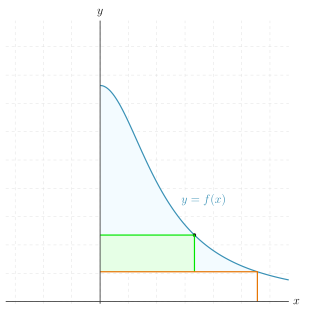
Clearly the blue area + green area is larger than the green area. So \(\displaystyle \int_0^t (f(x) - f(t))\d x > A_0(t)\). Notice that \(f(t) = \frac1{t} \int_0^t f(t) \d x \) so \(-t^2g'(t) = \int_0^t f(x) \d x > A_0(t)\)
- Not that if \(f(x) = \dfrac{1}{1+x}\), the \(f'(x) = -\frac{1}{(1+x)^2}\) and so \begin{align*} && -\frac{x_0}{(1+x_0)^2} + \frac{1}{1+x_0} &= \frac{1}{1+t} \\ && \frac{1}{(1+x_0)^2} &= \frac{1}{1+t} \\ \Rightarrow && x_0 &= \sqrt{1+t} - 1 \\ && A_0(t) &= (\sqrt{1+t} - 1) \left ( \frac{1}{\sqrt{1+t}} - \frac{1}{t+1} \right) \\ &&&= 1 - \frac{1}{\sqrt{1+t}} - \frac{1}{\sqrt{1+t}} + \frac{1}{1+t} \\ &&&= \frac{2+t}{1+t} - \frac{2}{\sqrt{1+t}} \\ && g(t) &= \frac{1}{t} \int_0^t \frac{1}{1+x} \d x \\ &&&= \frac{\ln(1+t)}{t} \\ \Rightarrow && g'(t) &= \frac{\frac{t}{1+t} - \ln(1+t)}{t^2} \\ \Rightarrow && -t^2g(t) &= \ln(1+t) - \frac{t}{1+t} \\ \Rightarrow && \ln(1+t) - \frac{t}{1+t} &> \frac{2+t}{1+t} - \frac{2}{\sqrt{1+t}} \\ \Rightarrow && \ln \sqrt{1+t} & > 1 - \frac{1}{\sqrt{1+t}} \end{align*}
2013 Paper 3 Q10
A uniform rod \(AB\) has mass \(M\) and length \(2a\). The point \(P\) lies on the rod a distance \(a-x\) from~\(A\). Show that the moment of inertia of the rod about an axis through \(P\) and perpendicular to the rod is \[ \tfrac13 M(a^2 +3x^2)\,. \] The rod is free to rotate, in a horizontal plane, about a fixed vertical axis through \(P\). Initially the rod is at rest. The end \(B\) is struck by a particle of mass \(m\) moving horizontally with speed \(u\) in a direction perpendicular to the rod. The coefficient of restitution between the rod and the particle is \(e\). Show that the angular velocity of the rod immediately after impact is \[ \frac{3mu(1+e)(a+x)}{M(a^2+3x^2) +3m(a+x)^2}\,. \] In the case \(m=2M\), find the value of \(x\) for which the angular velocity is greatest and show that this angular velocity is \(u(1+e)/a\,\).
2012 Paper 1 Q1
The line \(L\) has equation \(y=c-mx\), with \(m>0\) and \(c>0\). It passes through the point \(R(a,b)\) and cuts the axes at the points \(P(p,0)\) and \(Q(0,q)\), where \(a\), \(b\), \(p\) and \(q\) are all positive. Find \(p\) and \(q\) in terms of \(a\), \(b\) and \(m\). As \(L\) varies with \(R\) remaining fixed, show that the minimum value of the sum of the distances of \(P\) and \(Q\) from the origin is \((a^{\frac12} + b^{\frac12})^2\), and find in a similar form the minimum distance between \(P\) and \(Q\). (You may assume that any stationary values of these distances are minima.)
Solution: \begin{align*} && b &= c - ma \\ \Rightarrow && c &= b+ma \\ \Rightarrow && y &= m(a-x)+b \\ \Rightarrow && q &= ma+b \\ && p &= \frac{ma+b}{m} \\ \\ && d &= p+q \\ &&&= a + \frac{b}{m} + ma + b \\ \Rightarrow && d' &= -bm^{-2}+a \\ \Rightarrow && m &= \sqrt{b/a} \\ \\ \Rightarrow &&d &= a + \sqrt{ba}+\sqrt{ba} + b \\ &&&= (\sqrt{a}+\sqrt{b})^2 \\ \\ && |PQ|^2 &= p^2 + q^2 \\ &&&= a^2 + \frac{2ab}{m} + \frac{b^2}{m^2} + m^2a^2 + 2mab + b^2 \\ &&&= a^2+b^2 + \frac{b^2}{m^2} + \frac{2ab}{m}+ 2abm + a^2m^2 \\ && \frac{\d}{\d m}&= -2b^2m^{-3}-2abm^{-2}+2ab + 2a^2m \\ && 0 &=2a^2m^4+2abm^3-2abm-2b^2 \\ &&&= 2(am^3-b)(am+b) \\ \Rightarrow && m &= \sqrt[3]{\frac{b}{a}} \\ \\ &&|PQ|^2 &= \left[ a^{1/3}(a^{2/3} + b^{2/3}) \right]^2 + \left[ b^{1/3}(a^{2/3} + b^{2/3}) \right]^2 \\ &&&= a^{2/3}(a^{2/3} + b^{2/3})^2 + b^{2/3}(a^{2/3} + b^{2/3})^2 \\ &&&= (a^{2/3} + b^{2/3})^2 \cdot (a^{2/3} + b^{2/3}) \\ &&&= (a^{2/3} + b^{2/3})^3 \\ \Rightarrow && |PQ| &= (a^{2/3} + b^{2/3})^{3/2} \end{align*} We can also do this with AM-GM instead: \begin{align*} && d &= a + b + \frac{b}{m} + am \\ &&&\geq a+b + 2 \sqrt{\frac{b}{m} \cdot am} \\ &&&= a+2\sqrt{ab}+b \\ \\ && |PQ|^2 &= a^2+b^2 + \frac{b^2}{m^2} + \frac{2ab}{m}+ 2abm + a^2m^2 \\ &&&= a^2+b^2 + \frac{b^2}{m} + abm + abm + a^2m^2 + \frac{ab}{m} + \frac{ab}{m} \\ &&&= a^2+b^2 + 3\sqrt[3]{ \frac{b^2}{m} \cdot abm \cdot abm} + 3 \sqrt[3]{ a^2m^2 \cdot \frac{ab}{m} \cdot \frac{ab}{m} } \\ &&&= a^2 + 3b^{4/3}a^{2/3}+3b^{2/3}a^{4/3}+b^2 \\ &&&= (a^{2/3}+b^{2/3})^3 \end{align*}
2012 Paper 1 Q2
- Sketch the curve \(y= x^4-6x^2+9\) giving the coordinates of the stationary points. Let \(n\) be the number of distinct real values of \(x\) for which
\[
x^4-6x^2 +b=0.
\]
State the values of \(b\), if any, for which
- \(n=0\,\);
- \(n=1\,\);
- \(n=2\,\);
- \(n=3\,\);
- \(n=4\,\).
- For which values of \(a\) does the curve \(y= x^4-6x^2 +ax +b\) have a point at which both \(\dfrac{\d y}{\d x}=0\) and \(\dfrac{\d^2y}{\d x^2}=0\,\)? For these values of \(a\), find the number of distinct real values of \(x\) for which \(\vphantom{\dfrac{A}{B}}\) \[ x^4-6x^2 +ax +b=0\,, \] in the different cases that arise according to the value of \(b\).
- Sketch the curve \(y= x^4-6x^2 +ax\) in the case \(a>8\,\).
Solution:
- \(\,\)

- \(n = 0\) if \(b > 9\)
- \(n = 1\) is not possible, since by symmetry if \(x\) is a root, so is \(-x\), and \(0\) can never be the only root.
- \(n = 2\) if \(b < 0\) or \(b = 9\)
- \(n = 3\) if \(b = 0\)
- \(n = 4\) if \(0 < b < 9\)
- \(\,\) \begin{align*}
&& y' &= 4x^3-12x+a \\
&& y'' &= 12x^2-12 \\
\Rightarrow && x &= \pm 1 \\
\Rightarrow && 0 &= 4(\pm 1) - 12 (\pm 1) + a \\
&&&= a \mp 8 \\
\Rightarrow && a &= \pm 8
\end{align*}
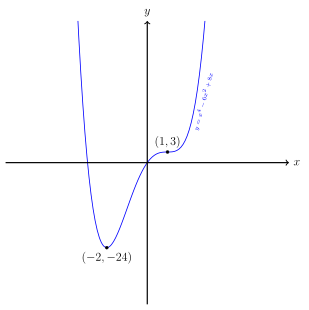
When \(a = 8\), we have \(y = x^4-6x^2+8x\) and
\begin{align*}
&&y' &= 4x^3-12x+8 \\
&&&= 4(x^3-3x+2) \\
&&&= 4(x-1)^2(x+2) \\
\Rightarrow && y(1) &= 3\\
&& y(-2) &= -24
\end{align*}
Therefore there are no solutions if \(b > 24\), one solution if \(b = 24\) and two solutions otherwise. Similarly, if \(a = -8\), we have \(y = x^4 - 6x^2-8x\) \begin{align*} && y' &= 4x^3-12x-8 \\ &&&= 4(x^3-3x-2) \\ &&&= 4(x-2)(x+1)^2 \end{align*} So we have stationary points at \(x = 2\) and \(x = -1\) (which is also a inflection point) and at \(x = 2\) \(y = -24\), so we have the same story: there are no solutions if \(b > 24\), one solution if \(b = 24\) and two solutions otherwise.
- \(\,\)

2012 Paper 1 Q9
A tall shot-putter projects a small shot from a point \(2.5\,\)m above the ground, which is horizontal. The speed of projection is \(10\,\text{ms}^{- 1}\) and the angle of projection is \(\theta\) above the horizontal. Taking the acceleration due to gravity to be \(10\,\text{ms}^{-2}\), show that the time, in seconds, that elapses before the shot hits the ground is \[ \frac1{\sqrt2}\left ( \sqrt{1-c}+ \sqrt{2-c}\right), \] where \(c = \cos2\theta\). Find an expression for the range in terms of \(c\) and show that it is greatest when \(c= \frac15\,\). Show that the extra distance attained by projecting the shot at this angle rather than at an angle of \(45^\circ\) is \(5(\sqrt6 -\sqrt2 -1)\,\)m.
Solution: \begin{align*} && s &= ut + \frac12 gt^2 \\ \Rightarrow && -2.5 &= 10 \sin \theta \, T - 5 T^2 \\ \Rightarrow && T &= \frac{10\sin \theta \pm \sqrt{100\sin^2 \theta - 4 \cdot 5 \cdot (-2.5)}}{10} \\ &&&= \sin \theta +\sqrt{\sin^2 \theta + \frac12} \\ &&&= \frac1{\sqrt{2}} \left ( \sqrt{2} \sin \theta +\sqrt{2 \sin^2 \theta +1} \right) \\ &&&= \frac1{\sqrt{2}} \left ( \sqrt{2 (1-\cos^2 \theta)} + \sqrt{2-\cos 2\theta} \right) \\ &&&= \frac1{\sqrt{2}} \left ( \sqrt{1-\cos2 \theta} + \sqrt{2-\cos 2\theta} \right) \\ &&&= \frac{1}{\sqrt{2}}\left ( \sqrt{1-c}+\sqrt{2-c} \right)\\ \\ && s &= 10 \cos \theta T \\ &&&= 10 \sqrt{\frac{\cos 2 \theta +1}{2}}\frac{1}{\sqrt{2}}\left ( \sqrt{1-c}+\sqrt{2-c} \right) \\ &&&= 5 \sqrt{c+1}\left ( \sqrt{1-c}+\sqrt{2-c} \right) \\ \\ && \frac15\frac{\d s}{\d c} &= \frac12(c+1)^{-1/2}((1-c)^{1/2} + (2-c)^{1/2}) - \frac12(c+1)^{1/2}\left ((1-c)^{-1/2}+(2-c)^{-1/2} \right) \\ &&&= \frac{((1-c)(2-c)^{1/2}+(2-c)(1-c)^{1/2})-((c+1)(2-c)^{1/2}+(c+1)(1-c)^{1/2})}{2\sqrt{c+1}\sqrt{1-c}\sqrt{2-c}} \\ &&&= \frac{\sqrt{2-c}\left (1-c-c-1 \right)+\sqrt{1-c}\left(2-c-c-1) \right)}{2\sqrt{c+1}\sqrt{1-c}\sqrt{2-c}} \\ &&&= \frac{\sqrt{1-c}\left(1-2c\right)-2c\sqrt{2-c}}{2\sqrt{c+1}\sqrt{1-c}\sqrt{2-c}} \\ \\ \frac{\d s}{\d c} =0: && \sqrt{1-c}\left(1-2c\right)&=2c\sqrt{2-c} \\ \Rightarrow && (1-c)(1-2c)^2&=4c^2(2-c) \\ \Rightarrow && 1-5c+8c^2-4c^3 &= 8c^2-4c^3 \\ \Rightarrow && 0 &= -5c+1 \\ \Rightarrow && c &= \frac15 \end{align*} When \(\theta = 45^{\circ}, c = 0\), so \(s_{45^{\circ}} = 5(1+\sqrt{2})\) When \(c = \frac15\), \begin{align*} s &= 5 \sqrt{\frac15+1}\left ( \sqrt{1-\frac15}+\sqrt{2-\frac15} \right) \\ &= 5 \sqrt{\frac65} \left ( \sqrt{\frac45} + \sqrt{\frac95} \right) \\ &= 2\sqrt{6}+3\sqrt{6} = 5\sqrt{6} \end{align*} Therefore the additional distance is \(5(\sqrt{6}-\sqrt{2}-1)\)
2012 Paper 2 Q9
A tennis ball is projected from a height of \(2h\) above horizontal ground with speed \(u\) and at an angle of \(\alpha\) below the horizontal. It travels in a plane perpendicular to a vertical net of height \(h\) which is a horizontal distance of \(a\) from the point of projection. Given that the ball passes over the net, show that \[ \frac 1{u^2}< \frac {2(h-a\tan\alpha)}{ga^2\sec^2\alpha}\,. \] The ball lands before it has travelled a horizontal distance of \(b\) from the point of projection. Show that \[ \sqrt{u^2\sin^2\alpha +4gh \ } < \frac{bg}{u\cos\alpha} + u \sin\alpha\,. \] Hence show that \[ \tan\alpha < \frac{h(b^2-2a^2)}{ab(b-a)}\,. \]
Solution: \begin{align*} && s &= ut \\ \Rightarrow && a &= u \cos \alpha t\\ \Rightarrow && t &= \frac{a}{u \cos \alpha}\\ && s &= ut+ \frac12at^2 \\ \Rightarrow && -h &< -u\sin \alpha \frac{a}{u \cos \alpha}-\frac12 g \left (\frac{a}{u \cos \alpha} \right)^2 \\ &&&= -a \tan \alpha-\frac12 g a^2 \frac{1}{u^2} \sec^2 \alpha \\ \Rightarrow && \frac12 g a^2 \frac{1}{u^2} \sec^2 \alpha &< h -a\tan \alpha \\ \Rightarrow &&\frac{1}{u^2} &< \frac{2(h-a\tan \alpha)}{ga^2 \sec^2 \alpha} \end{align*} \begin{align*} && s &= ut + \frac12a t^2 \\ \Rightarrow && 2h &= u\sin \alpha t + \frac12 gt^2 \\ \Rightarrow && t &= \frac{-u\sin \alpha \pm \sqrt{u^2 \sin^2 \alpha+4hg}}{g}\\ && t &= \frac{-u\sin \alpha +\sqrt{u^2 \sin^2 \alpha+4hg}}{g}\\ && s &= ut \\ \Rightarrow && b &> u \cos \alpha t \\ \Rightarrow && \frac{b}{u \cos \alpha} &> \frac{-u\sin \alpha +\sqrt{u^2 \sin^2 \alpha+4hg}}{g} \\ \Rightarrow && \sqrt{u^2 \sin^2 \alpha+4hg} &< \frac{bg}{u \cos \alpha} + u \sin \alpha \\ \end{align*} \begin{align*} \Rightarrow && u^2 \sin^2 \alpha+4hg &< \frac{b^2g^2}{u^2 \cos^2 \alpha} +u^2 \sin^2 \alpha + 2bg \tan \alpha \\ \Rightarrow && 4hg - 2bg \tan \alpha &< \frac{b^2g^2}{u^2 \cos^2 \alpha} \\ &&&< \frac{b^2g^2}{\cos^2 \alpha} \frac{2(h-a\tan \alpha)}{ga^2 \sec^2 \alpha} \\ &&&= \frac{2b^2g(h-a\tan \alpha)}{a^2} \\ \Rightarrow && \tan \alpha \left (\frac{2b^2g}{a} - 2bg \right) &< \frac{2b^2gh}{a^2} - 4hg \\ \Leftrightarrow && \tan \alpha \left (\frac{2b^2g- 2abg}{a} \right) &< \frac{2b^2gh- 4hga^2}{a^2} \\ \Leftrightarrow && \tan \alpha \left (\frac{2bg(b- a)}{a} \right) &< \frac{2hg(b^2- 2a^2)}{a^2} \\ \Rightarrow && \tan \alpha &< \frac{h(b^2-2a^2)}{ab(b-a)} \end{align*}
2012 Paper 2 Q12
A modern villa has complicated lighting controls. In order for the light in the swimming pool to be on, a particular switch in the hallway must be on and a particular switch in the kitchen must be on. There are four identical switches in the hallway and four identical switches in the kitchen. Guests cannot tell whether the switches are on or off, or what they control. Each Monday morning a guest arrives, and the switches in the hallway are either all on or all off. The probability that they are all on is \(p\) and the probability that they are all off is \(1-p\). The switches in the kitchen are each on or off, independently, with probability \(\frac12\).
- On the first Monday, a guest presses one switch in the hallway at random and one switch in the kitchen at random. Find the probability that the swimming pool light is on at the end of this process. Show that the probability that the guest has pressed the swimming pool light switch in the hallway, given that the light is on at the end of the process, is \(\displaystyle \frac{1-p}{1+2p}\).
- On each of seven Mondays, guests go through the above process independently of each other, and each time the swimming pool light is found to be on at the end of the process. Given that the most likely number of days on which the swimming pool light switch in the hallway was pressed is 3, show that \(\frac14 < p < \frac{5}{14}\).
Solution:
- \(\,\) \begin{align*} && \mathbb{P}(\text{hall switch on}) &= \underbrace{p \cdot \frac34 }_{\text{already on and not flipped}}+ \underbrace{(1-p) \cdot \frac14}_{\text{not on and flipped}} \\ &&&= \frac14 +\frac12 p\\ && \mathbb{P}(\text{kitchen on}) &= \frac12 \\ \Rightarrow && \mathbb{P}(\text{pool is on}) &= \frac18 + \frac14p \end{align*} \begin{align*} && \mathbb{P}(\text{flipped hall switch} | \text{pool on}) &= \frac{\mathbb{P}(\text{flipped hall and pool on})}{\mathbb{P}(\text{pool on})} \\ &&&= \frac{(1-p)\frac14 \cdot \frac 12}{\frac18 + \frac14 p} \\ &&&= \frac{1-p}{1+2p} \end{align*}
- The number of days the swimming pool light was pressed is \(X = B\left (7, \frac{1-p}{1+2p} \right)\), and we have that \(\mathbb{P}(X = 2) < \mathbb{P}(X = 3) > \mathbb{P}(X=4)\) (since the binomial is unimodal). Let \(q = \frac{1-p}{1+2p} \) \begin{align*} && \mathbb{P}(X = 2) &< \mathbb{P}(X = 3) \\ \Rightarrow && \binom{7}{2} q^2(1-q)^5 &< \binom{7}{3}q^3(1-q)^4 \\ \Rightarrow && 21(1-q) &< 35q \\ \Rightarrow && 21 &< 56q \\ \Rightarrow && \frac{3}{8} &< \frac{1-p}{1+2p} \\ \Rightarrow && 3+6p &< 8-8p \\ \Rightarrow && 14p &< 5\\ \Rightarrow && p &< \frac5{14} \\ \\ && \mathbb{P}(X = 3) &> \mathbb{P}(X = 4) \\ \Rightarrow && \binom{7}{3} q^3(1-q)^4 &> \binom{7}{4}q^4(1-q)^3 \\ \Rightarrow &&(1-q)&> q \\ \Rightarrow && \frac12 &> q \\ \Rightarrow && \frac12 &> \frac{1-p}{1+2p} \\ \Rightarrow && 1+2p &> 2-2p \\ \Rightarrow && 4p &> 1\\ \Rightarrow && p &> \frac1{4} \end{align*} Therefore \(\frac14 < p < \frac{5}{14}\) as required.
2011 Paper 1 Q5
Given that \(0 < k < 1\), show with the help of a sketch that the equation \[ \sin x = k x \tag{\(*\)}\] has a unique solution in the range \(0 < x < \pi\). Let \[ I= \int_0^\pi \big\vert \sin x -kx\big\vert \, \d x\,. \] Show that \[ I= \frac{\pi^2 \sin\alpha }{2\alpha} -2\cos\alpha - \alpha \sin\alpha\,, \] where \(\alpha\) is the unique solution of \((*)\). Show that \(I\), regarded as a function of \(\alpha\), has a unique stationary value and that this stationary value is a minimum. Deduce that the smallest value of \(I\) is \[ -2 \cos \frac{\pi}{\sqrt2}\, .\]
Solution: