Problems

Filters
Clear Filters

58 problems found

2002 Paper 1 Q9
D: 1500.0 B: 1470.9

\(\,\) \vspace*{-0.5in}

\psset{xunit=1.0cm,yunit=1.0cm,algebraic=true,dimen=middle,dotstyle=o,dotsize=3pt 0,linewidth=0.5pt,arrowsize=3pt 2,arrowinset=0.25} \begin{pspicture*}(-2.23,-0.31)(9.2,7.46) \psline(0,0)(8,0) \psline(0,0)(6.96,2.35) \psline(1.01,0.34)(-0.61,5.05) \psline(-0.61,5.05)(5.3,7.1) \psline(5.3,7.1)(6.96,2.35) \psline(0.84,0.83)(6.77,2.87) \psline[linestyle=dashed,dash=2pt 2pt](3,4)(4.16,0.56) \psline{->}(3,4)(9,4) \psline[linestyle=dashed,dash=2pt 2pt](3,4)(-1.37,2.42) \psline[linewidth=0.4pt,linestyle=dashed,dash=2pt 2pt]{->}(-0.43,2.76)(0.43,0.16) \psline[linestyle=dashed,dash=2pt 2pt]{->}(0.43,0.15)(-0.43,2.75) \psline[linestyle=dashed,dash=2pt 2pt](6.96,2.35)(7.29,1.39) \parametricplot{0.0}{0.32693321010422505}{1.28*cos(t)+0|1.28*sin(t)+0} \psline{->}(4.02,0.97)(7.1,1.93) \psline{->}(7.1,1.93)(4.02,0.97) \psline[linewidth=0.4pt,linestyle=dashed,dash=2pt 2pt]{->}(-0.71,5.29)(5.24,7.32) \psline[linestyle=dashed,dash=2pt 2pt]{->}(5.24,7.32)(-0.71,5.29) \psline(6.96,2.35)(7.98,2.71) \rput[tl](2.58,3.67){\(G\)} \rput[tl](8.9,3.81){\(P\)} \rput[tl](5.64,1.39){\(d\)} \rput[tl](1.81,6.79){\(2d\)} \rput[tl](-0.59,1.5){\(h\)} \rput[tl](1.52,0.32){\(\alpha\)} \begin{scriptsize} \psdots[dotstyle=*](3,4) \end{scriptsize} \end{pspicture*}
A lorry of weight \(W\) stands on a plane inclined at an angle \(\alpha\) to the horizontal. Its wheels are a distance \(2d\) apart, and its centre of gravity \(G\) is at a distance \(h\) from the plane, and halfway between the sides of the lorry. A horizontal force \(P\) acts on the lorry through \(G\,\), as shown.
  1. If the normal reactions on the lower and higher wheels of the lorry are equal, show that the sum of the frictional forces between the wheels and the ground is zero.
  2. If \(P\) is such that the lorry does not tip over (but the normal reactions on the lower and higher wheels of the lorry need not be equal), show that \[ W\tan(\alpha - \beta) \le P \le W\tan(\alpha+\beta)\;, \] where \(\tan\beta = d/h\,\).

2002 Paper 2 Q11
D: 1600.0 B: 1484.0

A rigid straight beam \(AB\) has length \(l\) and weight \(W\). Its weight per unit length at a distance \(x\) from \(B\) is \(\alpha Wl^{-1} (x/l)^{\alpha-1}\,\), where \(\alpha\) is a positive constant. Show that the centre of mass of the beam is at a distance \(\alpha l/(\alpha+1)\) from \(B\). The beam is placed with the end \(A\) on a rough horizontal floor and the end \(B\) resting against a rough vertical wall. The beam is in a vertical plane at right angles to the plane of the wall and makes an angle of \(\theta\) with the floor. The coefficient of friction between the floor and the beam is \(\mu\) and the coefficient of friction between the wall and the beam is also \(\mu\,\). Show that, if the equilibrium is limiting at both \(A\) and \(B\), then \[ \tan\theta = \frac{1-\alpha \mu^2}{(1+\alpha)\mu}\;. \] Given that \(\alpha =3/2\,\) and given also that the beam slides for any \(\theta<\pi/4\,\) find the greatest possible value of \(\mu\,\).

2000 Paper 1 Q11
D: 1500.0 B: 1484.0

A rod \(AB\) of length 0.81 m and mass 5 kg is in equilibrium with the end \(A\) on a rough floor and the end \(B\) against a very rough vertical wall. The rod is in a vertical plane perpendicular to the wall and is inclined at \(45^{\circ}\) to the horizontal. The centre of gravity of the rod is at \(G\), where \(AG = 0.21\) m. The coefficient of friction between the rod and the floor is 0.2, and the coefficient of friction between the rod and the wall is 1.0. Show that the friction cannot be limiting at both \(A\) and \(B\). A mass of 5 kg is attached to the rod at the point \(P\) such that now the friction is limiting at both \(A\) and \(B\). Determine the length of \(AP\).

2000 Paper 3 Q10
D: 1700.0 B: 1500.0

A sphere of radius \(a\) and weight \(W\) rests on horizontal ground. A thin uniform beam of weight \(3\sqrt3\,W\) and length \(2a\) is freely hinged to the ground at \(X\), which is a distance \({\sqrt 3} \, a\) from the point of contact of the sphere with the ground. The beam rests on the sphere, lying in the same vertical plane as the centre of the sphere. The coefficients of friction between the beam and the sphere and between the sphere and the ground are \(\mu_1\) and \(\mu_2\) respectively. Given that the sphere is on the point of slipping at its contacts with both the ground and the beam, find the values of \(\mu_1\) and \(\mu_2\).


Solution:

TikZ diagram
The first important thing to observe is the angle at \(X\) is \(60^{\circ}\). Now we can start resolving: \begin{align*} \overset{\curvearrowleft}{X}: && 3\sqrt{3} W \cos 60^{\circ} a - R_1\sqrt{3}a &= 0 \tag{\(1\)}\\ \overset{\curvearrowleft}{O}: && \mu_2 R_2 a - \mu_1R_1a &= 0 \tag{\(2\)} \\ \text{N2}(\rightarrow): && \mu_2 R_2 + \mu_1R_1 \cos 60^{\circ} - R_1 \cos 30^{\circ} &= 0 \tag{\(3\)} \\ \text{N2}(\uparrow): && R_2 - W - \mu_1 R_1 \cos 30^{\circ} - R_1 \cos 60^{\circ} &= 0 \tag{\(4\)} \\ \Rightarrow && \frac{3}{2}W &= R_1 \tag{\((5)\) from \((1)\)} \\ && \mu_1 R_1 &= \mu_2 R_2 \tag{\(2\)}\\ && \mu_1 R_1 \l 1 + \frac{1}{2} \r - R_1 \frac{\sqrt{3}}2 &= 0 \tag{\((3)\) and \((2)\)} \\ && \mu_1 &= \frac{1}{\sqrt3} \\ \\ && R_2 - W - \frac{1}{\sqrt3} \frac{3}{2}W \frac{\sqrt3}{2} - \frac{3}2W \frac12 &= 0 \\ \Rightarrow && R_2 &= W \l 1 + \frac{3}{2}\r \tag{\(6\)} \\ \Rightarrow && \mu_2 &= \frac{\mu_1 R_1}{R_2} = \frac{1}{\sqrt{3}} \frac{3}{5} = \frac{\sqrt3}{5} \tag{\((5)\) and \((6)\)} \end{align*}

2000 Paper 3 Q11
D: 1700.0 B: 1484.0

A thin beam is fixed at a height \(2a\) above a horizontal plane. A uniform straight rod \(ACB\) of length \(9a\) and mass \(m\) is supported by the beam at \(C\). Initially, the rod is held so that it is horizontal and perpendicular to the beam. The distance \(AC\) is \(3a\), and the coefficient of friction between the beam and the rod is \(\mu\). The rod is now released. Find the minimum value of \(\mu\) for which \(B\) strikes the horizontal plane before slipping takes place at \(C\).

1998 Paper 3 Q9
D: 1700.0 B: 1484.0

A uniform right circular cone of mass \(m\) has base of radius \(a\) and perpendicular height \(h\) from base to apex. Show that its moment of inertia about its axis is \({3\over 10} ma^2\), and calculate its moment of inertia about an axis through its apex parallel to its base. \newline[{\em Any theorems used should be stated clearly.}] The cone is now suspended from its apex and allowed to perform small oscillations. Show that their period is $$ 2\pi\sqrt{ 4h^2 + a^2\over 5gh} \,. $$ \newline[{\em You may assume that the centre of mass of the cone is a distance \({3\over 4}h\) from its apex.}]

1997 Paper 3 Q9
D: 1700.0 B: 1500.0

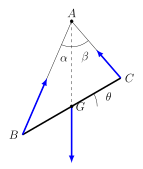
A uniform rigid rod \(BC\) is suspended from a fixed point \(A\) by light stretched springs \(AB,AC\). The springs are of different natural lengths but the ratio of tension to extension is the same constant \(\kappa\) for each. The rod is not hanging vertically. Show that the ratio of the lengths of the stretched springs is equal to the ratio of the natural lengths of the unstretched springs.


Solution:
TikZ diagram
By moments or "centre of mass" or whatever argument you choose, the centre of mass is directly below \(A\). \begin{align*} N2:&& 0 &= \frac{1}{|AC|}\binom{-l\cos \theta}{h-l \sin \theta} T_{AC} + \frac{1}{|AB|} \binom{l \cos \theta}{h+l \sin \theta}T_{AB} + \binom{0}{-1}mg \\ \Rightarrow && \frac{T_{AC}}{AC} &= \frac{T_{AB}}{AB} \\ \Rightarrow && \frac{\kappa(AC-l_{AC})}{AC} &= \frac{\kappa(BC-l_{BC})}{BC} \\ \Rightarrow && \frac{l_{AC}}{AC} &= \frac{l_{BC}}{BC} \\ \Rightarrow && \frac{l_{AC}}{l_{BC}} &= \frac{AC}{BC} \end{align*}

1997 Paper 3 Q11
D: 1700.0 B: 1500.0

\(\,\)

\psset{xunit=1.0cm,yunit=1.0cm,algebraic=true,dotstyle=o,dotsize=3pt 0,linewidth=0.5pt,arrowsize=3pt 2,arrowinset=0.25} \begin{pspicture*}(-1.14,-1.32)(3.52,3.04) \psline(-0.92,2.74)(-0.06,-0.6) \psline(-0.06,-0.6)(2.66,-0.6) \psline(2.66,-0.6)(3.38,2.74) \psline[linewidth=0.1pt,linestyle=dashed,dash=2pt 2pt](1.22,-0.6)(1.22,2.74) \psline(3.07,2.11)(1.22,-0.6) \psline{<->}(1.37,-0.6)(3.17,1.99) \psline{<->}(1.06,-0.6)(1.05,1.76) \psdots[dotstyle=*](1.22,1.86) \rput[tl](0.88,2.2){\(\mathrm{G}\)} \rput[tl](0.73,0.6){\(h\)} \pscustom{\parametricplot{0.9714278016111888}{1.5707963267948966}{0.83*cos(t)+1.22|0.83*sin(t)+-0.6}\lineto(1.22,-0.6)\closepath} \rput[tl](2.36,0.54){\(l\)} \rput[tl](1.46,0.7){\(\beta \)} \rput[tl](1.15,-0.69){\(O\)} \begin{scriptsize} \psdots[dotsize=10pt 0,dotstyle=*](3.07,2.11) \end{scriptsize} \end{pspicture*} \par
A heavy symmetrical bell and clapper can both swung freely in a vertical plane about a point \(O\) on a horizontal beam at the apex of the bell. The mass of the bell is \(M\) and its moment of inertia about the beam is \(Mk^{2}\). Its centre of mass, \(G\), is a distance \(h\) from \(O\). The clapper may be regarded as a small heavy ball on a light rod of length \(l\). Initially the bell is held with its axis vertical and its mouth above the beam. The clapper ball rests against the side of the bell, with the rod making an angle \(\beta\) with the axis. The bell is then released. Show that, at the moment when the clapper and bell separate, the clapper rod makes an angle \(\alpha\) with the upwards vertical, where \[ \cot\alpha=\cot\beta-\frac{k^{2}}{hl}\mathrm{cosec}\beta. \]

1996 Paper 3 Q10
D: 1700.0 B: 1500.0

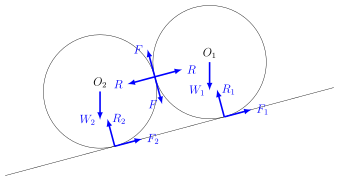
Two rough solid circular cylinders, of equal radius and length and of uniform density, lie side by side on a rough plane inclined at an angle \(\alpha\) to the horizontal, where \(0<\alpha<\pi/2\). Their axes are horizontal and they touch along their entire length. The weight of the upper cylinder is \(W_1\) and the coefficient of friction between it and the plane is \(\mu_1\). The corresponding quantities for the lower cylinder are \(W_2\) and \(\mu_2\) respectively and the coefficient of friction between the two cylinders is \(\mu\). Show that for equilibrium to be possible:

  1. \(W_1\ge W_2\);
  2. \(\mu\geqslant\dfrac{W_1+W_2}{W_1-W_2}\);
  3. \(\mu_{1}\geqslant\left(\dfrac{2W_{1}\cot\alpha}{W_{1}+W_{2}}-1\right)^{-1}\,.\)
Find the similar inequality to (iii) for \(\mu_2\).


Solution:

TikZ diagram
  1. \begin{align*} \overset{\curvearrowright}{O_2}: && 0 &= F_2 - F \\ \Rightarrow && F_2 &= F \\ \overset{\curvearrowright}{O_1}: && 0 &= F_1- F \\ \Rightarrow && F_1 &= F \\ \text{N2}(\swarrow, 2): && 0 &= R+W_2\sin\alpha -F \tag{1}\\ \text{N2}(\swarrow, 1): && 0 &= W_1\sin\alpha -F-R\tag{2}\\ \Rightarrow && W_1 \sin \alpha-R &= W_2 \sin \alpha+R \\ \Rightarrow && W_1 &\geq W_2 \end{align*}
  2. \begin{align*} (1)+(2)\Rightarrow && F &= \frac12 \sin \alpha (W_1 + W_2) \\ (1)-(2) \Rightarrow && R &= \frac12 \sin \alpha (W_1-W_2) \\ \Rightarrow && \frac{F}{R} &= \frac{W_1+W_2}{W_1-W_2} \\ \underbrace{\Rightarrow}_{F \leq \mu R} && \mu &\geq \frac{W_1+W_2}{W_1-W_2}\\ \end{align*}
  3. \begin{align*} \text{N2}(\nwarrow, 1): && 0 &= F+R_1-W_1\cos \alpha \\ \Rightarrow && R_1 &= W_1\cos \alpha - F \\ &&&= W_1 \cos \alpha - \frac12 \sin \alpha (W_1 + W_2) \\ \Rightarrow && \frac{R_1}{F_1} &= \frac{R_1}{F} \\ &&&= \frac{W_1 \cos \alpha - \frac12 \sin \alpha (W_1 + W_2)}{\frac12 \sin \alpha (W_1 + W_2) } \\ &&&= \frac{2W_1 \cot \alpha}{W_1+W_2} - 1 \\ \Rightarrow && \mu_1 & \geq \left ( \frac{2W_1 \cot \alpha}{W_1+W_2} - 1 \right)^{-1} \end{align*}
\begin{align*} \text{N2}(\nwarrow, 2): && 0 &= -F+R_2-W_2\cos \alpha \\ \Rightarrow && R_2 &= W_2\cos \alpha + F \\ &&&= W_2 \cos \alpha + \frac12 \sin \alpha (W_1 + W_2) \\ \Rightarrow && \frac{R_2}{F_2} &= \frac{R_2}{F} \\ &&&= \frac{ W_2 \cos \alpha + \frac12 \sin \alpha (W_1 + W_2)}{\frac12 \sin \alpha (W_1 + W_2) } \\ &&&= \frac{2W_2 \cot \alpha}{W_1+W_2} + 1 \\ \Rightarrow && \mu_2 & \geq \left ( \frac{2W_1 \cot \alpha}{W_1+W_2} + 1 \right)^{-1} \end{align*}

1995 Paper 1 Q11
D: 1500.0 B: 1500.0

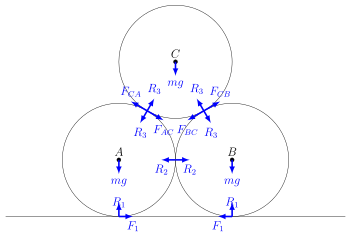
Two identical uniform cylinders, each of mass \(m,\) lie in contact with one another on a horizontal plane and a third identical cylinder rests symmetrically on them in such a way that the axes of the three cylinders are parallel. Assuming that all the surfaces in contact are equally rough, show that the minimum possible coefficient of friction is \(2-\sqrt{3}.\)


Solution:
TikZ diagram
First observe that many forces are equal by symmetry. Also notice that \(A\) and \(B\) are trying to roll in opposite directions, therefore there is no friction between \(A\) and \(B\). Considering the system as a whole \(R_1 = \frac32 mg\). \begin{align*} \text{N2}(\uparrow,C): && 0 &= -mg +2R_3\cos 30^{\circ} + 2F_{CA} \cos 60^{\circ} \\ \Rightarrow && mg &= \sqrt{3}R_3 + F_{CA} \\ \\ \text{N2}(\uparrow, A): && 0 &= -mg + \frac32mg-R_3\cos 30^{\circ} -F_{AC} \cos 60^\circ \\ \Rightarrow && mg &= \sqrt{3}R_3+F_{AC} \\ \text{N2}(\rightarrow, A): && 0 &= F_{AC}\cos 30^{\circ}+F_1-R_3 \cos 60^\circ -R_2 \\ \Rightarrow && 0 &=F_{AC}\sqrt{3}+2F_1-R_3-2R_2 \\ \overset{\curvearrowleft}{A}: && 0 &= F_1 - F_{AC} \end{align*} Since \(F_1 = F_{AC} = F_{CA}\) we can rewrite everything in terms of \(F= F_1\) so. \begin{align*} && mg &= \sqrt{3}R_3 + F \\ && 0 &= (2+\sqrt{3})F -R_3-2R_2 \\ \Rightarrow && (2+\sqrt3)F &\geq R_3 \\ \Rightarrow && F &\geq (2-\sqrt{3})R_3 \\ \Rightarrow && \mu & \geq 2 - \sqrt{3} \end{align*}

1995 Paper 2 Q9
D: 1600.0 B: 1484.0

\noindent

\psset{xunit=0.8cm,yunit=0.8cm,algebraic=true,dotstyle=o,dotsize=3pt 0,linewidth=0.5pt,arrowsize=3pt 2,arrowinset=0.25} \begin{pspicture*}(-0.55,-0.43)(7.35,5.27) \psline(0,0)(7,5) \psline[linewidth=1.2pt,linestyle=dashed,dash=3pt 3pt](0,0)(2,0) \pscustom{\parametricplot{0.0}{0.6202494859828215}{0.63*cos(t)+0|0.63*sin(t)+0}} \rput[tl](3.88,2.54){\(X\)} \rput[tl](4.6,3.84){\(Y\)} \rput[tl](6.06,4.04){\(Z\)} \rput[tl](0.78,0.43){\(\alpha\)} \begin{scriptsize} \psdots[dotsize=4pt,dotstyle=x](3.75,2.68) \psdots[dotsize=4pt 0,dotstyle=*](4.76,3.3) \psdots[dotsize=4pt 0,dotstyle=*](5.94,4.35) \end{scriptsize} \end{pspicture*} \par
Two thin horizontal bars are parallel and fixed at a distance \(d\) apart, and the plane containing them is at an angle \(\alpha\) to the horizontal. A thin uniform rod rests in equilibrium in contact with the bars under one and above the other and perpendicular to both. The diagram shows the bards (in cross section and exaggerated in size) with the rod over one bar at \(Y\) and under the other at \(Z\). (Thus \(YZ\) has length \(d\).) The centre of the rod is at \(X\) and \(XZ\) has length \(l.\) The coefficient of friction between the rod and each bar is \(\mu.\) Explain why we must have \(l\leqslant d.\) Find, in terms of \(d,l\) and \(\alpha,\) the least possible value of \(\mu.\) Verify that, when \(l=2d,\) your result shows that \[ \mu\geqslant\tfrac{1}{3}\tan\alpha. \]

1994 Paper 3 Q11
D: 1700.0 B: 1516.0

A step-ladder has two sections \(AB\) and \(AC,\) each of length \(4a,\) smoothly hinged at \(A\) and connected by a light elastic rope \(DE,\) of natural length \(a/4\) and modulus \(W\), where \(D\) is on \(AB,\) \(E\) is on \(AC\) and \(AD=AE=a.\) The section \(AB,\) which contains the steps, is uniform and of weight \(W\) and the weight of \(AC\) is negligible. The step-ladder rests on a smooth horizontal floor and a man of weight \(4W\) carefully ascends it to stand on a rung distant \(\beta a\) from the end of the ladder resting on the floor. Find the height above the floor of the rung on which the man is standing when \(\beta\) is the maximum value at which equilibrium is possible.


Solution:

TikZ diagram
\begin{align*} N2(\uparrow): && 0 &= R_B+R_C - 5W \\ \Rightarrow && 5W &= R_B + R_C \\ \\ \overset{\curvearrowright}{A}: && 0 &= (R_B - R_C) \cdot 4a \cdot \cos \theta -W \cdot 2a \cdot \cos \theta - 4W \cdot (4 - \beta)a \cdot \cos \theta \\ \Rightarrow && R_B-R_C &= W \left ( \frac12 + (4-\beta)\right) \\ \Rightarrow && R_B &= \frac{W}2 \left ( 5+\frac12+(4-\beta)\right) = \frac{W}{2}\left(\frac{19}{2} - \beta\right) \\ && R_C &= \frac{W}{2} \left (5 - \frac12 - 4 +\beta \right) = \frac{W}{2} \left (\frac12 + \beta \right) \\ \\ \overset{\curvearrowright}{(A, AC)}: && 0 &= T \cdot a \cdot \sin \theta - R_C \cdot 4a \cdot \cos \theta \\ \Rightarrow && T &=4 \cot \theta \frac{W}{2} \left ( \frac12 + \beta\right) \\ &&&= 20W \cot \theta \\ \text{Hooke's Law}:&& T &= \frac{W(2a \cos \theta - \frac{a}{4})}{\frac{a}{4}} = W(8 \cos \theta - 1) \\ \Rightarrow && 8 \cos \theta -1 &= \cot \theta (2\beta+1)\\ \Rightarrow && 1+2\beta &=8\sin \theta-\tan \theta \\ \Rightarrow && \beta &= 4 \sin \theta - \frac12 \tan \theta - \frac12 \\ \Rightarrow && \frac{\d \beta}{\d \theta} &= 4 \cos \theta - \frac12 \sec^2 \theta \\ &&&= \frac{8\cos^3 \theta - 1}{\cos^2 \theta} \\ \Rightarrow && \cos \theta &= \frac12 \\ \Rightarrow && h &= \beta a \sin \theta \\ &&&= \left (4 \frac{\sqrt{3}}{2}-\frac12 \sqrt{3}-\frac12 \right) a \frac{\sqrt3}{2} \\ &&&= \left ( \frac{9-\sqrt{3}}{4}\right)a \end{align*}

1993 Paper 1 Q10
D: 1500.0 B: 1500.0

A small lamp of mass \(m\) is at the end \(A\) of a light rod \(AB\) of length \(2a\) attached at \(B\) to a vertical wall in such a way that the rod can rotate freely about \(B\) in a vertical plane perpendicular to the wall. A spring \(CD\) of natural length \(a\) and modulus of elasticity \(\lambda\) is joined to the rod at its mid-point \(C\) and to the wall at a point \(D\) a distance \(a\) vertically above \(B\). The arrangement is sketched below. \noindent

\psset{xunit=0.8cm,yunit=0.8cm,algebraic=true,dotstyle=o,dotsize=3pt 0,linewidth=0.5pt,arrowsize=3pt 2,arrowinset=0.25} \begin{pspicture*}(-1.55,-0.7)(4.5,5.27) \psline(0,5)(0,-1.16) \psline(0,0)(3.11,3.89) \pscoil[coilheight=1,coilwidth=0.2,coilarm=0.05](0,2.53)(1.47,1.84) \rput[tl](-0.56,0.41){\(B\)} \rput[tl](1.59,1.89){\(C\)} \rput[tl](3.41,4.28){\(A\)} \rput[tl](-0.56,2.84){\(D\)} \parametricplot{0.7583777142101807}{3.8999703677999737}{1*0.16*cos(t)+0*0.16*sin(t)+3.22|0*0.16*cos(t)+1*0.16*sin(t)+3.77} \psline(3.1,3.66)(3.33,3.88) \begin{scriptsize} \psdots[dotsize=5pt 0](0,0) \psdots[dotstyle=*](3.11,3.89) \psdots[dotstyle=*](0,2.53) \end{scriptsize} \end{pspicture*} \par
Show that if \(\lambda>4mg\) the lamp can hang in equilibrium away from the wall and calculate the angle \(\angle DBA\).

1993 Paper 3 Q11
D: 1700.0 B: 1500.0

In this question, all gravitational forces are to be neglected. A rigid frame is constructed from 12 equal uniform rods, each of length \(a\) and mass \(m,\) forming the edges of a cube. Three of the edges are \(OA,OB\) and \(OC,\) and the vertices opposite \(O,A,B\) and \(C\) are \(O',A',B'\) and \(C'\) respectively. Forces act along the lines as follows, in the directions indicated by the order of the letters: \begin{alignat*}{3} 2mg\mbox{ along }OA, & \qquad & mg\mbox{ along }AC', & \qquad & \sqrt{2}mg\mbox{ along }O'A,\\ \sqrt{2}mg\mbox{ along }OA', & & 2mg\mbox{ along }C'B, & & mg\mbox{ along }A'C. \end{alignat*}

  1. The frame is freely pivoted at \(O\). Show that the direction of the line about which it will start to rotate is $\begin{pmatrix}1\\ 1\\ 2 \end{pmatrix}$ with respect to axes along \(OA\), \(OB\) and \(OC\) respectively.
  2. Show that the moment of inertia of the rod \(OA\) about the axis \(OO'\) is \(2ma^2/9\) and about a parallel axis through its mid-point is \(ma^2/18\). Hence find the moment of inertia of \(B'C\) about \(OO'\) and show that the moment of inertia of the frame about \(OO'\) is \(14ma^2/3\). If the frame is freely pivoted about the line \(OO'\) and the forces continue to act along the specified lines, find the initial angular acceleration of the frame.

1992 Paper 1 Q12
D: 1484.0 B: 1471.5

The diagram shows a crude step-ladder constructed by smoothly hinging-together two light ladders \(AB\) and \(AC,\) each of length \(l,\) at \(A\). A uniform rod of wood, of mass \(m\), is pin-jointed to \(X\) on \(AB\) and to \(Y\) on \(AC\), where \(AX=\frac{3}{4}l=AY.\) The angle \(\angle XAY\) is \(2\theta.\) \noindent

\psset{xunit=1.0cm,yunit=1.0cm,algebraic=true,dimen=middle,dotstyle=o,dotsize=3pt 0,linewidth=0.5pt,arrowsize=3pt 2,arrowinset=0.25} \begin{pspicture*}(-4.3,-1.22)(4.6,6) \psline(-4,0)(4,0) \psline(-2,0)(0,5) \psline(0,5)(2,0) \psline(-1.21,1.97)(1.21,1.97) \parametricplot{-1.9513027039072617}{-1.190289949682532}{1.2*cos(t)+0|1.2*sin(t)+5} \rput[tl](-0.2,4.26){\(2\theta\)} \rput[tl](-0.1,5.5){\(A\)} \rput[tl](-1.8,2.1){\(X\)} \rput[tl](1.5,2.1){\(Y\)} \rput[tl](-2.36,-0.1){\(B\)} \rput[tl](2.02,-0.1){\(C\)} \end{pspicture*} \par
The rod \(XY\) will break if the tension in it exceeds \(T\). The step-ladder stands on rough horizontal ground (coefficient of friction \(\mu\)). Given that \(\tan\theta>\mu,\) find how large a mass \(M\) can safely be placed at \(A\) and show that if \[ \tan\theta>\frac{6T}{mg}+4\mu \] the step-ladder will fail under its own weight. {[}You may assume that friction is limiting at the moment of collapse.{]}