Problems
Filters
66 problems found
2007 Paper 3 Q11
- A wheel consists of a thin
light circular rim attached by light spokes of length \(a\)
to a small hub of mass
\(m\). The wheel rolls without slipping
on a rough horizontal table
directly towards a straight edge of the table.
The plane of the wheel is vertical throughout the motion.
The speed of the wheel is \(u\), where
\(u^2
- Two particles, each of mass \(m/2\), are attached to a light circular hoop of radius \(a\), at the ends of a diameter. The hoop rolls without slipping on a rough horizontal table directly towards a straight edge of the table. The plane of the hoop is vertical throughout the motion. When the centre of the hoop is vertically above the edge of the table it has speed \(u\), where \(u^2
- Two particles, each of mass \(m/2\), are attached to a light circular hoop of radius \(a\), at the ends of a diameter. The hoop rolls without slipping on a rough horizontal table directly towards a straight edge of the table. The plane of the hoop is vertical throughout the motion. When the centre of the hoop is vertically above the edge of the table it has speed \(u\), where \(u^2
2006 Paper 2 Q9
A painter of weight \(kW\) uses a ladder to reach the guttering on the outside wall of a house. The wall is vertical and the ground is horizontal. The ladder is modelled as a uniform rod of weight \(W\) and length \(6a\). The ladder is not long enough, so the painter stands the ladder on a uniform table. The table has weight \(2W\) and a square top of side \(\frac12 a\) with a leg of length \(a\) at each corner. The foot of the ladder is at the centre of the table top and the ladder is inclined at an angle \(\arctan 2\) to the horizontal. The edge of the table nearest the wall is parallel to the wall. The coefficient of friction between the foot of the ladder and the table top is \(\frac12\). The contact between the ladder and the wall is sufficiently smooth for the effects of friction to be ignored.
- Show that, if the legs of the table are fixed to the ground, the ladder does not slip on the table however high the painter stands on the ladder.
- It is given that \(k=9\) and that the coefficient of friction between each table leg and the ground is \(\frac13\). If the legs of the table are not fixed to the ground, so that the table can tilt or slip, determine which occurs first when the painter slowly climbs the ladder.
2005 Paper 1 Q9
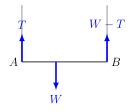
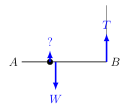
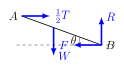
A non-uniform rod \(AB\) has weight \(W\) and length \(3l\). When the rod is suspended horizontally in equilibrium by vertical strings attached to the ends \(A\) and \(B\), the tension in the string attached to \(A\) is \(T\). When instead the rod is held in equilibrium in a horizontal position by means of a smooth pivot at a distance \(l\) from \(A\) and a vertical string attached to \(B\), the tension in the string is \(T\). Show that \(5T = 2W\). When instead the end \(B\) of the rod rests on rough horizontal ground and the rod is held in equilibrium at an angle \(\theta\) to the horizontal by means of a string that is perpendicular to the rod and attached to \(A\), the tension in the string is \(\frac12 T\). Calculate \(\theta\) and find the smallest value of the coefficient of friction between the rod and the ground that will prevent slipping.
Solution:
2005 Paper 2 Q9
Two particles, \(A\) and \(B\), of masses \(m\) and \(2m\), respectively, are placed on a line of greatest slope, \(\ell\), of a rough inclined plane which makes an angle of \(30^{\circ}\) with the horizontal. The coefficient of friction between \(A\) and the plane is \(\frac16\sqrt{3}\) and the coefficient of friction between \(B\) and the plane is \(\frac13 \sqrt{3}\). The particles are at rest with \(B\) higher up \(\ell\) than \(A\) and are connected by a light inextensible string which is taut. A force \(P\) is applied to \(B\).
- Show that the least magnitude of \(P\) for which the two particles move upwards along \(\ell\) is \(\frac{11}8 \sqrt{3}\, mg\) and give, in this case, the direction in which \(P\) acts.
- Find the least magnitude of \(P\) for which the particles do not slip downwards along~\(\ell\).
2005 Paper 2 Q11
A plane is inclined at an angle \(\arctan \frac34\) to the horizontal and a small, smooth, light pulley~\(P\) is fixed to the top of the plane. A string, \(APB\), passes over the pulley. A particle of mass~\(m_1\) is attached to the string at \(A\) and rests on the inclined plane with \(AP\) parallel to a line of greatest slope in the plane. A particle of mass \(m_2\), where \(m_2>m_1\), is attached to the string at \(B\) and hangs freely with \(BP\) vertical. The coefficient of friction between the particle at \(A\) and the plane is \( \frac{1}{2}\). The system is released from rest with the string taut. Show that the acceleration of the particles is \(\ds \frac{m_2-m_1}{m_2+m_1}g\). At a time \(T\) after release, the string breaks. Given that the particle at \(A\) does not reach the pulley at any point in its motion, find an expression in terms of \(T\) for the time after release at which the particle at \(A\) reaches its maximum height. It is found that, regardless of when the string broke, this time is equal to the time taken by the particle at \(A\) to descend from its point of maximum height to the point at which it was released. Find the ratio \(m_1 : m_2\). \noindent [Note that \(\arctan \frac34\) is another notation for \(\tan^{-1} \frac34\,\).]
2005 Paper 3 Q10
Two thin discs, each of radius \(r\) and mass \(m\), are held on a rough horizontal surface with their centres a distance \(6r\) apart. A thin light elastic band, of natural length \(2\pi r\) and modulus \(\dfrac{\pi mg}{12}\), is wrapped once round the discs, its straight sections being parallel. The contact between the elastic band and the discs is smooth. The coefficient of static friction between each disc and the horizontal surface is \(\mu\), and each disc experiences a force due to friction equal to \(\mu mg\) when it is sliding. The discs are released simultaneously. If the discs collide, they rebound and a half of their total kinetic energy is lost in the collision.
- Show that the discs start sliding, but come to rest before colliding, if and only if \mbox{\(\frac23 <\mu <1\)}.
- Show that, if the discs collide at least once, their total kinetic energy just before the first collision is \(\frac43 mgr(2-3\mu)\).
- Show that if \(\frac 4 9 > \mu^2 >\frac{5}{27}\) the discs come to rest exactly once after the first collision.
2004 Paper 1 Q11
Two uniform ladders \(AB\) and \(BC\) of equal length are hinged smoothly at \(B\). The weight of \(AB\) is \(W\) and the weight of \(BC\) is \(4W \). The ladders stand on rough horizontal ground with \(\angle ABC=60^\circ\,\). The coefficient of friction between each ladder and the ground is \(\mu\). A decorator of weight \(7W\) begins to climb the ladder \(AB\) slowly. When she has climbed up \(\frac13\) of the ladder, one of the ladders slips. Which ladder slips, and what is the value of \(\mu\)?
Solution:

2004 Paper 2 Q10
In this question take \(g = 10 ms^{-2}.\) The point \(A\) lies on a fixed rough plane inclined at \(30^{\circ}\) to the horizontal and \(\ell\) is the line of greatest slope through \(A\). A particle \(P\) is projected up \(\ell\) from \(A\) with initial speed \(6\)ms\(^{-1}\). A time \(T\) seconds later, a particle \(Q\) is projected from \(A\) up \(\ell\), also with speed \(6\)ms\(^{-1}\). The coefficient of friction between each particle and the plane is \(1/(5\sqrt{3})\,\) and the mass of each particle is \(4\)kg.
- Given that \(T<1+\sqrt{3/2}\), show that the particles collide at a time \((3-\sqrt6)T+1\) seconds after \(P\) is projected.
- In the case \(T=1+\sqrt{2/3}\,\), determine the energy lost due to friction from the instant at which \(P\) is projected to the time of the collision.
Solution: Since the particles are identical and are projected with the same speed, the only way they can reach the same point \(x\) at the same time, is if \(A\) has reached it's apex and started descending. Considering \(P\), we must have (setting the level of \(A\) to be the \(0\) G.P.E. level), suppose it travels a distance \(x\) before becoming stationary: \begin{align*} \text{N2}(\nwarrow): && R - 4g \cos(30^\circ) &= 0 \\ \Rightarrow && R &= 20\sqrt{3} \\ \Rightarrow && \mu R &= \frac1{5 \sqrt{3}} (20 \sqrt{3}) \\ &&&= 4 \\ \end{align*} Therefore in the two phases of the journey the particle is being accelerated down the slope by either \(6\) or \(4\). \(v^2 = u^2 + 2as \Rightarrow 0 = 36 - 12s \Rightarrow s = 3\). \(v = u + at \Rightarrow t = 1\). Therefore after \(1\) second \(P\) reaches its highest point having travelled \(3\) metres. It will pass back to the start in \(s = ut + \frac12 a t^2 \Rightarrow 3 = \frac12 4 t^2 \Rightarrow t = \sqrt{3/2}\) seconds, ie the constraint is that the particle hasn't already past \(Q\) before the collision. The collision will occur when \(s = 6t - \frac12 6 t^2\) and \(s =3 - \frac12 4 (t+T-1)^2\) coincide, ie: \begin{align*} && 6t - 3t^2 &= 3 - 2(t+T-1)^2 \\ && 0 &= 3 -2(T-1)^2 -(4(T-1)+6)t + t^2 \\ && 0 &= 3 -2(T-1)^2 -(4T+2)t + t^2 \\ \Rightarrow && t &= \frac{4T+2 \pm \sqrt{(4T+2)^2 - 4(3-2(T-1)^2)}}{2} \\ &&&= \frac{4T+2 \pm \sqrt{24T^2}}{2} \\ &&&= 2T + 1 \pm \sqrt{6} T \\ &&&= (2 \pm \sqrt{6})T + 1 \end{align*} we must take the smaller root, ie \((2-\sqrt{6})T + 1\). In the case the collision occurs exactly at the start, the particle \(P\) has traveled \(6\) meters, against a force of \(4\) newtons of friction, ie work done is \(24\) Joules.
2004 Paper 3 Q9
A circular hoop of radius \(a\) is free to rotate about a fixed horizontal axis passing through a point \(P\) on its circumference. The plane of the hoop is perpendicular to this axis. The hoop hangs in equilibrium with its centre, \(O\), vertically below \(P\). The point \(A\) on the hoop is vertically below \(O\), so that \(POA\) is a diameter of the hoop. A mouse \(M\) runs at constant speed \(u\) round the rough inner surface of the lower part of the hoop. Show that the mouse can choose its speed so that the hoop remains in equilibrium with diameter \(POA\) vertical. Describe what happens to the hoop when the mouse passes the point at which angle \(AOM = 2 \arctan \mu\,\), where \(\mu\) is the coefficient of friction between mouse and hoop.
2003 Paper 2 Q9
\(AB\) is a uniform rod of weight \(W\,\). The point \(C\) on \(AB\) is such that \(AC>CB\,\). The rod is in contact with a rough horizontal floor at \(A\,\) and with a cylinder at \(C\,\). The cylinder is fixed to the floor with its axis horizontal. The rod makes an angle \({\alpha}\) with the horizontal and lies in a vertical plane perpendicular to the axis of the cylinder. The coefficient of friction between the rod and the floor is \(\tan \lambda_1\) and the coefficient of friction between the rod and the cylinder is \(\tan \lambda_2\,\). Show that if friction is limiting both at \(A\) and at \(C\), and \({\alpha} \ne {\lambda}_2 - {\lambda}_1\,\), then the frictional force acting on the rod at \(A\) has magnitude $$ \frac{ W\sin {\lambda}_1 \, \sin({\alpha}-{\lambda}_2)} {\sin ({\alpha}+{\lambda}_1-{\lambda}_2)} \;.$$ %and that %$$ %p=\frac{\cos{\alpha} \, \sin({\alpha}+{\lambda}_1-{\lambda}_2)} %{2\cos{\lambda}_1 \, \sin {\lambda}_2}\;. %$$
2003 Paper 2 Q10
A bead \(B\) of mass \(m\) can slide along a rough horizontal wire. A light inextensible string of length \(2\ell\) has one end attached to a fixed point \(A\) of the wire and the other to \(B\,\). A particle \(P\) of mass \(3m\) is attached to the mid-point of the string and \(B\) is held at a distance \(\ell\) from~\(A\,\). The bead is released from rest. Let \(a_1\) and \(a_2\) be the magnitudes of the horizontal and vertical components of the initial acceleration of \(P\,\). Show by considering the motion of \(P\) relative to \(A\,\), or otherwise, that \(a_1= \sqrt 3 a_2\,\). Show also that the magnitude of the initial acceleration of \(B\) is \(2a_1\,\). Given that the frictional force opposing the motion of \(B\) is equal to \(({\sqrt{3}}/6)R\), where \(R\) is the normal reaction between \(B\) and the wire, show that the magnitude of the initial acceleration of \(P\) is~\(g/18\,\).
2002 Paper 1 Q9
\(\,\) \vspace*{-0.5in}
- If the normal reactions on the lower and higher wheels of the lorry are equal, show that the sum of the frictional forces between the wheels and the ground is zero.
- If \(P\) is such that the lorry does not tip over (but the normal reactions on the lower and higher wheels of the lorry need not be equal), show that \[ W\tan(\alpha - \beta) \le P \le W\tan(\alpha+\beta)\;, \] where \(\tan\beta = d/h\,\).
2002 Paper 2 Q11
A rigid straight beam \(AB\) has length \(l\) and weight \(W\). Its weight per unit length at a distance \(x\) from \(B\) is \(\alpha Wl^{-1} (x/l)^{\alpha-1}\,\), where \(\alpha\) is a positive constant. Show that the centre of mass of the beam is at a distance \(\alpha l/(\alpha+1)\) from \(B\). The beam is placed with the end \(A\) on a rough horizontal floor and the end \(B\) resting against a rough vertical wall. The beam is in a vertical plane at right angles to the plane of the wall and makes an angle of \(\theta\) with the floor. The coefficient of friction between the floor and the beam is \(\mu\) and the coefficient of friction between the wall and the beam is also \(\mu\,\). Show that, if the equilibrium is limiting at both \(A\) and \(B\), then \[ \tan\theta = \frac{1-\alpha \mu^2}{(1+\alpha)\mu}\;. \] Given that \(\alpha =3/2\,\) and given also that the beam slides for any \(\theta<\pi/4\,\) find the greatest possible value of \(\mu\,\).
2002 Paper 3 Q10
A light hollow cylinder of radius \(a\) can rotate freely about its axis of symmetry, which is fixed and horizontal. A particle of mass \(m\) is fixed to the cylinder, and a second particle, also of mass \(m\), moves on the rough inside surface of the cylinder. Initially, the cylinder is at rest, with the fixed particle on the same horizontal level as its axis and the second particle at rest vertically below this axis. The system is then released. Show that, if \(\theta\) is the angle through which the cylinder has rotated, then \[ \ddot{\theta} = {g \over 2a} \l \cos \theta - \sin \theta \r \,, \] provided that the second particle does not slip. Given that the coefficient of friction is \( (3 + \sqrt{3})/6\), show that the second particle starts to slip when the cylinder has rotated through \(60^\circ\).
2001 Paper 3 Q9
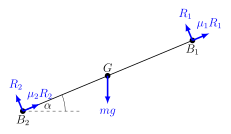
\(B_1\) and \(B_2\) are parallel, thin, horizontal fixed beams. \(B_1\) is a vertical distance \(d \sin \alpha \) above \(B_2\), and a horizontal distance \(d\cos\alpha \) from \(B_2\,\), where \(0<\alpha<\pi/2\,\). A long heavy plank is held so that it rests on the two beams, perpendicular to each, with its centre of gravity at \(B_1\,\). The coefficients of friction between the plank and \(B_1\) and \(B_2\) are \(\mu_1\) and \(\mu_2\,\), respectively, where \(\mu_1<\mu_2\) and \(\mu_1+\mu_2=2\tan\alpha\,\). The plank is released and slips over the beams experiencing a force of resistance from each beam equal to the limiting frictional force (i.e. the product of the appropriate coefficient of friction and the normal reaction). Show that it will come to rest with its centre of gravity over \(B_2\) in a time \[ \pi \left(\frac{d}{g(\mu_2-\mu_1)\cos\alpha }\right)^{\!\frac12}\;. \]
Solution: