Problems
Filters
43 problems found
1995 Paper 1 Q10
A small ball of mass \(m\) is suspended in equilibrium by a light elastic string of natural length \(l\) and modulus of elasticity \(\lambda.\) Show that the total length of the string in equilibrium is \(l(1+mg/\lambda).\) If the ball is now projected downwards from the equilibrium position with speed \(u_{0},\) show that the speed \(v\) of the ball at distance \(x\) below the equilibrium position is given by \[ v^{2}+\frac{\lambda}{lm}x^{2}=u_{0}^{2}. \] At distance \(h\), where \(\lambda h^{2} < lmu_{0}^{2},\) below the equilibrium position is a horizontal surface on which the ball bounces with a coefficient of restitution \(e\). Show that after one bounce the velocity \(u_{1}\) at \(x=0\) is given by \[ u_{1}^{2}=e^{2}u_{0}^{2}+\frac{\lambda}{lm}h^{2}(1-e^{2}), \] and that after the second bounce the velocity \(u_{2}\) at \(x=0\) is given by \[ u_{2}^{2}=e^{4}u_{0}^{2}+\frac{\lambda}{lm}h^{2}(1-e^{4}). \]
1995 Paper 2 Q10
Three small spheres of masses \(m_{1},m_{2}\) and \(m_{3},\) move in a straight line on a smooth horizontal table. (Their order on the straight line is the order given.) The coefficient of restitution between any two spheres is \(e\). The first moves with velocity \(u\) towards the second whilst the second and third are at rest. After the first collision the second sphere hits the third after which the velocity of the second sphere is \(u.\) Find \(m_{1}\) in terms of \(m_{2},m_{3}\) and \(e\). deduce that \[ m_{2}e>m_{3}(1+e+e^{2}). \] Suppose that the relation between \(m_{1},m_{2}\) and \(m_{3}\) is that in the formula you found above, but that now the first sphere initially moves with velocity \(u\) and the other two spheres with velocity \(v\), all in the same direction along the line. If \(u>v>0\) use the first part to find the velocity of the second sphere after two collisions have taken place. (You should not need to make any substantial computations but you should state your argument clearly.)
1994 Paper 3 Q9
A smooth, axially symmetric bowl has its vertical cross-sections determined by \(s=2\sqrt{ky},\) where \(s\) is the arc-length measured from its lowest point \(V\), and \(y\) is the height above \(V\). A particle is released from rest at a point on the surface at a height \(h\) above \(V\). Explain why \[ \left(\frac{\mathrm{d}s}{\mathrm{d}t}\right)^{2}+2gy \] is constant. Show that the time for the particle to reach \(V\) is \[ \pi\sqrt{\frac{k}{2g}}. \] Two elastic particles of mass \(m\) and \(\alpha m,\) where \(\alpha<1,\) are released simultaneously from opposite sides of the bowl at heights \(\alpha^{2}h\) and \(h\) respectively. If the coefficient of restitution between the particles is \(\alpha,\) describe the subsequent motion.
1993 Paper 2 Q14
A ball of mass \(m\) is thrown vertically upwards from the floor of a room of height \(h\) with speed \(\sqrt{2kgh},\) where \(k>1.\) The coefficient of restitution between the ball and the ceiling or floor is \(a\). Both the ceiling and floor are level. Show that the kinetic energy of the ball immediately before hitting the ceiling for the \(n\)th time is \[ mgh\left(a^{4n-4}(k-1)+\frac{a^{4n-4}-1}{a^{2}+1}\right). \] Hence show that the number of times the ball hits the ceiling is at most \[ 1-\frac{\ln[a^{2}(k-1)+k]}{4\ln a}. \]
Solution: \begin{align*} && \text{energy when projected} &= \frac12 m(2kgh) \\ &&&= kghm \\ && \text{energy when hitting ceiling the first time} &= mgh + \frac12 m v^2 \\ \text{COE}: && kghm &= mgh + \frac12 mv^2 \\ \Rightarrow && v^2 &= 2gh(k-1) \end{align*} It will rebound with speed \(\sqrt{2gh(k-1)}a\). \begin{align*} && \text{energy when rebounding from ceiling} &=gh(k-1)a^2 + mgh \\ && \text{energy before hitting the floor} &= \frac12 mv^2 \\ \text{COE}: && gh(k-1)a^2 + mgh &= \frac12 mv^2 \\ \Rightarrow && v^2 &= 2gh((k-1)a^2+1) \end{align*} The ball will rebound with kinetic energy \(m gh((k-1)a^2+1)a^2 = mgh((k-1)a^4+a^2)\) And will reach the ceiling with kinetic energy \(mgh((k-1)a^4+a^2-1)\). When \(n = 1\), the kinetic energy (before hitting the ceiling for the first time) is \(mgh(k-1)\). Suppose \(s_n\) is the expression for the kinetic energy divided by \(mgh\), ie \(s_1 = k-1\), then: Clearly \(s_1 = k-1 = a^{4\cdot1-4}(k-1) + \frac{a^{4\cdot-4}-1}{a^2+1}\), so our hypothesis holds for \(n=1\). Suppose it is true for \(n\), then the \(n+1\)th time it will be: \begin{align*} s_{n+1} &= s_n a^4+a^2-1 \\ &= \left ( a^{4n-4}(k-1)+\frac{a^{4n-4}-1}{a^{2}+1} \right) a^4 + a^2 - 1 \\ &= a^{4(n+1)-4}(k-1) + \frac{a^{4(n+1)-4}-a^4}{a^2+1} + \frac{a^4-1}{a^2+1} \\ &= a^{4(n+1)-4}(k-1) + \frac{a^{4(n+1)-4}-a^4+a^4-1}{a^2+1} \\ &= a^{4(n+1)-4}(k-1) + \frac{a^{4(n+1)-4}-1}{a^2+1} \end{align*} Which is our desired expression, therefore it is true by induction. We wont reach the ceiling if this energy is not positive, ie: \begin{align*} && 0 &\leq a^{4n-4}(k-1)+\frac{a^{4n-4}-1}{a^{2}+1} \\ \Rightarrow && \frac{1}{a^2+1}&\geq a^{4n-4}\left (k - 1 + \frac{1}{a^2+1} \right) \\ \Rightarrow && a^{4n-4} &\geq \frac{1}{a^2+1} \cdot \frac{1}{k - 1 + \frac{1}{a^2+1}} \\ \Rightarrow && a^{4n-4} &\geq \frac{1}{(k-1)(a^2+1)+1} \\ \Rightarrow && 4(n-1) \ln a &\geq - \ln[(k-1)(a^2+1)+1] \\ \underbrace{\Rightarrow}_{\ln a < 0} && (n-1) &\leq \frac{ - \ln[(k-1)(a^2+1)+1]}{4\ln a} \\ \Rightarrow && n & \leq 1 -\frac{ \ln[(k-1)(a^2+1)+1]}{4\ln a} \\ &&&= 1 -\frac{ \ln[(k-1)a^2+k]}{4\ln a} \end{align*}
1993 Paper 3 Q14
A particle rests at a point \(A\) on a horizontal table and is joined to a point \(O\) on the table by a taut inextensible string of length \(c\). The particle is projected vertically upwards at a speed \(64\surd(6gc)\). It next strikes the table at a point \(B\) and rebounds. The coefficient of restitution for any impact between the particle and the table is \({1\over 2}\). After rebounding at \(B\), the particle will rebound alternately at \(A\) and \(B\) until the string becomes slack. Show that when the string becomes slack the particle is at height \(c/2\) above the table. Determine whether the first rebound between \(A\) and \(B\) is nearer to \(A\) or to \(B\).
Solution: \begin{align*} \text{N2}(radially): && T + mg \cos \theta &= m\frac{v^2}{r} \\ \Rightarrow && v^2-gc \cos \theta &\geq 0 \\ \text{COE}: && \frac12 m u^2 &= \frac12mv^2 + mgc\cos \theta \\ \Rightarrow && u^2 &= v^2 + 2gc\cos \theta \\ && u^2 &\geq gc \cos \theta+2gc\cos \theta \\ \Rightarrow && u^2 &\geq 3gc\cos \theta \end{align*} Therefore it will complete bounces with the string taught if it leaves the table with \(u^2 \geq 3gc\). After \(6\) bounces it will leave the table with speed \(\sqrt{6gc} > \sqrt{3gc}\) and after \(7\) bounces it will leave the table with speed \(\sqrt{\frac{3}{2} gc} < \sqrt{3 gc}\). When it leaves the table with speed \(\sqrt{\tfrac32 gc}\), the string will go slack when \begin{align*} && \tfrac32 gc &= 3gc \cos \theta \\ \Rightarrow && \cos \theta &= \frac{1}{2} \end{align*} ie at a height \(c\cos \theta = \frac12c\) above the table. Once the string goes slack, the particle travels under circular motion, \begin{align*} && u^2 &= \frac12 gc \\ \Rightarrow && u_\rightarrow &= \sqrt{\tfrac12 gc} \cos \theta \\ && u_{\uparrow} &= \sqrt{\tfrac12 gc} \sin \theta \\ \Rightarrow && s &= ut - \tfrac12 gt^2 \\ \Rightarrow && -\frac{c}{2} &= \sqrt{\tfrac12 gc} \frac{\sqrt{3}}{2} t - \tfrac12 g t^2 \\ \Rightarrow && t &= \sqrt{\frac{c}{g}} \left ( \frac{\sqrt{6}+\sqrt{22}}{4} \right) \\ \Rightarrow && s_{\rightarrow} &= \tfrac12 \sqrt{\tfrac12 gc} \sqrt{\frac{c}{g}} \left ( \frac{\sqrt{6}+\sqrt{22}}{4} \right) - \frac{\sqrt{3}}{2}c \\ &&&= \left ( \frac{\sqrt{11}-3\sqrt{3}}{8} \right)c \\ \end{align*} We need to establish whether this position is positive or negative (ie if we cross the centre line. Clearly \(\sqrt{11} < 3\sqrt{3}\) so we haven't crossed the centre line and we land closer to where we took off. Since it's the 7th take off, this is closer to \(B\).
1992 Paper 2 Q13
Two particles \(P_{1}\) and \(P_{2}\), each of mass \(m\), are joined by a light smooth inextensible string of length \(\ell.\) \(P_{1}\) lies on a table top a distance \(d\) from the edge, and \(P_{2}\) hangs over the edge of the table and is suspended a distance \(b\) above the ground. The coefficient of friction between \(P_{1}\) and the table top is \(\mu,\) and \(\mu<1\). The system is released from rest. Show that \(P_{1}\) will fall off the edge of the table if and only if \[ \mu<\frac{b}{2d-b}. \] Suppose that \(\mu>b/(2d-b)\) , so that \(P_{1}\) comes to rest on the table, and that the coefficient of restitution between \(P_{2}\) and the floor is \(e\). Show that, if \(e>1/(2\mu),\) then \(P_{1}\) comes to rest before \(P_{2}\) bounces a second time.
1992 Paper 3 Q11
\(\,\)
1990 Paper 2 Q12
A straight staircase consists of \(N\) smooth horizontal stairs each of height \(h\). A particle slides over the top stair at speed \(U\), with velocity perpendicular to the edge of the stair, and then falls down the staircase, bouncing once on every stair. The coefficient of restitution between the particle and each stair is \(e\), where \(e<1\). Show that the horizontal distance \(d_{n}\) travelled between the \(n\)th and \((n+1)\)th bounces is given by \[ d_{n}=U\left(\frac{2h}{g}\right)^{\frac{1}{2}}\left(e\alpha_{n}+\alpha_{n+1}\right), \] where \({\displaystyle \alpha_{n}=\left(\frac{1-e^{2n}}{1-e^{2}}\right)^{\frac{1}{2}}}\). If \(N\) is very large, show that \(U\) must satisfy \[ U=\left(\frac{L^{2}g}{2h}\right)^{\frac{1}{2}}\left(\frac{1-e}{1+e}\right)^{\frac{1}{2}}, \] where \(L\) is the horizontal distance between the edges of successive stairs.
1990 Paper 3 Q12
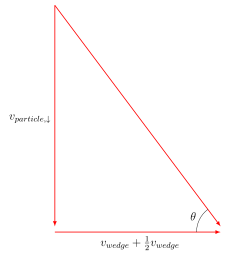
A uniform smooth wedge of mass \(m\) has congruent triangular end faces \(A_{1}B_{1}C_{1}\) and \(A_{2}B_{2}C_{2},\) and \(A_{1}A_{2},B_{1}B_{2}\) and \(C_{1}C_{2}\) are perpendicular to these faces. The points \(A,B\) and \(C\) are the midpoints of \(A_{1}A_{2},B_{1}B_{2}\) and \(C_{1}C_{2}\) respectively. The sides of the triangle \(ABC\) have lengths \(AB=AC=5a\) and \(BC=6a.\) The wedge is placed with \(BC\) on a smooth horizontal table, a particle of mass \(2m\) is placed at \(A\) on \(AC,\) and the system is released from rest. The particle slides down \(AC,\) strikes the table, bounces perfectly elastically and lands again on the table at \(D\). At this time the point \(C\) of the wedge has reached the point \(E\). Show that \(DE=\frac{192}{19}a.\)
Solution: Conservation of energy, tells us that \(2m \cdot g \cdot 4a = 8amg\) is equal to \(\frac12 m v_{wedge}^2 + \frac12(2m)v_{particle}^2\). Conservation of momentum (horizontally) tells us that \(m v_{wedge}+2mv_{particle, \rightarrow} = 0 \Rightarrow v_{particle, \rightarrow} = -\frac12 v_{wedge}\).
1989 Paper 3 Q11
A smooth uniform sphere, with centre \(A\), radius \(2a\) and mass \(3m,\) is suspended from a fixed point \(O\) by means of a light inextensible string, of length \(3a,\) attached to its surface at \(C\). A second smooth unifom sphere, with centre \(B,\) radius \(3a\) and mass \(25m,\) is held with its surface touching \(O\) and with \(OB\) horizontal. The second sphere is released from rest, falls and strikes the first sphere. The coefficient of restitution between the spheres is \(3/4.\) Find the speed \(U\) of \(A\) immediately after the impact in terms of the speed \(V\) of \(B\) immediately before impact. The same system is now set up with a light rigid rod replacing the string and rigidly attached to the sphere so that \(OCA\) is a straight line. The rod can turn freely about \(O\). The sphere with centre \(B\) is dropped as before. Show that the speed of \(A\) immediately after impact is \(125U/127.\)
1988 Paper 3 Q12
A smooth billiard ball moving on a smooth horizontal table strikes another identical ball which is at rest. The coefficient of restitution between the balls is \(e(<1)\). Show that after the collision the angle between the velocities of the balls is less than \(\frac{1}{2}\pi.\) Show also that the maximum angle of deflection of the first ball is \[ \sin^{-1}\left(\frac{1+e}{3-e}\right). \]
Solution:

1987 Paper 1 Q12
\(\,\) \vspace{-1cm}
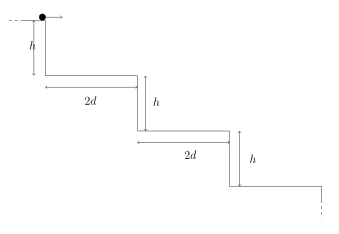
Solution: Considering the horizontal component, this will be constant as there are no forces acting in that direction. The first step will take the particle \(t = \sqrt{\frac{2h}g}\) to reach. At which point it will be travelling with speed \(v = \sqrt{2gh} \) (by energy considerations, \(mgh = \frac12 mv^2\)). To reach the second step must take twice as long (since the ball has to travel \(2d\) horizontally, rather than \(d\)). Since \(t = 2\sqrt{\frac{2h}g}\) we must have that: \begin{align*} && s &= ut + \frac12 gt^2 \\ \Rightarrow && h &= u 2\sqrt{\frac{2h}g} + \frac12 g \frac{8h}g \\ \Rightarrow && u &= -\frac{3}{2} h\sqrt{\frac{g}{2h}} \\ &&&= -\frac{3}{2\sqrt{2}} \sqrt{gh} \end{align*} Therefore, using Newton's experimental law, we must have that \(e = \frac{\frac{3}{2 \sqrt{2}} \sqrt{gh}}{\sqrt{2} \sqrt{gh}} = \frac{3}{4}\). Again by conservation of energy \(mgh + \frac12 \frac{9}{8} mgh = \frac12 mv^2 \Rightarrow v = \frac{5}{2\sqrt{2}} \sqrt{gh}\) when it lands on the next step. Therefore we would need the coefficient of restitution for the second (and subsequent steps) to be: \(\displaystyle \frac{\frac{3}{2\sqrt{2}} \sqrt{gh}}{\frac{5}{2\sqrt{2}} \sqrt{gh}} = \frac35\)
1987 Paper 2 Q13
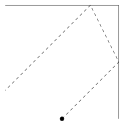
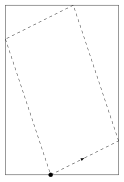
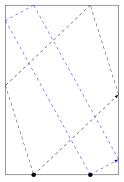
Ice snooker is played on a rectangular horizontal table, of length \(L\) and width \(B\), on which a small disc (the puck) slides without friction. The table is bounded by smooth vertical walls (the cushions) and the coefficient of restitution between the puck and any cushion is \(e\). If the puck is hit so that it bounces off two adjacent cushions, show that its final path (after two bounces) is parallel to its original path. The puck rests against the cushion at a point which divides the side of length \(L\) in the ratio \(z:1\). Show that it is possible, whatever \(z\), to hit the puck so that it bounces off the three other cushions in succession clockwise and returns to the spot at which it started. By considering these paths as \(z\) varies, explain briefly why there are two different ways in which, starting at any point away from the cushions, it is possible to perform a shot in which the puck bounces off all four cushions in succession clockwise and returns to its starting point.
Solution: