1992 Paper 3 Q11
Year: 1992
Paper: 3
Question Number: 11
Course: UFM Mechanics
Section: Momentum and Collisions 1
Difficulty: 1700.0
Banger: 1500.0
momentum and collisions
coefficient of restitution
relative velocity
kinematics
constant acceleration
particle
barrier
successive collisions
Problem
\(\,\)
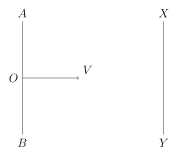 \(AOB\) represents a smooth vertical wall and \(XY\) represents a parallel smooth vertical barrier, both standing on a smooth horizontal table. A particle \(P\) is projected along the table from \(O\) with speed \(V\) in a direction perpendicular to the wall. At the time of projection, the distance between the wall and the barrier is \((75/32)VT\), where \(T\) is a constant. The barrier moves directly towards the wall, remaining parallel to the wall, with initial speed \(4V\) and with constant acceleration \(4V/T\) directly away from the wall. The particle strikes the barrier
\(XY\) and rebounds. Show that this impact takes place at time \(5T/8\).
The barrier is sufficiently massive for its motion to be unaffected by the impact. Given that the coefficient of restitution is \(1/2\), find the speed of \(P\) immediately after impact.
\(P\) strikes \(AB\) and rebounds. Given that the coefficient of restitution for this collision is also \(1/2,\) show that the next collision of \(P\) with the barrier is at time \(9T/8\) from the start of the motion.
\(AOB\) represents a smooth vertical wall and \(XY\) represents a parallel smooth vertical barrier, both standing on a smooth horizontal table. A particle \(P\) is projected along the table from \(O\) with speed \(V\) in a direction perpendicular to the wall. At the time of projection, the distance between the wall and the barrier is \((75/32)VT\), where \(T\) is a constant. The barrier moves directly towards the wall, remaining parallel to the wall, with initial speed \(4V\) and with constant acceleration \(4V/T\) directly away from the wall. The particle strikes the barrier
\(XY\) and rebounds. Show that this impact takes place at time \(5T/8\).
The barrier is sufficiently massive for its motion to be unaffected by the impact. Given that the coefficient of restitution is \(1/2\), find the speed of \(P\) immediately after impact.
\(P\) strikes \(AB\) and rebounds. Given that the coefficient of restitution for this collision is also \(1/2,\) show that the next collision of \(P\) with the barrier is at time \(9T/8\) from the start of the motion.
No solution available for this problem.
Rating Information
Difficulty Rating: 1700.0
Difficulty Comparisons: 0
Banger Rating: 1500.0
Banger Comparisons: 0
Show LaTeX source
Problem source
$\,$
\begin{center}
\begin{tikzpicture}
    % Draw vertical lines
    \draw (0,0) -- (0,4) node[above] {$A$};
    \draw (5,0) -- (5,4) node[above] {$X$};

    % Draw horizontal arrow
    \draw[->] (0,2) node[left] {$O$} -- (2,2) node[above right] {$V$};

    % Add bottom labels
    \node[below] at (0,0) {$B$};
    \node[below] at (5,0) {$Y$};
\end{tikzpicture}
\end{center}
$AOB$ represents a smooth vertical wall and $XY$ represents a parallel smooth vertical barrier, both standing on a smooth horizontal table. A particle $P$ is projected along the table from $O$ with speed $V$ in a direction perpendicular to the wall. At the time of projection, the distance between the wall and the barrier is $(75/32)VT$, where $T$ is a constant. The barrier moves directly towards the wall, remaining parallel to the wall, with initial speed $4V$ and with constant acceleration $4V/T$ directly away from the wall. The particle strikes the barrier
$XY$ and rebounds. Show that this impact takes place at time $5T/8$.
The barrier is sufficiently massive for its motion to be unaffected by the impact. Given that the coefficient of restitution is $1/2$, find the speed of $P$ immediately after impact.
$P$ strikes $AB$ and rebounds. Given that the coefficient of restitution for this collision is also $1/2,$ show that the next collision of $P$ with the barrier is at time $9T/8$ from the start of the motion.