Problems
Filters
49 problems found
1998 Paper 3 Q4
Show that the equation (in plane polar coordinates) \(r=\cos\theta\), for $-\frac{1}{2}\pi \le \theta \le \frac{1}{2}\pi$, represents a circle. Sketch the curve \(r=\cos2\theta\) for \(0\le\theta\le 2\pi\), and describe the curves \(r=\cos2n\theta\), where \(n\) is an integer. Show that the area enclosed by such a curve is independent of \(n\). Sketch also the curve \(r=\cos3\theta\) for \(0\le\theta\le 2\pi\).
1997 Paper 3 Q5
Find the ratio, over one revolution, of the distance moved by a wheel rolling on a flat surface to the distance traced out by a point on its circumference.
Solution: The point on the circumference will have position \((a\cos t, a \sin t )\) relative to the circumference where \(t \in [0, 2\pi]\). the wheel will travel \(2\pi a\), therefore the position is \((a\cos t + at, a \sin t )\). The total distance travelled can be computed using the arc length: \begin{align*} && s &= \int_0^{2\pi} \sqrt{\left ( \frac{\d y}{\d t} \right)^2 +\left ( \frac{\d x}{\d t} \right)^2} \d t \\ &&&= \int_0^{2\pi} \sqrt{(a - a\sin t)^2 +(a \cos t)^2 } \d t \\ &&&= a \int_0^{2\pi} \sqrt{2 - 2 \sin t } \d t \\ &&&= \sqrt{2}a \int_0^{2 \pi} \sqrt{1 - \sin t} \d t \\ &&&= \sqrt{2}a \int_0^{2 \pi} \frac{|\cos t|}{\sqrt{1 + \sin t}} \d t \\ &&&= 2\sqrt{2} a \int_{-\pi/2}^{\pi/2} \frac{\cos t}{\sqrt{1+\sin t}} \d t \\ &&&= 2\sqrt{2} a \left [ 2\sqrt{1+\sin t} \right]_{-\pi/2}^{\pi/2} \\ &&& = 2\sqrt{2} a 2\sqrt{2} \\ &&&= 8a \end{align*} Therefore the ratio is \(\frac{4}{\pi}\)
1996 Paper 2 Q7
Consider a fixed square \(ABCD\) and a variable point \(P\) in the plane of the square. We write the perpendicular distance from \(P\) to \(AB\) as \(p\), from \(P\) to \(BC\) as \(q\), from \(P\) to \(CD\) as \(r\) and from \(P\) to \(DA\) as \(s\). (Remember that distance is never negative, so \(p,q,r,s\geqslant 0\).) If \(pr=qs\), show that the only possible positions of \(P\) lie on two straight lines and a circle and that every point on these two lines and a circle is indeed a possible position of \(P\).
1995 Paper 2 Q5
The famous film star Birkhoff Maclane is sunning herself by the side of her enormous circular swimming pool (with centre \(O\)) at a point \(A\) on its circumference. She wants a drink from a small jug of iced tea placed at the diametrically opposite point \(B\). She has three choices:
- to swim directly to \(B\).
- to choose \(\theta\) with \(0<\theta<\pi,\) to run round the pool to a point \(X\) with \(\angle AOX=\theta\) and then to swim directly from \(X\) to \(B\).
- to run round the pool from \(A\) to \(B\).
1995 Paper 3 Q6
The variable non-zero complex number \(z\) is such that \[ \left|z-\mathrm{i}\right|=1. \] Find the modulus of \(z\) when its argument is \(\theta.\) Find also the modulus and argument of \(1/z\) in terms of \(\theta\) and show in an Argand diagram the loci of points which represent \(z\) and \(1/z\). Find the locus \(C\) in the Argand diagram such that \(w\in C\) if, and only if, the real part of \((1/w)\) is \(-1\).
Solution:

1994 Paper 2 Q4
By considering the area of the region defined in terms of Cartesian coordinates \((x,y)\) by \[ \{(x,y):\ x^{2}+y^{2}=1,\ 0\leqslant y,\ 0\leqslant x\leqslant c\}, \] show that \[ \int_{0}^{c}(1-x^{2})^{\frac{1}{2}}\,\mathrm{d}x=\tfrac{1}{2}[c(1-c^{2})^{\frac{1}{2}}+\sin^{-1}c], \] if \(0 < c\leqslant1.\) Show that the area of the region defined by \[ \left\{ (x,y):\ \frac{x^{2}}{a^{2}}+\frac{y^{2}}{b^{2}}=1,\ 0\leqslant y,\ 0\leqslant x\leqslant c\right\} , \] is \[ \frac{ab}{2}\left[\frac{c}{a}\left(1-\frac{c^{2}}{a^{2}}\right)^{\frac{1}{2}}+\sin^{-1}\left(\frac{c}{a}\right)\right], \] if \(0 < c\leqslant a\) and \(0 < b.\) Suppose that \(0 < b\leqslant a.\) Show that the area of intersection \(E\cap F\) of the two regions defined by \[ E=\left\{ (x,y):\ \frac{x^{2}}{a^{2}}+\frac{y^{2}}{b^{2}}\leqslant1\right\} \qquad\mbox{ and }\qquad F=\left\{ (x,y):\ \frac{x^{2}}{b^{2}}+\frac{y^{2}}{a^{2}}\leqslant1\right\} \] is \[ 4ab\sin^{-1}\left(\frac{b}{\sqrt{a^{2}+b^{2}}}\right). \]
1994 Paper 2 Q7
Show that the equation \[ ax^{2}+ay^{2}+2gx+2fy+c=0 \] where \(a>0\) and \(f^{2}+g^{2}>ac\) represents a circle in Cartesian coordinates and find its centre. The smooth and level parade ground of the First Ruritanian Infantry Division is ornamented by two tall vertical flagpoles of heights \(h_{1}\) and \(h_{2}\) a distance \(d\) apart. As part of an initiative test a soldier has to march in such a way that he keeps the angles of elevation of the tops of the two flagpoles equal to one another. Show that if the two flagpoles are of different heights he will march in a circle. What happens if the two flagpoles have the same height? To celebrate the King's birthday a third flagpole is added. Soldiers are then assigned to each of the three different pairs of flagpoles and are told to march in such a way that they always keep the tops of their two assigned flagpoles at equal angles of elevation to one another. Show that, if the three flagpoles have different heights \(h_{1},h_{2}\) and \(h_{3}\) and the circles in which the soldiers march have centres of \((x_{ij},y_{ij})\) (for the flagpoles of height \(h_{i}\) and \(h_{j}\)) relative to Cartesian coordinates fixed in the parade ground, then the \(x_{ij}\) satisfy \[ h_{3}^{2}\left(h_{1}^{2}-h_{2}^{2}\right)x_{12}+h_{1}^{2}\left(h_{2}^{2}-h_{3}^{2}\right)x_{23}+h_{2}^{2}\left(h_{3}^{2}-h_{1}^{2}\right)x_{31}=0, \] and the same equation connects the \(y_{ij}\). Deduce that the three centres lie in a straight line.
1994 Paper 3 Q3
Describe geometrically the possible intersections of a plane with a sphere. Let \(P_{1}\) and \(P_{2}\) be the planes with equations \begin{alignat*}{1} 3x-y-1 & =0,\\ x-y+1 & =0, \end{alignat*} respectively, and let \(S_{1}\) and \(S_{2}\) be the spheres with equations \begin{alignat*}{1} x^{2}+y^{2}+z^{2} & =7,\\ x^{2}+y^{2}+z^{2}-6y-4z+10 & =0, \end{alignat*} respectively. Let \(C_{1}\) be the intersection of \(P_{1}\) and \(S_{1},\) let \(C_{2}\) be the intersection of \(P_{2}\) and \(S_{2}\) and let \(L\) be the intersection of \(P_{1}\) and \(P_{2}.\) Find the points where \(L\) meets each of \(S_{1}\) and \(S_{2}.\) Determine, giving your reasons, whether the circles \(C_{1}\) and \(C_{2}\) are linked.
1994 Paper 3 Q14
Three points, \(P,Q\) and \(R\), are independently randomly chosen on the perimeter of a circle. Prove that the probability that at least one of the angles of the triangle \(PQR\) will exceed \(k\pi\) is \(3(1-k)^{2}\) if \(\frac{1}{2}\leqslant k\leqslant1.\) Find the probability if \(\frac{1}{3}\leqslant k\leqslant\frac{1}{2}.\)
1993 Paper 1 Q8
- Prove that the intersection of the surface of a sphere with a plane is always a circle, a point or the empty set. Prove that the intersection of the surfaces of two spheres with distinct centres is always a circle, a point or the empty set. {[}If you use coordinate geometry, a careful choice of origin and axes may help.{]}
- The parish council of Little Fitton have just bought a modern sculpture entitled `Truth, Love and Justice pouring forth their blessings on Little Fitton.' It consists of three vertical poles \(AD,BE\) and \(CF\) of heights 2 metres, 3 metres and 4 metres respectively. Show that \(\angle DEF=\cos^{-1}\frac{1}{5}.\) Vandals now shift the pole \(AD\) so that \(A\) is unchanged and the pole is still straight but \(D\) is vertically above \(AB\) with \(\angle BAD=\frac{1}{4}\pi\) (in radians). Find the new angle \(\angle DEF\) in radians correct to four figures.
1993 Paper 3 Q6
The point in the Argand diagram representing the complex number \(z\) lies on the circle with centre \(K\) and radius \(r\), where \(K\) represents the complex number \(k\). Show that $$ zz^* -kz^* -k^*z +kk^* -r^2 =0. $$ The points \(P\), \(Q_1\) and \(Q_2\) represent the complex numbers \(z\), \(w_1\) and \(w_2\) respectively. The point \(P\) lies on the circle with \(OA\) as diameter, where \(O\) and \(A\) represent \(0\) and \(2i\) respectively. Given that \(w_1=z/(z-1)\), find the equation of the locus \(L\) of \(Q_1\) in terms of \(w_1\) and describe the geometrical form of \(L\). Given that \(w_2=z^*\), show that the locus of \(Q_2\) is also \(L\). Determine the positions of \(P\) for which \(Q_1\) coincides with \(Q_2\).
1992 Paper 2 Q10
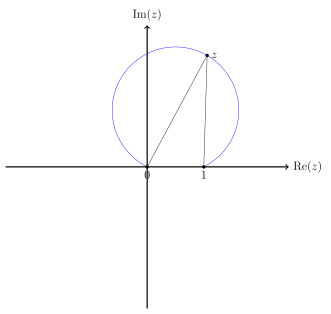
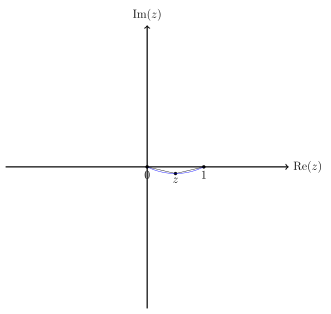
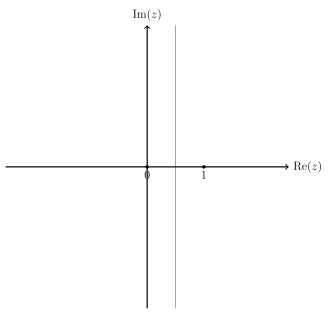
Let \(\alpha\) be a fixed angle, \(0 < \alpha \leqslant\frac{1}{2}\pi.\) In each of the following cases, sketch the locus of \(z\) in the Argand diagram (the complex plane):
- \({\displaystyle \arg\left(\frac{z-1}{z}\right)=\alpha,}\)
- \({\displaystyle \arg\left(\frac{z-1}{z}\right)=\alpha-\pi,}\)
- \(|\dfrac{z-1}{z}|=1.\)
Solution:
1992 Paper 3 Q3
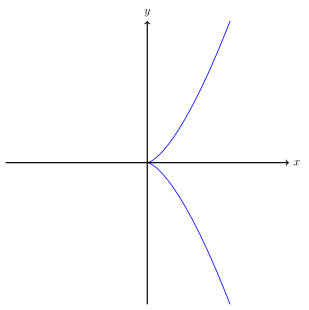
Sketch the curve \(C_{1}\) whose parametric equations are \(x=t^{2},\) \(y=t^{3}.\) The circle \(C_{2}\) passes through the origin \(O\). The points \(R\) and \(S\) with real non-zero parameters \(r\) and \(s\) respectively are other intersections of \(C_{1}\) and \(C_{2}.\) Show that \(r\) and \(s\) are roots of an equation of the form \[ t^{4}+t^{2}+at+b=0, \] where \(a\) and \(b\) are real constants. By obtaining a quadratic equation, with coefficients expressed in terms of \(r\) and \(s\), whose roots would be the parameters of any further intersections of \(C_{1}\) and \(C_{2},\) or otherwise, show that \(O\), \(R\) and \(S\) are the only real intersections of \(C_{1}\) and \(C_{2}.\)
Solution:
1990 Paper 2 Q5
The distinct points \(L,M,P\) and \(Q\) of the Argand diagram lie on a circle \(S\) centred on the origin and the corresponding complex numbers are \(l,m,p\) and \(q\). By considering the perpendicular bisectors of the chords, or otherwise, prove that the chord \(LM\) is perpendicular to the chord \(PQ\) if and only if \(lm+pq=0.\) Let \(A_{1},A_{2}\) and \(A_{3}\) be three distinct points on \(S\). For any given point \(A_{1}'\) on \(S\), the points \(A_{2}',A_{3}'\) and \(A_{1}''\) are chosen on \(S\) such that \(A_{1}'A_{2}',A_{2}'A_{3}'\) and \(A_{3}'A_{1}''\) are perpendicular to \(A_{1}A_{2},A_{2}A_{3}\) and \(A_{3}A_{1},\) respectively. Show that for exactly two positions of \(A_{1}',\) the points \(A_{1}'\) and \(A_{1}''\) coincide. If, instead, \(A_{1},A_{2},A_{3}\) and \(A_{4}\) are four given distinct points on \(S\) and, for any given point \(A_{1}',\) the points \(A_{2}',A_{3}',A_{4}'\) and \(A_{1}''\) are chosen on \(S\) such that \(A_{1}'A_{2}',A_{2}'A_{3}',A_{3}'A_{4}'\) and \(A_{4}'A_{1}''\) are respectively perpendicular to \(A_{1}A_{2},A_{2}A_{3},A_{3}A_{4}\) and \(A_{4}A_{1},\) show that \(A_{1}'\) coincides with \(A_{1}''.\) Give the corresponding result for \(n\) distinct points on \(S\).
Solution: The perpendicular bisector of the chords runs through the origin, therefore \(LM\) is perpendicular to \(PQ\) if and only if \(\frac{l+m}{2}\) is perpendicular to \(\frac{p+q}{2}\), ie \begin{align*} && (l+m) &= it (p+q) \\ \Leftrightarrow && \frac{l+m}{p+q} & \in i \mathbb{R} \\ \Leftrightarrow && 0 &= \frac{l+m}{p+q} + \frac{l^*+m^*}{p^*+q^*} \\ &&&= \frac{l+m}{p+q} + \frac{\frac{r^2}{l}+\frac{r^2}{m}}{\frac{r^2}{p}+\frac{r^2}{q}} \\ &&&=\frac{l+m}{p+q} + \frac{l+m}{p+q} \frac{pq}{lm} \\ &&&= \frac{l+m}{p+q} \left ( \frac{lm+pq}{lm} \right) \end{align*} Therefore as long as \(l+m, p+q \neq 0\) \(lm+pq = 0\) is equivalent to the chords being perpendicular. In the case where (say) \(l,m\) is a diameter, then the condition for the chords to be perpendicular is that \(p,q\) is also a diameter and at right angles, but clearly this is also equivalent to our condition. Suppose \(A_1, A_2, A_3\) are distinct points on \(S\), and \(A_1'\) is given and suppose \(a_i, a_i'\) are the corresponding complex numbers, then the conditions are: \begin{align*} A_1'A_2' \perp A_1A_2: && 0 &= a_1'a_2' + a_1a_2 \\ A_2'A_3' \perp A_2A_3: && 0 &= a_2'a_3' + a_2a_3 \\ A_3'A_1'' \perp A_3A_1: && 0 &= a_3'a_1'' + a_3a_1 \\ \\ \Rightarrow && a_2' &= -\frac{a_1a_2}{a_1'} \\ && a_3' &= -\frac{a_2a_3}{a_2'} \\ &&&= \frac{a_1'a_2a_3}{a_1a_2} \\ &&&= \frac{a_1'a_3}{a_1} \\ && a_1'' &= - \frac{a_3a_1}{a_3'} \\ &&&= \frac{a_3a_1a_1}{a_1'a_3} \\ &&&= \frac{a_1^2}{a_1'} \\ \Rightarrow && a_1'a_1'' &= a_1^2 \end{align*} Therefore \(a_1' = a_1''\) if \(a_1' = \pm a_1\) Suppose we have \(4\) points, then \begin{align*} A_1'A_2' \perp A_1A_2: && 0 &= a_1'a_2' + a_1a_2 \\ A_2'A_3' \perp A_2A_3: && 0 &= a_2'a_3' + a_2a_3 \\ A_3'A_4' \perp A_3A_4: && 0 &= a_3'a_4' + a_3a_4 \\ A_4'A_1'' \perp A_4A_1: && 0 &= a_4'a_1'' + a_4a_1 \\ \\ \Rightarrow && a_4' &= -\frac{a_3a_4}{a_3'} \\ &&&= -\frac{a_1a_3a_4}{a_1'a_3} \\ &&&= -\frac{a_1a_4}{a_1'} \\ \Rightarrow && a_1'' &= -\frac{a_4a_1}{a_4'} \\ &&&= \frac{a_4a_1a_1'}{a_1a_4} \\ &&&= a_1' \end{align*} So they coincide. For \(n\) points if there are an even number of points they coincide, an odd number and there are two points when they coincide.
1989 Paper 1 Q1

Solution: \(AG = r\), therefore the area is: \begin{align*} A &= [AHG] - 2*[ABC] + [CDE] \\ &= \frac12 \pi r^2 - \pi h^2 + \frac12 \pi (r-2h)^2 \\ &= \frac12 \pi \l r^2 - 2h^2 + r^2 -4rh+4h^2 \r \\ &= \frac12 \pi \l 2r^2 -4rh + 2h^2\r \\ &= \pi (r-h)^2 \end{align*} This is the same area as a circle radius \(r-h\) But \(HD = r + (r-2d) = 2(r-d)\), ie the circle with diameter \(HD\) has radius \(r-h\) as required. Suppose \(A = (-h, 0), C = (h, 0), B = (0, h)\) then our parabola is \(y = \frac1{h}(h^2-x^2)\)
