1992 Paper 2 Q10
Year: 1992
Paper: 2
Question Number: 10
Course: LFM Stats And Pure
Section: Complex Numbers (L8th)
Difficulty: 1600.0
Banger: 1529.8
complex numbers
locus
Argand diagram
argument
modulus
circle
inscribed angle theorem
geometric proof
cross-ratio
Problem
Let \(\alpha\) be a fixed angle, \(0 < \alpha \leqslant\frac{1}{2}\pi.\) In each of the following cases, sketch the locus of \(z\) in the Argand diagram (the complex plane):
- \({\displaystyle \arg\left(\frac{z-1}{z}\right)=\alpha,}\)
- \({\displaystyle \arg\left(\frac{z-1}{z}\right)=\alpha-\pi,}\)
- \(|\dfrac{z-1}{z}|=1.\)
Solution
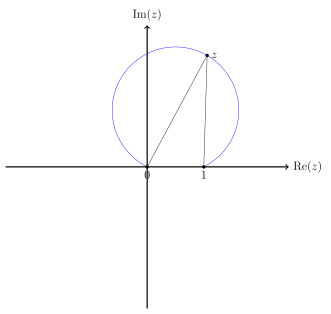
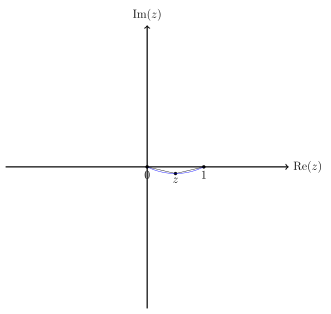
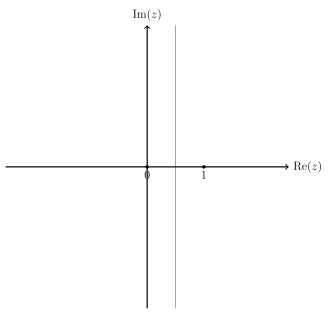
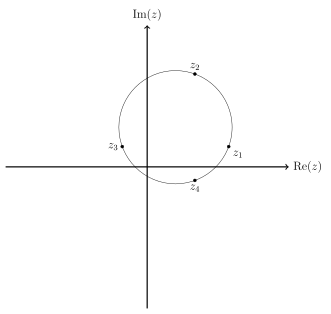
Rating Information
Difficulty Rating: 1600.0
Difficulty Comparisons: 0
Banger Rating: 1529.8
Banger Comparisons: 4
Show LaTeX source
Problem source
Let $\alpha$ be a fixed angle, $0 < \alpha \leqslant\frac{1}{2}\pi.$ In each of the following cases, sketch the locus of $z$ in the Argand diagram (the complex plane):
\begin{questionparts}
\item ${\displaystyle \arg\left(\frac{z-1}{z}\right)=\alpha,}$
\item ${\displaystyle \arg\left(\frac{z-1}{z}\right)=\alpha-\pi,}$
\item $|\dfrac{z-1}{z}|=1.$
\end{questionparts}
Let $z_{1},z_{2},z_{3}$ and $z_{4}$ be four points lying (in that order) on a circle in the Argand diagram. If
\[
w=\frac{(z_{1}-z_{2})(z_{3}-z_{4})}{(z_{4}-z_{1})(z_{2}-z_{3})}
\]
show, by considering $\arg w$, that $w$ is real.
Solution source
\begin{center}
    \begin{tikzpicture}
    \def\functionf(#1){((#1)+.5)*((#1)-1)*((#1)-2.1)};
    \def\xl{-2.5};
    \def\xu{2.5};
    \def\yl{-2.5};
    \def\yu{2.5};

    % Calculate scaling factors to make the plot square
    \pgfmathsetmacro{\xrange}{\xu-\xl}
    \pgfmathsetmacro{\yrange}{\yu-\yl}
    \pgfmathsetmacro{\xscale}{10/\xrange}
    \pgfmathsetmacro{\yscale}{10/\yrange}

    % Define the styles for the axes and grid
    \tikzset{
        axis/.style={very thick, ->},
        grid/.style={thin, gray!30},
        x=\xscale cm,
        y=\yscale cm
    }

    \coordinate (Z) at ({0.5+sqrt(1^2+0.5^2)*cos(60)}, {1 + sqrt(1^2+0.5^2)*sin(60)});

    % Define the bounding region with clip
    \begin{scope}
        % You can modify these values to change your plotting region
        \clip (\xl,\yl) rectangle (\xu,\yu);

        \filldraw (1, 0) circle (1.5pt) node[below]{$1$};
        \filldraw (0, 0) circle (1.5pt) node[below]{$0$};
        \filldraw (Z) circle (1.5pt) node[right]{$z$};

        \draw (0,0) -- (Z) -- (1,0);

    \end{scope}

    \begin{scope}
        % You can modify these values to change your plotting region
        \clip (\xl,0) rectangle (\xu,\yu);

        \draw[blue] (0.5, 1) circle ({sqrt(1^2+0.5^2)});

    \end{scope}

    % Set up axes
    \draw[axis] (\xl,0) -- (\xu,0) node[right] {$\textrm{Re}(z)$};
    \draw[axis] (0,\yl) -- (0,\yu) node[above] {$\textrm{Im}(z)$};

    \end{tikzpicture}
\end{center}


\begin{center}
    \begin{tikzpicture}
    \def\functionf(#1){((#1)+.5)*((#1)-1)*((#1)-2.1)};
    \def\xl{-2.5};
    \def\xu{2.5};
    \def\yl{-2.5};
    \def\yu{2.5};

    % Calculate scaling factors to make the plot square
    \pgfmathsetmacro{\xrange}{\xu-\xl}
    \pgfmathsetmacro{\yrange}{\yu-\yl}
    \pgfmathsetmacro{\xscale}{10/\xrange}
    \pgfmathsetmacro{\yscale}{10/\yrange}

    % Define the styles for the axes and grid
    \tikzset{
        axis/.style={very thick, ->},
        grid/.style={thin, gray!30},
        x=\xscale cm,
        y=\yscale cm
    }

    \coordinate (Z) at ({0.5+sqrt(1^2+0.5^2)*cos(270)}, {1 + sqrt(1^2+0.5^2)*sin(270)});

    % Define the bounding region with clip
    \begin{scope}
        % You can modify these values to change your plotting region
        \clip (\xl,\yl) rectangle (\xu,\yu);

        \filldraw (1, 0) circle (1.5pt) node[below]{$1$};
        \filldraw (0, 0) circle (1.5pt) node[below]{$0$};
        \filldraw (Z) circle (1.5pt) node[below]{$z$};

        \draw (0,0) -- (Z) -- (1,0);

    \end{scope}

    \begin{scope}
        % You can modify these values to change your plotting region
        \clip (\xl,\yl) rectangle (\xu,0);

        \draw[blue] (0.5, 1) circle ({sqrt(1^2+0.5^2)});

    \end{scope}

    % Set up axes
    \draw[axis] (\xl,0) -- (\xu,0) node[right] {$\textrm{Re}(z)$};
    \draw[axis] (0,\yl) -- (0,\yu) node[above] {$\textrm{Im}(z)$};

    \end{tikzpicture}
\end{center}


\begin{center}
    \begin{tikzpicture}
    \def\functionf(#1){((#1)+.5)*((#1)-1)*((#1)-2.1)};
    \def\xl{-2.5};
    \def\xu{2.5};
    \def\yl{-2.5};
    \def\yu{2.5};

    % Calculate scaling factors to make the plot square
    \pgfmathsetmacro{\xrange}{\xu-\xl}
    \pgfmathsetmacro{\yrange}{\yu-\yl}
    \pgfmathsetmacro{\xscale}{10/\xrange}
    \pgfmathsetmacro{\yscale}{10/\yrange}

    % Define the styles for the axes and grid
    \tikzset{
        axis/.style={very thick, ->},
        grid/.style={thin, gray!30},
        x=\xscale cm,
        y=\yscale cm
    }

    % \coordinate (Z) at ({0.5+sqrt(1^2+0.5^2)*cos(270)}, {1 + sqrt(1^2+0.5^2)*sin(270)});

    % Define the bounding region with clip
    \begin{scope}
        % You can modify these values to change your plotting region
        \clip (\xl,\yl) rectangle (\xu,\yu);

        \filldraw (1, 0) circle (1.5pt) node[below]{$1$};
        \filldraw (0, 0) circle (1.5pt) node[below]{$0$};
        % \filldraw (Z) circle (1.5pt) node[below]{$z$};

        \draw[blue] (0.5,\yu) -- (0.5,\yl);

    \end{scope}

    % Set up axes
    \draw[axis] (\xl,0) -- (\xu,0) node[right] {$\textrm{Re}(z)$};
    \draw[axis] (0,\yl) -- (0,\yu) node[above] {$\textrm{Im}(z)$};

    \end{tikzpicture}
\end{center}


\begin{center}
    \begin{tikzpicture}
    \def\functionf(#1){((#1)+.5)*((#1)-1)*((#1)-2.1)};
    \def\xl{-2.5};
    \def\xu{2.5};
    \def\yl{-2.5};
    \def\yu{2.5};

    % Calculate scaling factors to make the plot square
    \pgfmathsetmacro{\xrange}{\xu-\xl}
    \pgfmathsetmacro{\yrange}{\yu-\yl}
    \pgfmathsetmacro{\xscale}{10/\xrange}
    \pgfmathsetmacro{\yscale}{10/\yrange}

    % Define the styles for the axes and grid
    \tikzset{
        axis/.style={very thick, ->},
        grid/.style={thin, gray!30},
        x=\xscale cm,
        y=\yscale cm
    }

    \coordinate (A) at ({0.5+cos(-20)}, {0.7 + sin(-20)});
    \coordinate (B) at ({0.5+cos(70)}, {0.7 + sin(70)});
    \coordinate (C) at ({0.5+cos(200)}, {0.7 + sin(200)});
    \coordinate (D) at ({0.5+cos(290)}, {0.7 + sin(290)});

    % Define the bounding region with clip
    \begin{scope}
        % You can modify these values to change your plotting region
        \clip (\xl,\yl) rectangle (\xu,\yu);

        % \filldraw (1, 0) circle (1.5pt) node[below]{$1$};
        % \filldraw (0, 0) circle (1.5pt) node[below]{$0$};
        \filldraw (A) circle (1.5pt) node[below right]{$z_1$};
        \filldraw (B) circle (1.5pt) node[above]{$z_2$};
        \filldraw (C) circle (1.5pt) node[left]{$z_3$};
        \filldraw (D) circle (1.5pt) node[below]{$z_4$};

        \draw (0.5, 0.7) circle (1);

    \end{scope}

    % Set up axes
    \draw[axis] (\xl,0) -- (\xu,0) node[right] {$\textrm{Re}(z)$};
    \draw[axis] (0,\yl) -- (0,\yu) node[above] {$\textrm{Im}(z)$};

    \end{tikzpicture}
\end{center}

\begin{align*}
    \arg w &= \arg \frac{(z_{1}-z_{2})(z_{3}-z_{4})}{(z_{4}-z_{1})(z_{2}-z_{3})} \\
    &= \arg \frac{(z_{1}-z_{2})(z_{3}-z_{4})}{(z_{2}-z_{3})(z_{4}-z_{1})} \\
    &= \arg \frac{(z_{1}-z_{2})}{(z_{3}-z_{2})}\frac{(z_{3}-z_{4})}{(z_{1}-z_{4})} \\
    &= \arg \frac{(z_{1}-z_{2})}{(z_{3}-z_{2})} + \arg \frac{(z_{3}-z_{4})}{(z_{1}-z_{4})}\\
    &= \beta + \pi - \beta = \pi
\end{align*}

Therefore $w$ is real