Problems
Filters
39 problems found
2009 Paper 2 Q3
Prove that \[ \tan \left ( \tfrac14 \pi -\tfrac12 x \right)\equiv \sec x -\tan x\,. \tag{\(*\)} \]
- Use \((*)\) to find the value of \(\tan\frac18\pi\,\). Hence show that \[ \tan \tfrac{11}{24} \pi = \frac{\sqrt3 + \sqrt2 -1}{\sqrt3 -\sqrt6+1}\;. \]
- Show that \[ \frac{\sqrt3 + \sqrt2 -1}{\sqrt3 -\sqrt6+1}= 2+\sqrt2+\sqrt3+\sqrt6\,. \]
- Use \((*)\) to show that \[ \tan \tfrac1{48}\pi = \sqrt{16+10\sqrt2+8\sqrt3 +6\sqrt6 \ }-2-\sqrt2-\sqrt3-\sqrt6\,. \]
Solution: \begin{align*} && \tan \left ( \tfrac14 \pi -\tfrac12 x \right) &\equiv \frac{\tan \tfrac{\pi}{4} - \tan \tfrac12 x}{1 + \tan \tfrac{\pi}{4} \tan \tfrac12 x} \\ &&&= \frac{1-\tan \tfrac12 x}{1+\tan \tfrac12 x} \\ \\ && \sec x - \tan x &= \frac{1+t^2}{1-t^2} - \frac{2t}{1-t^2} \\ &&&= \frac{(1-t)^2}{(1-t)(1+t)} \\ &&&= \frac{1-t}{1+t} \end{align*} Therefore both sides are equal to the same thing.
- \(\tan \tfrac18 \pi = \tan(\tfrac14 \pi - \tfrac12 \tfrac14\pi) = \sec \tfrac14 \pi - \tan \tfrac14 \pi = \sqrt{2} - 1\) \begin{align*} && \tan \tfrac{11}{24} \pi &= \tan (\tfrac13 \pi +\tfrac18 \pi) \\ &&&= \frac{\tan \tfrac13 \pi +\tan \tfrac18 \pi}{1-\tan \tfrac13 \pi \tan \tfrac18 \pi} \\ &&&= \frac{\sqrt{3} + \sqrt{2} - 1}{1 - \sqrt{3}(\sqrt{2}-1)} \\ &&&= \frac{\sqrt{3} + \sqrt{2} - 1}{1 +\sqrt{3}-\sqrt{6}} \\ \end{align*}
- \(\,\) \begin{align*} && (\sqrt{3}-\sqrt{6}+1)(2+\sqrt{2}+\sqrt{3}+\sqrt{6}) &= (2\sqrt{3}+\sqrt{6}+3+3\sqrt{2}) + \\ &&&\quad+(-2\sqrt{6}-2\sqrt{3}-3\sqrt{2}-6) + \\ &&&\quad+(2+\sqrt{2}+\sqrt{3}+\sqrt{6}) \\ &&&= \sqrt{3}+\sqrt{2}-1 \end{align*}
- \(\,\) \begin{align*} && \tan \tfrac{1}{48} \pi &= \tan (\tfrac14\pi - \tfrac{11}{48} \pi) \\ &&&= \sec \tfrac{11}{24} \pi - \tan \tfrac{11}{24} \pi \\ &&&= \sqrt{1+\tan^2 \tfrac{11}{24}\pi} - \tan \tfrac{11}{24} \pi \\ &&&= \sqrt{1 + (2+\sqrt{2}+\sqrt{3}+\sqrt{6})^2} - (2+\sqrt{2}+\sqrt{3}+\sqrt{6}) \\ &&&= \sqrt{16+10\sqrt{2} + 8\sqrt{3}+6\sqrt{6}} - 2 - \sqrt2 - \sqrt3-\sqrt6 \end{align*}
2009 Paper 2 Q4
The polynomial \(\p(x)\) is of degree 9 and \(\p(x)-1\) is exactly divisible by \((x-1)^5\).
- Find the value of \(\p(1)\).
- Show that \(\p'(x)\) is exactly divisible by \((x-1)^4\).
- Given also that \(\p(x)+1\) is exactly divisible by \((x+1)^5\), find \(\p(x)\).
Solution: \(p(x) = q(x)(x-1)^5 + 1\) where \(q(x)\) has degree \(4\).
- \(p(1) = q(1)(1-1)^5 + 1 = 1\).
- \(p'(x) = q'(x)(x-1)^5 + 5(x-1)^4q(x) + 0 = (x-1)^4((x-1)q'(x) + 5q(x))\) so \(p'(x)\) is divisible by \((x-1)^4\)
- \(p(x)+1\) divisible by \((x+1)^5\) means that \(p(-1) = -1\) and \(p'(x)\) is divisible by \((x+1)^4\). Since \(p'(x)\) is degree \(8\) it must be \(c(x+1)^4(x-1)^4 = c(x^2 - 1)^4\). Expanding and integrating, we get \(p(x) = c(\frac{1}{9}x^9 -\frac{4}{7}x^7 + \frac{6}{5}x^5 - \frac{4}{3}x^3 + x) + d\). When \(x = 1\) we get \(c \frac{128}{315} + d = 1\) and when \(x = -1\) we get \(-c \frac{128}{315} + d = -1\) so \(2d = 0 \Rightarrow d = 0, c = \frac{315}{128}\) and \[ p(x) =\frac{315}{128} \l \frac{1}{9}x^9 -\frac{4}{7}x^7 + \frac{6}{5}x^5 - \frac{4}{3}x^3 + x\r \]
2009 Paper 2 Q5
Expand and simplify \((\sqrt{x-1}+1)^2\,\).
- Evaluate \[ \int_{5}^{10} \frac{ \sqrt{x+2\sqrt{x-1} \;} + \sqrt{x-2\sqrt{x-1} \;} } {\sqrt{x-1}} \,\d x\;. \]
- Find the total area between the curve \[ y= \frac{\sqrt{x-2\sqrt{x-1}\;}}{\sqrt{x-1}\;} \] and the \(x\)-axis between the points \(x=\frac54\) and \(x=10\).
- Evaluate \[ \int_{\frac54}^{10} \frac{ \sqrt{x+2\sqrt{x-1}\;} + \sqrt{x-2\sqrt{x+1}+2 \;} } {\sqrt{x^2-1} } \;\d x\;. \]
2009 Paper 2 Q6
The Fibonacci sequence \(F_1\), \(F_2\), \(F_3\), \(\ldots\) is defined by \(F_1=1\), \(F_2= 1\) and \[ F_{n+1} = F_n+F_{n-1} \qquad\qquad (n\ge 2). \] Write down the values of \(F_3\), \(F_4\), \(\ldots\), \(F_{10}\). Let \(\displaystyle S=\sum_{i=1}^\infty \dfrac1 {F_i}\,\).
- Show that \(\displaystyle \frac 1{F_i} > \frac1{2F_{i-1}}\,\) for \(i\ge4\) and deduce that \(S > 3\,\). Show also that \(S < 3\frac23\,\).
- Show further that \(3.2 < S < 3.5\,\).
Solution: \begin{array}{c|r} n & F_n \\ \hline 1 & 1 \\ 2 & 1 \\ 3 & 2 \\ 4 & 3 \\ 5 & 5 \\ 6 & 8 \\ 7 & 13 \\ 8 & 21 \\ 9 & 34 \\ 10 & 55 \end{array} \begin{questionparts} \item Claim: \(\frac1{F_i} > \frac1{2F_{i-1}}\) for \(i \geq 4\). Proof: Since \(F_i = F_{i-1}+F_{i-2}\) and \(F_i > 1\) for \(i \geq 1\) we have \(F_i > F_{i-1}\) for \(i \geq 3\). In particular we have \(F_i = F_{i-1}+F_{i-2} < 2F_{i-1}\) for \(i -1 \geq 3\) or \(i \geq 4\). Therefore \(\frac{1}{F_i} > \frac1{2F_{i-1}}\)
2009 Paper 2 Q7
Let \(y= (x-a)^n \e^{bx} \sqrt{1+x^2}\,\), where \(n\) and \(a\) are constants and \(b\) is a non-zero constant. Show that \[ \frac{\d y}{\d x} = \frac{(x-a)^{n-1} \e^{bx} \q(x)}{\sqrt{1+x^2}}\,, \] where \(\q(x)\) is a cubic polynomial. Using this result, determine:
- $\displaystyle \int \frac {(x-4)^{14} \e^{4x}(4x^3-1)} {\sqrt{1+x^2\;}} \, \d x\,;\(
- \)\displaystyle \int \frac{(x-1)^{21}\e^{12x}(12x^4-x^2-11)} {\sqrt{1+x^2\;}}\,\d x\,;\(
- \)\displaystyle \int \frac{(x-2)^{6}\e^{4x}(4x^4+x^3-2)} {\sqrt{1+x^2\;}}\,\d x\,.$
2009 Paper 2 Q8
The non-collinear points \(A\), \(B\) and \(C\) have position vectors \(\bf a\), \(\bf b\) and \(\bf c\), respectively. The points \(P\) and \(Q\) have position vectors \(\bf p\) and \(\bf q\), respectively, given by \[ {\bf p}= \lambda {\bf a} +(1-\lambda){\bf b} \text{ \ \ \ and \ \ \ } {\bf q}= \mu {\bf a} +(1-\mu){\bf c} \] where \(0<\lambda<1\) and \(\mu>1\). Draw a diagram showing \(A\), \(B\), \(C\), \(P\) and \(Q\). Given that \(CQ\times BP = AB\times AC\), find \(\mu\) in terms of \(\lambda\), and show that, for all values of \(\lambda\), the the line \(PQ\) passes through the fixed point \(D\), with position vector \({\bf d}\) given by \({\bf d= -a +b +c}\,\). What can be said about the quadrilateral \(ABDC\)?
2009 Paper 2 Q9
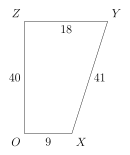
- A uniform lamina \(OXYZ\) is in the shape of the trapezium shown in the diagram. It is right-angled at \(O\) and \(Z\), and \(OX\) is parallel to \(YZ\). The lengths of the sides are given by \(OX=9\,\)cm, \(XY=41\,\)cm, \(YZ=18\,\)cm and \(ZO=40\,\)cm. Show that its centre of mass is a distance \(7\,\)cm from the edge \(OZ\).
- The diagram shows a tank with no lid made of thin sheet metal. The base \(OXUT\), the back \(OTWZ\) and the front \(XUVY\) are rectangular, and each end is a trapezium as in part (i). The width of the tank is \(d\,\)cm.
Show that the centre of mass of the tank, when empty, is a distance \[ \frac {3(140+11d)}{5(12+d)}\,\text{cm} \] from the back of the tank. The tank is then filled with a liquid. The mass per unit volume of this liquid is \(k\) times the mass per unit area of the sheet metal. In the case \(d=20\), find an expression for the distance of the centre of mass of the filled tank from the back of the tank.

Solution:
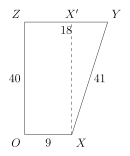
- \begin{array}{c|c|c|c} & OXX'Z & XX'Y & OXYZ \\ \hline \text{Area} & 360 & 180 & 540\\ \text{COM} & \binom{4.5}{20} & \binom{12}{\frac{80}{3}} & \binom{\overline{x}}{\overline{y}} \end{array} \begin{align*} && 2 \binom{3}{20} + \binom{12}{\frac{80}{3}} &= 3 \binom{\overline{x}}{\overline{y}} \\ \Rightarrow && \binom{\overline{x}}{\overline{y}} &= \frac13 \binom{21}{\frac{200}{3}} \\ &&&= \binom{7}{\frac{200}{9}} \end{align*} ie, the centre of mass is \(7\text{ cm}\) from \(OZ\)
- \begin{align*} && \underbrace{540 \cdot 7}_{OXYZ} + \underbrace{540 \cdot 7}_{TUVW} + \underbrace{40d\cdot 0}_{OTWZ} + \underbrace{9d\cdot 4.5}_{OXUT} + \underbrace{41d \cdot 13.5}_{XUVY} &= (540+540+40d+9d+41d) \overline{x} \\ \Rightarrow && \overline{x} &= \frac{540\cdot 14 + 50d \cdot 4.5 + 41d \cdot 9}{1080 + 90d} \\ &&&= \frac{90 \cdot 84 + 225d + 369d}{1080+90d} \\ &&&= \frac{90 \cdot 84 + 594d}{1080+90d} \\ &&&= \frac{54(140+11d)}{90(12+d)} \\ &&&= \frac{3(140+11d)}{5(12+d)} \end{align*} The volume of the prizm is \(540d\), it's center of mass is \(7\). For the tank, it COM is \(\frac{3(140+11\cdot20)}{5(12+20)} = \frac{27}4\) and area is \(2880\) Therefore for the combined shape we have: \begin{align*} && 540dk \cdot 7 + 2880 \cdot \frac{27}{4} &= (540 \cdot20 k+2880) \overline{x} \\ \Rightarrow && \overline{x} &= \frac{720(150k+27)}{720(15k + 4)} \\ &&&= \frac{3(50k+9)}{15k+4} \end{align*} \begin{align*} && \end{align*}
2009 Paper 2 Q10
\(\,\)
2009 Paper 2 Q11
A train consists of an engine and \(n\) trucks. It is travelling along a straight horizontal section of track. The mass of the engine and of each truck is \(M\). The resistance to motion of the engine and of each truck is \(R\), which is constant. The maximum power at which the engine can work is \(P\). Obtain an expression for the acceleration of the train when its speed is \(v\) and the engine is working at maximum power. The train starts from rest with the engine working at maximum power. Obtain an expression for the time \(T\) taken to reach a given speed \(V\), and show that this speed is only achievable if \[ P>(n+1)RV\,. \]
- In the case when \((n+1) RV/P\) is small, use the approximation \(\ln (1-x) \approx -x -\frac12 x^2\) (valid for small \( x \)) to obtain the approximation \[ PT\approx \tfrac 12 (n+1) MV^2\, \] and interpret this result.
- In the general case, the distance moved from rest in time \(T\) is \(X\). {\em Write down}, with explanation, an equation relating \(P\), \(T\), \(X\), \(M\), \(V\), \(R\) and \(n\) and hence show that \[ X= \frac{2PT - (n+1)MV^2}{2(n+1)R} \,. \]
2009 Paper 2 Q12
A continuous random variable \(X\) has probability density function given by \[ \f(x) = \begin{cases} 0 & \mbox{for } x<0 \\ k\e^{-2 x^2} & \mbox{for } 0\le x< \infty \;,\\ \end{cases} \] where \(k\) is a constant.
- Sketch the graph of \(\f(x)\).
- Find the value of \(k\).
- Determine \(\E(X)\) and \(\var(X)\).
- Use statistical tables to find, to three significant figures, the median value of \(X\).
Solution:
- \par

- Let \(Y \sim N(0,\frac14)\), then: \begin{align*} &&\int_0^\infty \frac{1}{\sqrt{2 \pi \cdot \frac14}} e^{-2x^2} \, dx &= \frac12\\ \Rightarrow && \int_0^\infty e^{-2x^2} &= \frac{\sqrt{\pi}}{2 \sqrt{2}} \\ \Rightarrow && k &= \boxed{\frac{2\sqrt{2}}{\sqrt{\pi}}} \end{align*}
- \begin{align*} \mathbb{E}[X] &= \int_0^\infty x f(x) \, dx \\ &= \frac{2\sqrt{2}}{\sqrt{\pi}}\int_0^\infty x e^{-2x^2}\, dx \\ &= \frac{2\sqrt{2}}{\sqrt{\pi}} \left [-\frac{1}{4}e^{-2x^2} \right]_0^\infty \\ &= \frac{1}{\sqrt{2\pi}} \\ \end{align*} In order to calculate \(\mathbb{E}(X^2)\) it is useful to consider the related computation \(\mathbb{E}(Y^2)\). In fact, by symmetry, these will be the same values. Therefore \(\mathbb{E}(X^2) = \mathbb{E}(Y^2) = \mathrm{Var}(Y) = \frac{1}{4}\) (since \(\mathbb{E}(Y) = 0\)). Therefore \(\mathrm{Var}(Y) = \mathbb{E}(Y^2) - \mathbb{E}(Y)^2 = \frac14 - \frac{1}{2\pi}\)
- \begin{align*} && \mathbb{P}(X < x) &= \frac12 \\ \Leftrightarrow && 2\mathbb{P}(0 \leq Y < x) &= \frac12 \\ \Leftrightarrow && 2\l \mathbb{P}(Y < x) - \frac12 \r &= \frac12 \\ \Leftrightarrow && \mathbb{P}(Y < x)&= \frac34 \\ \Leftrightarrow && \mathbb{P}(\frac{Y-0}{1/2} < \frac{x}{1/2})&= \frac34 \\ \Leftrightarrow && \mathbb{P}(Z < \frac{x}{1/2})&= \frac34 \\ \Leftrightarrow && \Phi(2x)&= \frac34 \\ \Leftrightarrow && 2x &= 0.6744895\cdots \\ \Leftrightarrow && x &= 0.3372\cdots \\ \Leftrightarrow && &= 0.337 \, (3 \text{sf}) \\ \end{align*}
2009 Paper 2 Q13
Satellites are launched using two different types of rocket: the Andover and the Basingstoke. The Andover has four engines and the Basingstoke has six. Each engine has a probability~\(p\) of failing during any given launch. After the launch, the rockets are retrieved and repaired by replacing some or all of the engines. The cost of replacing each engine is \(K\). For the Andover, if more than one engine fails, all four engines are replaced. Otherwise, only the failed engine (if there is one) is replaced. Show that the expected repair cost for a single launch using the Andover is \[ 4Kp(1+q+q^2-2q^3) \ \ \ \ \ \ \ \ \ \ \ \ \ (q=1-p) \tag{*} \] For the Basingstoke, if more than two engines fail, all six engines are replaced. Otherwise only the failed engines (if there are any) are replaced. Find, in a form similar to \((*)\), the expected repair cost for a single launch using the Basingstoke. Find the values of \(p\) for which the expected repair cost for the Andover is \(\frac23\) of the expected repair cost for the Basingstoke.
2009 Paper 3 Q1
The points \(S\), \(T\), \(U\) and \(V\) have coordinates \((s,ms)\), \((t,mt)\), \((u,nu)\) and \((v,nv)\), respectively. The lines \(SV\) and \(UT\) meet the line \(y=0\) at the points with coordinates \((p,0)\) and \((q,0)\), respectively. Show that \[ p = \frac{(m-n)sv}{ms-nv}\,, \] and write down a similar expression for \(q\). Given that \(S\) and \(T\) lie on the circle \(x^2 + (y-c)^2 = r^2\), find a quadratic equation satisfied by \(s\) and by \(t\), and hence determine \(st\) and \(s+t\) in terms of \(m\), \(c\) and \(r\). Given that \(S\), \(T\), \(U\) and \(V\) lie on the above circle, show that \(p+q=0\).
2009 Paper 3 Q2
- Let \(\displaystyle y= \sum_{n=0}^\infty a_n x^n\,\), where the coefficients \(a_n\) are independent of \(x\) and are such that this series and all others in this question converge. Show that \[ \displaystyle y'= \sum_{n=1}^\infty na_n x^{n-1}\,, \] and write down a similar expression for \(y''\). Write out explicitly each of the three series as far as the term containing \(a_3\).
- It is given that \(y\) satisfies the differential equation \[ xy''-y'+4x^3y =0\,. \] By substituting the series of part (i) into the differential equation and comparing coefficients, show that \(a_1=0\). Show that, for \(n\ge4\), \[ a_n =- \frac{4}{n(n-2)}\, a_{n-4}\,, \] and that, if \(a_0=1\) and \(a_2=0\), then \( y=\cos (x^2)\,\). Find the corresponding result when \(a_0=0\) and \(a_2=1\).
Solution:
- Let \(\displaystyle y= \sum_{n=0}^\infty a_n x^n\,\) then \begin{align*} y' &= \frac{\d}{\d x} \l \sum_{n=0}^\infty a_n x^n \r \\ &= \sum_{n=0}^\infty \frac{\d}{\d x} \l a_n x^n \r \\ &= \sum_{n=0}^\infty n a_n x^{n-1} \\ &= \sum_{n=1}^\infty n a_n x^{n-1} \\ \\ y'' &= \frac{\d}{\d x} \l\sum_{n=1}^\infty n a_n x^{n-1} \r \\ &= \sum_{n=1}^\infty \frac{\d}{\d x} \l n a_n x^{n-1} \r \\ &= \sum_{n=1}^\infty n(n-1) a_n x^{n-2} \\ &= \sum_{n=2}^\infty n(n-1) a_n x^{n-2} \\ \\ y &= a_0 + a_1 x+ a_2x^2 + a_3x^3 + \cdots \\ y'&= a_1 + 2a_2x+3a_3x^2 + \cdots \\ y'' &= 2a_2 + 6a_3x + \cdots \end{align*}
- \begin{align*} && 0 &= xy''-y'+4x^3y \\ &&&= x\sum_{n=2}^\infty n(n-1) a_n x^{n-2} - \sum_{n=1}^\infty n a_n x^{n-1} + 4x^3 \sum_{n=0}^\infty a_n x^n \\ &&&= \sum_{n=2}^\infty n(n-1) a_n x^{n-1} - \sum_{n=1}^\infty n a_n x^{n-1} + \sum_{n=0}^\infty 4a_n x^{n+3} \\ &&&= \sum_{n=2}^\infty n(n-1) a_n x^{n-1} - \sum_{n=1}^\infty n a_n x^{n-1} + \sum_{n=4}^\infty 4a_{n-4} x^{n-1} \\ &&&= \sum_{n=4}^{\infty} \l n(n-1) a_n- n a_n +4a_{n-4} \r x^{n-1} + 2a_2x + 6a_3x^2-a_1-2a_2x-3a_3x^2 \\ &&&= \sum_{n=4}^{\infty} \l n(n-2) a_n +4a_{n-4} \r x^{n-1}+ 3a_3x^2-a_1 \\ \end{align*} Therefore since all coefficients are \(0\), \(a_1 = 0\), \(a_3 = 0\) and \(\displaystyle a_n = -\frac{4}{n(n-2)}a_{n-4}\). If \(a_0 = 1, a_2 = 0\), and since \(a_1 = 0, a_3 = 0\) the only values which will take non-zero value are \(a_{4k}\). We can compute these values as: \(a_{4k} = -\frac{4}{(4k)(4k-2)} a_{4k-4} = \frac{1}{2k(2k-1)}a_{4k-r}\) so \(a_{4k} = \frac{(-1)^k}{(2k)!}\), which are precisely the coefficients in the expansion \(\cos x^2\). If \(a_0 = 0, a_2 = 1\) then since \(a_1 = 0, a_3 = 0\) the only values which take non-zero values are \(a_{4k+2}\) we can compute these values as: \(a_{4k+2} = -\frac{4}{(4k+2)(4k)}a_{4k-2} = -\frac{1}{(2k+1)2k}a_{4k-2}\) so we can see that \(a_{4k+2}= \frac{(-1)^k}{(2k+1)!}\) precisely the coefficients of \(\sin x^2\)
2009 Paper 3 Q3
The function \(\f(t)\) is defined, for \(t\ne0\), by \[ \f(t) = \frac t {\e^t-1}\,. \] \begin{questionparts} \item By expanding \(\e^t\), show that \(\displaystyle \lim _{t\to0} \f(t) = 1\,\). Find \(\f'(t)\) and evaluate \(\displaystyle \lim _{t\to0} \f'(t)\,\). \item Show that \(\f(t) +\frac12 t\) is an even function. [{\bf Note:} A function \(\g(t)\) is said to be {\em even} if \(\g(t) \equiv \g(-t)\).] \item Show with the aid of a sketch that \( \e^t( 1-t)\le 1\,\) and deduce that \(\f'(t)\ne 0\) for \(t\ne0\). \end{questionpart} Sketch the graph of \(\f(t)\).
Solution:
- Claim \(f(t) + \frac12 t\) is an even function. Proof: Consider \(f(-t) - \frac12t\), then \begin{align*} f(-t) - \frac12t &= \frac{-t}{e^{-t}-1} - \frac12t \\ &= \frac{-te^t}{1-e^t} - \frac12 t \\ &= \frac{t(1-e^t) -t}{1-e^t} - \frac12 t \\ &= t - \frac{t}{1-e^t} - \frac12 t \\ &= \frac{t}{e^t-1} + \frac12 t \end{align*} So it is even.
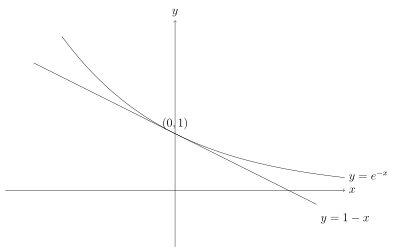
- Drawing the tangent to \(y = e^{-x}\) at \((0,1)\) we find that \(e^{-t} \geq (1-t)\) for all \(t\), in particular, \(e^t(1-t) \leq 1\) \(f'(t) = \frac{(e^t(1-t) -1}{(e^t-1)^2} \leq 0\) and \(f'(t) = -\frac12\) when \(t = 0\)

2009 Paper 3 Q4
For any given (suitable) function \(\f\), the Laplace transform of \(\f\) is the function \(\F\) defined by \[ \F(s) = \int_0^\infty \e^{-st}\f(t)\d t \quad \quad \, (s>0) \,. \]
- Show that the Laplace transform of \(\e^{-bt}\f(t)\), where \(b>0\), is \(\F(s+b)\).
- Show that the Laplace transform of \(\f(at)\), where \(a>0\), is \(a^{-1}\F(\frac s a)\,\).
- Show that the Laplace transform of \(\f'(t)\) is \(s\F(s) -\f(0)\,\).
- In the case \(\f(t)=\sin t\), show that \(\F(s)= \dfrac 1 {s^2+1}\,\).
Solution:
- \begin{align*} \mathcal{L}\{e^{-bt}f(t)\}(s) &= \int_0^{\infty}e^{-st}\{ e^{-bt}f(t) \} \d t \\ &= \int_0^{\infty} e^{-(s+b)t}f(t) \d t \\ &= F(s+b) \end{align*}
- \begin{align*} \mathcal{L}\{f(at)\}(s) &= \int_0^{\infty} e^{-st}f(at) \d t \\ &= \int_{u=0}^{\infty}e^{-s \frac{u}{a}} f\left(a \tfrac{u}{a}\right)\frac{1}{a} \d u \\ &= \int_0^{\infty}e^{-su/a}f(u) a^{-1} \d u \\ &= a^{-1} \int_0^{\infty} e^{-(s/a)u}f(u) \d u \\ &= a^{-1} F\left (\frac{s}{a} \right) \end{align*}
- \begin{align*} \mathcal{L}\{f'(t)\}(s) &= \int_0^{\infty} e^{-st}f'(t) \d t \\ &= \left [e^{-st} f(t) \right]_0^{\infty} - \int_0^{\infty} -s e^{-st} f(t) \d t\\ &= -f(0)+sF(s) \\ &= sF(s) - f(0) \end{align*}
- Since \(f''(t) = -f(t)\) we must have: \begin{align*} && -\mathcal{L}(f)&= \mathcal{L}(f'') \\ &&&= s\mathcal{L}(f') -f'(0) \\ &&&= s(s\mathcal{L}(f)-f(0)) - f'(0) \\ &&&= s^2\mathcal{L}(f) - 1 \\ \Rightarrow && (1+s^2) \mathcal{L}(f) &= 1 \\ \Rightarrow && F(s) &= \frac{1}{1+s^2} \end{align*}