Problems
Filters
40 problems found
2009 Paper 1 Q10
A triangular wedge is fixed to a horizontal surface. The base angles of the wedge are \(\alpha\) and \(\frac\pi 2-\alpha\). Two particles, of masses \(M\) and \(m\), lie on different faces of the wedge, and are connected by a light inextensible string which passes over a smooth pulley at the apex of the wedge, as shown in the diagram. The contacts between the particles and the wedge are smooth.
- Show that if \(\tan \alpha> \dfrac m M \) the particle of mass \(M\) will slide down the face of the wedge.
- Given that \(\tan \alpha = \dfrac{2m}M\), show that the magnitude of the acceleration of the particles is \[ \frac{g\sin\alpha}{\tan\alpha +2} \] and that this is maximised at \(4m^3=M^3\,\).
2009 Paper 3 Q6
Show that $\big\vert \e^{\i\beta} -\e^{\i\alpha}\big\vert = 2\sin\frac12 (\beta-\alpha)\,\( for \)0<\alpha<\beta<2\pi\,$. Hence show that \[ \big\vert \e^{\i\alpha} -\e^{\i\beta}\big\vert \; \big\vert \e^{\i\gamma} -\e^{\i\delta}\big\vert + \big\vert \e^{\i\beta} -\e^{\i\gamma}\big\vert \; \big\vert \e^{\i\alpha} -\e^{\i\delta}\big\vert = \big\vert \e^{\i\alpha} -\e^{\i\gamma}\big\vert \; \big\vert \e^{\i\beta} -\e^{\i\delta}\big\vert \,, \] where \(0<\alpha<\beta<\gamma<\delta<2\pi\). Interpret this result as a theorem about cyclic quadrilaterals.
2008 Paper 1 Q11
A straight uniform rod has mass \(m\). Its ends \(P_1\) and \(P_2\) are attached to small light rings that are constrained to move on a rough rigid circular wire with centre \(O\) fixed in a vertical plane, and the angle \(P_1OP_2\) is a right angle. The rod rests with \(P_1\) lower than \(P_2\), and with both ends lower than \(O\). The coefficient of friction between each of the rings and the wire is \(\mu\). Given that the rod is in limiting equilibrium (i.e. \ on the point of slipping at both ends), show that \[ \tan \alpha = \frac{1-2\mu -\mu^2}{1+2\mu -\mu^2}\,, \] where \(\alpha\) is the angle between \(P_1O\) and the vertical (\(0<\alpha<45^\circ\)). Let \(\theta\) be the acute angle between the rod and the horizontal. Show that \(\theta =2\lambda\), where \(\lambda \) is defined by \(\tan \lambda= \mu\) and \(0<\lambda<22.5^\circ\).
2008 Paper 2 Q4
A curve is given by \[x^2+y^2 +2axy = 1,\] where \(a\) is a constant satisfying \(0 < a < 1\). Show that the gradient of the curve at the point \(P\) with coordinates \((x,y)\) is \[\displaystyle - \frac {x+ay}{ax+y}\,,\] provided \(ax+y \ne0\). Show that \(\theta\), the acute angle between \(OP\) and the normal to the curve at \(P\), satisfies \[ \tan\theta = a\vert y^2-x^2\vert\;. \] Show further that, if \(\ \displaystyle \frac{\d \theta}{\d x}=0\) at \(P\), then:
- \(a(x^2+y^2)+2xy=0\,\);
- \((1+a)(x^2+y^2+2xy)=1\,\);
- \(\displaystyle \tan\theta = \frac a{\sqrt{1-a^2}}\,\).
Solution: \begin{align*} && 1 &= x^2 + y^2 + 2axy \\ \frac{\d}{\d x}: && 0 &= 2x + 2y \frac{\d y}{\d x} + 2ay + 2ax \frac{\d y}{\d x} \\ &&&= (2x+2ay) + \frac{\d y}{\d x} \left (2ax + 2y \right) \\ \Rightarrow && \frac{\d y}{\d x} &= -\frac{x+ay}{ax+y} \end{align*}
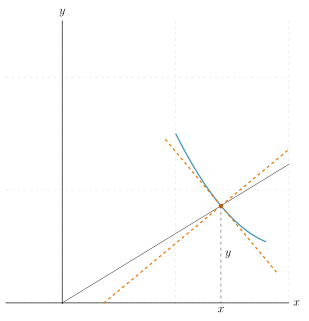
- \(\,\) \begin{align*} && \sec^2 \theta \frac{\d \theta}{\d x} &= \pm a \left (2y \frac{\d y}{\d x} - 2 x\right) \\ \Rightarrow && 0 &= a \left (y \cdot \frac{x+ay}{ax+y} + x \right) \\ &&&=a \left ( \frac{xy+ay^2+ax^2+xy}{ax+y} \right) \\ \Rightarrow && 0 &= a(x^2+y^2)+2xy \end{align*}
- \(\,\) \begin{align*} && 0 &=a(x^2+y^2)+2xy \\ && 1 &= x^2+y^2 + 2axy \\ \Rightarrow && 1 &= (a+1)(x^2+y^2) + (a+1)(2xy) \\ &&&= (a+1)(x^2+y^2+2xy) \end{align*}
- \(\,\) \begin{align*} && 1 &= (a+1)(x+y)^2 \\ \Rightarrow && x +y &= \pm \frac{1}{\sqrt{1+a}} \\ && 0 &=a(x^2+y^2)+2xy \\ && 1 &= x^2+y^2 + 2axy \\ \Rightarrow && 1 &= (1-a)(x^2+y^2) + (a-1)(2xy) \\ &&&= (1-a)(x^2+y^2-2xy)\\ \Rightarrow && x-y &= \pm \frac{1}{\sqrt{1-a}} \\ \Rightarrow && \frac{\d \theta}{\d x} &= a|y^2-x^2| \\ &&&= a|(y-x)(x+y)| \\ &&&= \frac{a}{\sqrt{1-a^2}} \end{align*}
2008 Paper 2 Q11
A wedge of mass \(km\) has the shape (in cross-section) of a right-angled triangle. It stands on a smooth horizontal surface with one face vertical. The inclined face makes an angle \(\theta\) with the horizontal surface. A particle \(P\), of mass \(m\), is placed on the inclined face and released from rest. The horizontal face of the wedge is smooth, but the inclined face is rough and the coefficient of friction between \(P\) and this face is \(\mu\).
- When \(P\) is released, it slides down the inclined plane at an acceleration \(a\) relative to the wedge. Show that the acceleration of the wedge is \[ \frac {a \cos\theta}{k+1}\,. \] To a stationary observer, \(P\) appears to descend along a straight line inclined at an angle~\(45^\circ\) to the horizontal. Show that \[ \tan\theta = \frac k {k+1}\,. \] In the case \(k=3\), find an expression for \(a\) in terms of \(g\) and \(\mu\).
- What happens when \(P\) is released if \(\tan\theta \le \mu\)?
2007 Paper 1 Q9
A particle of weight \(W\) is placed on a rough plane inclined at an angle of \(\theta\) to the horizontal. The coefficient of friction between the particle and the plane is \(\mu\). A horizontal force \(X\) acting on the particle is just sufficient to prevent the particle from sliding down the plane; when a horizontal force \(kX\) acts on the particle, the particle is about to slide up the plane. Both horizontal forces act in the vertical plane containing the line of greatest slope. Prove that \[ \left( k-1 \right) \left( 1 + \mu^2 \right) \sin \theta \cos \theta = \mu \left( k + 1 \right) \] and hence that $\displaystyle k \ge \frac{ \left( 1+ \mu \right)^2} { \left( 1 - \mu \right)^2}$ .
2007 Paper 3 Q10
A particle is projected from a point on a plane that is inclined at an angle~\(\phi\) to the horizontal. The position of the particle at time \(t\) after it is projected is \((x,y)\), where \((0,0)\) is the point of projection, \(x\) measures distance up the line of greatest slope and \(y\) measures perpendicular distance from the plane. Initially, the velocity of the particle is given by \((\dot x, \dot y) = (V\cos\theta, V\sin\theta)\), where \(V>0\) and \(\phi+\theta<\pi/2\,\). Write down expressions for \(x\) and \(y\). The particle bounces on the plane and returns along the same path to the point of projection. Show that \[2\tan\phi\tan\theta =1\] and that \[ R= \frac{V^2\cos^2\theta}{2g\sin\phi}\,, \] where \(R\) is the range along the plane. Show further that \[ \frac{2V^2}{gR} = 3\sin\phi + {\rm cosec}\,\phi \] and deduce that the largest possible value of \(R\) is \(V^2/ (\sqrt{3}\,g)\,\).
2005 Paper 3 Q11
A horizontal spindle rotates freely in a fixed bearing. Three light rods are each attached by one end to the spindle so that they rotate in a vertical plane. A particle of mass \(m\) is fixed to the other end of each of the three rods. The rods have lengths \(a\), \(b\) and \(c\), with \(a > b > c\,\) and the angle between any pair of rods is \(\frac23 \pi\). The angle between the rod of length \(a\) and the vertical is \(\theta\), as shown in the diagram. \vspace*{-0.1in}
2003 Paper 1 Q9
A particle is projected with speed \(V\) at an angle \(\theta\) above the horizontal. The particle passes through the point \(P\) which is a horizontal distance \(d\) and a vertical distance \(h\) from the point of projection. Show that \[ T^2 -2kT + \frac{2kh}{d}+1=0\;, \] where \(T=\tan\theta\) and \(\ds k= \frac{V^2}{gd}\,\). %Derive an equation relating \(\tan \theta\), \(V\), \(g\), \(d\) and \(h\). Show that, if \(\displaystyle {kd > h + \sqrt {h^2 + d^2}}\;\), there are two distinct possible angles of projection. Let these two angles be \(\alpha\) and \(\beta\). Show that \(\displaystyle \alpha + \beta = \pi - \arctan ( {d/ h}) \,\).
2003 Paper 3 Q6
Show that \[ 2\sin \frac12 \theta \, \cos r\theta = \sin\big(r+\frac12\big)\theta - \sin\big(r-\frac12\big)\theta \;. \] Hence, or otherwise, find all solutions of the equation \[ \cos a\theta + \cos (a + 1) \theta + \dots + \cos(b-2)\theta+\cos (b - 1 ) \theta = 0 \;, \] where \(a\) and \(b\) are positive integers with \(a < b-1\,\).
Solution: \begin{align*} && \sin\left(r+\frac12\right)\theta - \sin\left(r-\frac12\right)\theta &= \sin r \theta \cos \tfrac12 \theta+\cos r \theta \sin \tfrac12 \theta- \left (\sin r \theta \cos \tfrac12 \theta-\cos r \theta \sin \tfrac12 \theta \right)\\ &&&= 2 \cos r\theta \sin \tfrac12 \theta \end{align*} \begin{align*} && S &= \cos a\theta + \cos (a + 1) \theta + \dots + \cos(b-2)\theta+\cos (b - 1 ) \theta \\ && 2\sin\tfrac12 \theta S &= \sum_{r=a}^{b-1} 2\sin\tfrac12 \theta \cos r \theta \\ &&&= \sum_{r=a}^{b-1} \left ( \sin\left(r+\frac12\right)\theta - \sin\left(r-\frac12\right)\theta \right) \\ &&&= \sin \left (b-\frac12 \right)\theta - \sin \left (a -\frac12 \right)\theta \\ \Rightarrow && \sin \left (b-\frac12 \right)\theta &= \sin \left (a -\frac12 \right)\theta \\ \end{align*} Case 1: \(A = B + 2n\pi\) \begin{align*} && \left (b-\frac12 \right)\theta &= \left (a -\frac12 \right)\theta + 2n\pi \\ \Rightarrow && (b-a) \theta &= 2n \pi \\ \Rightarrow && \theta &= \frac{2n\pi}{b-a} \end{align*} Case 2: \(A = (2n+1)\pi - B\) \begin{align*} && \left (b-\frac12 \right)\theta &= (2n+1)\pi -\left (a -\frac12 \right)\theta \\ \Rightarrow && (b+a-1) \theta &= (2n+1) \pi \\ \Rightarrow && \theta &= \frac{2n\pi}{b+a-1} \end{align*}
2002 Paper 1 Q9
\(\,\) \vspace*{-0.5in}
- If the normal reactions on the lower and higher wheels of the lorry are equal, show that the sum of the frictional forces between the wheels and the ground is zero.
- If \(P\) is such that the lorry does not tip over (but the normal reactions on the lower and higher wheels of the lorry need not be equal), show that \[ W\tan(\alpha - \beta) \le P \le W\tan(\alpha+\beta)\;, \] where \(\tan\beta = d/h\,\).
2002 Paper 1 Q11
\(\,\)
2000 Paper 1 Q9
A child is playing with a toy cannon on the floor of a long railway carriage. The carriage is moving horizontally in a northerly direction with acceleration \(a\). The child points the cannon southward at an angle \(\theta\) to the horizontal and fires a toy shell which leaves the cannon at speed \(V\). Find, in terms of \(a\) and \(g\), the value of \(\tan 2\theta\) for which the cannon has maximum range (in the carriage). If \(a\) is small compared with \(g\), show that the value of \(\theta\) which gives the maximum range is approximately \[ \frac \pi 4 + \frac a {2g}, \] and show that the maximum range is approximately \(\displaystyle \frac {V^2} g + \frac {V^2a}{g^2}. \)
Solution: \begin{align*} && s_x &= V \cos \theta t + \frac12at^2 \\ && s_y &= V \sin \theta t - \frac12 gt^2 \\ \Rightarrow && T &= \frac{2V \sin \theta}g \\ \Rightarrow && s_{max} &= \frac{2V^2 \sin \theta \cos \theta}{g} + \frac12a \frac{4V^2 \sin^2 \theta}{g^2} \\ &&&= (g \sin 2 \theta+2a\sin^2 \theta)\frac{V^2}{g^2} \\ && \frac{\d s_{max}}{\d \theta} &= (2g \cos 2 \theta +4 a \cos \theta \sin \theta)\frac{V^2}{g^2} \\ &&&= (2g \cos 2\theta + 2a \sin2 \theta) \frac{V^2}{g^2} \\ \Rightarrow && \tan 2\theta &= -\frac{a}{g} \\ \Rightarrow && 2 \theta &\in (\frac{\pi}2, \pi) \\ \Rightarrow && \tan \left (\frac{\pi}{2} - 2 \theta\right) &=-\frac{a}{g} \\ \Rightarrow && \frac{\pi}{2} - 2 \theta&\approx -\frac{a}{g} \\ \Rightarrow && \theta &\approx \frac{\pi}{4} + \frac{a}{2g} \\ \\ && s_{max} & \approx \left (g \sin \left (\frac{\pi}{2} + \frac{a}{g} \right)+2a\sin^2 \left ( \frac{\pi}{4} + \frac{a}{2g}\right)\right)\frac{V^2}{g^2} \\ &&&\approx \left (g \cdot 1+2a\left( \frac{1}{\sqrt{2}}(\frac{a}{2g}+1)\right)^2\right)\frac{V^2}{g^2} \\ &&&\approx \left (g+a\left(1+\frac{a}{g}\right)^2\right)\frac{V^2}{g^2} \\ &&&\approx \left (g+a\right)\frac{V^2}{g^2} \\ &&&= \frac{V^2}{g} + \frac{V^2a}{g} \end{align*}
1997 Paper 1 Q2
- If \[{\mathrm f}(x)=\tan^{-1}x+\tan^{-1}\left(\frac{1-x}{1+x}\right),\] find \({\mathrm f}'(x)\). Hence, or otherwise, find a simple expression for \({\mathrm f}(x)\).
- Suppose that \(y\) is a function of \(x\) with \(0 < y < (\pi/2)^{1/2}\) and \[x=y\sin y^{2}\] for \(0 < x < (\pi/2)^{1/2}\). Show that (for this range of \(x\)) \[\frac{{\mathrm d}y}{{\mathrm d}x}= \frac{y}{x+2y^2\sqrt{y^{2}-x^{2}}}.\]
Solution:
- \begin{align*} && f(x)&=\tan^{-1}x+\tan^{-1}\left(\frac{1-x}{1+x}\right) \\ \Rightarrow && f'(x) &= \frac{1}{1+x^2} + \frac{1}{1+\l \frac{1-x}{1+x} \r^2} \cdot \l \frac{-2}{(1+x)^2}\r \\ &&&= \frac1{1+x^2}- \frac{2}{(1+x)^2+(1-x)^2} \\ &&&= \frac1{1+x^2} - \frac{2}{2+2x^2} \\ &&&= 0 \end{align*} Therefore $f(x) = \begin{cases} c_1 & \text{if } x < -1 \\ c_2 & \text{if } x > -1 \end{cases}$ \(f(0) = \tan^{-1} 0 + \tan^{-1} 1 = \frac{\pi}{4}\) \(\lim_{x \to \infty} f(x) = -\frac{\pi}{2} + \tan^{-1} -1 = -\frac{3\pi}{4}\) therefore $f(x) = \begin{cases} -\frac{3\pi}{4}& \text{if } x < -1 \\ \frac{\pi}{4} & \text{if } x > -1 \end{cases}$
- \begin{align*} && x &= y \sin y^2 \\ \Rightarrow && \frac{\d x}{\d y} &= \sin y^2 + 2y^2 \cos y^2 \\ \Rightarrow && \frac{\d y}{\d x} &= \frac{1}{\sin y^2+2y^2 \cos y^2} \\ &&&=\frac{1}{\frac{x}{y}+2y^2 \sqrt{1-\sin^2y^2}} \\ &&&= \frac{y}{x + 2y^3 \sqrt{1-\frac{x^2}{y^2}}} \\ &&&= \frac{y}{x+2y^2 \sqrt{y^2-x^2}} \end{align*}
1997 Paper 1 Q10
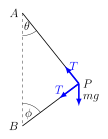
The point \(A\) is vertically above the point \(B\). A light inextensible string, with a smooth ring \(P\) of mass \(m\) threaded onto it, has its ends attached at \(A\) and \(B\). The plane \(APB\) rotates about \(AB\) with constant angular velocity \(\omega\) so that \(P\) describes a horizontal circle of radius \(r\) and the string is taut. The angle \(BAP\) has value \(\theta\) and the angle \(ABP\) has value \(\phi\). Show that \[\tan\frac{\phi-\theta}{2}=\frac{g}{r\omega^{2}}.\] Find the tension in the string in terms of \(m\), \(g\), \(r\), \(\omega\) and \(\sin\frac{1}{2}(\theta+\phi)\). Deduce from your results that if \(r\omega^2\) is small compared with \(g\), then the tension is approximately \(\frac{mg}{2}\)
Solution: None \begin{multicols}{2}