Problems
Filters
39 problems found
2021 Paper 2 Q1
Prove, from the identities for \(\cos(A \pm B)\), that \[ \cos a \cos 3a \equiv \tfrac{1}{2}(\cos 4a + \cos 2a). \] Find a similar identity for \(\sin a \cos 3a\).
- Solve the equation \[ 4\cos x \cos 2x \cos 3x = 1 \] for \(0 \leqslant x \leqslant \pi\).
- Prove that if \[ \tan x = \tan 2x \tan 3x \tan 4x \qquad (\dagger) \] then \(\cos 6x = \tfrac{1}{2}\) or \(\sin 4x = 0\). Hence determine the solutions of equation \((\dagger)\) with \(0 \leqslant x \leqslant \pi\).
Solution: \begin{align*} && \cos(A \pm B) &= \cos A \cos B \mp \sin A \sin B \\ A = a, B = 3a&& \cos 4a + \cos 2a &= 2\cos 3a \cos a \\ \Rightarrow && \cos a \cos 3a &= \tfrac12(\cos 4a + \cos 2a) \\ \\ && \sin(A \pm B) &= \sin A \cos B \pm \cos A \sin B \\ && \sin 4a + \sin(- 2a) &= 2 \sin a \cos 3a \\ \Rightarrow && \sin a \cos 3a &= \tfrac12 (\sin 4a - \sin 2a) \end{align*}
- \(\,\) \begin{align*} && 1 &= 4 \cos x \cos 2x \cos 3x \\ &&&= 2(\cos 4x +\cos 2x)\cos 2x \\ c = \cos 2x:&&&= 2(2c^2-1+c)c \\ \Rightarrow && 0 &= 4c^3+2c^2-2c-1 \\ &&&= (2c+1)(2c^2-1) \\ \Rightarrow && \cos 2x &= -\frac12 \\ \Rightarrow && x &= \frac{\pi}{3}, \frac{2\pi}{3} \\ && \cos 2x &= \pm \frac1{\sqrt2} \\ \Rightarrow && x&= \frac{\pi}{8}, \frac{3\pi}{8}, \frac{5\pi}{8}, \frac{7\pi}{8} \end{align*}
- \(\,\) \begin{align*} && \tan x &= \tan 2x \tan 3x \tan 4x \\ \Rightarrow &&1 &= \frac{\cos x\sin 2x \sin 3x \sin 4x}{\sin x \cos 2x \cos 3x \cos 4x} \\ &&&= \frac{\sin 2x \sin 4x (\sin4 x + \sin 2x)}{\cos 2x \cos 4x (\sin 4x - \sin 2x)} \\ &&&= \frac{(\cos 2x - \cos 6x) (\sin4 x + \sin 2x)}{(\cos 6x + \cos 2x) (\sin 4x - \sin 2x)} \\ \Rightarrow && 0 &= 2\cos 6x \sin 4x - 2\cos 2x \sin 2 x\\ &&&= \sin 4 x (2 \cos 6x - 1) \\ \Rightarrow && \sin 4x &= 0 \\ \text{ or }&& \cos 6x &= \frac12 \end{align*} \(\sin 4x = 0 \Rightarrow x = 0, \frac{\pi}{4}, \frac{\pi}{2}, \frac{3\pi}{4}, \pi\) \(\cos 6x = \frac12 \Rightarrow x = \frac{\pi}{18}, \frac{5\pi}{18},\frac{7\pi}{18}, \frac{11\pi}{18}, \frac{13\pi}{18}, \frac{17\pi}{18}\). We should verify these work, since not all of them will, especially where \(\sin 4x = 0\), so our final answer is \(x = 0, \pi, \frac{\pi}{18}, \frac{5\pi}{18},\frac{7\pi}{18}, \frac{11\pi}{18}, \frac{13\pi}{18}, \frac{17\pi}{18}\)
2021 Paper 2 Q6
A plane circular road is bounded by two concentric circles with centres at point~\(O\). The inner circle has radius \(R\) and the outer circle has radius \(R + w\). The points \(A\) and \(B\) lie on the outer circle, as shown in the diagram, with \(\angle AOB = 2\alpha\), \(\tfrac{1}{3}\pi \leqslant \alpha \leqslant \tfrac{1}{2}\pi\) and \(0 < w < R\).
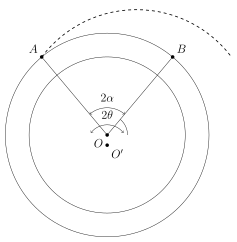
- Show that I cannot cycle from \(A\) to \(B\) in a straight line, while remaining on the road.
- I take a path from \(A\) to \(B\) that is an arc of a circle. This circle is tangent to the inner edge of the road, and has radius \(R + d\) (where \(d > w\)) and centre~\(O'\).
My path is represented by the dashed arc in the above diagram.
Let \(\angle AO'B = 2\theta\).
- Use the cosine rule to find \(d\) in terms of \(w\), \(R\) and \(\cos\alpha\).
- Find also an expression for \(\sin(\alpha - \theta)\) in terms of \(R\), \(d\) and \(\sin\alpha\).
- Show that \(\dfrac{d}{R}\) and \(\alpha - \theta\) are also both much less than \(1\).
- My friend cycles from \(A\) to \(B\) along the outer edge of the road. Let my path be shorter than my friend's path by distance~\(S\). Show that \[ S = 2(R+d)(\alpha - \theta) + 2\alpha(w - d). \] Hence show that \(S\) is approximately a fraction \[ \frac{\sin\alpha - \alpha\cos\alpha}{\alpha(1 - \cos\alpha)} \cdot \frac{w}{R} \] of the length of my friend's path.
2021 Paper 2 Q7
- The matrix \(\mathbf{R}\) represents an anticlockwise rotation through angle \(\varphi\) (\(0^\circ \leqslant \varphi < 360^\circ\)) in two dimensions, and the matrix \(\mathbf{R} + \mathbf{I}\) also represents a rotation in two dimensions. Determine the possible values of \(\varphi\) and deduce that \(\mathbf{R}^3 = \mathbf{I}\).
- Let \(\mathbf{S}\) be a real matrix with \(\mathbf{S}^3 = \mathbf{I}\), but \(\mathbf{S} \neq \mathbf{I}\). Show that \(\det(\mathbf{S}) = 1\). Given that \[ \mathbf{S} = \begin{pmatrix} a & b \\ c & d \end{pmatrix} \] show that \(\mathbf{S}^2 = (a+d)\mathbf{S} - \mathbf{I}\). Hence prove that \(a + d = -1\).
- Let \(\mathbf{S}\) be a real \(2 \times 2\) matrix. Show that if \(\mathbf{S}^3 = \mathbf{I}\) and \(\mathbf{S} + \mathbf{I}\) represents a rotation, then \(\mathbf{S}\) also represents a rotation. What are the possible angles of the rotation represented by \(\mathbf{S}\)?
2021 Paper 3 Q1
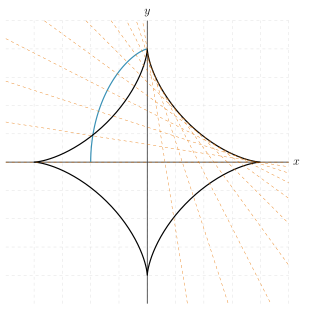
- A curve has parametric equations \[ x = -4\cos^3 t, \qquad y = 12\sin t - 4\sin^3 t. \] Find the equation of the normal to this curve at the point \[ \bigl(-4\cos^3\phi,\; 12\sin\phi - 4\sin^3\phi\bigr), \] where \(0 < \phi < \tfrac{1}{2}\pi\). Verify that this normal is a tangent to the curve \[ x^{2/3} + y^{2/3} = 4 \] at the point \((8\cos^3\phi,\; 8\sin^3\phi)\).
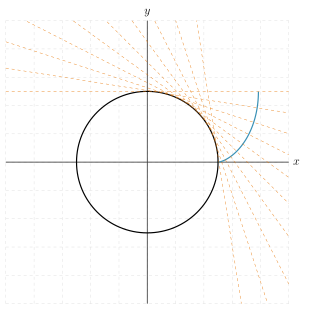
- A curve has parametric equations \[ x = \cos t + t\sin t, \qquad y = \sin t - t\cos t. \] Find the equation of the normal to this curve at the point \[ \bigl(\cos\phi + \phi\sin\phi,\; \sin\phi - \phi\cos\phi\bigr), \] where \(0 < \phi < \tfrac{1}{2}\pi\). Determine the perpendicular distance from the origin to this normal, and hence find the equation of a curve, independent of \(\phi\), to which this normal is a tangent.
Solution:
- \(\,\) \begin{align*}
&& \dot{x} &=12 \cos^2 t \sin t \\
&& \dot{y} &= 12 \cos t - 12 \sin^2 t \cos t \\
&& \frac{\d y}{\d x} &= \frac{12 \cos t - 12 \sin^2 t \cos t}{12 \cos^2 t \sin t} \\
&&&= \frac{1 - \sin^2 t}{\cos t \sin t} \\
&&&= \cot t \\
\\
&& \frac{y - (12\sin\phi - 4\sin^3\phi)}{x - (-4 \cos^3 \phi)} &= - \tan \phi \\
&& y &= -\tan \phi x -4 \cos^3 \phi \tan \phi + 12 \sin \phi -4\sin^3 \phi \\
&&&= -\tan \phi x -4 \cos^2 \phi \sin \phi + 12 \sin \phi -4\sin^3 \phi \\
&&&= -\tan \phi x - 4\sin \phi+12 \sin \phi \\
&&y&= -\tan \phi x + 8 \sin \phi
\end{align*}
Note that when \(x = 8\cos^3 \phi\) we have \(y =-8 \cos^2 \phi \sin \phi + 8 \sin \phi = 8 \sin^3 \phi\). So the point lies on the curve. Notice also that \((8\cos^3 \phi, 8 \sin^ 3\phi)\) is a parametrisation of \(x^{2/3} + y^{2/3} = 4\) and so we can use parametric differentiation to see the gradient is \(\frac{24\sin^2 \phi \cos \phi}{-24\cos^2 \phi\sin\phi} = - \tan \phi\) so it also has the same gradient as required.
- \(\,\) \begin{align*}
&& \dot{x} &= -\sin t + \sin t + t \cos t \\
&&&= t \cos t \\
&& \dot{y} &= \cos t - \cos t + t \sin t \\
&&&= t \sin t \\
&& \frac{\d y}{\d x} &= \frac{t \sin t}{t \cos t} = \tan t \\
\\
&& \frac{y - (\sin \phi - \phi \cos \phi)}{x - (\cos \phi + \phi \sin \phi)} &= -\cot \phi \\
\Rightarrow && y &= -\cot \phi x + (\cos \phi + \phi \sin \phi) \cot \phi + \sin \phi - \phi \cos \phi \\
&&&= -\cot \phi x + \cos \phi \cot \phi + \phi \cos \phi + \sin \phi - \phi \cos \phi \\
&&&= -\cot \phi x + \frac{\cos^2 \phi + \sin^2 \phi}{\sin \phi} \\
&&&= -\cot \phi x + \cosec \phi
\end{align*}
The distance to the origin is \(\displaystyle \frac{|\cosec \phi|}{\sqrt{1 + \cot^2 \phi}} = 1\) so this normal is a tangent to \(x^2 + y^2 = 1\)
2021 Paper 3 Q3
- Let \(\displaystyle I_n = \int_0^{\beta} (\sec x + \tan x)^n \, dx\), where \(n\) is a non-negative integer and \(0 < \beta < \dfrac{\pi}{2}\). For \(n \geqslant 1\), show that \[ \tfrac{1}{2}(I_{n+1} + I_{n-1}) = \frac{1}{n}\bigl[(\sec\beta + \tan\beta)^n - 1\bigr]. \] Show also that \[ I_n < \frac{1}{n}\bigl[(\sec\beta + \tan\beta)^n - 1\bigr]. \]
- Let \(\displaystyle J_n = \int_0^{\beta} (\sec x \cos\beta + \tan x)^n \, dx\), where \(n\) is a non-negative integer and \(0 < \beta < \dfrac{\pi}{2}\). For \(n \geqslant 1\), show that \[ J_n < \frac{1}{n}\bigl[(1 + \tan\beta)^n - \cos^n\beta\bigr]. \]
Solution: \begin{questionparts} \item \(\,\) \begin{align*} && I_n &= \int_0^{\beta} (\sec x + \tan x)^n \, \d x \\ && \tfrac12(I_{n+1}+I_{n-1}) &= \tfrac12\int_0^{\beta} \left ( (\sec x + \tan x)^{n+1}+(\sec x + \tan x)^{n-1}\right) \, \d x \\ && \tfrac12(I_{n+1}+I_{n-1}) &= \tfrac12\int_0^{\beta} (\sec x + \tan x)^{n-1}\left ( (\sec x + \tan x)^{2}+1\right) \, \d x \\ && \tfrac12(I_{n+1}+I_{n-1}) &= \tfrac12\int_0^{\beta} (\sec x + \tan x)^{n-1}\left ( \sec^2 x + \tan^2 x + 2\sec x \tan x + 1\right) \, \d x \\ && \tfrac12(I_{n+1}+I_{n-1}) &= \tfrac12\int_0^{\beta} (\sec x + \tan x)^{n-1}\left ( 2\sec x \tan x +2\sec^2 x \right) \, \d x \\ &&& = \left [\frac1n(\sec x + \tan x)^{n} \right]_0^{\beta} \\ &&&= \frac1n[(\sec \beta + \tan \beta)^n - 1] \end{align*} Notice that by AM-GM \(\tfrac12( ( (\sec x + \tan x)^{n+1}+(\sec x + \tan x)^{n-1}) \geq (\sec x + \tan x)^{n}\) with equality not holding most of the time. Integrating we obtain our result. \item \(\,\) \begin{align*} && J_n &= \int_0^{\beta} (\sec x \cos \beta + \tan x )^n \d x \\ && \tfrac12( J_{n+1} + J_{n-1}) &= \tfrac12 \int_0^{\beta} \left ( (\sec x \cos \beta + \tan x )^{n+1} +(\sec x \cos \beta + \tan x )^{n-1}\right ) \d x \\ && &= \tfrac12 \int_0^{\beta}(\sec x \cos \beta + \tan x )^{n-1} \left ( (\sec x \cos \beta + \tan x )^{2} + \right ) \d x \\ && &= \tfrac12 \int_0^{\beta}(\sec x \cos \beta + \tan x )^{n-1} \left ( \sec^2 x \cos^2 \beta + \tan^2 x+ 2\sec x \tan x \cos \beta +1 \right ) \d x \\ && &= \int_0^{\beta}(\sec x \cos \beta + \tan x )^{n-1} \left ( \sec x \tan x \cos \beta +\tfrac12(\cos^2 \beta +1)\sec^2 x \right ) \d x \\ && &< \int_0^{\beta}(\sec x \cos \beta + \tan x )^{n-1} \left ( \sec x \tan x \cos \beta +\sec^2 x \right ) \d x \\ &&&= \left [\frac1n (\sec x \cos \beta + \tan x)^{n} \right]_0^{\beta} \\ &&&= \frac1n[ (1 + \tan \beta)^n - \cos^n \beta] \end{align*} But notice we can use the same AM-GM argument from before to show that \(J_n < \tfrac12( J_{n+1} + J_{n-1}) < \frac1n[ (1 + \tan \beta)^n - \cos^n \beta]\)
2021 Paper 3 Q4
Let \(\mathbf{n}\) be a vector of unit length and \(\Pi\) be the plane through the origin perpendicular to \(\mathbf{n}\). For any vector \(\mathbf{x}\), the projection of \(\mathbf{x}\) onto the plane \(\Pi\) is defined to be the vector \(\mathbf{x} - (\mathbf{x} \cdot \mathbf{n})\,\mathbf{n}\). The vectors \(\mathbf{a}\) and \(\mathbf{b}\) each have unit length and the angle between them is \(\theta\), which satisfies \(0 < \theta < \pi\). The vector \(\mathbf{m}\) is given by \(\mathbf{m} = \tfrac{1}{2}(\mathbf{a} + \mathbf{b})\).
- Show that \(\mathbf{m}\) bisects the angle between \(\mathbf{a}\) and \(\mathbf{b}\).
- The vector \(\mathbf{c}\) also has unit length. The angle between \(\mathbf{a}\) and \(\mathbf{c}\) is \(\alpha\), and the angle between \(\mathbf{b}\) and \(\mathbf{c}\) is \(\beta\). Both angles are acute and non-zero. Let \(\mathbf{a}_1\) and \(\mathbf{b}_1\) be the projections of \(\mathbf{a}\) and \(\mathbf{b}\), respectively, onto the plane through the origin perpendicular to \(\mathbf{c}\). Show that \(\mathbf{a}_1 \cdot \mathbf{c} = 0\) and, by considering \(|\mathbf{a}_1|^2 = \mathbf{a}_1 \cdot \mathbf{a}_1\), show that \(|\mathbf{a}_1| = \sin\alpha\). Show also that the angle \(\varphi\) between \(\mathbf{a}_1\) and \(\mathbf{b}_1\) satisfies \[ \cos\varphi = \frac{\cos\theta - \cos\alpha\cos\beta}{\sin\alpha\sin\beta}. \]
- Let \(\mathbf{m}_1\) be the projection of \(\mathbf{m}\) onto the plane through the origin perpendicular to \(\mathbf{c}\). Show that \(\mathbf{m}_1\) bisects the angle between \(\mathbf{a}_1\) and \(\mathbf{b}_1\) if and only if \[ \alpha = \beta \qquad \text{or} \qquad \cos\theta = \cos(\alpha - \beta). \]
Solution:
- \(\,\) \begin{align*} && \cos \angle MOB &= \frac{\mathbf{m} \cdot \mathbf{b}}{|\mathbf{m}||\mathbf{b}|} \\ &&&= \frac{\cos \theta + 1}{2\sqrt{\frac14(\mathbf{a}+\mathbf{b})\cdot(\mathbf{a}+\mathbf{b})}} \\ &&&= \frac{\cos \theta + 1}{\sqrt{1+1+2\cos \theta}} \\ &&&= \frac{1 + \cos \theta}{\sqrt{2(1+\cos \theta})} \\ &&&= \frac1{\sqrt{2}} \sqrt{1+\cos \theta} \\ &&&= \cos \tfrac{\theta}{2} \end{align*} Since \(0 < \theta < \pi\) we must have \(\angle MOB = \tfrac{\theta}{2}\) ie it is the angle bisector.
- The plane through the origin perpendicular to \(\mathbf{c}\) has \(\mathbf{x} \cdot \mathbf{c} = 0\), so \begin{align*} && \mathbf{a}_1 \cdot \mathbf{c} &= (\mathbf{a} - (\mathbf{a} \cdot \mathbf{c}) \mathbf{c}) \cdot \mathbf{c} \\ &&&= \mathbf{a} \cdot \mathbf{c} - \mathbf{a} \cdot \mathbf{c} \\ &&&= 0 \\ \\ && |\mathbf{a}_1|^2 &= \mathbf{a}_1 \cdot \mathbf{a}_1 \\ &&&= (\mathbf{a} - (\mathbf{a} \cdot \mathbf{c}) \mathbf{c}) \cdot (\mathbf{a} - (\mathbf{a} \cdot \mathbf{c}) \mathbf{c}) \\ &&&= 1 - 2(\mathbf{a} \cdot \mathbf{c})^2 + \mathbf{a} \cdot \mathbf{c} \\ &&&= (1-\cos^2 \alpha) \\ &&&= \sin^2 \alpha \\ \Rightarrow && |\mathbf{a}_1| &= \sin \alpha \\ \Rightarrow && |\mathbf{b}_1| &= \sin \beta \tag{changing a and b} \\ \\ && \cos \phi &= \frac{\mathbf{a}_1 \cdot \mathbf{b}_1}{|\mathbf{a}_1||\mathbf{b}_1|} \\ &&&= \frac{(\mathbf{a} - (\mathbf{a} \cdot \mathbf{c}) \mathbf{c}) \cdot (\mathbf{b} - (\mathbf{b} \cdot \mathbf{c}) \mathbf{c})}{\sin \alpha \sin \beta} \\ &&&= \frac{\mathbf{a} \cdot \mathbf{b} - 2(\mathbf{a} \cdot \mathbf{c}) \cdot (\mathbf{b} \cdot \mathbf{c})+(\mathbf{a} \cdot \mathbf{c}) \cdot (\mathbf{b} \cdot \mathbf{c})}{\sin \alpha \sin \beta} \\ &&&= \frac{\cos \theta - \cos \alpha \cos \beta}{\sin \alpha \sin \beta} \end{align*}
- Note that \(\mathbf{m}_1 = \tfrac12(\mathbf{a}_1 + \mathbf{b}_1)\) either by expanding or by noting that projection is linear \begin{align*} && \cos \angle M_1OB_1 &= \frac{\mathbf{m}_1 \cdot \mathbf{b}_1}{|\mathbf{m}_1||\mathbf{b}_1|} \\ &&&= \frac{(\mathbf{a}_1 + \mathbf{b}_1) \cdot \mathbf{b}_1}{2|\mathbf{m}_1||\mathbf{b}_1|} \\ &&&= \frac{\mathbf{a}_1 \cdot \mathbf{b}_1 + |\mathbf{b}_1|^2}{2|\mathbf{m}_1||\mathbf{b}_1|} \\ &&&= \frac{|\mathbf{a}_1 || \mathbf{b}_1| \cos \phi + |\mathbf{b}_1|^2}{2|\mathbf{m}_1||\mathbf{b}_1|} \\ &&&= \frac{|\mathbf{a}_1 |\cos \phi + |\mathbf{b}_1|}{2|\mathbf{m}_1|} \\ &&&= \frac{\sin \alpha \cos \phi + \sin \beta}{2\sin \frac{\theta}{2}} \\ &&&= \frac{\sin \alpha \frac{\cos \theta - \cos \alpha \cos \beta}{\sin \alpha \sin \beta} + \sin \beta}{2\sin \frac{\theta}{2}} \\ &&&= \frac{\cos \theta - \cos \alpha \cos \beta+ \sin^2 \beta}{2\sin \frac{\theta}{2} \sin \beta} \\ \Rightarrow && \cos \angle M_1OA_1 &= \frac{\cos \theta - \cos \beta \cos \alpha+ \sin^2 \alpha}{2\sin \frac{\theta}{2} \sin \alpha} \end{align*} \(M_1\) is a bisector iff these two cosines are equal, ie \begin{align*} && \cos \angle M_1OB_1 &= \cos \angle M_1OA_1 \\ \Leftrightarrow && \frac{\cos \theta - \cos \alpha \cos \beta+ \sin^2 \beta}{2\sin \frac{\theta}{2} \sin \beta} &= \frac{\cos \theta - \cos \beta \cos \alpha+ \sin^2 \alpha}{2\sin \frac{\theta}{2} \sin \alpha} \\ \Leftrightarrow && \cos \theta (\sin \alpha - \sin \beta) &= \cos \alpha \cos \beta(\sin \alpha - \sin \beta) + \sin \alpha \sin \beta (\sin \alpha - \sin \beta) \\ \Leftrightarrow &&0 &= (\sin \alpha - \sin \beta)( \cos \theta - (\cos \alpha \cos \beta + \sin \alpha \sin \beta)) \\ &&&= (\sin \alpha - \sin \beta) (\cos \theta - \cos (\alpha - \beta)) \end{align*} From which the result immediately follows
2021 Paper 3 Q5
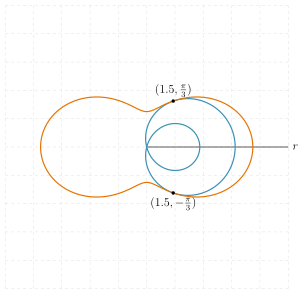
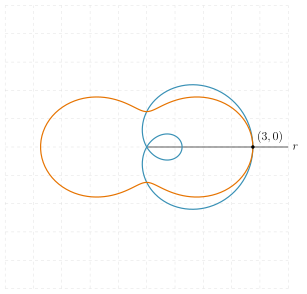
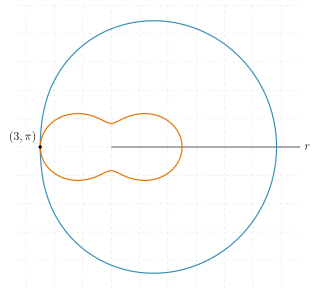
Two curves have polar equations \(r = a + 2\cos\theta\) and \(r = 2 + \cos 2\theta\), where \(r \geqslant 0\) and \(a\) is a constant.
- Show that these curves meet when \[ 2\cos^2\theta - 2\cos\theta + 1 - a = 0. \] Hence show that these curves touch if \(a = \tfrac{1}{2}\) and find the other two values of \(a\) for which the curves touch.
- Sketch the curves \(r = a + 2\cos\theta\) and \(r = 2 + \cos 2\theta\) on the same diagram in the case \(a = \tfrac{1}{2}\). Give the values of \(r\) and \(\theta\) at the points at which the curves touch and justify the other features you show on your sketch.
- On two further diagrams, one for each of the other two values of \(a\), sketch both the curves \(r = a + 2\cos\theta\) and \(r = 2 + \cos 2\theta\). Give the values of \(r\) and \(\theta\) at the points at which the curves touch and justify the other features you show on your sketch.
Solution:
- The curves meet when they have the same radius for a given \(\theta\) ie \begin{align*} && a + 2 \cos \theta &= 2 + \cos 2 \theta \\ &&&= 2 + 2\cos^2 \theta - 1 \\ \Rightarrow && 0 &= 2 \cos ^2 \theta - 2 \cos \theta + 1 - a \end{align*} The curves touch if this has a repeated root, ie \(0 = \Delta = 4 - 8(1-a) \Rightarrow a = \frac12\). The second way the curves can touch is if there is a single root, but it's at an extreme value of \(\cos \theta = \pm 1\) ie \(0 = 2 - 2\cdot(\pm1) + 1 - a \Rightarrow a = 3 \pm 2 = 1, 5\)
- Suppose \(a = \frac12\) then the curves touch when \(0 = 2\cos^2 \theta - 2 \cos \theta + \frac12 = (2 \cos \theta-1 )(\cos \theta -\frac12) \Rightarrow \theta = \pm \frac{\pi}{3}\)
- \(a = 1\)
\(a = 5\)
2020 Paper 2 Q9
Point \(A\) is a distance \(h\) above ground level and point \(N\) is directly below \(A\) at ground level. Point \(B\) is also at ground level, a distance \(d\) horizontally from \(N\). The angle of elevation of \(A\) from \(B\) is \(\beta\). A particle is projected horizontally from \(A\), with initial speed \(V\). A second particle is projected from \(B\) with speed \(U\) at an acute angle \(\theta\) above the horizontal. The horizontal components of the velocities of the two particles are in opposite directions. The two particles are projected simultaneously, in the vertical plane through \(A\), \(N\) and \(B\). Given that the two particles collide, show that \[d\sin\theta - h\cos\theta = \frac{Vh}{U}\] and also that
- \(\theta > \beta\);
- \(U\sin\theta \geqslant \sqrt{\dfrac{gh}{2}}\);
- \(\dfrac{U}{V} > \sin\beta\).
2020 Paper 3 Q1
For non-negative integers \(a\) and \(b\), let \[ \mathrm{I}(a,b) = \int_0^{\frac{\pi}{2}} \cos^a x \cos bx \; \mathrm{d}x. \]
- Show that for positive integers \(a\) and \(b\), \[ \mathrm{I}(a,b) = \frac{a}{a+b} \, \mathrm{I}(a-1, b-1). \]
- Prove by induction on \(n\) that for non-negative integers \(n\) and \(m\), \[ \int_0^{\frac{\pi}{2}} \cos^n x \cos(n+2m+1)x \; \mathrm{d}x = (-1)^m \frac{2^n \, n! \, (2m)! \, (n+m)!}{m! \, (2n+2m+1)!}. \]
2020 Paper 3 Q6
- Sketch the curve \(y = \cos x + \sqrt{\cos 2x}\) for \(-\frac{1}{4}\pi \leqslant x \leqslant \frac{1}{4}\pi\).
- The equation of curve \(C_1\) in polar co-ordinates is \[ r = \cos\theta + \sqrt{\cos 2\theta} \qquad -\tfrac{1}{4}\pi \leqslant \theta \leqslant \tfrac{1}{4}\pi. \] Sketch the curve \(C_1\).
- The equation of curve \(C_2\) in polar co-ordinates is \[ r^2 - 2r\cos\theta + \sin^2\theta = 0 \qquad -\tfrac{1}{4}\pi \leqslant \theta \leqslant \tfrac{1}{4}\pi. \] Find the value of \(r\) when \(\theta = \pm\frac{1}{4}\pi\). Show that, when \(r\) is small, \(r \approx \frac{1}{2}\theta^2\). Sketch the curve \(C_2\), indicating clearly the behaviour of the curve near \(r=0\) and near \(\theta = \pm\frac{1}{4}\pi\). Show that the area enclosed by curve \(C_2\) and above the line \(\theta = 0\) is \(\dfrac{\pi}{2\sqrt{2}}\).
2020 Paper 3 Q9
Two inclined planes \(\Pi_1\) and \(\Pi_2\) meet in a horizontal line at the lowest points of both planes and lie on either side of this line. \(\Pi_1\) and \(\Pi_2\) make angles of \(\alpha\) and \(\beta\), respectively, to the horizontal, where \(0 < \beta < \alpha < \frac{1}{2}\pi\). A uniform rigid rod \(PQ\) of mass \(m\) rests with \(P\) lying on \(\Pi_1\) and \(Q\) lying on \(\Pi_2\) so that the rod lies in a vertical plane perpendicular to \(\Pi_1\) and \(\Pi_2\) with \(P\) higher than \(Q\).
- It is given that both planes are smooth and that the rod makes an angle \(\theta\) with the horizontal. Show that \(2\tan\theta = \cot\beta - \cot\alpha\).
- It is given instead that \(\Pi_1\) is smooth, that \(\Pi_2\) is rough with coefficient of friction \(\mu\) and that the rod makes an angle \(\phi\) with the horizontal. Given that the rod is in limiting equilibrium, with \(P\) about to slip down the plane \(\Pi_1\), show that \[ \tan\theta - \tan\phi = \frac{\mu}{(\mu + \tan\beta)\sin 2\beta} \] where \(\theta\) is the angle satisfying \(2\tan\theta = \cot\beta - \cot\alpha\).
2019 Paper 1 Q3
By first multiplying the numerator and the denominator of the integrand by \((1 - \sin x)\), evaluate $$\int_0^{\frac{1}{4}\pi} \frac{1}{1 + \sin x} dx.$$ Evaluate also: $$\int_{\frac{1}{4}\pi}^{\frac{1}{3}\pi} \frac{1}{1 + \sec x} dx \quad \text{and} \quad \int_0^{\frac{1}{3}\pi} \frac{1}{(1 + \sin x)^2} dx.$$
Solution: \begin{align*} \int_0^{\frac{1}{4}\pi} \frac{1}{1 + \sin x} dx &= \int_0^{\frac{1}{4}\pi} \frac{1-\sin x}{1 - \sin^2 x} dx \\ &= \int_0^{\frac{1}{4}\pi} \frac{1-\sin x}{\cos^2 x} dx \\ &= \int_0^{\frac{1}{4}\pi} \sec^2 x - \sec x \tan x dx \\ &= \left [\tan x-\sec x \right]_0^{\frac{1}{4}\pi} \\ &= 2 - \frac{1}{\sqrt{2}} \end{align*} \begin{align*} \int_{\frac{1}{4}\pi}^{\frac{1}{3}\pi} \frac{1}{1 + \sec x} \d x &= \int_{\frac{1}{4}\pi}^{\frac{1}{3}\pi} \frac{1-\sec x}{1 - \sec^2 x} \d x \\ &= \int_{\frac{1}{4}\pi}^{\frac{1}{3}\pi} \frac{\sec x-1}{\tan^2 x} \d x \\ &= \int_{\frac{1}{4}\pi}^{\frac{1}{3}\pi} \cot x \cosec x-\cot^2 x\d x \\ &= \left [ -\cosec x +x+\cot x\right]_{\frac{1}{4}\pi}^{\frac{1}{3}\pi} \\ &= \l -\frac{2}{\sqrt3}+\frac{\pi}{3}+\frac{1}{\sqrt{3}}\r - \l-\sqrt{2}+\frac{\pi}{4}+1 \r \\ &= \frac{\pi}{12}-\frac{1}{\sqrt{3}}+\sqrt{2}-1 \end{align*} \begin{align*} \int_0^{\frac{1}{3}\pi} \frac{1}{(1 + \sin x)^2} \d x &= \int_0^{\frac{1}{3}\pi} \frac{1-2\sin x+\sin^2x}{(1-\sin^2 x)^2} \d x \\ &= \int_0^{\frac{1}{3}\pi} \frac{1-2\sin x+\sin^2x}{\cos^4 x} \d x \\ \end{align*} Splitting this up into: \begin{align*} \int_0^{\frac{1}{3}\pi} \frac{-2\sin x}{\cos^4 x} \d x &= -\frac23 \left [ \frac{1}{\cos^3 x}\right]_0^{\frac{1}{3}\pi} \\ &= -\frac{16}3+\frac23 \\ &= -\frac{14}3 \end{align*} and \begin{align*} && \int_0^{\frac{1}{3}\pi} \frac{1+\sin^2x}{\cos^4 x} \d x &= \int_0^{\frac{1}{3}\pi} (\sec^2 x + \tan^2 x) \sec^2 x \d x \\ &&&= \int_0^{\frac{1}{3}\pi} (1+ 2\tan^2 x) \sec^2 x \d x \\ u = \tan x, \d u = \sec^2 x \d x&&&= \int_0^{\sqrt{3}}(1+2u^2) \d u \\ &&&= \left [u + \frac23 u^3 \right]_0^{\sqrt{3}} \\ &&&= \sqrt{3} + 2\sqrt{3} \\ &&&= 3\sqrt{3} \end{align*} And so our complete integral is: \[ \int_0^{\frac{1}{3}\pi} \frac{1}{(1 + \sin x)^2} \d x = 3\sqrt{3} - \frac{14}3\]
2015 Paper 2 Q2
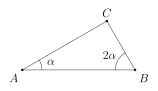
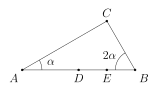
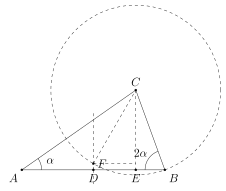
In the triangle \(ABC\), angle \(BAC = \alpha\) and angle \(CBA= 2\alpha\), where \(2\alpha\) is acute, and \(BC= x\). Show that \(AB = (3-4 \sin^2\alpha)x\). The point \(D\) is the midpoint of \(AB\) and the point \(E\) is the foot of the perpendicular from \(C\) to \(AB\). Find an expression for \(DE\) in terms of \(x\). The point \(F\) lies on the perpendicular bisector of \(AB\) and is a distance \(x\) from \(C\). The points \(F\) and \(B\) lie on the same side of the line through \(A\) and \(C\). Show that the line \(FC\) trisects the angle \(ACB\).
Solution:
2009 Paper 2 Q3
Prove that \[ \tan \left ( \tfrac14 \pi -\tfrac12 x \right)\equiv \sec x -\tan x\,. \tag{\(*\)} \]
- Use \((*)\) to find the value of \(\tan\frac18\pi\,\). Hence show that \[ \tan \tfrac{11}{24} \pi = \frac{\sqrt3 + \sqrt2 -1}{\sqrt3 -\sqrt6+1}\;. \]
- Show that \[ \frac{\sqrt3 + \sqrt2 -1}{\sqrt3 -\sqrt6+1}= 2+\sqrt2+\sqrt3+\sqrt6\,. \]
- Use \((*)\) to show that \[ \tan \tfrac1{48}\pi = \sqrt{16+10\sqrt2+8\sqrt3 +6\sqrt6 \ }-2-\sqrt2-\sqrt3-\sqrt6\,. \]
Solution: \begin{align*} && \tan \left ( \tfrac14 \pi -\tfrac12 x \right) &\equiv \frac{\tan \tfrac{\pi}{4} - \tan \tfrac12 x}{1 + \tan \tfrac{\pi}{4} \tan \tfrac12 x} \\ &&&= \frac{1-\tan \tfrac12 x}{1+\tan \tfrac12 x} \\ \\ && \sec x - \tan x &= \frac{1+t^2}{1-t^2} - \frac{2t}{1-t^2} \\ &&&= \frac{(1-t)^2}{(1-t)(1+t)} \\ &&&= \frac{1-t}{1+t} \end{align*} Therefore both sides are equal to the same thing.
- \(\tan \tfrac18 \pi = \tan(\tfrac14 \pi - \tfrac12 \tfrac14\pi) = \sec \tfrac14 \pi - \tan \tfrac14 \pi = \sqrt{2} - 1\) \begin{align*} && \tan \tfrac{11}{24} \pi &= \tan (\tfrac13 \pi +\tfrac18 \pi) \\ &&&= \frac{\tan \tfrac13 \pi +\tan \tfrac18 \pi}{1-\tan \tfrac13 \pi \tan \tfrac18 \pi} \\ &&&= \frac{\sqrt{3} + \sqrt{2} - 1}{1 - \sqrt{3}(\sqrt{2}-1)} \\ &&&= \frac{\sqrt{3} + \sqrt{2} - 1}{1 +\sqrt{3}-\sqrt{6}} \\ \end{align*}
- \(\,\) \begin{align*} && (\sqrt{3}-\sqrt{6}+1)(2+\sqrt{2}+\sqrt{3}+\sqrt{6}) &= (2\sqrt{3}+\sqrt{6}+3+3\sqrt{2}) + \\ &&&\quad+(-2\sqrt{6}-2\sqrt{3}-3\sqrt{2}-6) + \\ &&&\quad+(2+\sqrt{2}+\sqrt{3}+\sqrt{6}) \\ &&&= \sqrt{3}+\sqrt{2}-1 \end{align*}
- \(\,\) \begin{align*} && \tan \tfrac{1}{48} \pi &= \tan (\tfrac14\pi - \tfrac{11}{48} \pi) \\ &&&= \sec \tfrac{11}{24} \pi - \tan \tfrac{11}{24} \pi \\ &&&= \sqrt{1+\tan^2 \tfrac{11}{24}\pi} - \tan \tfrac{11}{24} \pi \\ &&&= \sqrt{1 + (2+\sqrt{2}+\sqrt{3}+\sqrt{6})^2} - (2+\sqrt{2}+\sqrt{3}+\sqrt{6}) \\ &&&= \sqrt{16+10\sqrt{2} + 8\sqrt{3}+6\sqrt{6}} - 2 - \sqrt2 - \sqrt3-\sqrt6 \end{align*}
2009 Paper 3 Q9
A particle is projected under gravity from a point \(P\) and passes through a point \(Q\). The angles of the trajectory with the positive horizontal direction at \(P\) and at \(Q\) are \(\theta\) and \(\phi\), respectively. The angle of elevation of \(Q\) from \(P\) is \(\alpha\).
- Show that \(\tan\theta +\tan\phi = 2\tan\alpha\).
- It is given that there is a second trajectory from \(P\) to \(Q\) with the same speed of projection. The angles of this trajectory with the positive horizontal direction at \(P\) and at \(Q\) are \(\theta'\) and \(\phi'\), respectively. By considering a quadratic equation satisfied by \(\tan\theta\), show that \(\tan(\theta+\theta') = -\cot\alpha\). Show also that \(\theta+\theta'=\pi+\phi+\phi'\,\).