2015 Paper 2 Q2
Year: 2015
Paper: 2
Question Number: 2
Course: LFM Pure
Section: Introduction to trig
Problem
Solution
Examiner's report
— 2015 STEP 2, Question 2As in previous years the Pure questions were the most popular of the paper with questions 1, 2 and 6 the most popular. The least popular questions on the paper were questions 8, 11 and 13 with fewer than 250 attempts for each of them. There were many examples of solutions in this paper that were insufficiently well explained given that the answer to be reached had been provided in the question.
Rating Information
Difficulty Rating: 1600.0
Difficulty Comparisons: 0
Banger Rating: 1484.0
Banger Comparisons: 1
Show LaTeX source
Problem source
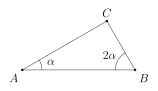
In the triangle $ABC$,  angle $BAC = \alpha$ and angle $CBA= 2\alpha$, where $2\alpha$ is acute, and $BC= x$. Show that $AB = (3-4 \sin^2\alpha)x$.
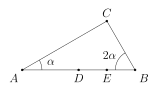
The point $D$ is the midpoint of $AB$ and the point $E$ is the foot of the perpendicular from $C$ to $AB$. Find an expression for $DE$ in terms of $x$.
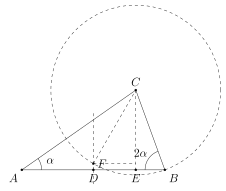
The point $F$ lies on the perpendicular bisector of $AB$ and is a distance $x$ from $C$. The points $F$ and $B$ lie on the same side of the line through $A$ and $C$. Show that the line $FC$ trisects the angle $ACB$.
Solution source
\begin{center}
    \begin{tikzpicture}

    \def\x{2};
    \def\a{30};
    \coordinate (A) at (0,0);
    \coordinate (B) at ({(3-4*sin(\a)^2)*\x}, 0);
    \coordinate (C) at ({3-4*sin(\a)^2)*\x+\x*cos(180-2*\a)}, {\x * sin(180-2*\a)});

    \filldraw (A) circle (1pt) node[below left] {$A$};
    \filldraw (B) circle (1pt) node[below right] {$B$};
    \filldraw (C) circle (1pt) node[above] {$C$};
    \draw (A) -- (B) -- (C) -- cycle;

    \pic [draw, angle radius=.7cm, angle eccentricity=1.5, "$\alpha$"] {angle = B--A--C};
    \pic [draw, angle radius=.7cm, angle eccentricity=1.5, "$2\alpha$"] {angle = C--B--A};
    \end{tikzpicture}
\end{center}

Note that the sine rule gives us
\begin{align*}
    && \frac{x}{\sin \alpha} &= \frac{AB}{\sin (180-3\alpha)} \\
    \Rightarrow && AB &= x \frac{\sin 3\alpha}{\sin \alpha} \\
    &&&= x \frac{\sin \alpha \cos 2\alpha + \cos \alpha \sin 2\alpha}{\sin \alpha} \\
    &&&= x \left ( \frac{\sin \alpha (1-2\sin^2\alpha) + 2(1-\sin^2 \alpha)\sin \alpha}{\sin \alpha} \right) \\
    &&&= x (3 - 4\sin^2 \alpha)
\end{align*}

\begin{center}
    \begin{tikzpicture}

    \def\x{2};
    \def\a{30};
    \coordinate (A) at (0,0);
    \coordinate (B) at ({(3-4*sin(\a)^2)*\x}, 0);
    \coordinate (C) at ({3-4*sin(\a)^2)*\x+\x*cos(180-2*\a)}, {\x * sin(180-2*\a)});
    \coordinate (D) at ($(A)!0.5!(B)$);
    \coordinate (E) at ({3-4*sin(\a)^2)*\x-\x*cos(2*\a)}, 0);


    \filldraw (A) circle (1pt) node[below left] {$A$};
    \filldraw (B) circle (1pt) node[below right] {$B$};
    \filldraw (C) circle (1pt) node[above] {$C$};
    \filldraw (D) circle (1pt) node[below] {$D$};
    \filldraw (E) circle (1pt) node[below] {$E$};
    \draw (A) -- (B) -- (C) -- cycle;

    \pic [draw, angle radius=.7cm, angle eccentricity=1.5, "$\alpha$"] {angle = B--A--C};
    \pic [draw, angle radius=.7cm, angle eccentricity=1.5, "$2\alpha$"] {angle = C--B--A};
    \end{tikzpicture}
\end{center}

Note that $AD = (\tfrac32 - 2 \sin^2\alpha)x$ and $AE = (3-4\sin^2\alpha-\cos2\alpha)x$ so

\begin{align*}
    DE &= (3-4\sin^2\alpha-\cos2\alpha)x - (\tfrac32 - 2 \sin^2\alpha)x \\
    &= (\tfrac32 - 2\sin^2 \alpha - (1-2\sin^2 \alpha))x \\
    &= \tfrac12x
\end{align*}


\begin{center}
    \begin{tikzpicture}

    \def\x{3};
    \def\a{35};
    \coordinate (A) at (0,0);
    \coordinate (B) at ({(3-4*sin(\a)^2)*\x}, 0);
    \coordinate (C) at ({3-4*sin(\a)^2)*\x+\x*cos(180-2*\a)}, {\x * sin(180-2*\a)});
    \coordinate (D) at ($(A)!0.5!(B)$);
    \coordinate (F) at ({(3/2-2*sin(\a)^2)*\x},.22);
    \coordinate (E) at ({3-4*sin(\a)^2)*\x-\x*cos(2*\a)}, 0);


    \filldraw (A) circle (1pt) node[below left] {$A$};
    \filldraw (B) circle (1pt) node[below right] {$B$};
    \filldraw (C) circle (1pt) node[above] {$C$};
    \filldraw (D) circle (1pt) node[below] {$D$};
    \filldraw (E) circle (1pt) node[below] {$E$};
    \filldraw (F) circle (1pt) node[right] {$F$};
    \draw (A) -- (B) -- (C) -- cycle;

    \pic [draw, angle radius=.7cm, angle eccentricity=1.5, "$\alpha$"] {angle = B--A--C};
    \pic [draw, angle radius=.7cm, angle eccentricity=1.5, "$2\alpha$"] {angle = C--B--A};

    \draw[dashed] (D) -- ++ (0, -0.5);
    \draw[dashed] (D) -- ++ (0, 2);
    \draw[dashed] (C) circle ({\x});
    % \draw[dashed] (A) -- (F) -- (B);
    \draw[dashed] (F) -- (C);
    \draw[dashed] (F) -- ++ ({\x/2}, {0});
    \draw[dashed] (C) -- (E);
    \end{tikzpicture}
\end{center}

Since $DE = \frac12x$ if we drop the perpendicular from $F$ to $EC$ we have a $30-60-90$ triangle. Therefore $\angle FCE = 30^\circ$. Notice that $\angle CEB = 90^{\circ} - 2\alpha$ and $\angle ACB = 180^\circ - 3\alpha$, therefore
\begin{align*}
    \angle ACF &= \angle ACB - \angle FCE - \angle ECB \\
    &= (180^\circ - 3\alpha) - 30^\circ - (90^{\circ} - 2\alpha) \\
    &= 60^\circ - \alpha \\
    &= \frac13 \angle ACB
\end{align*}
The average mark for question 2 was the highest on the paper with a large number of good solutions produced using a wide variety of different methods. However, many solutions did not explain clearly the method being used – it is advisable to make every step of the solution clear, especially in the case of questions where the answer that is to be reached has been given. In many cases the diagrams drawn were not sufficiently large to allow candidates to work easily on the question and on a number of occasions the sizes of two angles were reversed in the diagram leading to other points being in the wrong position on the diagram.