Problems
Filters
124 problems found
2016 Paper 1 Q5
- The diagram shows three touching circles \(A\), \(B\) and \(C\), with a common tangent \(PQR\). The radii of the circles are \(a\), \(b\) and \(c\), respectively. Show that \[ \frac 1 {\sqrt b} = \frac 1 {\sqrt{a}} + \frac1{\sqrt{c}} \tag{\(*\)} \] and deduce that \[ 2\left(\frac1{a^2} + \frac1 {b^2} + \frac1 {c^2} \right) = \left(\frac1 a + \frac1 {b} + \frac1 {c} \right)^{\!2} . \tag{\(**\)} \]
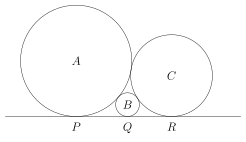
- Instead, let \(a\), \(b\) and \(c\) be positive numbers, with \(b < c < a\), which satisfy \((**)\). Show that they also satisfy \((*)\).
Solution:
- \(\,\)
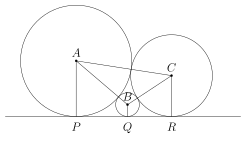
Notice that \begin{align*} && (a+b)^2 &= PQ^2 + (a-b)^2 \\ \Rightarrow && PQ^2 &= 4ab \\ && (b+c)^2 &= QR^2 + (c-b)^2 \\ \Rightarrow && QR^2 &= 4bc \\ && (a+c)^2 &= PR^2 + (a-c)^2 \\ \Rightarrow && PR^2 &= 4ac \\ \Rightarrow && 2\sqrt{ac} &= 2\sqrt{ab}+2\sqrt{bc} \\ \Rightarrow && \frac{1}{\sqrt{b}} &= \frac{1}{\sqrt{c}} + \frac1{\sqrt{a}} \\ \end{align*} Let \(x, y, z = \frac{1}{\sqrt{a}}, \frac1{\sqrt{b}}, \frac{1}{\sqrt{z}}\) so we would like to prove that \(2(x^4+y^4+z^4) = (x^2+y^2+z^2)^2\) or \(x^4+y^4+z^4 = 2x^2y^2+2y^2z^2+2z^2x^2\). We also have \begin{align*} && y &= x+z \\ \Rightarrow &&y^2 &= x^2+z^2+2xz \\ \Rightarrow && (y^2-x^2-z^2)^2 &= 4x^2z^2 \\ \Rightarrow && y^4+x^4+z^4 - 2x^2y^2-2y^2z^2+2x^2z^2 &= 4x^2z^2\\ \Rightarrow && y^4+x^4+z^4 &= 2x^2y^2+2y^2z^2+2z^2x^2 \end{align*}
- Notice that subject to \(y > z > x\) all these steps are reversible, so we must have the equality we desire
2016 Paper 1 Q6
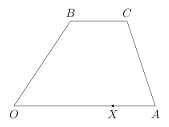
The sides \(OA\) and \(CB\) of the quadrilateral \(OABC\) are parallel. The point \(X\) lies on \(OA\), between \(O\) and \(A\). The position vectors of \(A\), \(B\), \(C\) and \(X\) relative to the origin \(O\) are \(\bf a\), \(\bf b\), \(\bf c\) and \(\bf x\), respectively. Explain why \(\bf c\) and \(\bf x\) can be written in the form \[ {\bf c} = k {\bf a} + {\bf b} \text{ and } {\bf x} = m {\bf a}\,, \] where \(k\) and \(m\) are scalars, and state the range of values that each of \(k\) and \(m\) can take. The lines \(OB\) and \(AC\) intersect at \(D\), the lines \(XD\) and \(BC\) intersect at \(Y\) and the lines \(OY\) and \(AB\) intersect at \(Z\). Show that the position vector of \(Z\) relative to \(O\) can be written as \[ \frac{ {\bf b} + mk {\bf a}}{mk+1}\,. \] The lines \(DZ\) and \(OA\) intersect at \(T\). Show that \[ OT \times OA = OX\times TA \text{ and } \frac 1 {OT} = \frac 1 {OX} + \frac 1 {OA} \,, \] where, for example, \(OT\) denotes the length of the line joining \(O\) and \(T\).
Solution:
2016 Paper 3 Q2
The distinct points \(P(ap^2 , 2ap)\), \(Q(aq^2 , 2aq)\) and \(R(ar^2,2ar)\) lie on the parabola \(y^2 = 4ax\), where \(a>0\). The points are such that the normal to the parabola at \(Q\) and the normal to the parabola at \(R\) both pass through \(P\).
- Show that \(q^2 +qp + 2 = 0\).
- Show that \(QR\) passes through a certain point that is independent of the choice of \(P\).
- Let \(T\) be the point of intersection of \(OP\) and \(QR\), where \(O\) is the coordinate origin. Show that \(T\) lies on a line that is independent of the choice of \(P\). Show further that the distance from the \(x\)-axis to \(T\) is less than \(\dfrac {\;a}{\sqrt2}\,\).
Solution:
- \begin{align*} && 2y \frac{\d y}{\d x} &= 4a \\ \Rightarrow && \frac{\d y}{\d x} &= \frac{2a}{y} \end{align*} Therefore we must have \begin{align*} && \underbrace{-\frac{2aq}{2a}}_{\text{gradient of normal}} &= \underbrace{\frac{2ap-2aq}{ap^2-aq^2}}_{\Delta y / \Delta x} \\ \Rightarrow && -q &= \frac{2}{p+q} \\ && 0 &= 2 + pq+q^2 \end{align*}
- We must have that \(q,r\) are the two roots of \(x^2+px+2 = 0\) \(QR\) has the equation: \begin{align*} && \frac{y-2aq}{x-aq^2} &= \frac{2ar-2aq}{ar^2-aq^2} \\ \Rightarrow && \frac{y-2aq}{x-aq^2} &= \frac{2}{r+q} \\ \Rightarrow && y &= \frac{2}{q+r}(x-aq^2) +2aq \\ && y &= -\frac{2}{p}x+2a\left(q-\frac{q^2}{q+r} \right) \\ &&y&= -\frac{2}{p}x+2a \frac{qr}{q+r} \\ && y &= -\frac{2}{p}x - 2a \frac{2}{p} \\ && y & = -\frac{2}{p}(x+2a) \end{align*} Therefore the point \((-2a,0)\) lies on all such lines.
- \(OP\) has equation \(y = \frac{2}{p} x\) \begin{align*} && y &= \frac{2}{p} x \\ && y & = -\frac{2}{p}(x+2a) \\ && 2y &= -\frac{4a}{p} \\ \Rightarrow && y &= -\frac{2a}{p} \\ && x &= -a \end{align*} Therefore \(T\left (-a, -\frac{2a}{p} \right)\) always lies on the line \(x = -a\) The distance to the \(x\)-axis from \(T\) is \(\frac{2a}{|p|}\). We need to show that \(p\) can't be too small. Specifically \(x^2+px+2 = 0\) must have \(2\) real roots, ie \(\Delta = p^2-8 \geq 0 \Rightarrow |p| \geq 2\sqrt{2}\), ie \(\frac{2a}{|p|} \leq \frac{2a}{2\sqrt{2}} = \frac{a}{\sqrt{2}}\) as required.
2016 Paper 3 Q7
Let \(\omega = \e^{2\pi {\rm i}/n}\), where \(n\) is a positive integer. Show that, for any complex number \(z\), \[ (z-1)(z-\omega) \cdots (z - \omega^{n-1}) = z^n -1\,. \] The points \(X_0, X_1, \ldots\, X_{n-1}\) lie on a circle with centre \(O\) and radius 1, and are the vertices of a regular polygon.
- The point \(P\) is equidistant from \(X_0\) and \(X_1\). Show that, if \(n\) is even, \[ |PX_0| \times |PX_1 |\times \,\cdots\, \times |PX_{n-1}| = |OP|^n +1\, ,\] where \(|PX_ k|\) denotes the distance from \(P\) to \(X_k\). Give the corresponding result when \(n\) is odd. (There are two cases to consider.)
- Show that \[ |X_0 X_1|\times |X_0 X_2|\times \,\cdots\, \times |X_0 X_{n-1}| =n\,. \]
Solution: Notice that \(\omega^n = e^{2\pi i} = 1\), so \(\omega\) is a root of \(z^n - 1\), notice also that \((\omega^k)^n =1\) so therefore the \(n\) roots are \(1, \omega, \omega^2, \cdots, \omega^{n-1}\) and so \((z-1)(z-\omega) \cdots (z-\omega^{n-1}) = C(z^n-1)\). By considering the coefficient of \(z^n\) we can see that \(C = 1\).
- \(P\) lies on the perpendicular bisect of \(1\) and \(\omega\), so \(p = re^{\pi i/n}\), where \(r\) can be positive or negative, but \(|r| = |OP|\). \begin{align*} && |PX_0| \times |PX_1| \times \cdots \times |PX_{n-1}| &= |(p-1)(p-\omega) \cdots (p-\omega^{n-1})| \\ &&&= |p^n - 1| \\ &&&= |r^ne^{\pi i} - 1| \\ &&&= |-|OP|^n - 1| \tag{since \(n\) even} \\ &&&= |OP|^n+1 \end{align*} If \(n\) is odd, depending on the sign of \(r\) we get \(|OP|^n+1\) or \(||OP|^n-1|\).
- \(\,\) \begin{align*} && (z-\omega) \cdots(z-\omega^{n-1}) &= \frac{z^n-1}{z-1} \\ &&&= 1 + z +\cdots + z^{n-1} \\ && |X_0X_1| \times |X_0X_2| \times \cdots \times |X_0X_{n-1}| &= |(1 - \omega)\cdots(1-\omega^{n-1})| \\ &&&= 1+1+1^2+\cdots + 1^{n-1} \\ &&&= n \end{align*}
2015 Paper 1 Q3
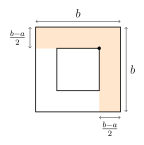
A prison consists of a square courtyard of side \(b\) bounded by a perimeter wall and a square building of side \(a\) placed centrally within the courtyard. The sides of the building are parallel to the perimeter walls. Guards can stand either at the middle of a perimeter wall or in a corner of the courtyard. If the guards wish to see as great a length of the perimeter wall as possible, determine which of these positions is preferable. You should consider separately the cases \(b<3a\) and \(b>3a\,\).
Solution:
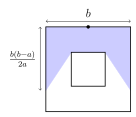
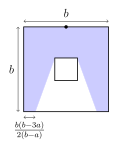
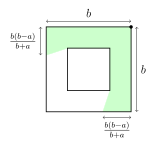
2015 Paper 1 Q6
The vertices of a plane quadrilateral are labelled \(A\), \(B\), \(A'\) and \(B'\), in clockwise order. A point \(O\) lies in the same plane and within the quadrilateral. The angles \(AOB\) and \(A'OB'\) are right angles, and \(OA=OB\) and \(OA'=OB'\). Use position vectors relative to \(O\) to show that the midpoints of \(AB\), \(BA'\), \(A'B'\) and \(B'A\) are the vertices of a square. Given that the lengths of \(OA\) and \(OA'\) are fixed (and the conditions of the first paragraph still hold), find the value of angle \(BOA'\) for which the area of the square is greatest.
Solution: Let \(O\) be the origin, and let \(\mathbf{a}, \mathbf{b}, \mathbf{a}', \mathbf{b}'\) be the four points. The conditions give us \begin{align*} && \mathbf{a} \cdot \mathbf{b} &= 0 \\ && |\mathbf{a}| &= |\mathbf{b}| \\ && \mathbf{a}' \cdot \mathbf{b}' &= 0 \\ && |\mathbf{a}'| &= |\mathbf{b}'| \\ \end{align*} So \begin{align*} \text{midpoint }AB \text{ to midpoint } BA' &= (\tfrac12(\mathbf{a}+\mathbf{b}) - \tfrac12(\mathbf{b}+\mathbf{a}'))\cdot (\tfrac12(\mathbf{a}+\mathbf{b}) - \tfrac12(\mathbf{b}+\mathbf{a}')) \\ &= \frac12(\mathbf{a}-\mathbf{a}')\cdot \frac12(\mathbf{a} - \mathbf{a}') \\ \text{midpoint }BA' \text{ to midpoint } A'B' &= (\tfrac12(\mathbf{b}+\mathbf{a}') - \tfrac12(\mathbf{a}'+\mathbf{b}')) \cdot (\tfrac12(\mathbf{b}+\mathbf{a}') - \tfrac12(\mathbf{a}'+\mathbf{b}'))\\ &= \frac12(\mathbf{b}-\mathbf{b}')\cdot \frac12(\mathbf{b} - \mathbf{b}') \\ &= \frac14 (|\mathbf{b}|^2 + |\mathbf{b}'|^2 - 2\mathbf{b}\cdot\mathbf{b}')\\ &= \frac14(|\mathbf{a}|^2 + |\mathbf{a}'|^2 - 2\mathbf{b}\cdot\mathbf{b}') \\ \text{midpoint }A'B' \text{ to midpoint } B'A &= (\tfrac12(\mathbf{a}'+\mathbf{b}') - \tfrac12(\mathbf{b}'+\mathbf{a})) \cdot (\tfrac12(\mathbf{a}'+\mathbf{b}') - \tfrac12(\mathbf{b}'+\mathbf{a}))\\ &= \frac12(\mathbf{a}'-\mathbf{a})\cdot \frac12(\mathbf{a}' - \mathbf{a}) \\ \text{midpoint }B'A \text{ to midpoint } AB &= (\tfrac12(\mathbf{b}'+\mathbf{a}) - \tfrac12(\mathbf{a}+\mathbf{b})) \cdot (\tfrac12(\mathbf{b}'+\mathbf{a}) - \tfrac12(\mathbf{a}+\mathbf{b}))\\ &= \frac12(\mathbf{b}'-\mathbf{b})\cdot \frac12(\mathbf{b}' - \mathbf{b}) \\ \end{align*} So it's sufficient to prove \(\mathbf{a}\cdot \mathbf{a}' = \mathbf{b}\cdot \mathbf{b}'\) but this is clear from looking at a diagram for 1 second. Given the length of the square is what it is, we want to minimise \(\mathbf{b}\cdot \mathbf{b}'\) which is when they are vertically opposite each other, ie \(\angle BOA' = 90^\circ\)
2015 Paper 2 Q8
\noindent
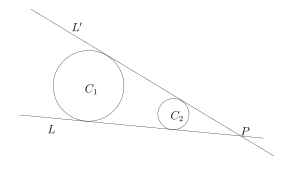
- Let \(\mathbf{x}_1\) and \(\mathbf{x}_2\) be the position vectors of the centres of \(C_1\) and \(C_2\), respectively. Show that the position vector of \(P\) is \[ \frac{r_1 \mathbf{x}_2- r_2 \mathbf{x}_1}{r_1-r_2} \,, \] where \(r_1\) and \(r_2\) are the radii of \(C_1\) and \(C_2\), respectively.
- The circle \(C_3\) does not overlap either \(C_1\) or \(C_2\) and its radius, \(r_3\), satisfies \(r_1 \ne r_3 \ne r_2\). The focus of \(C_1\) and \(C_3\) is \(Q\), and the focus of \(C_2\) and \(C_3\) is \(R\). Show that \(P\), \(Q\) and \(R\) lie on the same straight line.
- Find a condition on \(r_1\), \(r_2\) and \(r_3\) for \(Q\) to lie half-way between \(P\) and \(R\).
Solution:
- Notice that \(P\) lies on \(C_1C_2\), and that the triangles formed from \(C_iPT_i\) where \(T_i\) are the tangent points are similar, with ratios \(\frac{r_1}{r_2}\). Therefore \(\frac{C_1P}{r_1} = \frac{C_2P}{r_2}\), and hence \(\frac{C_1P}{C_1C_2} = \frac{C_1P}{C_1P-C_2P} = \frac{1}{1-\frac{r_2}{r_1}} = \frac{r_1}{r_1-r_2}\) So we have \(\mathbf{p} = \mathbf{x_1} + (\mathbf{x}_2 - \mathbf{x}_1)\cdot\frac{r_1}{r_1-r_2} = \frac{r_1\mathbf{x}_2 - r_2\mathbf{x}_1}{r_1-r_2}\)
- Suppose \(\mathbf{x}_3 = \binom{\alpha}{\beta}\) in the basis of \(\{ \mathbf{x}_1, \mathbf{x}_2 \}\), then we can see that \begin{align*} && \mathbf{p} &= \frac{1}{r_1-r_2}\binom{-r_2}{r_1} \\ && \mathbf{q} &= \frac{r_1(\alpha \mathbf{x}_1 +\beta \mathbf{x}_2) - r_3\mathbf{x}_1}{r_1-r_3} \\ &&&= \frac{1}{r_1-r_3} \binom{r_1\alpha -r_3}{r_1\beta} \\ && \mathbf{r} &=\frac{1}{r_2-r_3} \binom{r_2\alpha}{r_2\beta - r_3} \\ && \mathbf{p}-\mathbf{q} &= \frac{1}{r_1-r_2}\binom{-r_2}{r_1} - \frac{1}{r_1-r_3} \binom{r_1\alpha -r_3}{r_1\beta} \\ &&&= \frac{1}{(r_1-r_2)(r_1-r_3)} \binom{(r_1-r_3)(-r_2)-(r_1-r_2)(r_1\alpha-r_3)}{(r_1-r_3)r_1 - (r_1-r_2)r_1\beta} \\ &&&= \frac{r_1}{(r_1-r_2)(r_1-r_3)} \binom{(r_3-r_2)-\alpha(r_1-r_2)}{(r_1-r_3)-\beta(r_1-r_2)} \\ && \mathbf{q} - \mathbf{r} &= \frac{1}{r_1-r_3} \binom{r_1\alpha -r_3}{r_1\beta} - \frac{1}{r_2-r_3} \binom{r_2\alpha}{r_2\beta - r_3} \\ &&&= \frac{1}{(r_1-r_3)(r_2-r_3)}\binom{(r_2-r_3)(r_1\alpha-r_3) - (r_1-r_3)r_2\alpha)}{(r_2-r_3)r_1\beta - (r_1-r_3)(r_2\beta - r_3)} \\ &&&= \frac{1}{(r_1-r_3)(r_2-r_3)}\binom{(-r_2r_3+r_3^2) - \alpha(r_1r_3-r_3r_2)}{r_3(r_1-r_3)-\beta(r_1-r_2)} \\ &&&= \frac{r_3}{(r_1-r_3)(r_2-r_3)}\binom{(r_3-r_2)-\alpha(r_1-r_2)}{(r_1-r_3)-\beta(r_1-r_2)} \end{align*} Therefore they are clearly parallel, and hence lie on a line.
- \(Q\) is halfway between \(P\) and \(R\) if \begin{align*} && \frac{r_1}{(r_1-r_2)(r_1-r_3)} &= \frac{r_3}{(r_1-r_3)(r_2-r_3)} \\ \Leftrightarrow && r_1(r_2-r_3) &= r_3(r_1-r_2) \\ \Leftrightarrow && r_1r_2 - r_1r_3 &= r_1r_3 - r_2r_3 \\ \Leftrightarrow && r_2 &= \frac{2r_1r_3}{r_1+r_3} \end{align*}
2014 Paper 1 Q7
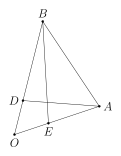
In the triangle \(OAB\), the point \(D\) divides the side \(BO\) in the ratio \(r:1\) (so that \(BD = rDO\)), and the point \(E\) divides the side \(OA\) in the ratio \(s:1\) (so that \(OE =s EA\)), where \(r\) and \(s\) are both positive.
- The lines \(AD\) and \(BE\) intersect at \(G\). Show that \[ \mathbf{g}= \frac{rs}{1+r+rs} \, \mathbf{a} + \frac 1 {1+r+rs} \, \mathbf{b} \,, \] where \(\mathbf{a}, \mathbf{b}\) and \(\mathbf{g}\) are the position vectors with respect to \(O\) of \(A\), \(B\) and \(G\), respectively.
- The line through \(G\) and \(O\) meets \(AB\) at \(F\). Given that \(F\) divides \(AB\) in the ratio \(t:1\), find an expression for \(t\) in terms of \(r\) and \(s\).
Solution:
2014 Paper 2 Q3
- Show, geometrically or otherwise, that the shortest distance between the origin and the line \(y= mx+c\), where \(c\ge0\), is \(c(m^2+1)^{-\frac12}\).
- The curve \(C\) lies in the \(x\)-\(y\) plane. Let the line \(L\) be tangent to \(C\) at a point \(P\) on \(C\), and let \(a\) be the shortest distance between the origin and \(L\). The curve \(C\) has the property that the distance \(a\) is the same for all points \(P\) on \(C\). Let \(P\) be the point on \(C\) with coordinates \((x,y(x))\). Given that the tangent to \(C\) at \(P\) is not vertical, show that \begin{equation} (y-xy')^2 = a^2\big (1+(y')^2 \big) \,. \tag{\(*\)} \end{equation} By first differentiating \((*)\) with respect to \(x\), show that either \(y= mx \pm a(1+m^2)^{\frac12}\) for some \(m\) or \(x^2+y^2 =a^2\).
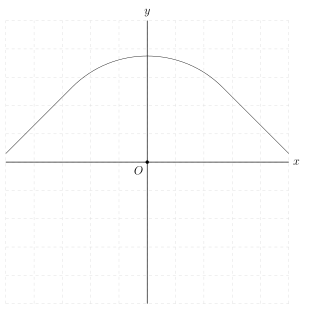
- Now suppose that \(C\) (as defined above) is a continuous curve for \(-\infty < x < \infty\), consisting of the arc of a circle and two straight lines. Sketch an example of such a curve which has a non-vertical tangent at each point.
Solution:
- \(\,\)
Note that we have a right angled triangle, with the sides in a ratio of \(m\). So if our target length is \(x\) we have \(x^2 + (mx)^2 = c^2\) and so \(x = c(m^2+1)^{-\frac12}\)
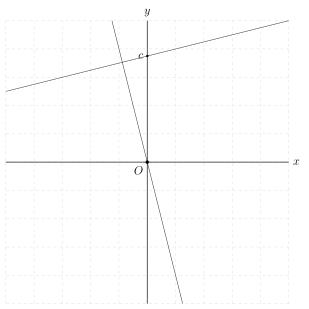
- The distance from the origin to \(L\) is \(a = c(m^2+1)^{-\frac12}\) so \begin{align*} && a^2(m^2+1) &= c^2 \\ && \frac{c-y(x)}{0-x} &= y' \\ \Rightarrow && c-y &= -xy' \\ \Rightarrow && a^2((y')^2+1) &= (y-xy')^2 \\ \\ && 2a^2y'y'' &= 2(y-xy')(y'-xy''-y') \\ &&&= 2(xy'-y)xy'' \\ \Rightarrow && y'' &= 0 \\ \text{ or } && 2a^2y' &= 2(xy'-y)x \end{align*} If \(y'' = 0\) then \(y = mx + c\) and the result follows immediately. \begin{align*} && 0 &= (a^2-x^2)y' + yx \\ \Rightarrow &&\frac1{y} y' &= -\frac{x}{a^2-x^2} \\ \Rightarrow && \ln y &= \frac12\ln (a^2-x^2) + K \\ \Rightarrow && y^2 &= M(a^2-x^2) \\ \Rightarrow && x^2 + y^2 &= a^2 \end{align*} Where in the last step we know the tangents from an ellipse are not all equidistant to the origin.
2014 Paper 3 Q5
A quadrilateral drawn in the complex plane has vertices \(A\), \(B\), \(C\) and \(D\), labelled anticlockwise. These vertices are represented, respectively, by the complex numbers \(a\), \(b\), \(c\) and \(d\). Show that \(ABCD\) is a parallelogram (defined as a quadrilateral in which opposite sides are parallel and equal in length) if and only if \(a+c =b+d\,\). Show further that, in this case, \(ABCD\) is a square if and only if \({\rm i}(a-c)=b-d\). Let \(PQRS\) be a quadrilateral in the complex plane, with vertices labelled anticlockwise, the internal angles of which are all less than \(180^\circ\). Squares with centres \(X\), \(Y\), \(Z\) and \(T\) are constructed externally to the quadrilateral on the sides \(PQ\), \(QR\), \(RS\) and \(SP\), respectively.
- If \(P\) and \(Q\) are represented by the complex numbers \(p\) and \(q\), respectively, show that \(X\) can be represented by \[ \tfrac 12 \big( p(1+{\rm i} ) + q (1-{\rm i})\big) \,. \]
- Show that \(XY\!ZT\) is a square if and only if \(PQRS\) is a parallelogram.
Solution: The vector representing the side \(AB\) is \(b - a\) and the vector representing the side \(DC\) is \(c - d\). \(ABCD\) is a parallelogram if and only if these opposite sides are parallel and equal in length, which is given by \(b - a = c - d\), or equivalently \(a + c = b + d\). Similarly, if \(a + c = b + d\), then \(c - b = d - a\), so the side \(BC\) is parallel and equal in length to the side \(AD\). Thus, \(a + c = b + d\) is the necessary and sufficient condition for \(ABCD\) to be a parallelogram. In a parallelogram, the shape is a square if and only if the diagonals are equal in length and perpendicular to each other. The diagonals are represented by the vectors \(c - a\) and \(d - b\). For these to be equal in length and perpendicular, one must be a \(90^\circ\) rotation of the other. Since \(A, B, C, D\) are labeled anticlockwise, a \(90^\circ\) anticlockwise rotation of the vector \(\vec{AC}\) (which is \(c-a\)) would point in the direction of \(\vec{DB}\) (which is \(b-d\) if we consider the relative orientation). Specifically: \(i(c - a) = d - b \implies -i(a - c) = d - b \implies i(a - c) = b - d\). Thus, \(ABCD\) is a square if and only if \(i(a - c) = b - d\).
- The midpoint of the side \(PQ\) is \(\frac{1}{2}(p + q)\). To find the centre \(X\) of the square built externally on \(PQ\), we start at the midpoint and move a distance equal to half the side length in a direction perpendicular to \(PQ\). Since \(P, Q, R, S\) are anticlockwise, the outward direction is a \(90^\circ\) clockwise rotation of the vector \(\vec{PQ}\). A clockwise rotation of \(90^\circ\) corresponds to multiplication by \(-i\). \[ x = \frac{p+q}{2} + (-i)\left(\frac{q-p}{2}\right) = \frac{p + q - iq + ip}{2} = \frac{1}{2} \big( p(1+i) + q(1-i) \big) \]
- From part (i), we have the representations for the centres: \begin{align*} x &= \tfrac{1}{2}(p(1+i) + q(1-i)) \\ y &= \tfrac{1}{2}(q(1+i) + r(1-i)) \\ z &= \tfrac{1}{2}(r(1+i) + s(1-i)) \\ t &= \tfrac{1}{2}(s(1+i) + p(1-i)) \end{align*} As shown in the first part of the problem, \(XYZT\) is a square if and only if: (1) \(x+z = y+t\) (it is a parallelogram) (2) \(i(x-z) = y-t\) (it is a square) First, examine condition (1): \begin{align*} x+z - (y+t) &= \tfrac{1}{2} \big[ (p+r)(1+i) + (q+s)(1-i) - (q+s)(1+i) - (r+p)(1-i) \big] \\ &= \tfrac{1}{2} \big[ (p+r)(1+i - (1-i)) - (q+s)(1+i - (1-i)) \big] \\ &= \tfrac{1}{2} \big[ (p+r)(2i) - (q+s)(2i) \big] \\ &= i(p+r - (q+s)) \end{align*} Thus, \(x+z = y+t\) if and only if \(p+r = q+s\), which is the condition that \(PQRS\) is a parallelogram. Next, examine condition (2): \begin{align*} i(x-z) &= \tfrac{1}{2} i \big[ p(1+i) + q(1-i) - r(1+i) - s(1-i) \big] \\ &= \tfrac{1}{2} \big[ p(i-1) + q(i+1) - r(i-1) - s(i+1) \big] \\ y-t &= \tfrac{1}{2} \big[ q(1+i) + r(1-i) - s(1+i) - p(1-i) \big] \\ \text{So, } i(x-z) - (y-t) &= \tfrac{1}{2} \big[ p(i-1 + 1-i) + q(i+1 - 1-i) + r(-i+1 - 1+i) + s(-i-1 + 1+i) \big] \\ &= 0 \end{align*} Since \(i(x-z) = y-t\) is an identity (always true for any \(PQRS\)), \(XYZT\) is a square if and only if it is a parallelogram. As established above, this occurs if and only if \(PQRS\) is a parallelogram.
2014 Paper 3 Q7
The four distinct points \(P_i\) (\(i=1\), \(2\), \(3\), \(4\)) are the vertices, labelled anticlockwise, of a cyclic quadrilateral. The lines \(P_1P_3\) and \(P_2P_4\) intersect at \(Q\).
- By considering the triangles \(P_1QP_4\) and \(P_2QP_3\) show that \((P_1Q)( QP_3) = (P_2Q) (QP_4)\,\).
- Let \(\+p_i\) be the position vector of the point \(P_i\) (\(i=1\), \(2\), \(3\), \(4\)). Show that there exist numbers \(a_i\), not all zero, such that \begin{equation} \sum\limits_{i=1}^4 a_i =0 \qquad\text{and}\qquad \sum\limits_{i=1}^4 a_i \+p_i ={\bf 0} \,. \tag{\(*\)} \end{equation}
- Let \(a_i\) (\(i=1\),~\(2\), \(3\),~\(4\)) be any numbers, not all zero, that satisfy~\((*)\). Show that \(a_1+a_3\ne 0\) and that the lines \(P_1P_3\) and \(P_2P_4\) intersect at the point with position vector \[ \frac{a_1 \+p_1 + a_3 \+p_3}{a_1+a_3} \,. \] Deduce that \(a_1a_3 (P_1P_3)^2 = a_2a_4 (P_2P_4)^2\,\).
2013 Paper 1 Q3
For any two points \(X\) and \(Y\), with position vectors \(\bf x\) and \(\bf y\) respectively, \(X*Y\) is defined to be the point with position vector \(\lambda {\bf x}+ (1-\lambda){\bf y}\), where \(\lambda\) is a fixed number.
- If \(X\) and \(Y\) are distinct, show that \(X*Y\) and \(Y*X\) are distinct unless \(\lambda\) takes a certain value (which you should state).
- Under what conditions are \((X*Y)*Z\) and \(X*(Y*Z)\,\) distinct?
- Show that, for any points \(X\), \(Y\) and \(Z\), \[ (X*Y)*Z = (X*Z)*(Y*Z)\, \] and obtain the corresponding result for \(X*(Y*Z)\).
- The points \(P_1\), \(P_2\), \(\ldots\) are defined by \( P_1 = X*Y\) and, for \(n \ge2\), \(P_n= P_{n-1}*Y\,.\) Given that \(X\) and \(Y\) are distinct and that \(0<\lambda<1\), find the ratio in which \(P_n\) divides the line segment \(XY\).
Solution:
- Suppose \(X*Y = Y*X\), then \begin{align*} && X * Y &= \lambda \mathbf{x} + (1-\lambda) \mathbf{y} \\ && Y * X &= \lambda \mathbf{y} + (1-\lambda) \mathbf{x}\\ \Rightarrow && 0 &= (2\lambda - 1)(\mathbf{x} -\mathbf{y}) \end{align*} Therefore, either \(\mathbf{x} = \mathbf{y}\) or \(\lambda = \frac12\). Since we assumed \(X,Y\) were distinct, \(\mathbf{x} \neq \mathbf{y}\) and so \(X*Y\) and \(Y*X\) are distinct unless \(\lambda = \frac12\)
- Suppose \((X*Y)*Z = X*(Y*Z)\) \begin{align*} &&(X*Y)*Z &= (\lambda \mathbf{x} + (1-\lambda) \mathbf{y}) * \mathbf{z} \\ &&&= (\lambda^2 \mathbf{x} + \lambda(1-\lambda)\mathbf{y} + (1-\lambda)\mathbf{z}\\ &&X*(Y*Z) &=\mathbf{x}* (\lambda \mathbf{y} + (1-\lambda) \mathbf{z}) \\ &&&= (\lambda \mathbf{x} + \lambda(1-\lambda)\mathbf{y} + (1-\lambda)^2\mathbf{z}\\ \Rightarrow && 0 &= (\lambda^2 - \lambda)\mathbf{x} + ((1-\lambda) - (1-\lambda)^2)\mathbf{z} \\ &&&=(1-\lambda)(-\lambda \mathbf{x} +\lambda \mathbf{z}) \\ &&&= \lambda(1-\lambda)(\mathbf{z}-\mathbf{x}) \end{align*} Therefore they are distinct unless \(\lambda = 1, 0\) or \(\mathbf{x} = \mathbf{z}\).
- Claim: \((X*Y)*Z = (X*Z)*(Y*Z)\) Proof: \begin{align*} && (X*Y)*Z &= (\lambda \mathbf{x} + \lambda(1-\lambda)\mathbf{y} + (1-\lambda)^2\mathbf{z} \\ && (X*Z)*(Y*Z) &= (\lambda \mathbf{x} + (1-\lambda)\mathbf{z}) * (\lambda \mathbf{y} + (1-\lambda)\mathbf{z}) \\ &&&= \lambda(\lambda \mathbf{x} + (1-\lambda)\mathbf{z}) + (1-\lambda)(\lambda \mathbf{y} + (1-\lambda)\mathbf{z}) \\ &&&= \lambda^2 \mathbf{x} + \lambda(1-\lambda)\mathbf{y} + (1-\lambda) \mathbf{z} \end{align*} Claim: \(X*(Y*Z) = (X*Y)*(X*Z)\) Proof: \begin{align*} X*(Y*Z) &= \lambda \mathbf{x} + \lambda(1-\lambda)\mathbf{y} + (1-\lambda)^2\mathbf{z} \\ (X*Y)*(X*Z) &= (\lambda \mathbf{x} + (1-\lambda)\mathbf{y})*(\lambda \mathbf{x} + (1-\lambda)\mathbf{z}) \\ &= \lambda (\lambda \mathbf{x} + (1-\lambda)\mathbf{y}) + (1-\lambda)(\lambda \mathbf{x} + (1-\lambda)\mathbf{z}) \\ &= \lambda \mathbf{x} + \lambda(1-\lambda)\mathbf{y} + (1-\lambda)^2\mathbf{z} \end{align*}
- \(P_1 = X*Y\) divides the line segment into the ratio \(\lambda:(1-\lambda)\). \(P_n\) divides the line segment \(P_{n-1}Y\) into the ratio \(\lambda:(1-\lambda)\), therefore it divides the line segment \(XY\) in the ratio \(\lambda^n : 1- \lambda^n\) Alternatively, \begin{align*} P_1 &= \lambda \mathbf{x} + (1-\lambda)\mathbf{y} \\ P_2 &= (\lambda \mathbf{x} + (1-\lambda)\mathbf{y} )*\mathbf{y} \\ &= \lambda^2 \mathbf{x} + (1-\lambda^2) \mathbf{y} \end{align*} Suppose \(P_k = \lambda^k\mathbf{x} + (1-\lambda^k)\mathbf{y}\) then \begin{align*}P_{k+1} &= (\lambda^k\mathbf{x} + (1-\lambda^k)\mathbf{y}) * \mathbf{y} \\ &= \lambda^{k+1}\mathbf{x} + \lambda(1-\lambda^k)\mathbf{y} + (1-\lambda)\mathbf{y}\\ & = \lambda^{k+1}\mathbf{x} + (1-\lambda^{k+1})\mathbf{y}\end{align*}
2013 Paper 2 Q1
- Find the value of \(m\) for which the line \(y = mx\) touches the curve \(y = \ln x\,\). If instead the line intersects the curve when \(x = a\) and \(x = b\), where \(a < b\), show that \(a^b = b^a\). Show by means of a sketch that \(a < \e < b\).
- The line \(y=mx+c\), where \(c>0\), intersects the curve \(y=\ln x\) when \(x=p\) and \(x=q\), where \(p < q\). Show by means of a sketch, or otherwise, that \(p^q > q^p\).
- Show by means of a sketch that the straight line through the points \((p, \ln p)\) and \((q, \ln q)\), where \(\e\le p < q\,\), intersects the \(y\)-axis at a positive value of \(y\). Which is greater, \(\pi^\e\) or \(\e^\pi\)?
- Show, using a sketch or otherwise, that if \(0 < p < q\) and \(\dfrac{\ln q - \ln p}{q-p} = \e^{-1}\), then \(q^p > p^q\).
Solution: \begin{questionparts} \item The tangent to \(y = \ln x\) is \begin{align*} && \frac{y - \ln x_1}{x - x_1} &= \frac{1}{x_1} \\ \Rightarrow && \frac{x_1y -x_1 \ln x_1}{ x- x_1} &= 1 \\ \Rightarrow && x_1 y - x_1 \ln x_1 &= x - x_1 \end{align*} So to run through the origin, we need \(\ln x_1 = 1 \Rightarrow x_1 = e\) so the line will be \(y = \frac1{e} x\) If \(ma = \ln a \Rightarrow m = \frac{\ln a}{a} = \frac{\ln b}{b} \Rightarrow b \ln a = a \ln b \Rightarrow a^b = b^a\). \item
2013 Paper 2 Q8
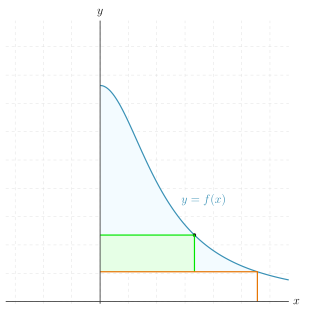
The function \(\f\) satisfies \(\f(x)>0\) for \(x\ge0\) and is strictly decreasing (which means that \(\f(b)<\f(a)\) for \(b>a\)).
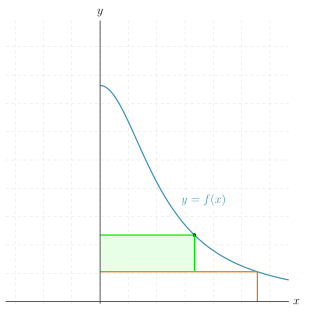
- For \(t\ge0\), let \(A_0(t)\) be the area of the largest rectangle with sides parallel to the coordinate axes that can fit in the region bounded by the curve \(y=\f(x)\), the \(y\)-axis and the line \(y=\f(t)\). Show that \(A_0(t)\) can be written in the form \[ A_0(t) =x_0\left( \f(x_0) -\f(t)\right), \] where \(x_0\) satisfies \(x_0 \f'(x_0) +\f(x_0) = \f(t)\,\).
- The function g is defined, for \(t> 0\), by \[ \g(t) =\frac 1t \int_0^t \f(x) \d x\,. \] Show that \(t \g'(t) = \f(t) -\g(t)\,\). Making use of a sketch show that, for \(t>0\), \[ \int_0^t \left( \f(x) - \f(t)\right) \d x > A_0(t) \] and deduce that \(-t^2 \g'(t)> A_0(t)\).
- In the case \(\f(x)= \dfrac 1 {1+x}\,\), use the above to establish the inequality \[ \ln \sqrt{1+t} > 1 - \frac 1 {\sqrt{1+t}} \,, \] for \(t>0\).
Solution:
- First, not that the point must be ony the curve:
Since otherwise it's pretty clear we could make the area of the rectangle larger by moving the point onto the curve. Therefore \(A = x(f(x)-f(t))\). To maximise this we need \(xf'(x) + f(x)-f(t) = 0\), ie \(x_0f'(x_0) + f(x_0) = f(t)\)
- Suppose \(\displaystyle \g(t) =\frac 1t \int_0^t \f(x) \d x\) then
\begin{align*}
&& \g(t) &=\frac 1t \int_0^t \f(x) \d x\\
\Rightarrow && tg(t) &= \int_0^t \f(x) \d x \\
\Rightarrow && tg'(t) +g(t) &= f(t) \\
\Rightarrow && tg'(t) &= f(t) - g(t)
\end{align*}
Clearly the blue area + green area is larger than the green area. So \(\displaystyle \int_0^t (f(x) - f(t))\d x > A_0(t)\). Notice that \(f(t) = \frac1{t} \int_0^t f(t) \d x \) so \(-t^2g'(t) = \int_0^t f(x) \d x > A_0(t)\)
- Not that if \(f(x) = \dfrac{1}{1+x}\), the \(f'(x) = -\frac{1}{(1+x)^2}\) and so \begin{align*} && -\frac{x_0}{(1+x_0)^2} + \frac{1}{1+x_0} &= \frac{1}{1+t} \\ && \frac{1}{(1+x_0)^2} &= \frac{1}{1+t} \\ \Rightarrow && x_0 &= \sqrt{1+t} - 1 \\ && A_0(t) &= (\sqrt{1+t} - 1) \left ( \frac{1}{\sqrt{1+t}} - \frac{1}{t+1} \right) \\ &&&= 1 - \frac{1}{\sqrt{1+t}} - \frac{1}{\sqrt{1+t}} + \frac{1}{1+t} \\ &&&= \frac{2+t}{1+t} - \frac{2}{\sqrt{1+t}} \\ && g(t) &= \frac{1}{t} \int_0^t \frac{1}{1+x} \d x \\ &&&= \frac{\ln(1+t)}{t} \\ \Rightarrow && g'(t) &= \frac{\frac{t}{1+t} - \ln(1+t)}{t^2} \\ \Rightarrow && -t^2g(t) &= \ln(1+t) - \frac{t}{1+t} \\ \Rightarrow && \ln(1+t) - \frac{t}{1+t} &> \frac{2+t}{1+t} - \frac{2}{\sqrt{1+t}} \\ \Rightarrow && \ln \sqrt{1+t} & > 1 - \frac{1}{\sqrt{1+t}} \end{align*}
2013 Paper 3 Q3
The four vertices \(P_i\) (\(i= 1, 2, 3, 4\)) of a regular tetrahedron lie on the surface of a sphere with centre at \(O\) and of radius 1. The position vector of \(P_i\) with respect to \(O\) is \({\bf p}_i\) (\(i= 1, 2, 3, 4\)). Use the fact that \({\bf p}_1+ {\bf p}_2+{\bf p}_3+{\bf p}_4={\bf 0}\,\) to show that \({\bf p}_i \,.\, {\bf p}_j =-\frac13\,\) for \(i\ne j\). Let \(X\) be any point on the surface of the sphere, and let \(XP_i\) denote the length of the line joining \(X\) and \(P_i\) (\(i= 1, 2, 3, 4\)).
- By writing \((XP_i) ^2\) as \(({\bf p}_i- {\bf x)}\,.\,({\bf p}_i- {\bf x})\), where \({\bf x}\) is the position vector of \(X\) with respect to \(O\), show that \[ \sum_{i=1}^4(XP_i) ^2 =8\,. \]
- Given that \(P_1\) has coordinates \((0,0,1)\) and that the coordinates of \(P_2\) are of the form \((a,0,b)\), where \(a > 0\), show that \(a=2\sqrt2/3\) and \(b=-1/3\), and find the coordinates of \(P_3\) and \(P_4\).
- Show that \[ \sum_{i=1}^4 (XP_i)^4 = 4 \sum_{i=1}^4 (1- {\bf x}\,.\,{\bf p}_i)^2\,. \] By letting the coordinates of \(X\) be \( (x,y,z)\), show further that \(\sum\limits_{i=1}^4 (XP_i)^4\) is independent of the position of \(X\).
Solution: Note that \({\bf p}_i \cdot {\bf p}_i = 1\) and \({\bf p}_i \cdot {\bf p}_j\) are all equal when \(i \neq j\) by symmetry and commutativity. \begin{align*} && 0 &= {\bf p}_i \cdot \left ( {\bf p}_1+ {\bf p}_2+{\bf p}_3+{\bf p}_4 \right) \\ &&&= 1 + \sum_{j \neq i} {\bf p}_i \cdot {\bf p}_j \\ &&&= 1 + 3 {\bf p}_i \cdot {\bf p}_j \\ \Rightarrow && {\bf p}_i \cdot {\bf p}_j &= -\frac13 \end{align*}
- \(\,\) \begin{align*} && (XP_i)^2 &= ({\bf p}_i- {\bf x)}\,.\,({\bf p}_i- {\bf x}) \\ &&&= {\bf p}_i \cdot {\bf p}_i - 2 {\bf p}_i \cdot {\bf x} + {\bf x} \cdot {\bf x} \\ &&&= 2 - 2 {\bf p}_i \cdot {\bf x} \\ \Rightarrow && \sum_i (XP_i)^2 &= \sum_i \left (2 - 2 {\bf p}_i \cdot {\bf x} \right) \\ &&&= 8 - 2 \sum_i {\bf p}_i \cdot {\bf x} \\ &&&= 8 - 2 \left ( {\bf p}_1+ {\bf p}_2+{\bf p}_3+{\bf p}_4 \right) \cdot {\bf x} \\ &&&= 8 \end{align*}
- Notice we have \(1 = \left \|\begin{pmatrix} a \\0 \\b \end{pmatrix} \right \|= a^2 + b^2\) and \(-\frac13 = \begin{pmatrix} a \\0 \\b \end{pmatrix} \cdot \begin{pmatrix} 0 \\0 \\ 1 \end{pmatrix} = b\). So \(b = -1/3\) and \(a = \sqrt{1-b^2} = 2\sqrt{2}/3\). Suppose another of the vertices has coordinates \((u,v,w)\) we must have \begin{align*} && 1 &= u^2+v^2+w^2 \\ && -\frac13&=w \\ && -\frac13 &= \frac{2\sqrt{2}}3 u +\frac19 \\ \Rightarrow && u &= -\frac{\sqrt2}3 \\ \Rightarrow && 1 &= \frac19 + \frac29 + v^2 \\ \Rightarrow && v &= \pm \sqrt{\frac{2}{3}} \end{align*} So \(P_3, P_4 = (-\frac{\sqrt2}3, \pm \frac{\sqrt{6}}3, -\frac13)\)
- \(\,\) \begin{align*} && \sum_{i=1}^4 (XP_i)^4 &= \sum_i \left (2 - 2 {\bf p}_i \cdot {\bf x} \right)^2 \\ &&&= 4 \sum_i \left (1 - {\bf p}_i \cdot {\bf x} \right)^2 \\ &&&= 4 \sum_i (1 - 2{\bf p}_i \cdot {\bf x} + ({\bf p}_i \cdot {\bf x})^2) \\ &&&= 16 + 4\sum_i ({\bf p}_i \cdot {\bf x})^2 \\ &&&=16+ 4\left ( z^2+\left (\frac{2\sqrt{2}}3x-\frac13z \right)^2 +\left (-\frac{\sqrt{2}}3x-\frac{\sqrt{6}}3y-\frac13z \right)^2 +\left (-\frac{\sqrt{2}}3x+\frac{\sqrt{6}}3y-\frac13z \right)^2 \right) \\ &&&= 16+4 \left ( \frac43z^2 + \left (\frac89 + \frac29+\frac29 \right)x^2+\left (\frac69 + \frac69 \right)y^2 + 0xz + 0yz + 0zx \right) \\ &&&= 16+ 4\cdot\frac43(x^2+y^2+z^2) \\ &&&=16+\frac{16}{3}=\frac{64}{3} \end{align*}